22921. Stoughton State Bank (Stoughton, WI)

Bank Information

Episode Type
Run → Suspension → Reopening
Bank Type
state
Start Date
September 15, 1905
Location
Stoughton, Wisconsin (42.917, -89.218)

Metadata

Model
gpt-5-mini
Short Digest
d3cb9543

Response Measures

Full suspension, Books examined

Other: Bank commissioner took possession by agreement; receiver application held in abeyance.

Description

Articles (Sept–Nov 1905) describe bank-specific insolvency problems (poor/worthless assets), a slight run when news became public, state examiner taking possession and temporary suspension, and a reopening announcement in late November 1905. No evidence of permanent closure or receivership assignment beyond an application that was held in abeyance.

Events (4)

1. September 15, 1905 Run
Cause
Bank Specific Adverse Info
Cause Details
News that the bank had a large amount of poor or worthless assets and examiner action led depositors to withdraw funds.
Measures
Deposit certificates requiring 30 days' notice allowed large amounts to be paid gradually; bank officers gave personal assurances; deputy examiner later took possession.
Newspaper Excerpt
When the news became public there was a slight run on the bank Saturday, but, no great amount was withdrawn.
Source
newspapers
2. September 15, 1905 Suspension
Cause
Bank Specific Adverse Info
Cause Details
State banking commissioner alleged $55,000 of poor or worthless assets and insufficient capital margin; examiner applied for receiver and took possession, resulting in temporary closure.
Newspaper Excerpt
Saturday morning Milo Hogan, deputy examiner, took possession and the bank will be temporarily closed.
Source
newspapers
3. September 21, 1905 Other
Newspaper Excerpt
Madison.-The state has taken possession of the Stoughton bank and will close it up.
Source
newspapers
4. November 24, 1905 Reopening
Newspaper Excerpt
The doors of the Stoughton State Bank will swing open for business not later than Wednesday of next week. The bank will start with an unimpaired capital and an abundance of cash to meet the demands of all the depositors...
Source
newspapers

Newspaper Articles (4)

Article from The Wisconsin Tobacco Reporter, September 15, 1905

Click image to open full size in new tab

Article Text

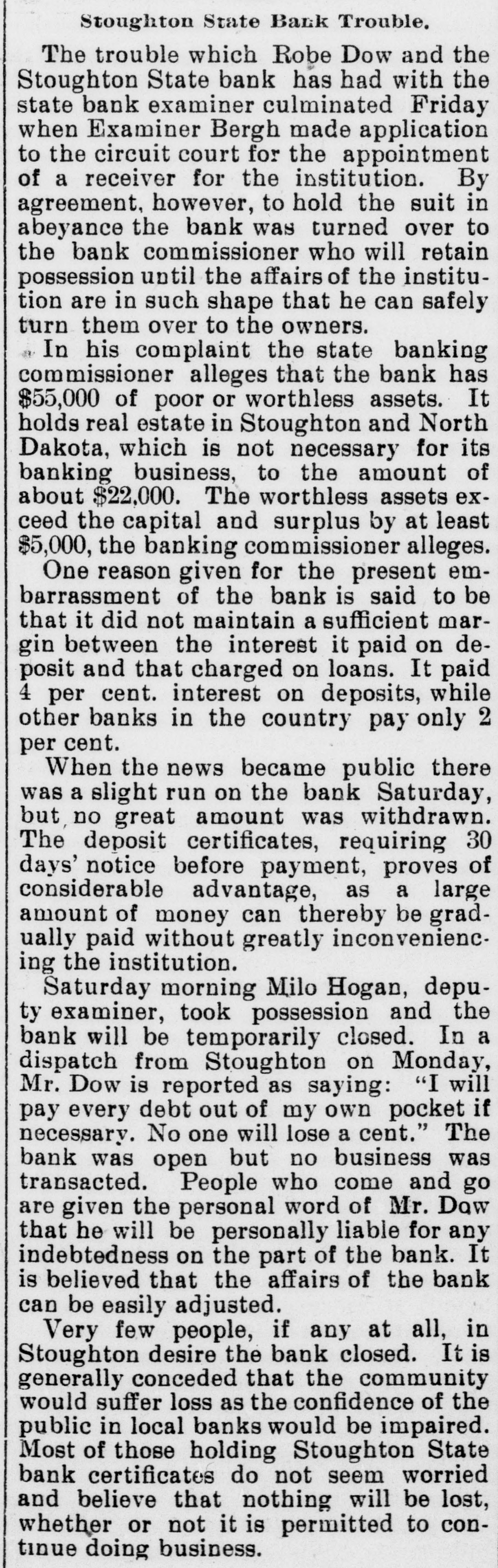
Stoughton State Bank Trouble. The trouble which Robe Dow and the Stoughton State bank has had with the state bank examiner culminated Friday when Examiner Bergh made application to the circuit court for the appointment of a receiver for the institution. By agreement, however, to hold the suit in abeyance the bank was turned over to the bank commissioner who will retain possession until the affairs of the institution are in such shape that he can safely turn them over to the owners. In his complaint the state banking commissioner alleges that the bank has $55,000 of poor or worthless assets. It holds real estate in Stoughton and North Dakota, which is not necessary for its banking business, to the amount of about $22,000. The worthless assets exceed the capital and surplus by at least $5,000, the banking commissioner alleges. One reason given for the present embarrassment of the bank is said to be that it did not maintain a sufficient margin between the interest it paid on deposit and that charged on loans. It paid 4 per cent. interest on deposits, while other banks in the country pay only 2 per cent. When the news became public there was a slight run on the bank Saturday, but, no great amount was withdrawn. The deposit certificates, requiring 30 days' notice before payment, proves of considerable advantage, as a large amount of money can thereby be gradually paid without greatly inconveniencing the institution. Saturday morning Milo Hogan, deputy examiner, took possession and the bank will be temporarily closed. In a dispatch from Stoughton on Monday, Mr. Dow is reported as saying: "I will pay every debt out of my own pocket if necessary. No one will lose a cent." The bank was open but no business was transacted. People who come and go are given the personal word of Mr. Dow that he will be personally liable for any indebtedness on the part of the bank. It is believed that the affairs of the bank can be easily adjusted. Very few people, if any at all, in Stoughton desire the bank closed. It is generally conceded that the community would suffer loss as the confidence of the public in local banks would be impaired. Most of those holding Stoughton State bank certificates do not seem worried and believe that nothing will be lost, whether or not it is permitted to continue doing business.
Article from River Falls Journal, September 21, 1905

Click image to open full size in new tab

Article Text

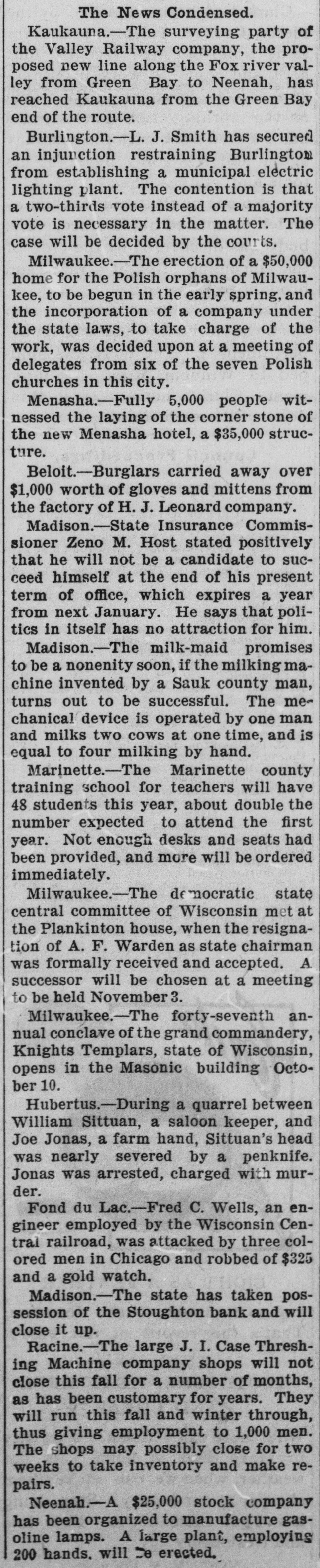
The News Condensed. Kaukauna.-The surveying party of the Valley Railway company, the proposed new line along the Fox river valley from Green Bay to Neenah, has reached Kaukauna from the Green Bay end of the route. Burlington.-L. J. Smith has secured an injunction restraining Burlington from establishing a municipal electric lighting plant. The contention is that a two-thirds vote instead of a majority vote is necessary in the matter. The case will be decided by the courts. Milwaukee.-The erection of a $50,000 home for the Polish orphans of Milwaukee, to be begun in the early spring, and the incorporation of a company under the state laws, to take charge of the work, was decided upon at a meeting of delegates from six of the seven Polish churches in this city. Menasha.-Fully 5,000 people witnessed the laying of the corner stone of the new Menasha hotel, a $35,000 structure. Beloit.-Burglars carried away over $1,000 worth of gloves and mittens from the factory of H. J. Leonard company. Madison.-State Insurance Commissioner Zeno M. Host stated positively that he will not be a candidate to succeed himself at the end of his present term of office, which expires a year from next January. He says that politics in itself has no attraction for him. Madison.-The milk-maid promises to be a nonenity soon, if the milking machine invented by a Sauk county man, turns out to be successful. The mechanical device is operated by one man and milks two cows at one time, and is equal to four milking by hand. Marinette.-The Marinette county training school for teachers will have 48 students this year, about double the number expected to attend the first year. Not enough desks and seats had been provided, and more will be ordered immediately. Milwaukee.-The de mocratic state central committee of Wisconsin met at the Plankinton house, when the resignation of A. F. Warden as state chairman was formally received and accepted. A successor will be chosen at a meeting to be held November 3. Milwaukee.-The forty-seventh annual conclave of the grand commandery, Knights Templars, state of Wisconsin, opens in the Masonic building October 10. Hubertus.-During a quarrel between William Sittuan, a saloon keeper, and Joe Jonas, a farm hand, Sittuan's head was nearly severed by a penknife. Jonas was arrested, charged with murder. Fond du Lac.-Fred C. Wells, an engineer employed by the Wisconsin Central railroad, was attacked by three colored men in Chicago and robbed of $325 and a gold watch. Madison.-The state has taken possession of the Stoughton bank and will close it up. Racine.-The large J. I. Case Threshing Machine company shops will not close this fall for a number of months, as has been customary for years. They will run this fall and winter through, thus giving employment to 1,000 men. The shops may possibly close for two weeks to take inventory and make repairs. Neenah.-A $25,000 stock company has been organized to manufacture gasoline lamps. A large plant, employing 200 hands. will e eracted.


Article from The Wisconsin Tobacco Reporter, October 6, 1905

Click image to open full size in new tab

Article Text

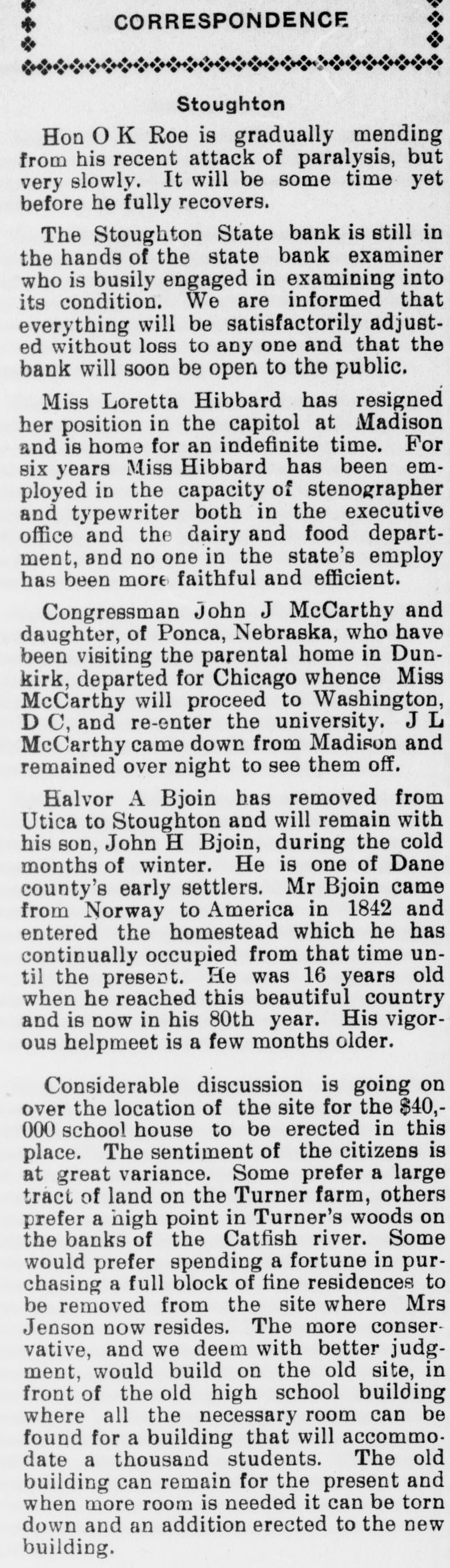
CORRESPONDENCE Stoughton Hon O K Roe is gradually mending from his recent attack of paralysis, but very slowly. It will be some time yet before he fully recovers. The Stoughton State bank is still in the hands of the state bank examiner who is busily engaged in examining into its condition. We are informed that everything will be satisfactorily adjusted without loss to any one and that the bank will soon be open to the public. Miss Loretta Hibbard has resigned her position in the capitol at Madison and is home for an indefinite time. For six years Miss Hibbard has been employed in the capacity of stenographer and typewriter both in the executive office and the dairy and food department, and no one in the state's employ has been more faithful and efficient. Congressman John J McCarthy and daughter, of Ponca, Nebraska, who have been visiting the parental home in Dunkirk, departed for Chicago whence Miss McCarthy will proceed to Washington, D C, and re-enter the university. J L McCarthy came down from Madison and remained over night to see them off. Halvor A Bjoin has removed from Utica to Stoughton and will remain with his son, John H Bjoin, during the cold months of winter. He is one of Dane county's early settlers. Mr Bjoin came from Norway to America in 1842 and entered the homestead which he has continually occupied from that time until the present. He was 16 years old when he reached this beautiful country and is now in his 80th year. His vigorous helpmeet is a few months older. Considerable discussion is going on over the location of the site for the $40,000 school house to be erected in this place. The sentiment of the citizens is at great variance. Some prefer a large tract of land on the Turner farm, others prefer a high point in Turner's woods on the banks of the Catfish river. Some would prefer spending a fortune in purchasing a full block of fine residences to be removed from the site where Mrs Jenson now resides. The more conservative, and we deem with better judgment, would build on the old site, in front of the old high school building where all the necessary room can be found for a building that will accommodate a thousand students. The old building can remain for the present and when more room is needed it can be torn down and an addition erected to the new building.


Article from The Wisconsin Tobacco Reporter, November 24, 1905

Click image to open full size in new tab

Article Text

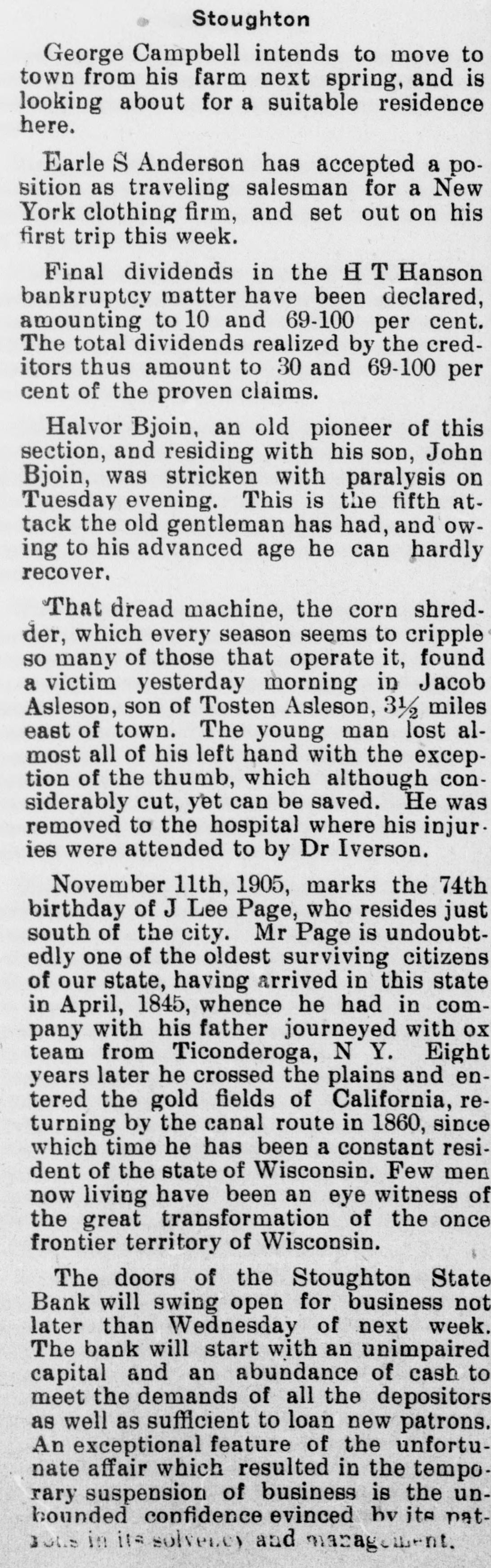
Stoughton George Campbell intends to move to town from his farm next spring, and is looking about for a suitable residence here. Earle S Anderson has accepted a position as traveling salesman for a New York clothing firm, and set out on his first trip this week. Final dividends in the H T Hanson bankruptcy matter have been declared, amounting to 10 and 69-100 per cent. The total dividends realized by the creditors thus amount to 30 and 69-100 per cent of the proven claims. Halvor Bjoin, an old pioneer of this section, and residing with his son, John Bjoin, was stricken with paralysis on Tuesday evening. This is the fifth attack the old gentleman has had, and OWing to his advanced age he can hardly recover. That dread machine, the corn shredder, which every season seems to cripple so many of those that operate it, found a victim yesterday morning in Jacob Asleson, son of Tosten Asleson, 3½ miles east of town. The young man lost almost all of his left hand with the exception of the thumb, which although considerably cut, yet can be saved. He was removed to the hospital where his injuries were attended to by Dr Iverson. November 11th, 1905, marks the 74th birthday of J Lee Page, who resides just south of the city. Mr Page is undoubtedly one of the oldest surviving citizens of our state, having arrived in this state in April, 1845, whence he had in company with his father journeyed with ox team from Ticonderoga, N Y. Eight years later he crossed the plains and entered the gold fields of California, returning by the canal route in 1860, since which time he has been a constant resident of the state of Wisconsin. Few men now living have been an eye witness of the great transformation of the once frontier territory of Wisconsin. The doors of the Stoughton State Bank will swing open for business not later than Wednesday of next week. The bank will start with an unimpaired capital and an abundance of cash to meet the demands of all the depositors as well as sufficient to loan new patrons. An exceptional feature of the unfortunate affair which resulted in the temporary suspension of business is the unbounded confidence evinced hv its natJohs in its solvency and management.