228. First National Bank (Selma, AL)

Bank Information

Episode Type
Suspension → Closure
Bank Type
national
Bank ID
1537
Charter Number
1537
Start Date
June 11, 1867
Location
Selma, Alabama (32.407, -87.021)

Metadata

Model
gpt-5-mini
Short Digest
f32078a09d96bd36

Response Measures

None

Receivership Details

Depositor recovery rate
46.6%
Date receivership started
1867-04-30
Date receivership terminated
1882-11-25
OCC cause of failure
Fraud
Share of assets assessed as good
40.0%
Share of assets assessed as doubtful
33.1%
Share of assets assessed as worthless
26.9%

Description

Multiple articles (June 1867) list the First National Bank of Selma, Ala. as failed and 'in the hands of receivers.' Coverage describes fraud/robbery by officers, insolvency, refusal to pay a government draft, and receiver actions (attachment litigation by Sept. 1867). No article describes a depositor run prior to suspension — the bank suspended/failed and entered receivership.

Events (5)

1. August 24, 1865 Chartered
Source
historical_nic
2. April 30, 1867 Receivership
Source
historical_nic
3. June 11, 1867 Receivership
Newspaper Excerpt
list of national banks that have failed and are now in the hands of receivers ... the First National Bank of Selma, Ala., $85,000; ... in the hands of receivers
Source
newspapers
4. June 11, 1867 Suspension
Cause
Bank Specific Adverse Info
Cause Details
Articles report the Selma bank was a fraud from the start; president accused of carrying off nearly every dollar including a treasury deposit of $75,000; insolvency and alleged robbery of funds led to failure and receivership
Newspaper Excerpt
the First National of Selma, Ala. $85,000 ... have failed and are now in the hands of receivers
Source
newspapers
5. September 2, 1867 Other
Newspaper Excerpt
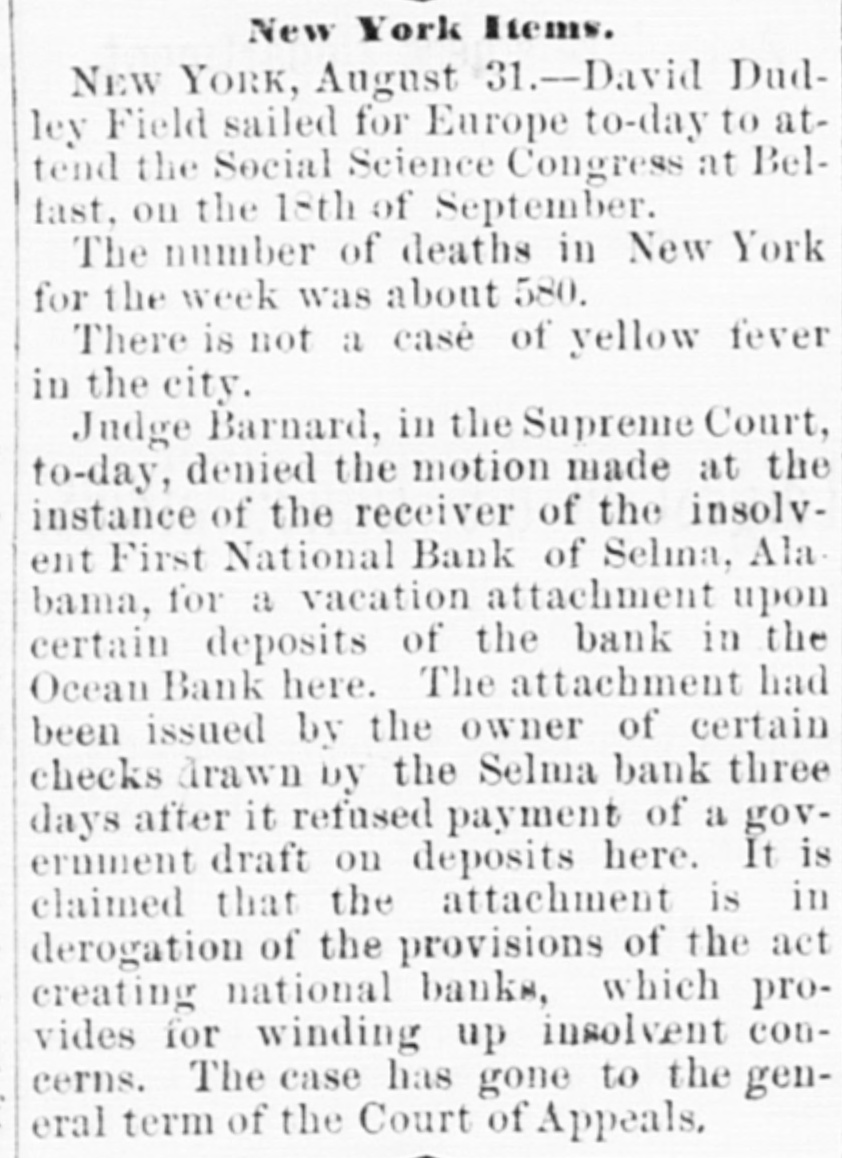
the receiver of the insolvent First National Bank of Selma, Alabama, for a vacation of attachment upon certain deposits of the bank in the Ocean Bank here ... attachment had been issued by the owner of certain checks drawn by the Selma bank three days after it refused payment of a Government draft on deposits here. Case gone to general term of Court of Appeals.
Source
newspapers

Newspaper Articles (13)

Article from The Wheeling Daily Register, May 16, 1867

Click image to open full size in new tab

Article Text

Buyers of goods in any line will cumscribe their purchases to the nar- rowest limits, and to such articles as are very certainly required by their customers. They justify themselves, and wisely, in doing this on the ground that as a rule there seems to be a sure market only for goods that are immedi- ately required, and that until a good surplus of the leading staples of the commerce of the country is harvested and safe, there will be no reliable basis for trade. Payments on current pur- chases are good, but old scores are not by any means wholly wiped out. The public are anxiously expecting some official report from the Comptrol- ler of the Currency relative to the Sel- ma Bank failure and robbery. The bank appears to have been a fraud from the start. It never had a bona fide capi- tal; its circulation was used to pay for the bonds upon which it was obtained; and the bonds deposited to secure Gov- ernment deposits were borrowed. The stock was principally held by the pres- ident, who is charged with having car- ried off nearly every dollar that could be reached, including a treasury depos- it of $75,000. The Government may re- duce its loss by means of, the bonds deposited at Washington, but for the depositors, who were tempted by the as- sumed guarantees of the national system not one cent is available. Of course the fraud implies perjury on the part of the president and directors; but even this scarcely explains the possibility of such disgraceful frauds. The New Or- leans Times hints that the Selma Bank, in common with other national banks in the South, granted a consideration to the Government agents for the loan of the public deposits. One of the officers of the Bank of England said the other day that "in all its dealings with the United States the bank had never lost a dollar by an American." The largest "piece of pa- per" ever discounted by this bank was a bill for £800,000, and the largest amount in one day was £2,500,000. This was during the panic of May, 1866, when the whole city of London was rushing to the bank for relief.


Article from The New York Herald, June 11, 1867

Click image to open full size in new tab

Article Text

Steward. Cornelius Vanof Smith Barker, Jr., and John H. Vanderbilt, Vice derbilt was re-elected President, W. ary. President, and Augustus Scheil, Secre banks that have The following is a list of national rs, with the Bive failed and are now in the bands of rec. First Na. amount of circulating notes issued to eac National, tional, Attica, N. Y., $45,000; Merchants FrankWashington, D. C., $180,000; Venango Nationa Tenn., lin, Pa., $85,000; Tennessee National, Memphis, 200; $90,000; First National, Newton, Mass., $130, First National, Selma, Ala., $85,000; First N tional, New Orleans, La, $180,000. In addition to these two banks have taken up their bonds and deposited lawful money in the United States Treasury to the amount of outstanding circulation, viz:-First National Carondolet, New Orleans, $25,500; First National Columbia, New Orleans, $11,990-making a total of $832,490 reverting to the government, upon the return and destruction of which an equal amount of circulation will be at the disposal of the Comptroller of the Currency for distribution. The Sub-Treasurer in this city reports:Total receipts $1,465,816 Total payments. $1,563,316 For customs. 229,000 Balance 134,015,419 495,000 For gold notes The Chicago Clearing House statements of the past two weeks compare as follows:Balances. Clearings. $11,540,292 Week ending June 8 $1,002,558 9,207,614 Week previous 992,819 The following is a statement of the value of the imports entered at the port of Boston during the month of May:Value. Species of Goods, Wares and Merchandise. Imports-Dutiable, entered tor consumption $1,411,579 2,544,749 Imports-Dutiable, warehoused $3,956,328 Total paying duty Free 289,188 Total imports $4,245,516 Merchandise withdrawn from warehouse for $1,727,877 consumption The earnings of the undermentioned railroads during May of this and last year compare as follows:1867. 1866. $329,078 $316,432 Toledo, Wabash and Western 365,196 333,952 Michigan Central Cleveland and Toledo 210,783 180,675 51,710 55,133 Virginia and Tennessee Atlantic and Great Western 451,447 459,370 A St. Louis journal says:or the notes of the old "Bank of the State of Missouri, " which went out existence in 1857, and whose currency was barred in 1860, there 18 still afloat about $60,000 worth. The now existing Bank of the State of Missouri, lately organized as the "National Bank of the State of Missouri" agree to redeem this issue together with all of their own afloat, now amounting to about $50,000. The receiver of the Cataract City Bank of Paterson, N. J., notifies holders of the notes of that bank that all such notes must be presented for redemption to the Treasurer of the State of New Jersey, at Trenton, on or before November 30, 1867, and that holders and owners thereof who fail to present the same will be barred from all right to have the notes redeemed.


Article from The Daily Dispatch, June 12, 1867

Click image to open full size in new tab

Article Text

FAILURES OF NATIONAL BANKS.-The followis a list of national banks that have and are now in the hands of receivers, the amount of circulating notes issued each The First National Bank of Attica, Y., 845,000; the Merchants National Bank Washington, D. C. $180,000; the Venango National Bank of Franklin, Penn., $35,000; Tennessee National Bank of Memphis, Tenn $90,000; the First National Bank of Newton Mass., $130,000; the First National of Selma, Ala. $85,000; the First NaBank tional Bank of New Orleans, La., $180,000. In addition to these, two banks have taken up their bonds and deposited lawful money in the Treasury 01 the United States to the amount of their outstanding circulation-viz. : The First National Bank of Carondelet, New Orleans. $25,500 the First National Bank of Co. lumbia. New Orleans, $11,990; making a total $582,490 which has reverted to the Governupon the return and destruction of equal amount of circulation will be althe disposal of the Comptroller of the Currency for distribution, according to the terms and conditions prescribed in the national currency net. subject to the same rules that governed the distribution of the amount origimally authorized by the act of Congress.-New 1 to


Article from Memphis Daily Appeal, June 15, 1867

Click image to open full size in new tab

Article Text

BANKS. TENNESSEE 90 Merchant's Bank Bank of Chattarooga10 Ocoee Memphis par Planters' Middle Tenn90 20 Southern Tenold is'se..35 40 SO W. Tenn Shelbyville 50 90 Traders' City B'k Nashville Union Commercial Bank par In Canada there are seventy-three yield gold mines, employing 708 miners. The is valof gold for the last three months ued As at an $690,955. illustration of the rapidity with of which the conversion and purchases the seven-thirty notes have been pushed forward it is officially reported that$151, have been taken in by the treas746,600 ury department during the four months ending June 1st. The reports in circulation that the sec- of of the treasury and comptroller of the retary currency are connected with any of efforts whereby the circulation suspended the banks is returned, and new circulation issued to the banks returning are officially denied. The comptroller it, of the currency regards all circulation or retire in the same light as new he circulation, and whenever has unlessed a margin unissued, he will distribute it according to the merits of the applications on file, without regard to who may return the circulation. If parties purthe circulation of retired banksaue they do it at a knows no and chase premium the comptroiler their of entitles own way risk, no of preventing it but that fact in the to any special privilèges new circulation. The national banks that is issue party list of of have receivers, following failed and a now in the hands of are the amount of circulating notes with to each: The First National bank issued Attica, N. Y., $45,000; the Merchants' of National bank of Washington, D. C., the Venango National bank of $180,000; Franklin, Penn., $85,000 the Tennessee $90,National bank of Memphis. Tenn., the First National bank of Newton, 000; Mass., $130,000; the First National bank NaSelma, Ala., $85,000; the First tional of bank of New Orleans, La., banks $180,addition to these, two up their bonds and in the treasury 000. have lawful taken In money deposited to of the the of the United States amount treasury of their outstanding circulation, The First National bank of Caron- First delet, viz: New Orieans, $25,500; the National bank of Columbia, New Orleans. $11,990, making a total of $832,490, which has reverted to the government, upon the return and destruction of which be at equal amount of circulation will an disposal of the comptroller of curthe for distribution, according to the the rency terms and conditions prescribed in national currency act, subject to the rules that governed the distribution by of same the amount originally authorized the act of congress. It has been reported that ex-President Jefferson Davis lost some money which of he was supposed to have in the hands Trenholm & Co. This error. He Frazer, had no funds on deposit with that upon the collapse of the ConMr. Judah Benjamin firm on account of from federacy, firm. the But, the procured Coufedt erate funds, a bill for twelve thousand t dollars in gold, which was duly paid. had received his salary in paper, and the sum for him as a partial cured Confederate Mr. Davis remuneration thus was se1 for the loss of depreciated paper strictly due. It is true, however, that a other members of the Confederate government were not so fortunate ( S The New Orleans Picayune of Tuesday Suit has been instituted in the p says: United States district court by Messrs. f George Soule and others, depositors in c the Bank of Commerce, of this city, o forcing the proprietor, Mr. Jacob Barker, bankruptcy. o Judge Dureil granted, upon the appliof an order to the States marshal, to cation United petitioners, directed seize the S property and effects of the defendant, the to be held subject to further orders of b ti b court. This is the first case either of voluntary or involuntary bankruptey in this in state under the operation of the new bankrupt law. a The showery character of the weather 4 made business more quiet than usual today. Very little was done in the way of S shipping, either by rail or river, Tomorrow, being the regular time for the ol departure of some of our local packets, will no doubt show a improvement. gi COTTON-The same remarks and to quotationsgiven yesterday would answer th very well for to-day. There is the very same firmness and the same difference W n the views of operators. Sales of about of 00 bales were reported to us, of mixed T ots. Receipts for the past 24 hours were 9 bales. No shipments.


Article from The Tri-Weekly Standard, June 15, 1867

Click image to open full size in new tab

Article Text

FAILURES OF NATIONAL BANKS-The following is a list of national banks that have failed and are now in the hands of receivers, with the amount of circulating notes issued to each : The first National Bank of Attica, N. Y., $45,000; the Merchants National Bank of Washington, D. C., $180,000; the Venango National Bank of Franklin, Penn., $35,000; the Tennessee National Bank of Memphis, Tenn., $90,000; the First National Bank of Newton, Mass., $130,000; the First National Bank of Selma, Ala., $85,000; the First National Bank of New Orleans, La., $180,000. In addition to these, two banks have taken up their bonds and deposited lawful money in the Treasury of the United States to the amount of their outstanding circulation-viz.: The First National Bank of Carondelet, New Orleans, $25,500; the First National Bank of Columbia, New Orleans, $11,990; making a total of $832,490 which has reverted to the Government; upon the return and distruction of which an equal amount of circulation will be at the disposal of the Comptroller of the Currency for distribution, according to the terms and conditions prescribed in the national currency act, subject to the same rules that governed the distribution of the amount originally authorized by the act of Congress.New York Times.


Article from The New York Herald, June 17, 1867

Click image to open full size in new tab

Article Text

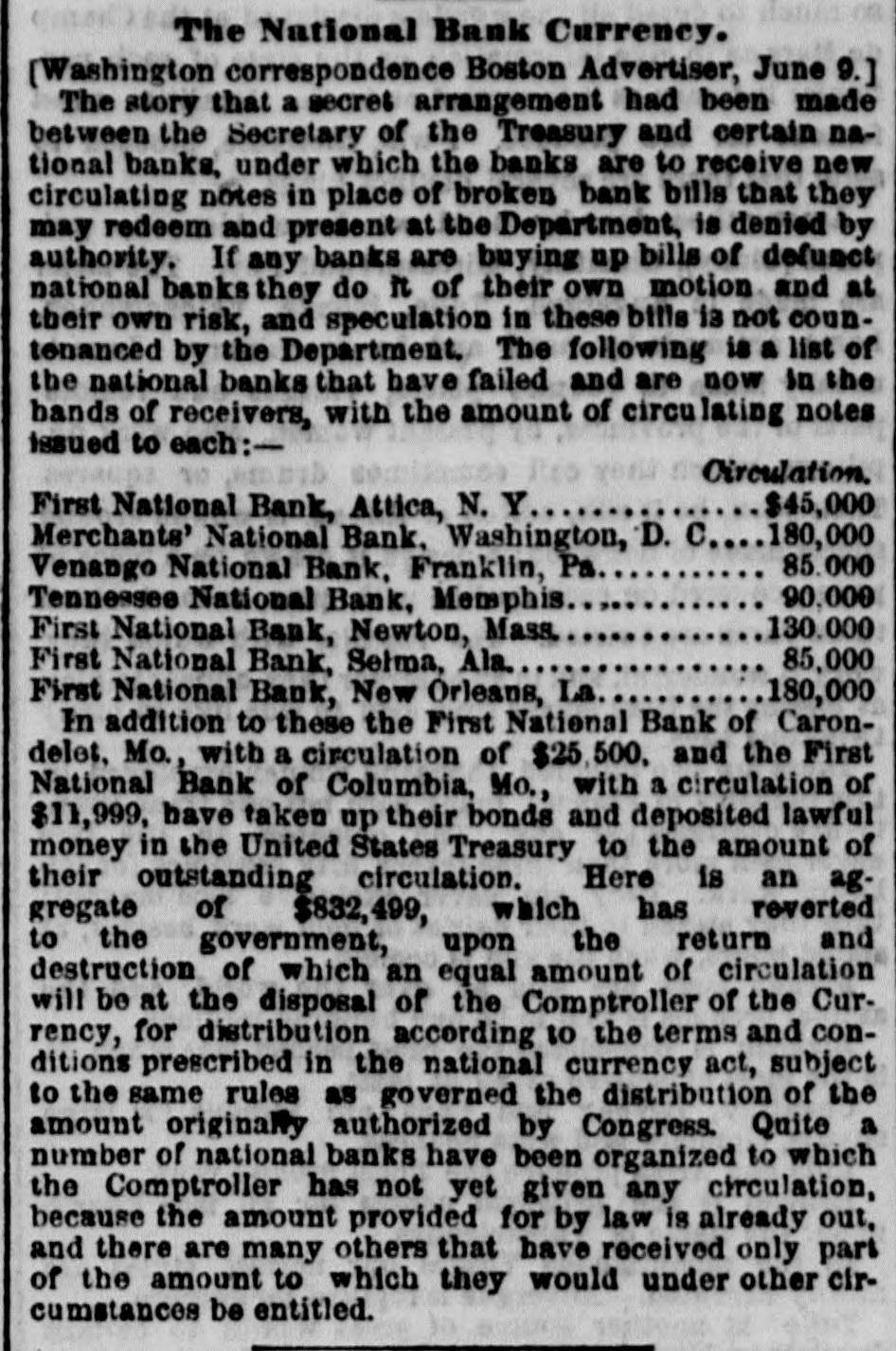
The National Bank Currency. (Washington correspondence Boston Advertiser, June 9.] The story that a secret arrangement had been made between the Secretary of the Treasury and certain national banks, under which the banks are to receive new circulating notes in place of broken bank bills that they may redeem and present at the Department, is denied by authority. If any banks are buying up bills of defunct national banks they do it of their own motion and at their own risk, and speculation in these bills is not countenanced by the Department. The following is a list of the national banks that have failed and are now in the bands of receivers, with the amount of circu lating notes issued to each:Circulation. $45,000 First National Bank, Attica, N. Y Merchants' National Bank, Washington, D. C 180,000 85.000 Venango National Bank, Franklin, Pa 90.000 Tennessee National Bank, Memphis 130.000 First National Bank, Newton, Mass. 85,000 First National Bank, Selma, Ala. 180,000 First National Bank, New Orleans, La In addition to these the First National Bank of Carondelet, Mo., with a circulation of $25,500. and the First National Bank of Columbia, Mo., with a circulation of $11,999, have taken up their bonds and deposited lawful money in the United States Treasury to the amount of their outstanding circulation. Here is an aggregate of $832,499, which has reverted to the government, upon the return and destruction of which an equal amount of circulation will be at the disposal of the Comptroller of the Currency, for distribution according to the terms and conditions prescribed in the national currency act, subject to the same rules as governed the distribution of the amount originalty authorized by Congress. Quite a number of national banks have been organized to which the Comptroller has not yet given any circulation, because the amount provided for by law is already out, and there are many others that have received only part of the amount to which they would under other circumstances be entitled.


Article from Public Ledger, June 19, 1867

Click image to open full size in new tab

Article Text

Failures of National Banks. The following is a list of National Banks that have failed and are now in the hands of the receivers, with the amount of circulating notes issued to each: The First National Bank of Attica, New York, $45,000; the Merchants' National Bank of Washington, D. C., $180,000: the Venango National Bank of Franklin, Penasylvania, $85,000; the Tennessee National Bank of Memphis, Tennessee, $90,000; the First National Bank of Newton, Massachusetts, $130,000; the First National Bank of Selma, Alabama, $85,000; the First National Bank of New Orleans, Louisiana, $180,000. In addition to these, two banks have taken up their bonds and deposited lawful money in the Treasury of the United States to the amount of their outstanding circulation, viz: The First National Bank of Carondelet, New Orleans, $25,000; the First National Bank of Columbia, New Orleans, $11,990, making a total of $832,490 which has reverted to the Government, upon the return and destruction of which an equal amount of circulation will be at the disposal of the Controller of the Currency for distribution, according to the terms and conditions prescribed in the National Currency act, subject to the same rules that governed the distribution of the amount originally authorized by the act of Congress.


Article from The Weekly North-Carolina Standard, June 19, 1867

Click image to open full size in new tab

Article Text

FAILURES OF NATIONAL BANKS- The following is a list of national banks that have failed and are now in the hands of receivers, with the amount of circulating notes issued to each : The first National Bank of Attica, N. Y., $45,000; the Merchants National Bank of Wash ington, D. C., $180,000; the Venango National Bank of Franklin, Penn., $35,000; the Tennessee National Bank of Memphis, Tenn., $90,000; the First National Bank of Newton, Mass., $130,000; the First National Bank of Selma, Ala., $85,000; the First National Bank of New Orleans, La., $180,000. In addition to these, two banks have taken up their bonds and deposited lawful money in the Treasury of the United States to the amount of their outstanding circulation-viz.: The First National Bank of Carondelet, New Orleans, $25,500; the First National Bank of Columbia, New Orleans, $11,990; making a total of $832,490 which has reverted to the Government; upon the return and distruction of which an equal amount of circulation will be at the disposal of the Comptroller of the Currency for distribution, according to the terms and conditions prescribed in the national currency act, subject to the same rules that governed the distribution of the amount originally authorized by the act of Congress.New York Times.


Article from Daily Ohio Statesman, September 2, 1867

Click image to open full size in new tab

Article Text

FROM NEW YORK. Hunting RobbersSailed for Califor nia. NEW YORK, Aug. 31.-Several Mexican detectives are here in seach of C.M. Medna inich and several others who a.e reported to have robbed the Mexican Liberal Government af $200 000 in gold at the time of the capture of Maximilian. (A woman who accompanied him sailed for Europe, it is supposed, with part of the money, but will be intercepted there by the cable. Medirich and confederates thus far have evaded the vigilance of the detectives, who, however. are confident that they are yet in the city with much of the gold. General Roussean and staff sailed per Arizona to-day for California. Sailed for Europe. David Dudiey Field sailed for Europe to-day to attend the Social Science Congress, at Belfast, our the 18th Sent. Mortuary Report. The deaths in New York for the week are reporte d at 580. There is not a case of yellow fever in the city. Judge Barnard, in the Supreme Court to-day, denied the motion made at the instance of the receiver of the insolvent First National Bank of Selma, Alabama, for a vacation of attachment upon certain de= posits of the bank in the Ocean Bank here. The attachment had been issued by the owner of certain checks drawn by the Selma bank three days after it refused payment of a Government draft on deposits here. It is claimed the attachment is in violation of the provisions of the act creating national banks, which provides for the winding up of insolvent concerns. Case gone to general term of Court of Appeals,


Article from The Wheeling Daily Register, September 2, 1867

Click image to open full size in new tab

Article Text

New York Items. NEW YORK, August 31.-David Dudley Field sailed for Europe to-day to attend the Social Science Congress at Belfast, on the 18th of September. The number of deaths in New York for the week was about 580. There is not a casé of yellow fever in the city. Judge Barnard, in the Supreme Court, to-day, denied the motion made at the instance of the receiver of the insolvent First National Bank of Selina, Ala. bama, for a vacation attachment upon certain deposits of the bank in the Ocean Bank here. The attachment had been issued by the owner of certain checks drawn by the Selma bank three days after it refused payment of a government draft on deposits here. It is claimed that the attachment is in derogation of the provisions of the act creating national banks, which provides for winding up insolvent concerns. The case has gone to the general term of the Court of Appeals,


Article from The Jeffersonian, October 24, 1867

Click image to open full size in new tab

Article Text

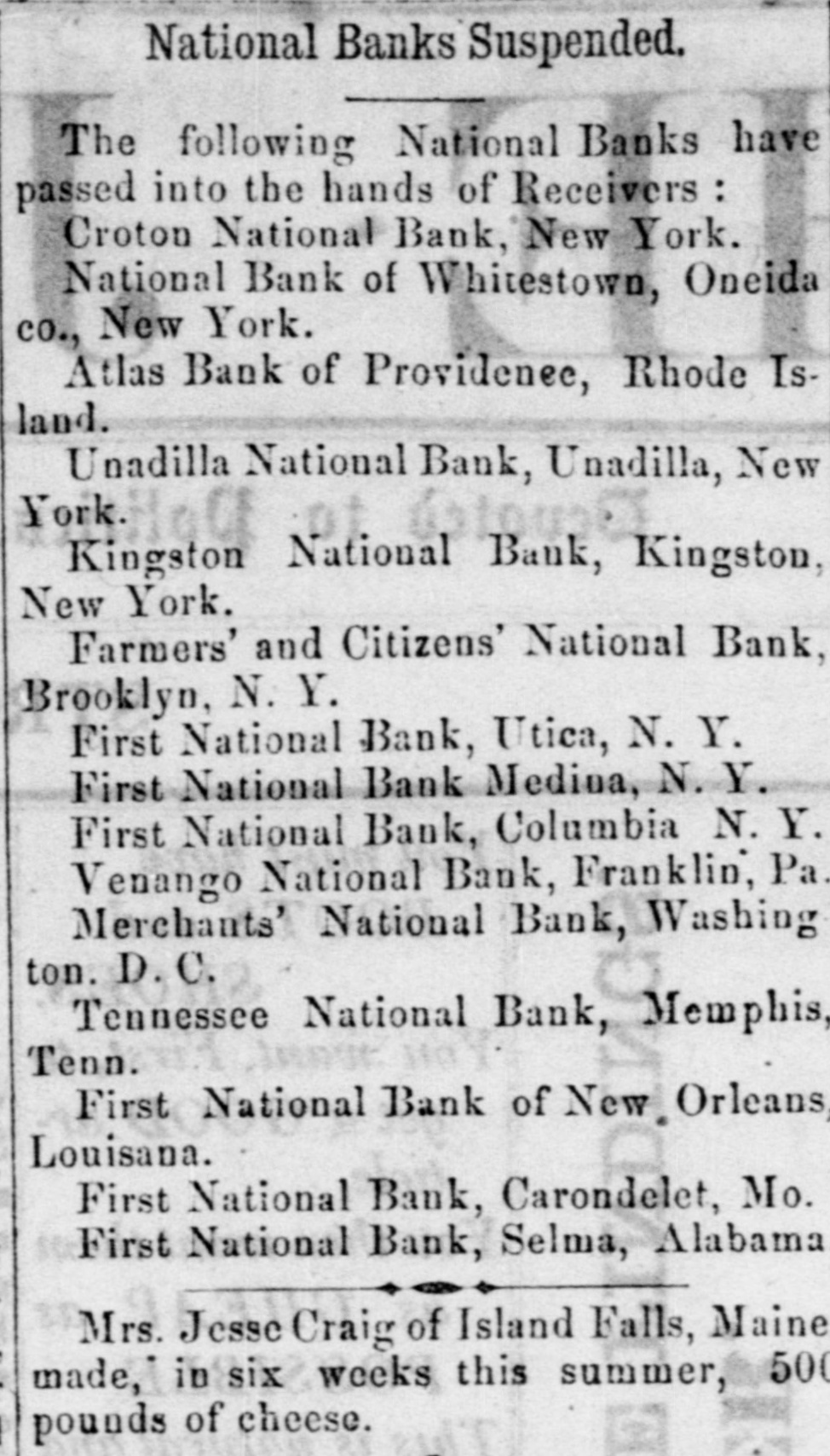
National Banks Suspended. The following National Banks have passed into the hands of Receivers : Croton National Bank, New York. National Bank of Whitestown, Oneida co., New York. Atlas Bank of Providence, Rhode Island. Unadilla National Bank, Unadilla, New York. Kingston National Bank, Kingston, New York. Farmers' and Citizens' National Bank, Brooklyn, N. Y. First National Bank, Utica, N. Y. First National Bank Medina, N. Y. First National Bank, Columbia N. Y. Venango National Bank, Franklin, Pa Merchants' National Bank, Washing ton. D. C. Tennessee National Bank, Memphis, Tenn. First National Bank of New Orleans Louisana. First National Bank, Carondelet, Mo. First National Bank, Selma, Alabama Mrs. Jesse Craig of Island Falls, Maine made, in six weeks this summer, 50 pounds of cheese.


Article from Indiana American, November 22, 1867

Click image to open full size in new tab

Article Text

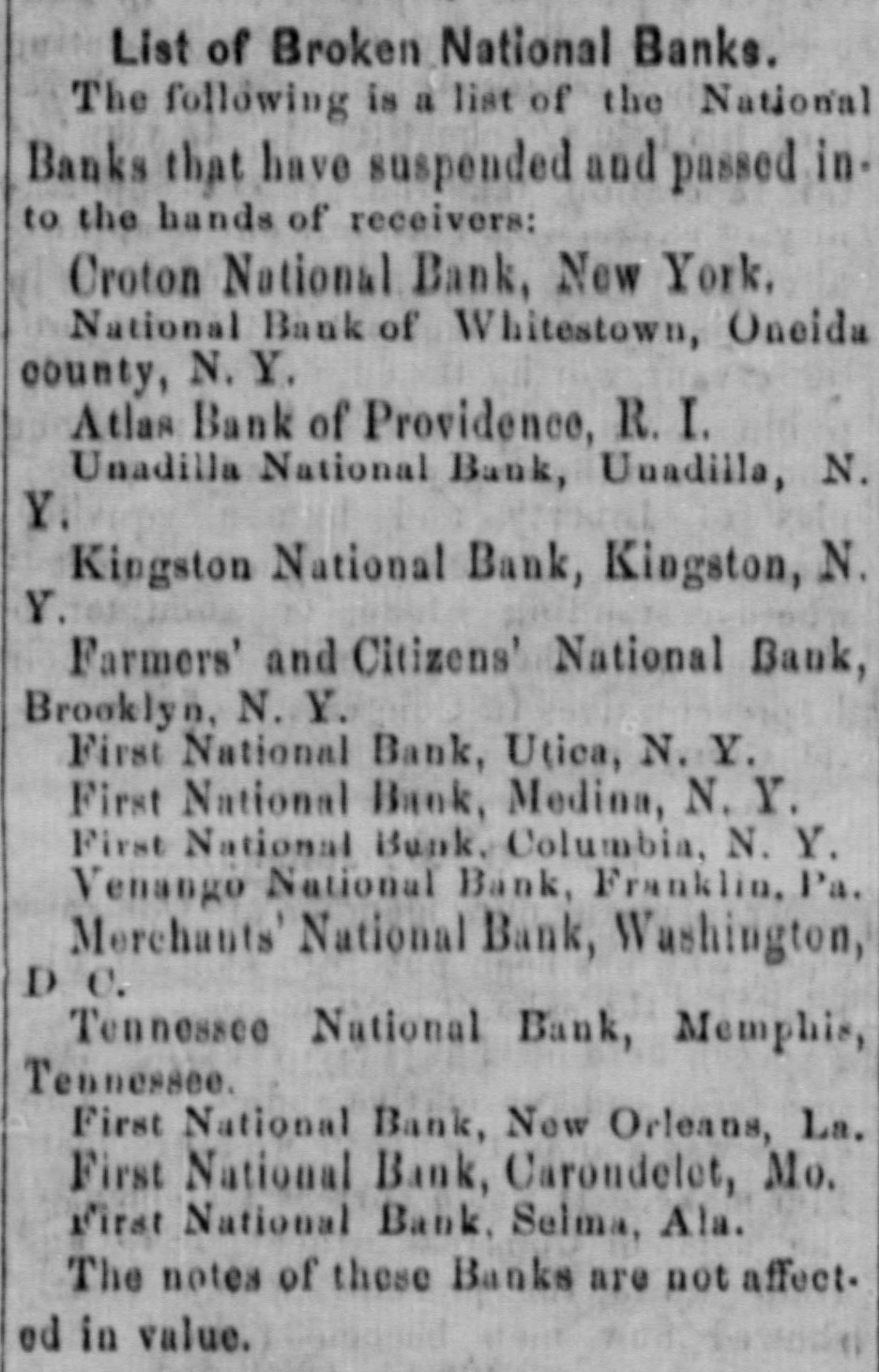
List of Broken National Banks. The following is a list of the National Banks that have suspended and passed in. to the hands of receivers: Croton National Bank, New York, National Bank of Whitestown, Oneida county, N. Y. Atlas Bank of Providence, R. I. Unadilla National Bank, Uuadilla, N. Y. Kingston National Bank, Kingston, N. Y. Farmers' and Citizens' National Bank, Brooklyn, N. Y. First National Bank, Utica, N. Y. First National Bank, Medina, N. Y. First National Bunk, Columbia, N. Y. Venango National Bank, Franklin, Pa. Merchants' National Bank, Washington, D C. Tennessee National Bank, Memphis, Tennessee. First National Bank, New Orleans, La. First National Bank, Carondelet, Mo. First National Bank, Selma, Ala. The notes of these Banks are not affect. ed in value.


Article from New-York Tribune, December 2, 1872

Click image to open full size in new tab

Article Text

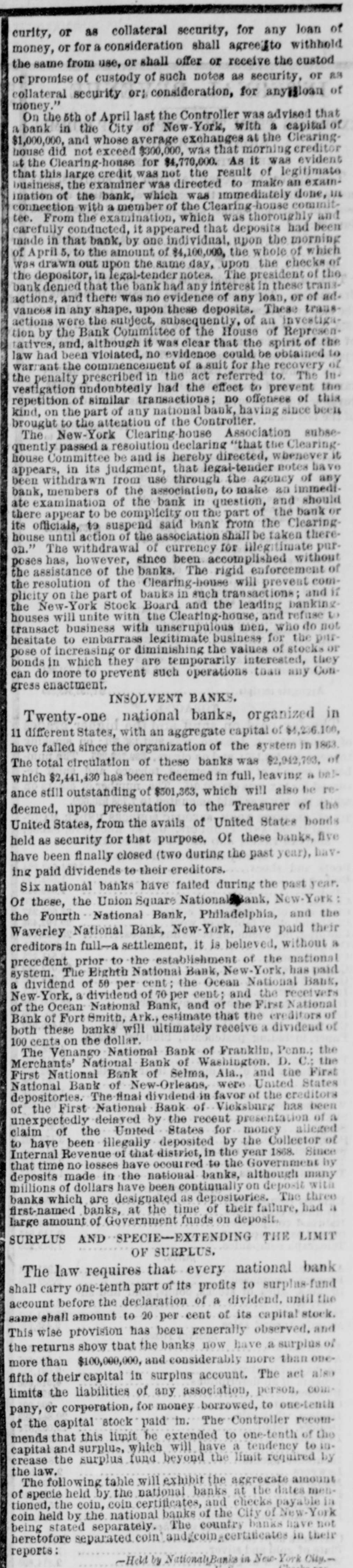
curity, or as collateral security, for any loan of money, or for a consideration shall agreeAto withhold the same from use, or shall offer or receive the custod or promise of custody of such notes as security, or as collateral security or consideration, for any lloan of money." 5th of April last the Controller was advised that bank On the in the City of New-York, with a capital of $1,000,000, a and whose average exchanges at the Clearinghouse did not exceed $300,000, was that morning creditor at the Clearing-house for $4,770,000. A8 it was evident that this large credit was not the result of legitimate business, the examiner was directed to make an exam ination of the bank, which was immediately done, 114 connection with a member of the Clearing-house committee. From the examination, which was thoroughly and carefully conducted, it appeared that deposits had been made in that bank, by one individual, upon the morning of April 5 to the amount of $4,100,000, the whole of which was drawn out upon the same day, upon the checks of the depositor, in legal-tender notes. The president of the bank denied that the bank had any interest in these trans actions, and there was no evidence of any loan, or of ad. vances in any shape. upon these deposits. These traus actions were the subject, subsequently, of an investiga tion by the Bank Committee of the House of Represent tarives, and, although it was clear that the spirit of the law had been violated, no evidence could be obtained to warrant the commencement of a suit for the recovery of the penalty prescribed in the act referred to. The in vestigation undoubtedly had the effect to prevent the repetition of similar transactions; no offenses of this been kind, on the part of any national bank, having since brought to the attention of the Controller. The New-York Clearing house Association subse quently passed a resolution declaring "that the Clearinghouse Committee be and is hereby directed, whenever it appears, in its judgment, that legal-tender notes have been withdrawn from use through the agency of any bank, members of the association, to make an immediate examination of the bank in question, and should there appear to be complicity on the part of the bank or its officials, to suspend said bank from the Clearing house until action of the association shall be taken there on." The withdrawal of currency for illegitimate purposes has, however, since been accomplished without the assistance of the banks. The rigid enforcement of the resolution of the Clearing-house will prevent complicity on the part of banks in such transactions; and it the New-York Stock Board and the leading banking houses will unite with the Clearing-house, and refuse to transact business with unserupulous men. who do not hesitate to embarrass legitimate business for the parpose of increasing or diminishing the values of stocks or bonds in which they are temporarily interested, they can do more to prevent such operations team any Congress enactment. INSOLVENT BANKS. Twenty-one national banks, organized in 11 different States, with an aggregate capital of $1,236,100, have failed since the organization of the system in 1863 The total circulation of these banks was $2,942,793. of which $2,441,430 has been redeemed in full, leaving a belance still outstanding of $501,363, which will also be redeemed, upon presentation to the Treasurer of the United States, from the avails of United States bonds held as security for that purpose. Of these banks, five have been finally closed (two during the past year), baying paid dividends to their ereditors. Six national banks have fatted during the past year. New-York: Of these, the Union Square National Bank, the Fourth National Bank, Philadelphia, and the Waverley National Bank, New-York, have paid their creditors in full-a settlement, it is believed, without a precedent prior to the establishment of the national system. The Eighth National Bank, New-York, has paid dividend of 50 per cent; the Ocean National Bank, New-York, a dividend of 70 per cent; and the receiver of the Ocean National Bank, and of the First National Bank of Fort Smith, Ark., estimate that the creditors of both these banks will últimately receive a dividend of 100 cents on the dollar. The Venango National Bank of Franklin, Penn.: the Merchants' National Bank of Washington. D. C. the First National Bank of Selma, Ala., and the First National Bank of New-Orleans, were United States depositories. e-final dividend in favor of the creditors of the First National Bank of Vicksburg has been unexpectedly delayed by the recent presentation of a claim of the United States for money alleged to have been illegally deposited by the Collector of Internal Revenue of that district, in the year 1868. Since that time no lesses have occurred to the Government by deposits made in the national banks, although many millions of dollars have been continually on deposit with banks which are designated as depositories. The three a first-named banks, at the time of their failure, had large amount of Government funds on deposit. SURPLUS AND SPECIE-EXTENDING THE LIMIT OF SURPLUS. The law requires that every national bank shall carry one-tenth part of its profits to surplus-fund account before the declaration of a dividend, until the same shall amount to 20 per cent of its capital stock. This wise provision has been generally observed. and the returns show that the banks now have a surplus of more than $100,000,000, and considerably more than onefifth of their capital in surplus account. The act also limits the liabilities of any association, person, com pany, or corporation, for money borrowed, to one-tenth of the capital stock paid in. The Controller recommends that this limit be extended to one-tenth of the capital and surplu. which will have a tendency to 10. crease the surplus fund beyond the limit required by the law. The following table will exhibit the aggregate amount of specie held by the national banks at the dates mentioned, the coin, coin certificates, and checks payable coin held by the national banks of the City of New York being stated separately. The country banks have not heretofore separated coin in their reports: -Held NationalsBanks in New- City.-