Article Text
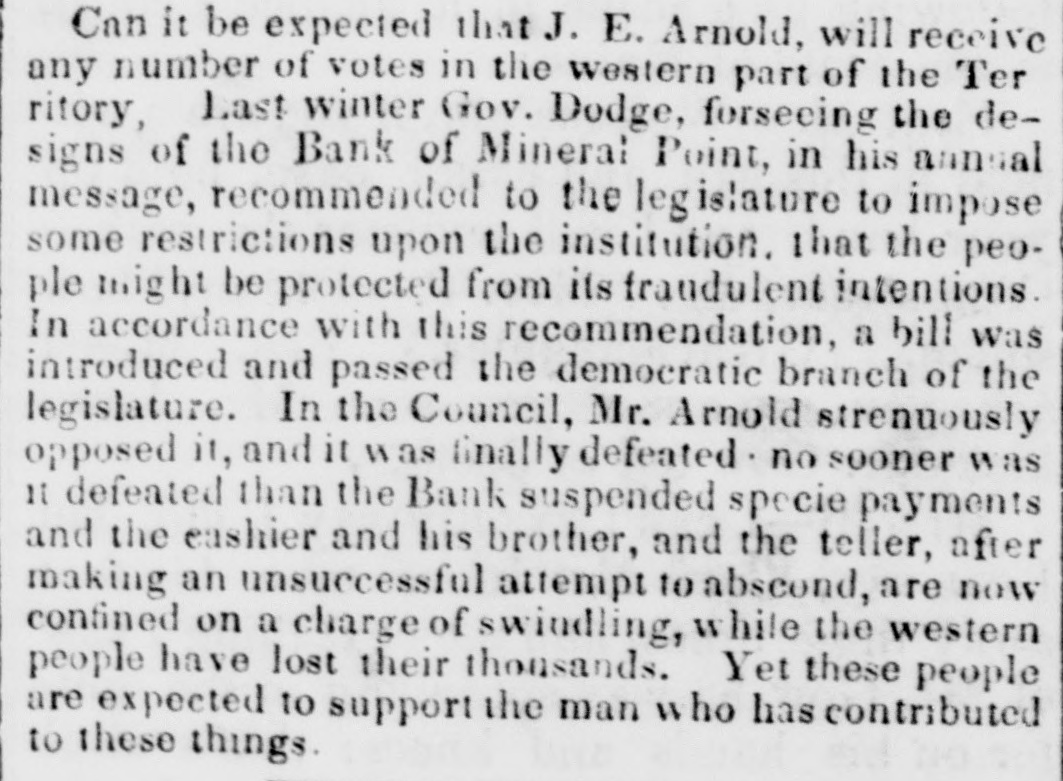
Intimate relation of cause and effect, must have been highly gratifying to his whig friends. It was the usual argument of the moonshine mongers. That the country was prosperous when Gen. Jackson came into power, that Gen Jackson had ambitious views, and as he could not convert the United States Bank to an engine for his own advancement, that he We determined to destroy it, that he did destroy it, tha the country fell into pecuniary distress, with its train of evils, that it was occasioned by the destruction o the United States Bank, and that Gen. Jackson wa the destroyer of the prosperity of his country. With the evidence before us of the fate of the late Unite States Bank and the unparallelled dishonesty of its officers, who were the officers of the old Bank, th's tinde against Gen. Jackson will no doubt have its full weight. The age is too far advanced in wisdom with regard to the United States Bark, as well as Bank financiering generally, for such nonsense to have efeet. The subtreasury was handled without gloves, with the same argument that every school-boy in the country knows the fallacy of. After demolislung Gen. Jackson, Mr. Van Buren, and some other great men as well as some great measures, Mr. Arnold came nearer home. He spoke of Gov. Dodge, and did I not believe that he dared not from the force of public opinion, speak otherwise than he did, I should give him great credit for candor; but he could not take the citadel of the people's affection by storm, and he was obliged to approach it cautiously. Although the whig press have been endeavoring since his removal, to impeach the character and fame of Gov. Dodge, Mr. Arnold said he was a brave and meritorious soldier in the field, a wise and prudent man in the council; that in defending the soil of our territory from a savage foe, he had won himself honorable laurels which would exist with the prosperity he fought to secure, and that as Governor he had won an increased reputation, which remained unsullied. He did not lay to his charge a single fault and when he come to account for his removal, he could only say, that "HE WAS A PROMINENT DEMOCRAT; -these were his words. Listen to it people of Wisconsin; Mr. Arnold says he was FAITHFUL, he was EFFICIENT, but HE WAS A PROMINENT DEMOCRAT, for which alone he was removed. There can be no comment forcible enough to add to the simple truth which Mr. Arnold, perhaps inadvertently, gave expression to in these words. Honesty and efficiency were all the people of Wisconsin wanted in their Governor. They enjoyed it in the person of their late Governor, but it availed nothing; the sin of Democracy must be punished, whatever the people might lose. Democrats. if you are to be trampled down for opinion's sake, for cherishing and upholding the principle which your conscience dictates and sanctions, will you neglect to avail yourselves of the rebuke of the ballot box. Will you not through that medium tell the persecutors of your principle, that you dare be free, and that you will uphold honesty and efficiency, even though attacked by those in power. After exhausting all his power of persuasion, Mr. Arnold narrowed the subject down to this: That principle called upon the Whigs to support him, and interest upon all others. I have spoken with regard to the extent whigs are called upon by principle to support Mr. Arnold, considering his intimate relation to Doty. The question of interest is but a paltry electioneering trick, and were it otherwise, it ought to bring down the indignation of every honest freeman upon the heads of those, who, Mr. Arnold tells us will be guided by such unpatriotic and anti-American views, in their relations with our territory. It may be so, though, as it would be but a piece with the removal of Dodge. Mr. Arnold tells us, that, if we expect any thing from the general government, it must be through the agency of a whig delegate. The government has every disposition to comply with our wants, but however honest, however upright a delegate we may send to Washington, unless he be a whig at the hands of whigs he can receive nothing. He regretted that it was so, it was wrong, but so it was. M:: Arnold calls upon the people to sustain in his election that which he acknowledges is wrong, -to sustain by their votes, proscription for opinion's sake, and to acknowledge that they are ready to sacrifice their principle to their interest: an interest which has its birth in an unholy proscription. People of Wisconsin, will you do it. To show, however, the fallacy of this catch word of interest, I need on'y say, that the great head of the whig party. Henry Clay, now in the Senate of the United States, denounced the settlers on the public lands, as, Land Pirates, who had not a shadow of right to a preemption on the land they claimed, and ought to be compelled to pay for or abandon it at once, while on the other hand, Thomas H. Benton, the champion of democracy, with the true democratie spirit, has been the able advocate of western interests, and the father of the preemption system. Mr. Arnold said further, if Gov. Dodge should be sent by the people to Washington, that in the Senate, Senators Benton and Linn would be his warm friends, which would insure the defeat of his endeavors for the good of the territory, because, senators Benton and Linn are democrats. Had I not heard these adraissions on the part of Mr Arnold, I could not have believed them, admissions involving the honor and honesty of the whig party as they do, Doubting the truth of them, myself, I cannot conceive the design of Mr. Arnold in making them, unless he thought the people had so little virtue so little principle, that it was only necessary to alarm them on the score of interest, to bring about his ends. Mr. Arnold continued on this subject, as a further reason against the election of Gen. Dodge, that as Dodge and Doty were enemies, should Dodge go to Washington, "Doty would throw stumbling blocks in his way:" these were the words. Here is Judge Doty's patriotism demolished at a blow. Dodge's efforts for the good or the territory would be likely to be defented by Doty. What a picture of the influence of selfish and personal hostility of feeling, in opposition to the public good, yet M. Arnold calls upon us to sustain him and through him, Judge Doty. Mr. Arnold alluded to his opposition, last winter, in the Council, to the bill which passed the House of Representatives, imposing restrictions on the bank of Mineral Point. He did not vote for it because he did not think it right to trammel so little an institution by its provisions, where it stood alone in the territory, or in other words, as the bank stood alone, and furnished the whole circulation of the west, it should be left in undisturded possession of its right to swindle, which privilege it availed itself of, by suspending specie payments, the moment it became evident that the bill which Mr. Arnold opposed, could not pass Mr. Arnold passed rapidly over some charges that had been made against his official acts, and explained them away, perhaps, as satisfactorily as mere words could do it. He denounced bitterly the press for daring to expose to the people the character of the man they are called upon to support, but finally congratulated himself because of their opposition, Ho was sorry the whigs had but one press, the Madison Express, which he said had but little influence. He said that all the people had to do, was with his official and public character, with his private character they had nothing, therefore, although that had been assailed he would not endeavor to clear himself of the charges which had been preferred. The character of a representative is a pretty good criterion of the people who send him. Have we not got an upright and moral people, and if grave charges have been preferred against Mr. Arnold's moral character, is it not his duty to disprove them to the people. If it is easy for him to do it, and no doubt it is if they are untrue, does he not by his silence tacitly admit them- There are parts of the speech which I should Like to allude to at more length, but as you will conclude in all conscience my communicattoni long enough, I will subscribe myself, SEVENTY SIX.