22760. Plankinton Bank (Milwaukee, WI)

Bank Information

Episode Type
Suspension → Closure
Bank Type
state
Start Date
July 1, 1898
Location
Milwaukee, Wisconsin (43.039, -87.906)

Metadata

Model
gpt-5-mini
Short Digest
d571219c

Response Measures

None

Description

No newspaper article describes a depositor run. The bank had failed and was in receivership/assigneeship (assignee William Plankinton), with contested final account and a new receiver (Irving M. Bean) appointed July 17, 1899. Evidence indicates permanent closure and ongoing receivership/settlement of claims. I corrected/used the July 1, 1898 assignee report date mentioned in articles as the approximate date of the bank's assignee report/closure activity.

Events (4)

1. July 1, 1898 Suspension
Cause
Bank Specific Adverse Info
Cause Details
Large shrinkage of assets (over $500,000), mismanagement and inability to account for assets leading to failure and suspension/assigneeship.
Newspaper Excerpt
he ex-receiver had also credited himself with $20,000 fees as assignee ... He could not decipher his report made as assignee on July 1, 1898.
Source
newspapers
2. June 30, 1899 Other
Newspaper Excerpt
Milwaukee Judge Served With a Writ of Mandamus by Supreme Court To Grant Relief to Plankinton Bank Creditors ... The creditors claim to have lost about $127,000 through the operations of Assignee William Plankinton ... The assignee did not make a report according to law, and the creditors failing to get satisfaction in the circuit court, carried the matter to the supreme court. It is now expected a complete investigation will follow.
Source
newspapers
3. July 17, 1899 Receivership
Newspaper Excerpt
Judge Johnson in the circuit court appointed Captain Irving M. Bean to succeed William Plankinton as assignee of the defunct Plankinton bank. According to the writ of mandamus issued by the supreme court, the creditors are granted leave to examine the books of Assignee Plankinton and officers of the bank. The report issued by Mr. Plankinton was ... unsatisfactory to the bank's creditors and a complete investigation of all affairs connected with the failure will now follow.
Source
newspapers
4. August 10, 1899 Other
Newspaper Excerpt
William Plankinton, ex-receiver for the defunct Plankinton Bank of Milwaukee, was examined Thursday before Court Commissioner Schreiber relative to his management of the bank's affairs. The shrinkage of over $500,000 from the face value of the bank's assets could not be accounted for by Plankinton ... He had also credited himself with $20,000 fees as assignee without notifying the court or creditors until after he had paid himself.
Source
newspapers

Newspaper Articles (10)

Article from Audubon Republican, May 18, 1899

Click image to open full size in new tab

Article Text

THE NOTES. SMIN TYNENED illiam Plankinton, assignee of the kinton bank, Milwaukee, has re'pe biscuit, cracker and capidy trust encompleted on the Pac Mo coast is capitalized at $4,000,000. eisch & Co., men's underwear, of York, are in the bankruptcy court their debts amount to $235,412; $95,200. in e Mexican Telephone company is ing connections with the United districe Buoj &q se buquerque, N. M., extends an inion to the Rough Riders to hold :, first annual convention at that conference between the Southern sas coal operators and miners red in failure of agreement, and rike will result. inufacturers of feed cutters, corn lers, feed and cider mills are efng a combination, and have de1 to raise prices 16 to 25 pervcent. cottish iron manufacturers deny a scheme has been submitted to 1 for a Carnegie syndicate to, abthe British iron and steel interII give ptain John Baxter, on dutyMas 0 quartermaster at Omaha, departt of the Missouri, has. been ordero sail not later than May 22 for Philippines. neral Brooke cables from Havana: tain Hickey has returned from an nded trip through the eastern part e island and reports a general imement of conditions at all points. e Standard Oil company is moying Toledo business to South Bend, It is the ultimate intention of the dard to close the Toledo office. men have already been transJutes pe ardinal Gibbons, in the course of a on at the cathedral in Baltimore he united church, characterized the nt divorce and marriage of a clèrlady in New York asia crime nst the law of Jesus Christ. e United States cruiser¹¹ Chicago arrived at Tanpier, Moreceoloto ort claims of the United States rnment against the sulternate.of beco. Admiral Howison and UnitStates Consul General Gunners -OW JO Joseph on TISTA 8 Musan Ben Hamed PIS °0 e United States delegates, to the e conference at The Hague have ructions to advance three lead10 ts of arbitration. the extension of declaration of Paris of 1856'to' the confiscation of all cargoes not'conand of war, and the extension of Geneva agreement to war by sea. v. Edward Morgan, late assistant or of the Church of the Godd SaItan in San' Francisco, is reported ave' been made a millionaire bythe h of an aunt in New Yorks Heris tive of Ireland, 34 years old, and done good missionary workiamong poor. e secretary of war received a cable sage from General Otis at Manila uo 1 18 11 that Superscript(2) anitary conditions to send to the ed States the bodies of any more he troops who lost their lives in Philippines until after the close he rainy season. hisa Homorid 1000 dispatch from Hamburg has been yed at New York announcing that 0 Galicians are on their way br aring to come 'to' this country. steerrage quarters on the Germanrican lines, it is said!' areacrowdith the immigrants,who are/debivup home project January call' was serit' out in Chicard-for Vention of representatives of leadcredit men's associations, members dicial committees:of the house,and te, United States district judges,

Article from The Madison Daily Leader, June 30, 1899

Click image to open full size in new tab

Article Text

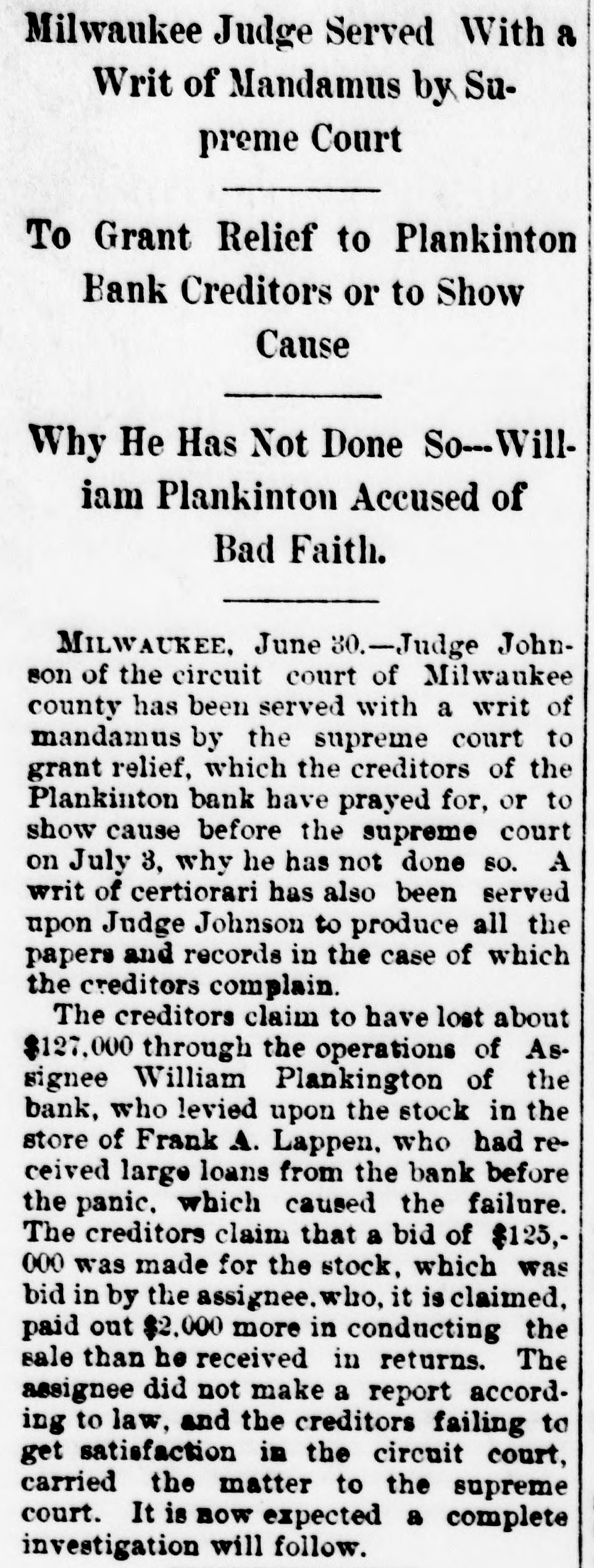
Milwaukee Judge Served With a Writ of Mandamus by Supreme Court To Grant Relief to Plankinton Bank Creditors or to Show Cause Why He Has Not Done So---William Plankinton Accused of Bad Faith. MILWAUKEE, June 30.-Judge Johnson of the circuit court of Milwaukee county has been served with a writ of mandamus by the supreme court to grant relief, which the creditors of the Plankinton bank have prayed for, or to show cause before the supreme court on July 3, why he has not done so. A writ of certiorari has also been served upon Judge Johnson to produce all the papers and records in the case of which the creditors complain. The creditors claim to have lost about $127,000 through the operations of Assignee William Plankington of the bank, who levied upon the stock in the store of Frank A. Lappen. who had received large loans from the bank before the panic. which caused the failure. The creditors claim that a bid of $125,000 was made for the stock, which was bid in by the assignee. who, it is claimed, paid out $2,000 more in conducting the sale than he received in returns. The assignee did not make a report according to law, and the creditors failing to get satisfaction in the circuit court, carried the matter to the supreme court. It is now expected a complete investigation will follow.


Article from Vilas County News, July 10, 1899

Click image to open full size in new tab

Article Text

Madison, July 6. The supreme court of Wisconsin handed down a decision Wednesday that will rank as one of the most important legal precedents in the history of the state. The decision was rendered in the case of the creditors of the defunct Plankinton bank of Milwaukee against Judge Johnson of the circuit court of Milwaukee county and was a complete victory for the creditors. This decision strikes out into a new field of jurisprudence, and brings into prominence an untried and unused clause of the state constitution. That clause gives the supreme court superintending authority over the inferior courts of the state. Heretofore there have been several methods of getting the supreme court to review the acts of a lower court, but all of them were slow and the parties to the litigation often lost interest in the case before the decision of the supreme court was reached, and the decision when obtained was of little or no value owing to the lapse of time. This was the situation in the Plankinton bank case, for if the ordinary methods of appeal had been waited for the statute of limitations would have run against many of the claims, and the creditors lost a large part of their money. This decision, by declaring that the supreme court has power to step in at any stage of the progress of a legal proceeding, and correct the acts of inferior courts will have an effect of the utmost importance on the progress of litigation in the future. The Plankinton case was novel in many respects. Judge Johnson, without proper notification to the creditors of the bank, some 2,300 in number, approved what was alleged to be the final account of Assignee William Plankinton. The creditors were lead to believe from utterances of the judge at a prior proceeding that the final account of the asignee would not be approved until several motions made by them had been disposed of. Some time later they were surprised to learn that the judge had entered an order approving the account. They protested and moved that such order be vacated and they be allowed to examine under oath the assignee and other witnesses relative to the report. Their real purpose in making this motion was to find out what disposal had been made of certain collaterals and to persuade the court to cut down the allowance of $101,000 to the assignee and his attorneys as fees for their services in settling the affairs of the defunct bank. The judge denied this motion and the creditors appealed to the supreme court to compel him to grant it, the appeal being taken under the heretofore overlooked clause of the constitution giving the supreme court such authority. Judge Johnson was cited to appear before the supreme court and give cause why he shouldn't do as the creditors desired. He filed a lengthy return in which he stated that the creditors had not shown sufficient foundation for their motion, that they had not objected to the report within the limit of time allowed by the statutes and that the report stood approved. This return was argued last Monday by Gen. F. C. Winkler, J. G. Flanders and E. H. Bottum for Judge Johnson and the assignee and by United States Senator-elect J. V. Quarles, J. B. Doe, M. M. Riley, Moritz Wittig and C. E. Estabrook for the creditors. The court decides that the creditors have a right to examine Assignee William Plankinton under oath and at the expense of the estate as to his management of the assets of the bank. This was the chief demand of the attorneys for the creditors. The court also decides that the report made by Mr. Plankinton and which has been in dispute is not a final report as required by law. The circuit court for Milwaukee county is directed to modify or withdraw all orders made which interfere with the rights of the creditors to examine Mr. Plankinton, or which treat the report made by Mr. Plankinton as a final report. The alternative


Article from Vilas County News, July 10, 1899

Click image to open full size in new tab

Article Text

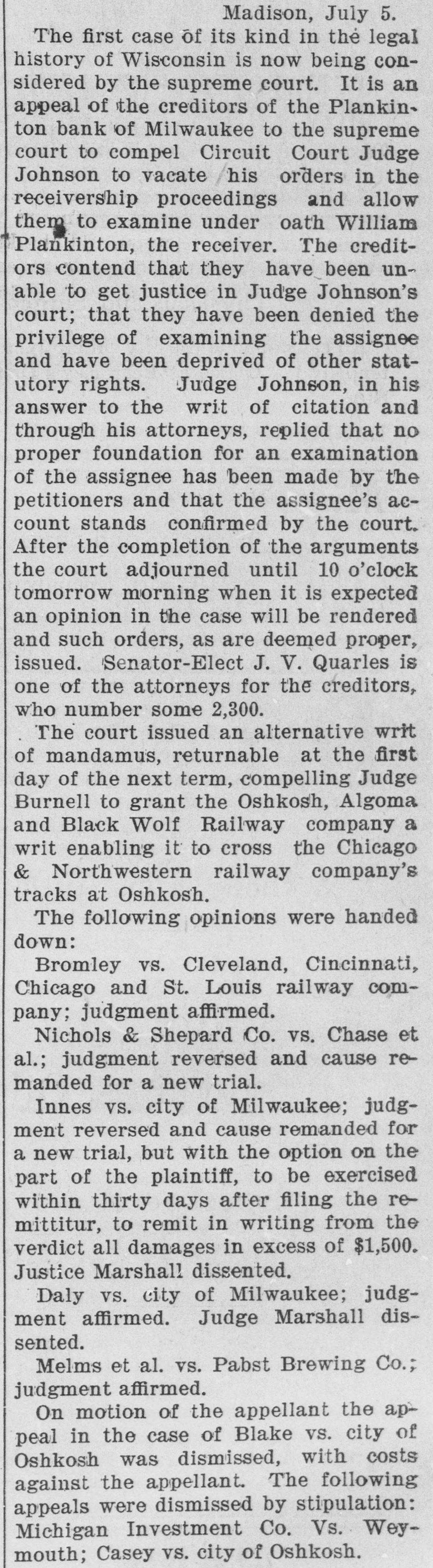
Madison, July 5. The first case of its kind in the legal history of Wisconsin is now being considered by the supreme court. It is an appeal of the creditors of the Plankinton bank of Milwaukee to the supreme court to compel Circuit Court Judge Johnson to vacate / his orders in the receivership proceedings and allow them to examine under oath William Plankinton, the receiver. The creditors contend that they have been unable to get justice in Judge Johnson's court; that they have been denied the privilege of examining the assignee and have been deprived of other statutory rights. Judge Johnson, in his answer to the writ of citation and through his attorneys, replied that no proper foundation for an examination of the assignee has been made by the petitioners and that the assignee's account stands confirmed by the court. After the completion of the arguments the court adjourned until 10 o'clock tomorrow morning when it is expected an opinion in the case will be rendered and such orders, as are deemed proper, issued. Senator-Elect J. V. Quarles is one of the attorneys for the creditors, who number some 2,300. The court issued an alternative writ of mandamus, returnable at the first day of the next term, compelling Judge Burnell to grant the Oshkosh, Algoma and Black Wolf Railway company a writ enabling it to cross the Chicago & Northwestern railway company's tracks at Oshkosh. The following opinions were handed down: Bromley vs. Cleveland, Cincinnati, Chicago and St. Louis railway company; judgment affirmed. Nichols & Shepard Co. vs. Chase et al.; judgment reversed and cause remanded for a new trial. Innes vs. city of Milwaukee; judgment reversed and cause remanded for a new trial, but with the option on the part of the plaintiff, to be exercised within thirty days after filing the remittitur, to remit in writing from the verdict all damages in excess of $1,500. Justice Marshall dissented. Daly vs. city of Milwaukee; judgment affirmed. Judge Marshall dissented. Melms et al. vs. Pabst Brewing Co.; judgment affirmed. On motion of the appellant the appeal in the case of Blake vs. city of Oshkosh was dismissed, with costs against the appellant. The following appeals were dismissed by stipulation: Michigan Investment Co. Vs. Weymouth; Casey vs. city of Oshkosh.


Article from The Sauk Centre Herald, July 20, 1899

Click image to open full size in new tab

Article Text

To SUCCEED PLANKINTON. Judge Johnson Appoints a New Receiver for the Plankinton Bank. MILWAUKEE, July 17.-Judge Johnson in the circuit court appointed Captain Irving M. Bean to succeed William Plankinton as assignee of the defunct Plankinton bank. According to the writ of mandamus issued by the supreme court, the creditors are granted leave to examine the books of Assignee Plankinton and officers of the bank. The report issued by Mr. Plankinton was in accordance with the statute and unsatisfactory to the bank's creditors and a complete investigation of all affairs connected with the failure will now follow.


Article from The Sauk Centre Herald, July 20, 1899

Click image to open full size in new tab

Article Text

To SUCCEED PLANKINTON. Judge Johnson Appoints a New Receiver for the Plankinton Bank. MILWAUKEE, July 17.-Judge Johnson in the circuit court appointed Captain Irving M. Bean to succeed William Plankinton as assignee of the defunct Plankinton bank. According to the writ of mandamus issued by the supreme court, the creditors are granted leave to examine the books of Assignee Plankinton and officers of the bank. The report issued by Mr. Plankinton was in accordance with the statute and unsatisfactory to the bank's creditors and a complete investigation of all affairs connected with the failure will now follow.


Article from Bismarck Weekly Tribune, July 21, 1899

Click image to open full size in new tab

Article Text

To SUCCEED PLANKINTON. Judge Johnson Appoints a New Receiver for the Plankinton Bank. MILWAUKEE, July 17.-Judge Johnson in the circuit court appointed Captain Irving M. Bean to succeed William Plankinton as assignee of the defunct Plankinton bank. According to the writ of mandamus issued by the supreme court, the creditors are granted leave to examine the books of Assignee Plankinton and officers of the bank. The report issued by Mr. Plankinton was in accordance with the statute and unsatisfactory to the bank's creditors and a complete investigation of all affairs connected with the failure will now follow.


Article from Crawford Avalanche, August 10, 1899

Click image to open full size in new tab

Article Text

HOW HE MANAGED THE BANK. Ex-Receiver William Plankinton Examined at Milwaukee. William Plankinton, ex-receiver for the defunct Plankinton Bank of Milwaukee, was examined Thursday before Court Commissioner Schreiber relative to his management of the bank's affairs. The shrinkage of over $500,000 from the face value of the bank's assets could not be accounted for by Plankinton, who claimed to be ignorant of many of the important details of the bank, as he did not give personal attention to the work. The ex-receiver had also credited himself with $20,000 fees as assignee without notifying the court or creditors until after he had paid himself. He could not decipher his report made as assignee on July 1, 1898. No attempt was made by the assignee to realize on various securities or collect numerous accounts due the bank.


Article from Vilas County News, September 11, 1899

Click image to open full size in new tab

Article Text

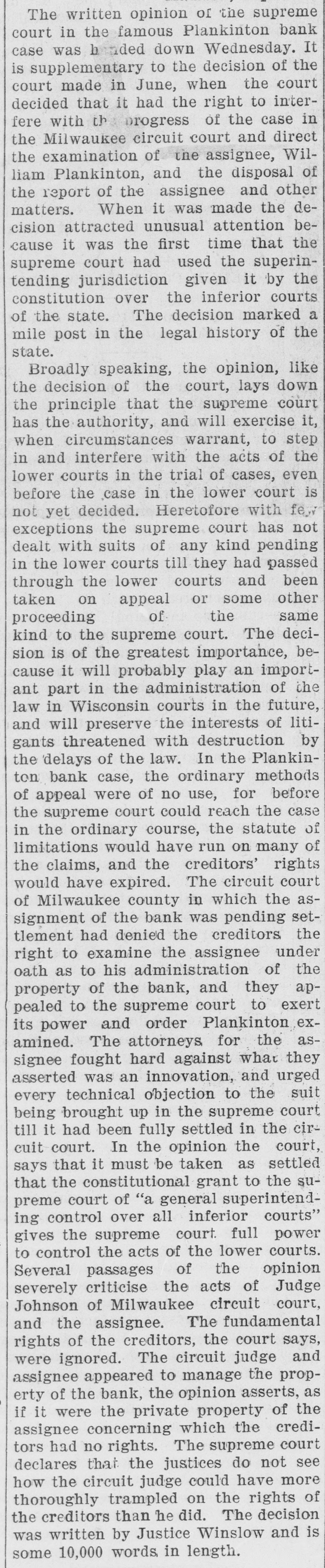
# SUPREME COURT OPINION The written opinion of the supreme court in the famous Plankinton bank case was handed down Wednesday. It is supplementary to the decision of the court made in June, when the court decided that it had the right to interfere with the progress of the case in the Milwaukee circuit court and direct the examination of the assignee, William Plankinton, and the disposal of the report of the assignee and other matters. When it was made the decision attracted unusual attention because it was the first time that the supreme court had used the superintending jurisdiction given it by the constitution over the inferior courts of the state. The decision marked a mile post in the legal history of the state. Broadly speaking, the opinion, like the decision of the court, lays down the principle that the supreme court has the authority, and will exercise it, when circumstances warrant, to step in and interfere with the acts of the lower courts in the trial of cases, even before the case in the lower court is not yet decided. Heretofore with few exceptions the supreme court has not dealt with suits of any kind pending in the lower courts till they had passed through the lower courts and been taken on appeal or some other proceeding of the same kind to the supreme court. The decision is of the greatest importance, because it will probably play an important part in the administration of the law in Wisconsin courts in the future, and will preserve the interests of litigants threatened with destruction by the delays of the law. In the Plankinton bank case, the ordinary methods of appeal were of no use, for before the supreme court could reach the case in the ordinary course, the statute of limitations would have run on many of the claims, and the creditors' rights would have expired. The circuit court of Milwaukee county in which the assignment of the bank was pending settlement had denied the creditors the right to examine the assignee under oath as to his administration of the property of the bank, and they appealed to the supreme court to exert its power and order Plankinton examined. The attorneys for the assignee fought hard against what they asserted was an innovation, and urged every technical objection to the suit being brought up in the supreme court till it had been fully settled in the circuit court. In the opinion the court, says that it must be taken as settled that the constitutional grant to the supreme court of "a general superintending control over all inferior courts" gives the supreme court full power to control the acts of the lower courts. Several passages of the opinion severely criticise the acts of Judge Johnson of Milwaukee circuit court, and the assignee. The fundamental rights of the creditors, the court says, were ignored. The circuit judge and assignee appeared to manage the property of the bank, the opinion asserts, as if it were the private property of the assignee concerning which the creditors had no rights. The supreme court declares that the justices do not see how the circuit judge could have more thoroughly trampled on the rights of the creditors than he did. The decision was written by Justice Winslow and is some 10,000 words in length.


Article from Virginian-Pilot, November 22, 1899

Click image to open full size in new tab

Article Text

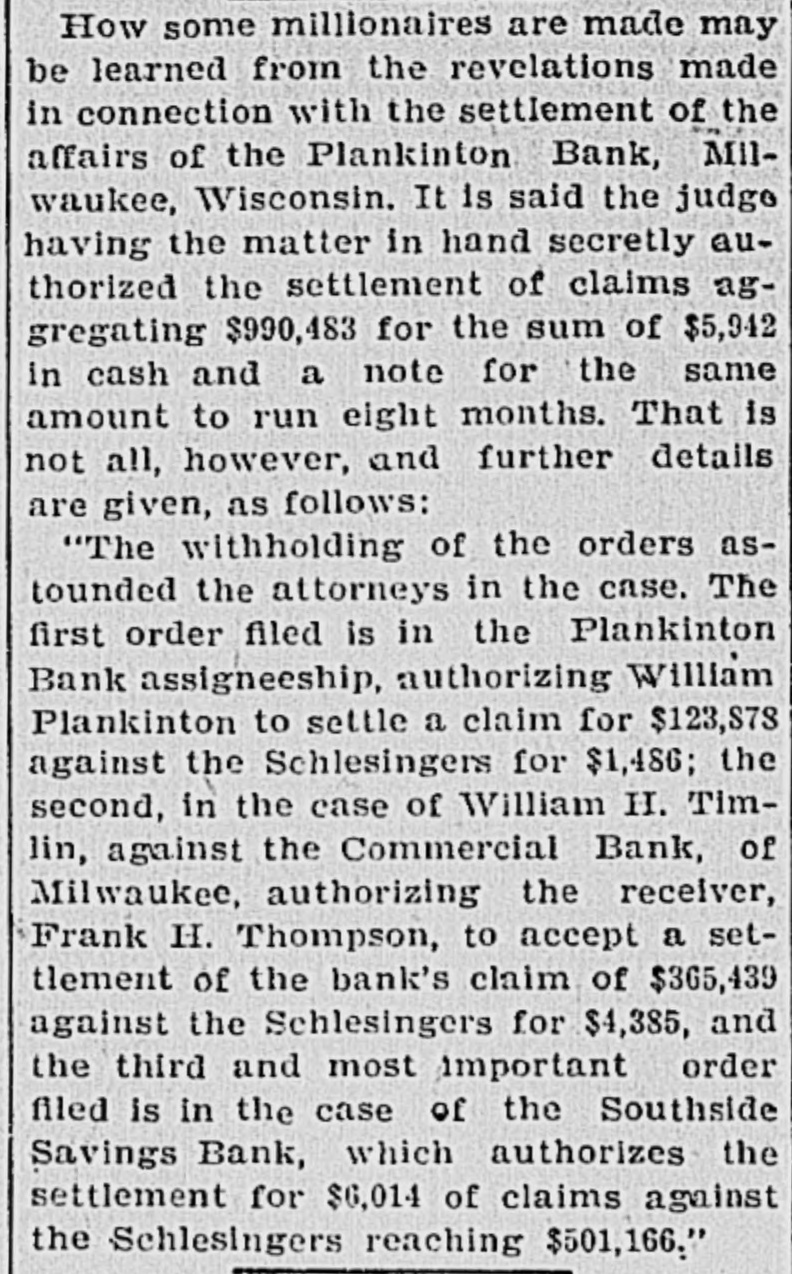
How some millionaires are made may be learned from the revelations made in connection with the settlement of the affairs of the Plankinton Bank, Milwaukee, Wisconsin. It is said the judge having the matter in hand secretly authorized the settlement of claims aggregating $990,483 for the sum of $5,942 in cash and a note for the same amount to run eight months. That is not all, however, and further details are given, as follows: "The withholding of the orders astounded the attorneys in the case. The first order filed is in the Plankinton Bank assigneeship, authorizing William Plankinton to settle a claim for $123,S78 against the Schlesingers for $1,486; the second, in the case of William H. Timlin, against the Commercial Bank, of Milwaukee, authorizing the receiver, Frank H. Thompson, to accept a settlement of the bank's claim of $365,439 against the Schlesingers for $4,385, and the third and most important order filed is in the case of the Southside Savings Bank, which authorizes the settlement for $6,014 of claims against the Schlesingers reaching $501,166."