22738. Milwaukee Bank (Milwaukee, WI)

Bank Information

Episode Type
Suspension → Closure
Bank Type
state
Start Date
July 21, 1893
Location
Milwaukee, Wisconsin (43.039, -87.906)

Metadata

Model
gpt-5-mini
Short Digest
130161ca

Response Measures

None

Description

Newspapers from July 1893 report a suspension/failure of the Milwaukee Bank during the broader 1893 panic. Articles repeatedly call it a failure or suspension. No explicit description of a depositor run (crowds/withdrawal lines) on this specific bank is given in the supplied clippings; the event is reported as a suspension/failure tied to the national panic, so I classify this as a suspension that resulted in closure.

Events (1)

1. July 21, 1893 Suspension
Cause
Macro News
Cause Details
Suspension/failure occurred in the context of the 1893 financial panic; articles describe it as a suspension/failure precipitating market declines and tied to the broader panic/news of banking distress across the country.
Newspaper Excerpt
The Milwaukee bank failure was largely the cause.
Source
newspapers

Newspaper Articles (7)

Article from The Times, July 22, 1893

Click image to open full size in new tab

Article Text

CHICAGO. CHICAGO, ILL., July 21.-A bad slump at the close spoiled to-day's record for the bulls in grain. The Milwaukee bank failure was largely the cause. Wheat showed considerable strength during most of the sersion, but unfavorable financial news changed all that, and the market got very nervous and turned very weak at the close. Corn received more than usual attention, the closing out of a large long line announced the bearish sentiment, and the market became weak. Prices went off rapidly during the last hour. In oats the offerings of July were quite heavy early, and the price dropped 3/4C. from the opening figure. September was steady to a shade firmer, owing to a better inquiry and also fewer sellers. The feeling toward the close was steadier. There were 16,000 hogs at the yards instead of 20,000, as has been reported. That gave the manipulators a chance to scare the crowd. One or two buying orders for pork put $1.50 on to the previous price of that article. There was no further trade until the price was back to $20.00. September lard advanced rapidly until it touched $10.37½. It then began to run down hill, and stopped only when it was back to $10.00, the same price it had closed at yesterday. Ribs were quiet and governed by lard.

Article from Richmond Dispatch, July 22, 1893

Click image to open full size in new tab

Article Text

steady: off A. 5 1-16a5&e.; standard A. 5 1-16a5-4c.; granulated, 5 1-16a5%c. Freights to Liverpool steadyand in fair demand: cotton, by asked. steam, 1/21.: grain, steam, 3%d,, bid, 31/40. CHICAGO. CHICAGO, July 21-A bad slump at the close spoiled to-day's records for the bulls in grain. The Milwaukee Bank failure was largely the cause. Wheat showed considerable strength during the best part of the session, but unfavorable financial news changed all that. and the market got very nervous and turned very weak at the close, Corn received more than usual attention, the closing out of a large, long line announced a bearish sentiment, and the market became wesk. Prices went off rapidly during the last hour. In oats the offerings of July were quite heavy early and the price dropped 1/4c. from the opening figure. September was steady to a shade firmer, owing to a better inquiry and also fewer sellers. The feeling towards the close was steadier. There were 16,000 hogs at the yards instead of 20,000, as had been reported. That gave the manipulators a chance to scare the crowd. One or two buying orders for pork put $1.50 on the previons prices of that article. There was no further trade until the price was back to $20. September lard advanced rapidly until is touched $10.37/2 Is then began to run down hill and stopped only when it was back to $10, the same price It had closed at yesterday. Ribs were quiet and governed by lard. Cash quotations: Flour easier, but with no established decline; No. 8 spring wheat, 62½ 63c. No. 2 corn, 387ga39c. No. 2 oats, 26160. Mess-pork, $19.75a$19.7734 Lard, 89.77 a$9.80. Short-rib sides (loose), 83.0216 Drysalted shoulders (boxed), $7.75a$8. Short-clear sides (boxed), $8.50m$8.6216 Whiskey, $1.12. The leading futures ranged as follows:

Article from The Morning News, July 22, 1893

Click image to open full size in new tab

Article Text

December delivery 15 @15 70; January delivery $15 01; March delivery $15 45@15 50; spot Rio dull and steady; No. 7 17¼c. Sugar-Raw easier and quiet, fair refining 3⅛c; centrifugals 96° test 4 3-16c; refined quiet and steady; off A 5 1-16@5⅛c; No. 6 A 4 13-16@5⅛c; standard A 5 7-16@5¼c; cutloaf 5⅛@6 1-16c; crusted 5 13-16@6c; granulated 5 7-16@5⅝c. Freights to Liverpool steady and in fair de-mand; cotton steam ⅝d; grain steam 3¼d bid; 3½d asked. Chicago, July 21—A bad slump at the close spoiled to-day's record for the bulls in grain. The Milwaukee bank failure was largely the cause. Wheat showed considerable strength during most of the session, but unfavorable financial news changed all that and the mar-ket got very nervous and turned very weak at the close. Corn received more than usual attention, closing out of a large long line aroused the bearish sentiment and the market became weak. Prices went off rapidly during the last hour. In oats the off-erings of July were heavy early and price dropped ½c from the opening figure. September was steady to a shade firmer, owing to a bet-ter inquiry and also fewer sellers. The feeling toward the close was steadier. There were 16,000 hogs at the yards instead of 20,000, as had been reported. That gave manipulators a chance to scare the crowd. One or two buying orders for pork put $1.50 on to the previous price of that article. There was no further trade until the price was back to $20. September lard advanced rapidly until it touched $10.37½. It then began to run down hill and stopped only when it was back to $10, the same price it had closed at yester-day. Ribs were quiet and governed by lard. Chicago, July 21.—Cash quotations were as follows: Flour easy, but there was no established decline; No. 2 spring in sack $3 62¼@3 62½; bakers #2 25. Wheat—No. 2 spring 62¼@62½c. Corn—No. 2 38⅛c. Oats—No. 2 26¼c. Mess pork $19 75@19 77½. Lard, per 100 pounds, $9 77½@9 80. Short rib sides, loose, $5 02½. Dry salted shoulders, boxed, $7 75@8 00; short clear sides, boxed, $8 50@ 8 62½. Whisky #1 12.

Article from The Sun, July 26, 1893

Click image to open full size in new tab

Article Text

ALL STREET IS VERY BLUE. STOCKS SELL AT THE LOWEST PRICES YET RECORDED. Milwaukee Bank Failure Precipitates Break in the Share# of the Granger Trunk R Lines-The Remainder of the List Follows Them-Paliadelphia Causes New York Bankers a Good Deal of TroubleLondon Continues to Buy Stocks. The question most frequently asked decline in Wall in just now 16. When will the than stop?" It was more pertinent leading yesterday. for. in n number of the to n further sharp break carried prices in lowest flgures that have been recorded the present downward movement. When those market opened. a large number of of some orested in It cherished timid hopos provement In the tone: for London quo- genfor American railway shares were here. above the final figures of Monday bulk besides. banking houses that do the were the buying and selling for Europe which liberal purchasers of stocks for is an International market. 'he hopes referred to soon disappeared. for local selling at once outweighed foreign ying. The principal bear operators. ignoring all proceeded to offer stocks down result the room. and. as usual. with the At bringing out more or less long stock. decline thus brought about they covered the of their ventures. but as soon as began to rally in response to their pur- had ther th turned sellers again. They the in their favor. First. a report that been offices of the Clearing House had assorted to by one of the city banks for with tance. It was said that compliance least request would result in an Issue of at certifimillion more Clearing House loan This report was soon disposed of by an state- issue $50,000 lonn certificates. and Commit- a only the Chairman of the Loan that had from the amount issued was all actual that applied for. There was enough prevent of unfavorable character to from exdisposal an of the report referred speculation. to influence upon the of the any earnings of the St. Paul and the third gross Railroad companies for were rechison the current month. which conof about midday. were in both cases week less than for the corresponding made lerably Though comparison was ago. the unusually year. heavy returns a year cumulative promptly regarded as railway returns. idence were of the effect of the times upon Me it became known that the banks to the were inext large amounts of currency movement on ipping top of 1% heavy out ward blow to the for on The final and hardest of the onday. was the news of the suspension Bank at arket Marine and Fire Insurance city state sconsin Despatches from institution that had Iwaukea barrassment of the of the known to the banking community days. and of Chicago for several of the Iwaukee intimated. too. that certain been inis the stock market had also of on of the impending crash. stockholder and in necessities of the iargest John L. bank. United States Senator tchell. street was quick to realize the Years Yearsago magniimportance of the failure. deal about and accustomed to under hear a the great management Alexander institution. Mitchell. when. one of its founders. and basis it the source of the financial projectors supplies of the Chicago. operations and for St. Paul Railroad system. in The the Iwaukee the bank was one of the oldest of New that and one of the largest outside of about untry. Chicago. having deposits an im000.000 and imparted to its suspension any that has not been felt respecting Indeed. rtance Institution that has failed. called. Bank. as it has generally been in the panic. tchell's the largest one that has gone down the close of business news was banks reBefore of the suspension of three more and a numtwo in Indianapolis. the Louisville, others in smaller towns throughout the bad untry. of The cumulative market force from of its comwoke sluggishness. the stock and the sagging shortly of rative became more rapid. until culminated the delivery hour it few minutes a sharp was actually break. For a demoralized. market good reasons, since Northwestern Burlfor to 89, St. Paul to 48%, Chicago. Island to opped and Quincy to 70. and Rock not closely ton number of other stocks fully as A the Granger group suffered which sold to among them Chicago Gas. figverely. Louisville and Nashville at and the same Western York Central at 95. stocks the New 72%. In the low price C. and eatest at declines were common. in Atchison. Missouri C., C., Pacific.


Article from The Waco Evening News, October 6, 1893

Click image to open full size in new tab

Article Text

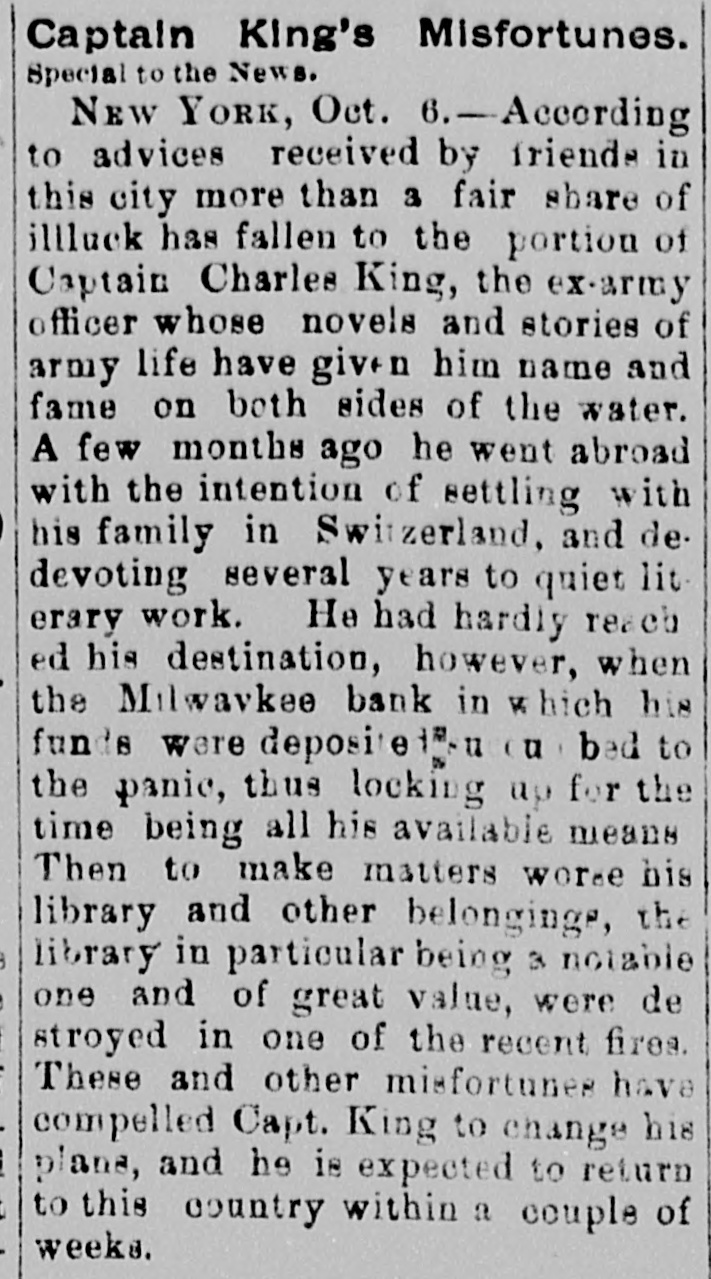
Captain King's Misfortunes. Special to the News. NEW YORK, Oct. 6.-According to advices received by friends in this city more than a fair share of illluck has fallen to the portion of Captain Charles King, the ex-army officer whose novels and stories of army life have given him name and fame on both sides of the water. A few months ago he went abroad with the intention of settling with his family in Switzerland, and dedevoting several years to quiet lit. erary work. He had hardly reach ed his destination, however, when the Milwavkee bank in which his funds were deposited used bed to the panic, thus locking up for the time being all his available means Then to make matters worse his library and other belongings, the library in particular being 3 notable one and of great value, were de stroyed in one of the recent fires. These and other misfortunes have compelled Capt. King to change his plans, and he is expected to return to this country within a couple of weeks.


Article from Abilene Weekly Reflector, October 12, 1893

Click image to open full size in new tab

Article Text

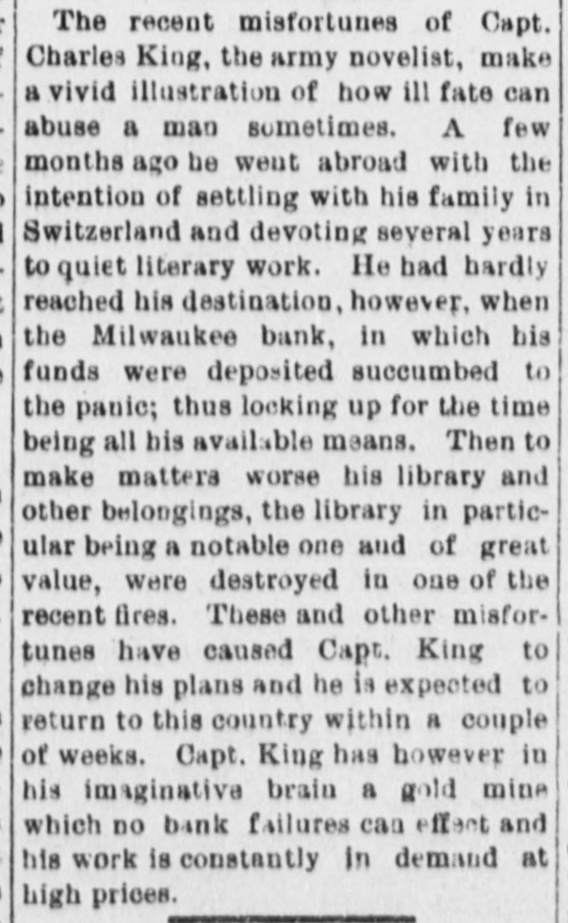
The recent misfortunes of Capt. Charles King, the army novelist, make a vivid illustration of how ill fate can abuse a man sometimes. A few months ago he went abroad with the intention of settling with his family in Switzerland and devoting several years to quiet literary work. He had hardly reached his destination, however, when the Milwaukee bank, in which his funds were deposited succumbed to the panic; thus locking up for the time being all his available means. Then to make matters worse his library and other belongings, the library in particular being a notable one and of great value, were destroyed in one of the recent fires. These and other misfortunes have caused Capt. King to change his plans and he is expected to return to this country within a couple of weeks. Capt. King has however in his imaginative brain a gold mine which no bank failures can effect and his work is constantly in demand at high prices.


Article from Custer Weekly Chronicle, October 14, 1893

Click image to open full size in new tab

Article Text

CAPTAIN KING'S BAD LUCK. The Ex-Army Officer and Novelist in Hard Lines. NEW YORK, Oct. 7.-According to advices received by friends in this city more than a fair share of ill luck has fallen to the portion of Captain Charles King, the ex-army officer, whose novels and stories of army life have given him name and fame on both sides of the water. A few months ago he went abroad with the intention of settling with his family in Switzerland, and devoting several years to quiet literary work. He had hardly reached his destination, however, when the Milwaukee bank in which his funds were deposited succumbed to the panic, thus locking up for the time being all his available means. Then to make matters worse his library and other belongings, the library in particular being a notable one and of great value, were destroyed in one of the recent fires. These and other misfortunes have compelled Captain King to change his plans and he is expected to return to this country within a couple of weeks.