22643. Kenosha State Bank (Kenosha, WI)

Bank Information

Episode Type
Suspension → Closure
Bank Type
state
Start Date
April 7, 1903
Location
Kenosha, Wisconsin (42.585, -87.821)

Metadata

Model
gpt-5-mini
Short Digest
f541e0e0

Response Measures

None

Description

The Kenosha State Bank was closed by the State Bank Examiner in April 1903 (suspension by government examiners), a receiver was appointed, the court temporarily turned assets back to President F. S. Komp so he could pay depositors (April 23, 1903) and the bank paid out depositors, but ultimately remained defunct (fixtures sold and described as 'defunct' by March 1904). No run is described in the articles; the suspension was driven by government examiner action and alleged insolvency. Dates are taken from newspaper publication dates and article statements.

Events (5)

1. April 7, 1903 Suspension
Cause
Government Action
Cause Details
Closed by State Bank Examiner M. O. Bergh; examiners declared bank could not continue and investigated alleged insolvency.
Newspaper Excerpt
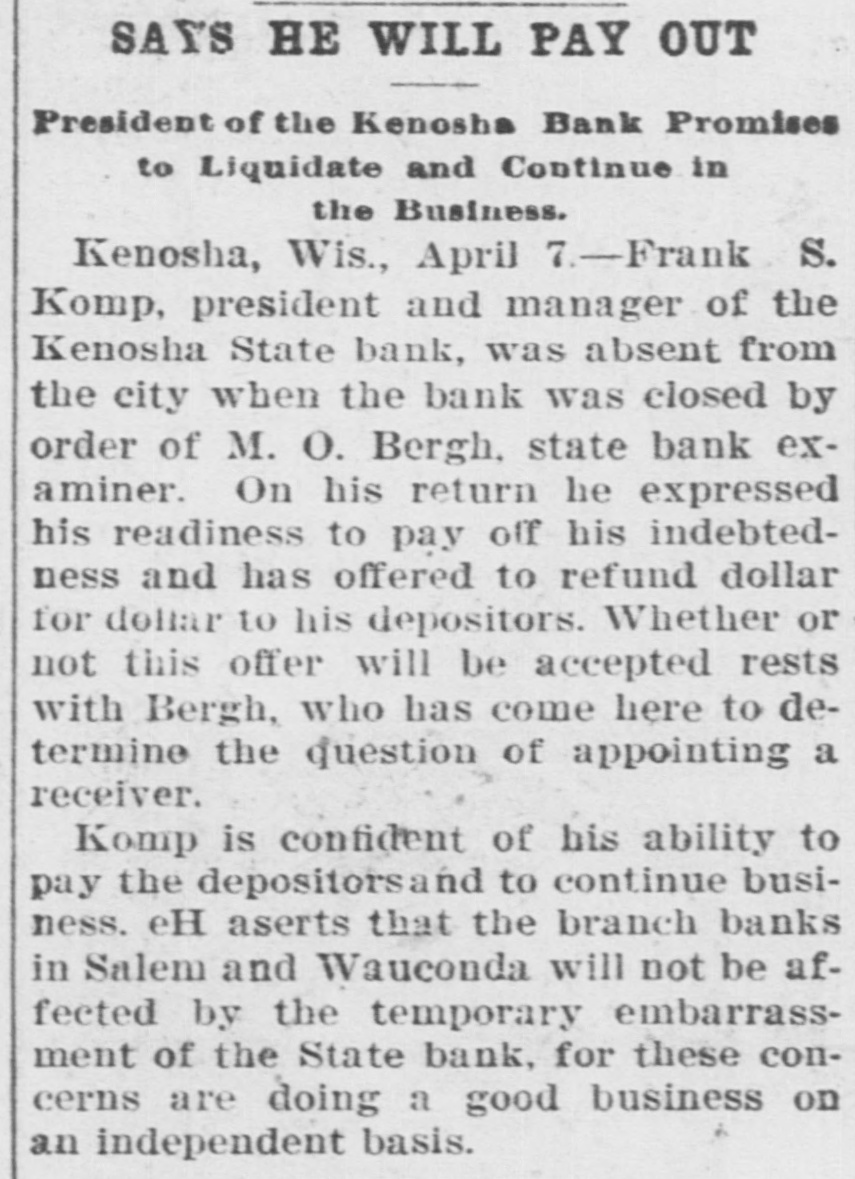
President of the Kenosha Bank Promises to Liquidate and Continue in the Business. ... was absent from the city when the bank was closed by order of M. O. Bergh, state bank examiner.
Source
newspapers
2. April 13, 1903 Receivership
Newspaper Excerpt
Judge Belden this afternoon appointed Henry F. Jordan receiver of the Kenosha State bank, which was recently closed by State Bank Examiner Bergh. Jordan furnished a $20,000 bond.
Source
newspapers
3. April 23, 1903 Reopening
Newspaper Excerpt
Judge Belden signed the order for the transfer of the property from the receiver to Mr. Komp ... the bank is now open for business. ... Komp presented a surety bond covering the entire amount of the deposits. Komp will begin the work of paying off all depositors to prove the solvency of the bank.
Source
newspapers
4. May 7, 1903 Other
Newspaper Excerpt
the Kenosha State Bank began to pay off creditors. ... There was nothing that could be considered a run during the morning hours. President Komp personally paid all accounts ... No move has been made to accept deposits and Mr. Komp has not announced his determination to re-open the bank when the depositors have been paid off.
Source
newspapers
5. March 10, 1904 Other
Newspaper Excerpt
LAST OF STATE BANK Fixtures of Defunct Institution are Being Shipped to Illinois This Afternoon. ... The last chapter in the history of the defunct Kenosha State bank is being written this afternoon, as the fixtures of the bank are being removed ...
Source
newspapers

Newspaper Articles (19)

Article from The Telegraph-Courier, August 28, 1902

Click image to open full size in new tab

Article Text

Sunday with sparents in Kenosha. Mr. and Mrs. Horlick, of Racin spent Sunday with friends in Kenosh Milton Pettit was home from R cine to spend Sunday with his pa ents. Mr. and Mrs. Walter Frost and ch dran spent Sunday afternoon at Zio City. Mrs. Frank Birbeck and daughte of Racine, spent Sunday with frien in Kenosha. John Scharding, Jr., of Chicag spent Sunday with his parents on tl Sand Ridge. Mr. and Mrs. Gerhard Buchmar spent Sunday with Chicago frien and relatives. Miss Amy Shearer returned hon Saturday from a vacation with rel tives in Salem. George G. Adams, and Miss Bel Giddings, of Franksville, spent Su day in Kenosha. Miss Helen Mayhew, of Milwauke spent Sunday with friends and rel tives in Kenosha. Mr. and Mrs. James Boatman, Chicago, spent Sunday afternoon wit friends in Kenosha. Grain throughout the county no being threshed averages from fifty sixty bushels per acre. Mr. and Mrs. Frank Carter went Chicago Sunday for a week's vis with friends and relatives. A large delegation of Kenosh rooters went to Racine Sunday afte noon to attend the ball game. Miss Grace Judd has resumed h work in the office of the Weekly Unio after a three weeks' vacation. Mr. and Mrs. Fred Hasse, of Bur ington, spent Sunday with friends Kenosha and Pleasant Prairie. Everything is moving quietly in tl political circles of the county, but CO siderable quiet work is being done. Michael Block, a ten year old Ken sha boy, was received into the Sta Reform school at Waukesha Monda The Kenosha State Bank has as y not secured a room, but the bank scheduled to open on next Tuesda morning. It is reported that Calvin Stewa will be a candidate for the Democrat nomination for the office of District Attorney. The present holders of county office may be a little shy but their friend have announced that they will all see re-election. Mr. and Mrs. William F. Fishe who have been visiting their son a Lusk, Wyoming, returned home Sa urday evening. The Main street ferry boat di a thriving business Sunday. Th novelty seems to be a drawing card i favor of the ferry. Miss Grace Duffee, who has bee visiting Miss Mae Bennett the pas few weeks, returned to her home i Chicago Saturday evening. Judge Horton, who recently left K nosha for his home in Topeka, Kan reached home safely and it is state that his health is improving. A number of Chicago yachtsme visited Kenosha Saturday evening an an effort is being made to arrange f a club run to this city in September. Mrs. Ira Larrabee and children hav returned to their home in Beloit after a two weeks' visit with Mr. and Mr Conrad Hansis and Mrs. E. Larrabe "For Home and Honor" drew large crowd to the Rhode opera hous Sunday evening. The play was we produced and gave general satisfa tion. The proposition to hold a street fa in Kenosha seems to have struck sympathetic chord among the busine: men and the idea is gaining friend daily. The funeral of the late Mrs. Anr Jensen was held on Sunday afternoo from the Danish Methodist churcl The remains were interred in the cit cemetery. There seems to be a lot of kickin on the new Main street ferry boa The ferry may be a novelty all rigl but it is a nuisance to the busy bus ness man.


Article from The Telegraph-Courier, September 18, 1902

Click image to open full size in new tab

Article Text

CASTORIA The Kind You Have Always Boughi Bears the Signature of Change your diet-eat Kennard's pure choice candies. Try Ping Pan chocolate and Mexico's. Something new. We sell over half the candy so] in Kenosha. This is why we keep the tf largest and finest assortment. Two car loads of coal came into Kenosha Thursday on a private order. The price for the coal is said to have been $11.75 a ton. Notwithstanding this fact coal is being sold in Kenosha for $8 per ton. Prof. Hammill, of the city schools, has decided to have a number of practical talks for the students during the coming year. This promises to be a very interesting feature of the school work during the year. On next Friday afternoon Secretary John Adams, of the Y. M. C. A., will give a talk before the High school pupils on his recent trip through Colorado. The talk will be illustrated with pictures taken during the trip. The public is invited to attend the lecture. Prof. Gruno, of the University of Chicago, made a very interesting address before the teachers and pupils of the German department of the High school Thursday afternoon, speaking especially of the life of Storm, the German writer. The lecture was greatly enjoyed by the students. Barry Bros. Transportation Company has added another boat to the fleet, purchase having been made last week of the freight steamer Gordon Campbell, at Buffalo. It is reported that the boat will be converted into a passenger steamer for use in the northern run next season. W.V. Cull, of Salem, was calling on friends in Kenosha Thursday. Mr. Cull had for display a sample of winter wheat raised on his farm which is probably the finest wheat raised in Kenosha in many years. The wheat graded sixty pounds to the bushel and the yield was forty bushels to the acre. The work on the new vault for the Kenosha State Bank is progressing very rapidly. The foundation for the new vault is being set six feet below the surface of the floor. The vault will be constructed according to the latest designs and will be both fire and burglar proof. The new bank will open about September 20. State Superintendent Harvey has favored Kenosha again. and every teacher in the city has been presented with one of the new State library lists. These lists were issued by the State superintendent and are considered the best lists ever sent out from the department. The lists will prove of great value to the teachers of Kenosha. Dr. D. C. John, Presiding Elder of the Milwaukee district of the Methodist church, made his final report of his work to the conference at Milwaukee Thursday, and at the close of the report the ministers of the district presented him with a purse as a token of the high esteem in which he is held in the district. Dr. John will probably be assigned to one of the churches in Milwaukee for the coming year. Recent orders from the postoffice department, to take effect Oct. 1, provide that all patrons of the rural free delivery must by that date provide themselues with mail boxes of one of the numerous patterns having the approval of the department. Boxes must be so placed by the roadside that the carriers can have convenient access to them without leaving their wagons and the same box must not be used for more than one family, unless they are near relatives or live in the same house.


Article from Rock Island Argus, April 7, 1903

Click image to open full size in new tab

Article Text

SAYS HE WILL PAY OUT President of the Kenosha Bank Promises to Liquidate and Continue in the Business. Kenosha, Wis., April 7.-Frank S. Komp, president and manager of the Kenosha State bank, was absent from the city when the bank was closed by order of M. O. Bergh, state bank examiner. On his return he expressed his readiness to pay off his indebtedness and has offered to refund dollar for dollar to his depositors. Whether or not this offer will be accepted rests with Bergh, who has come here to determine the question of appointing a receiver. Komp is confident of his ability to pay the depositorsand to continue business. eH aserts that the branch banks in Salem and Wauconda will not be affeeted by the temporary embarrassment of the State bank, for these concerns are doing a good business on an independent basis.


Article from The Telegraph-Courier, April 9, 1903

Click image to open full size in new tab

Article Text

Kenosha State Bank Fails to Open t pay Depositors as had Been Expected This Morning. KOMP CLAIMS SOLVENCY FOR IT States Attorney General Comes to Kenosh to Take Charge of the Case. Receiver to be Appointed Tomorrow. The Kenosha State Bank is stil closed, ane notwithstanding the state ment given out on Sunday that the bank was perfectly solvent and would pay depositors dollar for dollar, the ex aminers declare that when the bank opens again it will be opened in the hands of a receiver named by the courts. The settlement of the affairs of the institution will be taken up before a court commissioner late this afternoon The complaint for the closing of the bank has been made out by State At torney Sturdevant, of Madison, and h will arrive on the 4:42 train this even ing and make the formal complaint in the matter. During the day Assistan Examiner Knott has been in the city and has had charge of the bank prop erty. The complaint will be made in the local courts in order to give Mr Komp and his associates in business every possible chance Oto make good their promises as bankers and to allow the depositors to realize on their de posits with the least possible expense President Komp returned to the city on Saturday evening and was closeted with the bank examiner for severa hours. At this interview efforts were made to make some arrangements by which the bank could resume busines by the payment of the depositors, bu this plan was not in accordance with the State law, and the examiners hav demanded that the capital stock of th institution be made good before th bank is again opened to secure th funds of the public. President Komp was in Chicago 01 Sunday and this morning it was im possible for any statement to be se cured from him. In the meantime th depositors have called at the bank in a steady line and all have Ibeen given the same answer "The bank is in th hands of the State Examiners." Sat urday evening hope of payment in ful was held out to the depositors by As sistant Cashier Melville, but at the re quest of the examiners he finally re fused to make any statement to the de positors who called to secure thei funds. The investigations of the examiner seem to indicate that President Kom was the only man who knew anything of the affairs of the bank and Cashie Maloney and Assistant Cashier Mel ville knew little or nothing of wha was going on in the inner circles. The Kenosha Trust company seem to have largely furnished capital fo the bank and for the allied companie which had been established by Mr Komp in the last few months. Among these institutions were the Bank o Salem, the Komp Investment company the Bank of Wauconda, Ill., and o other days the firm of F. S. Komp 8 Co., bankers of Chicago. These companies figured largely in the business of Mr. Komp in Kenosha and furnished abundant stocks to pro vide capital for the different com panies. The statement of the ex aminer is being completed and it show that the capital of the bank is not only wiped out, but that there will be :


Article from Watertown Republican, April 11, 1903

Click image to open full size in new tab

Article Text

Brig. Gen. Leonard Wood is to be made a major general next fall and assigned to command in the Philippines. Southern Indiana was swept by a tornado; a schoolhouse near Washington collapsed and injured several pupils; a church and farm houses were damaged, and Oscar Cummins and his daughter were killed near Alexandria. There were 173 business failures in the United States during the seven days ended on the 3d, against 220 the same week in 1902. A new world's record in firing 13inch guns was set by the battleship Indiana's crew off Pensacola, Fla.. 14 out of 16 shots being scored at a fivemile range. G. Hallman Sims, collection clerk for the Capital City national bank in Atlanta, Ga., is charged with embezzling $94,000. The Wabash Railroad company and its employes have adjusted their differences and there will be no strike. B. F. Brown, of Redlands, Cal., who was arrested for making threats against President McKinley's life, has again been put in prison, having threatened injury to President Roosevelt. Illinois Central and Alton trainmen and conductors will ask for the adoption of the Wabash scale of wages, which gives 15 per cent. increase for freight and 12 per cent. increase for passenger service. Four members of the Philadelphia school board were found guilty of receiving bribes from women. United States marines were landed a second time at Santo Domingo from the cruiser Atlanta, the city being in possession of rebels and the consulate endangered. A plan to instruct all American public school children in scientific farming is being considered by Secretary Wilson. The entire business section of Dunsmuir, Cal., was destroyed by fire. Mrs. Margaret E. Armour, widow of S. B. Armour, has given $40,000 to the Woman's Christian association at Kansas City, Mo. Robbers at Ulysses, Pa., dynamited a safe in the Rowley private bank and seeured $1,000. Alfred A. Knapp pleaded not guilty at Hamilton, O., to the indictment charging him with the murder of his wife. Hannah G. Knapp, to whose murder, with five others, he had confessed. The Kenosha (Wis.) State bank closed its doors, with liabilities of $20.000. The Aultman-Miller company. manufacturers of agricultural implements in Cleveland, 0.. failed for $1,800,000. Terry McGovern and Benny Yanger are matched to fight in May or June. The president's wife and children returned to Washington after a cruise down the Potomac river. James S. Harlan, formerly attorney general of Porto Rico, says that the islanders are remarkably prosperous and are rapidly ado ting Am erican ideas and the English language.


Article from The Saint Paul Globe, April 14, 1903

Click image to open full size in new tab

Article Text

Appointed Bank Receiver. KENOSHA, Wis., April 13.-Judge Belden this afternoon appointed Henry F. Jordan receiver of the Kenosha State bank, which was recently closed by State Bank Examiner Bergh. Jordan furnished a $20,000 bond.


Article from The Telegraph-Courier, April 16, 1903

Click image to open full size in new tab

Article Text

TO OUST THE RECEIVER. Appointment of Henry F. Jordan Not Satisfactory to Bank's President. If reports heard in legal circles can be relied upon there will be interesting developments in the Kenosha State bank failure. The appointment of Henry F. Jordan as Receiver by Judge Belden yesterday, was not satisfactory to the bank President, who with his attorneys insists the bank is solvent, and that there are sufficient assets to pay all of the depositors. If the President can secure a sufficient bond, it is said that he will commence mandamus proceedings for the removal of the Receiver and proceed to settle with the depositors. The Bank Examiner declares that the condition of the bank is not such as to permit it continuing and believes that the affairs should be wound up.-Racine Journal.


Article from Watertown Republican, April 18, 1903

Click image to open full size in new tab

Article Text

LATER. Postmaster General Payne on his return to Washington announced that scandals in the postal department would be thoroughly investigated and all guilty persons punished. Mrs. Katherine Barrett, aged 116 years, the oldest person in Iowa, died at her home near Waterloo. County Commissioner Raymond and wife were drowned while crossing Blue Lick creek near Henryville, Ind. A cloudburst north of Portland, Ind., inundated the town. Capt. Nat Herreshoff's latest creation, the prospective cup defender, Reliance, has been launched at Bristol, R. I. Judge Belden has appointed Henry F. Jordan receiver of the Kenosha (Wis.) state bank, which was recently closed. After a quarrel with her husband over a bonnet, Mrs. Clarence Bishop. a 17-year-old bride at Port Jarvis, N. Y., drowned herself. Mrs. Catharine Danz and George Hossey, a negro herb "doctor" at Philadelphia, have been held responsible for the death of the woman's husband. Inclement weather caused abandonment of the usual Easter egg-rolling festivities at the white house in Washington. A move for a national nonunion plan has been given a start at Indianapolis by the incorporation of the American Association of Independent Mechanics. Charles Barron, chief engineer of the Graham & Morton line of Chicago, has resigned afted 60 years of service on the great lakes. Mrs. Mary Roll died in Minneapolis, aged 102 years. She was the first white woman born in Dayton, O. Abner Taylor, former member of congress from the First Illinois district, died at his home in Washington, aged 74 years. Brig, Gen. Frank K. Baldwin has taken charge of the department of the Colorado, succeeding Gen. Frederick Funston. Five men were killed by an explosion in a mine at Carbon, I. T. The warship Reina Christina, flagship of Admiral Montejo, sunk by Admiral Dewey in Manila bay, has been floated, and the skeletons of about 80 of her crew were found. Grover Cleveland, speaking with Booker T. Washington at a New York meeting, says the negro problem rests upon the whole nation, and praisesthe work done for blacks by the south. Albert West, a negro, was hanged at Media, Pa., for the murder of Mart W. Allen, a policeman of Chester. President David M. Parry, of the National Manufacturers' association, in session at New Orleans, in his annual address scored labor organizations. During a severe northeast gale the scow Hughes capsized in the Delaware river off Marcus Hook, Pa., and four men were drowned. President Palma, of Cuba, has called a conference at which he will explain the United States' new proposition for a permanent treaty. Ten persons were killed, many injured and numerous barns, residences, fences and outhouses were swept away by a cyclone in Monroe county, Ala. Ten handsomely bound volumes containing messages of all the presidents have been sent to the pope as a jubilee gift by President Roosevelt. Department of agriculture officials say the pink complexion taken on by subjects of pure food experiments are not due to chemicals, but to elimination of impurities from blood. Moro fortifications near Bacolod have been shelled and many Filipinos killed by 600 American troops under Capt. Pershing. Ex-Congressman Benoni F. Fuller, aged 77 years, died suddenly at Boonville, Ind. Dr. Chauncey Ayers, aged 95 years, died at Stamford, Conn. He was the oldest graduate. of the Yale medical school. J. J. Davis, who founded the Manhattan (Kan.) Mercury in 1884, died on a train while returning home from New Orleans. The Southern Association of Newspaper Publishers has been organized at Atlanta, Ga. President Roosevelt is enjoying his outing in Yellowstone park and is in the best of health. The boiler of a mill at Ruby, O., exploded, killing Charles Bevans, Richard Houck, Rufus Houck and two boys. A heavy snowstorm prevailed throughout central Wisconsin.


Article from Grant County Herald, April 23, 1903

Click image to open full size in new tab

Article Text

The News Condensed. The right of way for the proposed belt line between Chicago and Kenosha has now been secured and work on the line will be pushed. As a result of the lack of interest the State Baseball league has been abandoned. Milwaukee milling companies have increased the wages of the 1,000 mill workers on an average of one dollar a week. Dr. W. R. Hopkins, of Cumberland, is making arrangements to open a consumption sanitarium on the shores of Lake Nebagamon. The Lake Vista Hotel block at Williams Bay was burned, resulting in damage of $30,000, on which there is little insurance. Thomas Phillips pleaded guilty to breaking into a boat house at Racine and stealing a $300 yacht and was sent to prison for three years. The date for commencement at Carroll college at Waukesha has been set for June 26. Judge Belden has appointed Henry F. Jordan receiver of the Kenosha state bank, which was recently closed by State Bank Examiner Bergh. D. W. W. Walker's drug store at Marinette was robbed of $150 by burglars who climbed through the transom. Ed Jones was killed while driving a bus from the depot at Athens by falling. He fell from uis seat, breaking his neck. Thomas Maham, of La Grange, aged 48 years, fell down stairs, receiving internal injuries from which he died.


Article from The Telegraph-Courier, April 23, 1903

Click image to open full size in new tab

Article Text

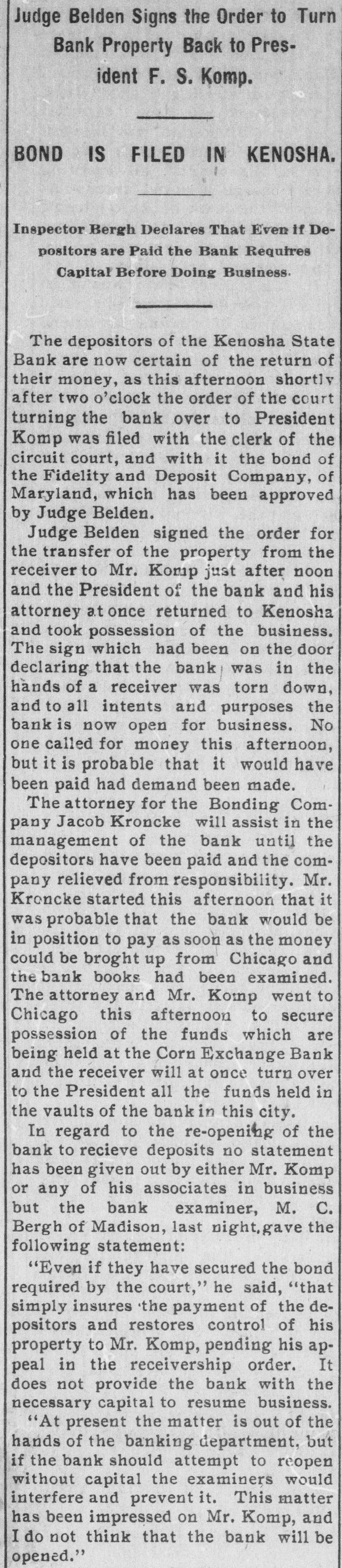
Judge Belden Signs the Order to Turn Bank Property Back to President F. S. Komp. BOND IS FILED IN KENOSHA. Inspector Bergh Declares That Even if Depositors are Paid the Bank Requires Capital Before Doing Business. The depositors of the Kenosha State Bank are now certain of the return of their money, as this afternoon shortly after two o'clock the order of the court turning the bank over to President Komp was filed with the clerk of the circuit court, and with it the bond of the Fidelity and Deposit Company, of Maryland, which has been approved by Judge Belden. Judge Belden signed the order for the transfer of the property from the receiver to Mr. Komp just after noon and the President of the bank and his attorney at once returned to Kenosha and took possession of the business. The sign which had been on the door declaring that the bank was in the hands of a receiver was torn down, and to all intents and purposes the bank is now open for business. No one called for money this afternoon, but it is probable that it would have been paid had demand been made. The attorney for the Bonding Company Jacob Kroncke will assist in the management of the bank until the depositors have been paid and the company relieved from responsibility. Mr. Kroncke started this afternoon that it was probable that the bank would be in position to pay as soon as the money could be broght up from Chicago and the bank books had been examined. The attorney and Mr. Komp went to Chicago this afternoon to secure possession of the funds which are being held at the Corn Exchange Bank and the receiver will at once turn over to the President all the funds held in the vaults of the bank in this city. In regard to the re-opening of the bank to recieve deposits no statement has been given out by either Mr. Komp or any of his associates in business but the bank examiner, M. C. Bergh of Madison, last night,gave the following statement: "Even if they have secured the bond required by the court," he said, "that simply insures the payment of the depositors and restores control of his property to Mr. Komp, pending his appeal in the receivership order. It does not provide the bank with the necessary capital to resume business. "At present the matter is out of the hands of the banking department, but if the bank should attempt to reopen without capital the examiners would interfere and prevent it. This matter has been impressed on Mr. Komp, and I do not think that the bank will be opened."


Article from The Telegraph-Courier, April 23, 1903

Click image to open full size in new tab

Article Text

Attorneys for the Kenosha State Bank Carry the Receivership to the Supreme Court of the State. DEPOSITORS TO BE PAID IN FULL President of the Bank Offers a Surety Bond of Twenty Thousand Dollars to Assure Payment of Creditors. Before the close of another week it is possible, and indeed probable, that Frank S. Komp will again be in charge of the Kenosha State bank pending a decision of the Supreme Court on the appointment of a Receiver. Cooper, Simmons, Nelson & Walker, of Racine, who represent Mr. Komp in the litigation, this morning forwarded to the attorneys in this city copies of the appeal from the decision of the Circuit Court, and the case will be taken to the Supreme Court at once. In the order, which has not as yet been signed by the Circuit Judge, but which will be signed if it is approved by the attorneys representing the depositors, the Court provides that pending the settlement of the receivership in the Supreme Court of the State, the moneys and books of the bank shall be turned over to the former officials, and that they be allowed to settle with the creditors in person. The Receiver will then take no part in any further action that the bank may do. The order provides that before the property is turned over to Mr. Komp and his associates, pending the appeal, the latter shall furnish a surety bond signed by two sureties or by a surety company, subject to the approval of the Judge. The bond will be given to assure the Court that all creditors will be paid on demand, or on such, notice as their claims against the bank allow. This bond has been prepared and the surety named is the Fidelity and Deposit company of Maryland. This is the company which bonded Mr. Komp as treasurer of the Modern Woodmen Camp, and it is claimed that he has convinced the company of his sovlency. Should this bond be secured one of the strongest companies in the country would be backing the bank, and there would be no doubt but that every cent of indebtedness would be paid. This arrangement may be perfected yet during the present week, and in such event the depositors will be paid off as fast as they make demand for their money. It will then be possible for Mr. Komp to elect whether he will close up the business or continue the bank. The order has been received with favor by the attorneys for the depositors, and they will undoubtedly send the Judge an approval of the order this afternoon. Mr. Komp was at the bank this morning, and it is said that he will begin the work of paying off depositors as soon as the order is signed. In the meantime a legal fight is on between the Receiver for the Kenosha bank and the Receiver for the Wauconda bank, both claiming funds deposited by President Komp in the Corn Exchange Bank in Chicago. The Wauconda people are the first to act, and they have asked the courts to issue an injunction to prevent the money being paid to the Receiver of the State bank. The cashier of the Chicago institution states that the Wauconda bank had no account in the Corn Exchange, and for this reason it appears certain that the money will finally be awarded to the Kenosha bank.


Article from Rock Island Argus, April 24, 1903

Click image to open full size in new tab

Article Text

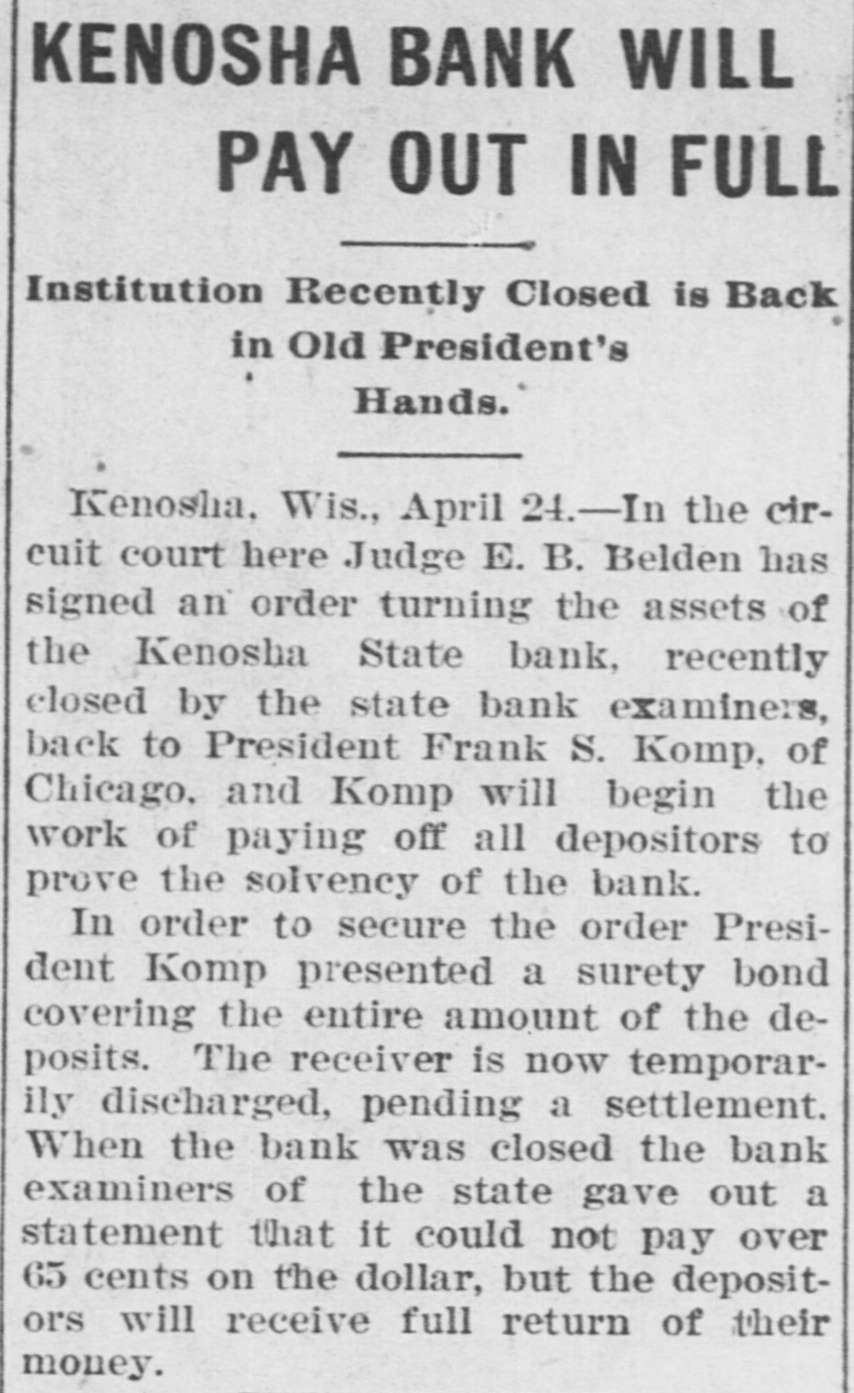
KENOSHA BANK WILL PAY OUT IN FULL Institution Recently Closed is Back in Old President's Hands. Kenosha, Wis., April 24.-In the circuit court here Judge E. B. Belden has signed an order turning the assets of the Kenosha State bank, recently closed by the state bank examiners, back to President Frank S. Komp, of Chicago, and Komp will begin the work of paying off all depositors to prove the solvency of the bank. In order to secure the order President Komp presented a surety bond covering the entire amount of the deposits. The receiver is now temporarily discharged, pending a settlement. When the bank was closed the bank examiners of the state gave out a statement that it could not pay over 65 cents on the dollar, but the depositors will receive full return of their money.


Article from Watertown Republican, April 25, 1903

Click image to open full size in new tab

Article Text

The News Condensed. The right of way for the proposed belt line between Chicago and Kenosha has now been secured and work on the line will be pushed. As a result of the lack of interest the State Baseball league has been abandoned. Milwaukee milling companies have increased the wages of the 1,000 millworkers on an average of one dollar a week. Dr. W. R. Hopkins, of Cumberland, is making arrangements to open a consumption sanitarium on the shores of Lake Nebagamon. The Lake Vista Hotel block at Williams Bay was burned, resulting in damage of $30,000, on which there is little insurance. Thomas Phillips pleaded guilty to breaking into a boat house at Racine and stealing a $300 yacht and was sent to prison for three years. The date for commencement at Carroll college at Waukesha has been set for June 26. Judge Belden has appointed Henry F. Jordan receiver of the Kenosha state bank, which was recently closed by State Bank Examiner Bergh. D. W. W. Walker's drug store at Marinette was robbed of $150 by burglars who climbed through the transom. Ed Jones was killed while driving a bus from the depot at Athens by falling. He fell from is seat, break ing his neck. Thomas Maham, of La Grange, aged 48 years, fell down stairs, receiving internal injuries from which he died.


Article from The Telegraph-Courier, April 30, 1903

Click image to open full size in new tab

Article Text

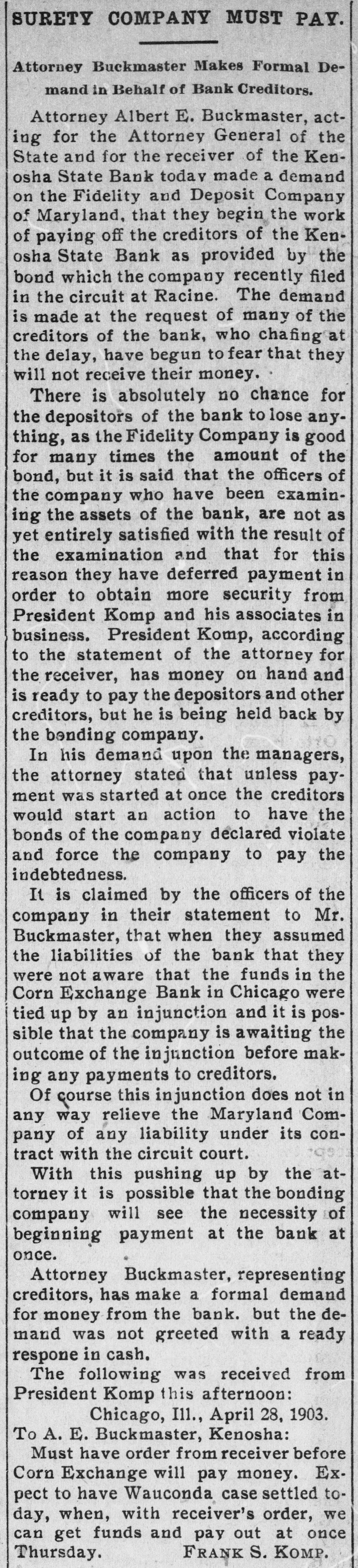
SURETY COMPANY MUST PAV. Attorney Buckmaster Makes Formal Demand in Behalf of Bank Creditors. Attorney Albert E. Buckmaster, acting for the Attorney General of the State and for the receiver of the Kenosha State Bank todav made a demand on the Fidelity and Deposit Company of Maryland, that they begin the work of paying off the creditors of the Kenosha State Bank as provided by the bond which the company recently filed in the circuit at Racine. The demand is made at the request of many of the creditors of the bank, who chafing at the delay, have begun to fear that they will not receive their money. There is absolutely no chance for the depositors of the bank to lose anything, as the Fidelity Company is good for many times the amount of the bond, but it is said that the officers of the company who have been examining the assets of the bank, are not as yet entirely satisfied with the result of the examination and that for this reason they have deferred payment in order to obtain more security from President Komp and his associates in business. President Komp, according to the statement of the attorney for the receiver, has money on hand and is ready to pay the depositors and other creditors, but he is being held back by the bending company. In his demand upon the managers, the attorney stated that unless payment was started at once the creditors would start an action to have the bonds of the company declared violate and force the company to pay the indebtedness. It is claimed by the officers of the company in their statement to Mr. Buckmaster, that when they assumed the liabilities of the bank that they were not aware that the funds in the Corn Exchange Bank in Chicago were tied up by an injunction and it is possible that the company is awaiting the outcome of the injunction before making any payments to creditors. Of course this injunction does not in any way relieve the Maryland Company of any liability under its contract with the circuit court. With this pushing up by the attorney it is possible that the bonding company will see the necessity of beginning payment at the bank at once. Attorney Buckmaster, representing creditors, has make a formal demand for money from the bank. but the demand was not greeted with a ready respone in cash. The following was received from President Komp this afternoon: Chicago, Ill., April 28, 1903. To A. E. Buckmaster, Kenosha: Must have order from receiver before Corn Exchange will pay money. Expect to have Wauconda case settled today, when, with receiver's order, we can get funds and pay out at once FRANK S. KOMP. Thursday.


Article from The Telegraph-Courier, May 7, 1903

Click image to open full size in new tab

Article Text

President of the Kenosha State Bank Personally Looks After the Settlement of Checking Accounts. SAVINGS ACCOUNTS MUST WAIT. Bank Will Claim the Time Limit on Sav Ings Accounts and Certificates of Deposit-Lots of Money in Sightat Bank. "I got mine" is the favorite song down around the bank cornenthis morn ing as the Kenosha State Bank began to pay off creditors. There was little rush abont the bank but the window was kept pretty busy cashing the checks of the former depositors. All arrangements for making the payments were made on Saturday evening and when the bank opened at the regular hour this morning the paying out started. There was a look of opulence about the bank. The money racks were well filled with silver and the money drawer was simply over crowded with the large stock of good green backs. More than three thousand dollars had been placed on the counter to provide for the demands of the day and from the way the depositors were arriving it is probable that every cent of it will be needed. At nine o'clock President F. S. Komp personally appeared at the window of the paying teller and the settlement of accounts started. Former Receiver Henry Jordan was the first man to appear at the window and he was closely followed by O. M. Calkins. As soon as these men had been paid the line became a steady one and seven and eight people were waiting at a time. There was lots of good natured bantering but there was nothing that could be considered a run during the morning hours. President Komp personally paid all accounts and took re ceipts in full for the amounts. All the time Special Agent Bowen of the Deposit and Fidelity Company kept a close tab on the paying out of the money. Only checking accounts were recognized for payment and it appears that the bank will claim the right to withhold payments on savings accounts for the period of thirty daysas allowed in the contract with depositors. No official announcement has been made in regard to these accounts but several of the depositors of savings called and were notified that they could get their money on giving due notice of their desire to withdraw the accounts. Cashier Frank T. Maloney was not in the bank during the day and it is said that he has accepted another place in Chicago. No move has been made to accept deposits and Mr. Komp has not announced his determination to re-open the bank when the depositors have been paid off. The paying off of the depositors will be continued as rapidly as possible and it is expected that all will be paid within the present week. The payments have been made free1y and there has been no quibble in regard to amounts. The bank simply insisted on the balancing of the ac counts and as fast as Teller Melville completed this work the money was paid out. It is learned from inside information that the bank still has considerable money on deposit in the Corn Exchange Bank and this is probably being held back to pay the savings accounts when they fall due. Of course all classes of accounts are fully protected by the bond filed by President Komp in the circuit court and it is only a matter of time until all will be paid.


Article from River Falls Journal, May 14, 1903

Click image to open full size in new tab

Article Text

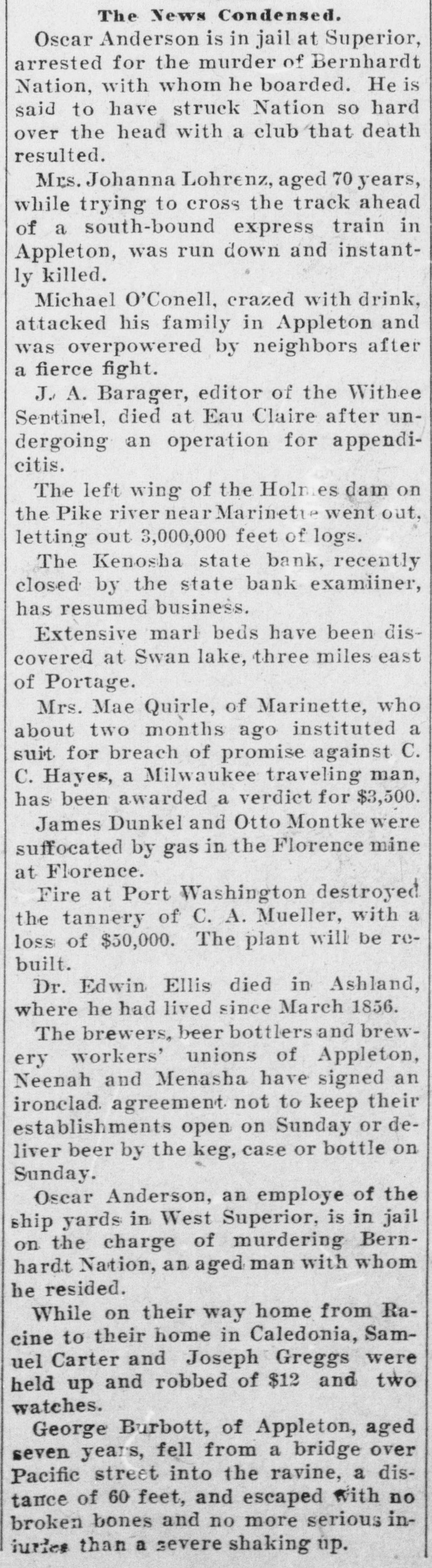
The News Condensed. Oscar Anderson is in jail at Superior, arrested for the murder of Bernhardt Nation, with whom he boarded. He is said to have struck Nation so hard over the head with a club that death resulted. Mrs. Johanna Lohrenz, aged 70 years, while trying to cross the track ahead of a south-bound express train in Appleton, was run down and instantly killed. Michael O'Conell, crazed with drink, attacked his family in Appleton and was overpowered by neighbors after a fierce fight. J. A. Barager, editor of the Withee Sentinel, died at Eau Claire after undergoing an operation for appendicitis. The left wing of the Holn es dam on the Pike river near Marinetu went out, letting out 3,000,000 feet of logs. The Kenosha state bank, recently closed by the state bank examiiner, has resumed business. Extensive marl beds have been discovered at Swan lake, three miles east of Portage. Mrs. Mae Quirle, of Marinette, who about two months ago instituted a suit for breach of promise against C. C. Hayes, a Milwaukee traveling man, has been awarded a verdict for $3,500. James Dunkel and Otto Montke were suffocated by gas in the Florence mine at Florence. Fire at Port Washington destroyed the tannery of C. A. Mueller, with a loss of $50,000. The plant will be rebuilt. Dr. Edwin Ellis died in Ashland, where he had lived since March 1856. The brewers, beer bottlers and brewery workers' unions of Appleton, Neenah and Menasha have signed an ironclad. agreement not to keep their establishments open on Sunday or deliver beer by the keg, case or bottle on Sunday. Oscar Anderson, an employe of the ship yards in West Superior, is in jail on the charge of murdering Bernhardt Nation, an aged man with whom he resided. While on their way home from Racine to their home in Caledonia, Samuel Carter and Joseph Greggs were held up and robbed of $12 and two watches. George Burbott, of Appleton, aged seven years, fell from a bridge over Pacific street into the ravine, a distance of 60 feet, and escaped with no broken bones and no more serious injuries than a severe shaking up.


Article from Watertown Republican, May 16, 1903

Click image to open full size in new tab

Article Text

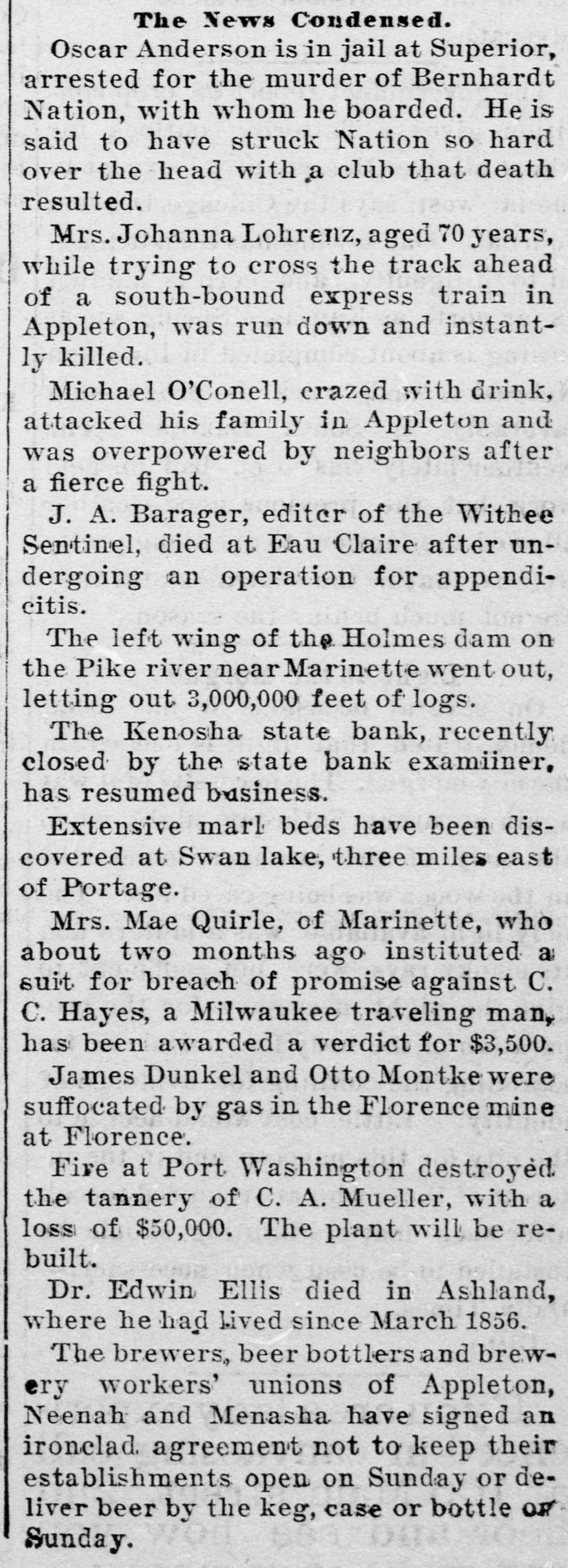
The News Condensed. Oscar Anderson is in jail at Superior, arrested for the murder of Bernhardt Nation, with whom he boarded. He is said to have struck Nation so hard over the head with a club that death resulted. Mrs. Johanna Lohrenz, aged 70 years, while trying to cross the track ahead of a south-bound express train in Appleton, was run down and instantly killed. Michael O'Conell, crazed with drink, attacked his family in Appleton and was overpowered by neighbors after a fierce fight. J. A. Barager, editer of the Withee Sentinel, died at Eau Claire after undergoing an operation for appendicitis. The left wing of the Holmes dam on the Pike river near Marinette went out, letting out 3,000,000 feet of logs. The Kenosha state bank, recently closed by the state bank examiiner, has resumed business. Extensive marl beds have been discovered at Swan lake, three miles east of Portage. Mrs. Mae Quirle, of Marinette, who about two months ago instituted a suit for breach of promise against C. C. Hayes, a Milwaukee traveling man, has been awarded a verdict for $3,500. James Dunkel and Otto Montke were suffocated by gas in the Florence mine at Florence. Fire at Port Washington destroyèd the tannery of C. A. Mueller, with a loss of $50,000. The plant will be rebuilt. Dr. Edwin Ellis died in Ashland, where he had Lived since March 1856. The brewers, beer bottlers and brewery workers' unions of Appleton, Neenah and Menasha have signed an ironclad. agreement not to keep their establishments open on Sunday or deliver beer by the keg, case or bottle OF Sunday.


Article from The Telegraph-Courier, March 10, 1904

Click image to open full size in new tab

Article Text

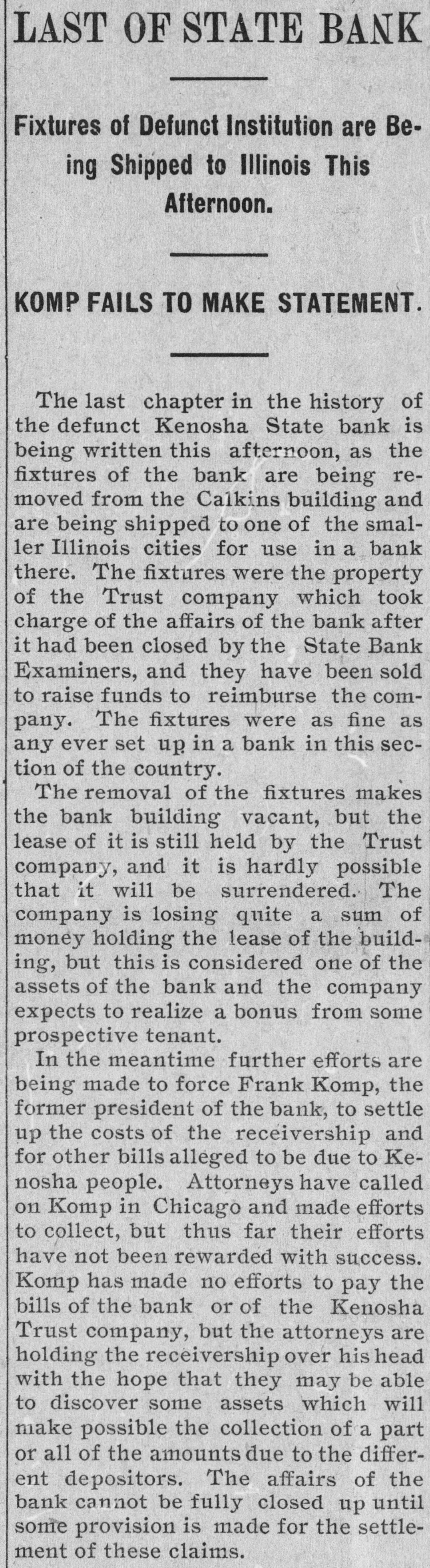
LAST OF STATE BANK Fixtures of Defunct Institution are Being Shipped to Illinois This Afternoon. KOMP FAILS TO MAKE STATEMENT. The last chapter in the history of the defunct Kenosha State bank is being written this afternoon, as the fixtures of the bank are being removed from the Calkins building and are being shipped to one of the smal1er Illinois cities for use in a bank there. The fixtures were the property of the Trust company which took charge of the affairs of the bank after it had been closed by the State Bank Examiners, and they have been sold to raise funds to reimburse the company. The fixtures were as fine as any ever set up in a bank in this section of the country. The removal of the fixtures makes the bank building vacant, but the lease of it is still held by the Trust company, and it is hardly possible that it will be surrendered. The company is losing quite a sum of money holding the lease of the building, but this is considered one of the assets of the bank and the company expects to realize a bonus from some prospective tenant. In the meantime further efforts are being made to force Frank Komp, the former president of the bank, to settle up the costs of the receivership and for other bills alleged to be due to Kenosha people. Attorneys have called on Komp in Chicago and made efforts to collect, but thus far their efforts have not been rewarded with success. Komp has made no efforts to pay the bills of the bank or of the Kenosha Trust company, but the attorneys are holding the receivership over his head with the hope that they may be able to discover some assets which will make possible the collection of a part or all of the amounts due to the different depositors. The affairs of the bank cannot be fully closed up until some provision is made for the settlement of these claims.


Article from The Telegraph-Courier, August 18, 1904

Click image to open full size in new tab

Article Text

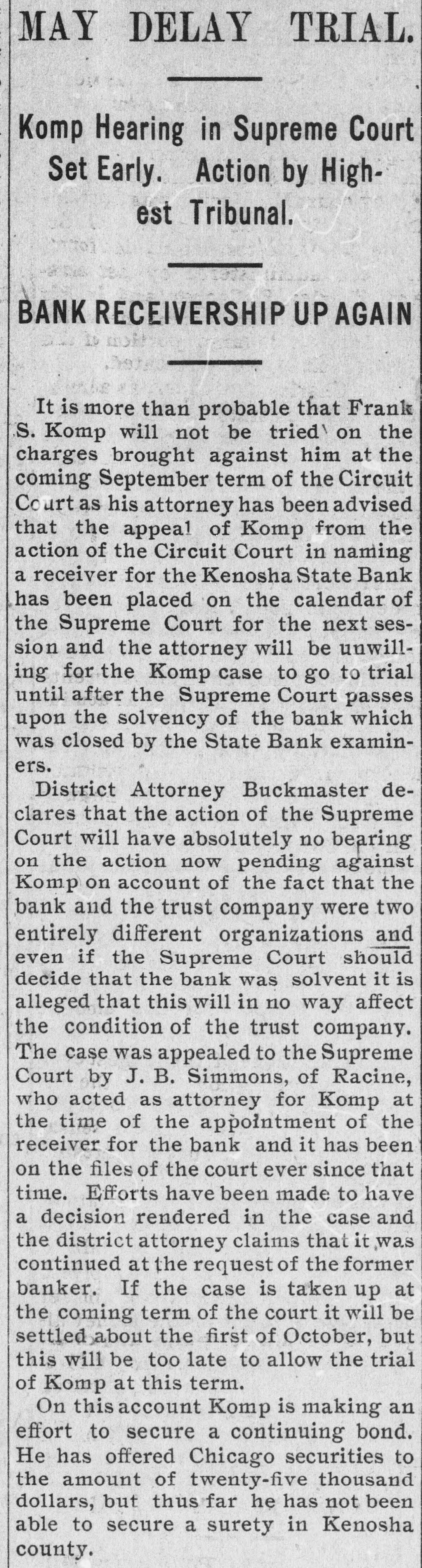
# MAY DELAY TRIAL. Komp Hearing in Supreme Court Set Early. Action by Highest Tribunal. # BANK RECEIVERSHIP UP AGAIN It is more than probable that Frank S. Komp will not be tried on the charges brought against him at the coming September term of the Circuit Court as his attorney has been advised that the appeal of Komp from the action of the Circuit Court in naming a receiver for the Kenosha State Bank has been placed on the calendar of the Supreme Court for the next session and the attorney will be unwilling for the Komp case to go to trial until after the Supreme Court passes upon the solvency of the bank which was closed by the State Bank examiners. District Attorney Buckmaster declares that the action of the Supreme Court will have absolutely no bearing on the action now pending against Komp on account of the fact that the bank and the trust company were two entirely different organizations and even if the Supreme Court should decide that the bank was solvent it is alleged that this will in no way affect the condition of the trust company. The case was appealed to the Supreme Court by J. B. Simmons, of Racine, who acted as attorney for Komp at the time of the appointment of the receiver for the bank and it has been on the files of the court ever since that time. Efforts have been made to have a decision rendered in the case and the district attorney claims that it was continued at the request of the former banker. If the case is taken up at the coming term of the court it will be settled about the first of October, but this will be too late to allow the trial of Komp at this term. On this account Komp is making an effort to secure a continuing bond. He has offered Chicago securities to the amount of twenty-five thousand dollars, but thus far he has not been able to secure a surety in Kenosha county.