Second National Bank (Chicago, IL)

Episode Information

Episode UID
22500885
Episode Type
Run β†’ Suspension β†’ Closure
Bank Type
national
Bank ID
2250 national
Charter Number
225
Start Date
September 22, 1873
Location
Chicago, Illinois (41.850, -87.650)

Metadata

Model
gpt-5-mini (chosen from majority vote of a three-model LLM ensemble)
Short Digest
81101ed0ef2cdcc9

Response Measures

Accommodated withdrawals, Partial suspension, Full suspension

Clearinghouse involved: Yes (loan, examination, or other measures)

Events (5)

1. February 1, 1864 Chartered
Source
historical_nic
2. September 22, 1873 Run
Cause
Macro News
Cause Details
Systemic financial panic originating from East (New York failures and collapse of financial houses) triggered heavy withdrawals in Chicago
Measures
Banks adhered to 30/60-day rule, paying only small sums (under $100) and limiting payments
Newspaper Excerpt
There is considerable of a run upon some of the banks here to-day ... they are adhering to the resolution ... to fall back on the thirty and sixty-day rule
Source
newspapers
3. September 25, 1873 Voluntary Liquidation
Source
historical_nic
4. September 26, 1873 Other
Newspaper Excerpt
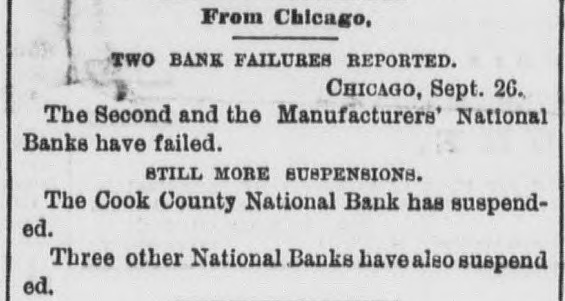
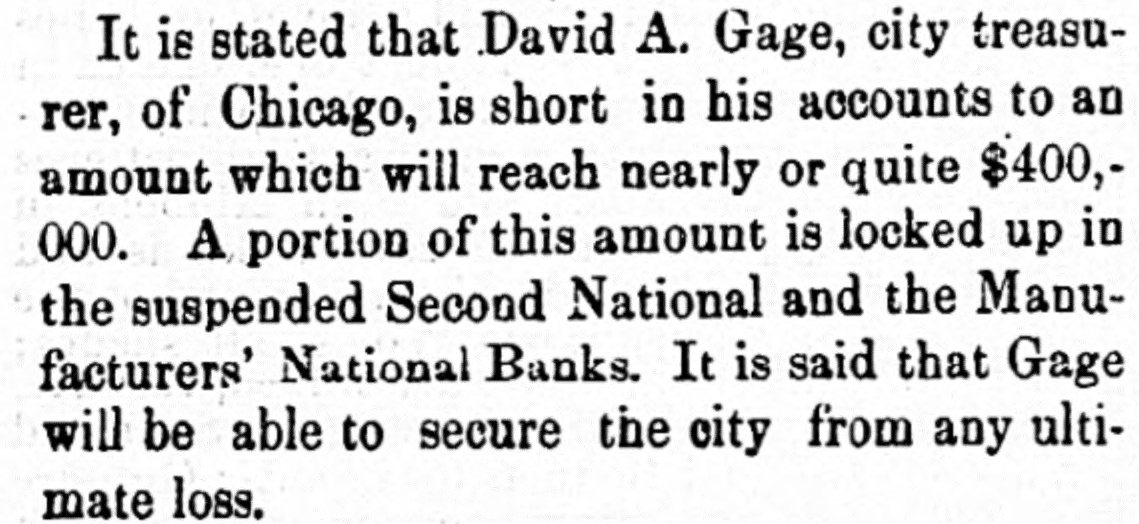
The Second and the Manufacturers' National Banks have failed. ... The Manufacturers' and Second National banks had decided to go into liquidation.
Source
newspapers
5. September 26, 1873 Suspension
Cause
Macro News
Cause Details
Lack of currency and nationwide financial panic prompted suspension of payments despite claimed adequate securities
Newspaper Excerpt
It is just announced that the Union National, Second National and Manufacturers' National Banks have suspended.
Source
newspapers

Newspaper Articles (25)

Article from The Wheeling Daily Intelligencer, October 18, 1871

Click image to open full size in new tab

Article Text

CHICAGO. by Lumber Attempted The Resumption.org Rebuilding the on Banks--The Work of attempt was Oct. 17.-An lumber dealers, lummade by a up the price but this yesterday, CHICAGO, to number carry per of thousand, larger of and at from $3 to $4 of the the was ber, was resisted respectable by many dealers, deteated. and Lumis selling at the old and filty millions tempted more ber extortion hundred prices. There the Italian sup- are of fully feet in two the continue yards in to this be abundant. city, and the will captured police have Peteri, who on keeper, week, in a Monday night stabbed two saloon ply The of Gregorio last saloon men on of to Buren street, at the Van He was found west of village this city. on death. about five miles dead bodies total held up inquests Of course Austin, which The number have been of when removed, to last the night, is ninety-two. burnt dietrict is debris in the be disovered. more will been made to-day the special removal of by many Aarrangements for the agent have of avenue the the Postoffice Church, PostDepartment the Wabash and Harrison office avenue for corner to Wabash will be occupied build that streets, and it the government Church can edifice purpose until building. This burned district, suitable the south line of the was considerably scorched, south is on division. but suffered It little or no of Trade injury inside. The directors this of morning, the Board for of the location. purhad a meeting settling the question it was deAfter to appoint a near the old cided a suitable lot, the Chamber pose to select of considerable and committee discussion on a rooms, Board tem- of of Trade rooms, and to erect thereon transaction of business. Sheridan to-day the porory their Commerce, General building, he for announces the issued contin- an There ad dress, peace in which and quiet violence of the city. since the disaster has uous been of Sunday no case night of and Monday morn- reing. The banks, national to-day. and The savings, calls settle- from sumed business were light for immediate to ascertain ment, as many what extent they depositors and to sought Many deposits could their or draw was no safely balance made. There hereafter. drafts on excitement the Savings were whatever. The and in many rush Bank were very light, made. There deposits were at the considerable many checks were confidence stances and excitement the thrown closing out. was the in- to hour, illustration of banks, we refer placed in Third public to-day's As an work: checked At the the out, and National, bank $72,000 pre$45,000 State dedeposited were rush, The but only Savings money, some forty the aghave gregate pared positors for of called a which for was their greatly exceeded been by deposits. contracts for building those who Many to-day. Among are William F. Wheeler, propose consummated to rebuild H. G. Powers, at once Armour, C.T. John Pot- B. Coolbaugh, George Walker, Mathew K. Drake, Boin Bros., of Drake Block, Laflin, J.C. C. H. Tuttle, Beck une ter Gregstin with, Palmer, Company, Edwin & Mackin, Hunt, &c. House Frederick Jas. The square H. entire Reese, from block Trib the on Court from Randolph streets, will Dr. Fowler, J. C. and John Drs. Union Depot land and street is to be east, by fronting Washington E. Goodell, Messrs. and others. of running Lake Charles Walker, The great be rebuilt scale. at at Quin- once once R. rebuilt at the toot and on a greatly were enlarged issued to-day thousand for A persons number leaving of passes the city. The number was The one action the of postoffice the postoflice on one-third authorities the South of the Side, in locating population where there surprise of the is less city and than and a good no gas, to deal have has of indignation, created great for the less accommodation regard seeming should of a mahad of the citizens than to-day, In number of of been jority lected. been. Brooklyn A various small $1,200 parts contributions was have New col- at from Committee State. telegraphed that in money ought to give Various New Chicago York are reported The $1,000,000 Boston England Massachusetts towns and for supplies. are reported $10,000 as a portion The registration for this the morning; election to-day Michigan. commenced registered 23,200. Germans November total was number of the leading for the purA meeting Hall to-night, element one pose held at of uniting the A German committee, was ap. organization. Apollo prominent Germans, Democ- includ. into ing many with the reform pointed racy for to the conter purpose of an alliance against


Article from The Daily State Journal, October 18, 1871

Click image to open full size in new tab

Article Text

# THE WRIT OF HABEAS CORPUS SUSPENDED IN SOUTH CAROLINA, &C. Washington, October 17.--The President to-day, after reciting the causes and quoting the laws under which he acts, issued a proclamation in which he suspends the writ of habeas corpus in Spartanburg, York, Marion, Chester, Laurens, Newberry, Fairfield, Lancaster, and Chesterfield counties, of South Carolina. The suspension extends to the arrest by the United States marshal, his deputies, any military officer of the United States, or any soldier or citizen acting under the orders of said marshal, deputy, or such military officer within said counties, of persons charged with any violation of the Ku-Klux act of Congress during the continuance of the "rebellion" in said counties. The Attorney-General has a dispatch from North Mississippi that five Ku-Klux with disguises complete have been captured. Seven hundred and fifty thousand dollars in revenue stamps were found safe in the government vault in Chicago. Secretary Boutwell has received the following dispatch from Chicago: "The Chicago banks are saved, and are paying every dollar on demand. A good feeling prevails. [Signed] H. R. Hurlbut, Comptroller of Currency." Mexican Affairs. Havana, October 17.-A steamer just arrived from Vera Cruz brings late dates from the Mexican capital. Juarez had been re-elected President by Congress, receiving 108 votes-all that were cast. The opposition abstained from voting. Everything was quiet in the city. The telegraph wire between the capital and Matamoras had been cut by Trevina. Telegraphic Summary. Eighty Catholic children have arrived at Cincinnati from Chicago, and have been committed to the care of the bishop. The cholera has again appeared in an epidemie form in Constantinople. Sixty deaths have occurred in two days, nine of whom are Englishmen. Hon. James McNab, Governor of Nova Scotia, is dead. The preparations for the exposition of the Industrial Association of Georgia, to be held in Savannah on the 21st of November, are nearly complete. A suit has been instituted in the Federal Court at Memphis, Tenn., against Gen. Forrest and others, by Capt. Houston, of the steamer Hester, for arms destroyed some years ago by disguised men. A dispatch from Raleigh states that the exhibition of the North Carolina State Fair at that place is unsurpassed in every respect. The sub-Ku-Klux Committee has been investigating at Montgomery, Ala., whence they go to Demopolis, in the same State, and thence return to Washington. Four deaths from yellow fever have occurred in Charleston during the past two days. The Security Insurance Company has suspended. Fires are raging in Deer and Harrison Creek Valley; extending to Jefferson county, Nebraska. The loss is estimated at $50,000. A later dispatch from Glocester, Canada, says an American fleet of four vessels is outside, and that any attempt to seize the "Horton" will meat with disastrious defeat. The vessels spoke the "Horton," but did not see the British gunboats.


Article from The Tipton Advertiser, October 19, 1871

Click image to open full size in new tab

Article Text

# THE CHICAGO FIRE considered a sufficiently large figure to cover all the losses. The number of acres actually burned over is about 2,500-comprising the most compact and thickly inhabited part of the city, and the great bulk of its business and substance. About 20,000 buildings were burned, one-fourth of which were of stone or brick. The actual loss of life was undoubtedly over 300. Concerning the situation and prospects, on Friday, the Journal said: "Chicago is not hopelessly down. Her capitalists and merchants are 'up and doing'-preparing for reorganization and reconstruction upon the old foundations -and it is very apparent to all intelligent observers, that all will soon be well, and that Chicago will, before long, be in rapid process of rebuilding, and that before many years she will in all respects be herself again. The fact, now positively stated, that the heaviest insurance companies at the East will promptly adjust and pay in full their losses by our Great Conflagration, is the most cheering news we have yet received since the Calamity. This will go far towards helping many of our people out of their troubles and setting them on their feet again." On Monday, it speaks yet more cheerfully, speaking of the announcement that the banks would resume business on the 17th, which is strengthened by a certificate from the United States Comptroller of Currency that the National banks of Chicago are solvent institutions, as follows: "The decision of the banks to abandon their fifteen per cent. installment policy, and resume business as usual to-morrow, has restored confidence in Chicago. The universal opinion now is that the grain business will soon be running as usual. At present the derangement in insurance is a hindrance to shipments. There is no speculative business attempted. It is believed that the permanent increase in the price of grain will be slight. We hear of scores of cases where merchants or capitalists are already fully determined to rebuild in the most substantial style on the old sites, and it is already very evident that the South Side will before many months be 'reconstructed' even more substantially than is was built originally." The peace of the city has been restored and is maintained. The papers deprecate the statements which are finding place in newspapers signifying a different state of things, and say that General Sheridan and the city authorities report no cases of outrage or serious disturbance.


Article from New-York Tribune, December 2, 1872

Click image to open full size in new tab

Article Text

THE CURRENCY. We complete to-day our extracts from the annual report of the Controller of the Currency, of which we printed a portion on Saturday. The limit of the National Bank issues in each State and Territory is fixed on the basis of population. resources, businees, and bank capital, as ascertained by the census. The last census required a new apportionment, as it showed a total increase in the population of the Union of more than 7,000,000 persons, and in wealth of nearly $14,000,000,000. An act was accordingly passed providing for an additional issue of $54,000,000. Of this the largest sum, $8,400,000, apportioned to any State, went to Illinois; Ohio and Kentucky each got over $5,000,000; Indiana, $4,000,000; Michigan and Louisiana each over $3,000,000; the distribution being made one-half on the population and one-half on the wealth of the country. It will be noticed that the increase all goes to the South and West, and more is yet needed to give those sections their due apportionment; to accomplish this, $25,000,000 is to be withdrawn and redeemed from the circulation of banks in New-York and New-England, and a corresponding amount authorized to banks in States that have not now their quota. It is a commonly received but somewhat erroneous opinon that the amount of currency in the hands of each individual member of the community has been on the average largely increased by the National Bank system; but this report only gives it now as, for the whole United States, $9 18 per capita, against $7 59 before National Banks existed: but the circulation of U. S. Treasury notes should be added before any conclusion is reached from these figures. The State of Rhode Island has the largest per capita circulation: $61 56; Mississippi the least:-one centexcept Florida and California, which have none. New-York has but $14 08. The National Banks have paid in the last eight years some $40,000,000 taxes to the United States; their State and national taxes for four specified years together amount to $71,000,000. The bank dividends are not so large on the average as is generally supposed: they do not exceed in the aggregate those of the old State banks; for the whole Union they but slightly exceed five per cent on invested capital. The great question of the proper reserve to be held by the National Banks is discussed in this report, and the conclusion reached that it is only the smaller and weaker banks that want to go below the present limit. Their necessities arise from putting out their funds at interest on deposit with Eastern banks-a condition which has more than once given riso to the most serious financial convulsions, as in 1857 - and a remedy proposed by the Controller is the issue of a new security by Government which will afford these banks the needful investment at interest. Not the least interesting feature of this report is the announcement that the Chicago banks, 80 far from being crippled as was anticipated after the fire by losses on discounted paper and the withdrawal of their balances, in point of fact steadily increased in business and profit, after resuming without embarrassment as soon as their safes were cool. There is a similar prospect in Boston, where the aggregate losses since the fire on bills receivable are estimated at less than three millions of dollars, which the bank surpluses will cover without touching capital or reserve. The question of usury is discussed. It appears that the penalty for its practice by National Banks is not clearly defined, and the Controller therefore declines to institute proceedings concerning it. A general law for the establishment of Savings Banks in the District of Columbia seems desirable. Locking up greenbacks is reprehended, and the New-York Stock Board and Clearing House are asked to discourage it. A table of the specie kept on hand by the banks shows it as less in October last than in many years before; as $10,000,000 against a usual average of $25,000,000. In the few cases of failure among the National Banks, the unfortunate institutions seem to be wound up with less ruinous loss to depositors and stockholders than has ever been re-


Article from Daily Kennebec Journal, December 4, 1872

Click image to open full size in new tab

Article Text

# THE CURRENCY. The Report of the Comptroller of the Currency is an elaborate document. The topic of most interest referred to is that of a proposed increase of the national bank notes. The Comptroller recommends the repeal of the act of Congress which calls for the redistribution of twenty-five millions of national bank currency, by withdrawing that amount from the Middle and Eastern States and giving it to the South and West, and in lieu thereof to issue five millions a year additional circulation for the next five years, to meet the wants of those States which have not had their full proportion. It is a commonly received but somewhat erroneous opinion that the amount of currency in the hands of each individual member of the community has been on the average largely increased by the National Bank system; but this report only gives it now as, for the whole United States, $9,18 per capita, against $7,59 before National Banks existed; but the circulation of United States Treasury notes should be added before any conclusion is reached from these figures. The State of Rhode Island has the largest per capita circulation: $61,56; Missippi the least: one centβ€”except Florida and California, which have none. New York has but $14,08. The National banks have paid in the last eight years some $40,000,000 taxes to the United States; their State and national taxes for four specified years together amount to $71,000,000. The bank dividends are not so large on the average as is generally supposed; they do not exceed in the aggregate those of the old State banks; for the whole Union they but slightly exceed five per cent on invested capital. The great question of the proper reserve to be held by the National Banks is discussed in this report, and the conclusion reached that it is only the smaller and weaker banks that want to go below the present limit. Their necessities arise from putting out their funds at interest on deposit with Eastern banksβ€”a condition which has more than once given rise to the most serious financial convulsions, as in 1857β€”and a remedy proposed by the Controller is the issue of a new security by a Government which will afford these banks the needful investment at interest. Not the least interesting feature of this report is the announcement that the Chicago banks, so far from being crippled as was anticipated after the fire by losses on discounted paper and the withdrawal of their balances, in point of fact steadily increased in business and profit, after resuming without embarrassment as soon as their safes were cool. There is a similar prospect in Boston, where the aggregate losses since the fire on bills receivable are estimated at less than three millions of dollars, which the bank surpluses will cover without touching capital or reserve. The question of usury is discussed. It appears that the penalty for its practice by National Banks is not clearly defined, and the


Article from Chicago Daily Tribune, September 16, 1873

Click image to open full size in new tab

Article Text

MONETARY. MONDAY EVENING, Sept. 15. Local finances word n little more quiet to-day than during last week. The country orders for burrency were considerably lighter, but the supply of currency in this markot in BO extremely scanty that the banks find it very difficult to moot oven the diminished domanda of their country customors. No considerable amounts of currency coino back from the country yet, and though the Chicago banks keep bringing currenby hore from Now York, all thoy get la in $100, 0500, and $1,000 bills, which are of but little uso In the country. Money is evidently becoming scarcer in this market AB the grain accumulates horo. It le estimated that the aggregate deposits of the Chicago banks havo fallen off between $2,000,000 and $3,000,000 in the last ten days. Now York exchange was much depressed again 10-day, owing to the pressure for currency, and was freely offored at $1.25 por $1,000 discount, with no buyers at that. EMBABRABSMENTS OF THE CANADA SOUTHERN. It is surmised in some quarters that the financial difficultion of the Canada Southorn Railroad, which were the cause of the susponsion of Kenyon, Cox & Co., of Now York, will intorforo with the construction of the Chicago oxtonlon of the road called the Chicago & Canada Bouthern." boing the line from Amherstburg, Canada (Detroit Rivor) to Chicago, in which case the main line and branches of the Canada Southorn already completed would have to dopend on the Michigan Southern and Tolodo, Wabash & Wostern for any connection with the great grain region of the West, instead of connecting at Chicago with the Rook Island and the Northwestern, as was intended by the projectors of the Canada Southern. It is oven not impossiblo that the confliot of intercete between the Michigan Southern and the Tolodo & Wabash on the one hand, and of the Rock Island and the Northwestern on the other, may have exercised wome influence to bring about the present financial difficulties. By Oct. 1 it is expected that the Canada Sonthorn will be operating 405 milos of road, viz. : The main lino and St. Thomas Branch in Canada, 292 miles; the Toledo, Canada Southorn & Detroit, which makes the connection with the Michigan Southorn, and also with the Tolodo, Wabash & Westorn, the Dayton & Michigan, the Pennsylvania Railroad branch leading to Pittsburgh, as well as with roads centering at Detroit, 58 miles; the Erie & Niagara, 31 miles: and the Michigan Midland and Canada, 14 miles. The Chicago & Canada Southern is finished 70 milos of the distance from opposite Amboratburg (Dotroit Rivor) toward this city. The noncompletion of this latter road would leave the main lino, Canada Southorn, with us principal Western connections at Tolodo instead of Chlcago. The opening of the Canada Southorn was delayed for some time by the non-completion of the International Bridgo over the Niagara River, a work over which tho Canada Southern had no control. In the menutime, arrangements have been made for the use of the Suspension Bridge, 15 miles bolow the International, and reached by the Erio & Niagara Railway, which is owned by the Canada Southorn. This routo has been, and will bo, used for freight business, but no through passenger trains will be put on until tho International Bridge is done. THE GAUGE OF THE GRAND TRUNK Railway will be changed to 4 foot 81/4 inches botween Toronto and Montreal, on Saturday, 4th of October next. IMPORTS AT NEW YORK AND BOSTON continuo light compared to previous years. At New York the imports for the wook ending Sept. 12 were: For the week. 1871. 1872. 1873, Entered at port $ 3,467,827 $ 3,492,058 $ 2,503,718 Thrown on market. 3,670,665 3,814,767 2,853,374 Since Jan. 1. 1871. 1873. 1873. Entered At port $101,134,535 $110,425,322 $90,487,529 Thrownon market. 99,070,410 104,345,101 92,910,729 At Boston, for the week ending Sept. 5, they were: 1873, 1872. $ 1,617,897 For the week ending Sept. 5 $ 1,288,197 Previously reported 43,867,776 50,456,133 845 156 079 Total


Article from Memphis Daily Appeal, September 22, 1873

Click image to open full size in new tab

Article Text

NEWS OF THE DAY. The Wisconsin State fair begins at Milwaukee to-day. The Texas editorial excursionists left Cincinnati last night for Louisville. The financial panic is reported to have seriously affected the narrow-gauge interests in Utah. The Chicago banks have taken advantage of the sixty-day privilege on their depositors. McClure's military academy, at Oakland, California, was entirely destroyed by fire Saturday night. Immediately after the cortes adjourns the Spanish government at Madrid will declare Spain in a state of seige. Thomas Tarwater, a brakeman, was run over and killed by a freight-train at Columbia, Tennessee, on the nineteenth instant. Pat Garnley, an insane man, set fire to a building in Jeffersonville, Indiana, yesterday, remained in it and was burned to death. Business generally will be suspended in Cincinnati to-day. it being proclaimed by the mayor. a holiday in the interest of the exposition. A strange and fatal disease at Kelter, in Utah, is very prevalent, producing great consternation. The patients die in a few hours. It resembles fever. Satisfactory arrangements have bee n perfected with the Ute and other tribes of Indians, hitherto in discontent, so that they will be settled upon their reservations. A Milwaukee dispatch says the financial panic of New York produces no disturbance there as yet, but the banks are preparing for any emergency that may occur the coming week. At Carbondale, Illinois, yesterday two negroes, Bill Smith and Frank Collins, remembered the Sabbath by playing cards, "fell out," resulting in the latter shooting the former through the heart. He's dead.


Article from The Daily Dispatch, September 23, 1873

Click image to open full size in new tab

Article Text

senior partner, has disappeared, causing great anxiety to his famile and friends. Search has been made in fall directions. CHICAGO. CHICAGO, September 20.-The Franklin Bank, a private banking institution, closed its doors to-day, being unable to settle at the clearing-house. The amount short was only $9,000. The vice-president of the concern says the embarros-ment is only temporary. CHICAGO, September - There is considerable of a run upon some of the banks here to-day, but they are adhering to the resolution adopted yesterday to fall back on the thirty and sixty-day rule, and are only paying sums of less than 8100. The latest reports, public and private, from New York appear to have had the effect to lessen the anxiety. BALTIMORE. BALTIMORE, September 21.-While the excitement in the New York market is watched with interest, and the brokers' offices have been visited by crowds to observe the sway and wreck of stock prices, everything has gone on calmly, and business is done at our banks in the usual way. Money continues at 10 to 12 per cent. for best paper on the street, though negotiations are limited, and are for strictly business en. gagements. IOWA. BURLINGTON, IOWA, September 20.-The Orchard City Savings Bank suspended at 12:20. PITTSBURGH. PITTSBURGH, PA., September James T. Brady & Co., bankers, and the Security Trust Company. of this city, suspended today. THE FEELING IN ENGLAND. The London Times says: " In view of the extraordinary prosperity of the United States and the high price of Government bonds the present must be regarded as a simple effort of the financial system to get rid of its dishonest element." The Daily Telegraph says stick local trouble as suspensions in New York seems to be merely the rank outgrowth of exuberant prosperity, ond accessories to progress which does not for a moment halt. LONDON, September 22.-5 P. M.-Much anxiety is manifested on all sides to hear further news from New York. Jay Cooke and McCultoch & Co. continue to pay cash in the usual manner over their counter. Among the rumors current in the Stock Exchange is one that the Bank of England holds $300,000 of Jay Cooke & Co.'s acceptances, and that the Roth-childs have $1,000,000 of. the same paper. LONDON, September 22.-4:30 P.M.10-40's are quoted at 904; new 58,911; Eries, 45. 5:30 P. M.-A dispatch announcing the closing of the New York Gold Exchange has just been bulletined. The news is accepted as an indiction of the gravity of the financial situation. and the market for American securities is again depressed.


Article from The New York Herald, September 23, 1873

Click image to open full size in new tab

Article Text

Run on the Chicago Banks. CHICAGO, Sept. 22, 1873. There is considerable of a run upon some of the banks here to-day, but they are adhering to the resolution adopted yesterday to fall back upon the thirty and sixty day rule, and are only paying on sums of less than $100. The largest assemblage appears to be gathered at the States Savings Institution, but so far the crowd has been very quiet and orderly. The latest reports, public and private, from New York, appear to have had the effect to lessen the anxiety which was manifested this morning among many bankers and business men.


Article from Knoxville Weekly Chronicle, September 24, 1873

Click image to open full size in new tab

Article Text

Georgia, to Hopkins, Dwight & Trowbridge; Deposit Savings Institution, Mobile, to Metropolitan National Bank The Brooklyn Banks. The Brooklyu bank presidents to resolved te sell $1,000,000 of U. S. securities in case of emergency. The majority were, however, of the opinion that there would be no run upon them. The Evening Post says: The day closed with an established improvement in general feeling; one day more with the Stock Exchange closed, will, it is thought, put everybody in such a condition, SO far as the exercise of reason is concerned, that it will be prudent for the brokers to again resume business. This afternoon money lent on the streets at : per cent., that rate having been paid by distressed brokers. President Rail, of the Bank of Commerce, said this afternoon that confidence had been very greatly improved and he Thought the action of the Government in buying 5-20s had been highly beneficial in loosening greenbacks. NEW York, Sept. 22.-When the doors of the Irving Savings Bank, 96 Warren street, were opened this morning, a crowd of depositors rushed in, clamoring for their money. The paying teller immediately set to work to satisfy their demands. When the majority, however, saw how willingly money was being paid out, they became quieted and left. Up to 2 o' clock the bank had paid out above $10,000, and had received a considerale amount in deposits. Feeling of Relief in New York. NEW YORK, Sept. 20.-The feeling among all classes is one of great relief. No runs on any of the national or state banks and the crowds on Wall street are mainly curious spectators. There are considerable inquirry for stocks on Wall street. Investors with greenbacks in hand are seeking to purchase, but the prohibition of Stock Ex: change drohibits transactions. The Chicago Banks. CHICAGO, Sept. 22.-There was a considerable run upon some of the banks here today, but they areadhering to the resolution adopted yesterday to fall back upon thirty and sixty days notice, and only paying sums of less than one hundred dollars. The largest assemblage appears to be gathered at the Statee Savings Institution, but so far the crowd has been very quiet and orderly. The latest reports, public and private from New York appear to have had the effect to lessen the anxiety. Chicago Savings Bank. CHICAGO, Sept. 22.-The Savings Banks give notice of the enforcement of thesixty days' notice. MEMPHIS, Sept. 22.-There were eight cases of yellow fever on Sunday. Philadelphia Banks. PHILADELPHIA, Sept. 22.-The run on the Savings] Banks has subsided. PHILADELPHIA, Sept. 2.-There is a much better feeling on the street to-day. The Stock Board is firmer. Pennsylvanias are holding ground at 40 to 50. A bank statement wili be out as usual to-day and will show a gratifying exhibit. The Situation in London. LONDON, Sept. 22-5 P. M.-Much excitement is manifested on all sides to hear further news from New York. Jay Cooke, McCulloch & Co. continue to pay cash in the usual manner over their counter. Among the rumors current in Stock Exchange is one that the Bank of England holds $400,000 of Jay Cooke Co.'s acceptances and that Rothschilds have $100,000 of the same paper. LONDON, Sept. 22-6:30 P. M. - dispatch announcing the closing of the New York Gold Exchanged has just been bulletined. This news is aceepted as an indication of the gravity of the financial situation and the market for American securities is again depressed.


Article from The Rock Island Daily Argus, September 25, 1873

Click image to open full size in new tab

Article Text

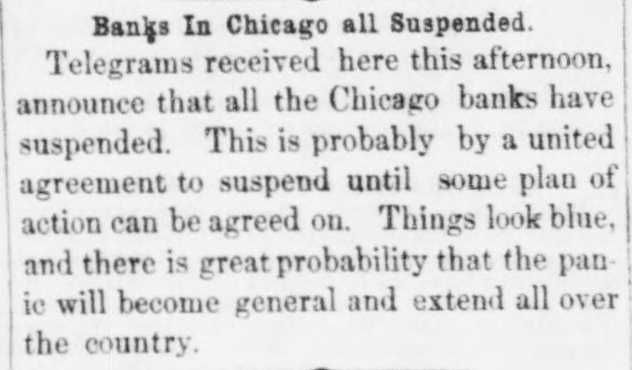
# Banks In Chicago all Suspended. Telegrams received here this afternoon, announce that all the Chicago banks have suspended. This is probably by a united agreement to suspend until some plan of action can be agreed on. Things look blue, and there is great probability that the panic will become general and extend all over the country.


Article from Wilmington Daily Commercial, September 26, 1873

Click image to open full size in new tab

Article Text

From Chicago, TWO BANK FAILURES REPORTED. CHICAGO, Sept. 26. The Second and the Manufacturers' National Banks have failed. STILL MORE SUSPENSIONS. The Cook County National Bank has suspended. Three other National Banks havealso suspend ed.


Article from The True Northerner, September 26, 1873

Click image to open full size in new tab

Article Text

# True Northerner. PAW PAW, MICHIGAN, Sept. 26, 1873. # Local Department. Hon. Wilder D. Foster, Representative in Congress from the Fifth District of Michigan, died in Grand Rapids Sept. 20. H. P. McFarlin will hold an Auction Sale at the residence of Fdward Stowman, two miles north-west of Glendale P. O., Oct. 11. We advise every young man or lady who wish to qualify for business to attend the Kalamazoo Business College. The Ann Arbor Courier says the seating capactity of the new University Hall is 3,000, and by the use of temporary seats 4,000 can be accommodated. Charles Smolk has removed his Sewing Machine Depot to the new building on the corner of Main and Niles streets, adjoining the residence of T. A. Granger. The Fair of the Paw Paw Valley Agricultural Society commenced last Wednesday and closed to-day. We will give a more extended notice of it in our next issue. REV. R. C. WELCH, who has been assigned by the Michigan Conference to the charge of the M. E. Church in this place for the ensuing year. preached his first sermon on Sunday morning last. All the Banks of Chicago entered into an arrangement by which they closed their doors yesterday morning, and take thirty days in which to pay depositors. A genral derangement of business must be the result. The South Haven Sentinel says: "The condition of religion is good." That is just as we had supposed, and we are right glad to see that fact verified in so public a manner, for the past season has been unusually sickly. The Government Printing office in the City of Washington, in the Territory of Columbia, is one of the largest printing offices in the world. Six colored compositors are employed at the case in that concern. The Lapeer Clarion wants the fat men to stand back in future and give the lean men of the State a chance to hold a convention and get a good, square meal out of East Saginaw or some other philanthropic city. At a public gathering lately one of the gentlemen present was called upon for a speech, and this is how he responded: "Gentlemen and women, I ain't no speecher. More'n 20 years ago I came here a poor idiot boy, and now what are I?" On Saturday last, Miss Emma Pugsley left for Ann Arbor to enter the State University. She is a graduate of the school here, and is an excellent scholar. There are now two young ladies attending the University from this village, the other being Mies Emma Andrews. who has been there for the past two years. The Circuit Court has been in session during the past week. On Monday the Matteson case came up on a motion for change of venue, which motion, after a hearing and the reading of affidavits in support of the motion and counter affidavits opposed to it, was denied. The time for the trial will probably be set down for the next term of the Court. The most important other matter before the Court was a case between A. M. Merrifield and Philo Reed. LAWRENCE, Sept. 16, 1873. TRUE NORTHERNER: DEAR. SIR, I have been away all summer, and have but just returned. The first newspaper I saw after getting home was yourself going "Up in a Balloon." If a little money will save you, the enclosed Two Dollars will help. Keep the thing flying till they all respond, and keep the paper coming. Can't keep house without it. Yours Truly, The State Fair, held at Grand Rapids last week, was a success as regards the magnitude of the exhibition in all its departmentst-he Lumber of people who attended and financially. We learn that the receipts exceeded thirty thousand dollars. Our own Van Buren County maintained the ascendency she had heretofore attained. She bore off the highest prize for her County Collection of Fruit; the township of South Haven took the first prize for her Township collection of Fruit; and the Williams' process for evaporating fruit was pronounced superior to the Alden process. Mr. Williams. the inventor, is a resident and fruit grower of South Haven, in this countv. Our worthy and honored friend. Judge Monroe. met with a very serious mishap on Saturday night last, by which he is now lying in a critical condition. He had arrived here on the nine o'clock train on his way home from Grand Rapids, where he had been attending the State Fair. He started for his home, aboat eight miles from town, on foot and leading a ball by a cord attached to a ring in his nose. When about one-half mile from town the bull became somewhat refractory and refused to go. the Judge meanwhile pulling him along by the cord, when the animal suddenly attacked nim, throwing him to the ground and trampling him under his feet, bruising and lacerating him very seriously about the chest, side and bowels. fter becoming released the Judge crawled to the house of Mr. Clancy and aroused the inmates. who took him in and cared for him until he was taken home, Sunday morning. Ir not unfrequently happens that a party political convention is moved to deliberately falsify history in their platforms, declarations and resolves, as was the case of the Ohio in ther recant numatform adopted by


Article from The Wheeling Daily Intelligencer, September 27, 1873

Click image to open full size in new tab

Article Text

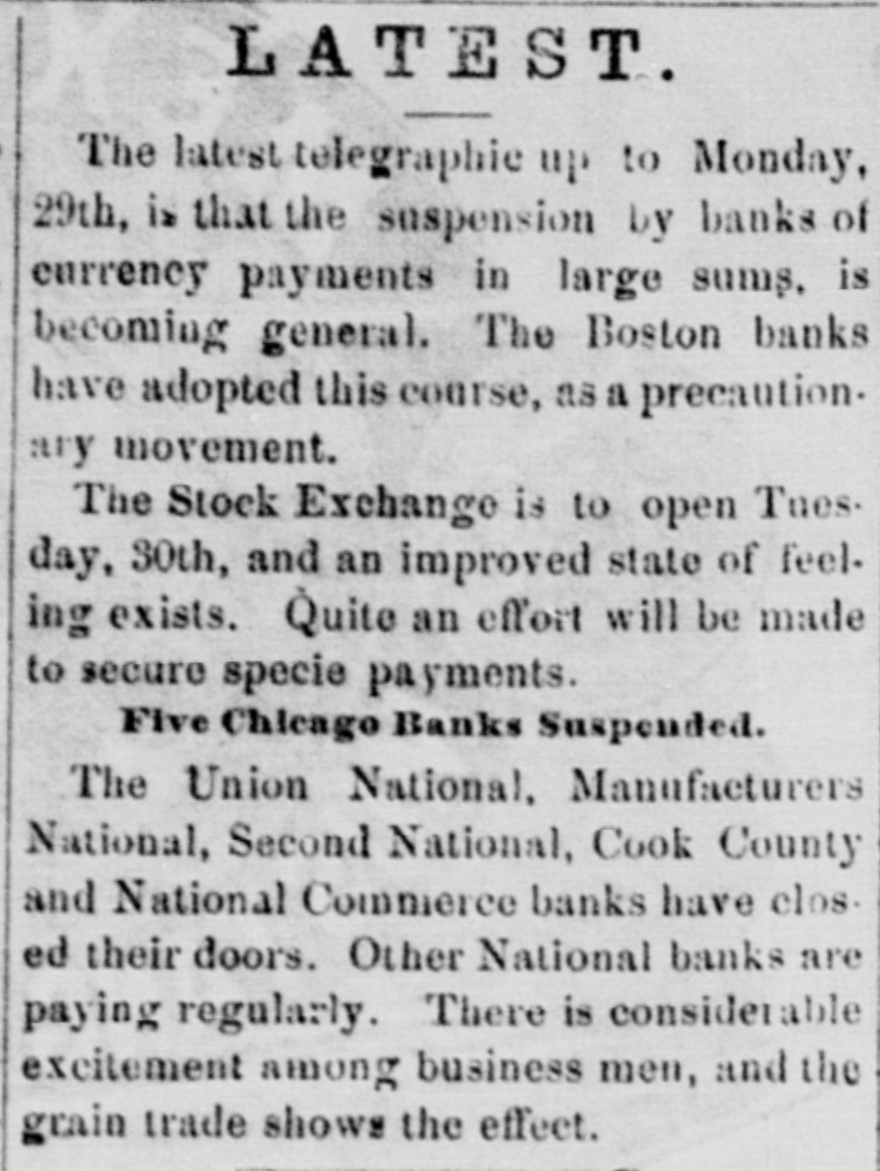
EXCITEMENT IN THE GRAIN TRADE. CHICAGO, Sept. 26.-It is just announced that the Union National, Second National and Manufacturers' National Banks have suspended. A notice on the door of the former says that the bank has abundant securities, but is compelled to suspend payment, on account of lack of currency, until they are able to realize. Nothing has been lost by failures, and their depositors will be made secure. CHICAGO, Sept. 26.-The Cook County City National Bank and the National Bank of Commerce have followed the example of the Union National Bank, and closed their doors. There was a run for an hour on the Commercial Exchange Bank, but as everything was paid, the run soon stopped. Some who drew have redeposited. This bank is considered very strong. The other National banks are paying regularly. There is considerable excitement among the business men, and the grain trade shows the effect. Mr. Coolbaugh, the President of the Union National Bank, is severely censured by the other bankers, and the whole community think the course proposed by him wholly unnecessary. It is suggested that there must be something rotten in his bank, though it has been regarded very strong.


Article from The Wheeling Daily Register, September 27, 1873

Click image to open full size in new tab

Article Text

THE FINANCIAL SITUATION. Reports From Various Cities. : Bank Suspensions in Chicago. CHICAGO. September 26.-To-day has been one ofmost intense excitement in banking and business circles in this city; a day of wild rumors and suspended banks and other financial calamities Moet of this excitement has been cause ed by false rumors. The following banks have temporarily suspended: W. F. Coolbaugh Pres't; Second Union Note, National, Manufacturers' Cook NaBank of Commerce, National. Rumor Conunty tional, had it being this morning that uns are made the on banking German houses National of Preston, (Kenn & Co.. Bank, Corn Exchange National, City National, Merchants' National and Farmers but be Savings Merchants, Bank, they and proved Mechanics' to false. Each of these institutions has been doing business as the day. usnal during The officers of the National Bank of they have only closed for and it on Commerce, the day, say will depend the condition of affairs whether they open not. The banks are of en to-morrow keeping or doors other and National doing business as with of some few that are paying usual, only the exception email It is not banks have deposite. Savings suspended learned rumored that during that any the It has been a fearful run is being made on day. Chan Corn namerce, Exchange Bank, in and the excitement was 80 inten to require the interferance of the police, but it to Ibe false. proved There bank had out been a run for money on the 188 the greater part h ad been got rid 01 the banks had alr eady received $40,000 more than had been drawn cut, had not found it necessary vaults nor even the express of from open package money juet received and New York. All was quiet the bank tyment for provided p all than who in thought their money safer out the The bank as and while not court sets, vaults. they did had ample the excitement, they dia'n't tear a ran. An explanatory notice of the Union National made its solvent it'is periectly by president and states has that met with no loases by suspensions in the east and has in cash and paper maturing within sixty days sufficient to pay all liabilities to depositors stock without touching a dollar of its capital or Purplus. Bank officers of Merchants' Saving, Loan ank Trust Company say that all collections maturing in the next few and all remittances been but days exbausted expresses received its ability have to all demands it mitted to ar and de range meet equitably fully per with all poeitors. TERRE HAUTE, September 26.-A1 is financially here at d no runso The suspensions. quiet Prairie Clews City & Bank, t Co., correspondent of Henry New and Wooler, Co., of meets Indianapolin, York, promptly Webb & all OD drawn out pandemands Clews & Co, made its before deposite, the with ic overHaute indidrawn. and with Terre Wooler, Webb banks & Co. had vidual with but are as they deposits recognized Clews sound & and Co., there are no indications of a run. If one should occur on any bank all will close doors. OMAHA, September 26.-Omaha banks are suffering very little in con sequence of the panic, and are transacting business as nsual. LOUISVILLE, Sept. 26.-The money market is tight, but nothing serious is on hand is pressure apprehended. very light, The stock and the of pork could not have come in a more favorable time for the provision dealers, but unless money will gets curtailed easier the for business want of of packing be cash.


Article from Nashville Union and American, September 27, 1873

Click image to open full size in new tab

Article Text

OTHER CITIES. Scattering Failures at Various Points The Chicago Grain Trade Stalled. New Orleans Discounts Certificates 5 per cent. Chicago Six or Seven Banks SusBoard of pend-The Trade Suspend Their Rules-No Grain Market. CHICAGO, Sept. 26-It is announced that the Union National, Second National, and Manufacturers' National banks have A notice on the door of the that bank former, suspended. says has abundant payment secubut is compelled to suspend of lack of currency to has teen lost realize. on rities, account Nothing from safe. until failures able and depositor will be made & Co., the National, LATER-Cook the Commerce City National Bank of have the of the and followed the example Union National and closed their door% There was a run for an hour on the Corn Exchange Bank, but everything was paid and the run soon Some who bank is very ed. stopped. The considered drew have redeposit- strong. Other National banks are paying regularly. There is considerable excitement among business men and the grain trade shows the effect. Coolbaugh, President consured of the by Union other National, is severely the whole as course was extreme bankers and wholly community, be unnecessary. something his It is suggested there must rotten in his bank, though it has been regarded as very strong. [It was Mr. Coolthat on Thursday resobaugh certificate offered the system.] lution adopting the loan The Board of Directors of the Board of Trade at a full meeting this morning unanthe following of which was greeted reading limously passed resolution, with applause the and universally approved. That all rules Resolved, directors of the to board authorizing the board of consider act on complaints of and far for violation such comcontract be suspended so as plaints are based on contracts for delivery of property in the future, made between the of this resolution of the association; ther passage order and and the further furthat the board shall not entertain complaints for the violation of contracts claimed to have been closed during the time indicated reason of the non deposit a that this resolution no case by provided shall of made in margin, in the be held to apply to any trades settlement of existing contracts. The bank failures brought operations on to astend 'Change nearly still rules and the brought action of the board suspending the to a full stop everything except still on rarer occasional settlement of a trade or a cash operation. The following banks continue to transact business as usual: The Commercial National, the Third National Bank, the Montreal Central National. the Corn Exchange, the Fifth, First, Fourth, Germania, International, the Merchants' National Bank, the Illinois, the Northwestern Traders' Bank of Chicago, the Union Stock Yards, Merchants' and Trust Company, the German Mechanics' National, Loan and Marine any ComThere has been no run upon of these although some pany. institutions, amounts of of them curhave paid out considerable To the above list the National Bank, lency. City which should the be officers added have all demands on to be very say There appears paid little presentation. excitement the the on the streets, beyond intense of among feeling people indiguation Union against Coolbaugh, President of the National, who is bitterly denounced by many as having unnecessarily precipitated this suspension to-day. it is authoritatively stated that Coolbaugh this morning received telegran S from his New York correspondents authorizing him to draw for the entire amount of bis balance there and $500,000 additional, which offer he refused. St. Losis Sympathetic--some Banks Paying Currency and Others Issuing Loan Certificates. ST. LOUIS, Sept. 26.-The action of the banks in this city last night seems to be by and an comparamunity, generally approved improved the mercantile manifested and com. this tively buoyant feeling was but when news came banks had forenoon, Chicago closed their that doors, several deep and and business on sprung anxiety up, apprehension became 'Change immed entirely almost lately stopped. Prices and for entirely nominal, except for settlements for grain and an occasional sale futures,


Article from The New York Herald, September 27, 1873

Click image to open full size in new tab

Article Text

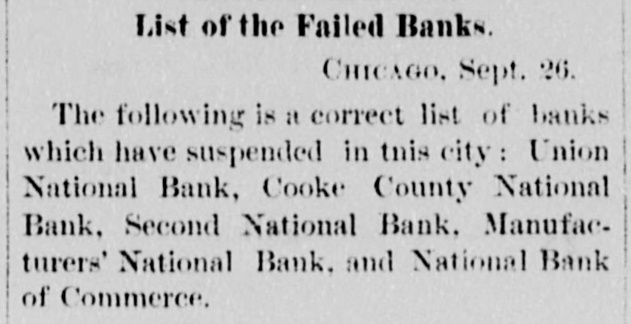
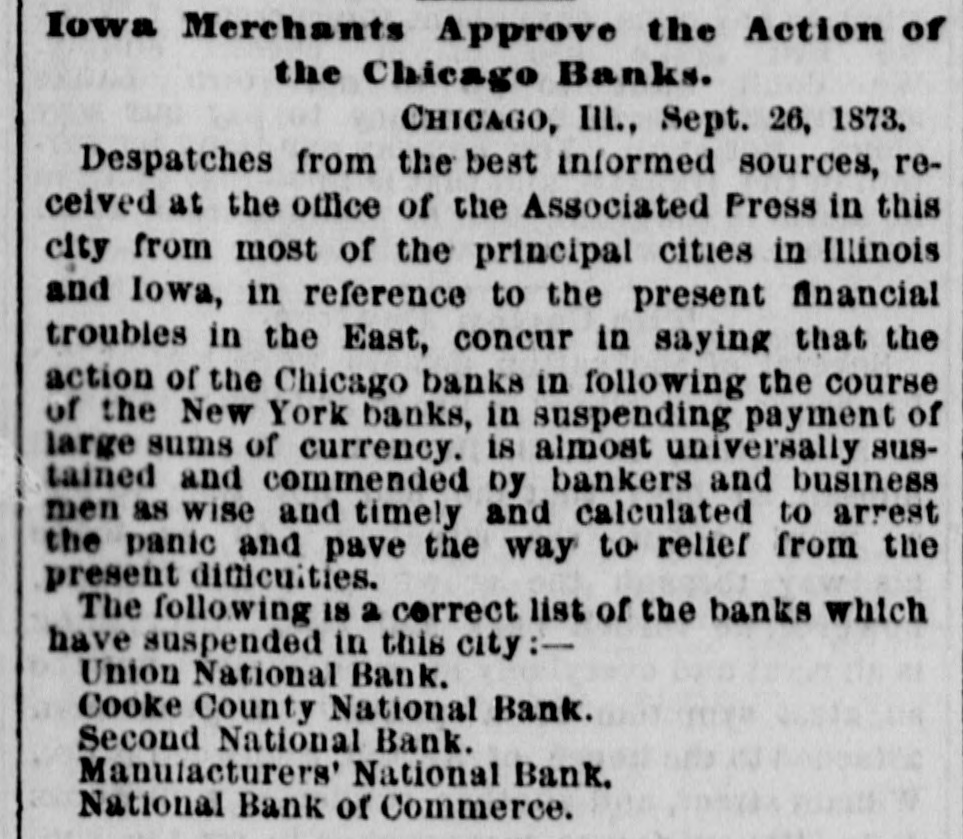
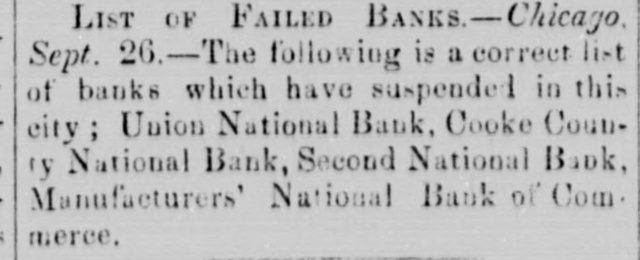
Iowa Merchants Approve the Action of the Chicago Banks. CHICAGO, III., Sept. 26, 1873. Despatches from the best informed sources, received at the office of the Associated Press in this city from most of the principal cities in Illinois and Iowa, in reference to the present financial troubles in the East, concur in saying that the action of the Chicago banks in following the course of the New York banks, in suspending payment of large sums of currency. is almost universally sustained and commended by bankers and business men as wise and timely and calculated to arrest the panic and pave the way to relief from the present difficulties. The following IS a correct list of the banks which have suspended in this city:Union National Bank. Cooke County National Bank. Second National Bank. Manulacturers' National Bank. National Bank or Commerce.


Article from Chicago Daily Tribune, September 30, 1873

Click image to open full size in new tab

Article Text

LAWRENCE, KS. Special Dispatch to The Chicago Tribune. LAWRENCE, Ks., Sept. 20.-Financial matters are looking brighter. The news of resumption by the Chicago banks is hailed with delight. Our banks have paid without suspension through the panic.


Article from Chicago Daily Tribune, September 30, 1873

Click image to open full size in new tab

Article Text

SAN FRANCISCO. Special Dispatch to The Chicago Tribune. SAN FRANCISCO, Sept. 20.-To-day was devoted almost exclusively to collections and legitimate channels, and the result inspirod confidence. Tho resumption of business by the Chicago banks was the subject of much congratulation, showing the panic had no serious effects on Western finance and stability. This, with the promptness with which to-day's matured obliga- tions were mot, has reopened the current of exchange, which resumed with some briskness. Coin drafts on New York sold at ΒΎ to 1 por cent; telegraphic transfers at 2 por cent. The panic has fully demonstrated the unadvisability of stock speculations. Capitalists are more unwilling than ever to invest in outside real estate, preferring legitimate enter- prises and staple products. The panic is charged


Article from The Kenosha Telegraph, October 2, 1873

Click image to open full size in new tab

Article Text

MONETARY. Since our last issue there has passed a week of great anxiety and fear throughout the country, the best of financiers and the wisest not being able to forsee what S day might bring forth. In New York there were but few or no more important failures and the panic has gradually subsid ed and business is assuming its usual activity The Gold and Produce Exchanges were ecarcely more than closed till they were opened again. The Stock Exchange remained closed till Tuesday morning at 10 o'clock when it was opened and immediately filled by the crowds rushin in at the three entrances on Wall Broad and New streets. Stocks at first rose and then remained etationary or fell. Dividend paying stocks generally held an ad vance. The day passed and closed as fa. vorably as was expected-perhaps more favorably. The Secretary of the Treasury paid out $14,000,000 for the purchase of government indebtedness and then declined paying out any more. His declining to purchase any more bonds had a depressing effect but the orders for the prepayment of the interest accruing in November and the President's letter on the situation and the USJ of currency to restore confidence and legitimate trade and commerce had a reassuring effect. During tne week the financial stringen cy reached Chicago and six National Bankssuspended,namely-Union Natioual, Cook County National, National Bank of Commerce, Second National, Third National, Manufacturers National. The Bank Officers held several meetings but could come to no agreement as to the course to be pursued. Two plans were before the meetings, one to issue Clearing House certificates as 1 New York to be used in the settlement of balances, the other to go on as usual A motion to issue Clearing House certifi cates was voted down and the last meeting adjourned. Two of the suspended banks, Manufacturers National and Sec ond National, went into liquidation last week. On Monday three of the suspended banks, Unlon National, Cook County National, National Bank of Commerce after a suspension of two business days. reopened at the usual time and continued open till the hour for closing without any unusual rnn on the banks. On Tuesday one of the three, Union National Bank of Chicago, did not open, and gavo notice that it had gone into liquidation. The reason given by the Union National for going into liquidation was that it had out on their would soon out currency paid Monday $400,000 all be drawn and and the bank would become crippled,but by going into liquidation it could in thirty or forty days pay all demands, save the capital and have a surplus left. The Union going into liquidation had an un favorable effect but all the banks including the other three which reopened on Monday went safely through the day and paid their clearances as on Monday. Altogether the prospect Tuesday night was that the crisis had passed and that business was assuming a healthy tone. y Yesterday was an encouraging day. All the bank in Chicago doing business passed e safely through the day, many or all receiving n more in deposits than was withdrawn. The produce trade is reviving and prices advanc. ing. The general aspect is more cheerful o and confidence is becoming more general. e There have been no bank suspensions in Milwaukee and it is thought there will not d be. Business has been partly suspended by the adjournment of the Chamber of Commerce but otherwise is passing on about as usual. n In New York the panic seems to have n subsided, business being transacted and n confidence increasing. Boston has thus n far had no panic, no bank failures, and h not much suspension of business. I. Gold to a large amount is being imkported from England and currency to very large amount has been transmitted g and is being transmitted by express from y the East to the West. Of the currency st transmitted Chicago has received and is receiving it by millions. The produce er and pork business cannot be fully carried g, on without the use and assistance of the gy e banks. And this cannot be had without naccommodation on the part of the banks de and confidence by the banks in each other and in the banks by the people. The


Article from Iowa Voter, October 9, 1873

Click image to open full size in new tab

Article Text

body known as the "People's Party;" repudiates party fealty as a tyrannical rule, sinking the citizen to a servile partisan; condemning the system of using money corruptly in elections; condemning all political rings and cliques formed to control elections; pledging the party to civil-service reform and to resist all Credit-Mobilier contracts with finance companies; denounces the present system of the distribution of lands and grants of lands to railway and other corporations; opposes all kinds of subsidy by Federal, State, county or municipal governments; opposes the present tariffs; favors taxing solvent debts; favors the eight-hour law; opposed to Chinese immigration, and also opposed to the election of the President for more than one term of four years. The last resolution indorses the stand taken by Governor Booth in behalf of popular rights against the encroachments of politicians and railway corporations. A dispatch from Denver, Col., states that over two-thirds of the mining town of Fairplay, Col., had been consumed on the 26th. All the stores, printing offices, the United States land office, post office, express office, hotels and other business places, with two or three exceptions, had been utterly destroyed. The Right Rev. Geo. M. Randall, Episcopal Bishop of Colorado, New Mexico and Wyoming, died at Denver, Colorado, on the 28th, of typhoid pneumonia. The Third National Bank, of Chicago, closed its doors on the 27th. The Cook County National, one of the suspended banks of that city, had announced its resumption. The Manufacturers' and Second National banks had decided to go into liquidation. The Union National, the first of the Chicago banks that closed its doors, had announced its assets at $5,600,000, and its liabilities at $4,300,000, and given notice of its speedy resumption of business. The Clearing-House Association met on the evening of the 27th, and after an animated discussion resolved not to issue Clearing-House certificates. A dispatch from St. Louis of the 27th says that the rear wall of the five-story warehouse, on the corner of Second and Chestnut streets, had fallen, opening a gap in the building fifty feet wide from the ground to the roof. One man had been killed and two seriously injured. In Chicago, on the 29th, business had resumed very nearly its normal condition. Three of the suspended banks had resumed business and were receiving deposits and paying out on checks as before the panic. Over $3,000,000 currency had been received during the preceding forty-eight hours. Traffic had fallen off on the various lines of railroad, and a large number of trains had been drawn off, and many men discharged. A St. Louis dispatch of the 29th says that while Joseph H. Fore, who attempted to kill his wife, on the 4th of June last, was being tried in that city on the 29th for that offense, he threw a heavy cut glass inkstand at his wife as she was giving in her testimony. The missile missed her, but struck her counsel full in the forehead, inflicting an ugly and dangerous wound. At a late hour on the night of the 29th the Union National Bank of Chicago, which had resumed business on that morning, and during the day had paid out $400,000, decided to go into liquidation, under the provisions of Sec. 42 of the National Currency Act. A call has been issued for a Northwestern Farmers' Convention, to meet at Chicago on the 22d of October, to consist of delegates from Granges and farmers' organizations. In Chicago, on the 30th, matters had very nearly resumed their normal condition, so far as the banks were concerned. The effect of the late panic was just beginning to be felt by merchants and traders. Trade was unmistakably dull and collections difficult to be made. A Madison, Wisconsin, dispatch of the 1st announces that the Bank of Madison had failed. A dispatch from Springfield, III., of the 1st, says the Leland House of that city had been damaged by fire to the extent of $10,000.


Article from The Redwood Gazette, October 9, 1873

Click image to open full size in new tab

Article Text

Federal, State, county or musicipal governments; opposes the present tariffs; favors taking solvent debts: favors the eight-hour law; opposed to Chinese immigration, and also opposed to the election of the President more than one term of four years. The last resolution indorses the stand taken by Governor Booth in behalf of popular rights against the encroachments of politicians and railway corporations. A dispatch from Deaver, Col., states that over vo-thirds of the mining town of Fairplay, Col., had been consumed on he 26th. All the stores, printing offices, the United States land office, post office, express office, als and other business places, three exceptions, had been utterly destroyed. The Right Rev. Geo. M. Randall, Episcopal Bishop of Colorado New Mexico and Wyoming, died at Denver, Colorado, on the 28th, of typhold pneumonia. The Third National Bank, of Chicago, closed its doors on the 27th. The Cook County National, one of the suspended banks of that city, had announced its resumption. The Manufacturers' and Second National banks had decided to go into liquidation. The Union National, the first of the Chicago banks that closed its doors, had announced its assets at $5,600,000, and its liabilities at $4,300,000. and given notice of its speedy resumption of business. The Clearing-Ho Association met on the evening of the 27th, and after an animated discussion resolved not to issue ClearHouse certificates. A dispatch from St. Louis of the 27th says that the rear wall of the five-story warehouse, on the corner of Second and Chestnut streets, had fallen, opening gap in the building fifty feet wide from the ground to the roof. One man had been killed and two seriously injured. In Chicago, on the 29th, business had resumed very nearly its normal condition. Three of the suspended banks had resumed business and were receiving deposits and paying out on checks as before the panic. Over $3,000,000 currency had been received during the preceding forty-eight hours. Traffic had fallen off on the various lines of railroad, and a large number of trains had been drawn off, and many men discharged. A St. Louis dispatch of the 29th says that while Joseph H. Fore, who attempted to kill his wife, on the 4th of June last, was being tried in that city on the 29th for that offense, hethrew heavy cut glass inkstand at his wife as she was giving in her testimony. The missile missed her, but struck her counsel full in the forehead, inflicting an ugly and danger wound. At a late hour on the night of the 29th the Union National Bank of Chicago, which had resumed business on that morning, and during the day had paid out $400,000, decided to go into liquidation, under the provisions of Sec. 42 of the National Currency Act. A call has been issued for a Northwestern Farmers' Convention, to meet at Chicago on the 22d of October, to consist of delegates from Granges and farmers' organizations. The South. A dispatch from Richmond, Va., of the 23d, says that the Merchants' National, the Planters', the Mechanics', the Peoples', the First National, and the Citizens' banks, of Petersburg, had suspended. A Baltimere telegram of the 24th announced that all the banks of that city had stopped currency payment. Brown, Lancaster & Cowell, agents of the Chesapeak and Ohio Railway, having houses in Baltimore, New York and Richmond, had also suspended. A Little Rock, Ark., dispatch of the 24th says the money panic in that city continued, caused not 80 much by Eastern financial complications as by the refusal of the city banks to take the shinplasters that have been current there. A dispatch from Richmond, Va., says that the Richmond Dollar Savings Bank had suspended, and that Taylor & Williams, bankers, had failed. A dispatch to the Associated Press, from Brownsville, Texas, of September 24, says that a series of butcheries and robberies had recently been committed in Mexico, the victime every case being Americans. The perpetrators of these crimes were arrested, and their guilt fully established, yet not one of them had been punished, the authorities being either indifferent or powerless. The facts had been reported by the Consuls to Washington, in the hopes that redress would be demanded. A Memphis dispatch of the 25th says that the First National and De Soto banks, of that city, had closed their doors. A dispatch from Nashville Tenn., says that the National Banks of that city had suspended currency payments on all balances exceeding $200. A dispatch from Selma, Ala., of the 25th. says the Savings Bank of Selma had suspended in consequence of an extraordinary run by depositors. All the banks of New Orleans partially suspended payment on the 25th, according to a dispatch from that city. The suspension was to remain in force for thirty days. Telegrams from various cities in Georgia, of the 25th, say the following banks had suspended: National Exchange, the Merchants' and Planters' National, the Planters' Loan and Savings Banks, of Augusta, Ga.; the Dollar Savings Bank, of Atlanta, Ga.: Savannah Bank and Trust Company, and the South ern Bank of Georgia. A dispatch from Shreveport, La., of the 25th, says the fever, which seemed to have abated on the preceding day, had broken out with renewed violence. The interments numbered twenty-two. A dispatch from Shreveport, La., of the 29th says that within the last four days sever al of the most prominent and useful citizens of that city had fallen victims to the epidemic. The dispatch adds: "The population has been fearfully thinned out by sickness and death We no longer have funerals. The hearses, followed by one or two carriages, dash through the streets like a section of artillery in a battle seeking position. A few men are drummed up, the coffins shoved into the hearse, and driven rapidly to the cemetery. This is the case even with the most prominent citizens. The Howards have opened an orphan asylum, and are feeding about two-thirds of the resident population. There are fewer deaths and new cases, because there are fewer people.' A Jackson, Miss., dispatch of the 29th says Governor Powers, acting under the advice of Attorney-General Morris, had issued proclamation postponing the State election. The Governor says that he will convene the Legislature in extraordinary session as soon as possible. The Pilot, the State organ, has pronounced the Governor's movement incendiary, and calculated to lead to revolution and anarchy.


Article from Ottumwa Weekly Courier, October 16, 1873

Click image to open full size in new tab

Article Text

At last it turns out that of the twenty-one National banks of Chicago before the panic, three have gone into liquidation, viz: the Union, the Second National, and the Manufacturers'. The three other banks which suspended have all opened again, and are moving along as usual. Rapidly currency is coming into Chicago, and the best and most hopeful teeling prevails. It is confidently expected that the three banks which have gone into liquidation, will pay everybody, depositors and all.


Article from The New York Herald, November 4, 1873

Click image to open full size in new tab

Article Text

CHICAGO PREPARED. No Present Distress in the City-Business Active and Unhampered, but the Winter Dreaded-A Table of Receipts and Shipments. CHICAGO, Nov. 3, 1873. Less, perhaps, than any large city on the Continent has Chicago been affected by the panic which commenced with the suspension of the Buchu banker of Philadelphia and continues with the failures and rumors of failures in Rhode Island. The panic among our banks was short and sharp, but all have weathered the storm save the Second National and Manufacturers' National, both of which have gone into private liquidation, and the Franklin, a small institution, which has been declared bankrupt. The liquidating banks will pay dollar for dollar, as Chicago never adopted the plan of issuing Clearing House certificates. Each bank stood from the outset on its own bottom. and the result is that all our other banking institutions are in excellent condition, doing business as usual, save that discounts are not granted as readily as of old. The savings banks having decided to stand by time rule, are all intact, and as their line of deposits was very large, frugal poor people. who were almost entirely their customers, will have a resource in case of distress. There has not been a single failure of note in mercantile circles, and BUSINESS IS ACTIVE AND UNHAMPERED, except by the difficulty of making collections. Take, for example, the dry goods-line:Mr. Leiter, of the firm of Field, Leiter & Co., the heaviest house here, declares that we are better prepared for hard times than any other section of the country. Business is flourishing and our orders average 100 a day. The past week was the best we have ever seen in the way of filling orders. It 'is our largest week on record. Our banks are in superb condition: they were never better. Not a single manufacturing house has thus tar shut down. THE PORK PACKING SEASON has not, however, fairly opened, and the prospect is at present that general scarcity of money will prevent anything like the business of former seasons. As this is our principal industry in winter, it is greatly leared that much distress will prevail among a large class dependent upon it for their winter's sustenance. No building operations have been suspended. The city goes on with its improvements, employing thousands of men, but the season for this kind of labor will close about the 1st of December, and if the packing houses are not in full blast men who usually work at anything in summer, and in the packing houses in winter, will suffer in the cold. As a rule the railways having shops in the city, or anywhere in the Northwest, have made no considerable, if any, reduction in their force; but the Chicago, Burlington and Quincy, Northwestern and LakeShore lines have cut down the wages of all their operatives from seven to ten per cent. I hear that THE WHOLESALE CLOTHIERS will not employ a large number of tailors this winter, and as the manufacture of clothing was carried on largely here it is likely that there will be much suffering among those depender upon this line of industry. Business upon 'Change is lively, though there is net 80 much speculation as usual, owing to the feeling of distrust among operators. To indicate how little trade in grain has been affected, I send a statement of receipts and shipments of breadstoffs and live stock at this point during the past week, comparing them with those of the corresponding week of last year :RECEIPTS.


Article from The Manitowoc Tribune, August 5, 1875

Click image to open full size in new tab

Article Text

THURSDAY, AUGUST 5, 1875. REPUBLICAN STATE TICKET. FOR GOVERNOR, HARRISON LUDINGTON. FOR LIEUT. GOVERNOR, H. L. EATON. FOR SECRETARY OF STATE, H. B. WARNER. FOR STATE TREASURER, HENRY BATZ. FOR ATTORNEY GENERAL, JOHN R. BENNET. FOR SUPT. OF PUE. INST'N., ROBERT GRAHAM. CAMPAIGN LIES EXPOSED. WE do not publish the following letter from Major Bætz because we think that any one believes him guilty of the charges made against him; but now that they have been circulated, it is but justice to the Major to give his plain concise refutation of the vile slander heaped upon him by that most depraved of all Wisconsin newspapers, the Milwankee News: Milwaukee, July 26. To the Editor of the Sentinet: Will you kindly permit me to notice, through the medium of the Sentinel, a few pasages in the Madison letter of Saturday's Milwaukee News, by which the anonymous writer tries to impeach my integrity as a former State officer. He says : The fact that Baetz, as treasurer, had some $12,000 of the State funds in the Second Nationa! Bank of Chicago hen it failed, $15,000 in the broken City Bank of this city, $6,000 in Wisconsin Central Railroad lands, and $4,000 in that digest of laws which was printed under a special act, is telling strongly against him. To the first charge I plead guilty, except that the amount is overstated. This bank was considered sound and safe, but the panic of 1873 forced it to go in to liquidation, The State Treasurer's Chicago account had been kept with it for years before 1 came into office. I