22468. First National Bank (Vancouver, WA)

Bank Information

Episode Type
Suspension → Closure
Bank Type
national
Bank ID
3031
Charter Number
3031
Start Date
April 20, 1901
Location
Vancouver, Washington (45.639, -122.661)

Metadata

Model
gpt-5-mini
Short Digest
c7a2a3ed

Response Measures

None

Receivership Details

Depositor recovery rate
100.0%
Date receivership started
1901-04-20
Date receivership terminated
1904-06-14
OCC cause of failure
Fraud
Share of assets assessed as good
55.0%
Share of assets assessed as doubtful
40.6%
Share of assets assessed as worthless
4.4%

Description

Bank closed by Comptroller on examiner's recommendation after discovery of an $81,000 shortage/embezzlement. Examiner Maxwell placed in charge as temporary receiver (04-20-1901); permanent receiver appointed July 16, 1901. No run reported in the articles; failure due to bank-specific adverse information and misapplication of funds by president and cashier (they later committed suicide).

Events (6)

1. August 15, 1883 Chartered
Source
historical_nic
2. April 20, 1901 Other
Newspaper Excerpt
Examiner Maxwell has been placed in charge as temporary receiver.
Source
newspapers
3. April 20, 1901 Receivership
Source
historical_nic
4. April 20, 1901 Suspension
Cause
Bank Specific Adverse Info
Cause Details
Examiner discovered a shortage of about $81,000 in the bank's accounts; substantial loans on insufficient security and alleged embezzlement by president and cashier.
Newspaper Excerpt
The doors of the First National Bank, Vancouver, Wash., were closed today under instructions from the controller of the currency upon the recommendation of National Bank Examiner J. W. Maxwell and a report from him that ... he had discovered a shortage of about $81,000.
Source
newspapers
5. April 21, 1901 Other
Newspaper Excerpt
Charles Brown and E. L. Canby, president and cashier, respectively, of the First National bank... committed suicide last night two miles from this city ... When Examiner Maxwell confronted the bank officials with the shortage of $81,000 both men admitted their guilt.
Source
newspapers
6. July 16, 1901 Receivership
Newspaper Excerpt
The Comptroller of the Currency has appointed Dr. A. B. Eastham, of Vancouver, Wash., permanent receiver of the insolvent First National Bank of that city.
Source
newspapers

Newspaper Articles (20)

Article from Evening Star, April 20, 1901

Click image to open full size in new tab

Article Text

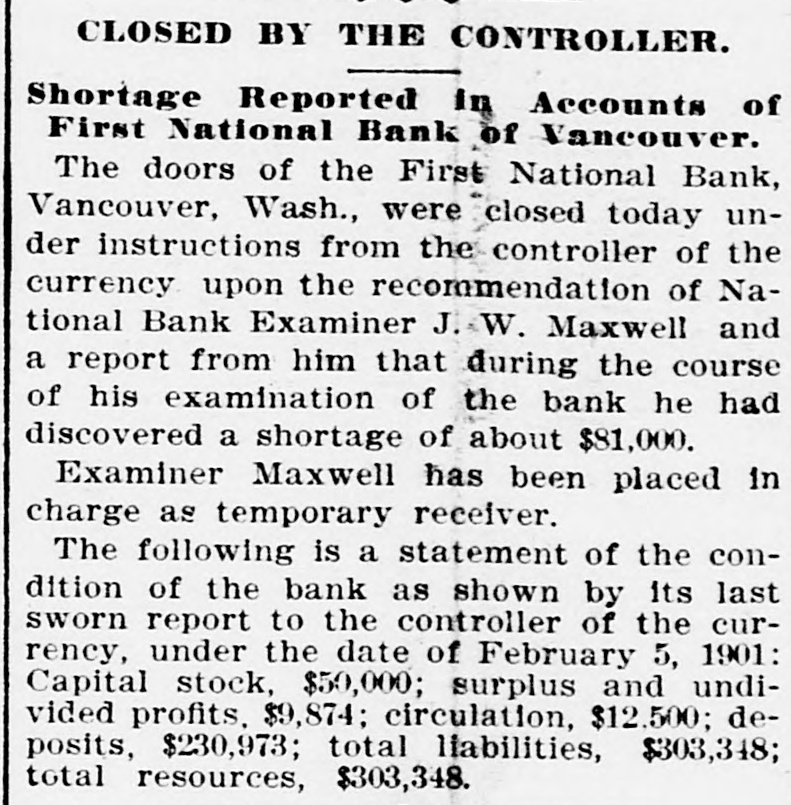
CLOSED BY THE CONTROLLER. Shortage Reported in Accounts of First National Bank of Vancouver. The doors of the First National Bank, Vancouver, Wash., were closed today under instructions from the controller of the currency upon the recommendation of National Bank Examiner J. r W. Maxwell and a report from him that during the course of his examination of the bank he had discovered a shortage of about $81,000. Examiner Maxwell has been placed in charge as temporary receiver. The following is a statement of the condition of the bank as shown by its last sworn report to the controller of the currency, under the date of February 5, 1901: Capital stock, $50,000; surplus and undivided profits. $9,874; circulation, $12.500; deposits, $230,973; total liabilities, $303,348; total resources, $303,348.


Article from The Evening Times, April 20, 1901

Click image to open full size in new tab

Article Text

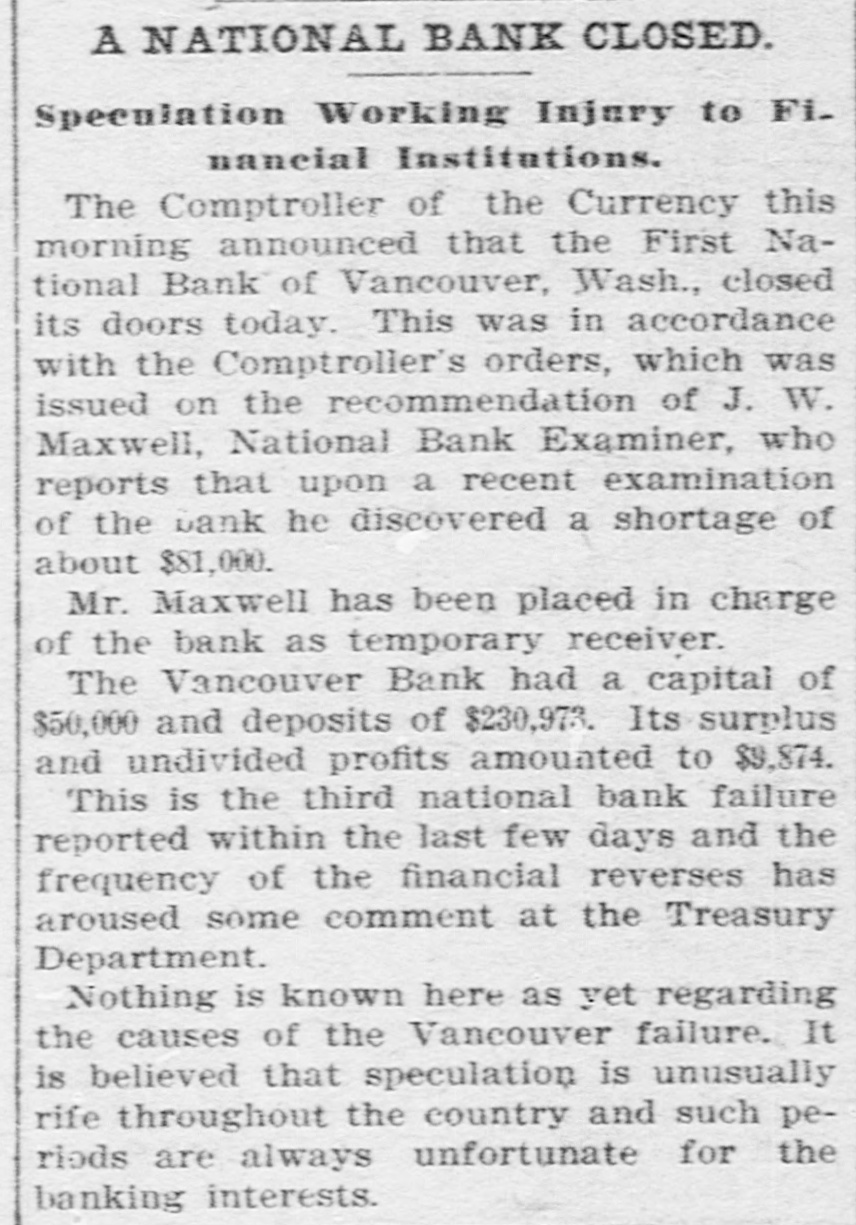
A NATIONAL BANK CLOSED. Speculation Working Injury to Financial Institutions. The Comptroller of the Currency this morning announced that the First National Bank of Vancouver, Wash., closed its doors today. This was in accordance with the Comptroller's orders, which was issued on the recommendation of J. W. Maxwell, National Bank Examiner, who reports that upon a recent examination of the Dank he discovered a shortage of about $81,000. Mr. Maxwell has been placed in charge of the bank as temporary receiver. The Vancouver Bank had a capital of $50,000 and deposits of $230,973. Its surplus and undivided profits amounted to $9,874. This is the third national bank failure reported within the last few days and the frequency of the financial reverses has aroused some comment at the Treasury Department. Nothing is known here as yet regarding the causes of the Vancouver failure. It is believed that speculation is unusually rife throughout the country and such periods are always unfortunate for the banking interests.


Article from The Morning Astorian, April 21, 1901

Click image to open full size in new tab

Article Text

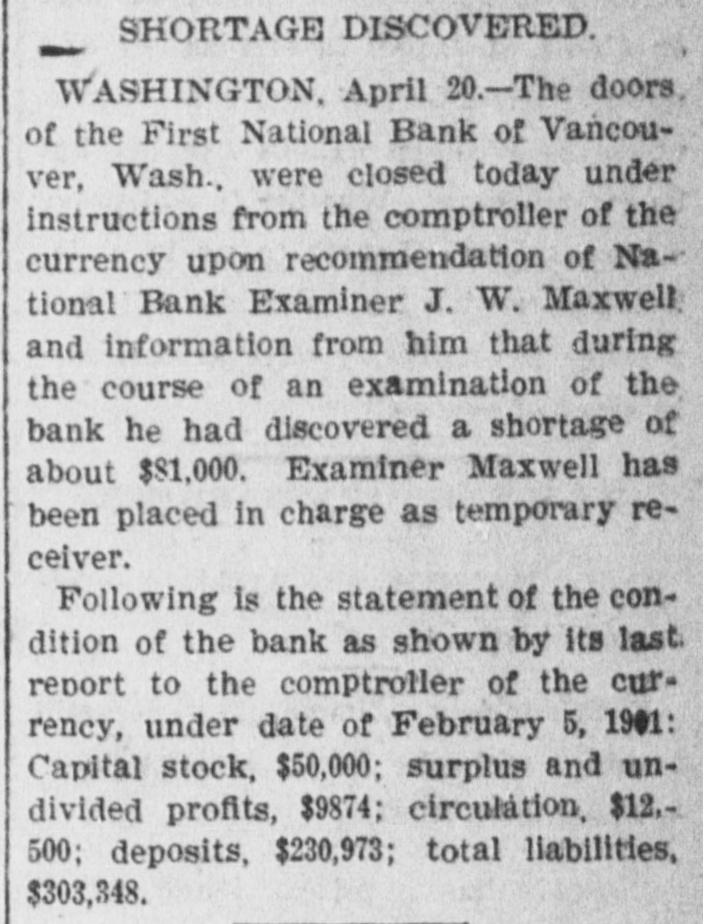
SHORTAGE DISCOVERED. WASHINGTON, April 20.-The doors. of the First National Bank of Vancouver, Wash., were closed today under instructions from the comptroller of the currency upon recommendation of National Bank Examiner J. W. Maxwell and information from him that during the course of an examination of the bank he had discovered a shortage of about $81,000. Examiner Maxwell has been placed in charge as temporary receiver. Following is the statement of the condition of the bank as shown by its last. report to the comptroller of the currency, under date of February 5, 1901: Capital stock, $50,000; surplus and undivided profits, $9874; circulation, $12.500; deposits, $230,973; total liabilities, $303,348.


Article from The Morning Astorian, April 21, 1901

Click image to open full size in new tab

Article Text

National Examiner Finds $81,000 Missing. OFFICIALS ALSO DISAPPEAR Connty and City Lose Heavily-Receiver Appointed-Great Excitement in City Up the Columbia-Statement of Bank's Condition. VANCOUVER, Wash., April 20.-This city was thrown into a fever of excitement this morning by the report that the First National Bank had failed. The first intimation of the occurrence was the appearance of the following notice on the front door of the bank at the beginning of banking hours: "This bank is closed and in the hands of the comptroller of the currency," signed, "J. W. Maxwell, Bank Examiner." Nothing could be learned today relative to the financial condition of the concern as Bank Examiner Maxwell was not prepared to give out any statement. The heavy depositors in the bank are generally of the opinion that the failure was due to bad investments made by the officials of the bank during the past ten years and carried along as assets until discovered by the bank examiners. Charles Brown, the president, and E. L. Canby, the cashier, have both disappeared and their present whereabouts are unknown. The failure is a heavy blow to the town. There is scarcely a man of property in the city who is not affected directly or indirectly. The bank was established in 1883. It was a profitable institution many years, paying big dividends to the stockholders. E. L. Canby has been the cashier since its organization. Among the heaviest losers are the fol lowing: County Clerk Galther, eleven thousand dollars paid into court two weeks ago by the Oregon-Washington Railroad Co., as payment for right of way; John Cander, treasurer of Skamania county, ten thousand; E. M. Scanlonkan, treasurer of the city of Vancouver, thirtysix hundred.


Article from The Daily Morning Journal and Courier, April 22, 1901

Click image to open full size in new tab

Article Text

Then Went and Blew Their Heads OffTheir Bodies Found Together-Used the Same Revolver-One President and the Other Cashier of the Vancouver First National Bank. Vancouver, Wash., April 21.-Charles Brown and E. L. Canby, president and cashier, respectively, of the First National bank, of Vancouver, which was closed yesterday by the controller of the currency, committed suicide last night two miles from this city, by shooting themselves with revolvers. Their bodies were found this morning lying together in a small clump of bushes. Both used the same weapon and Canby evidently died first, as the revolver was found in Brown's hand. Each put the muzzle of the revolver in his mouth and blew the top of his head off. The fact that Brown's bicycle and an umbrella of Canby were found a short distance out of town last night, led to the belief that they had taken their lives. A searching party started out today and after several hours' search the bodies were found. Canby upon being told by Bank Examiner J. W. Maxwell, on Friday evening, that the bank would not be permitted to open Saturday went out in the yard behind the bank and attempted to shoot himself. His revolver failed to explode. After failing to shoot himself, Canby came back into the bank and he and President Brown left together, taking his revolver. When Examiner Maxwell confronted the bank officials with the shortage of $81,000 both men admitted their guilt. It is said that Brown and Canby had been speculating in stocks. Besides Brown's body there was found a package containing $25 and a note saying that the money belonged to his daughter. Upon Canby's body the following brief note was found: "My Dear Wife: I feel what I am about to do is for the best. Forgive me if you can and try to live for our dear children. God bless you all. Good bye. Ned. April 20." Brown, who was fifty years of age, has lived in Vancouver since 1866. Canby was fifty-two years of age and was well connected. A brother is paymaster in the United States army. Another brother committed suicide by jumping off the wharf at Vancouver several years ago. While Bank Examiner Maxwell, who is now in charge as receiver, has made no official statement, it is known that the bank has loaned a large sum of money on insufficient security. According to his report to the controller of the currency there is a shortage of $81,000 in the bank's accounts and it is understood that a considerable portion of this amount was loaned to Brown and Canby on their personal notes. About a year ago the bank reduced its capital stock from $100,000 to $50,000. At that time about one-half of the socalled bad assets were "charged off" and carried as an asset since that time. The heaviest stockholder is Colonel Stephen Joslyn, of the regular army, a member of Gen. Shafter's staff. Colonel Joslyn is stationed at San Francisco. He was stationed at Vancouver when the bank was organized in 1883 According to the last statement issued in February, the bank had deposits amounting to about $230,000.


Article from Evening Journal, April 22, 1901

Click image to open full size in new tab

Article Text

SOUGHT DEATH BY HIS OWN HAND Suicide of Former Wilmingtoi Man in West SPECULATED WITH BANK'S CASH Edmund Lea Canby, Well Connected Here, Admits Guilt and Commits Suicide Vancouver, Wash. April 22.-Charles Brown and E.L. Canby, president and cashier, respectively, of the First National bank, of Vancouver, which was on the of committed Satclosed the urday currency. night Saturday by controller suicide two miles from this city were found in yesterday by shooting. morning Their lying bodies together a small clump of bushes. Both used the same weapon, and Canby evidently died first, as the revolver was found in Brown's hand. Each put the muzzle of the revolver in his mouth and blew the top of his head off. The fact that Brown's bicycle and an umbrella were found a short distance out of town Saturday night led to the belief that they had taken their lives. A searching party started out yeaterday, and after several hours' search the T bodies were found. a Canby, upon being told by Bank Ex aminer J. W. Maxwell on Friday evening that the bank would not be permitopen went out in the and to yard ted to behind Saturday, the bank attempted His to failing to it came back self shoot explode. Canby himself. After revolver into shoot the failed bank him Brown to a revolver and gether, he taking and President with left them In When Examiner Maxwell confronted T with the of it. men admitted their y the $81,000 bank both officials shortage guilt dIt is said that Brown and Canby had we been speculating in stocks. n, By the side of Brown's twas a $25 ly a that the be and found note saying package containing body money there Ly longed to his daughter. Upon Canby's y, body the following brief note was ed found: nt I feel lo"My Dear do is Wife: what I an a about to for the best. Forgive m re if you can and try to live for our deal ht children. God bless you all. Goodbye in Ned. April 19." who was of has 1since 1862. lived Brown, in Vancouver 54 years age, Canby twas 52 years of age, and was well conenected. A brother is a paymaster in on the United States army. Another n. rbrother committed suicide by jumping of off the wharf at Vancouver several years ago. sieWhile Bank Examiner Maxwell, who is is now in charge as receiver, has made is no official statement, it is known the an bank has loaned a large sum of money on insufficient,security. According to his report to the controller of the cur rency there is a shortage of $81,000 in the bank's accounts, and it is under ps stood that a considerable portion o this amount was loaned to Brown and Canby on their personal notes. About he a year ago the bank reduced its capi er tal stock from $100,000 to $50,000. A the that time about one-half of the so to er called bad assets were "charged off, and have been carried as an asset since that time as t: Edmund Lea Canby was well and fa K. vorably known here. He was the thir son of Edmund T. and Mary Canby on and was born in 1847 at Harmon the Mills, below Stanton, where his fathe be was engaged in the milling busines Edmund was educated at Delaware Co lege and in other institutions. Afte reaching this majority he entered th employ of the late firm of W. R. an H. Gause, lumber merchants, and late Sit with the Springer, Morely & Gaus Co. He went to Vancouver in 1877 accept a clerkship in the First Na the tional Bank, in which position he re lamained a very short time before bein iaappointed cashier of the institution. of came East two years ago on busines and visited his relatives here befo vill returning home. ed Friends of Mr. Canby cannot believ nce that he was in possession of his rig) aymind during the period he appropriate ent the money. They say he was generor Asto a fault; genial, whole-souled, obli of ing, and in every way a good citize He was known as a man who w above suspicion. He was of fine ph sique and handsome appearance. Se eral years ago he married a Miss Burr ave side, of Vancouver, and she, wit ake three young children, survive him. nia Relatives of the dead man receive turword of his death yesterday. in; hith and KIENLE WILL PRESENTED


Article from The Savannah Morning News, April 22, 1901

Click image to open full size in new tab

Article Text

WITH SAME WEAPON DEFAULTING BANK OFFICIALS END THEIR LIVES. BOTH HAD ADMITTED GUILT. EACH WITH PISTOL IN MOUTH BLEW TOP OF HEAD OFF. Bank Examiner Maxwell's Statement of Their Shortage of $81,000 Proved Death Warrant of Prestdent Brown and Cashier Canby of Vancouver National Bank-Had Borrowed Large Amounts From the Bank on Their Personal Notes. Col. Stephen Joslyn. of Gen.Shafter's StRIf, the Bank's Heaviest Stockholder. Vancouver, Wash., April 21.-Charles Brown and E. L. Canby, president and cashier, respectively, of the First National Bank of this city, which was forced to suspend yesterday, committeed suicide last night two miles from here. Their bodies were found this morning. Both used the same weapon and Canby evidently died first as the revolver was found in Brown's hand. Each put the muzzle of the revolver in his mouth and blew the top of his head off. Canby, upon being told by Bank Examiner J. W. Maxwell on Friday evening that the bank would not be permitted to open Saturday. went out in the yard behind the bank and attempted to shoot himself. His revolver failed to explode. Canby came back into the bank and he and President Brown left together, taking a revolver with them. When Examiner Maxwell confronted the bank officials with the shortage of $81,000 both men admitted their guilt. It is said that Brown and Canby had been speculating in stocks. Beside Brown's body there was a package containing $25 and a note saying that the money belonged to his daughter. Upon Canby's body the following brief note was found: "My dear Wife: I feel what I am about to do is for the best. Forgive me if you can and try to live for our dear children. Ned. God bless you all. Good-byeApril 19." Brown, who was 54 years of age, has lived in Vancouver since 1862. Canby was 52 years of Age, and was well connected. A brother is a paymaster in the United States army. Another brother committed súicide by jumping off the wharf at Vancouver several years ago. While Bank Examiner Maxwell, who is now in charge as receiver, has made no official statement, it is known that the bank has loaned a large sum of money on insufficient securities. According to his report to the controller of the currency there is a shortage of $81,000 in the bank's accounts, and it is understood that a considerable portion of this amount was loaned to Brown and Canby on their personal notes. About a year ago the bank reduced its capital stock from $100,000 to $50,000. At that time about onehalf of the so-called bad assets were "charged off" and have not been carried as an asset since that time. The heaviest stockholder of the bank is Col. Stephen Josiyn of the regular army, a member of Gen. Shafter's staff. According to the last statement, issued in February, the bank had deposits amounting to about $230,000.


Article from Daily Kennebec Journal, April 22, 1901

Click image to open full size in new tab

Article Text

THE SAME REVOLVER Used by President and Cashier in Committing Suicide. They Wreck the First National Bank of Vancouver, Wash., And Unable to Stand the Disgrace End Their Lives Together. Vancouver, Wash, April 21.-Charles Brown and E. L. Canby, president and cashier respectively of the First National Bank of Vancouver, which was closed, yesterday, by the comptroller of the currency, committed suielde, last night, two miles from this city, by shooting themselves with a revolver. Their bodies were found, this morning, lying together in a small clump of


Article from The Topeka State Journal, April 22, 1901

Click image to open full size in new tab

Article Text

DIED TOGETHER. Defaulting Bank Officials Confess and Commit Suicide. Each Blows the Top of His Own Head Off. Vancouver, Wash., April 22.-Charles Brown and F. L. Canby, president and cashier, respectively, of the First National bank, of Vancouver, which was closed Saturday by the comptroller of the currency, committed suicide two miles from this city by shooting themselves with a revolver. The bodies were found lying together in a small clump of bushes about one-half mile north of the Columbia school, which is situated on the outskirts of the town. They both used the same weapon and Canby evidently died first, as the revolver was found in Brown's hand. It is evident that Canby put the muzzle of the revolver in his mouth and then blew the top of his head off. Brown then took it and shot himself in exactly the same way, falling over Canby's body. The fact that Brown's bicycle and an umbrella belonging to Canby were found a short distance out of town led to the belief that the two bank officials had taken their lives. Early this morning a searching party started out and after several hours' hunt the bodies were found in the clump of bushes. Friday evening, Canby, upon being told by Bank Examiner J. W. Maxwell that the bank would not be permitted to open Saturday, went out in the yard behind the bank and attempted to shoot himself. His revolver failed to explode, although all five chahbers were loaded. After failing to shoot himself, Canby came back into the bank and he and President Brown left together later, taking his revolver. When Examiner Maxwell confronted the bank officials with the shortage of $81,000 which he had discovered, both men admitted their guilt. It is said that both Brown and Canby had been speculating in stocks. Beside Brown's body there was found a package containing $25 and a note saying that the money belonged to his daughter. Upon Canby's body the following brief note was found: "My Dear Wife: I feel what I am about to do is for the best. Forgive me if you can and try to live for our dear children. God bless you all. Good-by. "NED. "April 19." Brown who was 54 years old, has lived in Vancouver since 1862. His connection with the bank as its president dated back ten years. Canby was 52 years old and was well connected. He has a brother, who is a paymaster in the United States army. Another brother committed suicide by jumping off the wharf at Vancouver several years ago. While Bank Examiner Maxwell (now in charge as receiver) has made no official statement.it is known that the bank has loaned a large sum of money on insufficient security. According to his report to the comptroller of the currency, there is a shortage of $81,000 in the bank's accounts, and it is understood that a considerable portion of this amount was loaned to Brown and Canby on their personal notes. From the condition of the bodies and other circumstances it is almost certain that suicides occurred between 7 and 8 o'clock Friday evening. Two pistol shots coming from the direction of where the bodies were found were heard at that hour by L. B. Rand, who lives a quarter of a mile distant. Following the arrival of the United States district attorney, Wilson R. Gay, last night, a warrant was issued by Judge Miller, of the superior court, charging Brown and Canby with the embezzlement of $10,000 of the funds of the bank on January 18, 1901. The complaint contains four charges of embezzlement and misapplication of the funds of the bank, falsifying the books of the bank and issuing false reports of the bank's condition to the controller of the currency. The temporary receiver of the bank, still refuses to give out any statement of the affairs of the bank. Both Brown and Canby when confronted Friday by Maxwell with false entries in the books, made a full confession, Canby remarking: "Well, you have caught me this time, Mexwell: that is a false entry. Then, picking up a pistol from the counter he remarked, as he held the muzzle toward his head: "This is the only sure way out of the difficulty.' Maxwell remonstrated with him against his apparent suicidal intent. Canby lowered the weapon and left the room by the rear door. It is believed while outside he attempted to kill himself, as on returning he threw down the pistol, remarking: "The gun is no good and will not go off." In answer to an inquiry from Maxwell if he was implicated in the criminal entry, Brown replied: "Yes, I am equally guilty." District Attorney Gay stated today that there is evidence that the criminal acts of the two officials cover a period of several years, and only by a thorough investigation of the books can their full extent be known.


Article from Rock Island Argus, April 22, 1901

Click image to open full size in new tab

Article Text

TELEGRAPH BRIEFS. Thomas R. Hinds, of Butte, Mont., was awarded $231,116.30 for acting as receiver and counsel for five days for the Boston and Montana Mining company. Senator Frye, who has been to San Domingo. says the people there do not love us. The aing of Saxony opened the International Art exposition at Dresden Saturday. The census returns show a total of 760,329 population in Glasgow, an increase in a decade of 194,615. John I. Sabin is reported to be perfecting in New York'a $90,000.000 telephone combine that shall control the chief companies in the country. Dr. Joseph Muir, American consul general at Stockholm, lost $10,000 playing poker with sharpers while crossing the овеаи. The First National bank of Vancouver, Wash., is closed, owing depositors about $200,000. President Hill. of the Great Northern railway, went from Seattle to St. Paul in a special train in forty-five hours and fifty minutes. al Kansas City carpenter, threatened with arrest for bigamy. made peace with both wives, placating one by securing for her another husband. Captain Garnett Ripley was acquitted at Frankfort, Ky., of complicity in the assassination of William Goebel. The peace of Europe is imperiled by conditions in the Balkans, now rapidly nearing a crisis. Dr., W. C. Browning, who attended Chris L. Magee of Pittsburg in his last illness. has presented a bill against the estate for $190,000.


Article from Evening Star, April 22, 1901

Click image to open full size in new tab

Article Text

EMBEZZLERS COMMIT SUICIDE. Charles Brown and E. L. Canby Were Bank Officers. A dispatch from Vancouver, Wash., yesterday says: Charles Brown and E. L. Canby, president and cashier, respectively, of the First National Bank of Vancouver, which was closed yesterday by the controller of the currency, committed suicide last night two miles from this city by shooting themselves with a revolver. Their bodies were found this morning lying together in a small clump of bushes. Both used the same weapon. Canby evidently died first, as the revolver was found in Brown's hand. Each put the muzzle of the revelver to his mouth and blew the top of his head off. The fact that Brown's bicycle and an umbrella of Canby's were found a short distance out of town last night led to the belief that they had taken their lives. A searching party started out today, and after several hours' search the bodies were found. Canby, upon being told by Bank Examiner J. W. Maxwell on Friday evening that the bank would not be permitted to open Saturday, went out in the yard behind the bank and attempted to shoot himself. His revolver failed to explode. He then returned to the bank, and he and President Brown left together, taking a revolver with them. When Examiner Maxwell confronted the bank officials with the shortage of $81,000 both men admitted their guilt. It is said that Brown and Canby had been speculating in stocks. Beside Brown's body there was found a package containing $25 and a note saying that the money belonged to his daughter. Upon Canby's body the following brief note was found: My Dear Wife: I feel what I am about to do is for the best. Forgive me if you can, and try to live for our dear children. NED. God bless you all. Good-bye. April 19. Brown, who was fifty-four years of age, had lived in Vancouver since 1862. Canby was fifty-two years of age, and was well connected. A brother is a paymaster in the United States army. Another brother. committed suicide by jumping off the wharf at Vancouver several years ago., 18 While Bank Examiner Maxwell, who is now in charge, as receiver, has made no official statement, it is known that the bank has loaned a. large sum of money on insufficient securities. According to his report to the, controller of the currency there is a shortage, of $81,000 in the bank's accounts, and it isjunderstood that a considerable portien of this amount was loaned to Brown and Canby on their personal notes. About a year ago the bank reduced its capital stock from $100,000 to $50,000. At that time about one-half of the so-called bad assets were "charged off," and have been carried as an asset since that time. The heaviest stockholder is Col. Stephen Joslyn of the regular army, a member of General Shafter's staff.


Article from The Star, April 24, 1901

Click image to open full size in new tab

Article Text

TWO BANK OFFICIALS SUICIDE. SHORT $81,000. President and Cashier of Vancouver, Wash., Institution Could not Stand the Disgrace and Killed Themselves. Charles Brown and E. L. Canby, president and cashier, respectively, of the First National bank of Vancouver, Wash., which has been closed by the controller of the currrency, committed suicide by shooting themselves with revolvers. Their bodies were found lying together in a small clump of bushes near the town. Both used the same weapon, and Canby evidenty died first, as the revolver was found in Brown's hands. Each put the muzzle of the revolver in his mouth and blew the top of his head o.ff Brown, who was 54 years of age, has lived in Vancouver since 1862. Canby was 52 years-of age and was well connected. A brother is a paymaster in the United States army. Another brother committed suicide by jumping off the wharf at Vancouver several years ago. While Bank Examiner Maxwell, ho is now in charge as receiver, has ade no official statement it is known at the bank has loaned a large sum money on insufficient security. according to his report to the conoller of the currency there is a shortge of $81,000 in the bank's accounts, nd it is understood that a considerble portion of this amount was aned to Brown and Canby on their ersonal notes.


Article from The Brownsville Daily Herald, April 25, 1901

Click image to open full size in new tab

Article Text

Late Items. The Ohio valley flood was not SO bad as auticipated, though it did great damage at some points. The president and cashier of the First National bank of Vancouver, Wash., both committed suicide. The bank had suspended on account of a shortage of $81,000, the two officials confessing themselves guilty. The Męxican people are generally pleased at the restoration of diplomatic relations with Austria. The Standard Oil company will declare il dividend of 20 per cent May 1,0n its capital stock of $100,000,000. Its shares are now quoted at $805.


Article from Corvallis Gazette, April 26, 1901

Click image to open full size in new tab

Article Text

From All Parts of the New World and the Old. OF INTEREST TO OUR MANY READERS Comprehensive Review of the Important Hap penings of the Past Week in a Condensed Form. Vesuvius is again alive. The worst of the Ohio flood is over. There is renewed military activity in, Manchuria. Measles have broken out on the transport Buford. A Nebraska colony wishes to buy 50,000 acres in Oregon. A man was frozen to death in the streets of Huntsville, Tenn. The failure of the Vancouver bank is still shrouded in mystery. a Fred Rummel met death under snow slide in Eastern rOegon. The loss at Pittsburg, during the recent storm, is placed at $2,000,000. The Berlin police are watching anarchists who conspired against the emperor. An express train on the Choctaw road was held up and robbed in Arkansas. The Ohio river continues to rise, but it is thought no serious damage will result. Aguinaldo considers American SOVereignty preferable to native independence. Billy Smith, an American, was probably fatally injured in a London prizefight. The American rowing crews were very grudgingly welcomed on their arrival in England. Cold weather continues in Tennessee. Many orchards are ruined by the weight of snow on the trees. The leader of the Colombian rebels has agreed to end the revolution, and peace will soon be proclaimed. The English people are getting tired of the war with the Boers, and the taxpayers are beginning to grumble at the little progress being made. Rear Admiral Schley has arrived at Rio Janiero. Chinese rebels again attacked the Manchurian railway. All danger from the recent great storm in the Ohio valley has passed. United States officers have begun a war on the Chinese slave trade in San Francisco. The Philippine tariff is not likely 16 be promulgated until insular cases are decided. Joseph Hume, the pioneer salmon packer of the Pacific coast, is dead at Berkeley, Cal. The people of Santo Domingo will have nothing to do with annexation to the United States. Province of Leyte has been created in the Philippines and American officers placed in control. Leading stove manufacturers will form a combine for mutual benefit in the way of freight rates, etc. Manufacturers of mining machinery will combine to protect themselves against the Westinghouse Company. The Corean government has decided to borrow from France 5,000,000 yen for the purpose of constructing a railway. Charles Brown, president, and E. L. Canby, cashier, of the suspended First National Bank of Vancouver, committed suicide. A rock was thrown through the window of a car on the PortlandAstoria train. Several passengers narrowly escaped injury. The Twenty-sixth regiment, which arrived in San Francisco on the transport Garonne, has landed and gone into camp at the Presidio. The German riechstag has passed a bill which prolongs authors' rights on dramatic and musical productions from 30 to 50 years. a An attempt was made to poison prisoner in the county jail at Denver, Col. An apple pie and some cheese were left at the jail by an unknown person for the prisoner. Examination revealed the fact that both contained a great quantity of arsenic and other poisons. Another rebel force in Marinduque has surrendered. Cebu, Philippine islands, has not yet been pacified. An English company is building a railway across Mexico. Prospectors at Nome were starting for the hills in January. The steamer Ramona blew up near Victoria, B. C., and four people were killed. General Milner makes a discouraging report on conditions in South Africa. There are 120 different languages or dialects in the Philippines. The postoffice department is making plans to obviate the necessity of rehandling European mails at New York. Autograph letters of famous men will be far rarer in the future than now. Great men of today content themselves with signing their names, often with rubber stamps, to typewritten documents, and it will be hard to get much sentiment from type written manuscripts.


Article from The Abbeville Press and Banner, May 8, 1901

Click image to open full size in new tab

Article Text

SUICIDE OF BANKERS President and Cashier, Fearing Arrest, Die Together. BOTH MADE A FULL CONFESSION Had Wrecked a Bank in Vancouver, and a Posse of Depositors Was Searching For Them-Their Bodies Found on the Roadside-Used the Same Revolver -A Shortage of $81,000 Discovered. Vancouver, Wash. - Charles Brown and E. L. Canby, President and Cashier respectively of the First National Bank of Vancouver, which was closed by the Controller of the Currency, committed suicide by shooting themselves with revolvers. Their bodies were found lying together in a small clump of bushes near the city. Both used the same weapon, and Canby evidently died first, as the revolver was found in Brown's hand. Each put the muzzle of the revolver in his mouth and blew the top of his head off. The fact that Brown's bicycle and Canby's umbrella were found a short distance out of town led to the belief that they had taken their lives. A searching party started out, and after several hours' search the bodies were found. Following the arrival of District-Attorney Wilson R. Gay a warrant was issued by Judge Miller. of the Superior Court, charging Brown and Canby with the embezzlement of $10,000 of the funds of the bank on January 18, 1901. The complaint contains charges of embezzlement and misapplication of the funds of the bank, falsifying the books of the bank, and issuing false reports of the bank's condition to the Controller of the Currency. Brown and Canby, when confronted by Maxwell with false entries in the books, made a full confession, Canby remarking: "Well, you have caught me this time, Maxwell; that is a false entry." Then, picking up a pistol from the counter, he remarked as he held the muzzle toward his head, "This is the only way I see out of the difficulty." Maxwell remonstrated with him against his apparent suicidal intent when Canby lowered the weapon and 1 ft the room by the rear door. In answer to an inquiry from Maxwell if he was implicated in the criminal entry, Brown replied: "Yes, I am equally guilty." Beside Brown's body there was found a package containing $25 and a note saying that the money belonged to his daughter. Upon Canby's body the following brief note was found: "My Dear Wife: I feel that what I am about to do is for the best. Forgive me if you can, and try to live for our dear children. God bless you all. Good-bye, Ned." Brown, who was fifty-four years of age, had lived in Vancouver since 1862. Canby was fifty-two years of age, and was well connected. A brother committed suicide by jumping off the wharf at Vancouver several years ago. It is known that the bank has loaned a large sum of money on insufficient security. According to the report to the Controller of the Currency. there is a shortage of $81,000 in the bank's accounts, and it is understood that a considerable portion of this amount was loaned to Brown and Canby on their personal notes. About a year ago the bank reduced its capital stock from $100,000 to $50,000. At that time about half of the so-called bad assets were "charged off," and have been carcied as an asset since that time. According to the last statement, issued in February, the bank had deposits amounting to about $230,000. District-Attorney Gay stated that there is evidence that the eriminal acts of the two officials cover a period of several years, and only by a thorough investigation of the books can the full extent be known. Washington, D. C.-The Controller of the Currency announced that the First National Bank of Vancouver, Wash., closed its door by his order. This action was taken on the recommendation of J. W. Maxwell, National Bank Examiner, who reports that apon a recent examination of the bank he discovered a shortage of about $81,000. Examiner Maxwell has been placed in charge as temporary receiver. The Vancouver Bank had a capital of $50,000 and deposits of $230,973. Its surplus and undivided unted to $9874
Article from The Morning Astorian, May 9, 1901

Click image to open full size in new tab

Article Text

MAXWELL MAILS REPORT. But Tells Public Nothing Concerning Condition of Defunct Vancouver Bank. VANCOUVER, Wash., May 8.-Bank Examiner J. W. Maxwell, now temporary receiver of the defunct First National Bank of Vancouver, malled his report on the condition of the bank to the controller of the currency today. No inkling of the actual condition of the bank's affairs or the nature of his report has reached the ears of the public.


Article from The Billings Gazette, May 17, 1901

Click image to open full size in new tab

Article Text

SOME WERE CAUGHT. It would, indeed, have been remarkable had not some of the banks of the country been caught in the maelstrom of last week through the mistaken notion of their officials that they were safe in using the funds entrusted to them for the purpose of increasing their private fortunes by taking a "flyer" on the exchange. Since the excitement has aied out seven officials of national banks have been found out as having "gone wrong," according to reports from Washington. While all the details have not been learned as to what the officials did with the money they took, it is the opinion at the office of the comptroller of the currency that in every case speculation in some form is responsible* for the shortage. Four of the banks have been compelled to suspend. With the exception of one case, all the defalcations came to light while the bull boom in stocks was on, when many of the speculators were making money and apparently believing that there was no end to the advance in prices. The comptroiler's office believes that others will be heard of, cases where some of the officers or employes of the banks used funds illegally. The affected banks are scattered over a large area of the country, showing that the fever for suddenly getting rich was not peculiar to any one section. As shown by the figures obtainable the total of the seven shortages is $438,000. Of this shortage the largest amount IS charged up to the Farmers' National bank of Vergennes, Vermont, which is reported to have a discrepancy of $150,000. Away up in Washington state a bank, the First National of Vancouver, is behind $81,000. Of course, none of the men responsible for the shortages intended to steal the money. They expected to use it for a few days only, until they could unload, and then make good without anybody knowing the least concerning the transaction. They were simply weak men, who could not resist the temptation to gamble, a weakness with which many Americans, unfortunately, are affected, and who are every ready to grasp at the illusive opportunities presented on the stock exchanges to suddenly and easily grow wealthy, not having the patience or ability to accumulate riches in the legitimate way.


Article from The Evening Times, July 16, 1901

Click image to open full size in new tab

Article Text

A RECEIVER APPOINTED. One Named for the Insolvent National Bank at Vancouver, The Comptroller of the Currency has appointed Dr. A. B. Eastham. of Vancouver, Wash., permanent receiver of the insolvent First National Bank of that city. This is the bank whose president and cashier recently committed suicide. The affairs of the bank have recently been temporarily in the hands of Bank Examiner Maxwell.


Article from The Washington Times, July 17, 1901

Click image to open full size in new tab

Article Text

A Permanent Receiver Named. The Comptroller of the Currency yesterday appointed Dr. A. B. Eastham, of Vancouver, Wash., permanent receiver of the insolvent First National Bank of that city. The president and cashier of this bark recently committed suicide. since which time the affairs of the institution have been in the hands of Bank Examiner Maxwell, temporarily.


Article from The Ellensburg Dawn, January 18, 1902

Click image to open full size in new tab

Article Text

Smallpox has broken out at Coupville. The outlook for a crop of ice in this state is very poor. Indications point to an early spring on the Pacific coast. Roy Young, of Aberdeen, was held up and relieved of $25. Mrs. Ole Nelson, near Edgewood, suicided with strychnine. Penitentiary sacks will be sold for $63.50 per thousand this year. Wilson Creek, in Douglas county, has a newspaper called "The Chief." The Pembrokeshire stove a hole in her bottom on a reef in the Columbia river last Monday, The health officer of Seattle, has ordered the school children of that city to be vaccinated. Tishka dam, built at Aberdeen for floating logs to tide water, has been pronounced unsafe. The jury in the Lewis embezzlement case in Spokane, failed to agree and a new trial will be had. H. T. Howard, alias H. C. Collins, late of the state penitentiary, iscashing bogus checks over the state. An electric railroad is to be built be tween Aberdeen and Hoquiam, the two metropoles of Grays Harbor. Robert Hamm, of Seattle attempted suicide by laudnum recently, because of disappointment in love affairs. A rabbit drive in the Bitter Creek county, near Pendleton, resulted in the killing of 4,000 in two hours_time Robert Firth, an old pioneer of Friday Harbor, was seriously injured last week by being thrown from a wagon. Lieutenant Bevin, of the eighth artillery, was found dead in his bed at Ft. Canby. A supposed case of suicide. Tom McCoal a 17-year-old boy of Spokane, was shot in the abdomen by a boy of his own age as the result of a quarrell. The Weyerhaeuser syndicate purchased the Bell-Nelson sawmill and ship yards at Everett. Consideration, $280,000. There is a race war on in Seattle. Six bell boys in the Seattle hotel struck because two colored boys were added to their force. During the past year Washington has been the banner coal state of the northwest, the product being 2,474,093 short tons. Albert Weed, an inmate of the Snohomish connty jail attempted suicide New Years' day by cutting his throat with a pocket knife. Five youths under the age of 16 were arrested in Freemont, a suburb of Se attle; were arrested Tuesday and admitted to two burglaries. The receiver of the First National bank, of Vancouver is paying a 25-per cent dividend, and he thinks that it will eventually pay out. A daring thief hurled a coupling pin through a plate glass window of a jewelry store in Seattle recently and escaped with a tray of diamonds valued at $1,500.