22427. National Bank (Tacoma, WA)

Bank Information

Episode Type
Suspension → Closure
Bank Type
national
Bank ID
3417
Charter Number
3417
Start Date
July 24, 1893
Location
Tacoma, Washington (47.253, -122.444)

Metadata

Model
gpt-5-mini
Short Digest
117c6cae

Response Measures

None

Description

Three separate newspapers (Oct 1897) recount historical failures during the Panic of 1893 and explicitly list the Failure of Tacoma, Wash., National Bank. The articles do not describe an antecedent depositor run; they list it among many bank failures tied to the 1893 national panic. Classified as a suspension/closure (failure/receivership) driven by macro/systemic crisis.

Events (2)

1. July 24, 1893 Suspension
Cause
Macro News
Cause Details
Listed among numerous bank failures during the nationwide financial panic of 1893; failure attributed to the broader crisis rather than a localized run.
Newspaper Excerpt
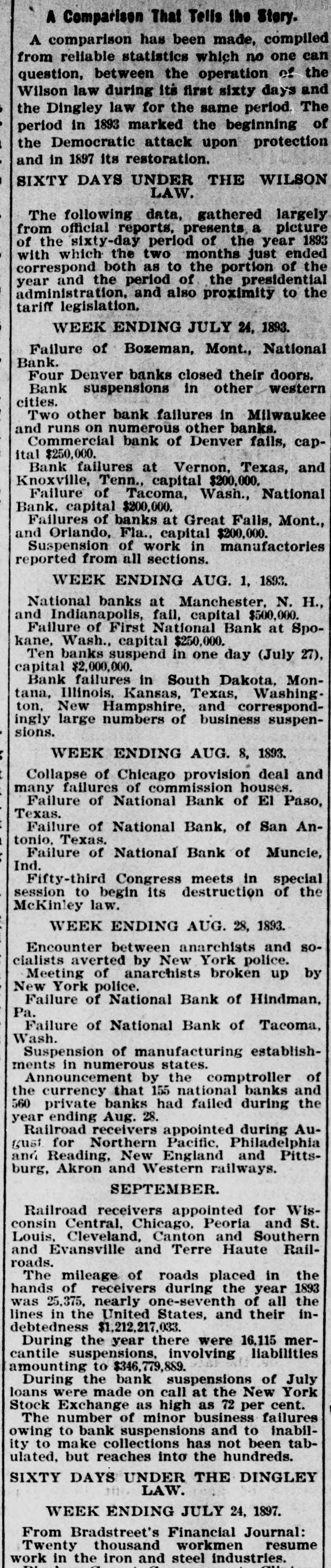
Failure of Tacoma, Wash., National Bank.
Source
newspapers
2. August 28, 1893 Receivership
Newspaper Excerpt
Announcement by the comptroller of the currency that 155 national banks and 560 private banks had failed during the year ending Aug. 28. ... Failure of national bank at Tacoma, Wash.
Source
newspapers

Newspaper Articles (3)

Article from Daily Kennebec Journal, October 1, 1897

Click image to open full size in new tab

Article Text

A Comparison That Tells the Story. A comparison has been made, compiled from reliable statistics which no one can question, between the operation of the Wilson law during its first sixty days and the Dingley law for the same period. The period in 1893 marked the beginning of the Democratic attack upon protection and in 1897 its restoration. SIXTY DAYS UNDER THE WILSON LAW. The following data, gathered largely from official reports, presents a picture of the sixty-day period of the year 1893 with which the two months just ended correspond both as to the portion of the year and the period of the presidential administration, and also proximity to the tariff legislation. WEEK ENDING JULY 24, 1893. Failure of Bozeman, Mont., National Bank. Four Denver banks closed their doors. Bank suspensions in other western cities. Two other bank failures in Milwaukee and runs on numerous other banks. Commercial bank of Denver fails, capital $250,000. Bank failures at Vernon, Texas, and Knoxville, Tenn., capital $200,000. Failure of Tacoma, Wash., National Bank. capital $200,000. Failures of banks at Great Falls, Mont., and Orlando, Fla., capital $200,000. Suspension of work in manufactories reported from all sections. WEEK ENDING AUG. 1, 1893. National banks at Manchester, N. H., and Indianapolis, fail, capital $500,000. Failure of First National Bank at Spokane, Wash., capital $250,000. Ten banks suspend in one day (July 27), capital $2,000,000. Bank failures in South Dakota, Montana, Illinois. Kansas, Texas, Washington. New Hampshire, and correspondingly large numbers of business suspensions. WEEK ENDING AUG. 8, 1893. Collapse of Chicago provision deal and many failures of commission houses. Failure of National Bank of El Paso, Texas. Failure of National Bank, of San Antonio. Texas. Failure of National Bank of Muncie, Ind. Fifty-third Congress meets in special session to begin its destruction of the McKinley law. WEEK ENDING AUG. 28, 1893. Encounter between anarchists and soclalists averted by New York police. Meeting of anarchists broken up by New York police. Failure of National Bank of Hindman, Pa. Failure of National Bank of Tacoma, Wash. Suspension of manufacturing establishments in numerous states. Announcement by the comptroller of the currency that 155 national banks and 560 private banks had failed during the year ending Aug. 28. Railroad receivers appointed during August for Northern Pacific, Philadelphia and Reading, New England and Pittsburg, Akron and Western railways. SEPTEMBER. Railroad receivers appointed for Wisconsin Central. Chicago, Peoria and St. Louis, Cleveland, Canton and Southern and Evansville and Terre Haute Railroads. The mileage of roads placed in the hands of receivers during the year 1893 was 25,375, nearly one-seventh of all the lines in the United States, and their indebtedness $1,212,217,033. During the year there were 16,115 mercantile suspensions, involving liabilities amounting to $346,779,889. During the bank suspensions of July loans were made on call at the New York Stock Exchange as high as 72 per cent. The number of minor business failures owing to bank suspensions and to inability to make collections has not been tabulated, but reaches into the hundreds. SIXTY DAYS UNDER THE DINGLEY LAW. WEEK ENDING JULY 24, 1897. From Bradstreet's Financial Journal: Twenty thousand workmen resume work in the iron and steel industries.


Article from The Salt Lake Herald, October 11, 1897

Click image to open full size in new tab

Article Text

yond the shadow of a doubt that McKinley tariff law had something to do with the inauguration of the great financial panic beginning in 1893. The fact that the Chicago Times-Herald is the staunchest advocate of a high protective tariff, and the added fact that the relations between its editor, Mr. Kohlsaat, and President McKinley are such that the Times-Herald is looked upon as the president's personal organ, makes this showing all the more unexpected and remarkable. The mere fact that the was mixed in its dates, charging the Wilson law with being the cause of things that transpired before the Wilson law was introduced in congress. does not break the force of that organ's arraignment of the McKinley law. The Times-Herald has apologized for its blunder. but the awful record of business failure and industrial depression under the McKinley law still stands. B Jepun '17 IO enss) S11 us Washington date line, the Times-Herald undertook to prove that the Dingley law is productive of prosperity The matter occupies a four column square on the first page, under a flaring head line, and contrasts two periods. One period covers the time from July 24 to September 24, 1893; the other a similar time in 1897. The two periods are printed in parallel columns. That of 1897 is under the sub-heading of "Sixty Days Under the Dingley Law. -qns Jepun SI 3683 JO that heading, 'Sixty Days Under the Wilson Law The latter is here reproDays Under the Wilson MET Week Ending July 24. 1893.-Failure of Bozeman (Mont.) National bank. Four Denver banks closed their doors Bank suspensions in other western cities. Two other bank failures in Milwaukee and runs on numerous other banks. Commercial bank of Denver fails, capital $250,000. Bank failures at Vernon. Tex. and Knoxville, Tenn. capital $200,000. Failure of Tacoma (Wash.) National bank, capital $200,000. Failures of banks at Great Falls. Mont. and Orlanda, Fla., capital $200,000. Suspension of work in manufactories reported from all sections. Week Ending Aug. 1. 1893.-National -UI pue "H N 18 dianapolis, Ind., fail, capital $500,000 Failure of First National bank at Spokane, Wash., capital $250,000. Ten banks suspend in one day (July 27), capital $2,000,000. Bank failures in South Dakota, Montana, Illinois, Kansas, Texas, Washington. New Hampshire and correspondingly large number of business suspensions. Week Ending Aug. 8. 1893.-Collapse of Chicago provision deal and many failures of commission houses. Failure of National bank of El Paso, Tex. Failure of National bank of San Antonio, Tex. Failure of National bank of Muncie, Ind. Fifty-third congress meets in special session to begin Its destruction of the McKinley law. Week Ending Aug. 28. 1893. -Encounter between anarchists and socialists averted by New York police. Meeting MIOX MAN sq dn broken JO police. Failure of national bank of Hindman. Pa. Failure of national bank of Tacoma, Wash. Suspension of manufacturing establishments in numerous states Announcement by the comptroller of the currency that 155 national banks and 560 private banks had falled during the year ending Aug 28 Railroad receivers appointed during August for Northern Pacific, Philadelphia & Reading. New England & Pittsburg, Akron & Western railways September.-Rallroad receivers ap pointed for Wisconsin Central, Chicago, Peoria & St. Louis, Cleveland. Canton & Southern and Evansville & Terre Haute. The mileage of roads placed in the hands of receivers during the year He TO seventh euo '948'97 SBM 2681 the lines in the United States, and their indebtedness 212,217 033. During the year there were 16,115 mercantile suspensions, involving liabilities amount ing to $346,779,889. During the bank suspensions of July loans were made on call at the New York Stock Exchange TO requinu ene ask 21 SE SB minor business failures owing to bank suspensions and to inability to make collections has not been tabulated, but reaches into the hundreds. This is a bad record for the tariff law under which all these calamities occurred. but. unfortunately for the Times-Herald, the Wilson law was not then in operation. In fact, at that time the Wilson law had not been introduced in congress. The congress which passed the Wilson law met in Decem ber, 1893-two months after the ending of the period set forth in the TimesHerald. The Wilson law passed the house on Feb. 1. 1894 four months after the ending of the period set forth by the Times Herald. It passed the sen1994 E Ainr uo u! air nine months after the ending of the period set forth by the Times Herald. After repeated conferences and disagreements the house adopted the sen ate bill entire on Aug. 13, 1894-ten months and 13 days after the expira tion of the period set forth by the Times-Herald. The Wilson law went into effect just 11 months after the ending of the period set forth by the Times Herald. Briefly, every business failure attributed by the Chicago Times-Herald in the above ex S tract to the Wilson law took place un der the McKinley law before the Wilson bill had been introduced in con. gress. In Its efforts to prove that the 941 JOJ SEM ME WITHON business depression in 1893 the Times Herald succeeeds only in proving that the McKinley law was responsible. A correspondent of the Chicago protection organ was quick to discover the hole which engulfed it, and wrote as follows: Editor of the Times-Herald: Did you not make a blunder in your supposedly 4 deadly parallel on Monday morning when you contrasted the workings of S the Wilson and the Dingley acts ano the business failures under them? The period dating from July 24 to Septem ber, 1833, which you say was "sixty days under the Wilson law." was more than 2. year before the Wilson law went into operation, and some months in 01 persented SEM 11 before house. The McKinley law was then in full force. Ought you not as a fair an & great newspaper to retract this mis statement? B. A. M'CONNELL The Times-Herald admitted that a made a grave mistake by publishing one


Article from The Laramie Republican, October 14, 1897

Click image to open full size in new tab

Article Text

JUST FOR COMPARISON. SOMETHING IN RELATION TO THE CONDITIONS WHICH EXISTED IN 1892. And Then Look Upon the Fair Picture Presented in 1897-Then the Banks Were Failing and Everything Was Tumbling-Now Everything is on the Mend and Mills Are Opening. Washington, D. C., Oct. 11.-(Special Correspondence.)-The reports of business improvement and activity in manu. facturing and commercial lines which have come to the front since the enact. ment of the Dingley law has suggested to somebody with a good memory a comparison of present conditions with those of the corresponding dates in the first year of the Cleveland administration. It is a curious fact that the enactment of the Wilson law came at just about a corresponding period with the meeting of the free-trade congress in the first year of Cleveland's second term, and that it is therefore possible to contrast business conditions under the shadow of approaching free trade with the busid ness conditions in the sunshine of re1 turning protection. This comparison is e startling. The period covered in the comparison is the two months since the final action upon the Dingley bill compared with the corresponding two it months in the Cleveland term, or from July 24 to September 24, 1893, contrasted with July 24 to September 24, 1897. Here is the contrast; it is well worth e laying aside for reference: Week ending July 24, 1893-Failure of e Bozeman, Montana, national bank. Four Denver banks closed their doors. Bank a suspensions in other western cities. Two e banks failed in Milwaukee, and runs.on d numerous other banks. Commercial bank of Denver falls; capital $250,000. h Bank failures at Vernon, Tex., and Knoxville, Tenn., capital, $200,000. Faily ure of Takoma, Wash., National bank; capital, $200,0000; also failure of banks d at Great Falls, Mont., and Orlando, Fla.; capital, $200,000. Suspension of work in y S manufactories reported from all seca tions. Week ending August 1, 1893-National banks at Manchester, N. H., and g Indianapolis, Ind., fail; capital $500,000. e Failure of First National bank at Spo. kane, Wash.,; capital $250,000. Ten 0 banks suspended in one day (July 27); n capital $2,000,000. Bank failures in South Dakota, Montana, Illinois, Kand sas, Texas, Washington, New Hampat shire, and correspondingly large num9 bers of business suspensions. 6 Week ending August 8, 1893-Collapse r of Chicago provision deal, and many failures of commercial houses. Failure at of national bank of El Paso, Texas. FailS ure of national bank of San Antonio, 1 Texas. Failure of national bank of it Muncie, Ind. Fifty-third congress meets 1 in special session to begin its destruction d of the McKinley law. d Week ending August 28, 1893-Ener counter between the anarchists and 80y clalists averted by New York police; * meeting of New York anarchists broken d up by New York police. Failure of na. tional bank at Hindman, Pa. Failure of Ф national bank at Tacoma, Wash. SusR pension of manufacturing establishments in numerous states. Announcement by 8 6 comptroller of currency that 155 national banks and 560 private banks had falled d during the year ending August 28. Railat road receivers appointed during August for Northern Pacific, Philadelphia and s Reading, New England, and Pittsburg, Akron and Western. is September-Railroad receivers ap0 pointed for Wisconsin Central, Chicago, 0 Peoria and St. Louis, Cleveland, Canton e and Southern, and Evansville and Terre Haute railroads. The mileage of roads 19 placed in the hands of receivers during g the year 1893 was 25,375, nearly oneseventh of all the lines in the United a States, and their indebtedness, $1,212,10 217,033. During the year there were 16,115 mercantile suspenions, Involve ing liabilities amounting to $346,779,889. 8 During the bank suspensions of July loans were made on call at the New York stock exchange as high as 72 per cent.