Article Text
Western and Southern States.
Five illicit distilleries were recently destroyed in one day in Putnam Co., Tenn., by United States revenue officers.
Official returns from Ohio give Barnes, Republican candidate for secretary of State, a plurality of 3 154.
The California constitutional convention adopted a resolution to memoralize the President and the United States Senate to so modify the Burlingame treaty as to prohibit Chinese immigration.
Five people were drowned near Sandford, in Orange county, Fla., a few days ago. Two were ladies named Hughey, and two were children of Calvin Martin. The fifth was a man named Melves. They were in a wagon en route for home from camp-meeting, and drove into a deep hole at the lake side. A sixth person was rescued after standing up in the wagon for several hours with the water up to his chin.
George T. Nelson, while climbing a fence near Kennedyville, Md., was accidentally killed by the discharge of his gun. When the news of the accident reached his mother, six hours after, she was so overcome that she died of grief.
By the bursting of a boiler belonging to a sawmill near McLeansboro, Ill., the proprietor and another man were killed and three other men were fatally injured.
Ten persons were poisoned at a wedding feast at Azalia, Ind. They partook of food in which some person supposed to be a disappointed lover of the bride-had placed strych nine. Three of the persons affected were made dangerously ill.
A Memphis (Tenn) dispatch says a party of white men killed a colored man near Glencoe, Tenn., shooting him while in bed, in his own house. In retaliation a party of colored men captured and killed a white man supposed to have been the murderer, while asleep on the porch of a grocery at Cuba, on the next night. It turned out they killed the wrong man.
The failure of Stagle Brothers, of Greenfield, Ohio, is the heaviest that has occurred in that section for years. They owned the largest farm in Fayette county. It comprised 2,200 acres. The liabilities exceed $120,000; the assets will probably reach ten per cent.
The appearance of frosts in the districts of the South given up to yellow fever was the cause of great rejoicing among the long-suffering people. The epidemic immediately decreased in the number of deaths and of new cases to such an extent that the medical and charitable associations of the large cities, called into existence by the plague, began to end their labors, while many persons, who had fled from the fever, returned to their homes.
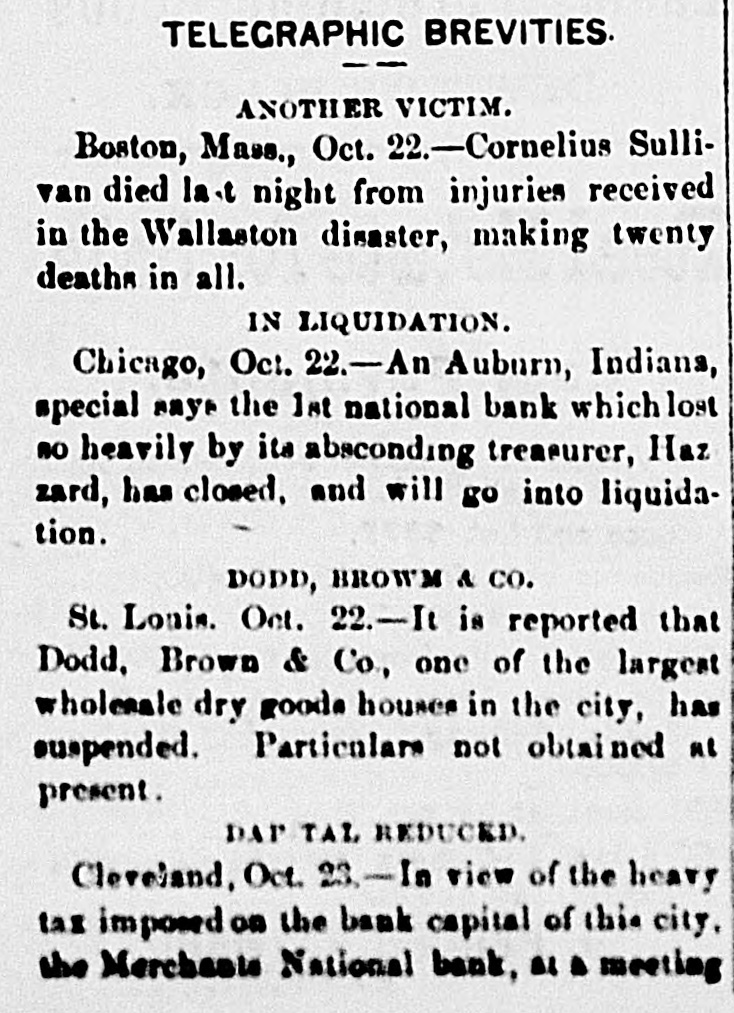
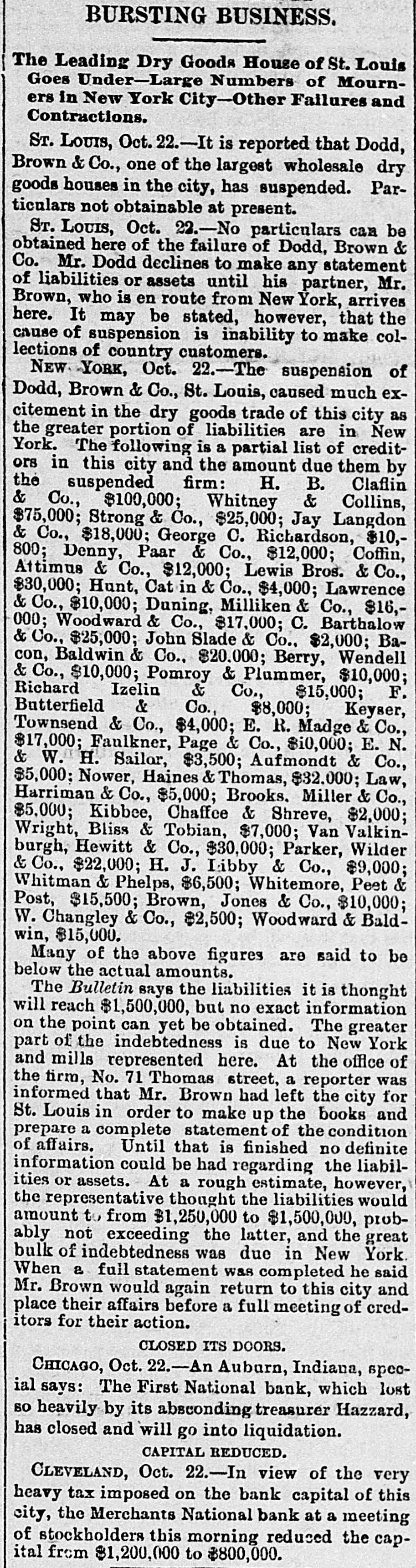
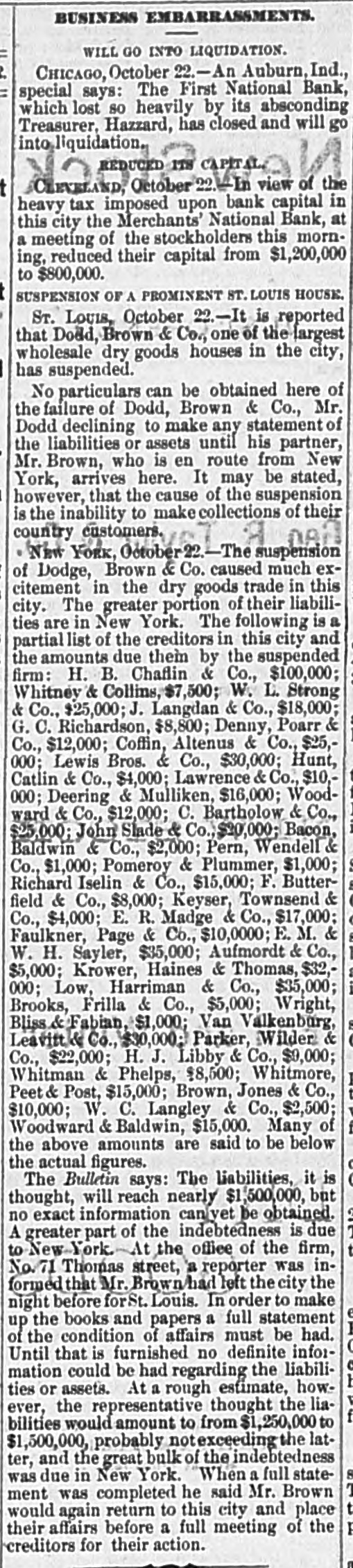
The First national bank, of Auburn, Ind., which suffered so heavily from the defalcation of George Hazard, its late cashier, has suspended.
The failure of Dodd, Brown & Co., the largest dry goods house in St. Louis, is announced. The depression in trade caused by the yellow fever in the South, was one of the principal causes of the failure. The firm's liabilities are estimated to be between $1,500,000 and $2,000,000, with assets of about $1,000,000.
"Big Mike" Roark, leader of a gang of Western highwaymen, for whose capture a reward of $3,000 had been out, was taken prisoner near Kansas City, Mo., and a companion named Dement was shot dead. This breaks up one of the most desperate gangs of train robbers in the country.
Telegrams received in Omaha, Neb., show that prairie fires in Butler, Seward and Saunders counties, are far more destructive and sweeping than was at first supposed. The fire originated in the Platte river bottom, northwest of David City, and extended over territory eight by twenty-five miles in extent, sweeping away every growing thing, stacks of hay and grain, barns, farm houses, etc. Leaping the Republican valley railroad track, burning telegraph poles and even ties off the railroad, in many places making a solid wall of flame, it swept down on David City with fearful rapidity. The town was barely saved by promptly setting a back fire, not two minutes too soon. Bone Creek valley, a splendid farming region and thickly settled, is a scene of black desolation, having been swept perfectly clean. The same is the case to the south and east. Fine groves, with which most of the farmers have protected their houses and farm buildings-for which Butler county is noted-are completely swept away, and years will be necessary to restore them. The very door yards of Brainard village were burned. In the overwhelming wind the flames leaped all ordinary fire guards with ease. Had the railroad proved a barrier the villages of Oak creek and of the head waters of Blue river, now burned over, would have escaped. Seven persons were burned to death, many more were severely injured, and the destruction of farming property is immense.
From Washington.
The recent decision in the internal revenue bureau that persons who sell certain patent medicines known as "bitters," either by the drink or in unbroken packages, are liquor dealers, and are liable to special taxes as such, will take effect from and after January 1, 1878 instead of November 1, as heretofore ordered.
During a recent session of the cabinet the heads, of the various departments presented their estimates for the next fiscal year.
The curious device of a postmaster to add to his salary is made public by the following Washington dispatch: The president has pardoned Jacob Carver, late postmaster at Warsaw, Ky. convicted of opening letters and sentenced to a year's imprisonment. The compensation of Carver was very small, and he attempted to add to his emoluments by selling postage stamps, upon which he received a commission. In order to increase the number of stamps disposed of, he opened registered letters passing through his office, extracted the money and substituted the value thereof in postage stamps. The persons to whom the letters were directed received the value of the money sent them in stamps, but the government was defrauded out of a commission for the sale thereof. He has already served six months of his term and having lost a leg in the Union.