22308. Guarantee Loan and Trust Company (Seattle, WA)

Bank Information

Episode Type
Suspension → Closure
Bank Type
state
Start Date
May 26, 1896
Location
Seattle, Washington (47.606, -122.332)

Metadata

Model
gpt-5-mini
Short Digest
d2970c99

Response Measures

None

Description

The bank is repeatedly described as a defunct/private banking corporation that failed on May 26, 1896 and was placed in receivership. No article describes a depositor run or reopening; instead the papers discuss receivers, assessments on stockholders, foreclosure of mortgages, and final accounting — consistent with permanent failure/closure. OCR errors in articles corrected (e.g., dates and small typos). Article dates used to date events.

Events (6)

1. May 26, 1896 Receivership
Newspaper Excerpt
the appointment of the receiver, and states that the claims presented and approved by the latter aggregate $192,840.77. The assets...the insolvent banking corporation; Jacob Furth (receiver) is mentioned as predecessor to Samuel C. Calderhead later on, indicating an earlier receivership following the failure in 1896. (OCR corrected).
Source
newspapers
2. May 26, 1896 Suspension
Cause
Bank Specific Adverse Info
Cause Details
Bank became insolvent and failed on May 26, 1896; claims against the bank exceeded assets according to court filings.
Newspaper Excerpt
a private banking corporation which failed on May 26, 1896
Source
newspapers
3. September 24, 1898 Other
Newspaper Excerpt
At the time the last mentioned institution failed it had on deposit about of the insurance money. The executors say that their claim for this amount has been allowed by the receiver of the ... institution and that they believe they will realize about 5 per cent of its (discussion of estate and deposits in failed institution).
Source
newspapers
4. May 14, 1899 Receivership
Newspaper Excerpt
Receiver of Guarantee Loan and Trust Co. Levies an Assessment. The first step toward the settlement of the indebtedness of the defunct Guarantee Loan and Trust Company, a private banking corporation which failed on May 26, 1896, was taken in the superior court yesterday by Samuel C. Calderhead, the new receiver appointed by Judge Moore to succeed Jacob Furth, Receiver Calderhead obtained an order of court authorizing the proceeding, and will at once levy an assessment of 78% per cent. upon the stockholders of the bank. (Seattle P-I 1899-05-14).
Source
newspapers
5. July 17, 1900 Other
Newspaper Excerpt
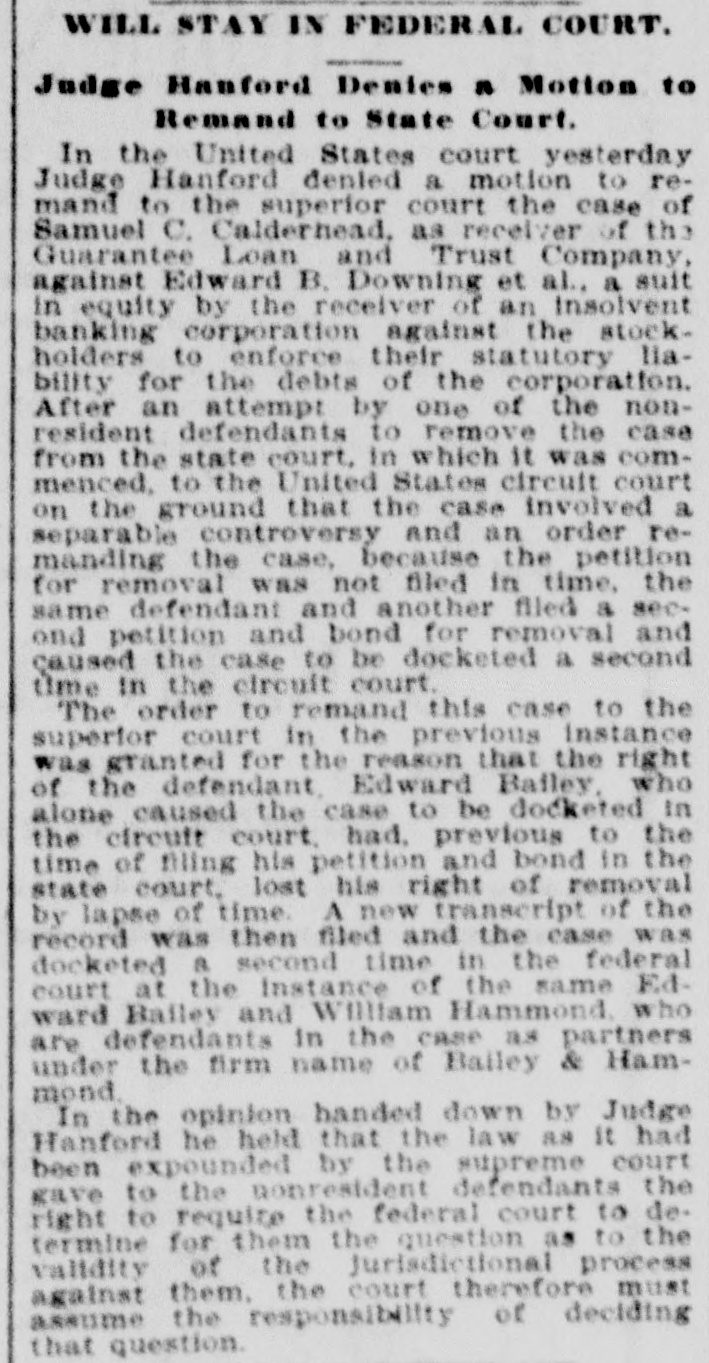
Judge Hanford denied a motion to remand to the superior court the case of Samuel C. Calderhead, as receiver of the Guarantee Loan and Trust Company, against Edward B. Downing et al., a suit in equity by the receiver of an insolvent banking corporation against the stockholders to enforce their statutory liability for the debts of the corporation.
Source
newspapers
6. May 28, 1903 Other
Newspaper Excerpt
Superior Judge Tallman yesterday afternoon refused to approve the final accounting of Samuel C. Calderhead as receiver of the defunct Guarantee Loan and Trust Company...the report shows a $562.32 balance in the hands of the receiver which has not been paid into court as ordered several days ago.
Source
newspapers

Newspaper Articles (5)

Article from The Seattle Post-Intelligencer, September 24, 1898

Click image to open full size in new tab

Article Text

# GEORGE HEILBRON'S ESTATE. Excutors File a Report in the Superior Court. The report of George F. Fay and William A. Peters, executors of the estate of George H. Heilbron, who died suddenly April 1, 1835, was filed in the probate court yesterday afternoon. The face value of the assets is $54.094.64 but the executors say that the actual value will not exceed $13.179.94. There are claims againg the estate amounting to $33,132.95. When the matter was taken before Judge Moore he appointed E. B. Downing, A. B. Stewart and J. M. Lyon appraisers, and issued an order directing that the estate be setted up according to law. This dedados vas rendered because the value of the property is not sufficient to pay off the indebtedness and the creditors will have to be ontent with their pro rata. Mr. Heilbron's estate, after his death, was find to consist of stocks, a $10.000 life insurance policy, a residence in Seattle sone acre tracts across Lake Washington and lots 1 and 2 in block 1, Werreit's addition. The insurance policy was held by the Guarantee Loan and Tust Company, which claimed it on the ground that has been deposited to secure an indebtedness on the part of Mr. Heilbron to the company, of which he was manager. The executors won the case both in the supelor and supreme courts. The $10,000 was hen deposited in three banks, one of whier was the Guarantee Loan and Trust Company. At the time the last mentioned sttution failed it had on deposit about of the insurance money. The exec-los say that their claim for this amount has been allowed by the receiver of the cinct institution and that they believe they will realize about 5 per cent of its
Article from The Seattle Post-Intelligencer, May 14, 1899

Click image to open full size in new tab

Article Text

STOCKHOLDERS MUST PAY UP. Receiver of Guarantee Loan and Trust Co. Levies an Assessment. The first step toward the settlement of the indebtedness of the defunct Guarantee Loan and Trust Company, a private banking corporation which failed on May 26, 1896, was taken in the superior court yesterday by Samuel C. Calderhead, the new receiver appointed by Judge Moore to succeed Jacob Furth, Receiver Calderhead obtained an order of court authorizing the proceeding, and will at once levy an assessment of 78% per cent. upon the stockholders of the bank. If entirely collected the assessment will net $156,500. Judge Moore's order. is quite lengthy. It recites the insolvency of the bank and the appointment of the receiver, and states that the claims presented and approved by the latter aggregate $192,840.77. The assets, it is stated. with the exception of the amount due from the stock-


Article from The Seattle Post-Intelligencer, December 17, 1899

Click image to open full size in new tab

Article Text

# ACTRESS' SEATTLE REAL ESTATE IS SOUGHT purchased by Mme. Rhea more than twelve years ago and cost her at the time, it is said, about $10,000. Those were boom days, however, and the property could not now be sold for that sum. Indeed, at one time property like Mme. Rhea's estate is now possessed of could not be sold at any price, and to all appearances the great actress at that dark period in Seattle's history concluded the investment was money thrown away and abandoned the property as not of enough value to justify further payment of taxes. Or possibly, engrossed as she was in the stage, Mme. Rhea had long before her death in Marseilles, France, last May, forgotten that she owned the little tract of land in far-away Seattle, which had always been managed for her by a local agent. To the fact that the actress, after purchasing the property, mortgaged it to the Guarantee Loan and Trust Company for $2,000, probably to secure a balance of the purchase money, is due the discovery now that Mme. Rhea owned Seattle real estate. The fact had long ago faded out of the minds of the Seattle men who were cognizant of the fact, but the watchful eye of the corporation had not slept, and immediately after the actress' death Samuel C. Calderhead, receiver of the loan company, which is now defunct, placed the mortgage in the hands of his lawyers, Donworth, Piles, Donworth & Howe, for foreclosure. Their first step, taken on Thursday in the probate court, was to obtain the appointment of Scott Calhoun, a well known attorney in their employe, to act as administrator of Mme. Rhea's estate, the receiver of the mortgage company, as principal creditor, having the power under the law to apply for an administrator in case the heirs did not. Mr. Calhoun is now engaged in searching for Rhea's helrs, but so far has met with little success. He has written the French consul in San Francisco for information regarding her, and has also been in correspondence with various well known theatrical people in the East. So far as he knows, the actress was never married. In the deeds to the property she is referred to as a single woman. Eleven acres of the West Seattle property Mme. Rhea bought from Harold Preston, now of the law firm of Preston, Carr & Gilman. "The property," said Mr. Preston yesterday, "was purchased for Mme. Rhea through L. S. J. Hunt. Mr. and Mrs. Hunt were personally acquainted with the actress, and I remember that when she visited Seattle she was always entertained by them in good style. My recollection is that Mme. Rhea was not here herself when the purchase was made, but had been just prior to that time. She was also here later, if I remember correctly. "At that time I was Mr. Hunt's attorney and kept track of his various real estate investments for him, paid taxes, etc. This property was in my care for some time after it passed into the actress' hands. How the sale came to be made I am not aware, but I suppose that Mme. Rhea bought it as an investment." The records of the county auditor's office show that Mme. Rhea, or, as she was known in the business world, Nellie Hortense Loret, at one time owned considerable real estate in Seattle, most of


Article from The Seattle Post-Intelligencer, July 17, 1900

Click image to open full size in new tab

Article Text

WILL STAY IN FEDERAL COURT. # Judge Hanford Denies a Motion to Remand to State Court. In the United States court yesterday Judge Hanford denied a motion to remand to the superior court the case of Samuel C. Calderhead, as receiver of the Guarantee Loan and Trust Company, against Edward B. Downing et al., a suit in equity by the receiver of an insolvent banking corporation against the stockholders to enforce their statutory liability for the debts of the corporation. After an attempt by one of the nonresident defendants to remove the case from the state court, in which it was commenced, to the United States circuit court on the ground that the case involved a separable controversy and an order remanding the case, because the petition for removal was not filed in time, the same defendant and another filed a second petition and bond for removal and caused the case to be docketed a second time in the circuit court. The order to remand this case to the superior court in the previous instance was granted for the reason that the right of the defendant, Edward Bailey, who alone caused the case to be docketed in the circuit court, had, previous to the time of filing his petition and bond in the state court, lost his right of removal by lapse of time. A new transcript of the record was then filed and the case was docketed a second time in the federal court at the instance of the same Edward Bailey and William Hammond, who are defendants in the case as partners under the firm name of Bailey & Hammond. In the opinion handed down by Judge Hanford he held that the law as it had been expounded by the supreme court gave to the nonresident defendants the right to require the federal court to determine for them the question as to the validity of the jurisdictional process against them, the court therefore must assume the responsibility of deciding that question.


Article from The Seattle Star, May 28, 1903

Click image to open full size in new tab

Article Text

# JACKS UP # RECEIVER # COURT REFUSES TO APPROVE # S. C. CALDERHEAD'S REPORT Superior Judge Tallman yesterday afternoon refused to approve the final accounting of Samuel C. Calderhead as received of the defunct Guarantee Loan and Trust Company, for the reason that the report shows a $562.32 balance in the hands of the receiver which has not been paid into court as ordered several days ago. The dissatisfaction of the court is also due to the fact that the report was merely a statement compiled for the receiver's books and not accompanied by bank records or vouches. Mr. Calderhead was appointed receiver for the company by Judge Moore in 199 and, although the affairs of the corporation are said to have been wound up two years ago, no formal report was filed until yesterday. The report of the receiver shows that he has collected $123,879.07 and distributed $133,411.75, leaving a balance of $567.32 on hand for which the receiver does not account.