22191. Wakefield State Bank (Elma, WA)

Bank Information

Episode Type
Suspension → Closure
Bank Type
state
Start Date
September 1, 1895*
Location
Elma, Washington (47.003, -123.409)

Metadata

Model
gpt-5-mini
Short Digest
b089d20f

Response Measures

None

Description

Articles (Sept 10 and Sept 20, 1895) report the Wakefield State Bank of Elma as having closed/suspended, assignees filing a statement, and imminent appointment of a receiver. Subsequent reporting describes gross mismanagement, insolvency, and criminal charges against the cashier. No run or depositor panic is mentioned; the bank closed and moved toward receivership due to bank-specific adverse information (mismanagement/insolvency).

Events (2)

1. September 1, 1895* Suspension
Cause
Bank Specific Adverse Info
Cause Details
Gross mismanagement and insolvency; assets overstated and insufficient cash at time of closing.
Newspaper Excerpt
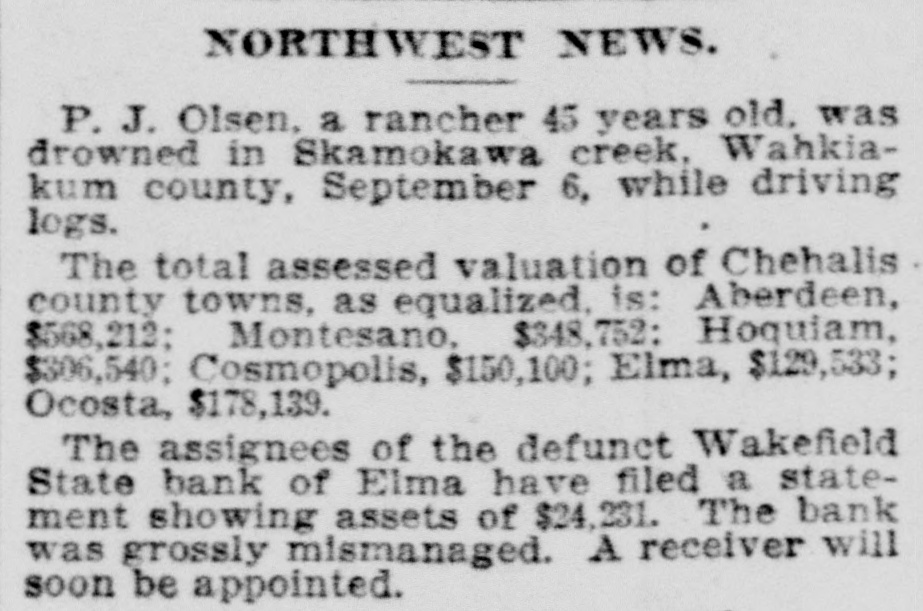
The assignees of the defunct Wakefield State bank of Elma have filed a statement ... The bank was grossly mismanaged. A receiver will soon be appointed.
Source
newspapers
2. September 10, 1895 Receivership
Newspaper Excerpt
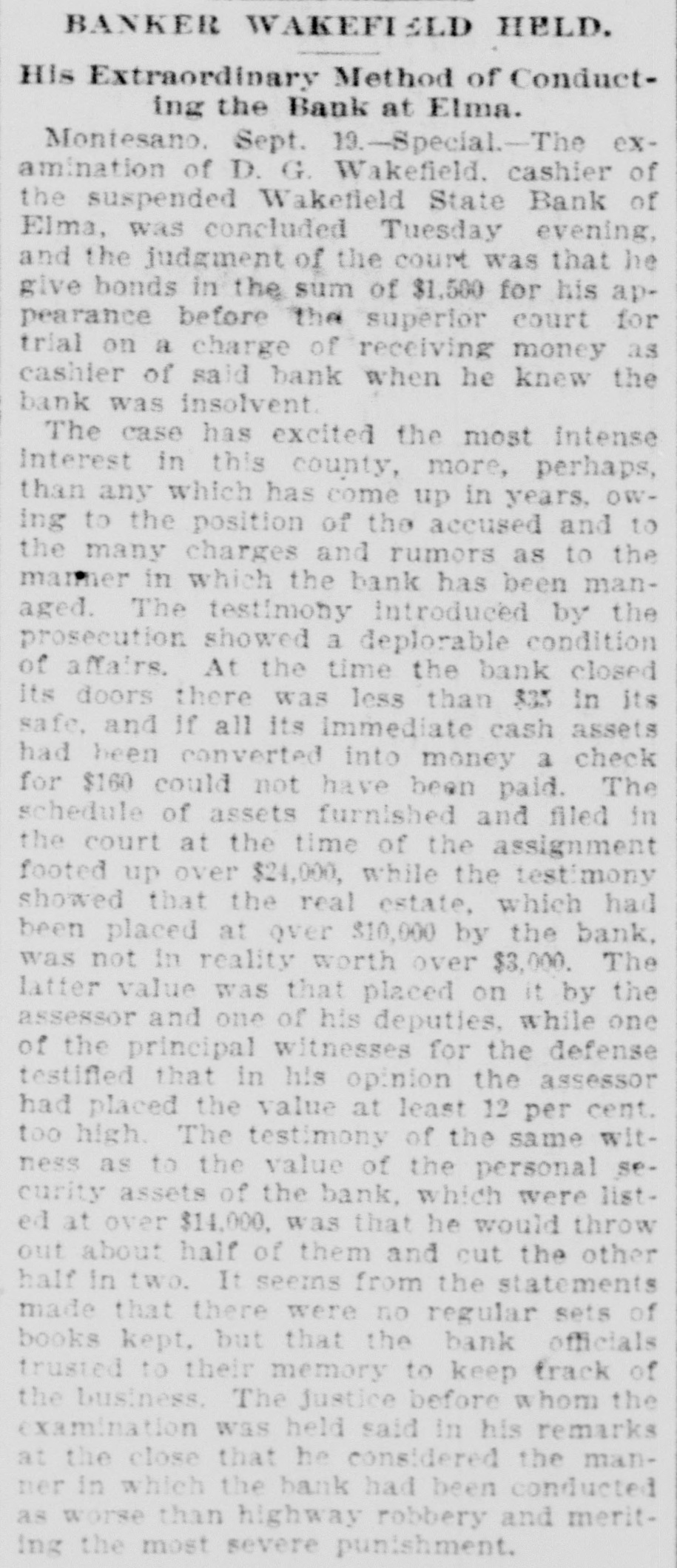
A receiver will soon be appointed. / The examination of D. G. Wakefield, cashier of the suspended Wakefield State Bank of Elma ... the bank closed its doors ... less than $35 in its safe ... testimony showed a deplorable condition of affairs.
Source
newspapers

Newspaper Articles (2)

Article from The Seattle Post-Intelligencer, September 10, 1895

Click image to open full size in new tab

Article Text

NORTHWEST NEWS. P. J. Olsen. a rancher 45 years old. was drowned in Skamokawa creek, Wahkiakum county, September 6, while driving logs. The total assessed valuation of Chehalis county towns, as equalized, is: Aberdeen, $568,212; Montesano, $348,752: Hoquiam, $306,540; Cosmopolis, $150,100; Elma, $129,533; Ocosta, $178,139. The assignees of the defunct Wakefield State bank of Elma have filed a statement showing assets of $24,231. The bank was grossly mismanaged. A receiver will soon be appointed.

Article from The Seattle Post-Intelligencer, September 20, 1895

Click image to open full size in new tab

Article Text

BANKER WAKEFIELD HELD. His Extraordinary Method of Conducting the Bank at Elma. Montesano. Sept. 19.-Special.-The examination of D. G. Wakefield. cashier of the suspended Wakefield State Bank of Elma, was concluded Tuesday evening, and the judgment of the court was that he give bonds in the sum of $1,500 for his appearance before the superior court for trial on a charge of receiving money as cashier of said bank when he knew the bank was insolvent The case has excited the most intense interest in this county, more, perhaps, than any which has come up in years. owing to the position of the accused and to the many charges and rumors as to the manner in which the bank has been managed. The testimony introduced by the prosecution showed a deplorable condition of affairs. At the time the bank closed its doors there was less than $35 in its safe. and If all its immediate cash assets had been converted into money a check for $160 could not have been paid. The schedule of assets furnished and filed in the court at the time of the assignment footed up over $24,000, while the testimony showed that the real estate, which had been placed at over $10,000 by the bank, was not in reality worth over $3,000. The latter value was that placed on it by the assessor and one of his deputies, while one of the principal witnesses for the defense testified that in his opinion the assessor had placed the value at least 12 per cent. too high. The testimony of the same witness as to the value of the personal security assets of the bank, which were listed at over $14,000. was that he would throw out about half of them and cut the other half in two. It seems from the statements made that there were no regular sets of books kept. but that the bank officials trusted to their memory to keep track of the business. The justice before whom the examination was held said in his remarks at the close that he considered the manner in which the bank had been conducted as worse than highway robbery and meriting the most severe punishment.