22064. St Albans Bank (St Albans, VT)

Bank Information

Episode Type
Run Only
Bank Type
state
Start Date
June 1, 1837*
Location
St Albans, Vermont (44.811, -73.083)

Metadata

Model
gpt-5-mini
Short Digest
b4251fc4

Response Measures

Accommodated withdrawals, Borrowed from banks or large institutions

Description

Contemporary accounts describe a discrete 1837 run on the St. Albans Bank. Directors borrowed silver from the Burlington bank overnight and paid depositors the next morning; confidence was restored in a few days and the bank did not suspend. Date within 1837 is imprecise (sources say summer of 1837 and a May 1837 paper references the episode).

Events (1)

1. June 1, 1837* Run
Cause
Local Banks
Cause Details
Directors learned that Boston parties were coming with large quantities of paper to try to crowd the bank, prompting heavy withdrawals.
Measures
Teller Henry Wells and Colonel Bell went to Burlington overnight, borrowed large amount of silver from the Burlington bank (packed in kegs), returned before banking hours and paid demands.
Newspaper Excerpt
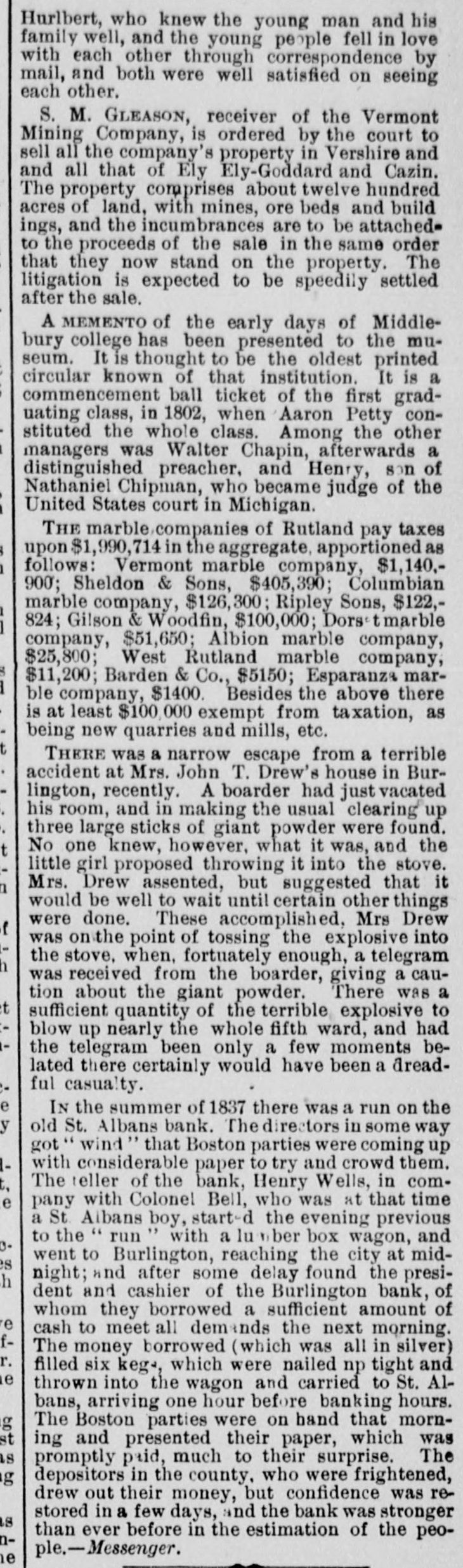
IN the summer of 1837 there was a run on the old St. Albans bank. ... they borrowed a sufficient amount of cash to meet all demands the next morning.
Source
newspapers

Newspaper Articles (2)

Article from Rutland Herald, May 16, 1837

Click image to open full size in new tab

Article Text

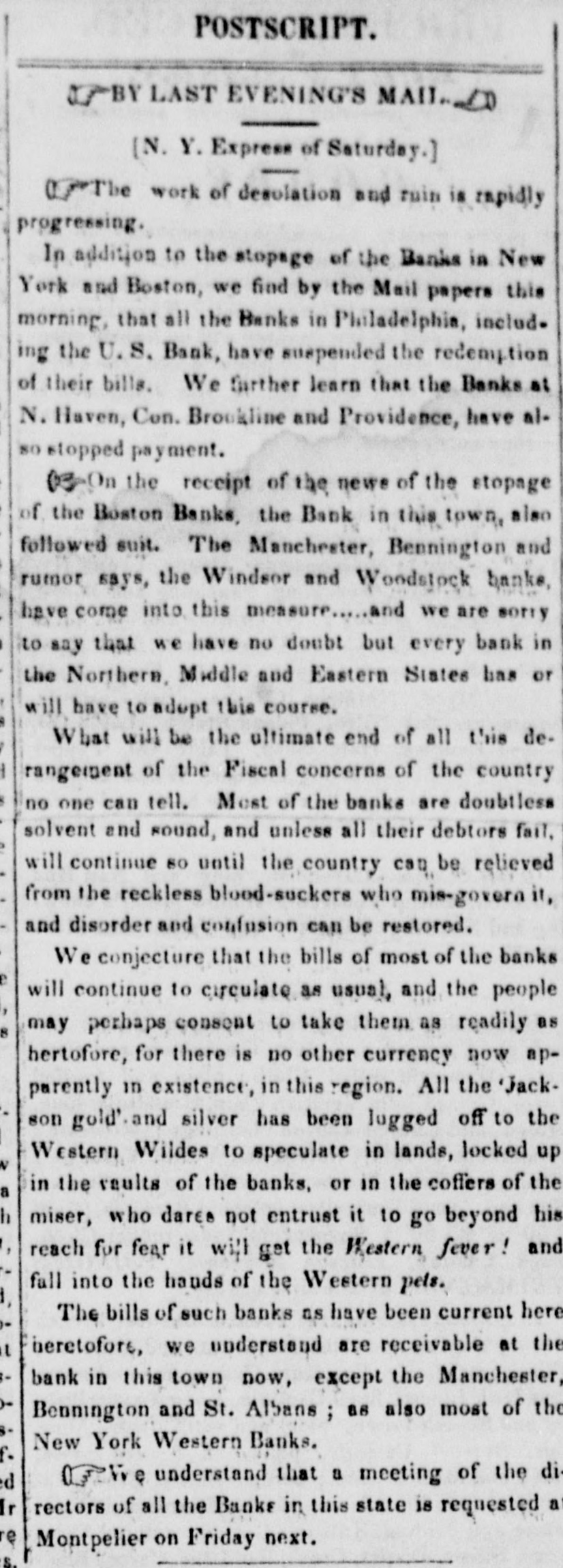
POSTSCRIPT. BY LAST EVENING'S MAIL so (N. Y. Express of Saturday.) 07 The work of desolation and ruin is rapidly progressing. In addition to the stopage of the Banks in New York and Boston, we find by the Mail papers this morning, that all the Banks in Philadelphia, includ. ing the U.S. Bank, have suspended the redemption of their bills. We further learn that the Banks at N. Haven, Con. Brookline and Providence, have al. so stopped payment. B On the receipt of the news of the stopage of the Boston Banks, the Bank in this town, also followed suit. The Manchester, Bennington and rumor says, the Windsor and Woodstock banks, have come into this measure and we are sorry to say that we have no doubt but every bank in the Northern. Middle and Eastern States has or will have to adopt this course. What will be the ultimate end of all this derangement of the Fiscal concerns of the country no one can tell. Most of the banks are doubtless solvent and sound, and unless all their debtors fail. will continue 80 until the country can be relieved from the reckless blood-suckers who mis- govern it, and disorder and confusion can be restored. We conjecture that the bills of most of the banks will continue to circulate as usual, and the people may perhaps consent to take them as readily as hertofore, for there is no other currency now apparently ID existence, in this region. All the Jack son gold' and silver has been lugged off to the Western Wildes to speculate in lands, locked up in the vaults of the banks, or in the coffers of the miser, who dares not entrust it to go beyond his reach for fear it will get the Western fever! and fall into the hands of the Western pels. The bills of such banks as have been current here heretofore, we understand are receivable at the bank in this town now, except the Manchester, Bennington and St. Albans ; 86 also most of the New York Western Banks. d we understand that a meeting of the directors of all the Banks in this state is requested a Montpelier on Friday next.

Article from The Vermont Watchman, May 21, 1884

Click image to open full size in new tab

Article Text

Hurlbert, who knew the young man and his family well, and the young people fell in love with each other through correspondence by mail, and both were well satisfied on seeing each other. S. M. GLEASON, receiver of the Vermont Mining Company, is ordered by the court to sell all the company's property in Vershire and and all that of Ely Ely-Goddard and Cazin. The property comprises about twelve hundred acres of land, with mines, ore beds and build ings, and the incumbrances are to be attachedto the proceeds of the sale in the same order that they now stand on the property. The litigation is expected to be speedily settled after the sale. A MEMENTO of the early days of Middlebury college has been presented to the museum. It is thought to be the oldest printed circular known of that institution. It is a commencement ball ticket of the first graduating class, in 1802, when Aaron Petty constituted the whole class. Among the other managers was Walter Chapin, afterwards a distinguished preacher, and Henry, son of Nathaniel Chipman, who became judge of the United States court in Michigan. THE marble.companies of Rutland pay taxes upon $1,990,714 in the aggregate, apportioned as follows: Vermont marble company, $1,140,900; Sheldon & Sons, $405,390; Columbian marble company, $126,300; Ripley Sons, $122,824; Gilson & Woodfin, $100,000; Dors t marble company, $51,650; Albion marble company, $25,800; West Rutland marble company, $11,200; Barden & Co., $5150; Esparanza marble company, $1400. Besides the above there is at least $100,000 exempt from taxation, as being new quarries and mills, etc. THERE was a narrow escape from a terrible accident at Mrs. John T. Drew's house in Burlington, recently. A boarder had just vacated his room, and in making the usual clearing up three large sticks of giant powder were found. No one knew, however, what it was, and the t little girl proposed throwing it into the stove. Mrs. Drew assented, but suggested that it would be well to wait until certain other things were done. These accomplished, Mrs Drew was on the point of tossing the explosive into the stove, when, fortuately enough, a telegram was received from the boarder, giving a caution about the giant powder. There was a sufficient quantity of the terrible explosive to blow up nearly the whole fifth ward, and had the telegram been only a few moments belated there certainly would have been a dreadful casualty. e IN the summer of 1837 there was a run on the y old St. Albans bank. The directors in some way got wind that Boston parties were coming up with considerable paper to try and crowd them. The teller of the bank, Henry Wells, in come pany with Colonel Bell, who was at that time a St. Albans boy, start-d the evening previous to the run with a lu ber box wagon, and went to Burlington, reaching the city at midnight; and after some delay found the president and cashier of the Burlington bank, of whom they borrowed a sufficient amount of e cash to meet all demands the next morning. fThe money borrowed (which was all in silver) r. filled six keg-, which were nailed np tight and e thrown into the wagon and carried to St. Albans, arriving one hour before banking hours. The Boston parties were on hand that morning and presented their paper, which was is promptly paid, much to their surprise. The depositors in the county. who were frightened, g drew out their money, but confidence was restored in a few days, and the bank was stronger is than ever before in the estimation of the peonple.-Messenger. e