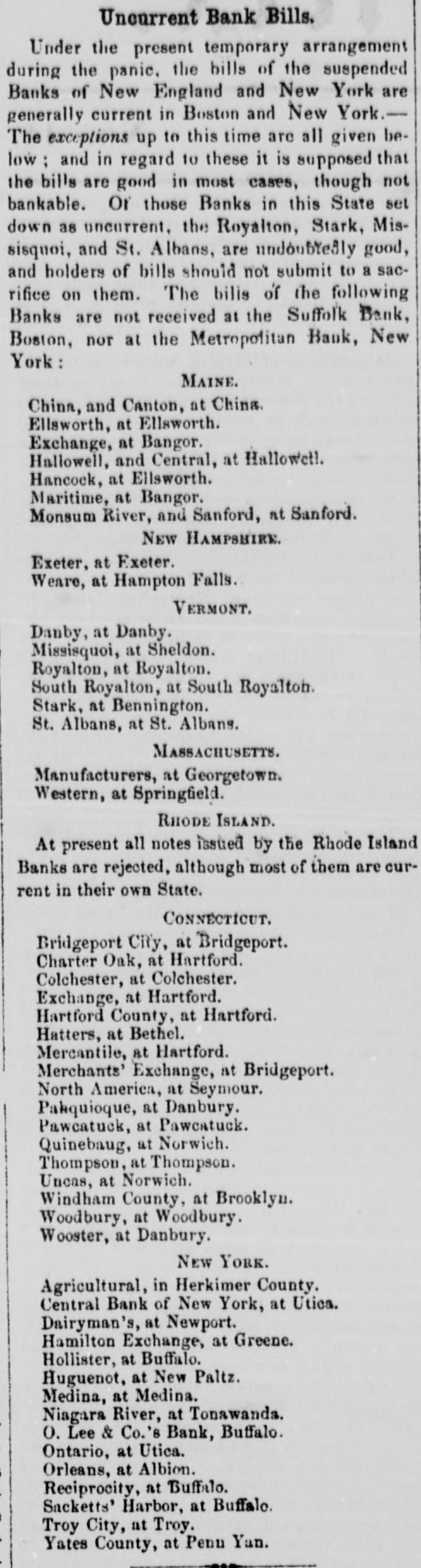
Click image to open full size in new tab
Article Text
where the House had not confined themselves strictly to the technical question of law. The motion to recommit pending, on motion of Mr. Kellog, the House adjourned.
FRIDAYY, October 29.
SENATE. Mr. Everts called up Senate Bill for the surrender of fugitives from service, and it was made a special order for Tuesday next at 11 o'clock A. M. Correction. In the Senate Reports of yesterday morning it appears that Mr. Chittenden moved a recommitment of bill for the relief of the St. Al- bans Banks, to committee on Banks. It should have read, Mr. French of Windsor. Mr. Chitten- den opposed the bill on the ground of establishing a dangerous precedent, and it was so reported, but by mistake at the office it appeared otherwise. Leave was granted to the committee on Roads to sit during the afternoon session. Mr. Stark moved to reconsider the vote indefi- nitely postponing Senate bill relating to witnesses, and the motion was agreed to. On motion of Mr. Chittenden, the bill was made the special order for to-morrow morning. Reports. By Mr. Chittenden, for committee on Judiciary, adverse to Senate bill extending the ju- risdiction of the constables, and the third reading was refused. By Mr. Stark, for Judiciary com- mittee, in favor of House bill to avoid delays in suits at law; ordered to a third reading. Public bill referred. Making further appropria- tion for the Ethan Allen Monument; to committee on Finance.
HOUSE. On motion of Mr. Deane, the committee on Roads had leave to sit during the sessions of the House. The Senate came in and the joint assembly elect ed Wm. G. Shaw. Esq., of Burlington, Reporter of the decisions of the Supreme Court. Reports. By Committee on Agriculture, bill to incorporate Connecticut Valley Fair Ground Co., and it was ordered to 3d reading. Also, bill for the encouragement of agriculture, exempting one yoke of oxen and certain farming tools from at- tachment. On motion of Mr. Hebard, the House went into committee of the whole on this bill; and the chair was assigned to Mr. Hebard. Mr. Olmstead moved to exempt one horse for every machanic; and Mr. Slayton moved to amend this proposition by adding one horse for each mechanic and lawyer, but the the chai ruled the last out of order at this time. Mesers Webber and Billings of Mt. Holly, favored the bill as reported, and on motion of Mr. Kellogg, the committee rose. Reports. By committee on Claims, bill to pay Geo. P. Marsh and John N. Pomeroy, for services in the supervision of the erection of the monument to Ethan Allen, in Burlington. Mr. Bridgman stated the facts in the caso, and Mr. Randall, of Roxbury, moved to dismiss; lost. And on motion of Mr. Hebard, the bill was laid on the table. By committee on Banks, bill for the relief of the St. Alban's Bank, (remitting the fine for temporary non-redemption of its bills in Boston and New York.) This bill was supported by Messrs. Ran- dall of Roxbury, Hebara and Deane, opposed by Messrs. Linsley of Rutiand, Rounds and Olmstead. This bill presents the simple question whether the alternative of paying a tax, instead of redeem- ing the bills of the bank as provided by Statute, shall be enforced in cases of exigency like that of last autumn. The House determined to enforce the Statute, by refusing the third reading of the bill.
SATURDAY, October 30.
SENATE. Mr. Gleed called up Senate Bill, re lating to witnesses. He thought the main objection to the bill was the fear of witnesses committing the crime of perjury; and in that he must disagree with other Senators. The argument that many a rogue would get clear by coolness, and innocent men suffer through em- barrassment, was one of the strongest presented by the Senator from Windsor. His experience was dif- ferent from this theory. Witnesses testifying un- der embarrassment, generally have their train of circumstances so connected that the embarrassment has a favorable effect upon the jury, and he be lieved that no criminal could go upon the stand, who was quilty, and have his story so well connect- ed, as to deceive a court and jury. By adopting the views a iverse to this bill we must exclude every witness on the stand, for all are liable to the crime of perjury. He thought the criminal code of the State was clearing itself of barbarism and approaching a plain system. The bill before the Senate proposed a further advance in the same di- rection. The change giving both parties the pri- vilege of testifying in civil cases had produced a most salutary effect. So it has been in our legis- lation, first to last, and this progression to im- provement is desirable. The law allowing the complainant to testify and excluding the respondent je a ludicrous one. By our law, as it now stands, a man of established character, for truth, can tes- tify in the case of another party, but when he himself is interested and is the best witness in the case, our statute excludes his testimony. Per- sons who have been confined in a Penitentiary for a criminal offence are allowed to testify against others, but where a man is arraigned on trial for a supposed crime, though of the best moral char- acter, by the present law, he must be excluded from vindicating his innocence. He was in fa- vor of this bill on the score of justice, and believ ed the time was not far distant when the change would be effected. Mr. Davis said that this bill with the amend- ment, provided that the respondent might testi y and be subjected to the usual cross examination: but he questioned the law, that will compel a witness to criminate himself. At that point the witness would claim his constitutional right and it was very strange that the State should allow the criminal to tell his own story, when he can fall at any moment upon his constitutional right and re- fuse any cross examination affecting his guilt- Such being the case with this bill, he was strongly opposed to it. Too often we should find men of previous good character go upon the stand, urged on by great excitement or personal interest, and commit the crime of perjury. He would not hold out such a temptation. The motion to indefinitely postpone was car- ried by 19 to 11. Reports. By Mr. Butier for committee on roads, bill to amend the charter of the Vermont and Canada railroad company, with amendment, substituting a new bill.) Mr. Buttler in explanation said that this char- ter expired to-morrow, and the committee offered the amendment, to extend the charter to the 5th of Nov. 1858, that further legislation might be had. The amendment was adopted and the bill passed. This bill was concurred in by the House in the afternoon.
TUESDAY, Nov. 2.
Senate Bill for the relief of the St. Albans Bank, being the special order, was taken up, the pending motion being to reconsider the vote by which the third reading was refused. Mr. Bartholoinew said he was one who voted against the bill and had not yet seen anything to change his vote upon it, but he was for a recom mitment, understanding that further facts would be presented, having a favorable bearing upon the bill. Mr. Chittenden called from the chairman of the bank committee a statement of facts. Mr. Smith said he had heard a statement in cir- culation that the bank had bought up its own cir- culation at a di count, which, if true, would have a serious effect upon the bill. He denied the charge, and was desirous of annearing, that the Senate might have a detailed statement of the condition of the bank at the time it was thrown out, and to present all the facts before the Senate before its final action. Mr. Chittenden did not desire to hear any fur- ther statement to correct the report that the Bank had bought up its bills at a discount. No Sens- tor, upon the denial of the report by the chair- man of the committee, could desire any further examination. Upon the bank committee is an officer of the St. Alban's Bank, and the friends of the bill had had an opportunity of making a full showing of facts. If the object to re-commait is to produce further facts which will have a tendency to clear up this case, and not to connect it with other matters, he would vote to reconsider; but until something was presented to that point he could not vote to recommit. The question wheth- er or not the bank did buy up its bills has no- thing indeed to do with the present question. All the precedents are one way on this matter, and there was not a case which had been presented but which had been granted; but none of these precedents apply to the Bank of St. Albans. When the Legislaiure interfered in these cases, the South Royalton Bank was in the hands of a Re- ceiver, and the Stark Bank and Bank of Castleton had impaired their capital by losses, so that a necessity existed, requiring it to be made up by the shareholders. Now the St. Albans' Bank does not ask a release upon grounds of insolvency, but while it is in a sound condition. Is it equitable, is it just that this bank should be so favored? This bank asks that a