Multiple syndicated articles (Mar 8–16, 1927) describe a heavy run on the Citizens Bank of West Palm Beach prompted by the closing/suspension of several nearby Palm Beach banks. An armored car brought cash from Miami and the Citizens Bank remained open and was able to meet withdrawals; the run subsided within a day or two. Classification: run only (no suspension/closure of Citizens Bank reported).
Events (1)
1.March 8, 1927Run
Cause
Local Banks
Cause Details
Run was triggered by the recent failure/closing of three nearby Palm Beach county banks; depositors withdrew from Citizens Bank in consequence.
Measures
Armored car dispatched from Miami bringing sacks of currency to the Citizens Bank to meet withdrawal demands; bank stayed open extended hours to pay depositors.
Newspaper Excerpt
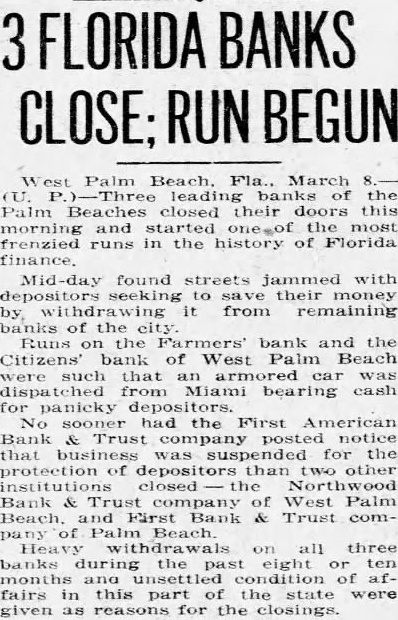
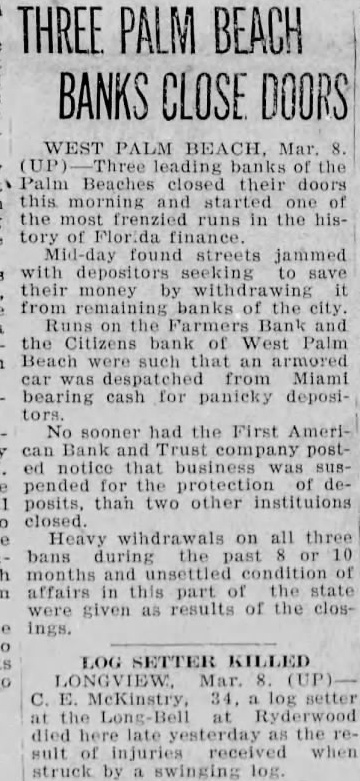
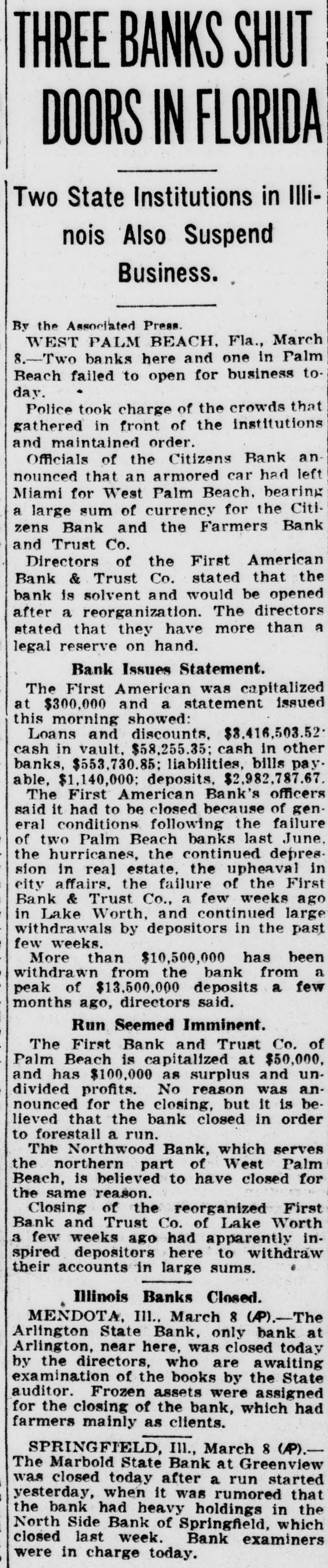
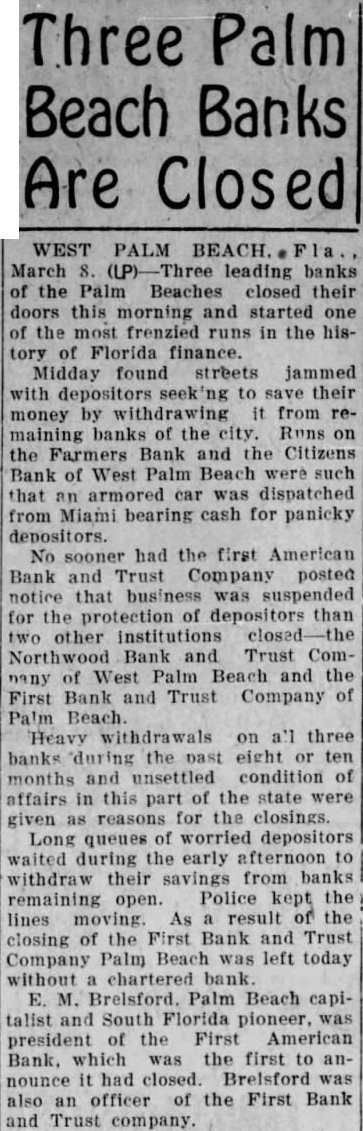
Runs on the Farmers Bank and the Citizens' bank of West Palm Beach were such that an armored car was dispatched from Miami bearing cash for panicky depositors.
Source
newspapers
Newspaper Articles (25)
1.March 8, 1927The Oregon Daily JournalPortland, OR
Click image to open full size in new tab
Article Text
FLORIDA BANKS CLOSE; RUN BEGUN
West Palm Fla., March leading banks the Palm Beaches closed their doors this morning and started one the most frenzied runs in the history of Florida finance. Mid-day found streets jammed with seeking to money it from remaining banks of the Runs on bank and the Citizens' bank of West Palm Beach were armored was from Miami bearing cash for panicky depositors. No sooner had First American Bank Trust notice that business suspended for the protection of depositors than two other Bank & company of West Palm and First Bank & Trust comof Beach all three banks during past eight and condition of fairs in this part the state were given as reasons for the closings.
2.March 8, 1927Astoria Evening BudgetAstoria, OR
Click image to open full size in new tab
Article Text
THREE PALM BEACH CLOSE
WEST PALM BEACH, Mar. leading banks of the Palm Beaches closed their doors this morning started one the most frenzied runs in the history of finance. Mid-day found streets jammed with depositors their money withdrawing from remaining banks of the city. Runs the Farmers Bank and the Citizens bank of West Palm Beach such that an armored despatched from Miami bearing cash for panicky deposiNo sooner had the First AmeriBank Trust company postnotice business pended for protection posits, than two other instituions closed. Heavy wihdrawals on all three bans during the past and unsettled condition affairs this part of state given as results of the closings.
LOG SETTER KILLED Mar. McKinstry, log setter the Ryderwood died late yesterday sult injuries received when by swinging log.
3.March 8, 1927Evening StarWashington, DC
Click image to open full size in new tab
Article Text
THREE BANKS SHUT DOORS IN FLORIDA Two State Institutions in Illinois Also Suspend Business. By the Associated Press. WEST PALM BEACH, Fla., March 8.-Two banks here and one in Palm Beach failed to open for business today. Police took charge of the crowds that gathered in front of the institutions and maintained order. Officials of the Citizens Bank an nounced that an armored car had left Miami for West Palm Beach. bearing a large sum of currency for the Citizens Bank and the Farmers Bank and Trust Co. Directors of the First American Bank & Trust Co. stated that the bank is solvent and would be opened after a reorganization. The directors stated that they have more than a legal reserve on hand. Bank Issues Statement. The First American was capitalized at $300,000 and a statement issued this morning showed: Loans and discounts, $3,416,503.52 cash in vault, $58,255.35; cash in other banks, $553,730.85; liabilities, bills pay able, $1,140,000; deposits, $2,982,787.67. The First American Bank's officers said it had to be closed because of gen. eral conditions following the failure of two Palm Beach banks last June. the hurricanes, the continued depres. sion in real estate. the upheaval in city affairs, the failure of the First Bank & Trust Co., a few weeks ago in Lake Worth, and continued large withdrawals by depositors in the past few weeks. More than $10,500,000 has been withdrawn from the bank from a peak of $13,500,000 deposits a few months ago, directors said. Run Seemed Imminent. The First Bank and Trust Co. of Palm Beach is capitalized at $50,000. and has $100,000 as surplus and un. divided profits. No reason was announced for the closing, but it is believed that the bank closed in order to forestall a run. The Northwood Bank, which serves the northern part of West Palm Beach, is believed to have closed for the same reason. Closing of the reorganized First Bank and Trust Co. of Lake Worth a few weeks ago had apparently inspired depositors here to withdraw their accounts in large sums. Illinois Banks Closed. MENDOTA, Ill., March 8 (AP).-The Arlington State Bank. only bank at Arlington, near here, was closed today by the directors, who are awaiting examination of the books by the State auditor. Frozen assets were assigned for the closing of the bank, which had farmers mainly as clients. SPRINGFIELD, Ill., March 8 (AP).The Marbold State Bank at Greenview was closed today after a run started yesterday, when it was rumored that the bank had heavy holdings in the North Side Bank of Springfield, which closed last week. Bank examiners were in charge today.
4.March 8, 1927Visalia Daily TimesVisalia, CA
Click image to open full size in new tab
Article Text
Three Palm Beach Banks Are Closed
WEST PALM March leading banks the Palm Beaches closed their doors this morning and started one of the most frenzied runs in the history of Florida finance. Midday found streets jammed with to save their money by withdrawing from remaining banks of the Runs on the Farmers Bank and the Citizens Bank of West Palm Beach were such that an armored car was dispatched from Miami bearing cash for panicky depositors. No sooner had the first American Bank and Trust Company posted notice that business was suspended for the protection of depositors than two other institutions Northwood Bank and Trust Comnany of West Palm Beach and the First Bank and Trust Company of Palm Beach. Heavy withdrawals on all three banks the past eight or ten months and unsettled condition of affairs in this part of the state were given as reasons for the closings. Long queues of worried depositors waited during the early afternoon to withdraw their savings from banks remaining Police kept the open. lines moving. As result of the closing of the First Bank and Trust Company Palm Beach was left today without chartered bank E. M. Brelsford. Palm Beach capitalist and South Florida pioneer, was president of the First American Bank, which was the first to announce it had closed. Brelsford was also an officer of the First Bank and Trust company.
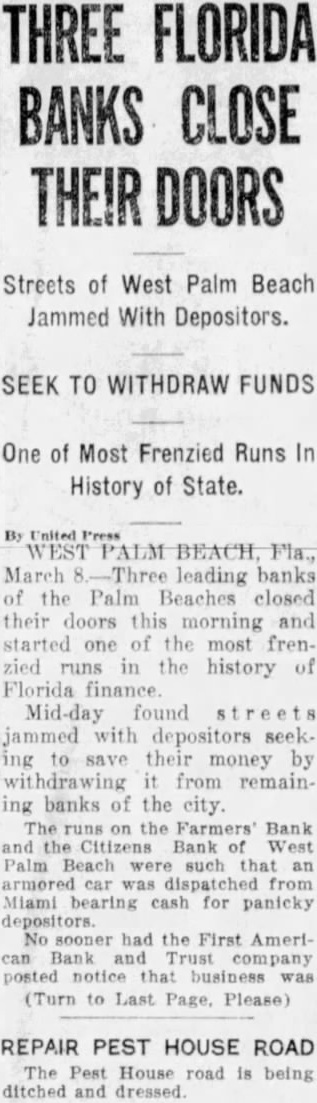
THREE FLORIDA BANKS CLOSE THEIR DOORS
Streets of West Palm Beach Jammed With Depositors.
SEEK TO WITHDRAW FUNDS
One of Most Frenzied Runs In History of State.
WEST March leading banks of the Palm Beaches closed their doors this morning and started one of the most frenzied runs in the history of Florida finance Mid-day found jammed with depositors seeking save their money by withdrawing from remaining banks of the city runs on the Farmers' Bank the Citizens Bank of West Palm Beach were such that an was dispatched from Miami bearing cash for panicky No sooner had the First AmeriBank and Trust company posted notice that business was (Turn to Last Page, Please)
REPAIR PEST HOUSE ROAD The Pest House road is being ditched and dressed.
6.March 8, 1927The Frederick LeaderFrederick, OK
Click image to open full size in new tab
Article Text
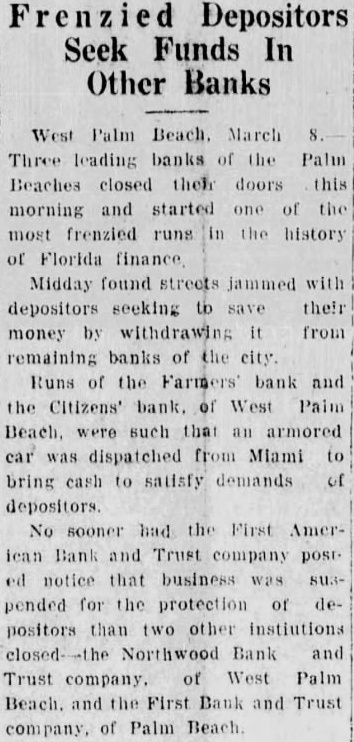
Frenzied Depositors Seek Funds In Other Banks
West Palm Beach. March Three leading banks of the Palm Beaches closed their doors this morning and started one of the most frenzied runs in the history of Florida finance Midday found streets jammed with depositors seeking to save their money by withdrawing it from remaining banks of the city. Runs of the Farmers bank and the Citizens' bank. of West Paim Beach, were such that an armored car was dispatched from Miami to bring cash to satisfy demands of depositors. No sooner had the First American Bank and Trust company post ed notice that business was suapended for the protection of depositors than two other instiutions Northwood Bank and Trust company. of West Palm Beach. and the First Bank and Trust company, of Palm Beach
7.March 8, 1927News JournalWilmington, OH
Click image to open full size in new tab
Article Text
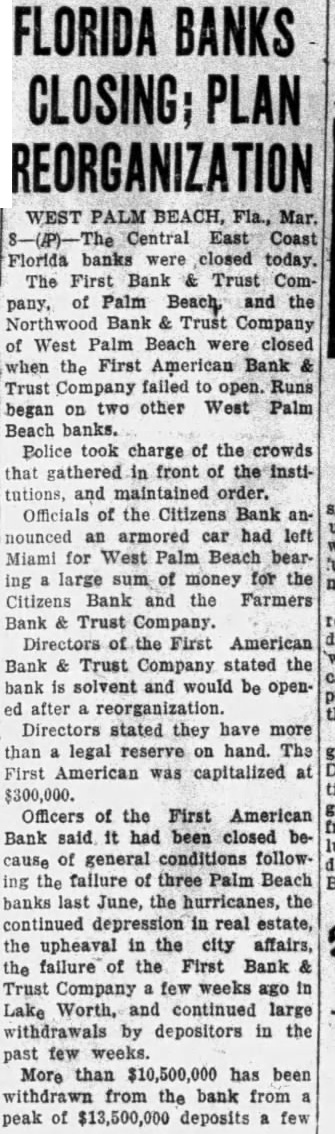
FLORIDA BANKS CLOSING; PLAN REORGANIZATION
WEST PALM BEACH, Mar. Central East Coast Florida banks were closed today. The First Bank Trust Company, of Palm Beach, and the Bank & Trust Company of West Palm Beach were closed when the First American Bank Trust Company failed to open. Runs began on two other West Palm Beach banks. Police took charge of the crowds that gathered in front of the institutions, and maintained order. Officials of the Citizens Bank announced an armored car had left Miami for West Palm Beach bearing large sum of money for the Citizens Bank and the Farmers Bank & Trust Company. Directors of the First American Bank Trust Company stated the bank is solvent and would be opened after reorganization. Directors stated they have more than legal reserve on hand. The First American was capitalized at $300,000. Officers of the First American Bank said it had been closed because of general conditions following the failure of three Palm Beach banks last June, the hurricanes, the continued depression real estate, the upheaval in the city affairs, the failure of the First Bank Trust Company few weeks ago in Lake Worth, and continued large withdrawals by depositors in the past few weeks. More than $10,500,000 has been withdrawn from the bank from peak of $13,500,000 deposits few
8.March 8, 1927Porterville RecorderPorterville, CA
Click image to open full size in new tab
Article Text
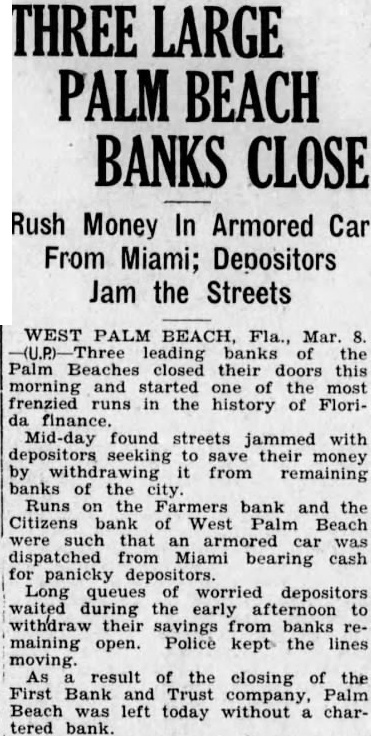
THREE LARGE PALM BEACH BANKS CLOSE
Rush Money In Armored Car From Miami; Depositors Jam the Streets
WEST PALM BEACH, Fla., Mar. leading banks of the Palm Beaches closed their doors this morning and started one of the most frenzied runs in the history of Florida finance. Mid-day found streets jammed with depositors seeking to save their money by from remaining banks of the Runs on the Farmers bank and the Citizens bank West Palm Beach were that armored car was dispatched from Miami bearing cash for panicky depositors. Long queues worried depositors waited during the early afternoon to withdraw their savings from banks maining open. Police kept the lines moving. As result of the closing of the First Bank and Trust Palm Beach was left today without chartered bank.
ARMORED CAR
Brings Relief To Banks
Three West Palm Beach Institutions Close Doors.
Depression Following Hurricane Is Attributed as Cause-Two Depositories Survive Runs.
8 (A. First Bank and Trust Company of Palm Beach and the Nor wood Bank and Trust Company of West Palm Beach closed today when the First American Bank and Trust began on two other Palm banks Police took charge of the crowds that gathered in front of the institu tions and maintained order Officials of the Citizens Bank announced that an armored car had left Miami for West Palm ing large of currency for the Citizens Bank and the Farmers Bank and Trust Company Directors of the First American stated that the bank solvent and would be opened The First American was and statement morning showed deposits of
Depression is Cause. for closing the First Amer10an Bank given by the officers the failure of three Palm Beach banks last June, the the continued depression in real the city the failure of the First Bank and Trust Company Lake Worth and continued large withdrawals in the past few weeks The First Bank and Trust Company of Palm Beach is capitalized at $50,000 and gives - and un. divided profits No was for the closing but it that the bank closed in order to forestall The Northwood Bank which serves the northern part of the city, is beIteved to have closed for the The closings followed closely upon the failure of the First Bank and Trust Company of Lake worth few weeks ago and which has inspired depositors to withdraw their accounts in large sums The Citizens Bank and the ers' Bank and Trust Company vived and their usual hour cus tom. following the closing of three other banks.
March Arlington State Bank. only bank Arlington, near here, closed the Directors, are awaiting examination of the books by the Frozen assigned for the closing of the bank.
March 8 The Marbold State at was closed today after a started when it was ru mored that the bank had hold the North Side Bank Springfield. which closed last Bank examiners were in charge to day.
10.March 9, 1927The Springfield Daily RepublicanSpringfield, MA
Click image to open full size in new tab
Article Text
THREE FLORIDA BANKS CLOSE THEIR DOORS
West Palm Beach, Fla., March 8Three leading banks of the Palm Beach district closed their doors today and one the most frenruns in the history of Florida finance. Midday found» streets jammed with depositors seeking to save their money by withdrawing it from remaining banks of the Runs on the Farmers bank and the Citizens bank of West Palm Beach were such that an armored car was
11.March 10, 1927The Owensboro MessengerOwensboro, KY
Click image to open full size in new tab
Article Text
Run On Bank Ends When Band Plays March Music West Palm Beach, Fla., Mar. steady on the Farmers Bank and Trust which began with the closing of three banks in West Palm Beach Palm Beach, ended here today when organized parade marched down street band began march for to keep step to they went into the bank to withdraw their funds. The Citizens bank suffered prolonged run yesterday, opened as usual today, but did not witness run. Officials of the bank said they did the usual day's business.
Business Men Bear Banners Reading, 'Men or
THREE BANKS CLOSE OTHERS SURVIVING
Night Club Employees Are Filled with Woe as Savings Are Tied Up in Closed Banks
WEST PALM BEACH, Fla., Mar. steady run Farmers Bank and Trust Company, which began yesterday with closing three banks Palm Beach Palm Beach, endhere today when organized parade marched the band began playing march for depositors to keep step to they went into bank to withdraw their funds. The parade, led by the municithrough the principal streets the city ended front the Farmers Bank and Trust Company. Banners claring have in and "men were carried by men. The Citizens Bank, which suffered prolonged yesterday opened usual today but did not witness run. Officials the bank said they did normal day's busi-
The runs the two banks yesterday when three banks falled to open their doors for businoon mored carrying $2,000,000 currency despatched from and arrived time keep the banks closing heavy Wealthy the Palm Beach winter colony said large posits the two withstand the large withdrawals. Today's parade, organized by leadcitizens, traffic the street front the Farmers Bank and Trust Company, and inscribed sheepprominently displayed front long line waiting withdraw its officials tonight said they the crisis had passed that banks would have trouble withstanding any size. Hits WEST BEACH, Mar. the world looks Florida's latest bank closings and wonders what will happen next, several hundred night employes other ter tourists amusers sigh and think things couldn't much They are the people came this "gold mine the 20th century" last prepared enterthe think more handing thousand dollar bill than average man does tossing over nickel for cola. Lightly they tripped from the railway arrived here, full when those gain this spring lightly they tripped fantastic many many night during the tinkle gold pieces ringing their These entertainers sang and play smiled, and perhaps the smile always but they worked their and they got them thousand dollars thousand dollars, they put their money the local banks and watched saving grow the days lengthened summer neared time go home. But dance tonight they wonder whether take back home, they'll have stick out the nights in the coach station The banks which they put their money have closed, and have intimation when they re-open for the little books which many them hold about all they have.
SNAPPY MARCH SENDS DEPOSITORS
Florida "Run" Ends Signs Up Sheep."
WEST PALM BEACH, Fla., March 9 (P).-A steady run on the Farmers Bank and Trust company, which began yesterday with the closing of three banks in West Palm Beach and Palm Beach ended here today when an organized parade marched down the street and band began playing march for depositors to keep step to as they went into the bank to withdraw their funds. The parade, led by the municipal band, marched through the principal streets of the city and ended in front of the Farmers Bank and Trust Banners declaring "we haw faith in our banks' and "men or sheep- which?" were carried by business men. The Citizens Bank, which suffered a prolonged run yesterday opened as usual today but did not witness a run. Officials of the bank said they did a usual day's business. Today's parade, organized by leading citizens, blocked traffic in the street in front of the Farmers Bank and Trust company, and the banners inscribed "men or sheep which?" were prominently displayed in front of the long line waiting to withdraw its deposits Banking officials tonight said they felt the crisis had passed and that both banks would have no trouble run of any size if it were to start.
14.March 10, 1927The Charlotte ObserverCharlotte, NC
Click image to open full size in new tab
Article Text
BANDS PLAY AS BANK RUN ENDS
Floridians Flaunt Banners and Parade Before Rescued Institutions.
WEST PALM BEACH, Fla., March 9.-(AP)-A steady run on the Farmers Bank & Trust company, which began yesterday with the closing of three banks in West Palm Beach and Palm Beach, ended here today when an organized parade marched down the street and a band began playing a march for depositors to keep step to they went into the bank to withdraw their funds. The parade, led by the municipal band, marched through the principal streets of the city and ended in front of the Farmers Bank & Trust company. Banners declaring "we have faith in our banks" and "men or sheep-which were carried by business men. BUSINESS NORMAL. The Citizens bank, which suffered a prolonged run yesterday opened as usual today but did not witness run. Officials of the bank said they did a normal day's business. The runs on the two banks began yesterday when three banks failed to open their doors for business About noon yesterday an armored car carrying currency was dispatched from Miami and ar rived in time to keep the two remaining banks from closing because of the heavy run Wealthy members of the Palm Beach winter colony said to have made large deposits to help the two institutions withstand the large withdrawals. Today's parade. organized by leading citizens, blocked traffic in the street in front of the Farmers Bank and Trust company. and the banners prominently displayed in front of the long line waiting to withdraw its deposits Banking officials tonight said they felt the crisis had passed and that both banks would have no trouble withstanding a run of any size.
15.March 14, 1927The Winchester SunWinchester, KY
Click image to open full size in new tab
Article Text
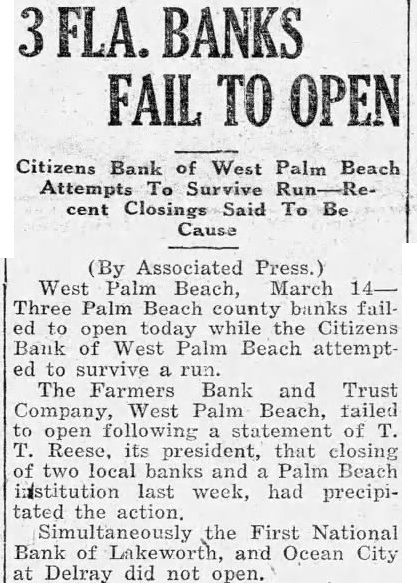
BANKS FAIL TO
Citizens Bank of West Palm Beach To cent Closings Said To Be Cause
(By Associated Press.) West Palm Beach, March Three Palm Beach county banks failed to today while the Citizens open Bank West Palm Beach attempted to survive run. The Farmers Bank and Trust Company, West Palm Beach, failed open statement of its president, that closing of two local banks and Palm Beach institution last week, had precipitated the action. the First National Bank of and Ocean City at Delray did not open.
16.March 14, 1927Kenosha NewsKenosha, WI
Click image to open full size in new tab
Article Text
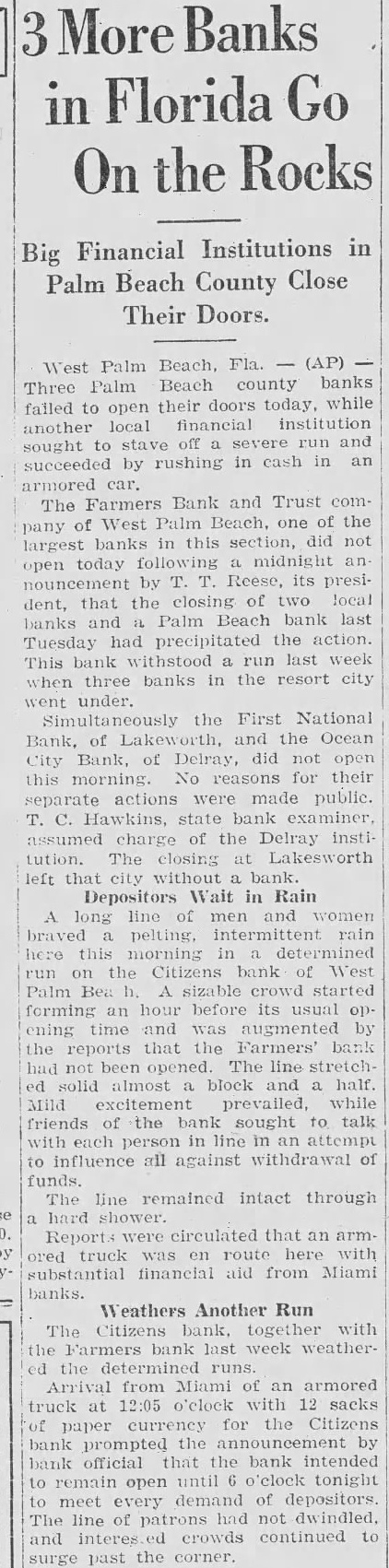
in Florida Go On the Rocks
Big Financial Institutions in Palm Beach County Close Their Doors.
West Palm Beach, Fla. Beach banks Three Palm county falled to open doors today, while local financial institution another sought stave off and succeeded by rushing in cash in armored The Farmers Bank and Trust pany of West Beach, one the largest banks in this section, did not today midnight nouncement by Reese, its president, that the closing of two banks Palm Beach bank last Tuesday had precipitated the action. This bank withstood run last week three banks in the resort city under. Simultaneously First National Bank, of Lakeworth, and the Ocean Bank, of Delray, not morning. reasons for their actions were made public. Hawkins, state bank assumed charge of the Delray instiThe closing at Lakesworth bank. Depositors Wait in Rain braved intermittent this determined Citizens bank West started forming before usual time and augmented reports that Farmers' bank The line stretchblock half. excitement prevailed, while friends bank sought talk person in line attempt influence all against withdrawal of funds. remained intact through shower circulated that an truck was route substantial financial from Miami
Weathers Another Run Citizens bank, together with Farmers week weatherdetermined Arrival Miami an armored truck o'clock with 12 sacks currency the Citizens paper bank prompted announcement by official that the bank intended remain open until tonight meet every demand of depositors The patrons had not and crowds continued past the corner.
17.March 15, 1927The Grand Rapids PressGrand Rapids, MI
Click image to open full size in new tab
Article Text
THREE PALM BEACH BANKS CLOSE, BUT PATRONS ARE CALM
Run on One Institution Subsides After Half Day of "Rushing."
ALL PLACES TO REOPEN
Inactivity of Real Estate Operations Blamed; Money Houses Not Insolvent.
West Palm Beach, March 16. quieter tone pervailed the Palm Beaches Monday period of when determined run Citizens bank, prompted by the closing of three banks in Palm Beach county abated early in only short lines of depositors windows Two three banks remaining open did experience closing The bank plenty funds been pay positors, until to meet all requests for payment return to normality aided largely Miami of sacks of currency for bank The which did open Monday included Farmers Bank Trust of the largest banking institutions here. bank closed temporarily, announced. the interest Plans the bank within 30 or 60 days Officials Issue Statements.
First bank of Lake Worth and Delray were other banks which did Monday No statement was regarding their Officials of the Citizens bank expressed their determination close will be even stronger now when direcbank the real estate mar ket and the fact much the based upon estate security was given by the the which faster the banks could liquidate resulted in the down making necessary for the institutions suspend, he that does not that because bank close Another reason. for the recent suspensions, the comptroller lieved, been cashing checks for into the state this winter This costs the banks instead of helping them, he declared. Officials the Central Farmers bank and the National Bank West Palm Beach, the other institutions which the condibe good. They anticipated no financial culties.
18.March 15, 1927The Des Moines RegisterDes Moines, IA
Click image to open full size in new tab
Article Text
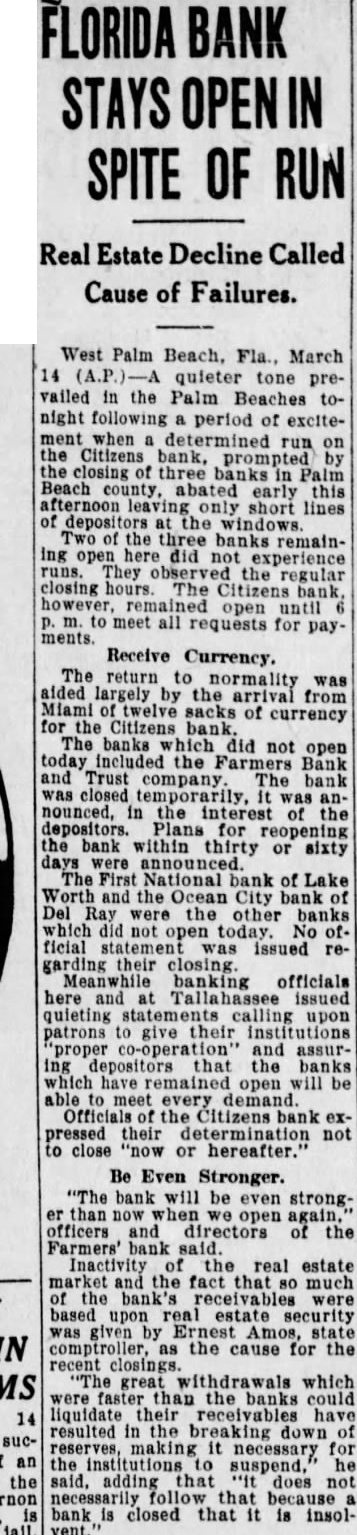
FLORIDA BANK STAYS OPEN IN SPITE OF RUN
Real Estate Decline Called Cause of Failures.
West Palm Beach, Fla., March 14 quieter tone prevailed in the Palm Beaches tonight following period of excitement when determined run the Citizens bank, prompted by the closing of three banks in Palm Beach county, abated early this afternoon only short lines of depositors at the windows. Two of the three banks remaining open here did not experience runs. They observed the regular closing hours. The Citizens bank, however, open until p. m. to meet all requests for payments.
Receive Currency. The return to normality was aided largely by the arrival from Miami twelve sacks of currency for the Citizens bank. The banks which did not open today included the Farmers Bank and Trust company. The bank was closed temporarily, was announced, in the interest of the depositors. Plans for reopening the bank within thirty or sixty days were announced. The First National bank of Lake Worth and the Ocean City bank of Del Ray were the other banks which did not open today. No official statement was issued regarding their closing. Meanwhile banking officials here at Tallahassee issued quieting calling upon patrons to give their institutions "proper co-operation" and assuring depositors that the banks which have remained open will be able meet every demand. Officials the Citizens bank expressed their determination not to close "now or hereafter.' Be Even Stronger. "The bank will be even stronger than now we open again, officers and directors of the Farmers' bank said. Inactivity of the real estate market and the fact that 80 much of the bank's receivables were based upon real estate security was given by Ernest Amos, state comptroller, as the cause for the recent closings. "The great withdrawals which were faster than the banks could liquidate their receivables have resulted in the breaking down of reserves, making it necessary for the institutions suspend,' said, adding that does not necessarily follow that because bank is closed that it is insolvent.
19.March 15, 1927The Baltimore SunBaltimore, MD
Click image to open full size in new tab
Article Text
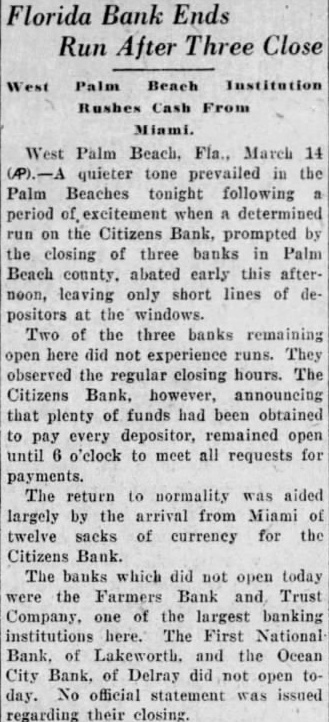
Florida Bank Ends Run After Three Close
West Palm Beach Institution Rushes Cash From Miami.
West Palm Beach, Fla., March 14 (P).-A quieter tone prevailed in the Palm Beaches tonight following period of excitement when determined run on the Citizens Bank, prompted by the closing of three banks in Palm Beach county. abated early this afternoon, leaving only short lines of depositors at the windows. Two of the three banks remaining open here did not experience runs. They observed the regular closing hours. The Citizens Bank, however, announcing that plenty of funds had been obtained to pay every depositor, remained open until 6 o'clock to meet all requests for payments. The return to normality was aided largely by the arrival from Miami of twelve sacks of currency for the Citizens Bank. The banks which did not open today were the Farmers Bank and Trust Company, one of the largest banking institutions here. The First National Bank, of Lakeworth. and the Ocean City Bank, of Delray did not open today. No official statement was issued regarding their closing.
20.March 15, 1927The News-JournalLancaster, PA
Click image to open full size in new tab
Article Text
CLOSE
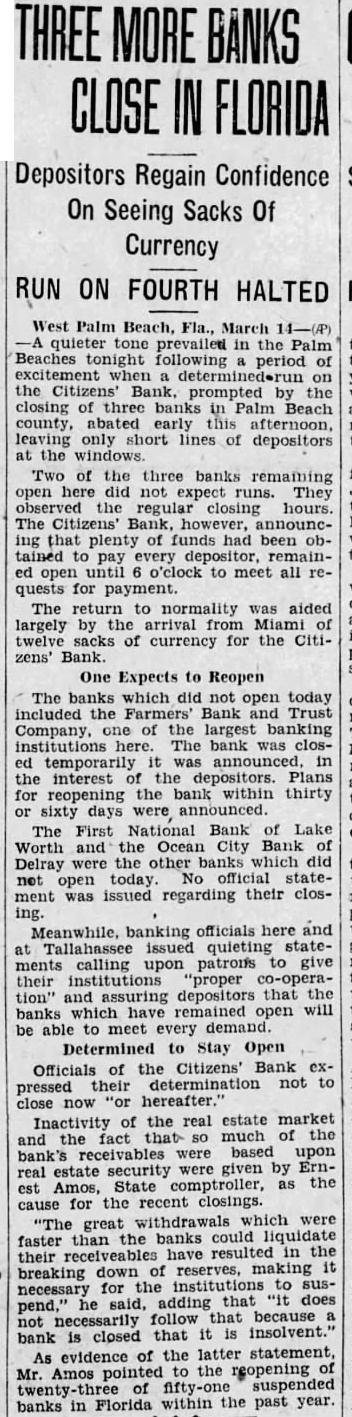
Depositors Regain On Seeing Sacks Of Currency RUN ON FOURTH HALTED
West Palm Beach, March prevailed in the Palm Beaches following period of the prompted the closing of three banks Palm Beach county, abated early leaving only short lines of depositors the windows Two of the three banks remaining here did not expect They regular closing hours. The ing funds had been obpay ed to meet all quests for The normality aided largely the arrival sacks of currency for the Citizens' Bank. One Expects to Reopen The banks which not open today included the Bank Trust Company, the largest banking institutions The bank was closed temporarily announced, in the interest depositors. Plans for the within thirty sixty days were The First Bank Lake Worth and the City Bank Delray were did not today official issued regarding their clos-
Meanwhile, banking officials here and Tallahassee issued quieting statements calling upon patrons to their institutions "proper co-operation" assuring depositors that which have remained open will banks be able Determined to Stay Open Officials Citizens' Bank determination not pressed close now hereafter." Inactivity of the real estate much of the based estate security given by comptroller, as the est Amos, recent closings. withdrawals which were banks could liquidate faster than have resulted in the receiveables making breaking down for the institutions necessary adding pend," because not necessarily that insolvent.' closed of the latter statement, As evidence Amos the reopening Mr. in Florida within the past year. banks
21.March 15, 1927The Lexington HeraldLexington, KY
Click image to open full size in new tab
Article Text
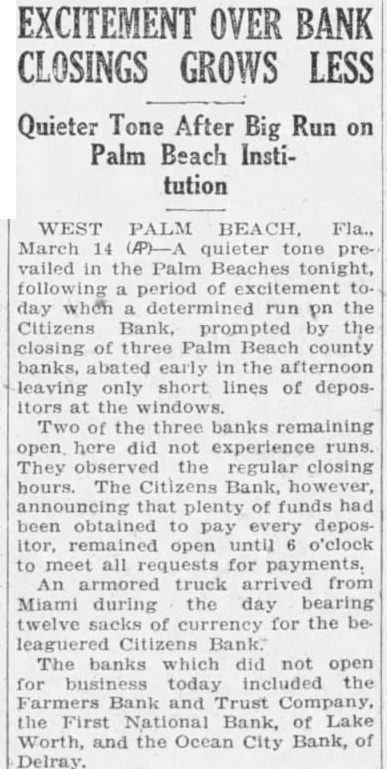
EXCITEMENT OVER BANK CLOSINGS GROWS LESS
Quieter Tone After Big Run on Palm Beach Institution
WEST PALM BEACH, Fla., March (AP)-A quieter vailed in the Palm Beaches tonight, period of excitement day when determined run pn the Citizens Bank, prompted the closing of three Palm Beach county banks, abated early the afternoon leaving only short lines of depositors the windows. Two of the three banks remaining open. here did not experience runs. They regular closing hours. The Citizens Bank, however, announcing that plenty of funds had been obtained pay every deposremained open until o'clock to meet all requests for payments. An armored truck arrived from Miami during the day bearing twelve sacks of currency for the beleaguered Citizens Bank." The banks which did not open for business today included Farmers Trust Company, the First National Bank, Lake Worth, and the Ocean City Bank, of Delray.
22.March 15, 1927News and RecordGreensboro, NC
Click image to open full size in new tab
Article Text
MORE RUNS ARE WHEN THREE BANKS ARE NOT OPEN
One of Largest Palm Beach Banks Is Closed.
OTHERS WEATHER DRIVE
They Are Declared to Be On Solid Foundation and Can Pay All Depositors.
REASON FOR CONDITIONS
Comptroller Banks Are Solvent But Are Unable To Collect counts Funds Are Withdrawn.
West Palm Beach, March 14. quieter prevailed in the Palm Beachers tonight followperiod excitement today when determined the Citizens bank, prompted by the closing of three Palm Beach counbanks, abated the afterof depositors the windows Two three remaining open here did experience The bank, announcing that plenty funds had obtained remained meet all refor payments The normaley aided largely by the arrival shortly armored truck from bearing sacks for the beleaguered Citizens bank. One Big The which for open the Bank Trust company, the largest banking institutions here, which closed temporarily, in the interest positors whom the banks statement declared would not cent result the closing for the 30 or days National Lake Worth the Ocean City bank of Delray the did today. No official statement issued regarding their closing today brought the to. banks which the Palm the seven. Three of these Co-Operation. Meanwhile banking officials here Tallahassee issued calling upon patrons banks Institutions "proper depositors that the open will be able to meet every deOfficials of the Citizens bank Declaring that the condition of of the suspended banks has and looking for greater the people will keep their heads. If they become frightened run bank locality. the situation become aggravated. The people themselves help Banks with, and With the proper of banks re-opened. takes community spirit over." Another reason for the recent pensions, the comptroller believed, travelers state This banks Instead of helping he declared
23.March 16, 1927The Miami NewsMiami, FL
Click image to open full size in new tab
Article Text
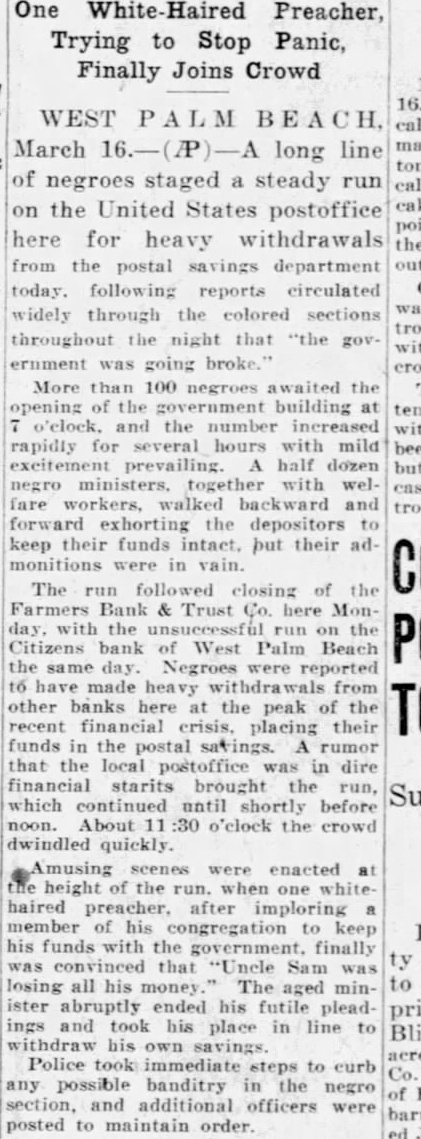
One White-Haired Preacher, Trying to Stop Panic, Finally Joins Crowd
WEST PALM
March long line ton of negroes staged a steady run on the United States postoffice here for heavy withdrawals from the postal savings department today. following reports circulated was widely through the colored sections throughout the night that gov ernment was going broke. More than 100 negroes awaited the opening the government building at o'clock. the number increased rapidly for several hours with mild been prevailing. half dozen negro with workers, walked backward and the depositors keep funds intact. put their adin vain. The closing of the Farmers & Trust Co. here Monthe the Citizens bank of West Palm Beach same day. made heavy from other banks the peak of the recent placing their funds the rumor that the local postoffice in dire financial starits brought run, which continued until shortly before noon. About o'clock the crowd dwindled quickly. Amusing scenes enacted height the run. haired after imploring member his congregation keep his funds with the government. finally that "Uncle Sam was losing all his The to money. aged minister abruptly ended his futile plead ings and took his place in line to withdraw his own savings. Police took immediate steps to curb any possible banditry in the negro section, additional officers were posted to maintain order ed
24.March 16, 1927The Barre Daily TimesBarre, VT
Click image to open full size in new tab
Article Text
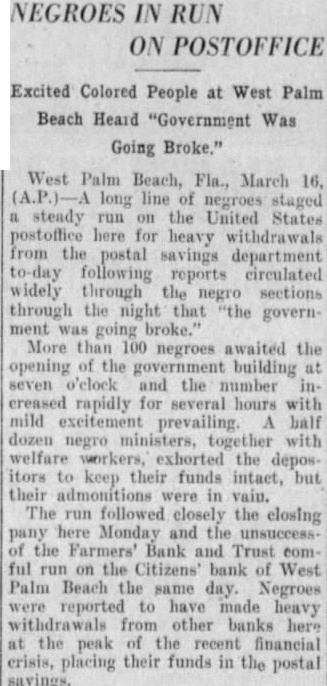
NEGROES IN RUN ON
Excited Colored People at West Palm Beach Heard "Government Was Going Broke."
West Palm Beach, March 16, long line negroes staged steady run the United States for heavy the postal savings department following reports circulated widely through negro sections through the night More 100 negroes awaited the opening of the building seven and the rapidly for hours with mild balf negro welfare the keep funds intact, but in run followed the closing Monday the the Bank and Trust comthe Citizens' bank West Beach the Negroes have the peak financial crisis, placing their funds in the postal savings.
25.March 19, 1927Weekly Town TalkAlexandria, LA
Click image to open full size in new tab
Article Text
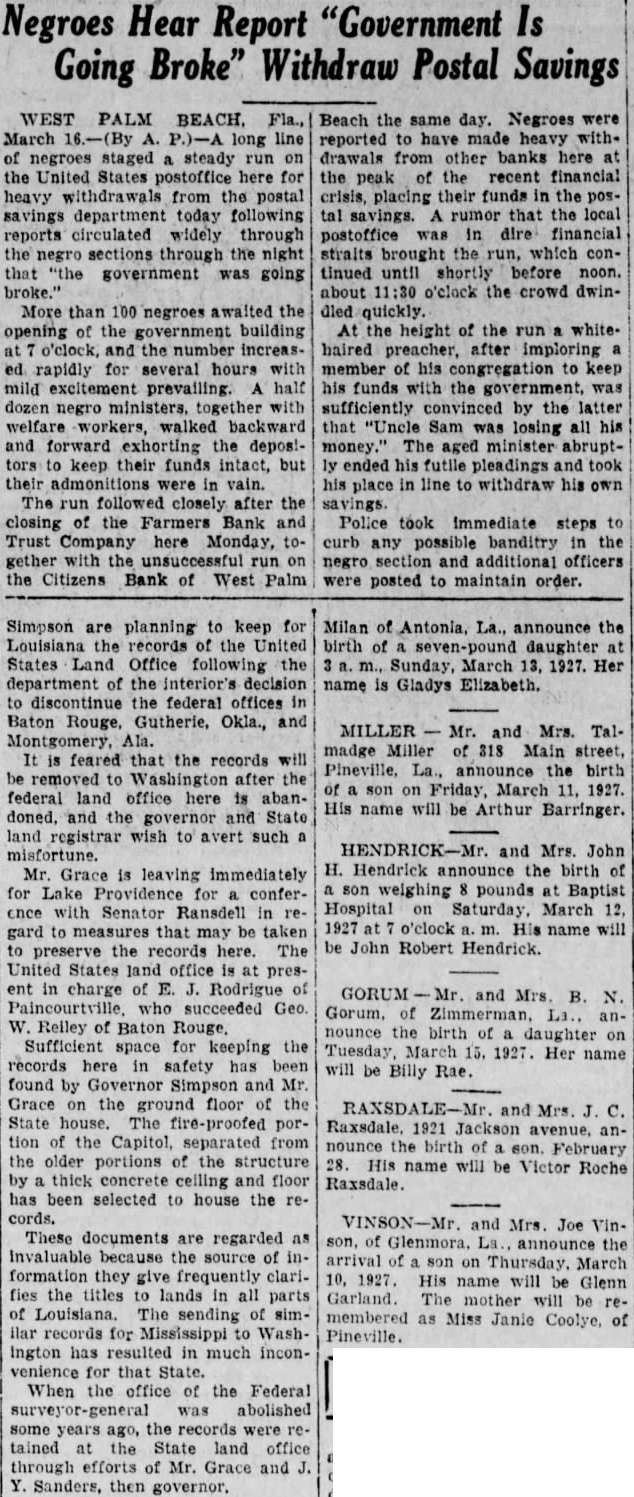
Negroes Hear Report "Government Is Going Broke" Withdraw Postal Savings
WEST PALM Fla., March long line negroes staged steady run on the United States for heavy withdrawals from the postal savings department today following reports circulated widely through the negro sections through night government going broke." More than 100 negroes the opening the government building and ed rapidly for several hours with prevailing. half welfare walked backward forward exhorting deposikeep their funds intact, but vain. The run closely after the closing the and Trust Monday, tothe Citizens Bank of West Palm
Beach same day. Negroes were reported withdrawals banks here the recent financial placing in the postal savings. rumor that the postoffice was in financial straits brought the which tinued shortly before noon. about o'clock the crowd dwinquickly. At the height of the run white. haired after member congregation to keep his funds with the was sufficiently by the latter that "Uncle losing all money. minister abruptended his pleadings and took his place line his own Police immediate steps curb any banditry the negro and officers were posted to maintain order.
Simpson are planning to keep for Louisiana records the United States Office following the the the federal offices Rouge, Gutherie, Okla., and feared records will the federal land office here is abandoned. and State land to such misfortune. Mr. Grace is leaving immediately for Lake conferonce Ransdell gard that taken records United States land office ent charge Rodrigue Reiley Baton Rouge. space for keeping the records in safety found and Mr. Grace the ground floor the State house. The tion the Capitol, the older portions the structure thick concrete celling and floor has been selected to house the reThese are regarded as Invaluable because the source of information they clarifies titles lands all parts of Louisiana. The ilar records Mississippi Washington has resulted much inconvenience for State. When the office the Federal was abolished ago, the records were retained State land office through efforts of Mr. Grace and Sanders, then governor.
Milan Antonia, La., announce the March 1927. Her name is Gladys Elizabeth.
MILLER Mr. and Mrs. Talmadge Miller 318 Main street, Pineville, announce the Friday, March 11, His name will Arthur Barringer.
Mrs. H. the birth of weighing pounds Baptist Hospital March 1927 will be John Robert and Mrs. B. nounce on Tuesday, 1927. Her will be Billy Rae. nounce the name will be Victor Roche Raxsdale.
Mrs. Joe Vinthe arrival son Thursday. will Glenn Garland. be membered as Miss Janie Coolye, of Pineville.