Article Text
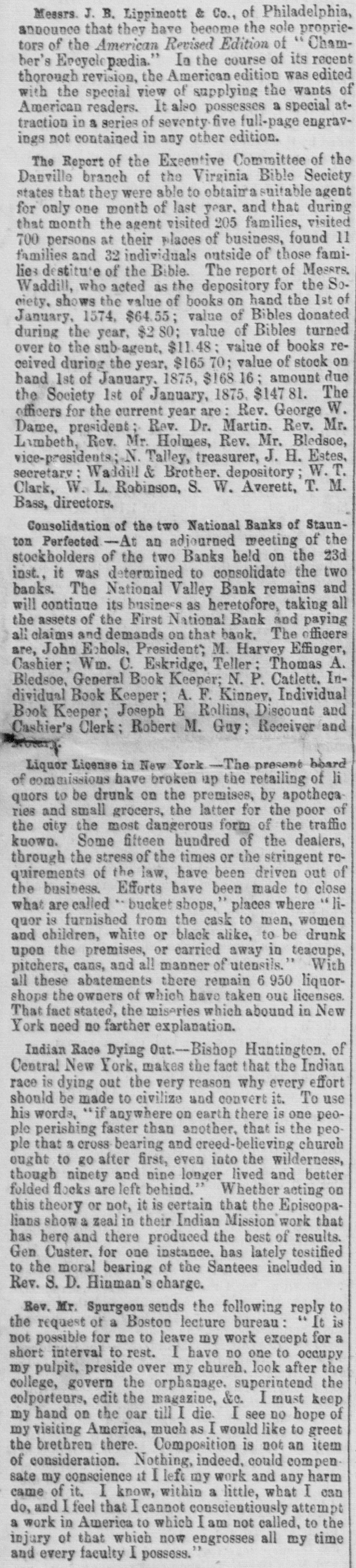
Messrs. J. B. Lippineott & Co., of Philadelphia, announce that they have become the sole proprietors of the American Revised Edition of Chamber's Evoycle pædia." In the course of its recent thorough revision, the American edition was edited with the special view of supplying the wants of American readers. It also possesses a special attraction in a series of seventy five full-page engravings not contained in any other edition. The Report of the Executive Committee of the Danville branch of the Virginia Bible Seciety states that they were able to obtaira suitable agent for only one month of last year. and that during that month the agent visited 205 families, visited 700 persons at their places of business, found 11 families and 32 individuals outside of those families destitute of the Bible. The report of Messrs. Waddill, who acted as the depository for the Society, shows the value of books on hand the 1st of January, 1574, $64.55; value of Bibles donated during the year, $2 80; value of Bibles turned over to the sub-agent, $11.48: value of books received during the year, $165 70; value of stock on hand 1st of January. 1875, $168 16; amount due the Society 1st of January, 1875, $147 81. The officers for the current year are: Rev. George W. Dame, president; Rev. Dr. Martin. Rev. Mr. Lambeth, Rev. Mr. Holmes, Rev. Mr. Bledsoe, vice-presidents; N. Talley, treasurer, J. H. Estes. secretary Waddill & Brother. depository; W.T. Clark, W. L. Robinson, S. W. Averett, T. M. Bass, directors. Consolidation of the two National Banks of Staunton Perfected -At an adjourned meeting of the stockholders of the two Banks held on the 23d inst., it was determined to consolidate the two banks. The National Valley Bank remains and will continue its business as heretofore, taking all the assets of the First National Bank and paying all claims and demands on that bank. The officers are, John Echols, President; M. Harvey Effinger, Cashier; Wm. C. Eskridge, Teller : Thomas A. Bledsoe, General Book Keeper; N. P. Catlett. Individual Book Keeper; A. F. Kinnev, Individual Book Keeper; Joseph E Rollins, Discount and Cashier's Clerk : Robert M. Guy; Receiver and Liquor License in New York -The present board of commissions have broken up the retailing of li quors to be drunk on the premises, by apothecaries and small grocers, the latter for the poor of the city the most dangerous form of the traffic known. Some filteen hundred of the dealers, through the stress of the times or the stringent requirements of the law, have been driven out of the business. Efforts have been made to close what are called bucket shops," places where liquor is furnished from the cask to men, women and children, white or black alike, to be drunk upon the premises, or carried away in teacups, pitchers, cans, and all manner of utensils." With all these abatements there remain 6 950 liquorshops the owners of which have taken out licenses. That fact stated, the miseries which abound in New York need no farther explanation. Indian Race Dying Out.-Bishop Huntington. of Central New York, makes the fact that the Indian race is dying out the very reason why every effort should be made to civilize and convert it. To use his words, "if anywhere on earth there is one people perishing faster than another, that is the people that a cross bearing and creed-believing church ought to go after first, even into the wilderness, though ninety and nine longer lived and better folded flocks are left behind. Whether acting on this theory or not, it is certain that the Episcopalians show a zeal in their Indian Mission work that has here and there produced the best of results. Gen Custer. for one instance. has lately testified to the moral bearing of the Santees included in Rev. S. D. Hinman's charge. Rev. Mr. Spurgeon sends the following reply to the request of a Boston lecture bureau: " It is not possible for me to leave my work except for a short interval to rest. I have no one to occupy my pulpit, preside over my church. look after the college, govern the orphanage. superintend the colporteurs, edit the magazine, &o. I must keep my hand on the oar till I die. I see no hope of my visiting America, much as I would like to greet the brethren there. Composition is not an item of consideration. Nothing, indeed, could compensate my conscience it I left my work and any harm came of it. I know, within a little, what I can do, and I feel that I cannot conscientiously attempt a work in America to which I am not called, to the injury of that which now engrosses all my time and every faculty I possess."