Williamsburg Trust Company (New York, NY)

Episode Information

Episode UID
2186477391294
Episode Type
Run โ†’ Suspension โ†’ Reopening
Bank Type
trust
Bank ID
218647739 hash
Start Date
October 25, 1907
Location
New York, New York (40.714, -74.006)

Metadata

Model
gpt-5-mini (chosen from majority vote of a three-model LLM ensemble)
Short Digest
d3016fdc86bbdfd3

Response Measures

None

Description

Directors/insiders made large withdrawals just before suspension; receivers later found irregular loans.

Events (5)

1. October 25, 1907 Receivership
Newspaper Excerpt
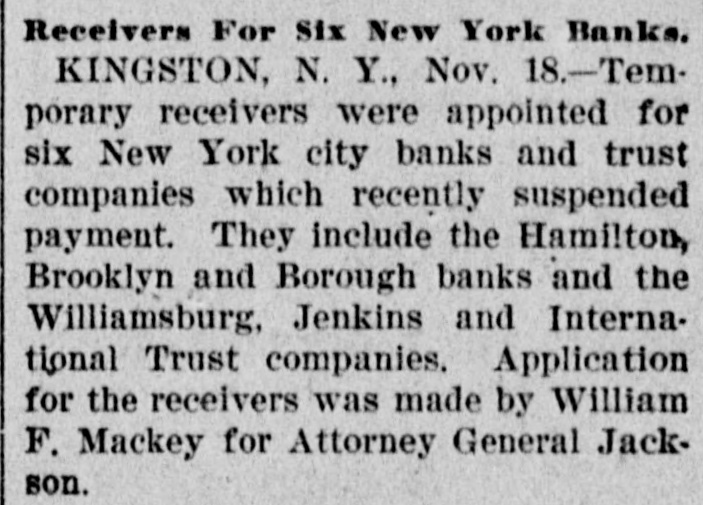
temporary receiver of the Williamsburg Trust company...reports show large withdrawals...the matter will be taken before the grand jury of Kings county.
Source
newspapers
2. October 25, 1907 Run
Cause
Bank Specific Adverse Info
Cause Details
Large withdrawals and loss of ready cash after insiders/directors drew out funds and doubtful demand loans reduced liquidity; presenting of a $10,000 check precipitated closure.
Measures
Closed main office and branches temporarily to avoid precipitating a larger public run; state bank examiner notified.
Newspaper Excerpt
there have been steady withdrawals of money...gradually brought the cash supply down to something like a danger point.
Source
newspapers
3. October 25, 1907 Suspension
Cause
Bank Specific Adverse Info
Cause Details
Inability to meet present demands due to depleted cash from heavy withdrawals and poor-quality demand loans; management closed offices.
Newspaper Excerpt
Closed temporarily for lack of cash. The branches...were closed at about the same time.
Source
newspapers
4. December 1, 1907 Other
Newspaper Excerpt
reports of the temporary receivers...show gross irregularities, loans to clerks and insiders, and withdrawals by directors just before suspension.
Source
newspapers
5. June 8, 1908 Reopening
Newspaper Excerpt
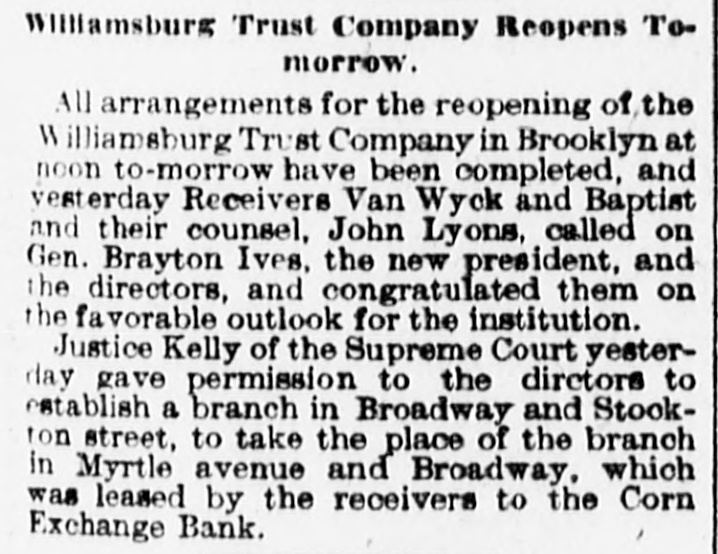
The reopening of the Williamsburg Trust company took place at 10 o'clock to-day...The company suspended payments on October 25 last...Metropolitan Trust company having provided $1,500,000 to meet demands.
Source
newspapers

Newspaper Articles (25)

Article from Evening Times-Republican, October 25, 1907

Click image to open full size in new tab

Article Text

Brooklyn Bank All Right. Washington, Oct. 25.-Comptroller of the Currency Ridgely was in communication with Brooklyn this afternoon, and later stated that the Jenkins Trust Company and the Williamsburg Trust Company, which suspended payment today, were directly responsible for the closing of the doors of the First National bank of Brooklyn. It appears that the latter bank cleared for the two trust companies and the closing of its doors was for the purpose of protecting their depositors, inasmuch as otherwise it would be held responsible for the paper of the two trust companies that might come in any time up to tomorrow morning.


Article from The Spokane Press, October 26, 1907

Click image to open full size in new tab

Article Text

BANKS WILL IMPORT GOLD CLOSES MARKET MONEY STRONG TODAY AFTER BRISK TRADING IN WHICH EARLIER LOSSES ARE RECOVERED. NEW YORK, Oct. 26.-The National City bank is planning to import $5,000,000 in gold, and another bank is going to import another million. The run on the Lincoln Trust Co. is still on, but all demands are being paid promptly. J. P. Morgan is suffering intensely from a cold but was in his office all morning. The buying movement which characterized yesterday's close was resumed this morning with renewed vigor, with the result that favorite issues opened point or two higher. The bears tried to sell down, but after a sag of a point or two the market held steady until the band statement was issued This was considered very good, and under the stimulus considerable buying was done and the close was strong, earlier losses being recovered. The Williamsburg Trust Co., of Williamsburg, Brooklyn, closed yesterday because of inability to cash a $10,000 check. Frank Jenkins is president of this bank, which has a capital stock of $700,000 and liabilities of $9,676,484. PROVIDENCE, R. I., Oct. 26.After an all-night session the clearing house commission decided to assist local banks whenever neces sary. PITTSBURG, Oct. 26-The clearing house here is still closed.


Article from East Oregonian : E.O, October 26, 1907

Click image to open full size in new tab

Article Text

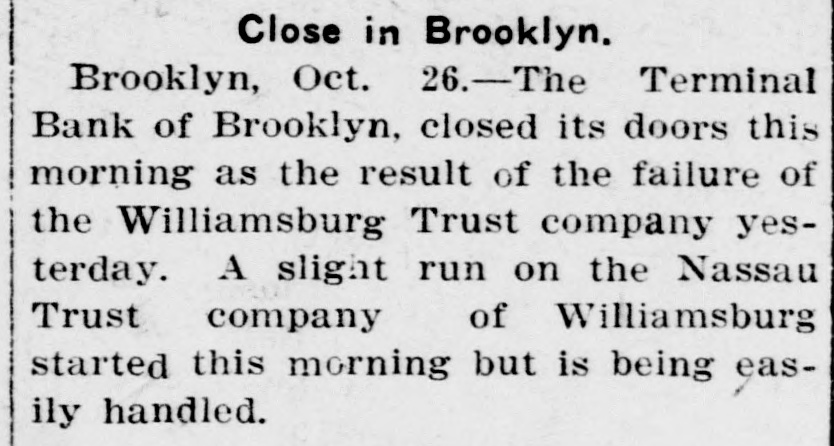
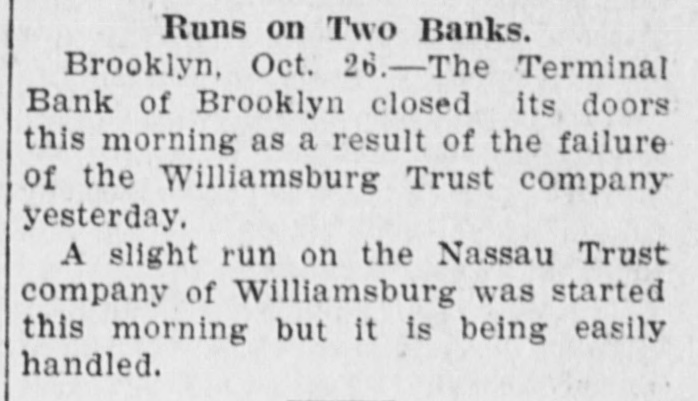
Runs on Two Banks. Brooklyn, Oct. 26.-The Terminal Bank of Brooklyn closed its doors this morning as a result of the failure of the Williamsburg Trust company yesterday. A slight run on the Nassau Trust company of Williamsburg was started this morning but it is being easily handled.


Article from The Washington Herald, October 26, 1907

Click image to open full size in new tab

Article Text

New York, Oct. 25.-The Williamsburg Trust Company ceased operations to-day, President Frank Jenkins, posting up a sign on the door of the main office on the Brooklyn plaza"Closed temporarily for lack of cash." The branches, one on Fulton street opposite the Borough Hall, and the other at Broadway and Myrtle avenue, were closed at about the same time. There was no excitement at all about the main office, but many persons made efforts to enter the Fulton street branch after it had been closed. The Fulton office was much the busiest of the three, as a general rule. It was reported that the cause of the stoppage of business In the main office was brought about through the presenting of a check for $10,000, which the trust company officials learned was to be followed by others of like amounts. Apparently this was not the case, because Fernando Solinger, counsel for the trust company, said that, even at the time of closing, there was a great deal of money still in the hands of the company. Aimed to Avoid a Run. As Mr. Solinger explained it, the trust company did not want to precipitate a run or a panic by giving public notice before closing that money was getting low. It was decided that it was better to close up first. There was no run, so to speak, on the Williamsburg Trust Company or its branches, but for the past three days there have been steady withdrawals of money. These gradually brought the cash supply down to something like a danger point. Just what was drawn out, Mr. Solinger was not prepared to say, but he had the impression that it was not a very great sum. State Officials Notified, The State bank examiner's office was notified, and the trust company folks expect that work will begin to-morrow in clearing up the difficulties. The Williamsburg Trust Company is by no means insolvent, Mr. Solinger said. It was solely the lack of ready money and the uselessness of attempting to recall loans from persons who had no money that drove the company to close. Mr. Solinger looks for an early resumption of business.


Article from The Montgomery Advertiser, October 26, 1907

Click image to open full size in new tab

Article Text

NEW YORK PASSES TRYING DAY (Continued from Page One.) issues occurred in 1873 and 1884. The last occasion on which they were used was in 1893. The clearing house certificate is practically a guarantee byal banks in the clearing house that the certificates shall be redeemed at par, but the clearing house banks are protected against loss by the fact that first class securities, either commercial -paper or stocks and bonds, are required before the certificates are issued. The certificates are used only be tween banks. They do not appear in general circulation, but by relieving the banks of the strain of large debit balances, they enable them to keep their cash reserves comparatively in. tact It is believed by competent bankers that an issue of $50,000,000 will be the outside requirement at present. It is believed also that the mere fact that they are to be issued will so far re store confidence that runs upon banks win cease, so that it will not be necessary to keep certificates outstanding for any considerable time. Already the strong city banks are receiving large deposits from persons who have withdrawn their money from institutions which have fallen under suspicion. This does not preclude the fact that considerable amounts have been put in safe deposit boxes and thereby withdrawn from circulation, but it is believed that renewed confidence will cause the return of this money to the banks within a short time Imports of Gold. Late in the afternoon a favorable light was cast upon the prospects of imports of gold by a sudden fall in foreign exchange. The market has been practically at standstill for several days with large offerings of bills and few takers This afternoon, how ever, the rate dropped to 4.85. which practically makes imports of gold possible at a profit. Leading bankers and foreign exchange houses have been looking for this development but hardly expected that it would come so soon. The tide of gold, once it sets on. the way, will undoubtedly reach a large volume, in view of the considerable amounts due this country for the outgoing crops and for securities. While the present market is one to encourage the general public to buy American securities, there are always shrewd observers in Europe who are disposed to buy at times like the present and some of them have been in the market during the past few days. It will be possible even by the process of Joans to transfer a part of the burden of carrying stocks from New York to London and Paris, but this has been tone thus far to only a limited extent The fact that the banks and the stock exchanges will be open for business but two hours tomorrow and that Sunday with all its opportunities of calming public sentiment will intervene, added to the more hopeful view taken by leading financiers tonight will do much toward clearing the financial skies before next week. At a meeting of the directors of the Lincoln Trust Company tonight, Louis Stern, a director, was authorized to make the following statement: (The directors of the Lincoln Trust Company are justified in stating that the company is in a position to meet every demand that may be made upon it and that the company is In a strong. et position tonight than any day this week. Furthermore, the withdrawal of funds has been less day by day At a meeting late today the direc. tors, of the Knickerbocker Trust Com. pany appointed a committee to take steps to bring about a resumption of business The committee later announced that an agreement providing for the deposit of claims of depositors and of shares of stock of the company was being prepared The committee will meat Monday to pass on this agreement Run Continues Baltimore. Oct. 25. The run on the East Branch of the Home Bank, continued today and shortly before noon, the depositors who were in line waiting for their money were notified that the bank would take advantage of a chare ter provision which permits the institution to demand sixty days notice of a positor's intention to withdraw his or her account A member of the firm of Bernstein, Cohen and Company, owners of the bank, today admitted that the run has been of much larger proportions than had been reported. Runs on Pawtucket Banks. Pawtucket R. I. Oct. -Follow ing the posting of the ninety day notice to depositors by the local branch of the New England Trust Company, of Providence runs were started today on all banks in Pawtucket. With the exception of the New England Trust Company all the banks met the demand without difficulty GOVERNOR APPEALED TO. A Legal Holiday to Relieve Financial Situation Asked For. Albany, N. Y., Oct. 25 -Governor Hughes today received a number of telegrams suggesting that he proclaim a legal holiday during which the financial situation might be relieved. The Governor acknowledged the receipt of all of these messages without indicat ing his intentions. He would not dis. cuss the question tonight, but there is a good reason to believe there is no immediate probability of his taking this step. COMPTROLLER OF CURRENCY GIVES OUT A STATEMENT. Washington, Oct. 25.- The following statement was given out today by the Comptroller's office: The First National Bank of Brook lyn. N. Y., closed its doors this afternoon and National Bank Examiner George T. Cutts has taken charge by order of the Comptroller of the Currency. The First National Bank cleared for the Williamsburg Trust Com pany and the Jenkins Trust Company of Brooklyn, both of which failed to. day The National Bank was closed to protect its depositors against the checks of the Trust Companies, which might be presented through the Clear ing House.


Article from The Weekly Iberian, October 26, 1907

Click image to open full size in new tab

Article Text

ACTION IS TAKEN IN ORDER TO ALLOW A RESTORATION OF CONFIDENCE ON TRUST COMPANY OF AMERICA CONTINUED YESTERDAY-DEVELOPMENTS COME RAPIDLY IN FINANCIAL SITUATION BANKS ARE SMALL SOLVENT MANY UNCLE SAM. J. PIERPONT MORGAN AND JOHN D. ROCKEFELLER ( TOGETHER WITH MANY WALL STREET FINANCIERS, HAVE CONFIDENCE IN THE SITUATION. t New York, Oct. The Trust t Company of America opened for busi$ BOUDREAU'S LETTER ness as usual this morning. The line of depositors awaiting to with$ TO BROUSSARD draw money was much smaller than il yesterday. i The United States Bank, at 23d. Below we print a letter from Mr. t 25th and West 125th streets, has Joseph Boudreau to Congressman a Broussard, which has caused the posted a notice of temporary suspension. canceling of an address by the latter The Brooklyn Bank, located at to-day at Derouen. Fulton and Clinton streets, with a It will be recalled by our readers C branch at 601 Fulton street, that that about three weeks ago the Sanc 2 ders peeople were invited to attend Borough, closed its doors this mornre ing. The institution has a paid up the wedding festivities of a young couple which took place in the hall capital of $300,000, and its depositbe are estimated at $2,116,430. at Derouen, over which Mr. Boudde All the members of the New reau maintains supervision. The le York Stock Exchange made the daily Lieutenant Governor and several n settlements of accounts as usual togentlemen from New Iberia attended, g and made short addresses. The ocday to the Stock Exchange Clearing House. casion was referred to in some of the g: The Lincoln Trust Company rebl public prints as a Sanders rally, and th sumed payment to its depositors as to this allusion. many of the good W usual this morning. people who are identified with the br The International Trust Company Wilkinson faction, objected.: To one of the small and inconspicuous even things up, however, Mr. Brousst trust companies, closed its doors at to sard was invited to speak at the en same hall when practically the same10:40 this morning. do people would be in attendance as beA conference of prominent finanio fore-the crowd being about half, clers at the clearing house has adWilkinson and Sandersites. journed. James Stillman, president The letter bears the earmarks of of the National City Bank, said that inconsistency or cowardice-one or the conference had arranged to throw both. If political speaking was indulged in before to satisfy the San$10,000,000 into the stock exchange ders element, why not let the other of money market. faction hav a hearing. If the Sandre The Guardian Trust Company anders people are afraid to hear the of nounced its suspense this afternoon ar truth spoken-well, then, say so, and at its main office. Third avenue and be done with it. mc There is little doubt that Mr. 526 street, Brooklyn. The trust an Broussard will acquiesce in an invitacompany's money was tied up in the tion at some ffuture date to address in Borough Bank, and when that instidis these people, and when he doestation closed to-day, it could not do well-well-"just stand from unup budness. wi der." co Here is the letter: Berman Metz, comptroller, is me Derouen, La., Oct. 25, 1907. provident of the trust company has Hon. R. F. Brousard, New Iberia, above mentioned; William A. Maxfor Louisiana. well, secretary, and ex-Sheriff Wm. My Dear Friend:- had invited J. Buttline is one of the directors. Ibe you to attend the wedding ball to be ber It was reported this afternoon that given at my hall on to-morrow effi (Saturday) night, and to make a Secretary Cortelyou had deposited ma speech, as was done when Mr. Sanabout $8,000,000 in New York banks the ders was here recently. Since then. to-day, in addition to deposits which Cle Mr. Simonet Miguez, one of the ele that previously made. young men in honor of whom the The Jenkins Trust Company, of marriage ball is being given, who is a good friend of mine and of yours, Brooklyn, closed its doors this aftertells me, as he told you. the other noon. Its total of deposits is To day, that most of his friends $2,500,000. will not attend this ball if there is did The Union Dime Savings Bank, at any political speaking. As a favor to tio 32d street and Broadway, this afterhim and to me, I wish you would Jan soon posted a notice that it will repostpone the speaking until the 17th ati quire sixty days' notice from deposiof November, when I will have races par tors desiring to withdraw. It has and a ball. I shall be very glad $27,450,000 due to depositors. then to have you come here and The WHliamsburg Trust Company, speak. Broadway and ent avenue, WilliamsYour friend, I JOSEPH BOUDREAU. burg. closed its doors at 1:15 p. m., for to-day, being unable to cash a check ic for $10,000. Californians Want Dewey. Cou


Article from New-York Tribune, October 28, 1907

Click image to open full size in new tab

Article Text

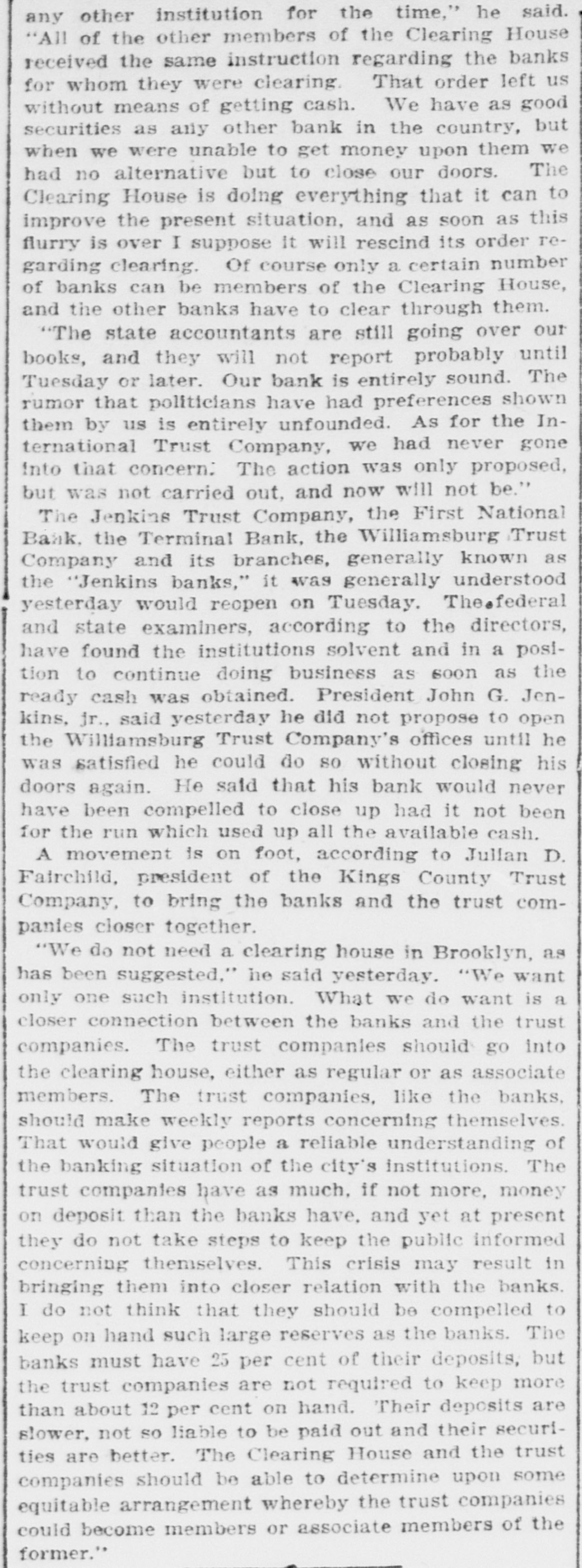
any other institution for the time," he said. "All of the other members of the Clearing House received the same instruction regarding the banks for whom they were clearing That order left us without means of getting cash. We have as good securities as any other bank in the country, but when we were unable to get money upon them we had no alternative but to close our doors. The Clearing House is doing everything that it can to improve the present situation, and as soon as this flurry is over I suppose it will rescind its order regarding clearing. Of course only a certain number of banks can be members of the Clearing House, and the other banks have to clear through them. "The state accountants are still going over our books, and they will not report probably until Tuesday or later. Our bank is entirely sound. The rumor that politicians have had preferences shown them by us is entirely unfounded. As for the International Trust Company, we had never gone into that concern. The action was only proposed, but was not carried out, and now will not be." The Jenkins Trust Company, the First National Bank. the Terminal Bank, the Williamsburg Trust Company and its branches, generally known as the "Jenkins banks," it was generally understood yesterday would reopen on Tuesday. The federal and state examiners, according to the directors, have found the institutions solvent and in a position to continue doing business as soon as the ready cash was obtained. President John G. Jenkins, jr., said yesterday he did not propose to open the Williamsburg Trust Company's offices until he was satisfied he could do SO without closing his doors again. He said that his bank would never have been compelled to close up had it not been for the run which used up all the available cash. A movement is on foot, according to Jullan D. Fairchild, president of the Kings County Trust Company, to bring the banks and the trust companies closer together. "We do not need a clearing house in Brooklyn, as has been suggested," he said yesterday. "We want only one such institution. What we do want is a closer connection between the banks and the trust companies. The trust companies should go into the clearing house, either as regular or as associate members. The trust companies, like the banks, should make weekly reports concerning themselves. That would give people a reliable understanding of the banking situation of the city's institutions. The trust companies have as much. if not more, money on deposit than the banks have, and yet at present they do not take steps to keep the public informed concerning themselves. This crisis may result in bringing them into closer relation with the banks. I do not think that they should be compelled to keep on hand such large reserves as the banks. The banks must have 25 per cent of their deposits, but the trust companies are not required to keep more than about 12 per cent on hand. Their deposits are slower. not so liable to be paid out and their securities are better. The Clearing House and the trust companies should be able to determine upon some equitable arrangement whereby the trust companies could become members or associate members of the former."


Article from New-York Tribune, October 30, 1907

Click image to open full size in new tab

Article Text

M. S. DRIGGS IN CONTROL. Frank Jenkins Out of Williamsburg Trust-Brooklyn Outlook. After a meeting yesterday of the directors of the Williamsburg Trust Company, which suspended on Friday, this statement was given out: The resignation of Frank Jenkins as president and director was presented and accepted, the resignation of W. Addison Field as secretary and director was also accepted. The resignation of John G. Jenkins as director was demanded, the same to take effect at once. This was taken to mean that the interests in the board which are represented by Marshall S. Driggs had secured control, and the belief was strengthened when it was announced that a special committee, of which Mr. Driggs is a member, had been appointed with power to act for and represent the board of directors in all matters pertaining to the affairs of the company and for the protection of the interests of depositors and stockholders. The other members of the committee are Charles Jerome Edwards, Fred C. Lemmerman, John W. Weber and John J. Cooney. The Williamsburg Trust Company was organized in 1899 by John G. Jenkins, and Frank Jenkins, his son, was made president. Some months ago Marshall S. Driggs, who is president of the Williamsburg City Fire Insurance Company, had a disagreement with John G. Jenkins, the result of which was that he withdrew from the First National Bank. of Brooklyn, of which Mr. Jenkins is president. Several of his friends also withdrew from the First National. Now Mr. Jenkins and his friends have got out of the Williamsburg Trust Company. The following resolution was passed by the directors yesterday: "That this board, after a thorough examination of the assets and liabilities of the Williamsburg Trust Company, is firmly convinced that on the most conservative estimate the institution is entirely solvent and that it is in a position to resume full banking functions, and that on the completion of the examination by the bank examiner the permission of the department to resume business be secured." J. W. Seofield, the receiver for the federal government of the First National Bank, said yesterday it would take at least ten days more to complete the examination of its affairs. The bank examiner is still at work on the books of the Jenkins Trust Company.


Article from The Salt Lake Herald, December 1, 1907

Click image to open full size in new tab

Article Text

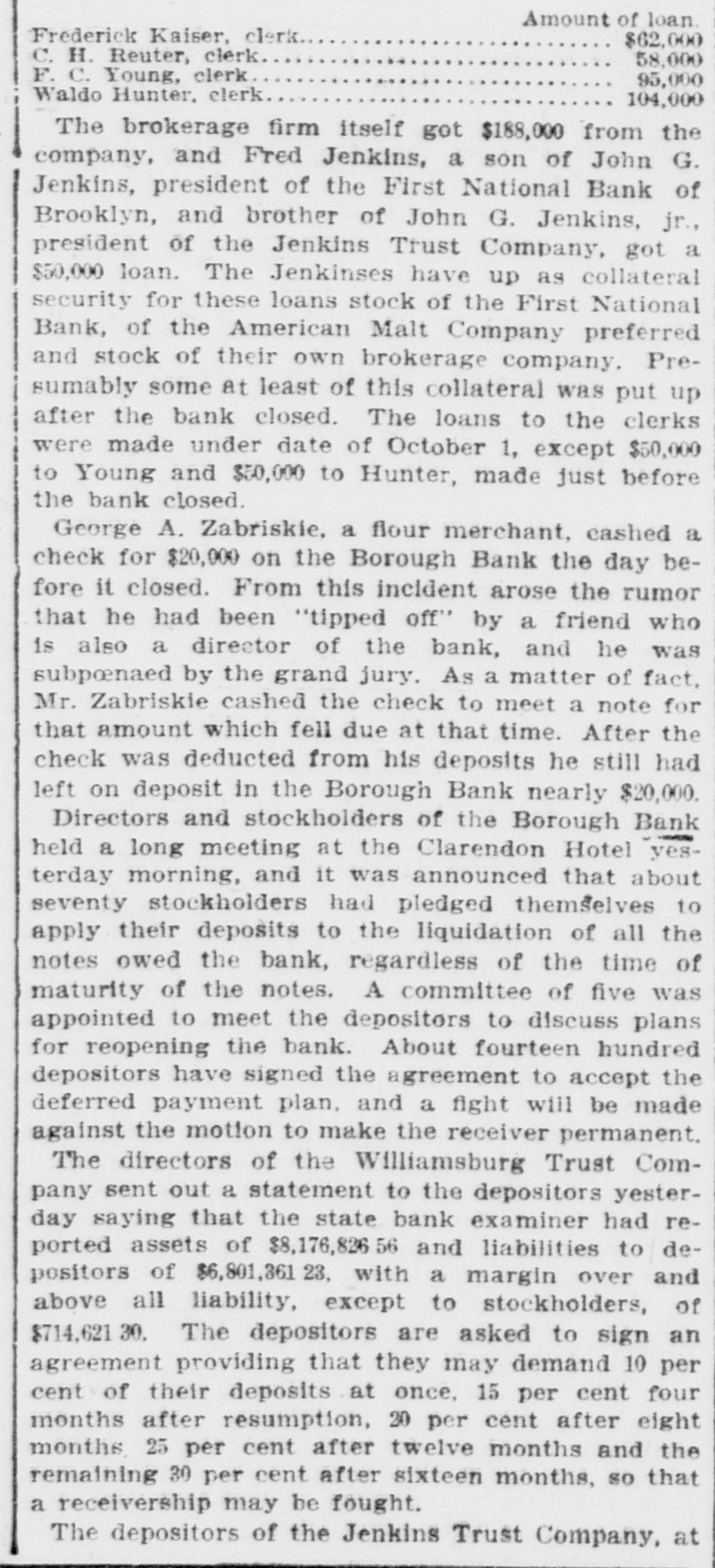
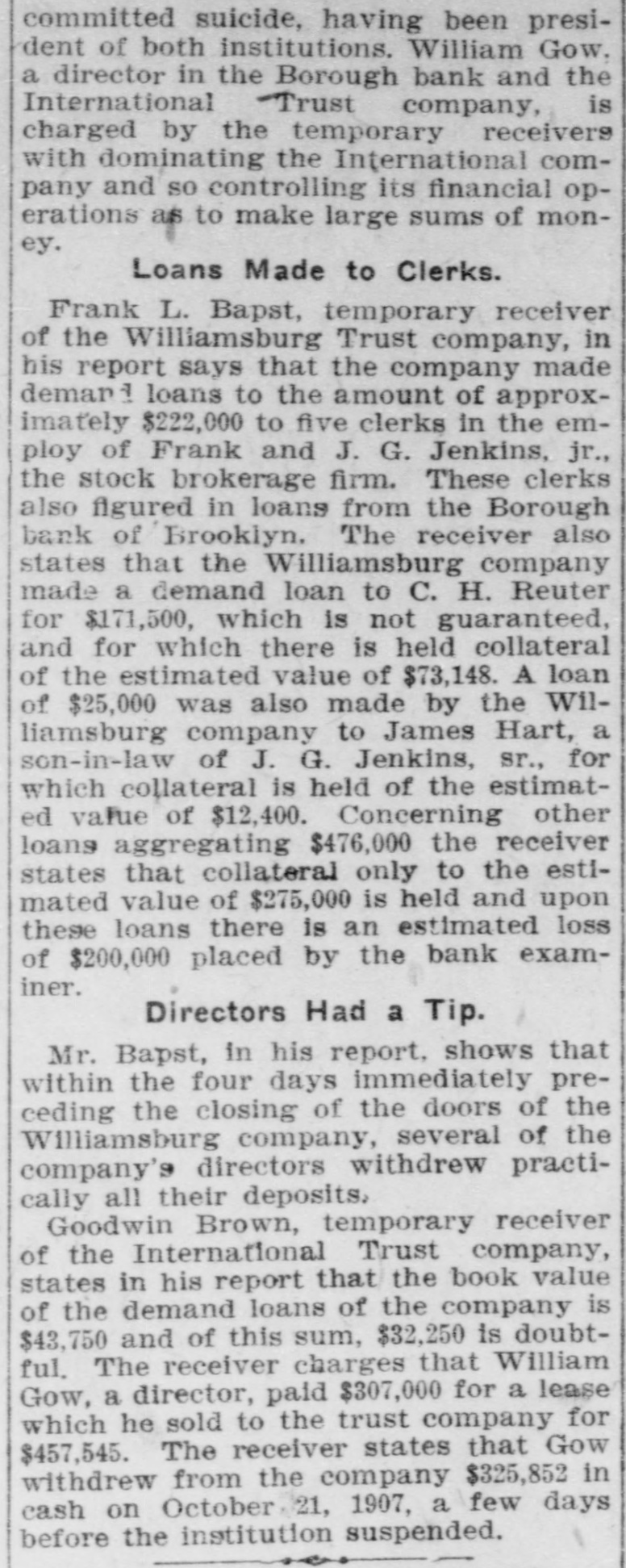
committed suicide, having been president of both institutions. William Gow. a director in the Borough bank and the International Trust company, is charged by the temporary receivers with dominating the International company and SO controlling its financial operations as to make large sums of money. Loans Made to Clerks. Frank L. Bapst, temporary receiver of the Williamsburg Trust company, in his report says that the company made demard loans to the amount of approximately $222,000 to five clerks in the employ of Frank and J. G. Jenkins, jr., the stock brokerage firm. These clerks also figured in loans from the Borough bank of Brooklyn. The receiver also states that the Williamsburg company made a demand loan to C. H. Reuter for $171,500, which is not guaranteed, and for which there is held collateral of the estimated value of $73,148. A loan of $25,000 was also made by the Williamsburg company to James Hart, a son-in-law of J. G. Jenkins, sr., for which collateral is held of the estimated value of $12,400. Concerning other loans aggregating $476,000 the receiver states that collateral only to the estimated value of $275,000 is held and upon these loans there is an estimated loss of $200,000 placed by the bank examiner. Directors Had a Tip. Mr. Bapst, in his report, shows that within the four days immediately preceding the closing of the doors of the Williamsburg company, several of the company's directors withdrew practically all their deposits. Goodwin Brown, temporary receiver of the International Trust company, states in his report that the book value of the demand loans of the company is $43,750 and of this sum, $32,250 is doubtful. The receiver charges that William Gow, a director, paid $307,000 for a lease which he sold to the trust company for $457,545. The receiver states that Gow withdrew from the company $325,852 in cash on October 21, 1907, a few days before the institution suspended.


Article from New-York Tribune, December 1, 1907

Click image to open full size in new tab

Article Text

BIG SUMS DRAWN OUT. BANK RECEIVERS REPORT. Trust Company Accounts Almost at Minimum Before Suspension. Reports of the temporary receivers of the Williamsburg Trust Company and the International Trust Company were made public by Attorney General Jackson yesterday. They show that large withdrawals were made from both institutions just prior to their suspension on October 25. The array of accounts that were drawn down almost to a minimum in the International Trust Company is startling. It would appear that William Gow made some $150,000 by the transfer of the lease of No. 206 Broadway, where the company did business. Deputy Attorney General Robert J. will before District all the facts he has in to-morrow Steele Special place Attorney connection and Jerome ask with the International Trust Company, that some action be taken on them. At the same time the Kings County Grand Jury for December, take which is to be sworn in to-morrow, will up the Williamsburg Trust Company Attorney General Jackson said last night that the loan committee of the Williamsburg Trust Company might be responsible for loans amounting to $220,000, which went to five clerks in the employ of the F. & J. G. Jenkins, jr., brokerage in which this corporation, all which is held by the concern. the stock farm The of ly, way members of dollars of Jenkins borrowed thousands from the Jenkins Trust Company has already been told. It is understood that it also had large loans from the First National Bank, of Brooklyn, which is in the hands of a federal receiver. More evidence has been found to show how some of the accounts in the Borough Bank were drawn down just before its suspension. Arguments were heard yesterday by Justice Bette in Albany on an application to make the receivers of suspended Brooklyn institutions permanent. The application was strenuously opposed by counsel for the banks. All the arguments were adjourned, the Borough Bank to December 10, the International Trust Company. the Brocklyn Bank, the Williamsburg Trust Company and the Jenkins Trust Company to December 12. ORGANIZED OUT OF WIND In giving out the report of Goodwin Brown, receiver for the International Trust Company. Attorney General Jackson said it would seem as if the concern had been organized largely out of whid. "If the report of the receiver is correct," he said, "there was a falsification of the books of the Borough Bank and the Brooklyn Bank and a manipulation of their securities, in order, apparently to give the International Trust Company a surplus and capital of $1.000,000. It was organized only a few weeks before it went up, and when it closed its doors had only about ninety depositors, with deposits of between $110,000 and $120,000. The report states that R. W. Jones, jr., the former president of the Oriental Bank, had a demand loan of $32,250, which was entirely unsecured. "This indebtedness has not been adjusted," says Mr. Brown. "Mr. Jones is ill, but his attorney has promised to confer with me in reference to the matter." An interesting transaction, where William Gow, the organizer of the trust company, apparently made $150,000 is related at some length. It seems that Gow paid to the trustees of the Henderson estate for the lease of No. 206 Broadway, where the trust company did businear, $107,000 in cash and gave a mortgage for $200,000. He apparently sold the lease to the trust company for $457,545 on October 21. or four days before the suspension, receiving $257.545 55 above the mortgage. He on the same day deposited stocks and bonds with the company and drew out $325,852. CONCERNING GOW'S DEAL Concerning this transaction the report has this to say: In another part of my report 1 have called attention to Gow windrawing from the company the $325,852 50 on October 21, 1907 This covered credit he received from the transfer of the leasehold of the building No. 206 Broadway, at a total cost to the company of $457,545 55. which, however, included a mortgage for $200.000 w hich Gow gave to the Henderson trustees at the time he purchased the lease from them. a He by taking out the amount he did, realized profit of $150,000 in disposing of the lease to the company On the other hand however, is to be noted the fact that on October 21 Gow also turned over of to the company stocks and bonds of the value $150,000, so that as a result of the entire transaction if the company had a balance left of about $82,293. we are to concede the full value paid by the compass for the leasehold. and that, as pointed out in another part of my report, is extremely doubtful. In my opinion, Gow originally had no intention of transferring the lease to the company Having paid $107,000 in cash on account of the purchase price paid by him to the Henderson trustees, the the rentals exceeded the charges of operating building by substantial amount It was good investment for him. but on October 21 he evidently needed money either for his own use or to put in the Borough Bank. By turning the lease over to the company on that date at the price of $257,545.65 over and above the existing mortgage for $200,000, and also turning over to the company stocks and bonds of the stated value of $157,600. he was enabled thereby to take on the Fame day from the company's cash at the Oriental Bank the sum of $225,852.50 In support of my opinion that Gow had no inten In tion originally of transferring the lease to the ternational Trust Company, call attention to the fact that the lease itself is not dated, although it The was duly acknowledged on October 21. 1907. original lease made by the Church Corporation contained a clause that in the event of an assignment of the lease being made without their consent, the Church Corporation could then re-enter. This conContinued on second page. CONGRESS OPENS DECEMBER 2ND.


Article from Albuquerque Morning Journal, December 1, 1907

Click image to open full size in new tab

Article Text

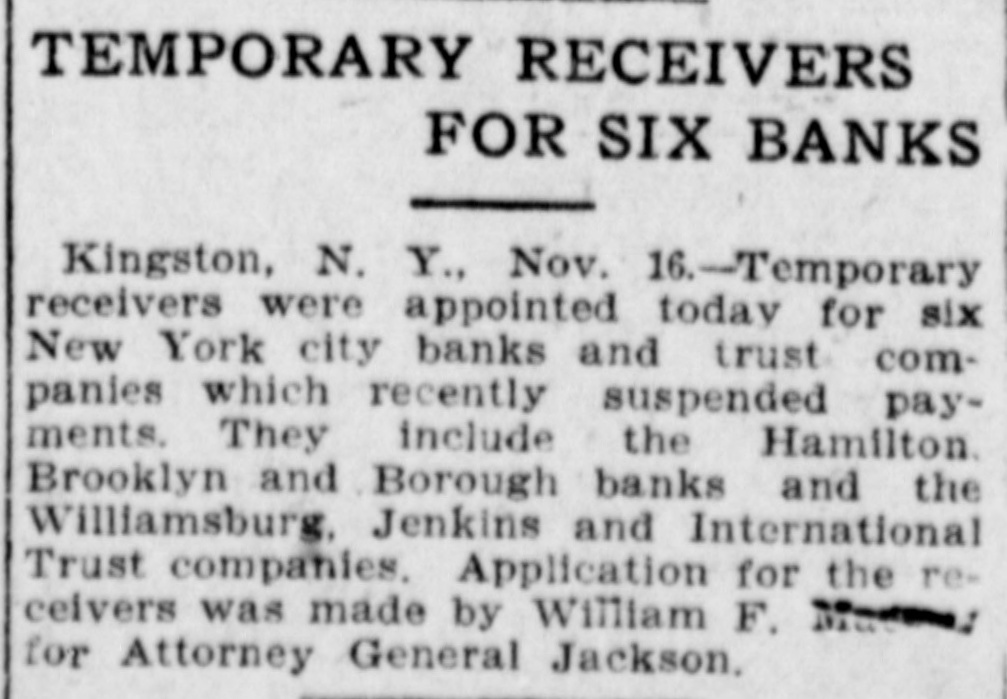
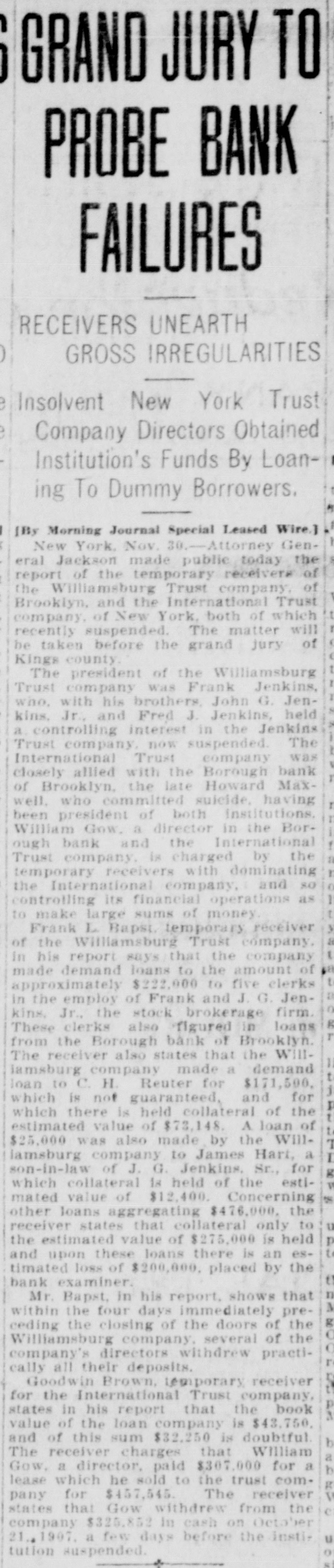
PROBE BANN FAILURES RECEIVERS UNEARTH GROSS IRREGULARITIES Insolvent New York Trust Company Directors Obtained I Institution's Funds By Loaning To Dummy Borrowers. M [By Morning Journal Special Leased Wire.] New York. Nov. 30.-Attorney GenI eral Jackson made public today the report of the temporary receiver# of the Williamsburg Trust company, of Brooklyn, and the International Trust I company. of New York, both of which 800 recently suspended. The matter will be taken before the grand jury of ( Kings county. The president of the Williamsburg I Trust company was Frank Jenkins, BAG who, with his brothers. John G. Jen8 kins. Jr., and Fred J. Jenkins, held X a controlling interest in the Jenkins 1 Trust company. now suspended. The International Trust company was closely allied with the Borough bank of Brooklyn, the late Howard Maxwell. who committed suicide, having Miss been president of both Institutions. I William Gow. a director in the Borough bank and the International ! a Trust company. is charged by the temporary receivers with dominating o the International company, and so controlling its financial operations as 1 to make large sums of money y Frank L Rapst. temporary receiver a of the Williamsburg Trust company. in his report says that the company 18 made demand loans to the amount of 1 approximately $222,000 to five clerks a in the employ of Frank and J. G. Jen0 kins, Jr., the stock brokerage firm. g These clerks also figured in loans T from the Borough bank of Brooklyn. The receiver also states that the WIIIlamsburg company made a demand loan to C. H. Reuter for $171,500. j which is not guaranteed, and for which there is held collateral of the 1 estimated value of $73,148. A loan of t $25,000 was also made by the Will1 lamsburg company to James Hart, a I son-in-law of J. G. Jenkins. Sr., for DE which collateral is held of the estiV mated value of $12,400. Concerning * other loans aggregating $476,000. the receiver states that collateral only to e the estimated value of $275,000 is held p to and upon these loans there is an estimated loss of $200,000. placed by the t) bank examiner. n Mr. Bapst, in his report, shows that 3 within the four days immediately prebe ceding the closing of the doors of the C Williamsburg company. several of the ( company's directors withdrew practir cally all their deposits. C Goodwin Brown, temporary receiver to for the International Trust company, P states in his report that the book value of the loan company is $43.750. and of this sum $32.250 is doubtful. b The receiver charges that William a Gow. a director, paid $307.000 for a b lease which he sold to the trust comg V pany for $457,545. The receiver states that Gow withdrew from the 0 company $325,852 In cash on October 21., 1907. a few days before the insti- u


Article from Daily Arizona Silver Belt, December 1, 1907

Click image to open full size in new tab

Article Text

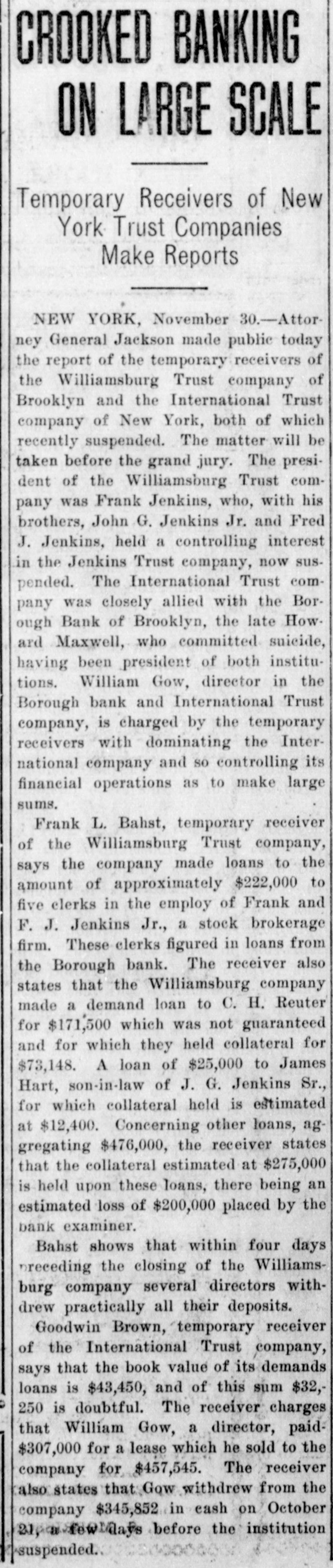
CROOKED BANKING ON LARGE SCALE Temporary Receivers of New York Trust Companies Make Reports NEW YORK, November 30.-Attorney General Jackson made public today the report of the temporary receivers of the Williamsburg Trust company of Brooklyn and the International Trust company of New York, both of which recently suspended. The matter will be taken before the grand jury. The president of the Williamsburg Trust company was Frank Jenkins, who, with his brothers, John G. Jenkins Jr. and Fred J. Jenkins, held a controlling interest in the Jenkins Trust company, now suspended. The International Trust company was closely allied with the Borough Bank of Brooklyn, the late Howard Maxwell, who committed suicide, having been president of both institutions. William Gow, director in the Borough bank and International Trust company, is charged by the temporary receivers with dominating the International company and so controlling its financial operations as to make large sums. Frank L. Bahst, temporary receiver of the Williamsburg Trust company, says the company made loans to the amount of approximately $222,000 to five clerks in the employ of Frank and F. J. Jenkins Jr., a stock brokerage firm. These clerks figured in loans from the Borough bank. The receiver also states that the Williamsburg company made a demand loan to C. H. Reuter for $171,500 which was not guaranteed and for which they held collateral for $73,148. A loan of $25,000 to James Hart, son-in-law of J. G. Jenkins Sr., for which collateral held is estimated at $12,400. Concerning other loans, aggregating $476,000, the receiver states that the collateral estimated at $275,000 is held upon these loans, there being an estimated loss of $200,000 placed by the bank examiner. Bahst shows that within four days preceding the closing of the Williamsburg company several directors withdrew practically all their deposits. Goodwin Brown, temporary receiver of the International Trust company, says that the book value of its demands loans is $43,450, and of this sum $32,250 is doubtful. The receiver charges that William Gow, a director, paid$307,000 for a lease which he sold to the company for $457,545. The receiver also states that Gow withdrew from the company $345,852 in eash on October 21pm fewl/days before the institution suspended.


Article from The Washington Herald, December 2, 1907

Click image to open full size in new tab

Article Text

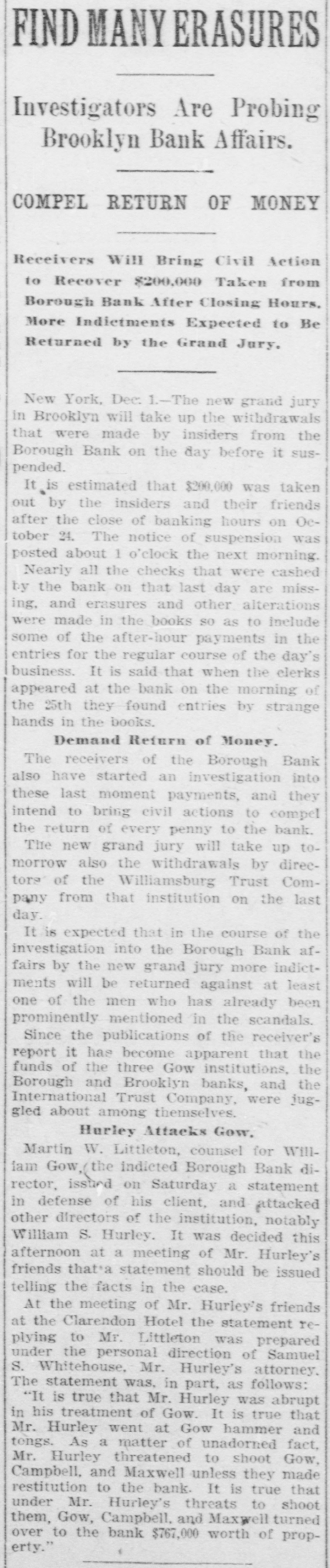
FIND MANY ERASURES Investigators Are Probing Brooklyn Bank Affairs. COMPEL RETURN OF MONEY Receivers Will Bring Civil Action to Recover $200,000 Taken from Borough Bank After Closing Hours. More Indictments Expected to Be Returned by the Grand Jury. New York, Dec: 1.-The new grand jury in Brooklyn will take up the withdrawals that were made by insiders from the Borough Bank on the day before it suspended. It is estimated that $200,000 was taken out by the insiders and their friends after the close of banking hours on October 24. The notice of suspension was posted about 1 o'clock the next morning. Nearly all the checks that were cashed by the bank on that last day are missing, and erasures and other alterations were made in the books so as to include some of the after-hour payments in the entries for the regular course of the day's business. It is said that when the elerks appeared at the bank on the morning of the 25th they found entries by strange hands in the books. Demand Return of Money. The receivers of the Borough Bank also have started an investigation into these last moment payments, and they intend to bring civil actions to compel the return of every penny to the bank. The new grand jury will take up tomorrow also the withdrawals by directors of the Williamsburg Trust Company from that institution on the last day. It is expected that in the course of the investigation into the Borough Bank affairs by the new grand jury more indictments will be returned against at least one of the men who has already been prominently mentioned in the scandals. Since the publications of the receiver's report it has become apparent that the funds of the three Gow institutions, the Borough and Brooklyn banks, and the International Trust Company, were juggled about among themselves. Hurley Attacks Gow. Martin W. Littleton, counsel for William Gow.(the indicted Borough Bank director. issued on Saturday a statement in defense of his client, and attacked other directors of the institution, notably William S. Hurley. It was decided this afternoon at a meeting of Mr. Hurley's friends that'a statement should be issued telling the facts in the case. At the meeting of Mr. Hurley's friends at the Clarendon Hotel the statement replying to Mr. Littleton was prepared under the personal direction of Samuel S. Whitehouse, Mr. Hurley's attorney. The statement was. in part, as follows: "It is true that Mr. Hurley was abrupt in his treatment of Gow. It is true that Mr. Hurley went at Gow hammer and tongs. As a matter of unadorned fact, Mr. Hurley threatened to shoot Gow. Campbell, and Maxwell unless they made restitution to the bank. It is true that under Mr. Hurley's threats to shoot them, Gow, Campbell, and Maxwell turned over to the bank $767,000 worth of property." .


Article from The Evening World, December 4, 1907

Click image to open full size in new tab

Article Text

NEW INDICTMENTS ARE DRAWN FOR BANK WRECKERS Brooklyn Grand Jury Ready to Present More Bills in Scandal. POLITICIANS UNEASY. Men Who Expected Subpoenas Are Wondering Why They Didn't Get Them. The December Grand Jury investigathan into the wrecking of the Brooklyn banks has progressed so far that indictments have, been prepared and will be submitted "to the Court as soon as the evidence is all in. The Williamsburg Trust Company officials were on the Grand Jury rack to-day. Marshall Driggs, a director who was apposed to the control of the conqern by the Jenkins family, was called beSere the Grand Jury twice. The other witnesses were Directors Charles Jerome Edwards, J. H. Weber, J. N. Mobeidt, T. F. Jackson, R. T. Weber and Paying Teller W. A. Fields. District-Attorney Clarke has succeeded in burying his investigations under mound of secrecy that is causing a lot of uneasiness in Brooklyn financial and political circles. Certain directors of suspended banks who have not been called as witnesses before the Grand Jury are wondering why. They recall that none of those thus far indicted was called before the Grand Jury except Arthur Campbell, cashier of the Borsugh Bank, who turned State's evidenoe. Ald for Two Trust Companies. The controversy between the receive ers appointed at the instance of Attor ney-General Jackson for the bankrupt Brooklyn banks and the stockholders and depositors who are not willing to have the institutions go into permanent receiverships wages bitterly. It was announced to-day that two syndicates have been formed to aid the Williams. burg Trust Company and the Jenkins Trust Company to resume business, the former company to be advanced $1,000,000 and the latter $500,000. Stephen C. Baldwin, attorney for the three Jenkins brothers, against whom indictments have already been found, fearing his clients may be indicted on other counts, has addressed letters to Police Commissioner Bingham and Deputy O'Keeffe warning the Police De partnent not to put John G. Jenkins, Jr., through the workings of the Berfillon system if he is arrested. The report current to-day was that Indictments were expected against at least two of the Jenkins family for alleged fraudulent loans from the Williamsburg Trust Company. made through clerks. Frank Jenkins, deposed head of the Williamsburg Trust Company: John G. Jenkins, Jr., former President of the Jenkins Trust Company, and Fred Jen. kins, a director in the latter CO ern, have already been indicted for similar loans made from the Jenkins Trust Company. After their first indictments Frank and Fred Jenkins were photographed for the Rogues' Gallery and measured by the Bertillon system. John G., Jr., escaped this humiliation through a writ after surfendering in court. Mr. Baldwin has promised to surrender any member of the Jenkins family to court as soon as additional indictments are found. Sympathy for Jenkins, Sr. Two sons-in-law of John G. Jenkins,


Article from The Evening World, December 12, 1907

Click image to open full size in new tab

Article Text

Receiver Bapst Finds More Than 10 Per Cent. of Williamsburg's Capital Invested in Inter-Met. HOW DIRECTORS OF WILLIAMSBURG TRUST COMPANY VIOLATED THE LAW In May, and June, 1906, the Williamsburg Trust Cornpany, with the approval of its directory, at the head of which was Anthony N. Brady, millionaire capitalist of New York and Albany, bought 1,330 shares of Inter.-Met. preferred stock at 105 and 106, paying $146,512.25 for the same. On Dec. 11, 1907, these 1,330 shares of Inter.-Met. preferred stock, quoted on the New York Stock Exchange at 19, were worth just $25,270. Net loss to the Williamsburg Trust Company by this transaction. $121,242.25, for which Mr. Brady and his associate directors are liable to the depositors. The Williamsburg Trust Company has a capital stock of $700,000, and Section 159 of the banking laws prohibits the purchase by a trust company of the stock of a private corporation in excess of 10 per cent. of the capital stock of the trust company. Ten per cent. of $700,000 is $70,000, not $146,512.25.


Article from Evening Star, January 9, 1908

Click image to open full size in new tab

Article Text

BASE BALL NOTES. Jack O'Conor, like Jim McGuire, is gradually slipping out of harness. O'Conor will scout for the Browns next season. Denver has re-engaged Frank Selee as manager for another season. This indicates that he is enjoying much better health than he has in recent years. Tommy Corcoran and Bill Bernhard are rival candidates for the management of the Nashville team. Bernhard has the better chance. Jesse Burkett is in Clark Griffith's class as a manager. He has signed fifteen pitchers for his Worcester team. That's going some for a minor league club. Word comes from Chicago that Griff told a friend Jake Stahl would succeed Hal Chase as the first baseman of the Yankees. According to the story, Chase will be shifted to the outfield. Billy Gilbert will have a formidable rival for the second base job in St. Louis in Charles, the Williamsport graduate. Gilbert will go to Hot Springs early next month to prepare for what promises to be a good season for him. Willie Keeler was stung when the Williamsburg Trust Company closed its doors. However. Willie will struggle along on his income from a dozen or more Brooklyn apartment houses until the base ball season opens. According to figures compiled by Garry Herrmann. chairman of the national commission, the two major leagues expended $213,000 last season in purchasing ball players from the minor leagues. It has been settled that Dan McGann is to captain the Boston Nationals. Joe Kelley thinks an infielder should have the job and he (Kelley) has assigned himself to the outfield. It is said that Whitey Alperman, who broke his leg last fall, is still limping and that he will be of little value to the Dodgers for the first few weeks of the season. It will be hard lines for Pat Donovan if this sterling player has to do bench duty. The Dodgers have asked for waivers on Outfielder Al Burch. This seems to indicate that John Hummell will be the regular left fielder next season. with Heine Batch as utility man. Brooklyn is still after George Browne. whom the Giants recently traded to Boston. It is probable the Dodgers will keep a string on Burch so he can be called back in case of need. Jay Gould. the multimillionaire, may become a ball player. He is now a student at Columbia, and Tommy Corcoran, who is coaching the base ball team, says the son of the wealthy railroad magnate has great ability on the diamond and may get a place on the team. Manager McGuire has informed Young, Criger, Winter, Tarinehill, Morgan, Burchill, McFarland and Barrett to report at Hot Springs Tuesday. February 18. His idea of having them report early is to have these men in first-class trim when the season opens. They will remain at the Hot Springs three weeks and will report at Little Rock Tuesday, March 10. "Jiggs" Donohue has had a conference with President Comiskey of the White Sox, and has not yet signed his contract with that club. It is not likely that "Jiggs" is holding out for more money. but many suspect that he has another scheme in view. Last fall he made the remark that he would like to get a block of the stock in the Milwaukee club and then manage the team himself. "Jiggs" Donohue has entered a five-man team, composed entirely of ball players, in the American bowling congress tourney in Cincinnati next month. Al Selbach, who recently won the individual championship of Ohio, will pilot a team from Columbus, and John Ganzel is a probable competitor. A special prize may be hung up for base ball entries. There was ten minutes of excitement in the Yankees' headquarters in the Flatiron building yesterday when little Willie Keeler blew in. After practicing a few minutes with a fountain pen Willie announced he was ready to put his signature to a contract. Secretary Abe Nahon removed his coat, vest, collar and necktie and, digging deep into a drawer, hauled out a legal-looking document and gave it to Keeler. The latter wrote his name right the very first time, while Ira Thomas, whom the Yankees recently traded to Detroit, looked on enviously. But Thomas proved game. He remarked that he was delighted with the trade that made him a Tiger, and said he expected to see Detroit again land the pennant of


Article from New-York Tribune, February 4, 1908

Click image to open full size in new tab

Article Text

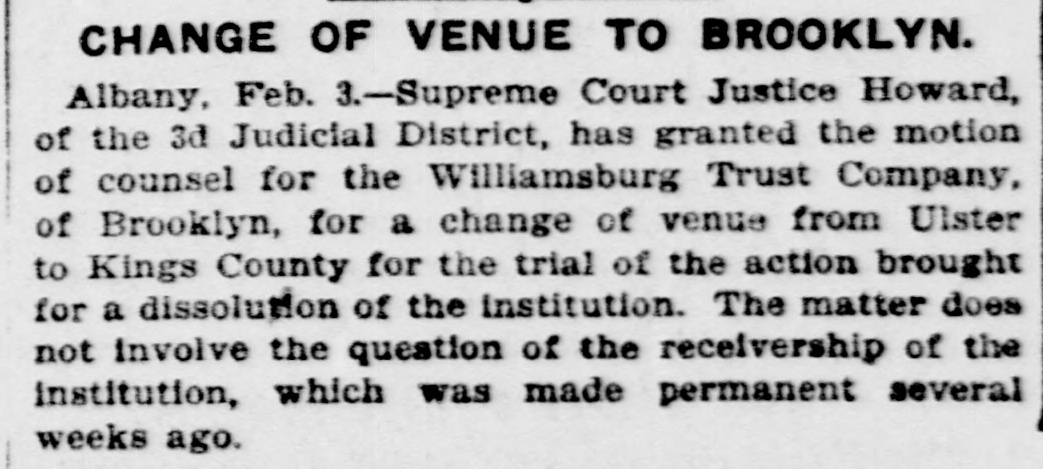
CHANGE OF VENUE TO BROOKLYN. Albany, Feb. 3.-Supreme Court Justice Howard, of the 3d Judicial District, has granted the motion of counsel for the Williamsburg Trust Company. of Brooklyn, for a change of venue from Ulster to Kings County for the trial of the action brought for a dissolution of the institution. The matter does not involve the question of the receivership of the institution, which was made permanent several weeks ago.


Article from New-York Tribune, February 14, 1908

Click image to open full size in new tab

Article Text

CHANGE OF VENUE DENIED. Justice Howard Renders Decision in Williamsburg Trust Company Case. Kingston, N. Y., Feb. 13.-In a decision handed down to-day by Supreme Court stice Howard, of Troy, a change of venue to Ulster County from Kings County was denied in the case of the Williamsburg Trust Company, the affairs of which are now being administered by Frank L. Babst and Augustus Van Wyck as receivers. Attorney General Jackson immediately filed a notice of appeal from the decision. Justice Howard held that no reason for laying the venue in Ulster County other than that an impartial trial could not be had in Kings County had been asserted and "the fact that the trial is to be had before a judge without a jury, to my mind, renders that proposition untenable."


Article from The Evening World, March 12, 1908

Click image to open full size in new tab

Article Text

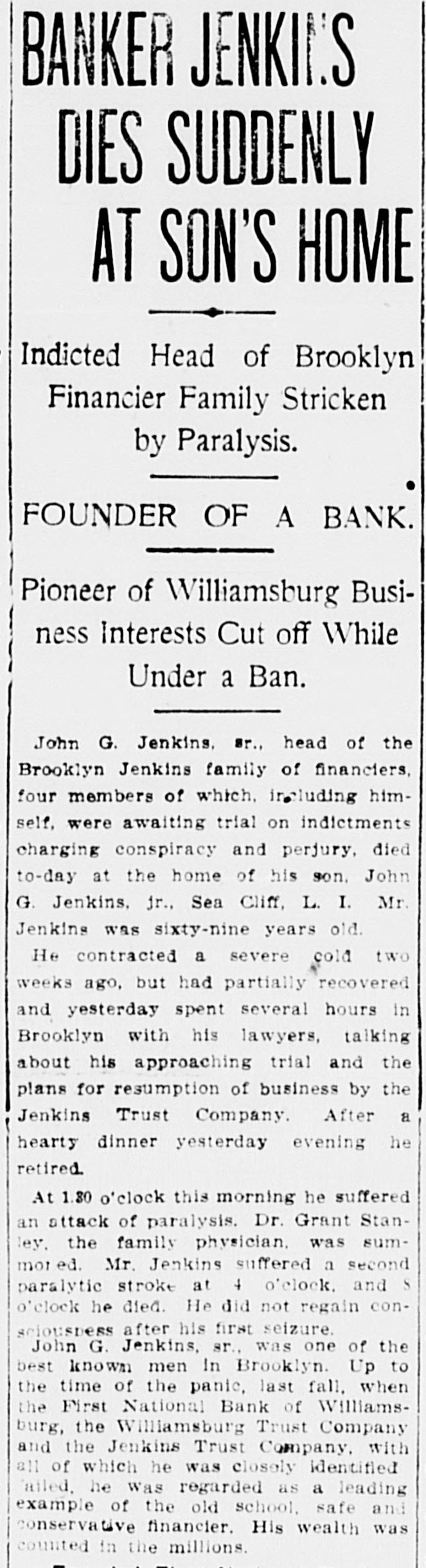
BANKER JENKINS DIES SUDDENLY AT SON'S HOME Indicted Head of Brooklyn Financier Family Stricken by Paralysis. FOUNDER OF A BANK. Pioneer of Williamsburg Business Interests Cut off While Under a Ban. John G. Jenkins, sr., head of the Brooklyn Jenkins family of financiers, four members of which, including himself, were awaiting trial on indictments charging conspiracy and perjury, died to-day at the home of his son, John G. Jenkins, jr., Sea Cliff, L. I. Mr. Jenkins was sixty-nine years old. He contracted a severe cold two weeks ago, but had partially recovered and yesterday spent several hours in Brooklyn with his lawyers, talking about his approaching trial and the plans for resumption of business by the Jenkins Trust Company. After a hearty dinner yesterday evening he retired. At 1.30 o'clock this morning he suffered an attack of paralysis. Dr. Grant Stanley. the family physician. was summored. Mr. Jenkins suffered a second paralytic stroke at 4 o'clock. and S o'clock he died. He did not regain consciousness after his first seizure. John G. Jenkins, sr., was one of the best known men in Brooklyn. Up to the time of the panic, last fall, when the First National Bank of Williamsburg, the Williamsburg Trust Company and the Jenkins Trust Company, with all of which he was closely identified ailed. he was regarded as a leading example of the old school, safe and conservative financier. His wealth was counted in the millions.


Article from New-York Tribune, March 31, 1908

Click image to open full size in new tab

Article Text

TRUST COMPANY'S ASSETS $7,935,917. Kingston, N. Y., March 30.-The assets of the Williamsburg Trust Company, of Brooklyn, which has been in the hands of receivers for several months, are valued at $7,935,917 in a report of the appraisal filed with the Supreme Court to-day by Clark Williams, State Superintendent of Banks. The book value of the assets is given as $8,441,351. the appraisal showing a shrinkage therefrom of $505,433. Of the shrinkage, $296,342 was in stocks and bonds and $146,702 in demand loans. The report shows the company has cash assets of $374,569, of which $66,448 is in the hands of the receivers.


Article from Tonopah Daily Bonanza, April 11, 1908

Click image to open full size in new tab

Article Text

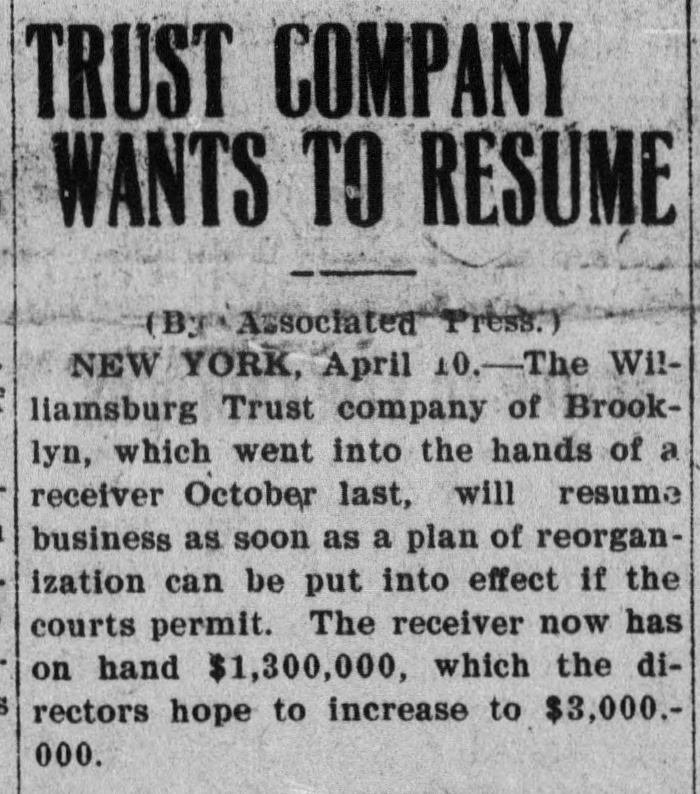
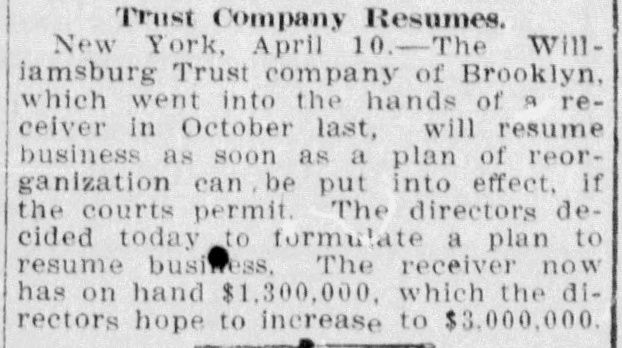
TRUST COMPANY WANTS TO RESUME (B) Associated Press. y NEW YORK, April 10.-The Williamsburg Trust company of Brooklyn, which went into the hands of a receiver October last, will resume business as soon as a plan of reorganization can be put into effect if the courts permit. The receiver now has on hand $1,300,000, which the directors hope to increase to $3,000.000.


Article from New-York Tribune, June 2, 1908

Click image to open full size in new tab

Article Text

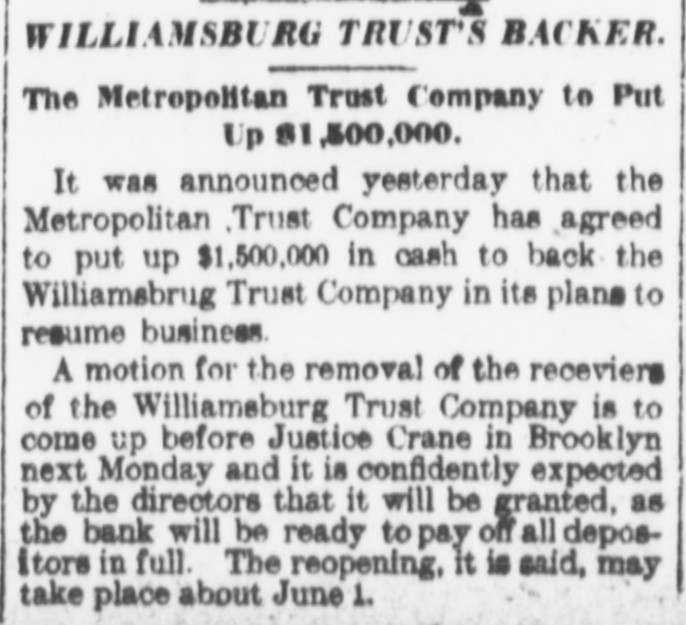
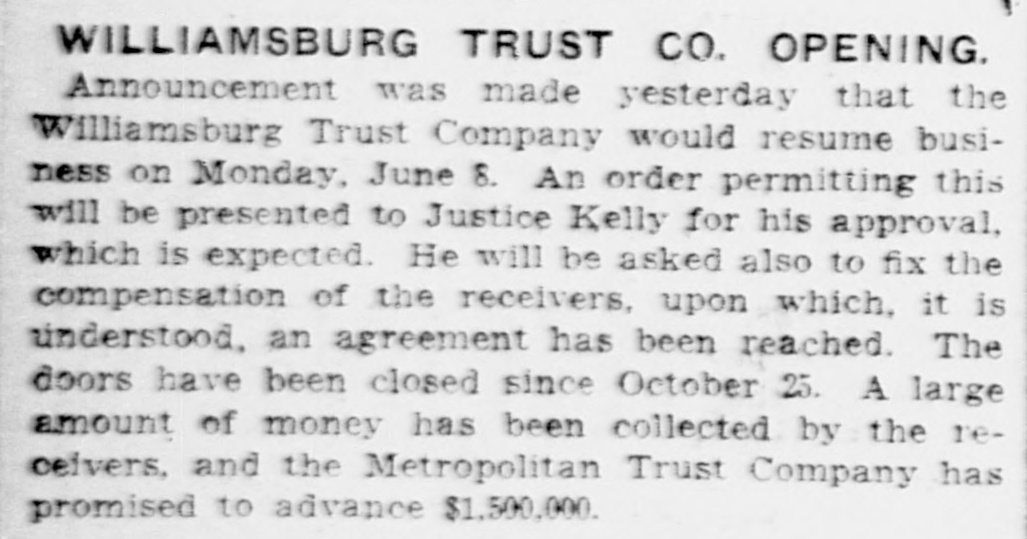
RECEIVERS ASK $200,000, GET $30,000. Williamsburg Trust Company Resumption Order Signed by Justice Kelly. Justice Kelly, in the Supreme Court. in Brooklyn, ordered yesterday that the Williamsburg Trust Company resume business on the morning of Monday, June 8. At the same time, he discharged the receivers. This action was taken with the approval of Clark Williams, the State Superintendent of Banking. The Williamsburg Trust Company was one of the Jenkins chain of banking institutions that went under last fall. All depositors who wish to withdraw their money may do so in full. The receivers asked $200.000, while John D. Lyons, their counsel. wanted $10,000, which was granted. Justice Kelly decided that the receivers should have $30,000; Augustus Van Wyck, receiving $20,000 and Frank L. Bapst, $10,000. An allowance of $25,000 for running expenses was made some time ago. The Metropolitan Trust Company loaned $1,500,000 to the Williamsburg Trust Company, which has a capital of $200,000, unimpaired, and a surplus of $149,000. It has on hand $1,700,000 in cash and ready assets of $1,800,000.


Article from The Morning Journal-Courier, June 9, 1908

Click image to open full size in new tab

Article Text

WILLLAMSBURG TRUST OPEN. Brooklyn Company Reopens After Forced Suspension. New York, June 8.-The reopening of the Williamsburgh Trust company took place at 10 o'clock to-day, when the three branch offices in Brooklyn, on the Williamsburgh Bridge Plaza, at 391 Fulton street and at Broadway and Stockton street, were ready for business. The company suspended payments on October 25 last, and the plan for resumption provides for no restrictions on depositors who wish to withdraw their funds, the Metropolitan Trust company having provided $1.500,000 to meet demands, and, as announced, standing ready to furnish as much more as may be needed.


Article from New-York Tribune, April 6, 1910

Click image to open full size in new tab

Article Text

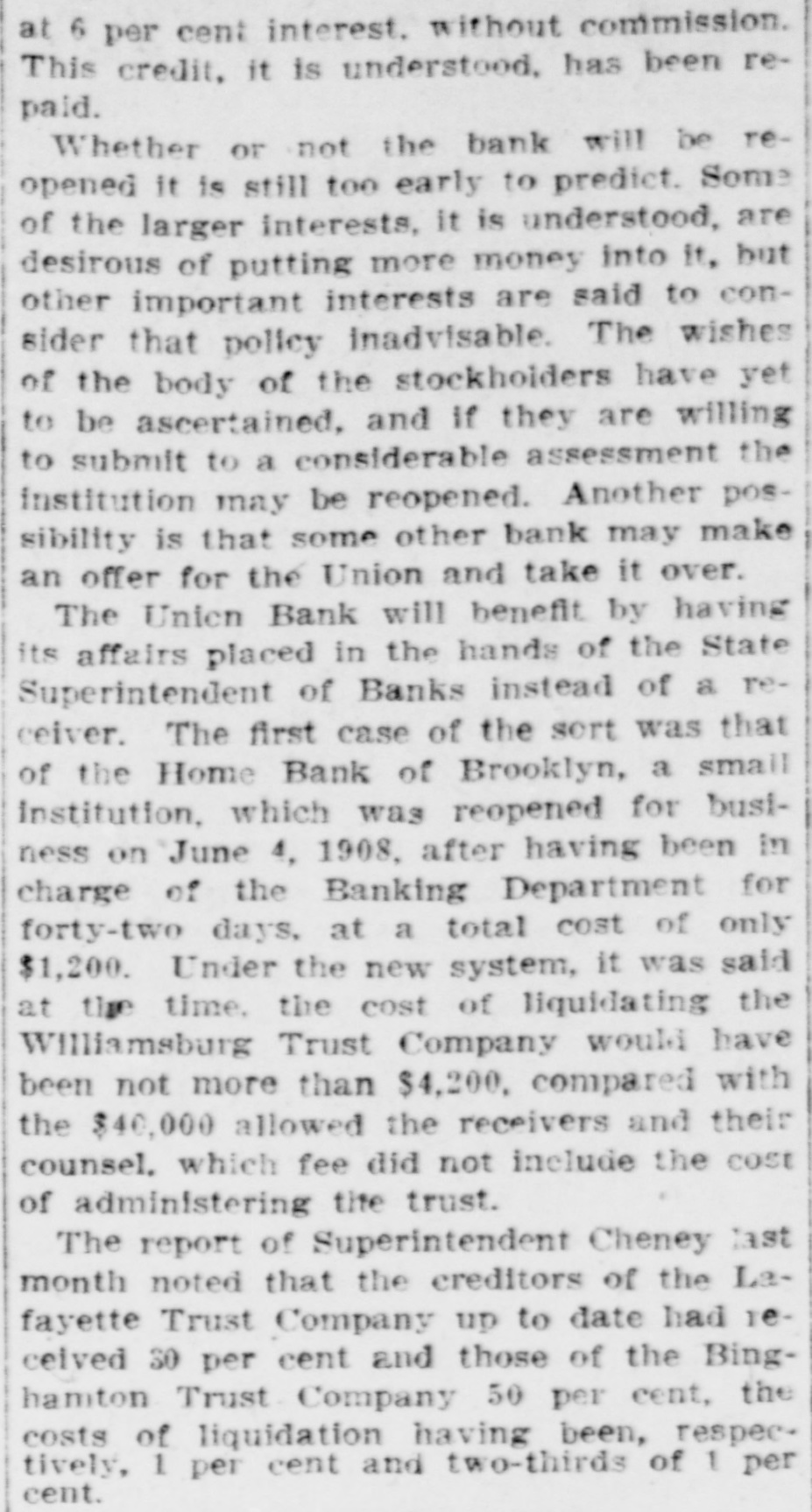
at 6 per cent interest, without commission. This credit, it is understood, has been repaid. Whether or not the bank will be reopened it is still too early to predict. Some of the larger interests, it is understood, are desirous of putting more money into it, but other important interests are said to consider that policy inadvisable. The wishes of the body of the stockholders have yet to be ascertained, and if they are willing to submit to a considerable assessment the institution may be reopened. Another possibility is that some other bank may make an offer for the Union and take it over. The Union Bank will benefit by having its affairs placed in the hands of the State Superintendent of Banks instead of a receiver. The first case of the sort was that of the Home Bank of Brooklyn, a small institution, which was reopened for business on June 4, 1908, after having been in charge of the Banking Department for forty-two days, at a total cost of only $1,200. Under the new system, it was said at the time, the cost of liquidating the Williamsburg Trust Company would have been not more than $4,200, compared with the $40,000 allowed the receivers and their counsel, which fee did not include the cost of administering the trust. The report of Superintendent Cheney last month noted that the creditors of the Lafayette Trust Company up to date had received 30 per cent and those of the Binghamton Trust Company 50 per cent, the costs of liquidation having been, respectively, 1 per cent and two-thirds of 1 per cent.


Article from New-York Tribune, December 15, 1910

Click image to open full size in new tab

Article Text

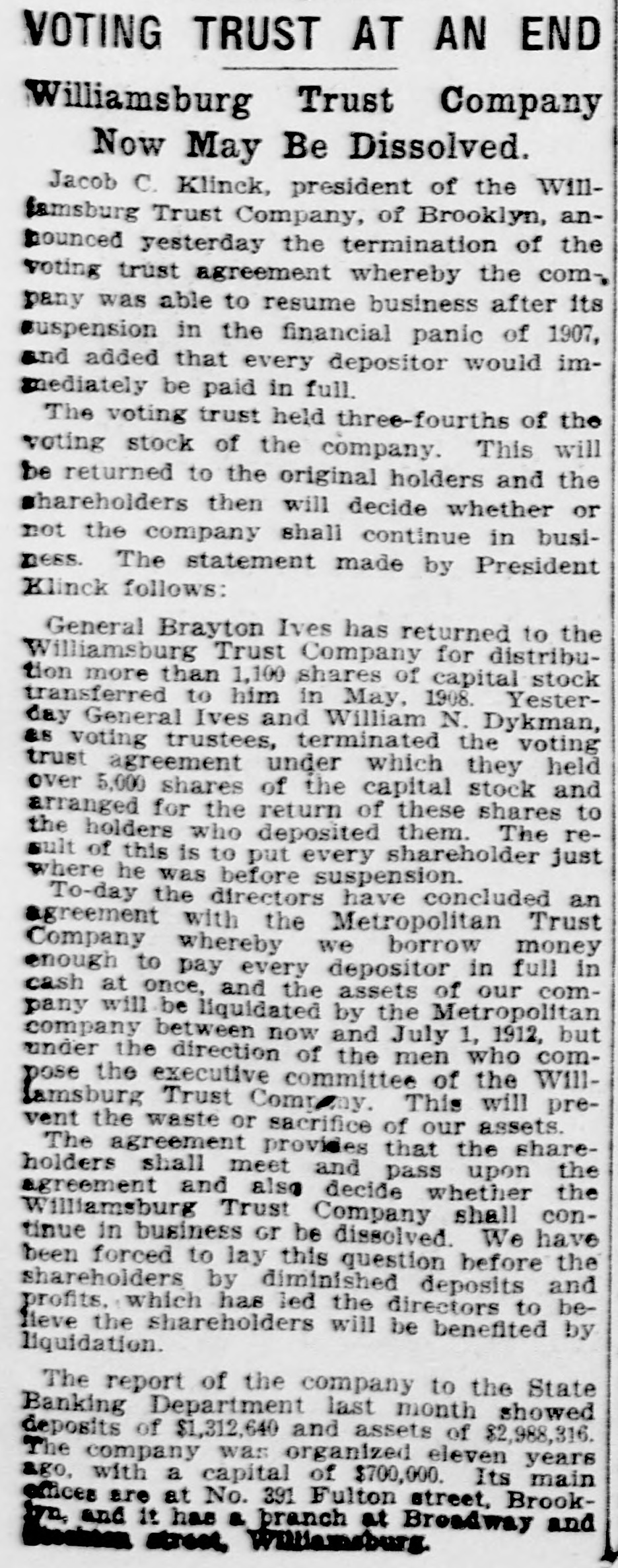
VOTING TRUST AT AN END Williamsburg Trust Company Now May Be Dissolved. Jacob C. Klinck, president of the Willfamsburg Trust Company, of Brooklyn, anhounced yesterday the termination of the voting trust agreement whereby the com-, pany was able to resume business after its suspension in the financial panic of 1907, and added that every depositor would immediately be paid in full. The voting trust held three-fourths of the voting stock of the company. This will be returned to the original holders and the hareholders then will decide whether or not the company shall continue in busiaess. The statement made by President Klinck follows: General Brayton Ives has returned to the Williamsburg Trust Company for distribution more than 1,100 shares of capital stock transferred to him in May, 1908. Yesterday General Ives and William N. Dykman, as voting trustees, terminated the voting trust agreement under which they held over 5,000 shares of the capital stock and arranged for the return of these shares to the holders who deposited them. The reult of this is to put every shareholder just where he was before suspension. To-day the directors have concluded an greement with the Metropolitan Trust Company whereby we borrow money enough to pay every depositor in full in cash at once, and the assets of our company will be liquidated by the Metropolitan company between now and July 1, 1912, but under the direction of the men who compose the executive committee of the WillLamsburg Trust Company. This will prevent the waste or sacrifice of our assets. The agreement provides that the shareholders shall meet and pass upon the agreement and also decide whether the Williamsburg Trust Company shall continue in business Gr be dissolved. We have been forced to lay this question before the shareholders by diminished deposits and profits, which has led the directors to believe liquidation. the shareholders will be benefited by The report of the company to the State Banking Department last month showed deposits of $1,312,640 and assets of $2,988,316. The company was organized eleven years ago, with a capital of $700,000. Its main fices are at No. 391 Fulton street, BrookP and It has & branch at Breadway and Williamsburg.