Article Text
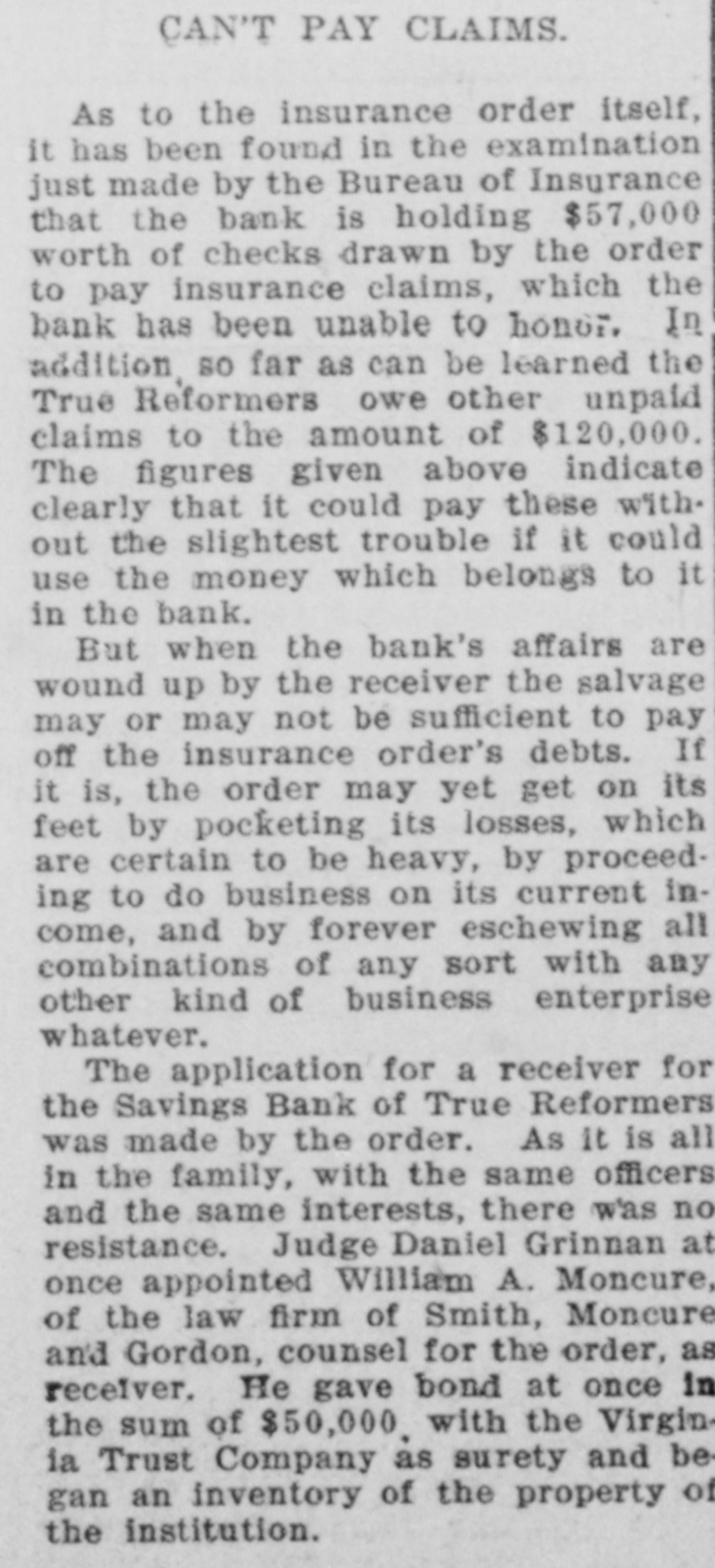
TRUE REFORMERS INVOLVED IN RUIN (Continued From First Page.) prises as three branches of the same concern. Can't Pay Claims. As to the insurance order itself, It has been found in the examination just made by the Bureau of Insurance that the bank is holding $57,000 worth of checks drawn by the order to pay insurance claims, which the bank has been unable to honor. In addition, 30 far as can be learned, the True Reformers owe other unpaid claims to the amount of $120,000. The figures given above indicate clearly that it could pay these without the slightest trouble If it could use the money which belongs to it in the bank. But when the bank's affairs are wound up by the receiver the salvage may or may, not be sumcient to pay off the insurance order's debts. If it is. the order may yet get on its feet by pocketing its losses, which are certain to be heavy, by DFOceeding to do business on its current income, and by forever eschewing all combinations of any sort with any other kind of business enterprise whatever. The application for a receiver for the Savings Bank of True Reformers was made by the order. As it 18 all in the family, with the same officers and the same interests, there was no resistance. Judge Daniel Grinnan at once appointed William A. Moncure, 05. the law firm of Smith, Moncure & Gordo:. counsel for the order, as receiver. He gave bond at once in the sum of $50,000, with the Virginia Trust Company as surety. and began an inventory of the property of the institution. Was Popular Order. For nearly thirty years the True Reformers has held a leading place in the admiration and affection of the colored people of this part of the country. Its home office, with its bank and its printing office, are located on Second Street near Leigh, in Richmond. Only a few weeks ago the biennial session of the Grand Fountain was held here, at which time, on demand of the Bureau of Insurance, W. L. Taylor was ousted from the presidency and A. W. Homes was elected It his place. It was hoped at that time that the order would be placed on a sounder basis, but the real condition of affairs in the bank was not then known and has apparently precluded such a happy issue out of all its troubles. The order's success was phenomenal from the start. Thousands of members flocked to its standard, and there are now nearly 2,500 subordinate lodges scattered over the Southern and Middle States and in the Middle West. In 1888 the Savings Bank was chartered. Stock was subscribed to by individual members of the order. The charter of the bank provides that its board of directors shall be the board of directors of the True Reformers. Stock was sold on the condition that at the death of the stockholder it should revert to the bank, and no provision was made for its reissuance. Checks Held Up. For some time complaints have been coming to the Bureau of Insurance as to the non-payment of insurance claims by the True Reformers. As long as a year ago officials of the department warned the officers of the allied institutions that unless they dropped the bank it would sooner or later involve the entire enterprise in disaster. But nothing was done. However, last hys