Receiver was appointed during the suspension but the bank later reorganized and resumed.
Events (4)
1.August 5, 1893Suspension
Cause
Macro News
Cause Details
Stringency in the money market and lack of ready currency forced assignment and suspension.
Newspaper Excerpt
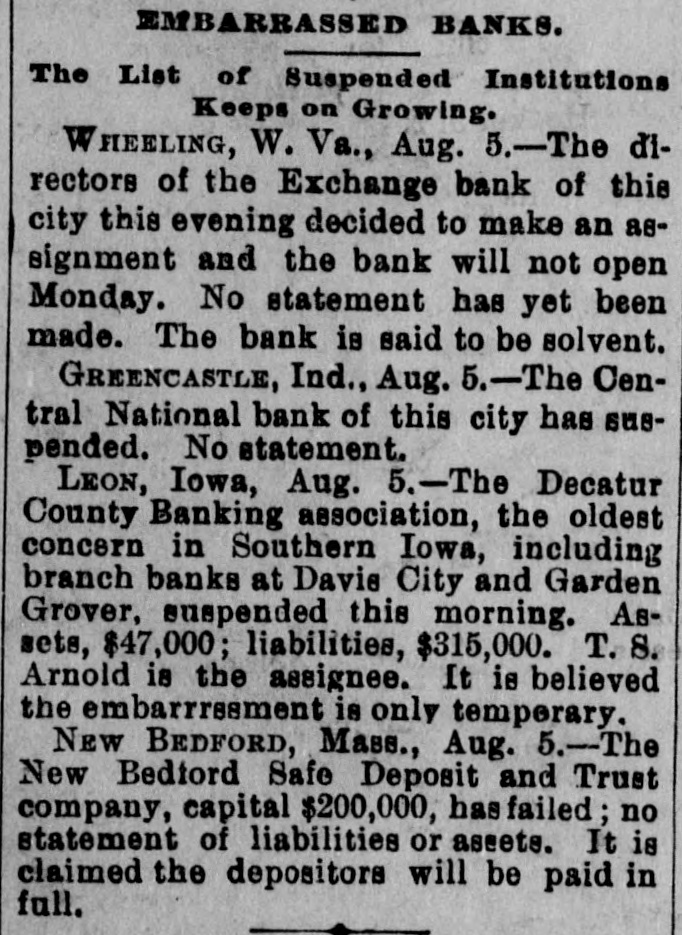
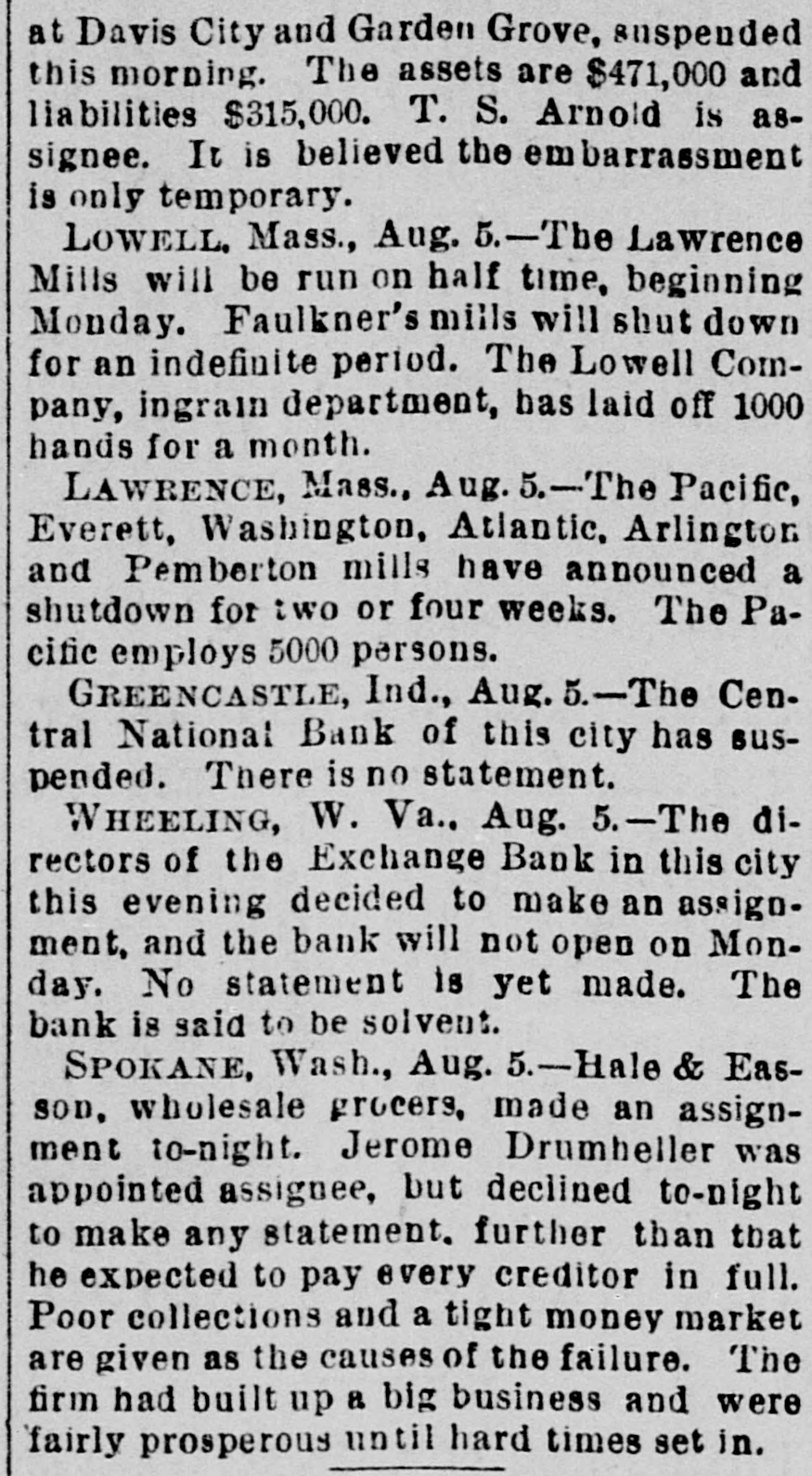
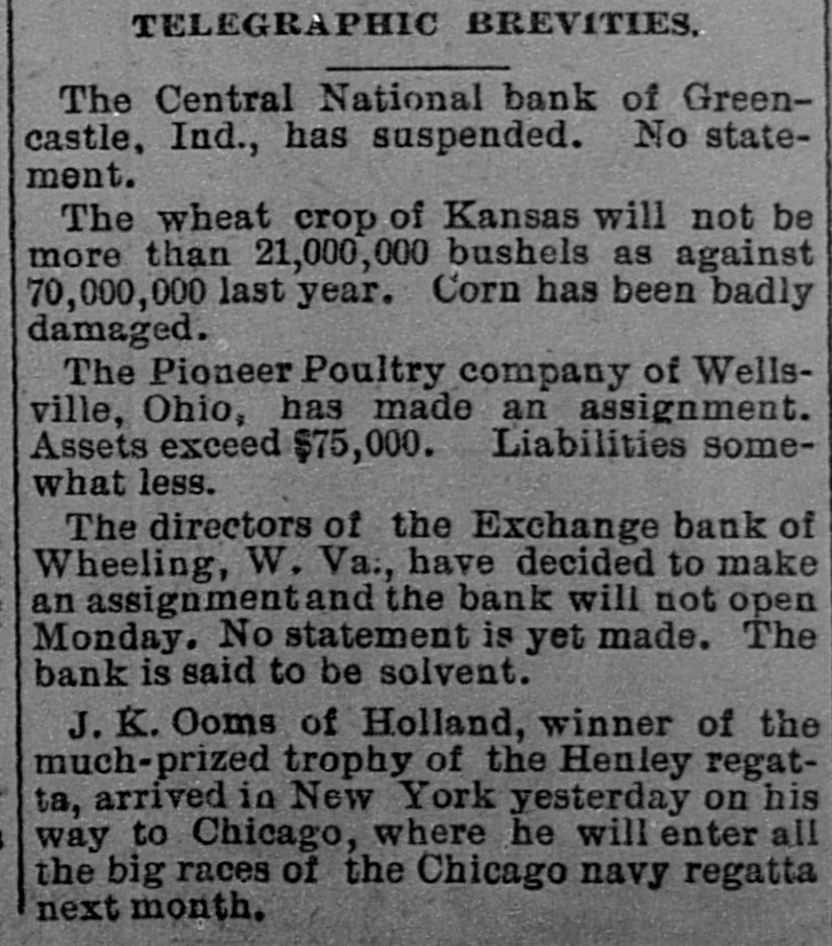
The directors of the Exchange bank of this city this evening decided to make an assignment and the bank will not open Monday.
Source
newspapers
+2 days
2.August 7, 1893Run
Cause
Local Banks
Cause Details
Runs on other local banks triggered by news of Exchange Bank's assignment/suspension.
Measures
Large deposits by business men and issuance proposal of certificates of deposit later to reassure depositors.
Newspaper Excerpt
As a result of a scare created by the assignment of the Exchange Bank a run began on several other banks this morning, but it did not last long.
Source
newspapers
+5 days
3.August 12, 1893Receivership
Newspaper Excerpt
Hon. John J. Jones, cashier, was appointed receiver.
Source
newspapers
+39 days
4.September 20, 1893Reopening
Newspaper Excerpt
The Exchange Bank ... reopened its doors today; suspended business August 5 and now re-opens with $100,000 additional stock.
Source
newspapers
Newspaper Articles (22)
1.August 6, 1893The HeraldLos Angeles, CA
Click image to open full size in new tab
Article Text
EMBARRASSED BANKS
The List of Suspended Institutions Keeps on Growing. WHEELING, W. Va., Aug. 5.-The directors of the Exchange bank of this city this evening decided to make an assignment and the bank will not open Monday. No statement has yet been made. The bank is said to be solvent. GREENCASTLE, Ind., Aug. 5.-The Central National bank of this city has suspended. No statement. LEON, Iowa, Aug. 5.-The Decatur County Banking association, the oldest concern in Southern Iowa, including branch banks at Davis City and Garden Grover, suspended this morning. Assets, $47,000; liabilities, $315,000. T.S. Arnold is the assignee. It is believed the embarrreement is only temporary. New BEDFORD, Mass., Aug. 5.-The New Bedford Safe Deposit and Trust company, capital $200,000, has failed; no statement of liabilities or aseets. It is claimed the depositors will be paid in full.
2.August 6, 1893The Morning CallSan Francisco, CA
Click image to open full size in new tab
Article Text
at Davis City and Garden Grove, suspended this morning. The assets are $471,000 and liabilities $315,000. T. S. Arnold is assignee. It is believed the em barrassment is only temporary. LOWELL. Mass., Aug. 5.-The Lawrence Mills will be run on half time, beginning Monday. Faulkner's mills will shut down for an indefinite period. The Lowell Company, ingrain department, has laid off 1000 hands for a month. LAWRENCE, Mass., Aug. 5.-The Pacific, Everett, Washington, Atlantic, Arlington and Pemberton mills have announced a shutdown for two or four weeks. The Pacific employs 5000 persons. GREENCASTLE, Ind., Aug. 5.-The Central National Bank of this city has suspended. There is no statement. WHEELING, W. Va.. Aug. 5.-The directors of the Exchange Bank in this city this evening decided to make an assignment, and the bank will not open on Monday. No statement is yet made. The bank is said to be solvent. SPOKANE, Wash., Aug. 5.-Hale & EasSOD. wholesale grocers, made an assignment to-night. Jerome Drumbeller was appointed assignee, but declined to-night to make any statement. further than that he expected to pay every creditor in full. Poor collections and a tight money market are given as the causes of the failure. The firm had built up a big business and were fairly prosperous until hard times set in.
3.August 6, 1893The Salt Lake HeraldSalt Lake City, UT
Click image to open full size in new tab
Article Text
TELEGRAPHIC BREVITIES, The Central National bank of Greencastle, Ind., has suspended. No statement. The wheat crop of Kansas will not be more than 21,000,000 bushels as against 70,000,000 last year. Corn has been badly damaged. The Pioneer Poultry company of Wellsville, Ohio, has made an assignment. Assets exceed $75,000. Liabilities somewhat less. The directors of the Exchange bank of Wheeling, W. Va., have decided to make an assignmentand the bank will not open Monday. No statement is yet made. The bank is said to be solvent. J. K. Ooms of Holland, winner of the much-prized trophy of the Henley regatta, arrived in New York yesterday on his way to Chicago, where he will enter all the big races of the Chicago navy regatta next month.
4.August 7, 1893The Record-UnionSacramento, CA
Click image to open full size in new tab
Article Text
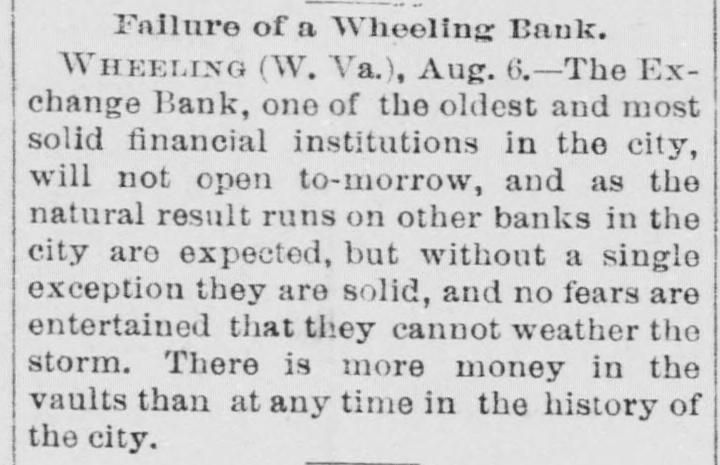
Failure of a Wheeling Bank
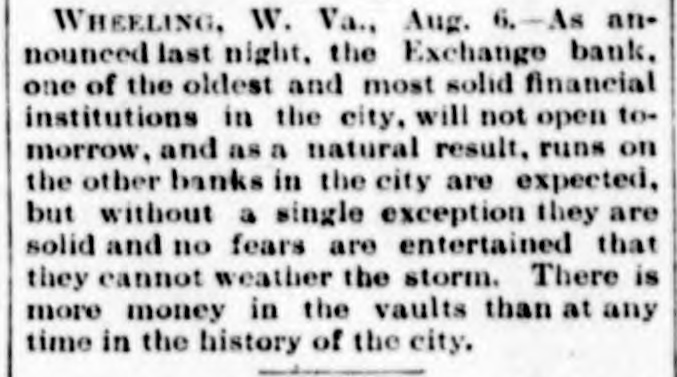
WHEELING (W. Va.), Aug. 6.-The Exchange Bank, one of the oldest and most solid financial institutions in the city, will not open to-morrow, and as the natural result runs on other banks in the city are expected, but without a single exception they are solid, and no fears are entertained that they cannot weather the storm. There is more money in the vaults than at any time in the history of the city.
5.August 7, 1893The Anaconda StandardAnaconda, MT
Click image to open full size in new tab
Article Text
WHEELING, W. Va., Aug. 6. - As announced last night. the Exchange bank. one of the oldest and most solid financial institutions in the city, will not open tomorrow. and as a natural result. runs on the other banks in the city are expected, but without a single exception they are solid and no fears are entertained that they cannot weather the storm. There is more money in the vaults than at any time in the history of the city.
6.August 7, 1893Morning Journal and CourierNew Haven, CT
Click image to open full size in new tab
Article Text
Bank Suspensions Reported
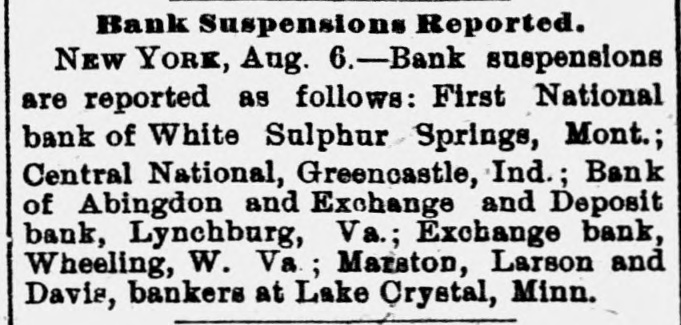
NEW YORK, Aug. 6.-Bank suspensions are reported as follows: First National bank of White Sulphur Springs, Mont.; Central National, Greencastle, Ind.; Bank of Abingdon and Exchange and Deposit bank, Lynchburg, Va.; Exchange bank, Wheeling, W. Va; Marston, Larson and Davis, bankers at Lake Crystal, Minn.
7.August 7, 1893The SunNew York, NY
Click image to open full size in new tab
Article Text
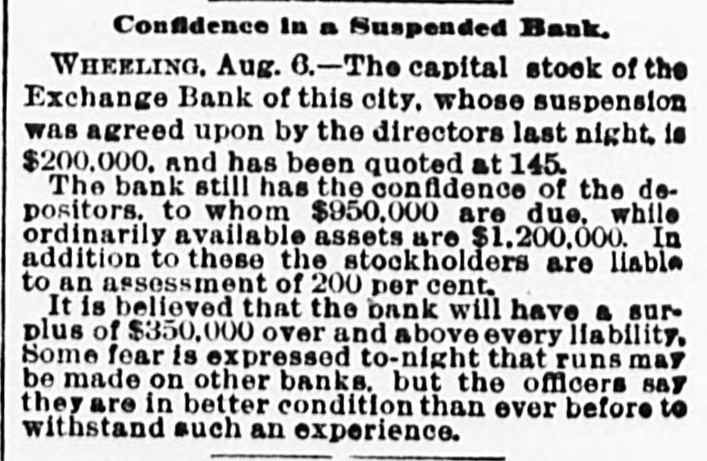
Confidence In a Suspended Bank
WHEELING. Aug. 6.-The capital stock of the Exchange Bank of this city, whose suspension was agreed upon by the directors last night. is $200,000. and has been quoted at 145. The bank still has the confidence of the depositors. to whom $950,000 are due, while ordinarily available assets are $1,200,000. In addition to these the stockholders are liable to an assessment of 200 per cent. It is believed that the bank will have & surplus of $350,000 over and above every liability. Some fear is expressed to-night that runs may be made on other banks. but the officers say they are in better condition than ever before to withstand such an experience.
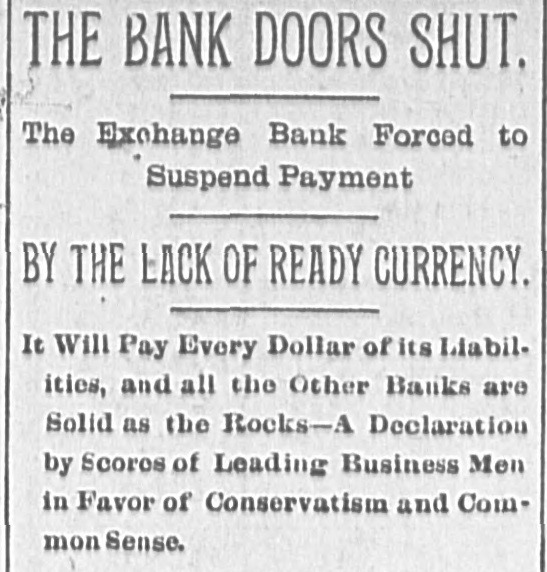
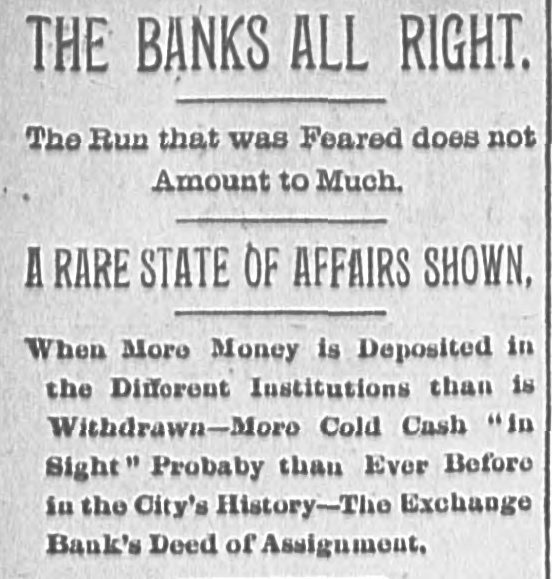
The Exchange Bank Forced to Suspend Payment BY THE EACK OF READY CURRENCY. It Will Pay Every Dollar of its Liabilities, and all the Other Banks are Solid as the Rocks-A Declaration by Scores of Leading Business Men in Favor of Conservatism and Common Sense.
9.August 8, 1893The Record-UnionSacramento, CA
Click image to open full size in new tab
Article Text
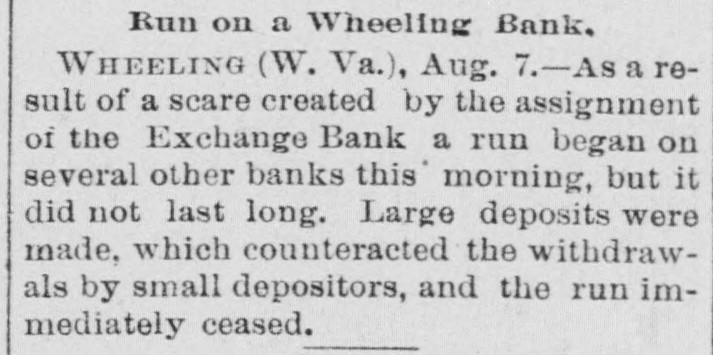
Run on a Wheeling Bank
WHEELING (W. Va.), Aug. 7.-As a result of a scare created by the assignment of the Exchange Bank a run began on several other banks this morning, but it did not last long. Large deposits were made, which counteracted the withdrawals by small depositors, and the run immediately ceased.
The Run that was Feared does not Amount to Much. A RARE STATE OF AFFAIRS SHOWN, When More Money is Deposited in the Different Institutions than is Withdrawn-Moro Cold Cash "in Sight" Probaby than Ever Before in the City's History-The Exchange Bank's Deed of Assignment,
11.August 8, 1893The Salt Lake HeraldSalt Lake City, UT
Click image to open full size in new tab
Article Text
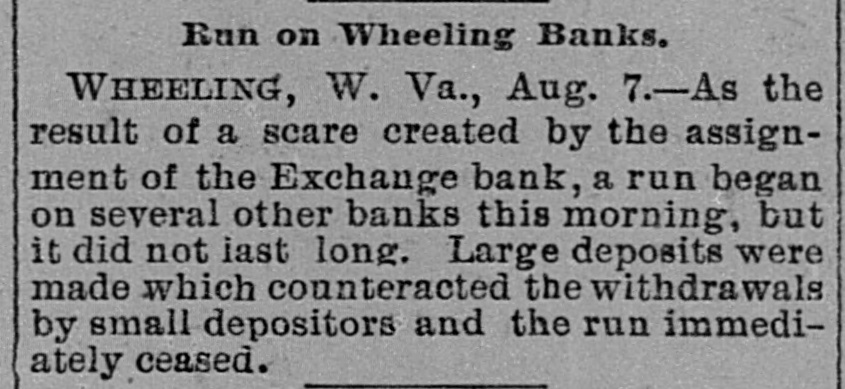
Run on Wheeling Banks
WHEELING, W. Va., Aug. 7.-As the result of a scare created by the assignment of the Exchange bank, a run began on several other banks this morning, but it did not last long. Large deposits were made which counteracted the withdrawals by small depositors and the run immediately ceased.
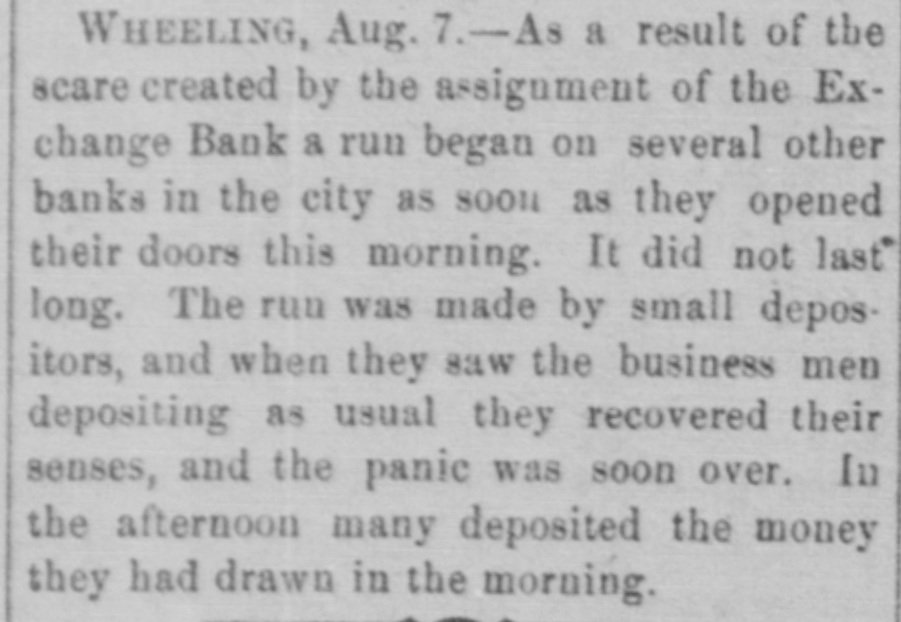
WHEELING, Aug. 7.-As a result of the scare created by the assignment of the Exchange Bank & run began on several other banks in the city as soon as they opened their doors this morning. It did not last long. The run was made by small depositors, and when they saw the business men depositing as usual they recovered their senses, and the panic was soon over. In the afternoon many deposited the money they had drawn in the morning.
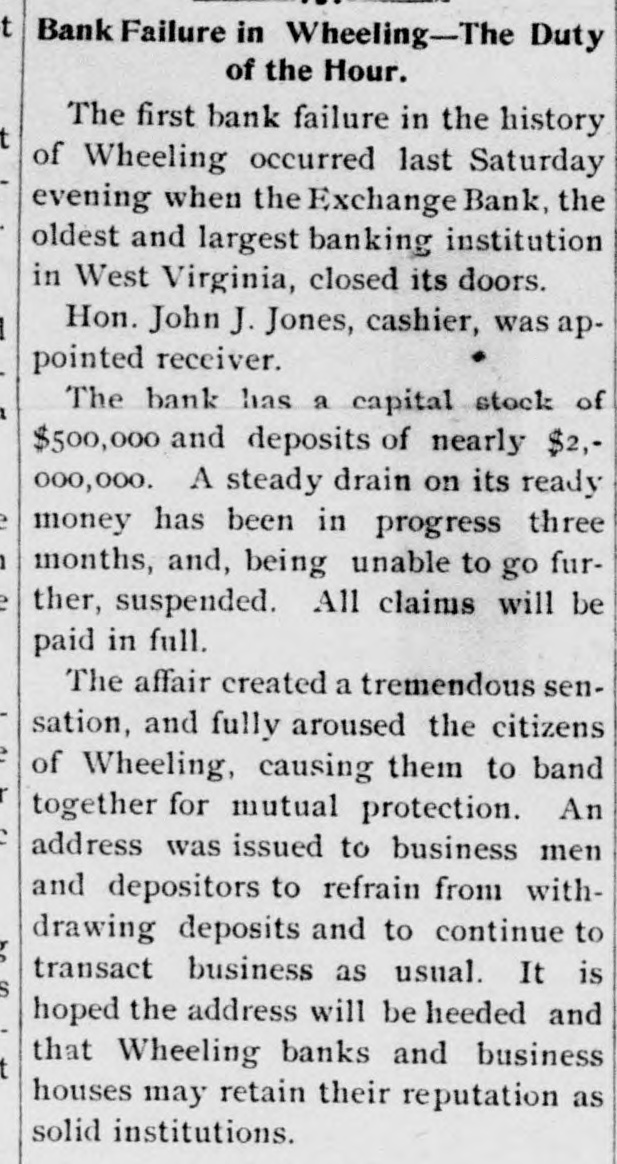
Bank Failure in Wheeling-The Duty of the Hour. The first bank failure in the history of Wheeling occurred last Saturday evening when the Exchange Bank, the oldest and largest banking institution in West Virginia, closed its doors. Hon. John J. Jones, cashier, was appointed receiver. The bank has a capital stock of $500,000 and deposits of nearly $2,000,000. A steady drain on its ready money has been in progress three months, and, being unable to go further, suspended. All claims will be paid in full. The affair created a tremendous sensation, and fully aroused the citizens of Wheeling, causing them to band together for mutual protection. An address was issued to business men and depositors to refrain from withdrawing deposits and to continue to transact business as usual. It is hoped the address will be heeded and that Wheeling banks and business houses may retain their reputation as solid institutions.
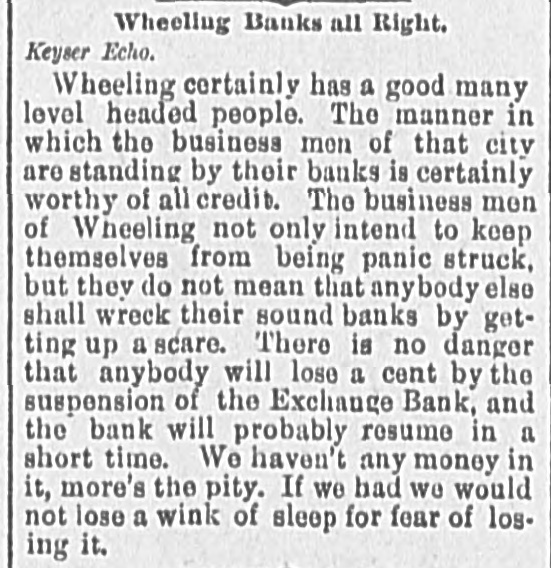
Keyser Echo. Wheeling certainly has a good many level headed people. The manner in which the business men of that city are standing by their banks is certainly worthy of all credit. The business men of Wheeling not only intend to keep themselves from being panic struck, but they do not mean that anybody else shall wreck their sound banks by getting up a scare. There is no danger that anybody will lose a cent by the suspension of the Exchange Bank, and the bank will probably resume in a short time. We haven't any money in it, more's the pity. If we had we would not lose a wink of sleep for fear of losing it.
15.August 16, 1893Ceredo AdvanceCeredo, WV
Click image to open full size in new tab
Article Text
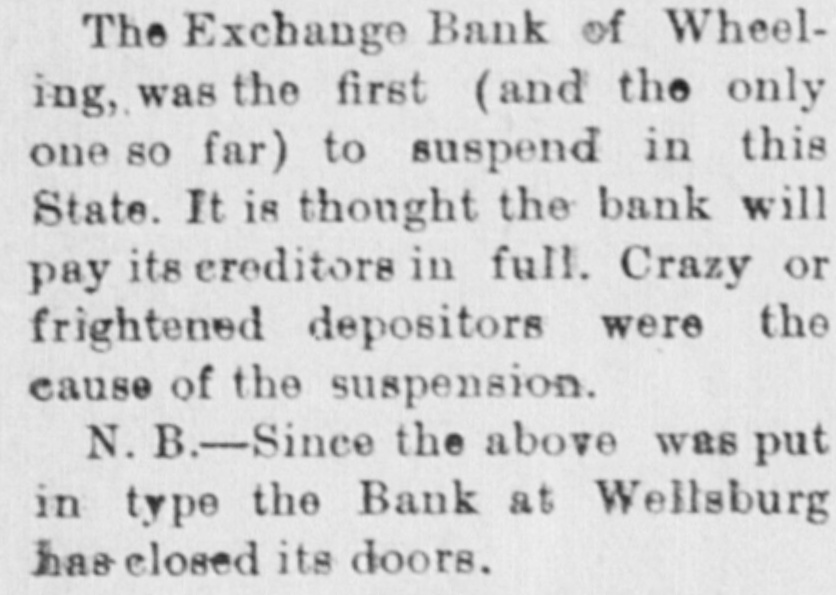
The Exchange Bank of Wheeling, was the first (and the only one so far) to suspend in this State. It is thought the bank will pay its ereditors in full. Crazy or frightened depositors were the cause of the suspension. N. B.-Since the above was put in type the Bank at Wellsburg has closed its doors.
16.August 25, 1893Evening StarWashington, DC
Click image to open full size in new tab
Article Text
DISTRICT GOVERNMENT
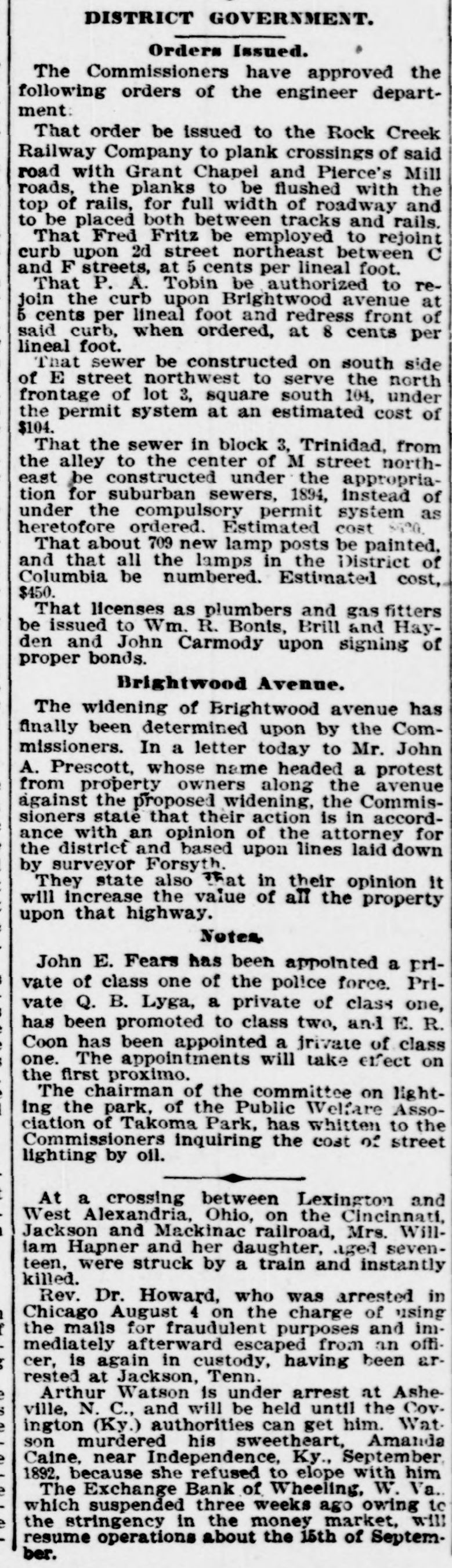
Orders Issued. The Commissioners have approved the following orders of the engineer department: That order be issued to the Rock Creek Railway Company to plank crossings of said road with Grant Chapel and Pierce's Mill roads, the planks to be flushed with the top of rails, for full width of roadway and to be placed both between tracks and rails. That Fred Fritz be employed to rejoint curb upon 2d street northeast between C and F streets, at 5 cents per lineal foot. That P. A. Tobin be authorized to rejoin the curb upon Brightwood avenue at 5 cents per lineal foot and redress front of said curb, when ordered, at 8 cents per lineal foot. That sewer be constructed on south side of E street northwest to serve the north frontage of lot 3, square south 104, under the permit system at an estimated cost of $104. That the sewer in block 3, Trinidad, from the alley to the center of M street northeast be constructed under the appropriation for suburban sewers, 1894, instead of under the compulsory permit system as heretofore ordered. Estimated cost 8520. That about 709 new lamp posts be painted, and that all the lamps in the District of Columbia be numbered. Estimated cost, $450. That licenses as plumbers and gas fitters be issued to Wm. R. Bonis, Brill and Hayden and John Carmody upon signing of proper bonds. Brightwood Avenue. The widening of Brightwood avenue has finally been determined upon by the Commissioners. In a letter today to Mr. John A. Prescott, whose name headed a protest from property owners along the avenue against the proposed widening, the Commissioners state that their action is in accordance with an opinion of the attorney for the district and based upon lines laid down by surveyor Forsyth. They state also That in their opinion it will increase the value of all the property upon that highway. Notes. John E. Fears has been appointed a private of class one of the police force. Private Q. B. Lyga, a private of class one, has been promoted to class two, and E. R. Coon has been appointed a irivate of class one. The appointments will take effect on the first proximo. The chairman of the committee on lighting the park, of the Public Welfare Association of Takoma Park, has whitten to the Commissioners inquiring the cost of street lighting by oil. At a crossing between Lexington and West Alexandria, Ohio, on the Cincinnati, Jackson and Mackinac railroad, Mrs. William Hapner and her daughter, aged seventeen, were struck by a train and instantly killed. Rev. Dr. Howard, who was arrested in Chicago August 4 on the charge of using the mails for fraudulent purposes and immediately afterward escaped from an officer, is again in custody, having been arrested at Jackson, Tenn. Arthur Watson is under arrest at Asheville, N. C., and will be held until the Covington (Ky.) authorities can get him. Wat. son murdered his sweetheart, Amanda Caine, near Independence, Ky., September 1892. because she refused to elope with him The Exchange Bank of Wheeling, W. Va. which suspended three weeks ago owing to the stringency in the money market, will resume operations about the 15th of September.
17.August 26, 1893Daily Kennebec JournalAugusta, ME
Click image to open full size in new tab
Article Text
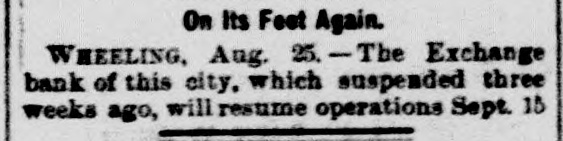
On Its Feet Again
WHEELING, Aug. 25. - The Exchange bank of this city. which suspended three weeks ago, will resume operations Sept. 15
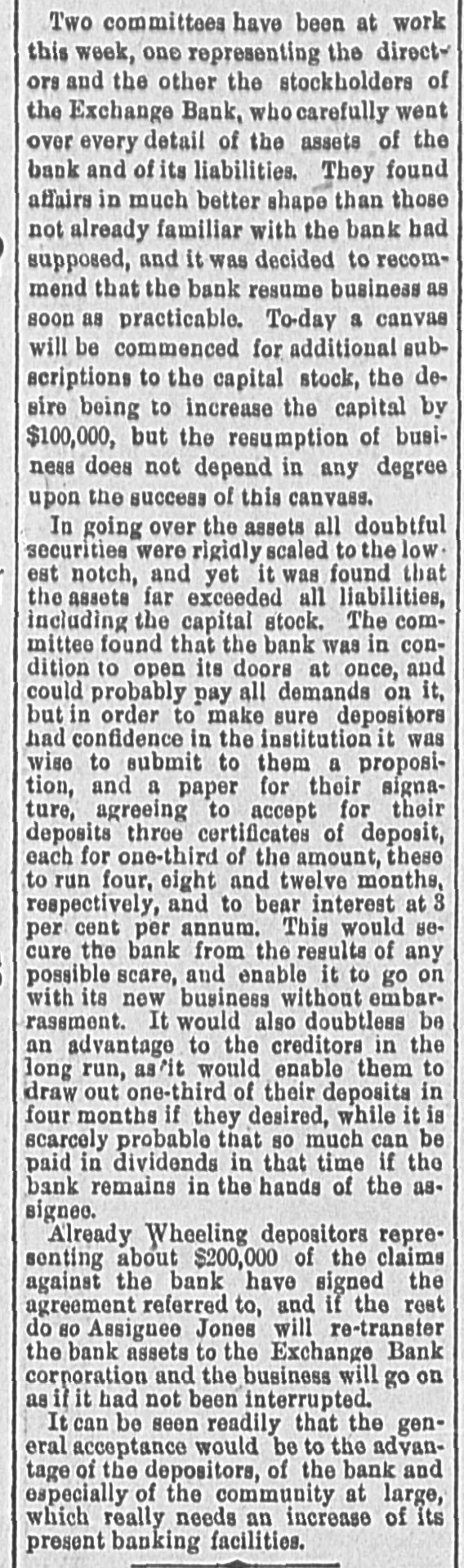
Two committees have been at work this week, one representing the directors and the other the stockholders of the Exchange Bank, who carefully went over every detail of the assets of the bank and of its liabilities. They found affairs in much better shape than those not already familiar with the bank had supposed, and it was decided to recommend that the bank resume business as soon as practicable. To-day a canvas will be commenced for additional subscriptions to the capital stock, the desire being to increase the capital by $100,000, but the resumption of business does not depend in any degree upon the success of this canvass. In going over the assets all doubtful securities were rigidly scaled to the low. est notch, and yet it was found that the assets far exceeded all liabilities, including the capital stock. The committee found that the bank was in condition to open its doors at once, and could probably pay all demands on it, but in order to make sure depositors had confidence in the institution it was wise to submit to them a proposition, and a paper for their signature, agreeing to accept for their deposits three certificates of deposit, each for one-third of the amount, these to run four, eight and twelve months, respectively, and to bear interest at 3 per cent per annum. This would secure the bank from the results of any possible scare, and enable it to go on with its new business without embarrassment. It would also doubtless be an advantage to the creditors in the long run, as'it would enable them to draw out one-third of their deposits in four months if they desired, while it is scarcely probable that so much can be paid in dividends in that time if the bank remains in the hands of the assignee. Already Wheeling depositors representing about $200,000 of the claims against the bank have signed the agreement referred to, and if the rest do 80 Assignee Jones will re-transier the bank assets to the Exchange Bank corporation and the business will go on as if it had not been interrupted. It can be seen readily that the general acceptance would be to the advantage of the depositors, of the bank and especially of the community at large, which really needs an increase of its present banking facilities.
19.September 1, 1893Wheeling RegisterWheeling, WV
Click image to open full size in new tab
Article Text
A LARGE BLOCK OF ADDITIONAL STOCK SUBSCRIBED TO THE EXCHANGE BANK. Seven Hundred More Shares Wanted-The Reorganiza ion Plan Working Well-City Officers to Be Paid. The committee having charge of the work of securing subscriptions of additional capital for the Exchange Bank put in a full day's work yesterday, and last evening reported that they had signatures for about 300 shares of new stock. The gentlemen of the committee were much encouraged by this showing and thought that the 1,000 shares desired before the reorganization of the bank was undertaken, could be secured, and that with this added capital the institution would be enabled to start on a new career of usefulness. It was also reported that no depositor so far approached for his signature to the agreement to take certificates of deposit to the amount of his deposits, had refused to do SO. Several had taken time to consider the matter, but the very large majority had unhesitatingly agreed to the arrangement, and it looks as though there would in the end be pràctical unanimity upon this point, and that the matter can be laid before the meeting of stockholders called for the eleventh of September in excellent shape. The proposition, as regards deposits, is to divide each deposit account into three parts, and issue time certificates of deposit, bearing interest at four, eight and twelve months, for the whole amount of the old deposits. This would prevent any sudden withdrawal of funds, while giving the depositors quicker access to their cash than under any other feasible plan, and with the cash on hand in the vaults of the bank at present, and that to be received from the new issue of stock, the bank will be in excellent shape to go right along with business. There is now over one hundred thousand dollars in cash in the vaults of the Exchange, and this sum will be largely increased by the middle of September, and if the additional one hundred thousand dollars of stock desired is secured, it would be possible for the bank, calling in twentyfive per cent. of the new stock at once, to have something like $200,000 in cash on hand by October 1st-the most probable day of resumption. if everything goes well. With time certificates out for the old deposits, none of which would become due before February 1st, 1894, the Bank would be in excellent shape, and before the first series of certificates become payable there would be a very large eash reserve on hand to meet them, and that and subsequent payments would not interfere with the regular course of business. If the new stock is secured, and the depositors generally agree to the certificate plan, there is little question as to what the outcome of the stockholders meeting September 11th, will be. To-day is pay day for the city officers, police, firemen and others about the City Hall. Clerk Thoner came up to the city Wednesday afternoon, and has made arrangements to have the pay roll met, not exactly with cash, but with certificates which will "go" the same as cash. The Bank of the Ohio Valley has arranged to issue certificates, for five, ten and twenty dollars, bearing four per cent. interest, and these will be paid out to the officers and employes,
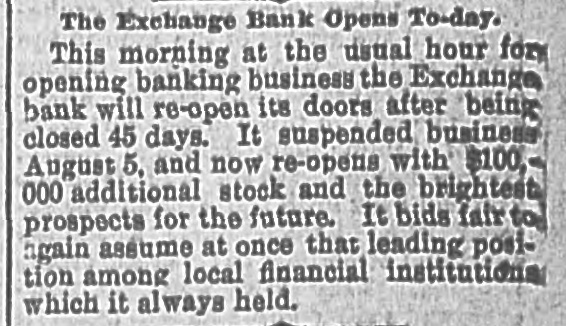
This morning at the usual hour for opening banking business the Exchange bank will re-open its doors after being closed 45 days. It suspended business August 5. and now re-opens with $100 000 additional stock and the brightest prospects for the future. It bids fair to again assume at once that leading position among local financial institutions which it al ways held.
21.September 21, 1893New-York TribuneNew York, NY
Click image to open full size in new tab
Article Text
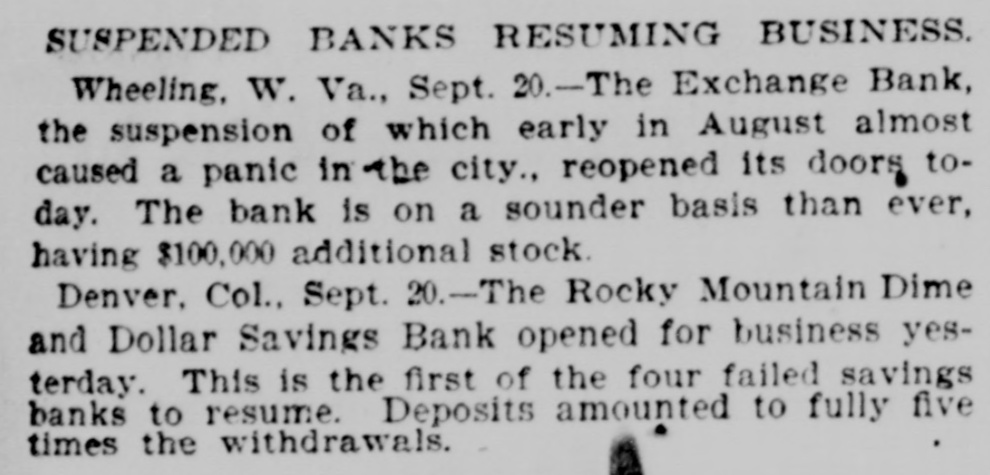
SUSPENDED BANKS RESUMING BUSINESS
Wheeling, W. Va., Sept. 20.-The Exchange Bank, the suspension of which early in August almost caused a panic in the city., reopened its doors today. The bank is on a sounder basis than ever, having $100,000 additional stock. Denver, Col., Sept. 20.-The Rocky Mountain Dime and Dollar Savings Bank opened for business yesterday. This is the first of the four failed savings banks to resume. Deposits amounted to fully five times the withdrawals.
22.September 27, 1893The StarReynoldsville, PA
Click image to open full size in new tab
Article Text
Financial and Commercial
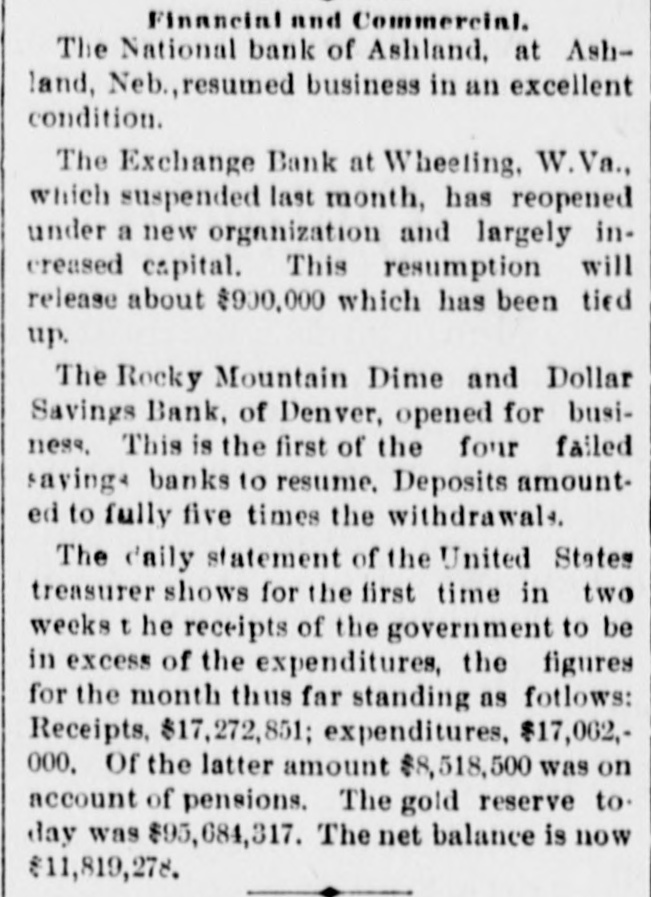
The National bank of Ashland, at Ashland, Neb., resumed business in an excellent condition. The Exchange Bank at Wheeting, W.Va., which suspended last month, has reopened under a new organization and largely increased capital. This resumption will release about $900,000 which has been tied up. The Rocky Mountain Dime and Dollar Savings Bank, of Denver, opened for business. This is the first of the four failed savings banks to resume. Deposits amounted to fully five times the withdrawals. The daily statement of the United States treasurer shows for the first time in two weeks t he receipts of the government to be in excess of the expenditures, the figures for the month thus far standing as fotlows: Receipts, $17,272,851; expenditures, $17,062,000, Of the latter amount $8,518,500 was on account of pensions. The gold reserve to. day was $95,684,317. The net balance is now $11,819,278.
Bank runs are almost always and everywhere a deterioration of bank fundamentals.
But not for you.
You are the measure-zero exception: great fundamentals, solid bank, and yet the Diamond Dybvig fairy spread its rumor. Depositors woke up. Your collateral was not prepositioned. The Clearinghouse had it for you.
Do not pass Go. Do not collect $200. Go directly to jail… or worse.