Article Text
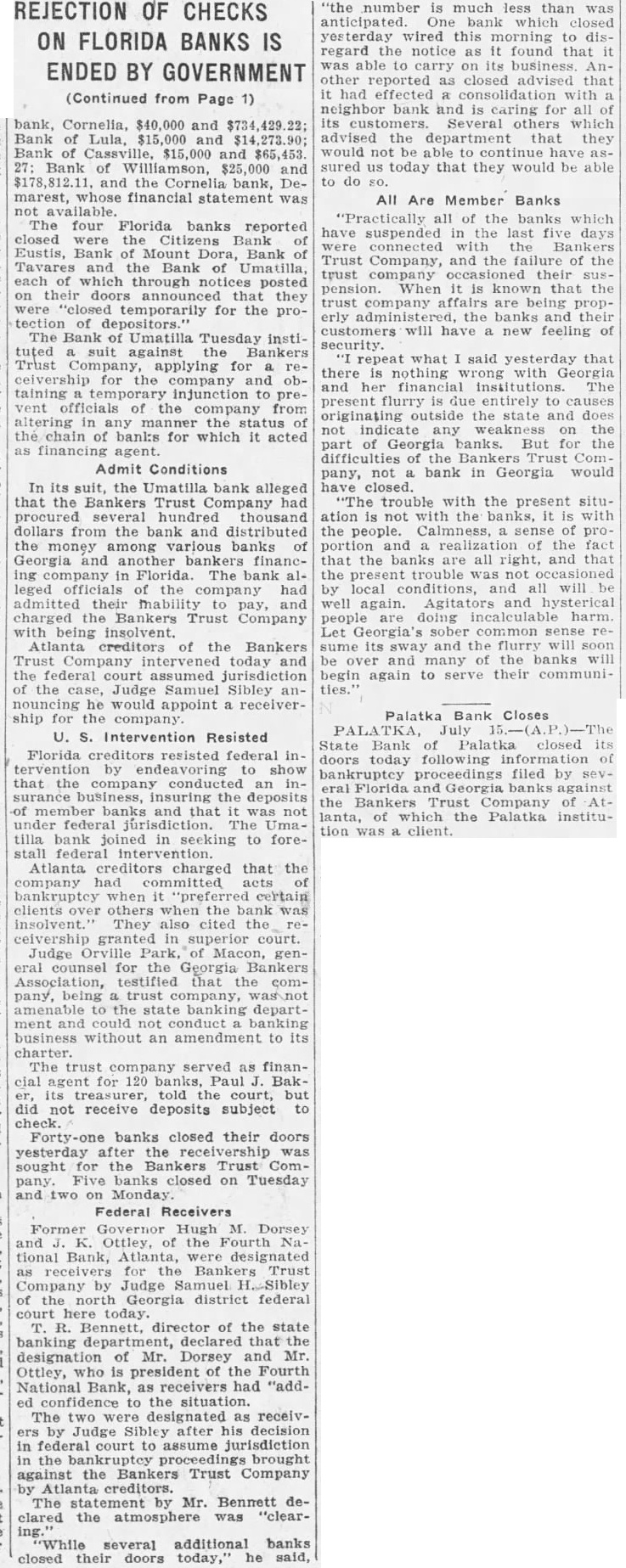
REJECTION OF CHECKS ON FLORIDA BANKS IS ENDED BY GOVERNMENT (Continued from Page 1) bank, Cornelia, $40,000 and Bank of Lula, $15,000 and $14,273.90; Bank of Cassville, $15,000 and $65,453 27: Bank of Williamson, $25,000 and $178,812.11 and the Cornelia bank, Demarest, financial was not available. The four Florida banks reported closed were the Citizens Bank of Eustis, Bank of Mount Dora, Bank of Tavares and the Bank of Umatilla, each of which through posted on that they were temporarily for the protection of The Bank of Umatilla Tuesday instituted suit against the Bankers Trust Company, applying for ceivership the company and taining injunction prevent officials of the company from altering in any manner the status the chain of banks for which it acted as financing agent. Admit Conditions In its suit, the Umatilla bank alleged that the Bankers Trust Company had procured several hundred thousand dollars from the bank and distributed the among various banks Georgia and another bankers financing in Florida. The bank alleged officials of the company had admitted their fhability to and charged the Bankers Trust Company with insolvent. creditors of the Bankers Trust Company intervened today and the federal court assumed jurisdiction of the case, Judge Samuel Sibley announcing he would appoint a receivership for the company U. S. Intervention Resisted Florida resisted federal in. tervention by endeavoring to show that the company insurance business, insuring the deposits of member banks and that it was not under federal jurisdiction. The Umatilla bank joined in seeking to forefederal intervention. Atlanta creditors charged that the company had acts bankruptcy "preferred certain ellents over others when the bank was insolvent. They also cited the receivership granted in superior court. Judge Park, of Macon, eral counsel for the Georgia Bankers testified that the company, being trust company, amenable to the state banking depart ment and could not conduct banking business without an amendment to its charter. The trust served as financial agent for 120 Paul Bakits told the court, but did not receive deposits subject to check. Forty-one banks closed their doors yesterday the sought the Trust pany. Five banks closed on Tuesday and two on Monday Federal Receivers Former Governor Hugh Dorsey and J. Ottley, of the Fourth Na tional Bank, Atlanta, were designated as receivers the Company by Judge Samuel Sibley of the Georgia district federal court here T. R. Bennett, director of the state banking department, declared that the designation of Mr. Dorsey and Mr Ottley, is president of the Fourth National Bank, as had "added to the situation. The two were designated as receivers by Judge after his decision in federal court to assume jurisdiction in the proceedings brought against the Bankers Trust Company by Atlanta creditors. The by Mr. Bennett declared the atmosphere was "clearing. "While several additional banks closed their doors today,' he said, "the number is much less than was anticipated One bank which closed yesterday wired this morning to disregard the notice as it found that it able to carry on its business Another reported as closed advised that it had effected a consolidation with neighbor bank and is earing for all of its Several others which advised the department that they would be sured us today that they would be able to do All Are Member Banks "Practically all of the banks which have suspended in the last five days were connected Trust Company, and the failure of the trust company their pension. When it is known that the trust company affairs are being properly the banks and their customers will a new feeling of security repeat what said yesterday that there nothing wrong with Georgia her financial institutions The present is to causes originating the state and does not indicate on the part of Georgia banks. But for the difficulties of the Bankers Trust Company, not a bank in Georgia would have closed. "The trouble with the present situation not with the it is with the people. of proand realization of the fact that the banks are all right, and that the trouble was not by local conditions, and all will be well again. Agitators and hysterical people are doing harm. Let common reits and the flurry will soon be over and many of the banks will begin again to serve their communities.' Palatka Bank Closes State Bank Palatka closed its doors today following information of bankruptcy proceedings filed by several Florida and Georgia against the Bankers Trust Company of Atlanta, of which the Palatka institution was client.