Article Text
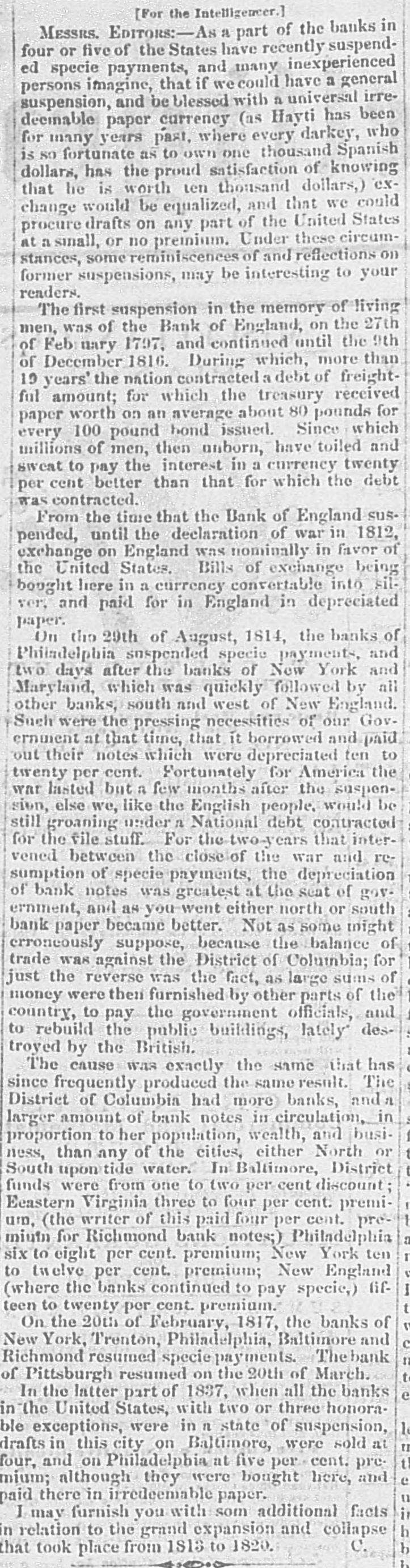
[For the Intelligencer.] MESSRS. EDITORS:-As a part of the banks in four or five of the States have recently suspended specie payments, and many inexperienced persons imagine, that if we could have a general suspension, and be blessed with a universal irredeemable paper currency (as Hayti has been for many years past, where every darkey, who is so fortunate as to own one thousand Spanish dollars, has the proud satisfaction of knowing that he is worth ten thousand dollars,) exchange would be equalized, and that we could procure drafts on any part of the United States at a sinall, or no premium. Under these circumstances, some reminiscences of and reflections on former suspensions, may be interesting to your readers. The first suspension in the memory of living men, was of the Bank of England, on the 27th of February 1797, and continued until the 9th of December 1816. During which, more than 19 years' the nation contracted a debt of freightful amount; for which the treasury received paper worth on an average about 80 pounds for every 100 pound bond issued. Since which millions of men, then unborn, have toiled and sweat to pay the interest in a currency twenty per cent better than that for which the debt was contracted. From the time that the Bank of England suspended, until the declaration of war in 1812, exchange on England was nominally in favor of the United States. Bills of exchange being bought here in a currency convertable into silver, and paid for in England in depreciated paper. On the 29th of August, 1814, the banks of Phindelphia suspended specie payments, and two days after the banks of New York and Maryland, which was quickly followed by all other banks, south and west of New England. Such were the pressing necessities of our Government at that time, that it borrowed and paid out their notes which were depreciated ten to twenty per cent. Fortunately for America the war lasted but a few months after the suspension, else we, like the English people, would be still groaning under a National debt contracted for the vile stuff. For the two years that intervened between the close of the war and resumption of specie payments, the depreciation of bank notes was greatest at the seat of government, and as you went either north or south bank paper became better. Not as some might erroneously suppose, because the balance of trade was against the District of Columbia; for just the reverse was the fact, as large sums of money were then furnished by other parts of the country, to pay the government officials, and to rebuild the public buildings, lately destroyed by the British. The cause was exactly the same that has since frequently produced the same result. The District of Columbia had more banks, and a larger amount of bank notes in circulation, in proportion to her population, wealth, and business, than any of the cities, either North or South upon tide water. In Baltimore, District funds were from one to two per cent discount; Eastern Virginia three to four per cent. premium, (the writer of this paid four per cent, premium for Richmond bank notes;) Philadelphia six to eight per cent. premium; New York ten to twelve per cent. premium; New England (where the banks continued to pay specie,) fifteen to twenty per cent. premium. On the 20th of February, 1817, the banks of New York, Trenton, Philadelphia, Baltimore and Richmond resumed specie payments. The bank of Pittsburgh resumed on the 20th of March. In the latter part of 1837, when all the banks in the United States, with two or three honorable exceptions, were in a state of suspension, drafts in this city on Baltimore, were sold at four, and on Philadelphia at five per cent. premium; although they were bought here, and paid there in irredeemable paper. I may furnish you with som additional facts in relation to the grand expansion and collapse that took place from 1813 to 1820. C.