Click image to open full size in new tab
Article Text
RICHMOND, NOVEMBER 16, 1816.
VIRGINIA LEGISLATURE.
HOUSE OF DELEGATES,
Wednesday, Nου, 13.
# CHARTERED BANKS.
SKETCH OF THE DEBATE
On the Suspension Bill [CONTINUED.
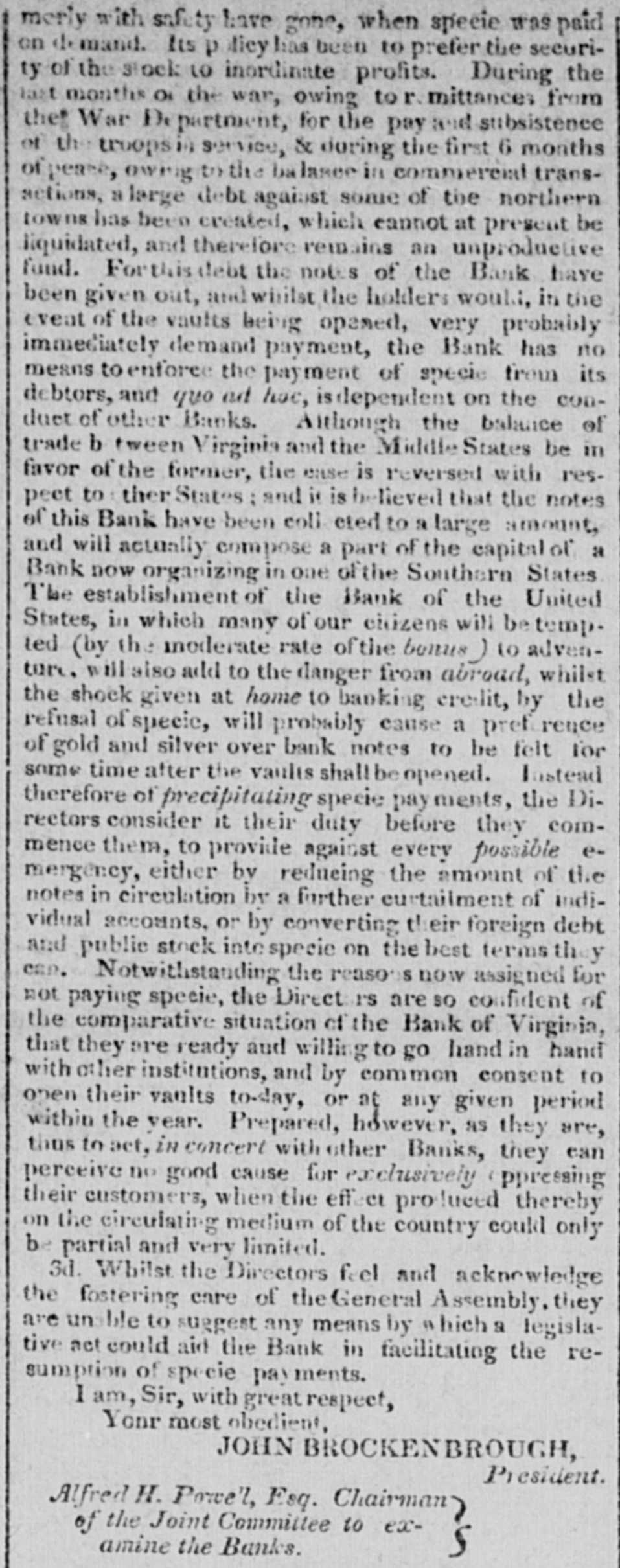
After Mr. Giles-concluded his remarks, Mr. Smyth (of Wythe) rose-He observed that he concurred with the Select Committee in the i-dea of giving time for the House to consider the question; bat, after the discussion which had now taken place, he thought it better to close the subject at once-For his ownpart, he thought it best to suspend the law till the 1st of July-not, because certain corporations had fixed on that day as the period for resuming specie payments; but, because the Congress of the U. States seem to have designated that period, by making thetast instalment of the National Bank fall due at that time. He begged leave toremind the House, that the Banks are not to be censured for the suspension of specie payments; for, he gave them great credit for the supplies which they had furnished in carrying on the War. The Farmers' Bank had loaned at least $ 2,000,000 to the State of Virginia; and $350,000 to the government of the U. S. When he looked at these exertions, he was disposed to excuse them for the suspension of specie payments.
He had looked to another circumstance-He had attempted to satisfy his mind, whether the Banks had with good faith endeavoured to comply with the Law of the last Legislature-But, on that point, the evidence was irresistible. They had both drawn in their paper to a very considerable amount.
He stated, for example, that the debts due from other banks to The Farmers' Bank of Virginia last year-
Amounted to the sum of $ 1,143,370
That those debts now amounted only to 256,960
So that within the year the sum of 886,420 had been collected from other banks.
He stated, that The Farmers' Bank had in circulation lastyear-
Notes to the amount of .... $3,310,591
That they have now out the sum of 2,150,000
And have thus reduced the sum in circulation 1,160,594 within the year.
They had, too, made sacrifices to obtain specio -He stated, that the Bank of Virgima ha loaned a large sum in paper for six months without interest, to be repaid in specie-which was equivalent to giving a premium of 3 cent. The Farmers Bank, too, had made considerable exertions. But, suppose that they had not; and that these institutions had not been weil conducted-still, what would the public interest reguire? Recollect that the State is interested in these banks to a large amount.-He would beg leave to state, that these two banks have in circulation-
Notes to the amount of $3,603,304
And that the specie of both amounts to.... 1,608,915
So that half their notes being presented for payment, would require a sum greater than they had in their vaults to meet them.
The notes which they had in circulation were but little more than double the specie which they had in their vaults. But, if half of these were presented, all their specie would be drained out. This, indeed, might be a safe state of business at other fimes. On ordinary occasions, no banks have half as much specie as notes in circulation. The Charter of the Virginia Banks authorizes them to issue three times as many notes as they have specie in their vaults. -But, at present, they have., only double the amount of their specie in circulation: This is, surely, a very moderate, proportion. But, in these times, this proportion would not render them perfectly safe Let it be recollected, that in the City of Rigamond alone $ 400,000 are due for the Stock of the National Bank This amount might be drawn from the Virginia Banks, if they were compelled to pay specie. Besides, as they have more than $3,000,000 in notes in circulation, much of this sum may be hoarded up in the Northern Banks and alarge proportion of it may be presented for payment. Besides, in the village banks, whether chartered or unchartered, a large amount of the paper is hoarded, which may be presented for specie. Thus, a demand exists from the Stockholders of the National Bank in this City alone, from the Northern and the village banks, as well as from private citizens, which might seriously affect the resources of our Banks. Is there no danger, then, that they should stop payment? But, if this result were now to occur, it would be far more fatal to them than when the for-imer suspension took place These banking institutions would now be considered as utterly bankrupt, and their notes would no longer have any value. But, if these notes were no longer good, what would be the situation of the Commonwealth? All our State taxes are payable in this paper the State is compelled to receive them. Is it, then, expedient for this House to pursue any measure, which may reduce them to bankruptcy? He was, for these reasons, in favor of a suspension till the 1st of July-nor did he conceive, that the government would be dishonored by this course; because, it was not adopted on account of any peculiar respect to the measures of the Convention at Philadelphia; but, because the last instalment of the National Bank would fall due on that day
Mr. Colston did not exactly concur with the gentleman lasť up (Mr. Smyth). He conceived, this was an improper time for debating the general question. He was willing to suspend the operation of the law he was willing to give all reasonable time he was not disposed to distress these banking institutions; but, he was not satisfied, to allow them till the 1st of July. As to Congress having fixed on that day, as alledged by the gentleman from Wythe, he bogged leave to remind him of another circumstance; that they had actually fixed on the 20th of February as the period, when all the taxes and dues to the Treasury must be paid in specie. So far, then, as they had expressed their wishes, they had fixed on the 20th of February, not the Ist of July, as the day for resuming specie payments. He was willing to fix on the same period, himself; but, further than this he was not prepared to go at present. But, this was surely not the time to launch out into arguments on the general question, Gentlemen say, let us grant indulgence to the Banks; for his own part, he was willing to indulge them to a certain extent. But, he wished the House to recollect, that this thing of legislation was often a matter of compromise among the members that we cannot all agree upon the very same proposition. Many of his acquaintances in the House would perhaps even vote against the Bill, as it stood-Why then venture to extend it Why not, for the present, take it as it is, with a view of givinga temporary relief to the Banks?
Mr. Chamberlayne concurred with the last gentleman in most of his views. He regarded this bill as a reprieve, rather than a pardon; bat whether it be a reprieve or a pardon he would not assent to it but upon certain cortitions-