21668. First National Bank (Norfolk, VA)

Bank Information

Episode Type
Suspension → Closure
Bank Type
national
Bank ID
271
Charter Number
271
Start Date
May 26, 1874
Location
Norfolk, Virginia (36.847, -76.285)

Metadata

Model
gpt-5-mini
Short Digest
e91a531c

Response Measures

None

Receivership Details

Depositor recovery rate
57.5%
Date receivership started
1874-06-03
Date receivership terminated
1883-06-02
OCC cause of failure
Fraud
Share of assets assessed as good
36.3%
Share of assets assessed as doubtful
26.3%
Share of assets assessed as worthless
37.5%

Description

The First National Bank of Norfolk suspended payments on May 26, 1874 and was described as having 'hopelessly failed' (depositors expected to realize ~25 cents on the dollar). No article describes a depositor run prior to suspension; the bank entered receivership (references to a receiver and dividends in later years). Classified as suspension leading to permanent closure/receivership.

Events (7)

1. February 23, 1864 Chartered
Source
historical_nic
2. May 26, 1874 Other
Newspaper Excerpt
At a meeting of the directors this afternoon it was ascertained that the bank had hopelessly failed. It is stated on the street that the depositors will only realize about 25 cents on the dollar.
Source
newspapers
3. May 26, 1874 Suspension
Cause
Bank Specific Adverse Info
Cause Details
Directors determined the bank had 'hopelessly failed' and depositors expected to realize only about 25 cents on the dollar; deficits of $50,000–$60,000 cited in press investigation suggesting insolvency.
Newspaper Excerpt
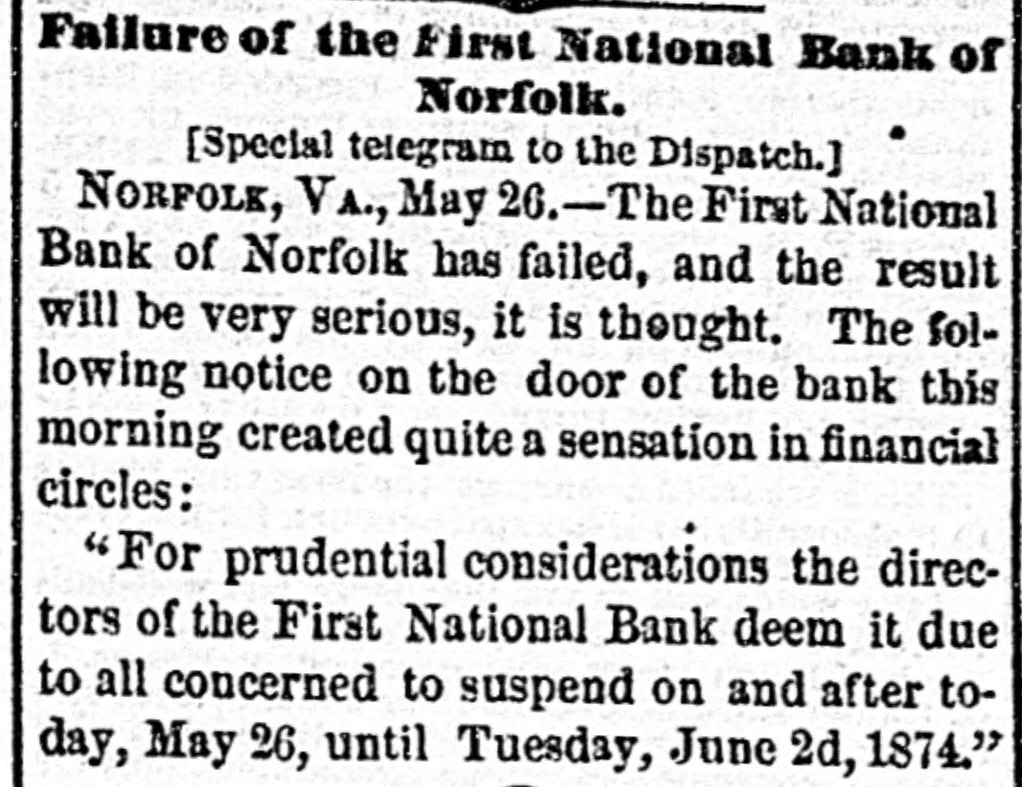
For prudential considerations the directors of the First National Bank deem it due to all concerned to suspend on and after today, May 26, until Tuesday, June 2d, 1874.
Source
newspapers
4. June 3, 1874 Receivership
Source
historical_nic
5. January 22, 1878 Receivership
Newspaper Excerpt
The Controller of the Currency has declared a dividend ... in favor of the creditors of the First National Bank of Norfolk, Va., 10 per cent, making in all 45 per cent; ... (refers to receiver and dividends).
Source
newspapers
6. April 11, 1878 Other
Newspaper Excerpt
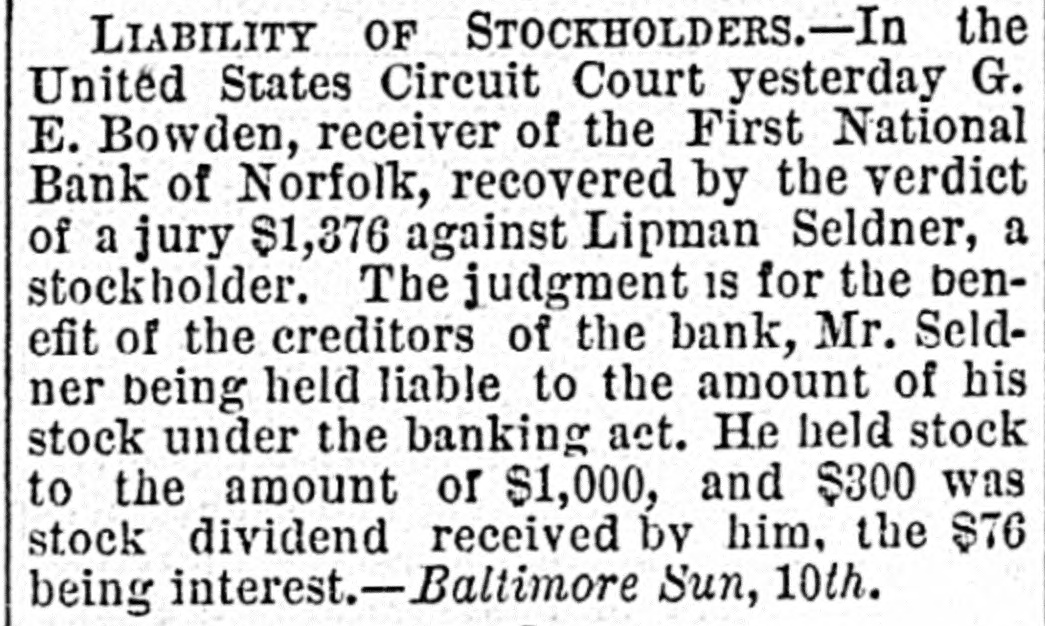
G. E. Bowden, receiver of the First National Bank of Norfolk, recovered by the verdict of a jury $1,376 against Lipman Seldner, a stockholder.
Source
newspapers
7. June 29, 1883 Other
Newspaper Excerpt
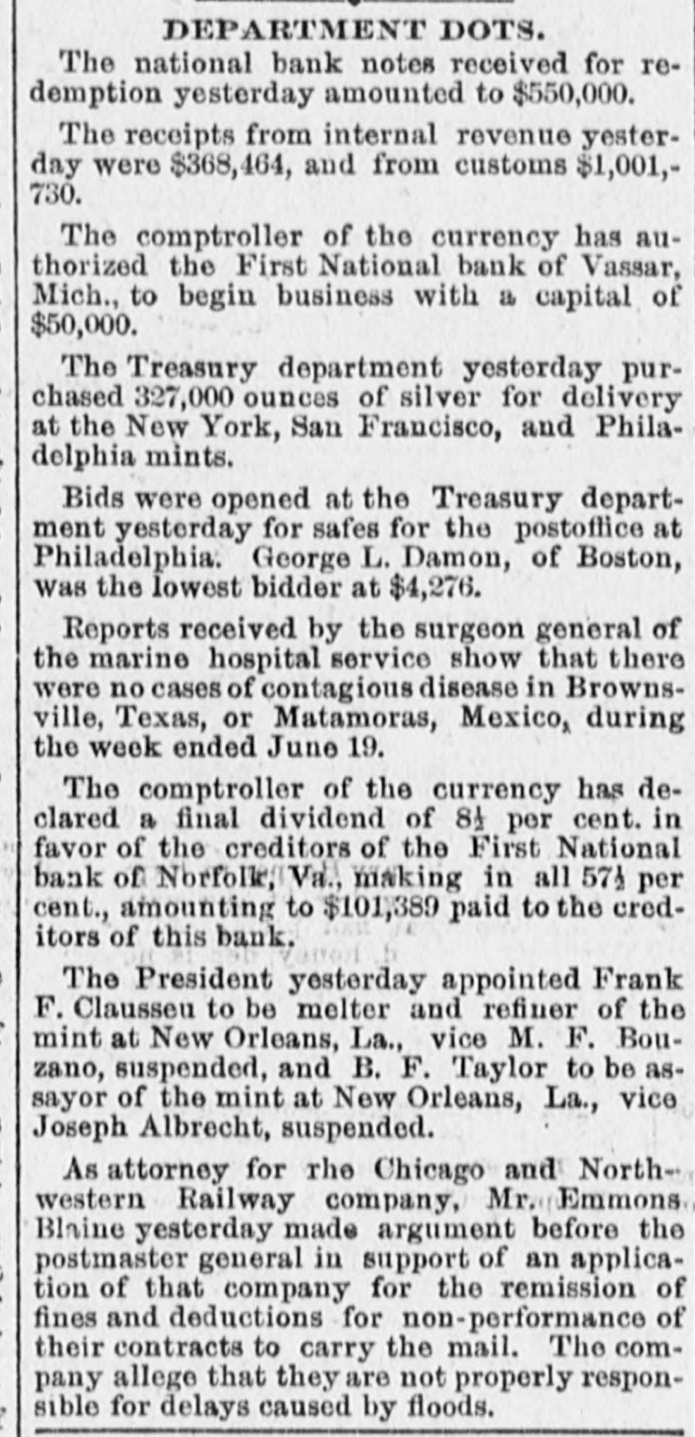
The comptroller of the currency has declared a final dividend of 81 per cent. in favor of the creditors of the First National bank of Norfolk Va., making in all 571 per cent., amounting to $101,389 paid to the creditors of this bank.
Source
newspapers

Newspaper Articles (15)

Article from The Daily Dispatch, May 27, 1874

Click image to open full size in new tab

Article Text

Failure of the First National Bank of Norfolk. [Special telegram to the Dispatch.] NORFOLK, Va., May 26.-The First National Bank of Norfolk has failed, and the result will be very serious, it is thought. The following notice on the door of the bank this morning created quite a sensation in financial circles: "For prudential considerations the directors of the First National Bank deem it due to all concerned to suspend on and after today, May 26, until Tuesday, June 2d, 1874."


Article from Evening Star, May 28, 1874

Click image to open full size in new tab

Article Text

SUSPENSION OF A NORFOLK (VA.) BANK.-A special to the Richmond Enquirer from Nortolk, dated the 26th instant, says: "The First National Bank of this city suspended this morning. At a meeting of the directors this afternoon it was ascertained that the bank had hopelessly failed. It is stated on the street that the depositors will only realize about 25 cents on the dollar. Several merchants here will suffer by this loss, but none will be foreed to suspend business."


Article from Alexandria Gazette, May 28, 1874

Click image to open full size in new tab

Article Text

SUSPENSION OF A BANK.-A special to the Richmond Enquirer from Norfolk, dated the 26th inst., says: "The First National Bank of this city suspended this morning. At a meeting of the directors this afternoon it was ascertained that the bank had hopelessly failed. It is stated on the street that the depositors will only realize about twenty-five cents on the dollar. Several merchants here will suffer by this loss, but pone will be forced to suspend business."


Article from Wilmington Daily Gazette, May 29, 1874

Click image to open full size in new tab

Article Text

SUSPENSION OF A NORFOLK (NA.) BANK A special to the Richmond Enquirer from Nortolk, dated the 26th inst., say: s: The First National Bank of this city, suspended this morning. At a meeting of the directors this afternoon it was ascertained that the bank had hopelessly failed. It is stated that the depositors will only realize about twenty-tive cents on the dollar. Several merchants here will suffer by this loss, but none will be foreed to suspend business.


Article from Staunton Vindicator, May 29, 1874

Click image to open full size in new tab

Article Text

The Piedmont "Virginian" announces the death at Orange Court-house, on the 19th, of Professor John F. Allen, in the 50th year of his age. Hon Willoughby Newton, of Westmoreland, a well known Virginian, in other days, who once beat Senator Hunter for Congress, died on the 23d inst. Congressman Mellish, of New York, who was sent to the Lunatic Asylum in Washington last week, died there Sunday, William Shakspeare Caldwell, who gave $250,000 for a Asylum in Richmond, Va., a few days since, died in New York Monday. W. T. Anderson, of Lynchburg, Va., has fallen heir to $150,000 by the death of a relative in England. The First National Bank of Norfolk, Va., suspended Tuesday.


Article from The Daily Dispatch, May 30, 1874

Click image to open full size in new tab

Article Text

THE FIRST NATIONAL BANK SUSPENSION.-We tear the suspension of this bank is much worse than at first supposed, as rumors contipue to find their way about putting worse and worse features on the matter. At the best it is thought with good management that the depositors will sustain a loss of 25 or 35 cents on the dollar. This is not SO bad in a bank failure, it is true, but it is bad enough. The First National Bank has never been considered A No. 1 since it sustained a loss of some twenty-five thousand dollars under its first president. Since then it has been kept afloat by putting the best foot forward until the present time, when we hear that a meeting of merchants and others interested took place to investigate 2nd discuss its condition with the view, it is said, of coming to its rescue. It was thought and put forward as an exhibit at this meeting that $25,000 aid would put it on its pins again; but on close investigation by an old merchant, an expert in such matters, a deficit of some filty or sixty thousand dollars was apparent. even after all the stock was considered sunk. Not, we presume, in the latter case, allowing each stockbolder liable for double the amount of stock held by him, as the national bank law put it. Fortunately for the monetary and commercial interests of this community, this bank-failure in no way involves our other banks or merchants, and cannot reasonably have any effect in impairing public confidence in our other banking institutions, for the reason that the First National, as we said before, has not stood in good repute since the loss it sustained in its youthful days.-Norfolk Day Book, May 28th.


Article from Middletown Transcript, May 30, 1874

Click image to open full size in new tab

Article Text

Items of General News. SUSPENSION OF A NORFOLK (VA.) BANK. -A special to the Richmond Enquirer from Norfolk, dated the 26th inst., says: The First National Bank of this city suspended this morning. At a meeting of the directors this afternoon it was ascertained that the bank had hopelessly failed. It is stated on the street that the depesitors will only realize about twenty-five cents on the dollar. Several merchants here will suffer by this loss, but none will be forced to suspend business. The Arkansas House of Representatives on Saturday, by a vote of 47 to 9. adopted resolutions declaring that Senators Dorsey and Clayton obtained their seats by bribery and corruption, and asking the United States Senate, if they do not resign within ten days, to inquire into the circumstances of their election and expel them. The House also passed a joint resolution for a final adjournment on Thursday next. About forty crusaders were arrested again at Pittsburg, Pa., Saturday, and confined in the central police station, charged with obstrueting the sidewalks. They were released upon giving bail for a hearing on Monday. Great excitement prevailed, and large crowds gathered about the police station. The women say they are determined to continue their work, notwithstanding the action of the authorities. CHEAP.-The most fashionable of Saratoga cottages rent for $3,000 for the season of three months, others being $2,500, others $2,000, and so on down to $500. Who wouldn't have so cheap an article? Hon. David B Mellish, member of the House of Representatives from New York city, who was taken to the Government Asylum for insane persons some two weeks since, died in that institution OH Saturday afternoon. It is reported that two fast day trains soon on adelphia will and be put Pittsburg, the road which between will Pbil- stop only at Harrisburg and Altoona, and run at the rate of forty-five miles an hour. Bishop Clark, of Rhode Island, has issued a pastoral letter urging that all the churches in his diocese take up collections for the relief of sufferers by the Southern inundations. Governor Seymour, of New York, authorizes the Utica Observer to announce h that he is out of the race for Governor, and "refuses to be a candidate for any office in the gift of the people." James R. Randall, author of Maryland, My Maryland," has written a poem entitled "Alexandrine," the refrain of d which is of the Tennyson "Alexandrovna" order. o The President's Long Branch cottage this season will be "the Executive mann sion by brevet." A new "drag" is being o built to receive guests at the depot. e Ex-Gevernor Rufus B. Bullock, of d Georgia, the carpet-bagger, that abscondit ed after depleting the treasury, has turned n up again in New York.


Article from The Daily Phoenix, May 30, 1874

Click image to open full size in new tab

Article Text

Poreign Affairs. LONDON, May 2S.-A midnight train of American Pullman pal cars will be put ou the Midland Railway between London and Leeds, Sueffield and Bradford, Dext Monday. Similar cars will be run directly between this and Liverpool as soon us the Midland is open to the latter place. HAVANA, May 28.-The journals of to-day discoss the scandalous increase of contraband goods introduced into the island concea ed in barrels of flour. The Voz says a matter 80 grave deserves immediate investigation by the In tendents without waiting orders from the United States, and this contraband game has been carried on on a large scale for many years. Many of the reputable merchants express the opinion that Gen. Concha will be able to stop smuggling, provided he treats all concerned in the business with impartial severity instead of the jaxity heretofore in vogue. ROME, May 28.-The health of the Pope is very much improved to-day. and he is able to be about, but his physicians advise him not to go into the open air. PARIS, May 29.-The Minister of Interior has issued an order prohibiting the sule in Paris of the Nineteenth Century newspaper, because "it is offensive to public morality." LONDON, May 29 -A despatch to the Standard says Gen. Concha has seized the heights near Artaban and the roads leading from Biscay, by way of Villaral and Gumboa. The army of Don Carlos consequently abandoned Durango, and retired into Guipuzeoa. It is reported the Carlists have received twenty Krupp steel cannons, and are re-organizing their forces. VIENNA, May .-Despatches from represent the condition of the H by Father as serious. Telegrabhie-American Matters. NORFOLK, May 26 -Ata meeting of the directors of the First National Bank, it was ascertained that the bank had hopelessly failed. It is stated on the streets that the depositors will realize about twenty-five cents on the dollar. Several merchants here will suffer by this loss, but none will be forced to suspend business. New ORLEANS, May 28.-Chief State Engineer Thompson writes Gov. Kellogg that 3,000,000 cubic yards of levee is required to be built to save the State from overflow next year, and that Louisiana cannot pay for the construction of more than one-third. He suggests that an appeal be made for national aid. ROCHESTER, May 23.-The German Catholic Convention adjourned last evening. It meets in Cincinnati on the 24th May, 1875. NEW YORK, May 23.-The will of Henry R. Rutgers, of New York, was admitted to probate yesterday. It disposes of the property valued at $2,000,000 in real estate and securities, to his widow and six children. GRAND RAPIDS, MICH, May 28 -J. J. Elliott's lightuing rod manufactory was burned this morning. Loss $35,000. ELWOOD, ILL, May 29.-Fifteen firms were burned out last night; loss $50,000. ST. LOUIS, May 29.-By a cyclone, several houses were unroofed and steamboats lost chimneys. DEFIANCE, OHIO, May 29 -The business square was burned last night. CINCINNATI, May 29.-Judge wayne, of the United States District Court, yesterday rendered a decision in the case of the Newport and Cincinnati Bridge Company, against the United States. The auit was bronght by the plaintiffs to recover $457,000 damages for changing the plans of the bridge during its constraction. The United States District Attorney demurred. Judge Swayne ruled out the demurrer, but gave leave to answer. The case will be heard on its merits. An appeal to the Supreme Court is probable in any event. HALIFAX. May 29.-Theship Alfred, of Drammen, from Pensacola for Liverpool, was abandoned at sea. The crew was saved. WASHINGTON, May 29.-The committee, by a strict party vote, discharged from further consideration Sykes vs. Spencer, in the Alabama Senatorial contest. This confirms Spencer in his seat. CHICAGO. May 29.-Rochefort passed here for New York. No demonstration. PROVIDENCE, R. I., May 29.-The prohibitory liquor law passed both houses. NEW YORK, May 29.-The Southern Bagging Company's wurehouse, on Carbarry and Decatur streets, WHO burned last night: loss $125 000


Article from Daily Kennebec Journal, June 4, 1874

Click image to open full size in new tab

Article Text

GENERAL NEWS. The southern summer resorts are anticipating a brilliant season. A Virginian is under arrest for pawning his wife's corset for a quart of whisky. Justice is blessed with blindness in Chicago, according to the Times of that city. The First National Bank of Norfolk, has suspended. The Tariff bill has passed the House and now goes to the Senate. The Moors in Fez, to the number of $12,000, have rebelled against the re-imposition of the gate tax. Gov. Dix has appointed Abraham Lansing of Albany State Treasurer. Twenty acres of George Francis Train's domain in Omaha are advertised to be sold to pay taxes amounting to $3500. Massachusetts papers say that if apple blossoms keeps their promises, apples will hardly be worth gathering next fall. Mr. Whittier has written a poem to be read when Mr. George William Curtis delivers his oration on Senator Summer, in Boston, this week. A Missouri paper has undertaken a noble work, that of discouraging deaths. It publishes marriage notices free, but charges heavily for obituaries. Mr. Beecher advises despondent people to write down the things that trouble them, and inspect the list every month or two, when they will find that their great tribulations have become very small. Hon. George Brown, Canadian Commissioner at Washington, has sent a partial draft of the proposed reciprocity treaty to Ottawa; its features meet the approbation of the government. Woman's rights in Dubuque, Iowa. A young lady, the daughter of a prominent citizen is the most efficient church sexton in the city, performing all the duties of the office without aid. The number of pilgrims who visited the tomb of Mahomet at Mecca this year is said to have been 16,000; and, owing to the precautions adopted by the Egyptian government, their health has been unusually good. The Chicago Times takes to task a Georgia editor, who says in reference to the wordy war between Stephens and Hill that the fight is "nothing to us, we are mere lookers-on in Venus." The New York Central and Hudson River Railway has leased land from the city of New York at the junction of Sixtieth street with the Hudson river, where it is proposed to erect docks, a large grain elevator and make other improvements. A Washington correspondent says that Sentor Morrill of Maine visited a church occupied by a colored congregation on Sunday, and found that civil rights did not prevail there. He received a hint that white folks were not wanted there, and accordingly retired. Settlers in Iowa and Minnesota have been impoverished by the devastations of grasshoppers, and the House has passed a bill allowing them to vacate their lands for one year without prejudice to their titles, in order that they may go elsewhere to earn a living. The Young American woman with whom the Grand Duke Nicholas was so desperately in love that he stole his mother's diamonds to give her, is said to be now in Paris with jewels valued at 500,000 franes. The application for entrance to the Anderson school of natural history at Penikese number nearly 150, though only about one-third of that number can possibly be admitted. The school will continue from July 7 to August 29. Six conductors on the Pennsylvania Railroad have been discharged for "general irregularities;" seven more are anticipating dismissal, and three others have resigned. Some of the discharged men are among the oldest on the road, having been in its employ from 10 to 20 years. A bricklayer named John Blair lately murdered his wife and five children and then committed suicide while crazy with drink, at the East End of London. The bodies were horribly mangled. Between Thursday evening and Friday morning two deputy United States marshals and four officers of the Secret Service arrested eight men and two women at Cincinnati, Ohio, on a charge of counterfeiting. In default of bail nine of them were on Friday sent to jail to await trial this week. The tenth prisoner gave bail in $2500. The women crusaders against King Alcohol have achieved one victory, and that of a no mean character. They have 80 thoroughly alarmed the large liquor dealers of New York for the prosperity of their business that an address to the public is about to be circulated denying the charges preferred against the liquor traffic, and protesting against the woman movement. A Nevada man who was walking with his brother to attend his wedding, was astonished by a proposition to take the bride elect off his hands and marry her in his stead. He was equal to the emergency and did so, to the satisfaction of all concerned. The reporter of the Chicago Times thus describes Rochefort: A light mustache and imperial, and hair turning iron gray a prominent cheek-bone: heavy evehrow wide


Article from The Middlebury Register, June 9, 1874

Click image to open full size in new tab

Article Text

The First National Bank of Norfork, Va., has suspended.


Article from The Anderson Intelligencer, June 11, 1874

Click image to open full size in new tab

Article Text

ITEMS-EDITORIAL AND OTHERWISE. - Ex-President Davis is on his way back to this country. - The First National Bank of Norfolk, Va., has suspended, and will pay about twenty-five cents in the dollar. - The Charleston Hotel will be closed on and after the 15th instant, and remain closed until the 1st of October. - The citizens of Spartanburg County are organizing Tax Unions, in accordance with the plan suggested by the Tax-payer's Convention. - J. Dunklin Sullivan, Alexander McBee, Sr., and Dr. W. A. Mooney have been appointed by Judge Cooke on the Board of Equalization for Greenville County. A good selection. - The Columbia Daily Union has been discontinued for the summer, and a semi-weekly issue takes its place. Scarcity of greenbacks and a plentiful lack of official patronage are the reasons for this change of base. - Mr. R. G. Fleming, for a long time connected with the Charlotte, Columbia and Augusta, and Wilmington, Columbia and Augusta Railroad Companies, at Columbia, has been appointed general superintendent of the Port Royal Railroad. - Westminster is the name of a station on the Air Line Railway, eight miles west of Seneca City. Mr. J. D. Kay is the depot agent at that point, and Mr. Albert Zimmerman is the express agent. Westminster is favorably located, and bids fair to become a prominent point on this great thoroughfare. - The late J. Edgar Thomson, President of the Pensylvania Central Railroad, was the first engineer of the Georgia Railroad, and after long and faithful labor, he had the honor of connecting the seaboard with the West at the "Gate City," then called Marthasville, which he afterwards changed to Atlanta. - Rev. Dr. B. M. Palmer, of New Orleans, has been elected chancellor of the new Southwestern Presbyterian University, which is to be located at Clarksville, Tenn. Dr. Palmer having decided to accept the important trust placed in his hands, has tendered his resignation as pastor of the First Presbyterian Church of New Orleans, but his congregation, and his friends generally throughout that city, are using every effort to induce him to reconsider his action, and remain with them. - The Governor has pardoned George E. Tupper, of Charleston, who was found guilty of manslaughter at the May term, 1873, in Richland County, and sentenced by Judge Carpenter to five years in the Penitentiary, which was immediately commuted to imprisonment in jail, where Mr. Tupper has remained until the pardon was issued. This exercise of executive clemency was founded upon a petition signed by a number of the most substantial and law-abiding citizens of the State, without reference to political parties. - The New York Sun says "it is understood that Moses is to give up his aspirations for another term of office and give his influence in favor of Chamberlain, and if he fulfills this agreement it is not likely that he will be troubled any further by the courts about his stealing. But if he should undertake to play false with the carpet-bag faction, of which Chamberlain is the leading representative, it is quite probable that he might be brought to trial and convicted. This is an interesting situation for the Chief Magistrate of a sovereign State."


Article from New-York Tribune, January 23, 1878

Click image to open full size in new tab

Article Text

CURRENT TOPICS AT THE CAPITAL. LOYALTY PROMOTED BY VEGETABLES. WASHINGTON, Tuesday, Jan. 22, 1878. Yesterday General Sherman received from Major Brisbin, commanding the post at Fort Ellis, Montana, reports of the company gardeners for the year just ended. They state that the troops have for two years been constantly in the field during all the Summer, or growing months; yet both seasons they have had excellent gardens. The amount of perishable stuff produced was enormous. There have been no desertions from Fort Ellis for a long time, and the commander attributes this in a large measure to the manner in which the soldiers are fed and cared for. The vegetables raised were potatoes, onions, turnips, carrots, beets, parsnins, salsify, and cabbages. They were cultivated in twenty-six and a half acres, by companies F. G, H, and L, of the 2d, and company G of the 7th Cavalry. DRIBLETS FOR CREDITORS. The Controller of the Currency has declared a dividend of 45 per cent in favor of the creditors of the Third National Bank of Chicago, and 25 per cent in favor of the creditors of the Central National Bank of Chicago, payable as soon as the schedules are received from the receivers and examined. He has also declared dividends in favor of the creditors of the following banks: First National Bank of Norfolk, Va., 10 per cent, making in all 45 per cent; First National Bank of Delphi, Ind., 25 per cent, making in all 50 per cent; First National Bank of Duluth, Miun., 20 per cent, making in all 65 per cent, and 7 per cent in favor of the creditors of the First National Bank of Selma, Ala., in all 42 per cent. A SWEDE LEARNING FROM AMERICANS. Lieutenant Smolenski, of the Swedish Artillery, is passing a few days in Washington as the guest of Mr. Thomas P. Morgan, president of the Board of Fire Commissioners. Lieutenant Smolenski was one of the Commissioners from his country to the Centennial Exhibition, and while in Philadelphia became much interested in the American plan of dealing with fires in large cities. On returning to his home he obtained leave from his Government to come back and make a tour of American cities 110 order to give our Are systems a more complete examination. He is an enthusiast on this subject, spending much time in the engine houses and riding on the engines with the firemen when they are called out by an alarm. He will leave for Chicago in a few days.


Article from The Daily Dispatch, April 11, 1878

Click image to open full size in new tab

Article Text

LIABILITY OF STOCKHOLDERS.-In the United States Circuit Court yesterday G. E. Bowden, receiver of the First National Bank of Norfolk, recovered by the verdict of a jury $1,376 against Lipman Seldner, a stockholder. The judgment IS for the benefit of the creditors of the bank, Mr. Seldner being held liable to the amount of his stock under the banking act. He held stock to the amount of $1,000, and $300 was stock dividend received by him, the $76 being interest.-Baltimore Sun, 10th.


Article from National Republican, March 6, 1883

Click image to open full size in new tab

Article Text

debts, dues, and demands due the state. Under this act many bonds were put out with coupons, which expressed on their face that they were receivable for taxes. On the seventh of March, 1872, however, the general assembly passed another act pro- hibiting the officers charged by law with the collection of taxes from receiving in payment thereof anything else than coin, or treasury, or national bank notes. The supreme court of appeals of Virginia decided at its Novem- ber term, 1872, in the case of Antoni against Wright, that in issuing these bonds the state entered into a valid contract with all persons taking the coupons to receive them in pay- ment of taxes and state dues; that the act of 1872, so far as it conflicted with this contract, was void; and that the writ of mandamus was the proper remedy to compel a collector to accept the coupons in question when offered in payment of taxes. On the fourteenth of January, 1882, the general assembly passed another act, entitled "An act to prevent frauds upon the common- wealth and the holders of her securities in the collection and disbursement of revenues," which provided, among other things, that coupons should not be received for taxes until their genuineness had been established by an appropriate judical proceeding, the nature of which the act duly set forth. On the twentieth of March Andrew Antoni tendered to the treasurer of the city of Rich- mond a coupon for $415 in payment of taxes. It was refused and Antoni potitioned the su- preme court of appeals for a mandamus to re- quire its acceptance. That court being equally divided in opinion on the questions involved, denied the writ and the case was brought to this court for review Chief Justice Waite in delivering the opinion of the court says the question we are now to consider is not whether if the coupon tendered is in fact genuine, and such as ought un- der the contract to be received and the tender is kept good, the treasurer can proceed to collect the tax by distraint or such other process as the law allows, without mak- ing himself personally responsible for any trespass he may commit, but whether the act of 1882 violates any implied obligation of the state in respect to the remedies that may be employed for the enforcement of its contract if the collector refuses to take them. The right of the coupon holder is to have his coupon received for taxes when offered. The question here is not as 'to that right, but as to the remedy the holder has for its enforcement when denied. At the time the coupon was issued there was a remedy by mandamus from the supreme court of appeals to compel the tax collector to take the coupon and cancel the tax. By the act of 1882 the following changes are made in the old remedy: First, the taxes actually due must be paid in money before the court can proceed after the collector has signified in the proper way his willingness to receive the coupons if they are genuine and in law receivable; second, the coupons must be filed in the court of ap- peals; and third, they must be sent to the local court to have the fact of their genineness and receivability determined, subject to an ap- peal to the circuit court and the supreme court of appeals. As the suit is for a mandamus all the provisions of the general law regulating the practice not inconsistent with the new law remain, and if the petitioner succeeds in getting his peremptory writ he will recover his costs. No issues are required that it would not have been in the power of the collector to raise be- fore the change was made, and there is no ad- ditional burden of proof imposed to meet the issues, so that the simple question is whether the requirements of the advance of the taxes and the change of the place and manner of trial impair the obligation of the contract on the part of the state to furnish an adequate and efficacious remedy to compel a tax col- lector to receive the coupons in payment of taxes in case he will not do it without com- pulsion. In the opinion of this court they do not. Inasmuch as we are satisfied that a remedy is given by the act of 1882, substantially equivalent to that in force when the coupons were issued, we have not deemed it necessary to consider what would be the effect of a statute taking away all remedies. The judg- ment of the Virginia supreme court of appeals is affirmed. Justices Field and Harlau dis- sented. ### MR. JUSTICE FIELD DISSENTS. Justice Field in his dissent says: "I am not able to agree with the majority of the court in the judgment in this case, nor in the reasoning on which it is founded. The legislation of Virginia which is sustained appears to me to be in flagrant vio- lation of the contract with her creditors under the act of Mar. 30, 1871, commonly known as the funding act; and the doctrines advanced by the court, though not so intended, do, in fact, license any disregard of her obligations which the ill-advised policy of the legislature may suggest. I find myself bewildered by the opinion of the majority of the court. I confess that I cannot comprehend it, so for- eign does it appear to be to what I have here- tofore supposed to be established and settled law, and I fear that it will be appealed to as an excuse, if not justification, for legislation amounting practically to the repudiation of the obligations of states and of their subordinate minicipalities-their cities and counties. It will only be necessary to insert in their statutes a false recital of the existence of forged and spurious bonds and coupons as a plausible protext for such legis- lation-and their schemes of plunder will be accomplished. No greater calamity could, in my judgment, befall the country than the general adoption of the doctrine that it is not a constitutional impairment of the obligation of contracts to embarrass their enforcement with onerous and destructive conditions and thus to evade the performance of them. I am of opinion that the judgment of the court of appeals of Virginia should be reversed and the cause remanded with instructions to award the mandamus. ### THE OTHER CASES DECIDED are as follows: No. 166, Orsor Adams, substi- tuted for George E. Bowden, as receiver of the First National bank of Norfolk, Va., ap- pellant vs. Jacob C. Johnston and Betsy Val- entine. Appeal from circuit court of the United States for the district of New Jersey. Decree reversed with costs and cause re- manded with directions to enter decree in conformity with the opinion of this court. Opinion of Mr. Justice Blatchford. No. 22, John N. Cushing et al. appellants vs. John Laird, the younger, et al. Appeal from the cir- cuit court of the United States for the southern district of New Yoak. Decree affirmed, with costs and interest. Opinion by Mr. Justice Gray. No. 113. J. P. Giraud Foster and James Thomson, garnishees, appellants, vs. John N. Cushing, et al. Appeal from the circuit court of the United States for the southern district of New York. Decree affirmed, with costs.. Opinion by Mr. Justice Gray. No. 51. James D. Russell et al., appellants, vs. Anne R. Allen et al. Appeal from the circuit court of the United States for the eastern district of Missouri. Decree af- firmed, with costs. Opinion by Mr. Justice Gray. No. 82. Wallace S. Jones, executor, &c., et al., appellants, vs. Wm. N. Habersliam and Wm. Hunter, executors, &c. Appeal from

Article from National Republican, June 29, 1883

Click image to open full size in new tab

Article Text

DEPARTMENT DOTS. The national bank notes received for redemption yesterday amounted to $550,000. The receipts from internal revenue yesterday were $368,464, and from customs $1,001,730. The comptroller of the currency has authorized the First National bank of Vassar, Mich., to begin business with a capital of $50,000. The Treasury department yesterday purchased 327,000 ounces of silver for delivery at the New York, San Francisco, and Philadelphia mints. Bids were opened at the Treasury department yesterday for safes for the postoffice at Philadelphia. George L. Damon, of Boston, was the lowest bidder at $4,276. Reports received by the surgeon general of the marine hospital service show that there were no cases of contagious disease in Brownsville, Texas, or Matamoras, Mexico, during the week ended June 19. The comptroller of the currency has declared a final dividend of 81 per cent. in favor of the creditors of the First National bank of Norfolk Va., making in all 571 per cent., amounting to $101,389 paid to the creditors of this bank. ) The President yesterday appointed Frank F. Clausseu to be melter and refiner of the mint at New Orleans, La., vice M. F. Bouzano, suspended, and B. F. Taylor to be assayor of the mint at New Orleans, La., vice Joseph Albrecht, suspended. As attorney for rhe Chicago and Northwestern Railway company, Mr. Emmons Blaine yesterday made argument before the postmaster general in support of an application of that company for the remission of fines and deductions for non-performance of their contracts to carry the mail. The company allege that they are not properly responsible for delays caused by floods. e