21661. Exchange Bank (Norfolk, VA)

Bank Information

Episode Type
Suspension → Closure
Bank Type
state
Start Date
May 1, 1886*
Location
Norfolk, Virginia (36.847, -76.285)

Metadata

Model
gpt-5-mini
Short Digest
1d699aa3

Response Measures

None

Description

The articles describe the Exchange Bank of Norfolk as having failed and a receiver (William H. Peters) in place; court actions in May–July 1886 concern receivership, trustees and deposited funds. There is no clear description of a depositor run prior to suspension — the coverage focuses on failure, receivership, and litigation. Date of failure not explicitly given in these excerpts; receiver and court actions are dated May–July 1886.

Events (2)

1. May 1, 1886* Receivership
Newspaper Excerpt
William H. Peters, receiver of the Exchange Bank of Norfolk, ... the sum in the hands of the trustees is more than $100,000, which the Court ordered to be deposited in the National Bank of Norfolk until the further order of the Court, and Mr. L. Harmanson ... was appointed special master-commissioner of the court.
Source
newspapers
2. May 1, 1886* Suspension
Cause
Bank Specific Adverse Info
Cause Details
Large insider overdrafts and loans (e.g., Whitehead indebtedness of $223,472; massive loans and alleged fraudulent conveyances involving Bain & Brother) undermined the bank's solvency leading to failure.
Newspaper Excerpt
On the day the bank failed, witness said, Mr. Whitehead's several accounts aggregated $144,000.
Source
newspapers

Newspaper Articles (3)

Article from Richmond Dispatch, May 27, 1886

Click image to open full size in new tab

Article Text

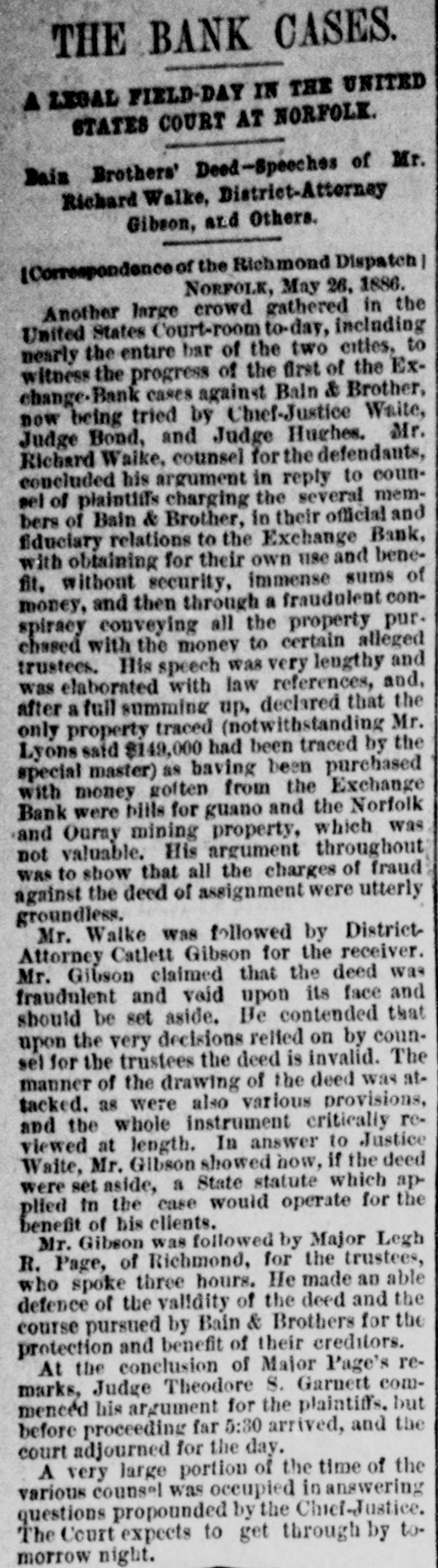
THE BANK CASES. LEGAL FIELD-DAY IN THE UNITED STATES COURT AT NORFOLK. Bain Brothers' Deed-Speeches of Mr. Richard Walke, District-Atterney Gibson, and Others. [Correspondence of the Richmond Dispatch NORFOLK, May 26, 1886. Another large crowd gathered in the United States Court-room to-day, including nearly the entire bar of the two cities, to witness the progress of the first of the Exchange-Bank cases against Bain & Brother, now being tried by Chief-Justice Waite, Judge Bond, and Judge Hughes. Mr. Richard Waike, counsel for the defendants, concluded his argument in reply to counsel of plaintifs charging the several members of Bain & Brother, in their official and fiduciary relations to the Exchange Bank, with obtaining for their own use and benefit. without security, immense sums of money, and then through a fraudulent conspiracy conveying all the property purchased with the money to certain alleged trustees. His speech was very lengthy and was elaborated with law references, and, after a full summine up, declared that the only property traced (notwithstanding Mr. Lyons said $149,000 had been traced by the special master) as baving been purchased with money gotten from the Exchange Bank were bills for guano and the Norfolk and Ouray mining property, which was not valuable. His argument throughout was to show that all the charges of fraud against the deed of assignment were utterly groundless. Mr. Walke was followed by DistrictAttorney Catlett Gibson for the receiver. Mr. Gibson claimed that the deed was fraudulent and vaid upon its face and should be set aside. Be contended that upon the very decisions relied on by counsel for the trustees the deed is invalid. The manner of the drawing of the deed was attacked. as were also various provisions, and the whole instrument critically reviewed at length. In answer to Justice Waite, Mr. Gibson showed how, if the deed were set aside, a State statute which applied in the case would operate for the benefit of his clients. Mr. Gibson was followed by Major Legh R. Page, of Richmond, for the trustees, who spoke three hours. He made an able defence of the validity of the deed and the course pursued by Bain & Brothers for the protection and benefit of their creditors. At the conclusion of Major Page's remarks, Judge Theodore S. Garnett commenced his argument for the plaintiffs. but before proceeding far 5:30 arrived, and the court adjourned for the day. A very large portion of the time of the various counsel was occupied in answering questions propounded by the Chief-Justice. The Court expects to get through by tomorrow night.
Article from Richmond Dispatch, July 17, 1886

Click image to open full size in new tab

Article Text

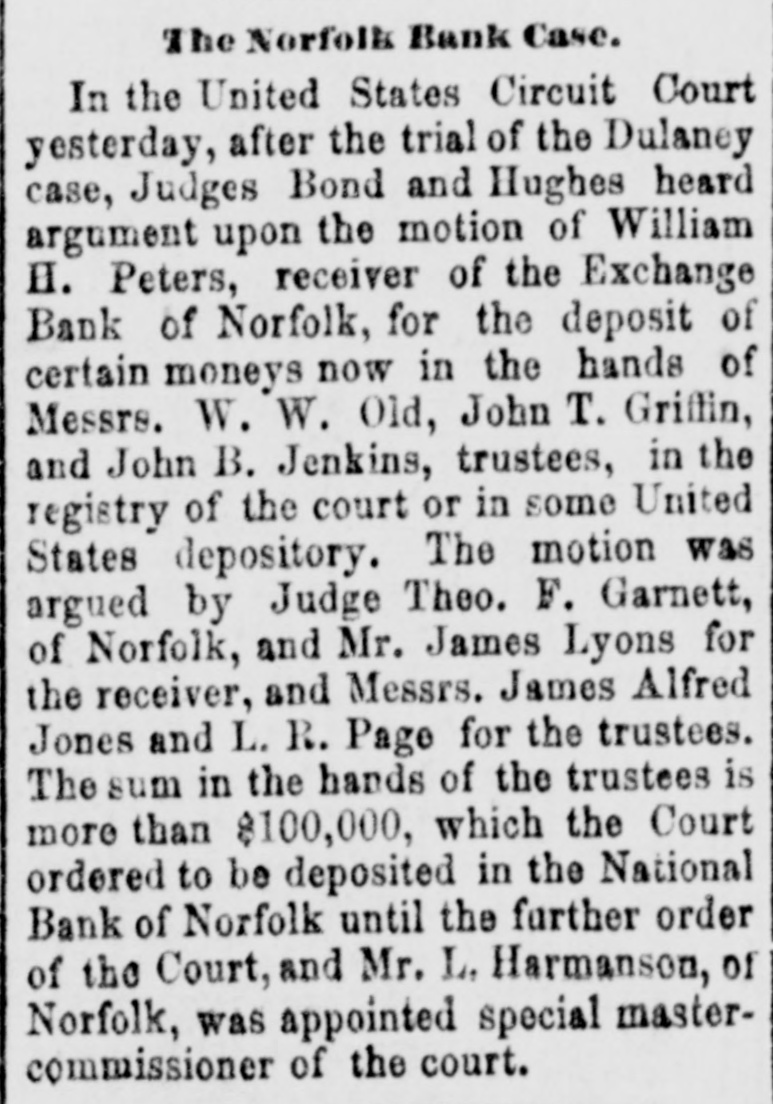
The Norfolk Bank Case. In the United States Circuit Court yesterday, after the trial of the Dulaney case, Judges Bond and Hughes heard argument upon the motion of William H. Peters, receiver of the Exchange Bank of Norfolk, for the deposit of certain moneys now in the hands of Messrs. W. W. Old, John T. Griffin, and John B. Jenkins, trustees, in the registry of the court or in some United States depository. The motion was argued by Judge Theo. F. Garnett, of Norfolk, and Mr. James Lyons for the receiver, and Messrs. James Alfred Jones and L. R. Page for the trustees. The sum in the hands of the trustees is more than $100,000, which the Court ordered to be deposited in the National Bank of Norfolk until the further order of the Court, and Mr. L. Harmanson, of Norfolk, was appointed special mastercommissioner of the court.


Article from Richmond Dispatch, November 12, 1886

Click image to open full size in new tab

Article Text

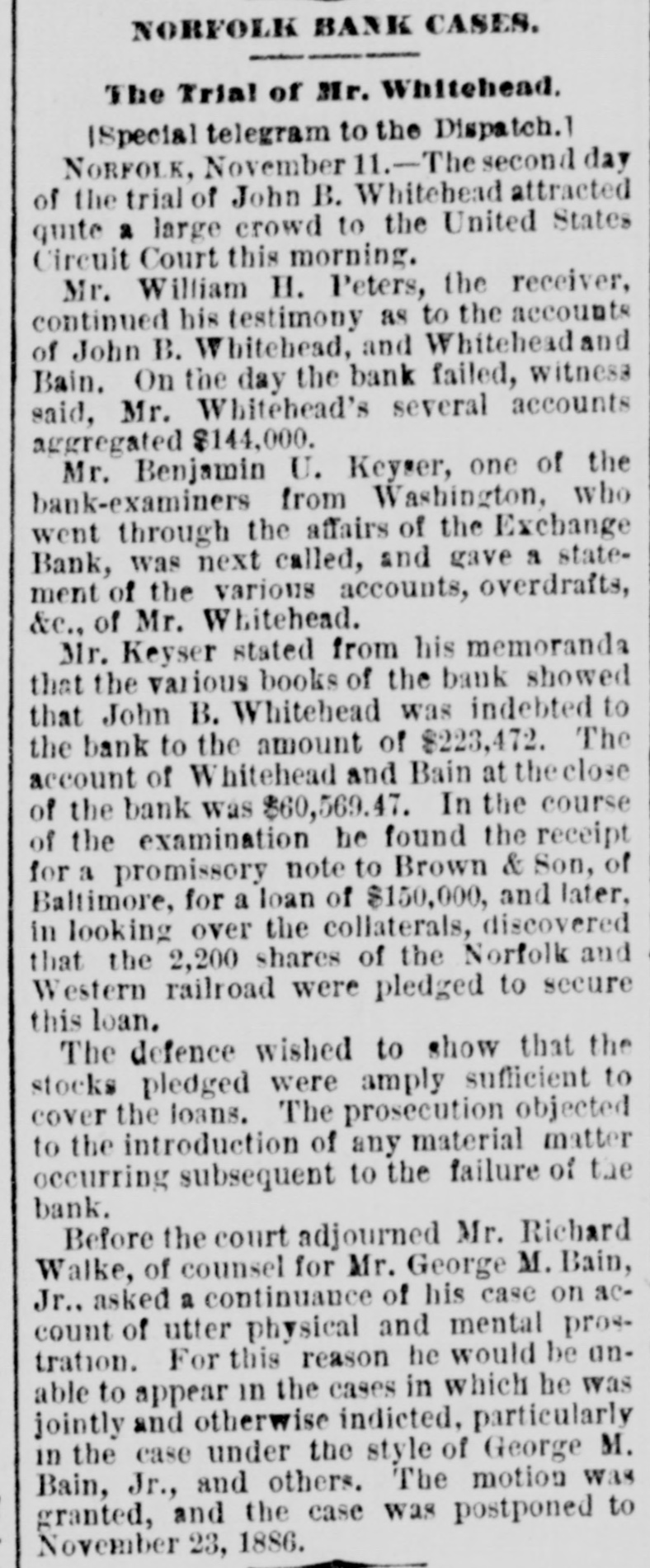
NORFOLK BANK CASES. # The Trial of Mr. Whitehead, [Special telegram to the Dispatch.] NORFOLK, November 11.-The second day of the trial of John B. Whitehead attracted quite a large crowd to the United States Circuit Court this morning. Mr. William H. Peters, the receiver, continued his testimony as to the accounts of John B. Whitehead, and Whitehead and Bain. On the day the bank failed, witness said, Mr. Whitehead's several accounts aggregated $144,000. Mr. Benjamin U. Keyser, one of the bank-examiners from Washington, who went through the affairs of the Exchange Bank, was next called, and gave a statement of the various accounts, overdrafts, &c., of Mr. Whitehead. Mr. Keyser stated from his memoranda that the various books of the bank showed that John B. Whitehead was indebted to the bank to the amount of $223,472. The account of Whitehead and Bain at the close of the bank was $60,569.47. In the course of the examination he found the receipt for a promissory note to Brown & Son, of Baltimore, for a loan of $150,000, and later, in looking over the collaterals, discovered that the 2,200 shares of the Norfolk and Western railroad were pledged to secure this loan. The defence wished to show that the stocks pledged were amply sufficient to cover the loans. The prosecution objected to the introduction of any material matter occurring subsequent to the failure of the bank. Before the court adjourned Mr. Richard Walke, of counsel for Mr. George M. Bain, Jr., asked a continuance of his case on account of utter physical and mental pros-tration. For this reason he would be un-able to appear in the cases in which he was jointly and otherwise indicted, particularly in the case under the style of George M. Bain, Jr., and others. The motion was granted, and the case was postponed to November 23, 1886.