Click image to open full size in new tab
Article Text
The Sons of Temperance order in Fincastle is about on its last legs. Bad on Fincastle.
The McCormick Observatory, at the University, was dedicated with appropriate ceremonies on Monday last.
The Legislature of Nevada has passed a law imposing a fine of $20 on any person who treats another in a saloon.
The Washington correspondent of the Alexandria Gazette states that Hon. John T. Haris will be a candidate for the Governorship.
One of the most encouraging features in the industrial situation just now is that during the past few weeks the iron trade has steadily but slowly improved.
If our cotemporary of the Vindicator would call to mind the fact that a Readjuster Legislature was elected in 1879, and the party continued in power until 1883, it would hardly contend that the transfer of lunatics from the jails to the asylums in 1881-82, was not the result of Readjuster management.
The Alexandria Gazette, referring to the conference in Washington last week of the Democratic members of Congress to divide the spoils and the recommendations they made, says: "The impression among others than Virginians here is that the action of the conference will have little influence on the appointing powers."
Fourteen years ago, Jack Taylor, a colored man, was indicted in the county court of Page, charged with stealing a few chickens and implicated with others in stealing bacon. He eluded arrest and fled to another State. He recently returned, and while enjoying himself with his fiddle at his home, was arrested last week and incarcerated.
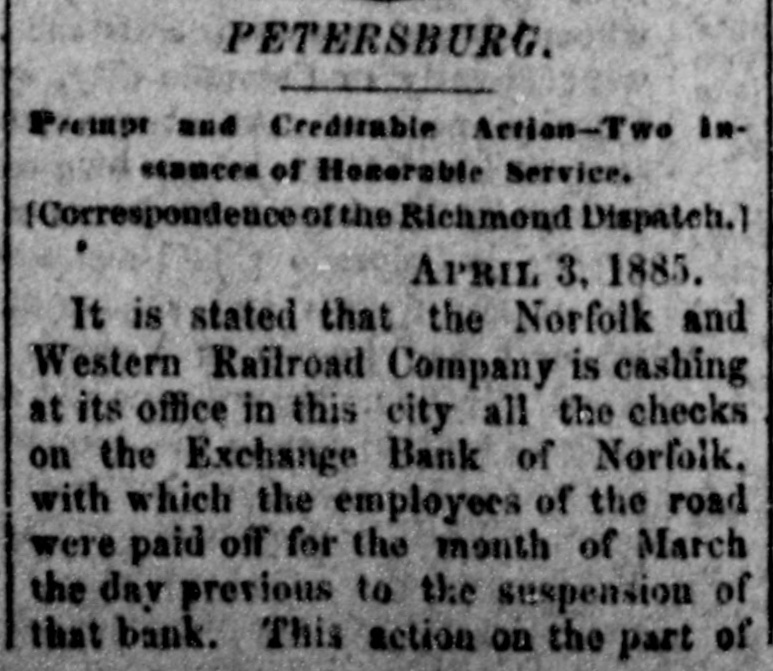
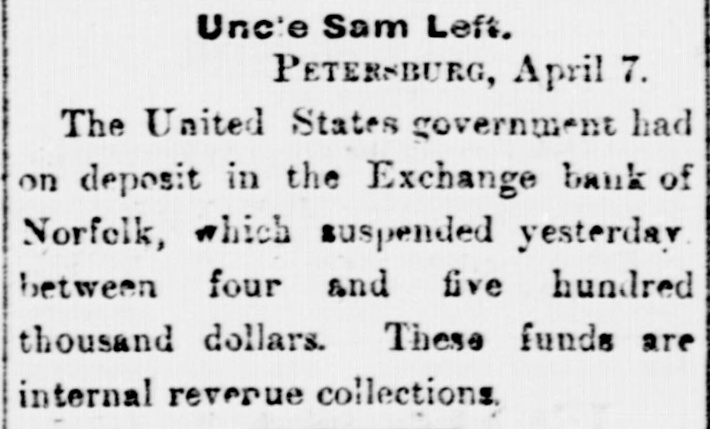
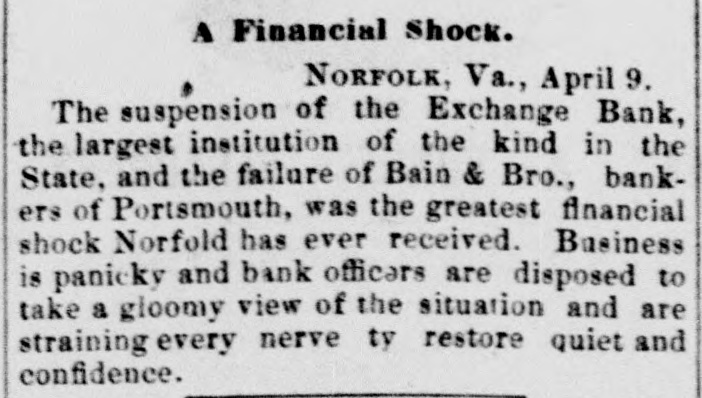
On the 9th The Farmers Bank of Norfolk closed its doors, making the fourth banking institution of that city that has suspended within the past two weeks. There was by the Exchange Bank due depositors $3,000,000. One firm, Bain Bros., had been allowed to overdraw to the amount of $1,200,000. The State had $300,000 in this bank, and there was past due taxes to the State, $12,000. Suit has been brought by the Attorney General to recover.
### THE BALTIMORE MANUFACTURERS' RECORD
April 11th, furnishes a detailed statement of the manufacturing enterprises started in the South for the first three months of 1885. The list embraces fourteen States, and the aggregate capital invested is $20,591,100, divided as follows: Alabama, $2,035,000-including four new coke furnaces at Birmingham: Arkansas, $179,600; Florida, $200,000 Georgia, 3991,000: Kentucky, $7,728,000: Louisiana, $465,500: Maryland. $3,400,000: Mississippi, $96,000; North Carolina, $715,000; South Carolina, $332,000: Tennessee, $1,225,000; Texas, $510,000; Virginia, $1,496,000: West Virginia, $1,220,000,
Amherst Democrat: Capt. J. W. Henley of the Virginia Tin Company, was in town Monday and said his company had the biggest thing ever discovered in the United States. He informed us that they had gotten out from 1,500 to 1,800 tons of ore since Christmas which would average 30 per cent., and were now getting out from thirty-five to forty tons a day. One of the veins has exceeded their most sanguine expectations. It was though that it would only be forty feet in width, but it turns out to be fully 120 feet wide and of very fine ore. A specimen shown us was 78 per cent. pure tin. As soon as possible the company will erect a furnace and smelt the ore.
A new sect is being started in Connecticut. The creed of this novel church declares a belief in an intelligent over-ruling power, a future life for everybody, whose happiness will depend on the state of the conscience, and will be inversely proportionate to the amount of wrong committed on earth and that wrong can be determined only by the exercise of reason. It then enumerates nine wrongs which include to murder, steal, give anything needless discomfort, &c. The organization rejects the Bible, but retains God, whom it calls "Pote." Prayer is regarded as needless, and Sunday rest is recommended for health. Liquor, tobacco and gambling are forbidden.
The effect of the disastrous bank failures in Norfolk has been to paralyze business and reduce to poverty many who a few weeks ago were considered in comfortable circumstances. The business men are facing the difficulties and embarrassments which environ them with heroic courage. Aid is also coming in from the North, to sustain the existing banks and enlarge their facilities for accommodating business demands. Prominent gentlemen of Portsmouth and Norfolk are moving to organize a new bank, and the indications are that it will not be long before the shock experienced by the bank failures will have subsided and all business resume its wonted activity.
Eight five-story tenement houses, each to accommodate ten families, on the south side of West Sixty-Second street, between 10th and 11th avenues, New York, that had been recently put under roof, fell down on the evening of the 14th, while efforts were being made to brace then up, that the yielding foundation might be made secure. The wreck was complete. Not a stick remained standing, not a timber remained whole, in the entire roof. Fifty workmen were engaged at the time, thirty of whom were injured, and about eight killed. Fifty men had been ordered away during the day, and the contractor drove off a few moments before the collapse of the houses. He is greatly censured because of the material out of which the buildings were being constructed, and especially for the bad character he bears, in respect to building.
Judge Wiley, of the Supreme Court of the District of Columbia, has informed the President that he wishes to avail himself of the provision of law which allows him to retire on full pay after twenty years' service. The President requested him to withhold his resignation for the present, until he could select a suitable person to fill the important position. It is stated also that Chief-Justice Cartter and Justice MacArthur desire to avail of the law. The name of Judge James Keith, of the Alaxendria Circuit, is mentioned in connection with one of the positions.