21581. Conway, Gordon & Garnett National Bank (Fredericksburg, VA)

Bank Information

Episode Type
Run → Suspension → Closure
Bank Type
national
Bank ID
5268
Charter Number
5268
Start Date
November 2, 1912
Location
Fredericksburg, Virginia (38.299, -77.487)

Metadata

Model
gpt-5-mini
Short Digest
cbed7bdc

Response Measures

Accommodated withdrawals

Other: Bank merged/taken over by Farmers' and Merchants' State Bank; effectively closed rather than temporary suspension.

Description

A run driven by reports of a cashier's shortage/indictment (initially described as an 'unfounded rumor' but the underlying embezzlement was later revealed) led the bank to be taken over by the Farmers' and Merchants' State Bank and the Conway, Gordon & Garnett National Bank went out of business (merger/takeover around mid-November 1912). Dates derived from contemporaneous articles.

Events (2)

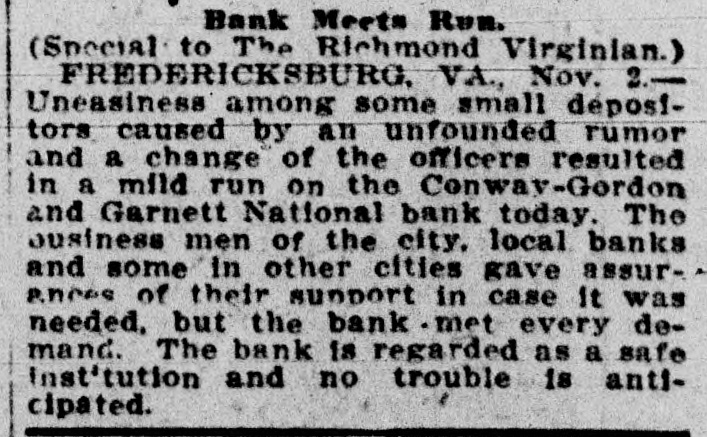
1. November 2, 1912 Run
Cause
Rumor Or Misinformation
Cause Details
Uneasiness of small depositors caused by an unfounded rumor and change of officers triggered a mild run; later articles tie this to discovery of the cashier's shortage.
Measures
Business men and local banks gave assurances of support; the bank met every demand.
Newspaper Excerpt
Uneasiness among some small depositors caused by an unfounded rumor and a change of the officers resulted in a mild run on the Conway-Gordon and Garnett National bank today. ... the bank met every demand.
Source
newspapers
2. November 14, 1912 Suspension
Cause
Bank Specific Adverse Info
Cause Details
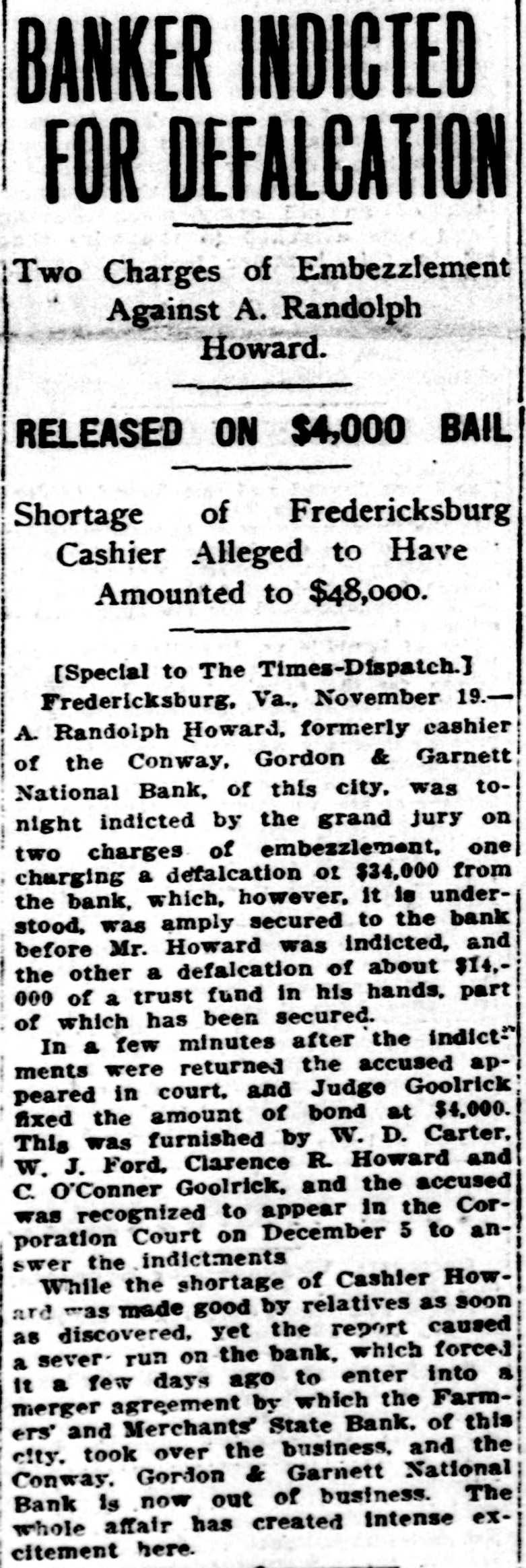
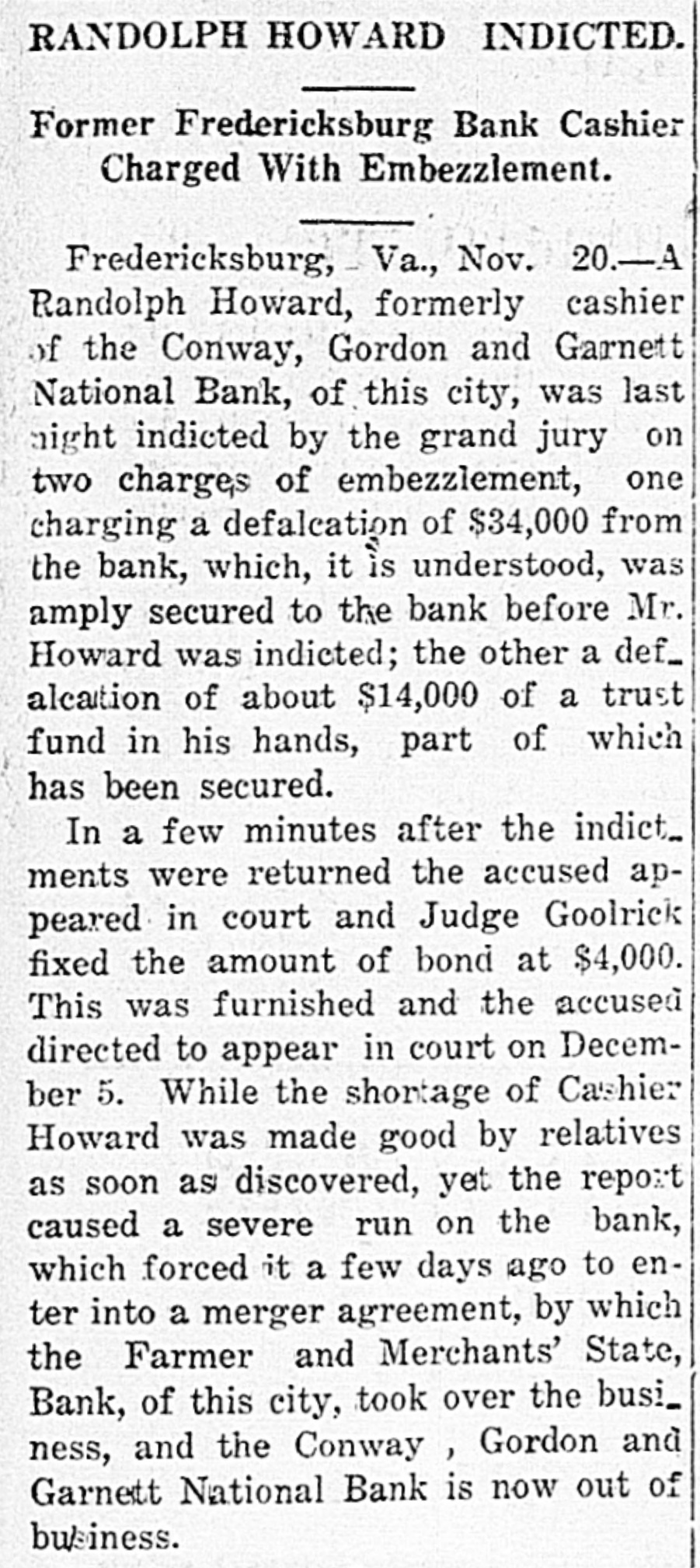
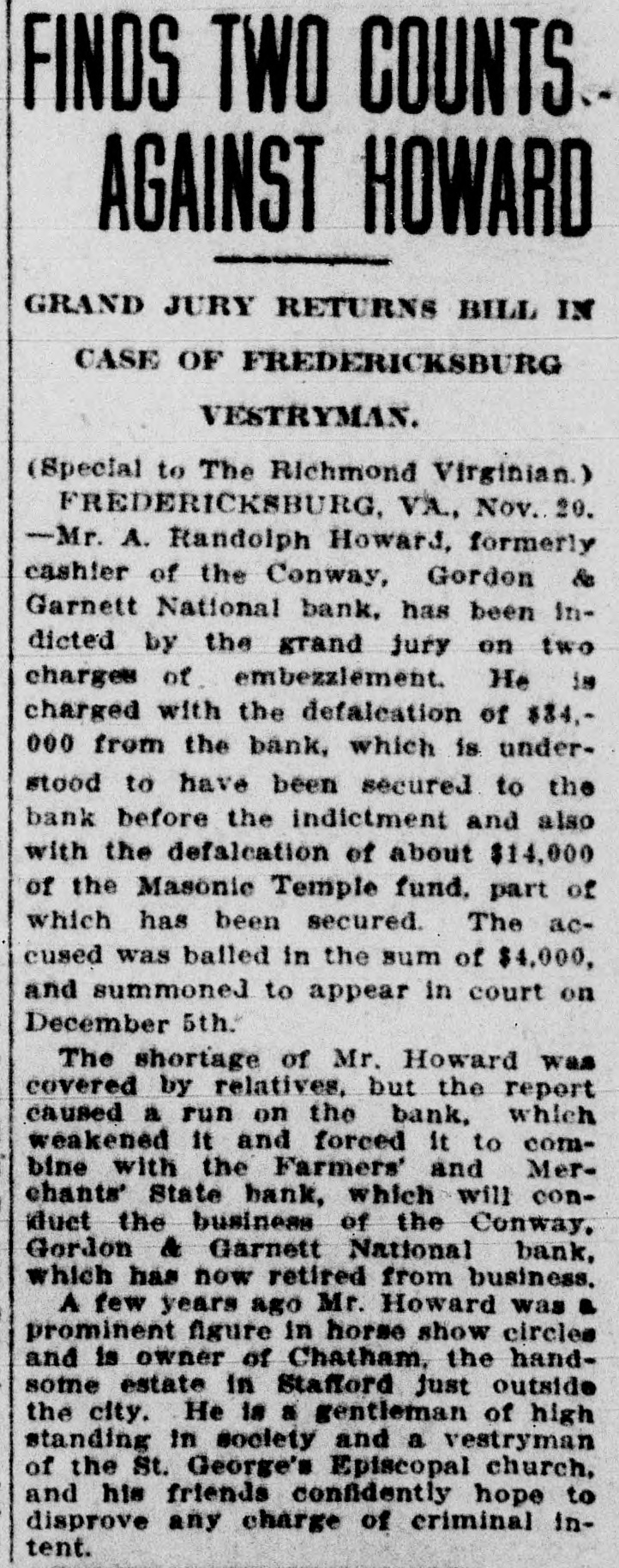
Discovery/publication of a large shortage/defalcation by cashier A. Randolph Howard (embezzlement indictments) weakened the bank and forced a merger/takeover by Farmers' and Merchants' State Bank.
Newspaper Excerpt
On November 14th, the Conway, Gordon & Garnett National bank entered into an agreement with the Farmers' and Merchants' State bank, of this city, whereby deposits and assets of sufficient value to fully protect all depositors were taken over by the latter and the Conway, Gordon & Garnett bank went out of business.
Source
newspapers

Newspaper Articles (7)

Article from The Richmond Virginian, November 3, 1912

Click image to open full size in new tab

Article Text

Bank Meets Run. (Special to The Richmond Virginian.) FREDERICKSBURG, V.A., Nov. 2.Uneasiness among some small dépositors caused by an unfounded rumor and a change of the officers resulted in a mild run on the Conway-Gordon and Garnett National bank today. The business men of the city, local banks and some in other cities gave assurances of their support in case it was needed, but the bank.met met every demand. The bank is regarded as a safe institution and no trouble is anticipated.


Article from The Times Dispatch, November 20, 1912

Click image to open full size in new tab

Article Text

BANKER INDICTED FOR DEFALCATION Two Charges of Embezzlement Against A. Randolph Howard. RELEASED ON $4,000 BAIL of Fredericksburg Shortage Cashier Alleged to Have Amounted to $48,000. [Special to The Times-Dispatch.] Fredericksburg, Va., November 19.A. Randolph Howard, formerly cashier of the Conway, Gordon & Garnett National Bank, of this city, was tonight indicted by the grand jury on two charges of embezzlement, one charging a defalcation of $34,000 from the bank, which, however, it is understood, was amply secured to the bank before Mr. Howard was indicted, and the other a defalcation of about $14,000 of a trust fund in his hands, part of which has been secured. In a few minutes after the indict-" ments were returned the accused appeared in court, and Judge Goolrick fixed the amount of bond at $4,000. This was furnished by W. D. Carter, W. J. Ford, Clarence R. Howard and C. O'Conner Goolrick, and the accused was recognized to appear in the Corporation Court on December 5 to answer the indictments While the shortage of Cashier Howand was made good by relatives as soon as discovered, yet the report caused a sever run on the bank, which forced It a few days ago to enter into a merger agreement by which the Farmers' and Merchants' State Bank, of this city, took over the business, and the Conway. Gordon & Garnett National Bank is now out of business. The whole affair has created intense excitement here.


Article from Alexandria Gazette, November 20, 1912

Click image to open full size in new tab

Article Text

RANDOLPH HOWARD INDICTED. Former Fredericksburg Bank Cashier Charged With Embezzlement. Fredericksburg, Va., Nov. 20.-A Randolph Howard, formerly cashier of the Conway, Gordon and Garnett National Bank, of this city, was last night indicted by the grand jury on two charges of embezzlement, one charging a defalcation of $34,000 from the bank, which, it is understood, was amply secured to the bank before Mr. Howard was indicted; the other a def_ alcation of about $14,000 of a trust fund in his hands, part of which has been secured. In a few minutes after the indict_ ments were returned the accused appeared in court and Judge Goolrick fixed the amount of bond at $4,000. This was furnished and the accused directed to appear in court on December 5. While the shortage of Cashier Howard was made good by relatives as soon as discovered, yet the report caused a severe run on the bank, which forced it a few days ago to enter into a merger agreement, by which the Farmer and Merchants' State, Bank, of this city, took over the busi_ ness, and the Conway ) Gordon and Garnett National Bank is now out of business.


Article from The Richmond Virginian, November 21, 1912

Click image to open full size in new tab

Article Text

FINDS TWO COUNTS AGAINST HOWARD GRAND JURY RETURNS BILL IN CASE OF FREDERICKSBURG VESTRYMAN. (Special to The Richmond Virginian.) FREDERICKSBURG, VA, Nov. 20. -Mr. A. Randolph Howard, formerly cashier of the Conway, Gordon & Garnett National bank, has been Indicted by the grand jury on two charges of embezzlement. He is charged with the defalcation of $84.000 from the bank, which is understood to have been secured to the bank before the indictment and also with the defalcation of about $14,000 of the Masonie Temple fund, part of which has been secured. The accused was balled in the sum of $4,000, and summoned to appear in court on December 5th. The shortage of Mr. Howard was covered by relatives, but the report caused a run on the bank, which weakened It and forced it to combine with the Farmers' and Merchants' State bank, which will conduet the business of the Conway, Gordon & Garnett National bank, which has now retired from business. A few years ago Mr. Howard was a prominent figure in horse show circles and is owner of Chatham, the handsome estate in Stafford just outside the city. He is a gentleman of high standing in society and a vestryman of the St. George's Episcopal church, and his friends confidently hope to disprove any charge of criminal intent.


Article from The Richmond Virginian, November 23, 1912

Click image to open full size in new tab

Article Text

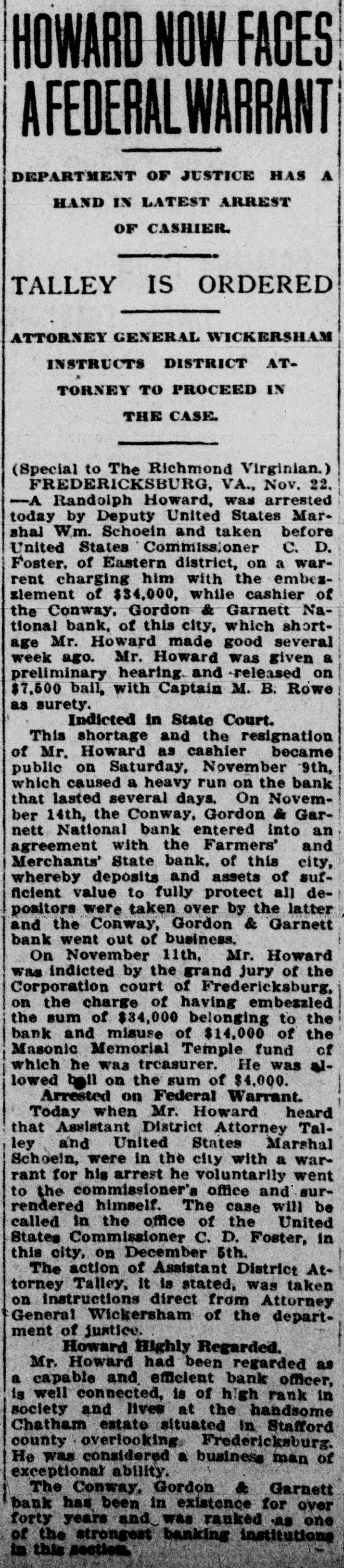
HOWARD NOW FACES AFEDERAL WARRANT DEPARTMENT OF JUSTICE HAS A HAND IN LATEST ARREST OF CASHIER. TALLEY IS ORDERED ATTORNEY GENERAL WICKERSHAM INSTRUCTS DISTRICT ATTORNEY TO PROCEED IN THE CASE. (Special to The Richmond Virginian.) FREDERICKSBURG, VA., Nov. 22. -A Randolph Howard, was arrested today by Deputy United States Marshal Wm. Schoein and taken before United States Commissioner C. D. Foster. of Eastern district, on a warrent charging him with the embezzlement of $34,000, while cashier of the Conway, Gordon & Garnett National bank, of this city, which shortage Mr. Howard made good several week ago. Mr. Howard was given a preliminary hearing. and released on $7,500 ball, with Captain M. B. Rowe as surety. Indicted in State Court. This shortage and the resignation of Mr. Howard as cashier became public on Saturday, November 9th, which caused a heavy run on the bank that lasted several days. On November 14th, the Conway, Gordon & Garnett National bank entered into an agreement with the Farmers' and Merchants' State bank, of this city, whereby deposits and assets of sufficient value to fully protect all depositors were taken over by the latter and the Conway, Gordon & Garnett bank went out of business. On November 11th, Mr. Howard was indicted by the grand jury of the Corporation court of Fredericksburg, on the charge of having embezzled the sum of $34,000 belonging to the bank and misuse of $14,000 of the Masonic Memorial Temple fund of which he was treasurer. He was allowed hall on the sum of $4,000. Arrested on Federal Warrant. Today when Mr. Howard heard that Assistant District Attorney Talley and United States Marshal Schoein, were in the city with a warrant for his arrest he voluntarily went to the commissioner's office and surrendered himself. The case will be called in the office of the United States Commissioner C. D. Foster, in this city, on December 5th. The action of Assistant District Attorney Talley, It is stated, was taken on instructions direct from Attorney General Wickersham of the department of justice. Howard Highly Regarded. Mr. Howard had been regarded as a capable and efficient bank officer, is well connected, is of high rank in society and lives at the handsome Chatham estate situated in Stafford county overlooking Fredericksburg. He was considered a business man of exceptional ability. The Conway, Gordon & Garnett bank has been in existence for over forty years and was ranked as one of the strongest banking institutions in this section.


Article from Alexandria Gazette, January 8, 1913

Click image to open full size in new tab

Article Text

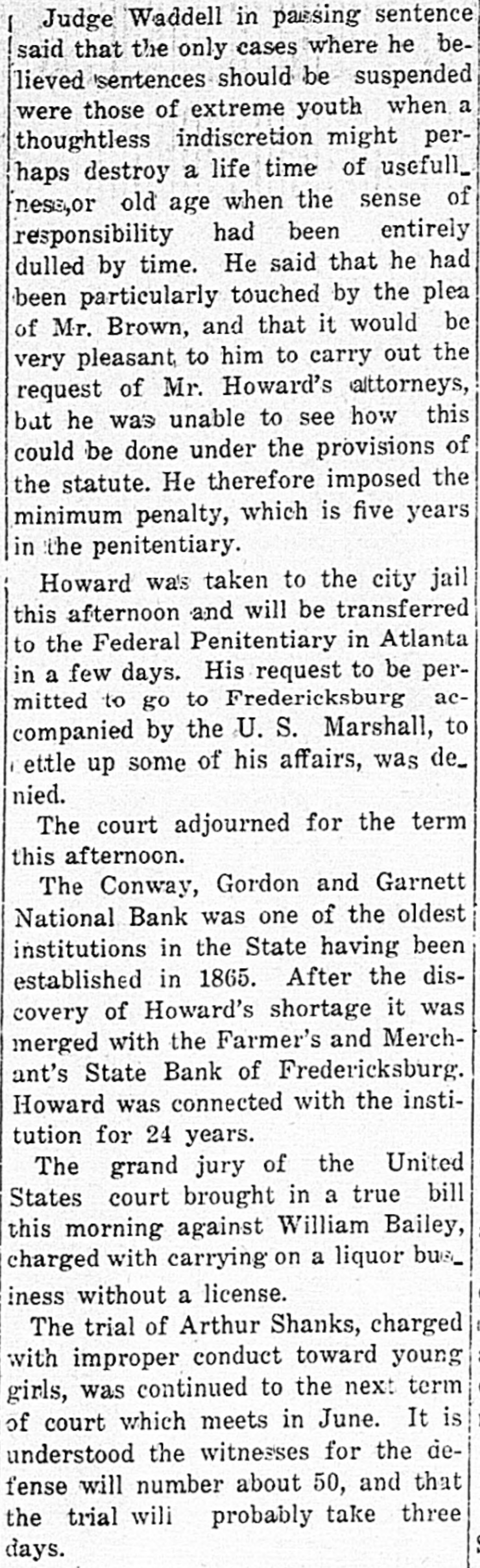
Judge Waddell in passing sentence said that the only cases where he believed sentences should be suspended were those of extreme youth when a thoughtless indiscretion might perhaps destroy a life time of usefull. ness, or old age when the sense of responsibility had been entirely dulled by time. He said that he had been particularly touched by the plea of Mr. Brown, and that it would be very pleasant, to him to carry out the request of Mr. Howard's attorneys, but he was unable to see how this could be done under the provisions of the statute. He therefore imposed the minimum penalty, which is five years in the penitentiary. Howard was taken to the city jail this afternoon and will be transferred to the Federal Penitentiary in Atlanta in a few days. His request to be permitted to go to Fredericksburg accompanied by the U. S. Marshall, to ettle up some of his affairs, was de_ nied. The court adjourned for the term this afternoon. The Conway, Gordon and Garnett National Bank was one of the oldest institutions in the State having been established in 1865. After the discovery of Howard's shortage it was merged with the Farmer's and Merchant's State Bank of Fredericksburg. Howard was connected with the institution for 24 years. The grand jury of the United States court brought in a true bill this morning against William Bailey, charged with carrying on a liquor bus_ iness without a license. The trial of Arthur Shanks, charged with improper conduct toward young girls, was continued to the next term of court which meets in June. It is understood the witnesses for the defense will number about 50, and that the trial wili probably take three days.


Article from The Free Lance-Star, March 6, 1933

Click image to open full size in new tab

Article Text

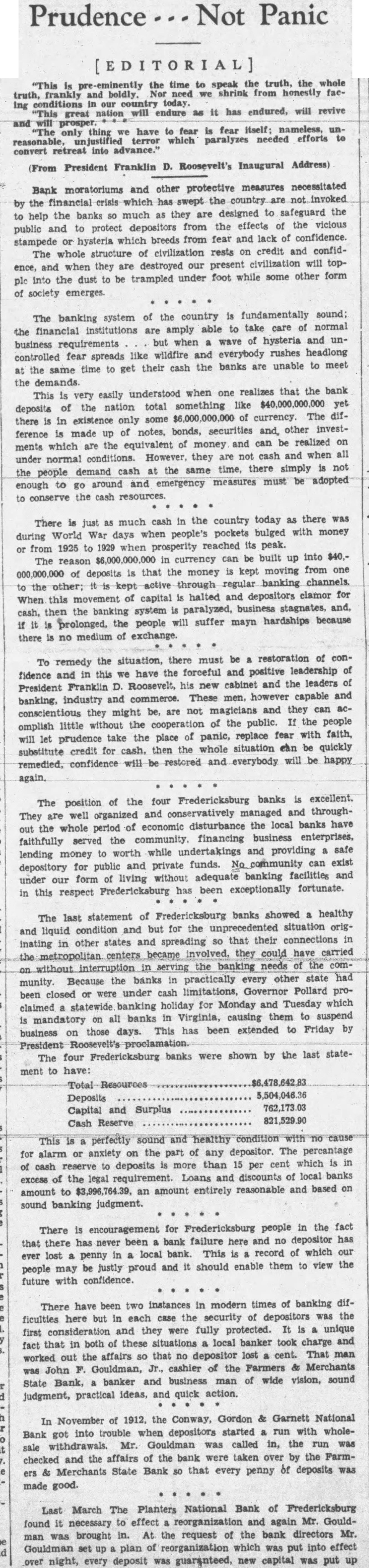
Prudence Panic "This is pre-eminently the time to speak the truth, the whole truth, frankly and boldly. Nor need we shrink from honestly facconditions in our country today. ing "This great nation will endure as it has endured, will revive and will "The only thing we have to fear fear itself: nameless, unreasonable, terror which paralyzes needed efforts convert retreat into advance." (From President Franklin D. Roosevelt's Inaugural Address) Bank moratoriums and other protective measures necessitated by the financial crisis which has swept the country are not invoked to help the banks so much as they are designed to safeguard the public and to protect depositors from the effects of the vicious stampede or hysteria which breeds from fear and lack of confidence. The whole structure of civilization rests on credit and confidence, and when they are destroyed our present civilization will topplc into the dust to be trampled under foot while some other form of society emerges. The banking system of the country is fundamentally sound; the financial institutions are amply able to take care of normal of hysteria and unrequirements but when wave business controlled fear spreads like wildfire and everybody rushes headlong at the same time to get their cash the banks are unable to meet the This is very easily understood when one realizes that the bank deposits of the nation total something like $40,000,000,000 yet there is in existence only some $6,000,000,000 of currency. The difference is made up of notes, bonds, securities and, other investments which are the equivalent of money and can be realized on under normal conditions. However, they are not cash and when all the people demand cash at the same time, there simply is not enough to go around and emergency measures must be adopted to conserve the cash resources. There is just as much cash in the country today as there was during World War days when people's pockets bulged with money or from 1925 to 1929 when prosperity reached its peak. The reason $6,000,000,000 in currency can be built up into $40,000,000,000 of deposits is that the money is kept moving from one to the other; it is kept active through regular banking channels. When this movement of capital is halted and depositors clamor for cash, then the banking system is paralyzed, business stagnates, and, if it is prolonged, the people will suffer mayn hardships because there is no medium of exchange. To remedy the situation, there must be restoration of confidence and in this we have the forceful and positive leadership of President Franklin D. Roosevelt, his new cabinet and the leaders of banking, industry and commerce. These men, however capable and conscientious they might be, are not magicians and they can acomplish little without the cooperation of the public. If the people will let prudence take the place of panic, replace fear with faith, substitute credit for cash. then the whole situation can be quickly remedied, confidence will be restored and everybody will be happy again. The position of the four Fredericksburg banks is excellent. They are well organized and conservatively managed and throughout the whole period of economic disturbance the local banks have faithfully served the community. financing business enterprises. lending money to worth while undertakings and providing a safe depository for public and private funds. community can exist under our form of living without adequate banking facilities and in this respect Fredericksburg has been exceptionally fortunate. The last statement of Fredericksburg banks showed healthy and liquid condition and but for the unprecedented situation originating in other states and spreading so that their connections in the metropolitan centers became involved, they could have carried without interruption in serving the banking needs of the community. Because the banks in practically every other state had been closed or were under cash limitations, Governor Pollard proclaimed a statewide banking holiday for Monday and Tuesday which is mandatory on all banks in Virginia, causing them to suspend business on those days. This has been extended to Friday by President Roosevelt's proclamation. The four Fredericksburg banks were shown by the last statement to have: $6,478,642.83 5,504,046.36 Deposits 762,173.03 Capital and Surplus 821,529.90 Cash Reserve This perfectly sound and healthy condition with cause for alarm or anxiety on the part of any depositor. The percantage of cash reserve to deposits is more than 15 per cent which is in excess of the legal requirement. Loans and discounts of local banks amount to $3,996,764.39. an amount entirely reasonable and based on sound banking judgment. There is encouragement for Fredericksburg people in the fact that there has never been bank failure here and no depositor has ever lost penny in a local bank This is record of which our people may be justly proud and it should enable them to view the future with confidence. There have been two instances in modern times of banking difficulties here but in each case the security of depositors was the first consideration and they were fully protected. It is a unique fact that in both of these situations a local banker took charge and worked out the affairs so that no depositor lost cent. That man was John F. Gouldman, Jr., cashier of the Farmers & Merchants State Bank, banker and business man of wide vision, sound judgment, practical ideas, and quick action. In November of 1912, the Conway, Gordon & Garnett National Bank got into trouble when depositors started run with wholesale withdrawals. Mr. Gouldman was called in, the run was checked and the affairs of the bank were taken over by the Farmers & Merchants State Bank so that every penny of deposits was made good. Last March The Planters National Bank of Fredericksburg found it necessary to effect reorganization and again Mr. Gouldman was brought in. At the request of the bank directors Mr. Gouldman set up plan of reorganization which was put into effect over night, every deposit was guaranteed, new capital was put up