21458. Bank of Alexandria (Alexandria, VA)

Bank Information

Episode Type
Suspension → Closure
Bank Type
state
Start Date
April 1, 1834*
Location
Alexandria, Virginia (38.818, -77.082)

Metadata

Model
gpt-5-mini
Short Digest
7a41a31b

Response Measures

None

Description

Contemporary Alexandria Gazette advertisement (Apr 12, 1834) states the Bank of Alexandria has... been compelled to suspend specie payment. Coverage links the suspension to pressure of the times and removal of deposits related to the federal deposit controversy (so government action / loss of deposits). Later (1890 article) explicitly states the Bank had failed and its claim was transferred to the Bank of Potomac, indicating permanent closure/receivership. No specific run on this bank is described in the articles provided.

Events (4)

1. April 1, 1834* Receivership
Newspaper Excerpt
The 1890 article notes the Bank of Alexandria 'had failed' and its claim was transferred to the Bank of Potomac; later assets went into hands of a receiver, indicating permanent failure/receivership.
Source
newspapers
2. April 12, 1834 Suspension
Cause
Government Action
Cause Details
Suspension attributed to 'pressure of the times' and contemporaneous removal/redistribution of government deposits (the 'Pet Banks' controversy) which reduced specie and compelled suspension of specie payments.
Newspaper Excerpt
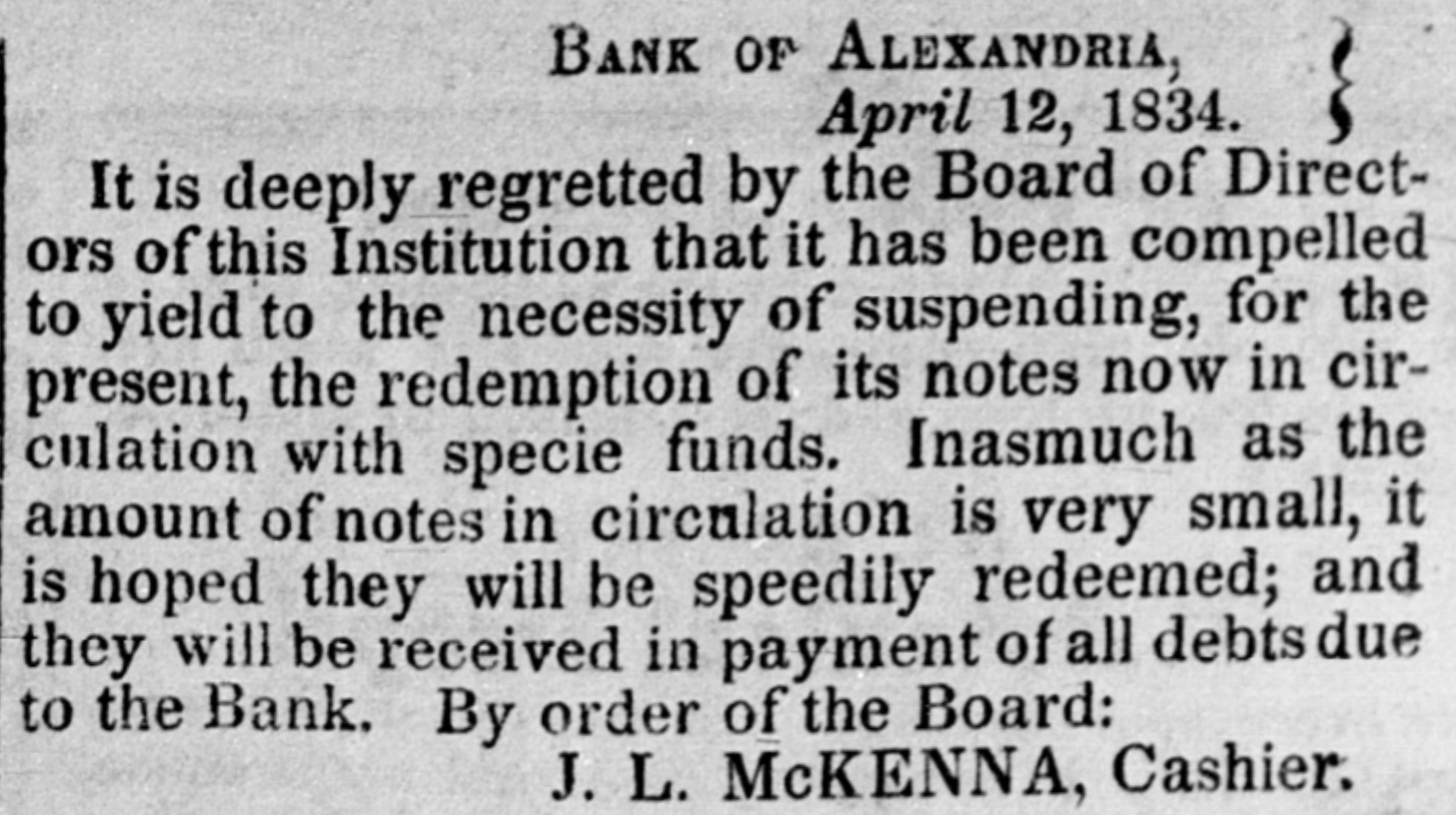
It is deeply regretted by the Board of Directors of this Institution that it has been compelled to yield to the necessity of suspending, for the present, the redemption of its notes now in circulation with specie funds.
Source
newspapers
3. April 14, 1834 Other
Newspaper Excerpt
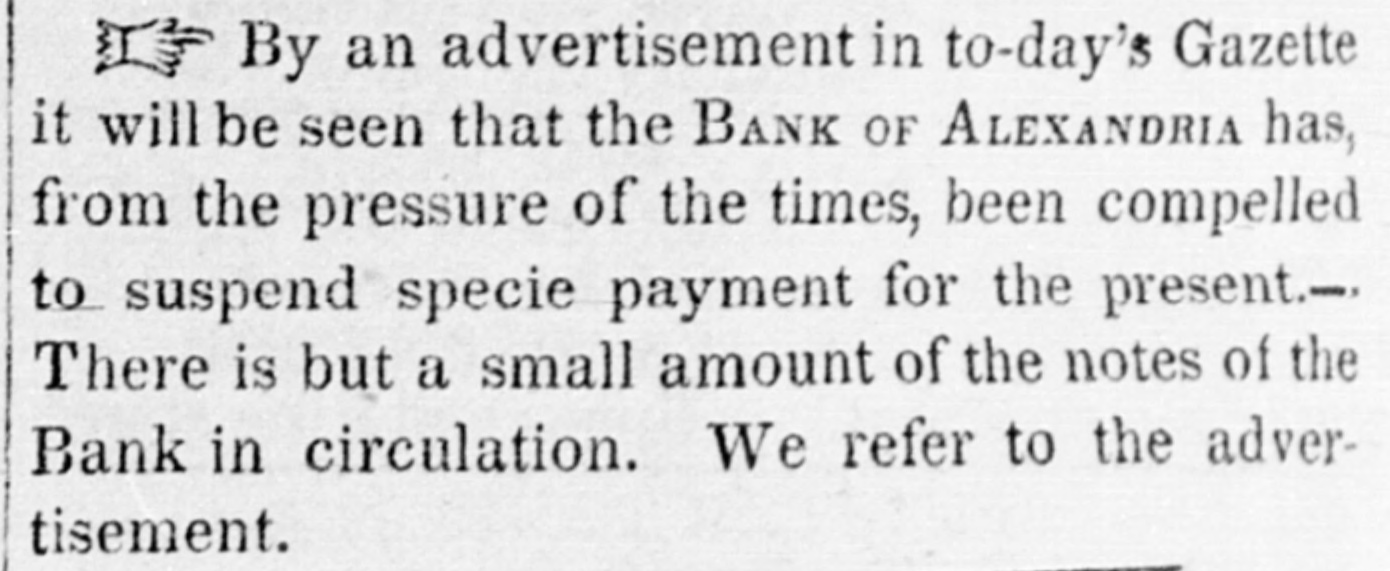
By an advertisement in to-day's Gazette it will be seen that the BANK OF ALEXANDRIA has, from the pressure of the times, been compelled to suspend specie payment for the present.-. There is but a small amount of the notes of the Bank in circulation. We refer to the advertisement.
Source
newspapers
4. January 1, 1840 Other
Newspaper Excerpt
It is further stated that the Bank of Alexandria had failed and the claim had been transferred to the Bank of Potomac, and that Phineas Janney, president, accepted the terms ... with interest from January 1, 1836.
Source
newspapers

Newspaper Articles (8)

Article from Alexandria Gazette, April 14, 1834

Click image to open full size in new tab

Article Text

By an advertisement in to-day's Gazette it will be seen that the BANK OF ALEXANDRIA has, from the pressure of the times, been compelled to suspend specie payment for the present.-. There is but a small amount of the notes of the Bank in circulation. We refer to the advertisement.


Article from Alexandria Gazette, April 14, 1834

Click image to open full size in new tab

Article Text

BANK OF ALEXANDRIA, S April 12, 1834. It is deeply regretted by the Board of Directors of this Institution that it has been compelled to yield to the necessity of suspending, for the present, the redemption of its notes now in circulation with specie funds. Inasmuch as the amount of notes in circulation is very small, it is hoped they will be speedily redeemed; and they will be received in payment of all debts due to the Bank. By order of the Board: J. L. McKENNA, Cashier.


Article from Richmond Enquirer, April 15, 1834

Click image to open full size in new tab

Article Text

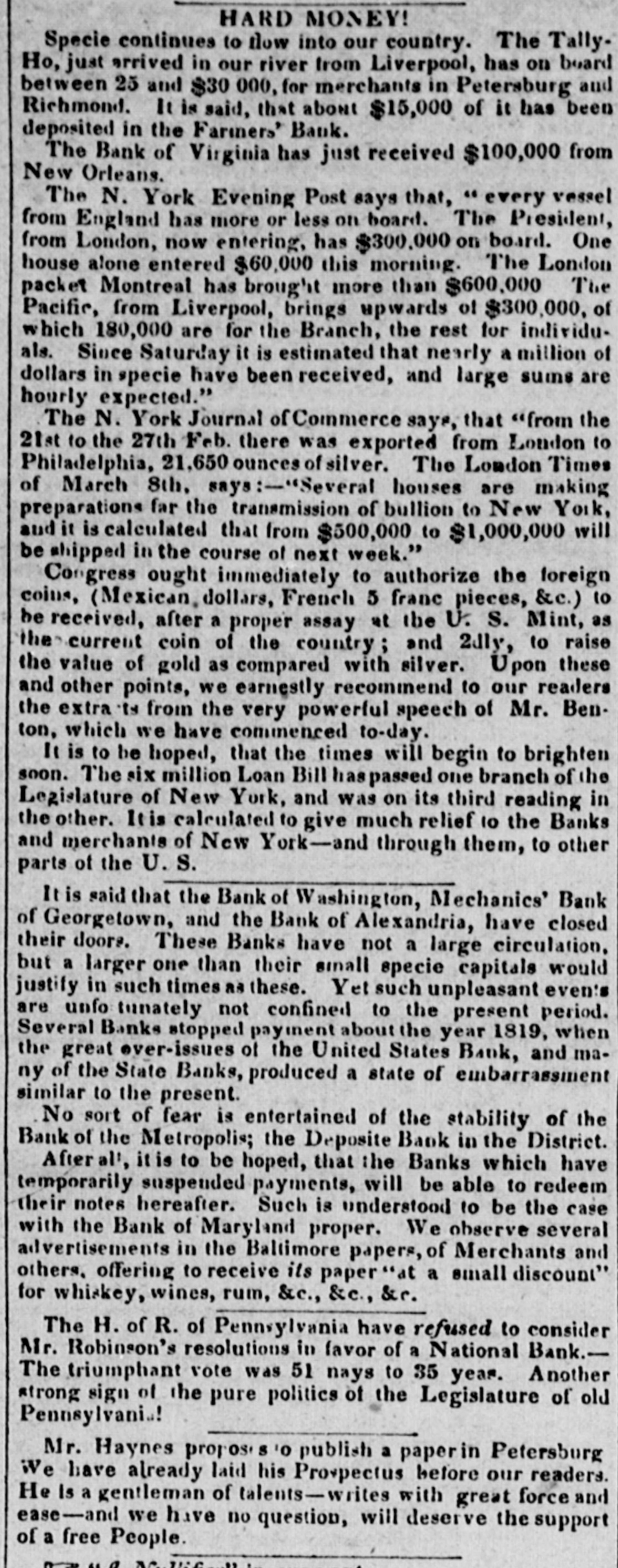
HARD MONEY! Specie continues to flow into our country. The TallyHo, just arrived in our river from Liverpool, has on board between 25 and $30 000, for merchants in Petersburg and Richmond. It is said, that about $15,000 of it has been deposited in the Farmers' Bank. The Bank of Virginia has just received $100,000 from New Orleans. The N. York Evening Post says that, every vessel from England has more or less on board. The President, from London, now entering, has $300,000 on board. One house alone entered $60,000 this morning. The London packet Montreal has brought more than $600,000 The Pacific, from Liverpool, brings upwards of $300,000, of which 180,000 are for the Branch, the rest for individuals. Since Saturday it is estimated that nearly a million of dollars in specie have been received, and large sums are hourly expected." The N. York Journal of Commerce says, that "from the 21st to the 27th Feb. there was exported from London to Philadelphia, 21,650 ounces of silver. The London Times of March 8th. says:- Several houses are making preparations far the transmission of bullion to New York, and it is calculated that from $500,000 to $1,000,000 will be shipped in the course of next week." Congress ought immediately to authorize the foreign coins, (Mexican, dollars, French 5 frane pieces, &c.) to be received, after a proper assay at the U. S. Mint, as the current coin of the country; and 2dly, to raise the value of gold as compared with silver. Upon these and other points, we earnestly recommend to our readers the extra is from the very powerful speech of Mr. Ben. ton, which we have commenced to-day. It is to be hoped, that the times will begin to brighten soon. The six million Loan Bill haspassed one branch of the Legislature of New York, and was on its third reading in the other. It is calculated to give much relief to the Banks and merchants of New York-and through them, to other parts of the U.S. It is said that the Bank of Washington, Mechanics' Bank of Georgetown, and the Bank of Alexandria, have closed their doors. These Banks have not a large circulation, but a larger one than their small specie capitals would justify in such times as these. Yet such unpleasant even's are unfo tunately not confined to the present period. Several Banks stopped payment about the year 1819, when the great over-issues of the United States Bank, and many of the State Banks, produced a state of embarrassment similar to the present. No sort of fear is entertained of the stability of the Bank of the Metropolis; the Deposite Bank in the District. Afteral', it is to be hoped, that the Banks which have temporarily suspended payments, will be able to redeem their notes hereafter. Such is understood to be the case with the Bank of Maryland proper. We observe several advertisements in the Baltimore papers, of Merchants and others. offering to receive its paper"at a small discount" for whiskey, wines, rum, &c., &c., &r. The H. of R. of Pennsylvania have refused to consider Mr. Robinson's resolutions in favor of a National Bank.The triumphant vote was 51 nays to 35 year. Another strong sign of the pure politics of the Legislature of old Pennsylvani.! Mr. Haynes proposis '0 publish a paperin Petersburg We have already laid his Pro+pectus before our readers. He Is a gentleman of talents-writes with great force and ease-and we have no question, will deserve the support of a free People.


Article from Herald of the Times, April 16, 1834

Click image to open full size in new tab

Article Text

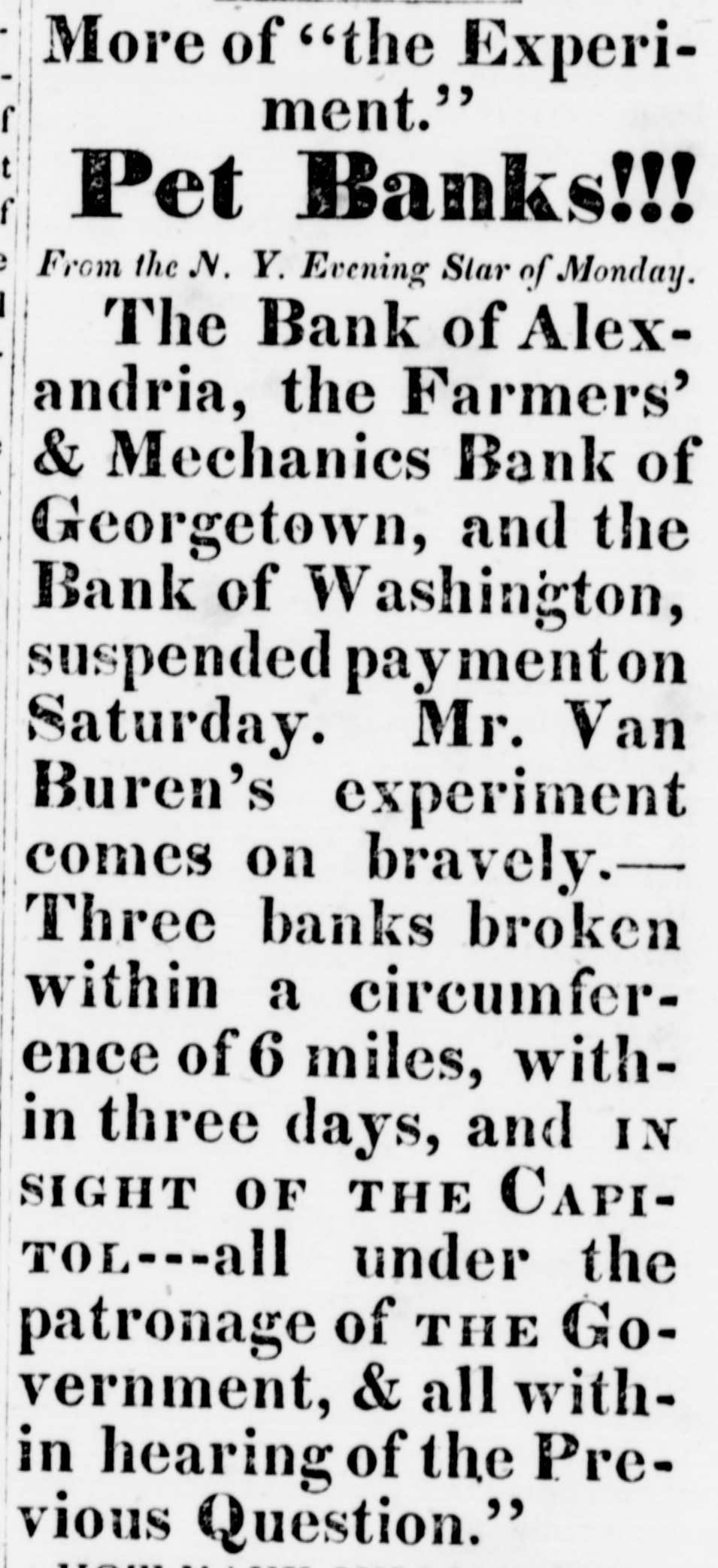
More of "the Experiment." Pet Banks!!! From the N. Y. Evening Star of Monday. The Bank of Alexandria, the Farmers' & Mechanics Bank of Georgetown, and the Bank of Washington, suspended paymenton Saturday. Mr. Van Buren's experiment comes on bravely.Three banks broken within a circumference of 6 miles, within three days, and IN SIGHT OF THE CAPITOL---all under the patronage of THE Government, & all within hearing of the Previous Question."


Article from Richmond Enquirer, April 18, 1834

Click image to open full size in new tab

Article Text

POLATICAL April 14.-1 stoppage of produced the Bank WASHINGTON, as might have been expected, and we a of Washington, the other Banks in this District, Bank of heavy run on that the Farmers' and Mechanics' suspended specie understand Georgetown, and the Bank of Alexandria, have will represent It is payments probable that the agents of the the Bank, Bank with of Alex their usual disregard as one of of those truth, selected by the Secretary when of the it andria Treasury for the deposite Bank of of the the public United money, ates. In or. was removed against from the this attempt at deception, has we been take the oc. der to guard state, that the Bank of Alexandria Alexandria, casion to for the small revenue collected at is, depository the establishment of the Governm has no conthe with removal ever for more since than forty years. Its employment of the deposites from the nexion the Bank whatever of the United States. made The at deposites, Alexandria, since in the same the removal, manner continued that they have to be always been made from the aware, establishment of the Government. because we are fully of the United and We the give public this are statement, aware, of the States, daily efforts and its of adherents, the re. tainers of to throw the the Bank country into general confusion, suspension and by of specie pay destroying to stop, ments. confidence, Every to produce day reports are industriously and such circulated report will generally that some produce bank is the about effect of making it The stop, People how see, suivent in the present and well condition conduete of things, it months, may the be. to fruits ruin the of those credit un- of tix ing efforts, and for the to throw last four the currency into confusion, surrender in the country, the People of the country to ambitious order their liberties into to compel the hands of this arrogant and corporation.- W. Globe. MR. ADAMS AND THE labored SPEAKER article of The Mr. Intelligen John Q cer Adams of Saturday upon the contains deposite question, of a speech which intended is now to present- be deed to the pnblic alleged in the to be form suppressed by the Previous (reject Ques: livered,but There is prefix to this rejected address, debate,) tion. the House by a vote to cut off further introductory an ed by on the part of the author, in some occasioned attempt to inculpate the Speaker as having shall, by remarks, disappointment and mortification! We pains the statement of facts, which we have taken that the dis- to plain uscertain and are authorized to make, show sounding respect complained of by Mr. Adains, (and !rom so the Speakthe to his feelings and variey .) proceeded public will no: be able to judge er, but what the authority House- and Mr. Adams has considered himself against upon in making the charges and insinfuations article. We justified the Speaker, contained in his introductory now proceed rules to of do the so. House, we find that petitions, are me. not By the other papers addressed to the House, morials, debated and or decided on the day they are first Before present- the to ed, be unless the House were should presented, otherwi the allow. (debate on which Virginia Adams resolutions FO much complains of) there had been touching much Mr. various memorials and resolutions This dis. discussion absorbing on subjects of the Bank and deposites. and acquiesthe had been allowed, by the permission We know the cussion of the House, and not the Speaker. and cence fact, that the Speaker frequently irregular interposed and unusual, attempt- but ed arrest the and discussion, it was allowed as to go on, by the debate, perwithout effect of the House. The responsibility the of Chair. the mission therefore, with the House, not with the W was, the 3.1 of March, (the only day Gordon in eek Oa Monday & can be presented,) Mr. pre- and on the general sented when petitions, the resolutions of the Assembly subj- et Virginia, embraced in Gholson, floor, them. addressed He the was House followed by his colleague, of Virginia, Mr. obtain- Patton, Ohio and late in the but evening yielded Mr. it for the purpose of adjournment moved 10 the in rules, ed On the Wednesday, the 5th, order to member'thou have the States called for Adais suspend presentation of petitions and memorials. as Mr. to exclude the amend the motion to suspend, would have moved 10 the Virgima resolutions, which debate on first in order, if there had been a genecome up as of the rule. !he mo ion Mr. to amend, Adams, was ral suspension afterwards, we learn, withdrawn waive by his right to (Mr. Gholson having consented and the to rule being suspended, the floor for that called, day, and upwards of 150 petitions, me. the States &c were were prese nted and acted on. On Monday, morials, 10.h of March, the Virgi resolutions again and came Mr. the consideration, as the unfinished business, when Mr. for addressed the House, with others, some time, Gholson having obtained the floor and spoken concluded Pinckney for motion to adjourn, before he had the floor gave way He was consequently entitled to the is argumen ensuing Monday, when the subject would again come up. here it may be proper to remark, that on the the rules day of And we are told, only restrict debate is petition the House, is first presented under -and that consideration, on any subsequent it is open day when the other, subject to full and free debate; and that it the is like every the power of the Speaker of the House, after first not in day, 10 deprive any member March of the 11th) floor. Mr. Adams, On the next day, (Tuesday, consent of the House to present the Massachusetts it seems, asked resolutions, the which was referred, and which he moved to suspend the rules for that purpose, (Wedthen also rejected! On the acceeding House morning, to present was he again asked the leave of the a second nesday ,) W hich was objected to, and he refused. these resolutions, to suspend the rules, which was again the time was, moved we believe, on these occasions be preface. entered into We are authorized, It expostulations moreover, of which in he saying, speaks deny in that his to Mr. far Adams from or the the Speaker's having any wish the right to be heard, he felt him State of that the opportunity should be afforded could, to licitous present the regolutions of his State, and, as far aslic he aided Monday, in the the effort. 17th, Mr. Pinckney was entitled to the them floor, Oa and we learn that he yielded ii, for and the purpose mortals to his enabling gentlemen The Chair " ho had we petitions believe, on that occasion so, doing suggested present Mr. understand Pinckney the that propriety ii he did, of be would not and gave afterwards him to to the floor After Mr. Pinckney and Massa- had his right assented to the wishes of the House, the resolutions by accompanied readily chuseits was called, Mr. Adams a space which, in consequence of her Legislature of its characier and violence, that the Mr. Virginia Polk rose reto reply to-but passed understood over, to have petitions presentsolutions without had debate, been the Speaker we learn, would leave not of per- the ed Polk to proceed W ithout the express V te of mil Mr. accordingly asked and by the Adams' the House House; granted. it WAS Mr. Polk then replied to Mr. speech. succeeding Monday, (the 24th,) when the declined VirOathe mia resolutions again came up. Mr. without Pinckney debate, and by speaking, and the laid resolutions on the table. were, These are bri fly the Adams general consent, relation to the proceedings of which introduction. Mr. facts complains in much the first part of his in W hich is chargrelation to that of part the House, of the article and the lex parliamentato necessary ria, ed that are the administered rules by the the Speaker will of the in House, such manner it s only the w motives with to substitute remark his will that for such inginuations are firith as the gratui im tous as unfounded; have be en made, and of and the authority for himself them, believe them. world putations will judge. He cannot, we presume, to As to the fact of not being able to catch the Speaker's my thing Mr. which eye those and ear who on know the 4th, the posi ion, in McDuilie the House, spoke, of Mr. and Adams, who and rose that around from him to get the member floor So from far Mas. from the to sachusetts right Mr. had Adams those the Speaker's wishing to speak, deprive we the are authorized in say risen and ing, that he did not know that no doubt, to his position,) contended for the floor, (owing, papers. until was announced in supposed the public the charge could have Indeed, we against had never the present Presiding Officer, official of rigor des; been made Adams, in the of know his and and towards and Mr. we doubt not, from what we man, on both sides, have heard, appealed that if every to, they candid would say that of the the Speaker rules, in lim forehore were to enforce rigid more observance than to any other member doubt, lation to this individual, House, His motives for doing #0 will, re- no probably at once in the suggest themselves to the mind every fleeting man. to Mr. Mason's getting the floor, we and are the au inIn relation which is made against the Speaker, 10 Mr M have therized sinuation to say, that the floor was given
Article from Richmond Enquirer, April 22, 1834

Click image to open full size in new tab

Article Text

KenuraT arrest, and no person should be permitted to charge him with having done FO, without being contradicted in such terms - admitted of equivocation. He made the motion in reference to those who were then outraging and insuling the Senate whom he heard over his head. He asked it the business of the Senate was not interrupted. He asked if it was possible for business to proceed while the tumult rasgoing on; and if hisses as well as applauses were not heard. Those who were permitted to applaud in a legislative body would find the same right to censure; and he asked it this was not a commencement of such scenes as were exhibited by the fish women of Paris in the French Legislature, when the members were threatened with bludgeous? He did not know whether the applauses or the hisses were loudest, but both ere equally censurable. Hedid not, he repeated, move to take into custody those who applauded the gentleman from Virginia, but those n who insulted the Senate and interrupted its proceedings long after be had sat down; those who were hissing, those who were applauding, and those W ho were trampling over his head at the time The Sergeant-al-Arms could have designated the individuals-Inseye would have been sufficient-and taken them into custody while committing the offence. He hoped those who heard him, and those " ho were taking notes, would not represent him as making a motion for general order of arrest. Mr. B. then withdrew his motion, because, he said, the people were all gone. Mr. Leigh then resumed and concluded his remarks Mr. Ewing then obtained the floor, but, forbeating to proceed with the discussion at so late an hour, yielded the floor for the present, and Mr. ilkins moved that the Senate proceed to the consideration of Executive business. This motion was resisted by Mr. Clayton, on the ground that it did not become the Senate to transact any other Executive business until the present debate should have terminated, and the communication of the President be disposed of. Mr. Calhoun and Mr. Sprague followed on the same side, and Mr. Wilkins explained that his only object was to consider a treaty which would require ratification in few He days. withdrew subsequently his motion, giving notice that he should renew it on Monday, alter the Se. nator from Ohio should have concluded his remarks. The Senate then adjourned to Monday. HOUSE OF REPRESENTATIVES Mr. Jar.is now renewed the request he had made yes. terday, for leave to introduce a resulution for inquiry into the state of the Banks within the District of Columbia which have suspended specie payments. Mr. H ardin inquired of Mr. J., whether he would consent to modify his resolution so as to include all the Banks in the District, and the state of the public moneys therein? It 80, he should have his vote to suspend the rule. Mr. Jarvis replied that there was no such power in this body Objection being made to granting leave to offer hisreso. lution, Mr. Jarvis moved to suspend the rules to allow him to it. do Mr. Wilde asked whether it would be in order to move to postpone this motion ? The Chair replied in the negative. Mr. Archer asked whether the mover would extend his resolution, as requested by Mr. Hardin Mr. Jarvis said, that, it the rules should be suspended, he would ex end the resolution as far as any gentleman might wish. he question being put, the rules were suspendedYeas 151; Nays 22 Mr. Jarvis's resolution was then offered, as follows: Resolved, That a Committee be appointed to investigate the situation of the Bank of Washington, the Farmers' and Mechanies' Bank of Georgetown, the Patriotic Bank, and the Bank of Alexandria, situaled in the District of Columbia, and to inquire into the causes which have led said to the recent suspension of specie payments by the afore. Banks, h power send for persons and papers, and that the Committee be directed to report the result of their proceedings to the House. Mr. Hardin said he had an amendment to offer; but before it was read, the morning hour expired; and the resolution and amendment lie over. [Mr. Hardin proposed to amend the resolution by add. ing- and to inquire into the present condition of the Bank of the Metropolis; and also what is the amount of debts and obligations, and the means it has to pay them, and particularly the species of property it possesses, what amount to the its officers, or any and of them."] Mr. Wise of THE Virginia, PUBLIC now asked TREASURE. leave to offer the following resolutions: Resolved, the That the custody and control of the of United States, not appropriated by law, are, moneys the Constitution, placed under the order and direction by of the Congress of the United States. United Resolved. That no change of the Constitution of the the United States is necessary to authorize the Congress of States to entrust the custody of the money, not appropriated by law, whenever or public obtained, to other agency than that of the Executive howsoever partment, and that the custody of the public money deto NOT BE, necessarily, under the Constitution, entrusted MUST the Executive department. Resolved, That Congress can take our of the hands the Executive department the custody of the public of perty or money, without an assumption of Executive proer,or a subversion of the first principles of the Constitu- pow. tion, by the repeal and enactment of such laws as may be necessary to that end. Objection being made, Mr. Wise moved to suspend the rules of the House, and asked the year and pays; whereupon, Mr. Love moved a call of the House; which was agreed 10. ed The that names 140 members of the members were present. being called over it appearthat The 163 absentees were then called over, when it appeared m mbers had answered to their names. The of doors of the House were then closed, and fered names absentees being again called, excuses the in by their colleagnes or friends. Most were offered few cases, the House refused to admit the excused; susficient and for some, no excuses excuses of. they Repeated attempts were made to suspend the were given. those were uniformly negatived. At length, on call; motion. but mitted members who were waiting at the doors, The to enter. There were now 171 members ad. were Sergeant-at- still was ordered to notify present. sitting absent, and within reach, that the House those who [It was with closed doors, and demanded their attendance. was in the Senate understood, Chamber.] and stated, that many of them were After much ful motion desultory conversation, and an at to adjourn, (lost by 4 votea only) the unsuccess. open. length suspended, and the doors of the House call thrown was Mr. On Reed now moved an adjournment. The When motion, this, Mr. however, Beadsley was demanded withdrawn- the yeas and nays. rules of Mr. Wise renewed his motion to this the House, in order to offer his suspend the They motion. Mr. Beardsley demanded the resolutions. Yeas On Nays 93. were ordered and stood as follows Yeas 103 Nays. rules Two-thirds were not not having voted in the affirmative, the suspended. saine Mr. motion Wise then gave notice, that he should resolutions. troduce the every until leave should be given renew toin- the rules, Mr. to Peyton of Tennessee, asked for a the Resolved, enable him to offer the following suspenson of the late That the President of the United resolutions Revenue, Executive proceedings in relation to States, in has not assumed " himself the Public but power that he not conferred by the Constitution upon and authority Laws," and has acted in conformity to both. solution Resolved, That the Senate o the U. States, in wit: " passed by that body, in the words a late re. to tive Resolved, That the President, in following, proceeding in relation to the public the late Execu. by sumed the Constitution upon himself authority and power not conferred have, by and laws, but in derogation action, but that as a resolution, solemn not with a view to legislative of both," rogatives fringed upon the rightful and censure legitimate upon the powers President. and pre. of the House of Representatives se. have the power, by law, to Resolved, That Congress


Article from Vandalia Whig and Illinois Intelligencer, May 1, 1834

Click image to open full size in new tab

Article Text

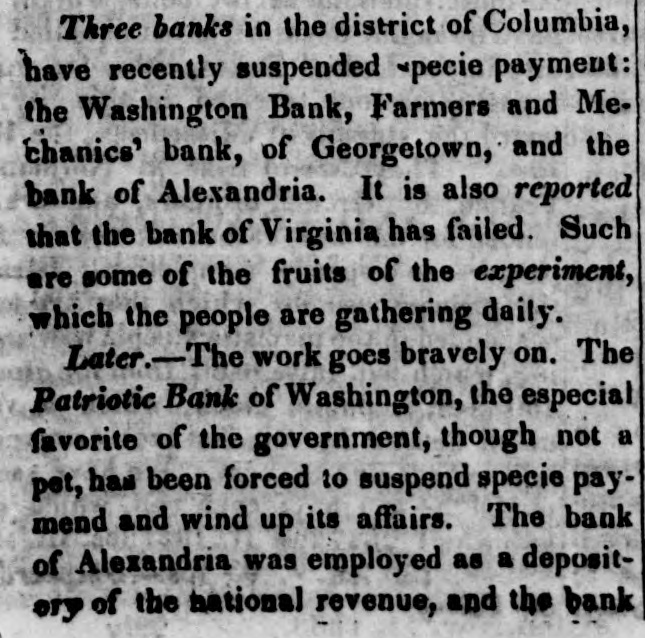
Three banks in the district of Columbia, have recently suspended <pecie payment: the Washington Bank, Farmers and Mechanics' bank, of Georgetown, and the bank of Alexandria. It is also reported that the bank of Virginia has failed. Such are some of the fruits of the experiment, which the people are gathering daily. Later.-The work goes bravely on. The Patriotic Bank of Washington, the especial favorite of the government, though not a pet, has been forced to suspend specie paymend and wind up its affairs. The bank of Alexandria was employed as a depository of the national revenue, and the bank


Article from Evening Star, October 24, 1890

Click image to open full size in new tab

Article Text

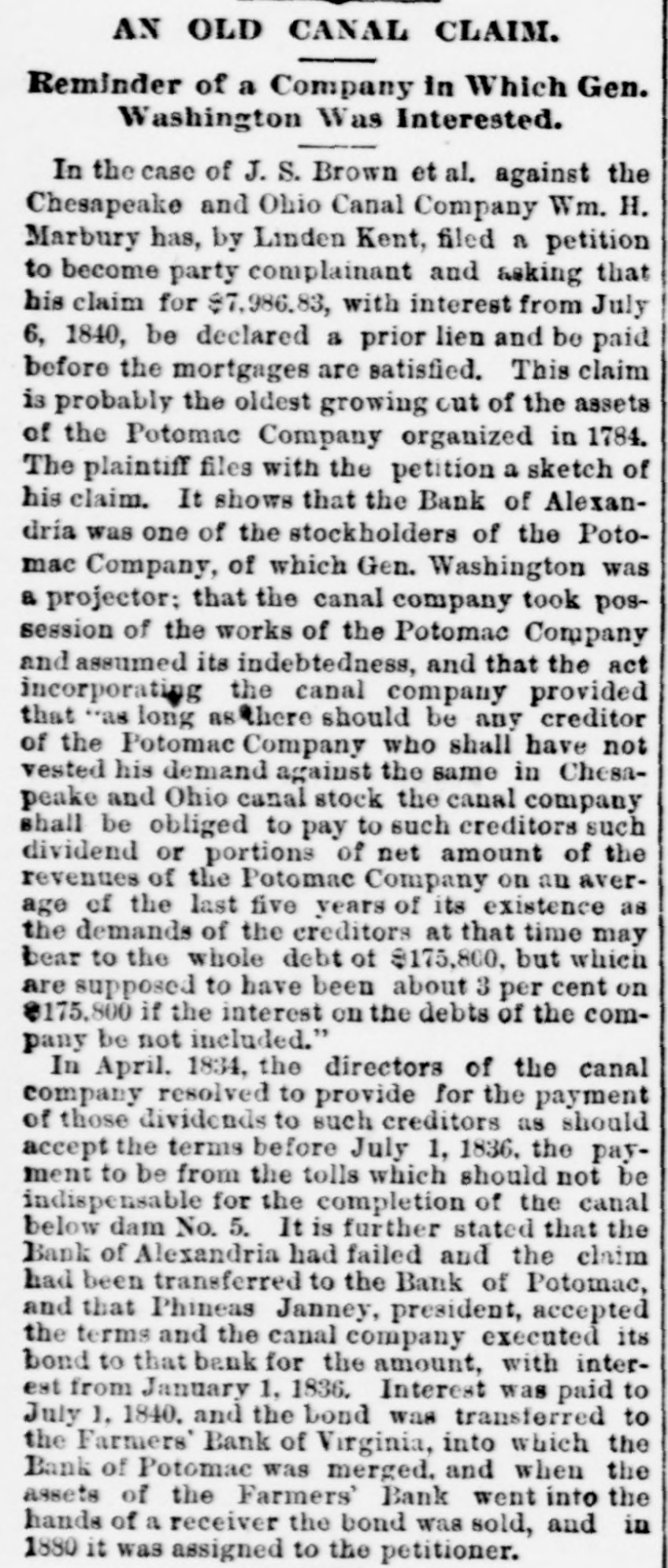
# AN OLD CANAL CLAIM. Reminder of a Company in Which Gen. Washington Was Interested. In the case of J. S. Brown et al. against the Chesapeake and Ohio Canal Company Wm. H. Marbury has, by Linden Kent, filed a petition to become party complainant and asking that his claim for $7,986.83, with interest from July 6, 1840, be declared a prior lien and be paid before the mortgages are satisfied. This claim is probably the oldest growing out of the assets of the Potomac Company organized in 1784. The plaintiff files with the petition a sketch of his claim. It shows that the Bank of Alexandria was one of the stockholders of the Potomac Company, of which Gen. Washington was a projector; that the canal company took possession of the works of the Potomac Company and assumed its indebtedness, and that the act incorporating the canal company provided that "as long as there should be any creditor of the Potomac Company who shall have not vested his demand against the same in Chesapeake and Ohio canal stock the canal company shall be obliged to pay to such creditors such dividend or portions of net amount of the revenues of the Potomac Company on an average of the last five years of its existence as the demands of the creditors at that time may bear to the whole debt of $175,800, but which are supposed to have been about 3 per cent on $175,800 if the interest on the debts of the company be not included." In April, 1834, the directors of the canal company resolved to provide for the payment of those dividends to such creditors as should accept the terms before July 1, 1836, the payment to be from the tolls which should not be indispensable for the completion of the canal below dam No. 5. It is further stated that the Bank of Alexandria had failed and the claim had been transferred to the Bank of Potomac, and that Phineas Janney, president, accepted the terms and the canal company executed its bond to that bank for the amount, with interest from January 1, 1836. Interest was paid to July 1, 1840, and the bond was transferred to the Farmers' Bank of Virginia, into which the Bank of Potomac was merged, and when the assets of the Farmers' Bank went into the hands of a receiver the bond was sold, and in 1880 it was assigned to the petitioner.