Click image to open full size in new tab
Article Text
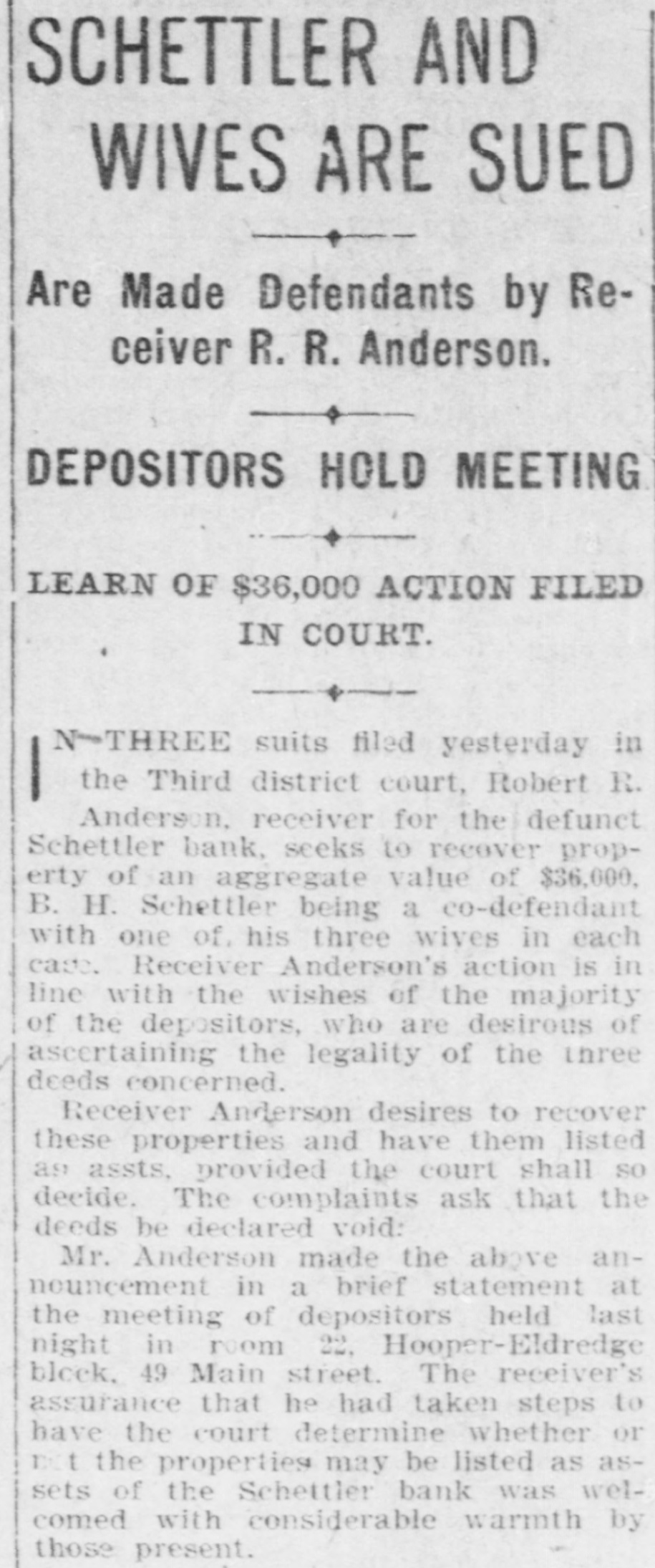
# SCHETTLER AND
# WIVES ARE SUED
Are Made Defendants by Receiver R. R. Anderson.
# DEPOSITORS HOLD MEETING
LEARN OF $36,000 ACTION FILED
IN COURT.
IN-THREE suits filed yesterday in the Third district court, Robert R. Anderson, receiver for the defunct Schettler bank, seeks to recover property of an aggregate value of $36,000, B. H. Schettler being a co-defendant with one of his three wives in each case. Receiver Anderson's action is in line with the wishes of the majority of the depositors, who are desirous of ascertaining the legality of the three deeds concerned.
Receiver Anderson desires to recover these properties and have them listed as assts, provided the court shall so decide. The complaints ask that the deeds be declared void:
Mr. Anderson made the above announcement in a brief statement at the meeting of depositors held last night in room 22, Hooper-Eldredge block, 49 Main street. The receiver's assurance that he had taken steps to have the court determine whether or not the properties may be listed as assets of the Schettier bank was welcomed with considerable warmth by those present.
Over Fifty at Meeting.
The meeting of creditors was called to order shortly after 8 o'clock by Chairman Andrew Grundfor. J. F. O'Brien acted as secretary. Mr. Grundfor made a quarter of an hour address to the fifty or more depositors present in which he outlined a series of questions which he, as a depositor, wanted to have investigated and answered.
"I want to know the cause of failure, something more and beyond the fact that it was the result of continued insolvency," declared the speaker.
"I also want to find out all I can about the assets of the bank. So far as I have seen, these figures have been furnished to the public only by The Herald. The proper course to be pursued in order to wind up the affairs of the bank is not just clear to me. We are not here, of course, in a spirit of revenge. We are simply here to get all we can on the dollar. What about the daily expenses? It seems to me that it might be wise to have some of these matters looked after more carefully.
"The question as to the extent to which the state officials are to blame is one of interest to us. There seems to have been grave errors in the administering of the law as regards to the Schettler bank."
# Lawyer Makes a Talk.
Chairman Grundfor was followed by Attorney G. W. Moyer, representing a number of depositors. Mr. Moyer said, in part:
"I am satisfied that there are sufficient assets existing, if they are only looked up, to pay off every depositor dollar for dollar. Not only this, but the assets would be sufficient to satisfy all incidental expenses.
"I want to say right here that in any statements I have made in regards to property being concealed which might be listed as assets, I have in no way sought to reflect upon Receiver Anderson. I have known Mr. Anderson many years and believe he will discharge his duties with ability and regard to the best interests of the creditors.
"However, I do say that Schettier has been dishonest in the conduct of his private bank. In The Herald of this morning he practically admits, he does admit, that he has been liable to the penal code for months past. As evidence of his dishonesty there is the deeding of his Brigham street property last May over to his wife. Another evidence of his dishonesty he took money from trusting depositors up until almost the last day."
Attorney Moyer was here interrupted by shouts of "He took mine" and "He got' this man's money" and similar expressions.
Mrs. Tillie Sutherland related that Schettler had taken as a non-interest-hearing deposit $580 on Oct. 13, six days before the bank suspended business. Others told of having placed various sums in the bank prior to ten days of Oct. 19, when the bank was closed.
Continuing, Mr. Moyer advised against tedious and expensive litigation. He urged the depositors to ferret out and get hold of all the legal assets, and then convert these into cash.
"Things ought to be wound up in six months," he said. "Don't let Schettler name the day. He's had his day."
"And we've got to have ours," came a voice.
# Kinney Charges Felony.
Attorney C. S. Kinney, representing other depositors, spoke briefly. He objected to permitting Banker Schettler the run of the receiver's office where he was enabled to look over the different books and papers. Mr. Kinney told of visits to the office when he would find Schettler alone, "fingering over papers and stock and bank books to which by right he had no access."
"If I had my way," continued the speaker. "I'd take Mr. Schettler by the nape of the neck and the trousers and lift him out of the office door. While we can't get him out this way, there is a way. Under section 4,412, revised statutes of Utah, Schettler is undoubtedly guilty of a felony. The penalty for his offense would be imprisonment in the state penitentiary for a period of not to exceed five years."
The section referred to by Attorney Kinney is as follows:
"Every officer, agent, teller, or clerk of any bank, and every individual banker, or agent, teller or clerk of any individual banker, who receives any deposits, knowing that such bank or banker is insolvent, is guilty of a felony."
The section comes under the caption of "Agent of insolvent bank receiving deposits."
The question of the propriety of permitting Schettler an opportunity of looking over the institution's books was discussed at length by several of those present. At this juncture, some one suggested to the chair that "as Receiver Anderson is here, why not let him tell us something of the bank's affairs?"
The announcement that Mr. Anderson was in attendance created considerable interest, as few had observed him come in. He was called upon by the chair to address the meeting, but his son explained, felt that he should decline owing to the position which he held through court appointment-representative alike of the depositors and of Schettler. Chairman Grundfor explained that the meeting was an en-
(Continued on Page 2.)