21343. Utah Banking Company (Lehi, UT)

Bank Information

Episode Type
Run → Suspension → Closure
Bank Type
state
Start Date
January 24, 1911
Location
Lehi, Utah (40.392, -111.851)

Metadata

Model
gpt-5-mini
Short Digest
e475efbd

Response Measures

Capital injected, Full suspension, Books examined

Other: Directors voted a 60% stock assessment and outsiders agreed to advance funds; receiver appointed and assets being sold.

Description

Heavy withdrawals and rumors produced a run in January 1911; banks at Lehi and American Fork suspended Jan 24, 1911 and were placed in receivership and wound up. Underlying problem: long-term loans made the banks illiquid. Classified as run→suspension→closure because a receiver was appointed and the banks did not resume normal operations.

Events (3)

1. January 24, 1911 Run
Cause
Rumor Or Misinformation
Cause Details
Rumors three weeks earlier that banks were in bad shape, leading depositors to withdraw funds; underlying illiquidity from long-term loans exacerbated withdrawals.
Measures
Directors voted a 60% assessment on stockholders and sought outside advances to meet demands.
Newspaper Excerpt
there was quite a run on the institutions in the last several days.
Source
newspapers
2. January 24, 1911 Suspension
Cause
Bank Specific Adverse Info
Cause Details
Inability to realize on long-term loans and other assets quickly enough to meet heavy withdrawals.
Newspaper Excerpt
the suspension of the Utah Banking company's banks at American Fork and Lehi... Inability to realize on their assets rapidly enough to meet heavy withdrawals of cash on the part of depositors is given today as the principal reason for the suspension
Source
newspapers
3. February 8, 1911 Receivership
Newspaper Excerpt
Charles C. Friel, receiver for the Utah Banking company of Lehi, has filed his report... the company's bank at Lehi and the branch at American Fork recently closed their doors.
Source
newspapers

Newspaper Articles (11)

Article from The Seattle Star, January 24, 1911

Click image to open full size in new tab

Article Text

BANKS SUSPEND (By United Press.) SALT LAKE, Utah, Jan. 24.-In: bility to realize on their assets rapIdly enough to meet heavy withdrawals of cash on the part of depositors is given today as the principal reason for the suspension of the Utah Banking company's banks at American Fork and Lehi, Utah.


Article from The Salt Lake Tribune, January 24, 1911

Click image to open full size in new tab

Article Text

Utah Banking Company's Institutions at Lehi and American Fork Close Doors. DIRECTORS PREDICT EARLY RESUMPTION OF BUSINESS Heavy Demands and Inability to Realize Promptly on Assets Given as Cause. Two Utah county banks suspended operations Monday morning. They were the bank of the Utah Banking company at Lehi and the company's branch at American Fork. Both institutions are now in the hands of State Bank Examiner C. Albert Glazier, pending the appointment of a receiver. According to a statement issued Monday by Secretary of State Tingey. the failures were caused by heavy demands made upon the bank, a steady withdrawal to of deposits, which It was unable meet, and inability to realize promptly on its notes and other assets. The statement adds that the depositors will, without doubt, be paid in full, and that, in all probability, the banks will be permitted to resume business in the near future. To Make Heavy Assessment. The bank directors met at Lehi Monday evening and after going over the situation announced that both institutions undoubtedly will be reopened within sixty days. A majority of the stock was represented at the meeting. and it was decided to make an assessment to meet some of the biggest and most insistent demands. The assessment will amount to 60 per cent of all holdings and this will be paid in immediately. This. the directors say. will raise about $25,000. The directors announce that outsiders have agreed to advance them enough money. when the assessment is paid in. to carry both institutions through in good shape. The Utah Banking company apparently was doing a prosperous business Ira D. Wines of this city is president: Thomas Webb and J. H. Storrs are the vice presidents. and among other stockholders are A. J. Evans, William Thornton, John Y. Smith, George Webb and James H. Clark Mr. Wines Is in Lehi in consultation with other officials. C. C. Friel was cashier of the bank at Lehi. and James H. Clark was cashier of the American Fork branch. Last Statement. The last sworn statement made to the secretary of state shows the condition of the banks at the close of business November 21, 1910, to have been as follows: Resources-Loans and discounts, $329.495.85: overdrafts. $3788.37; bonds, stocks. certificates, etc., $32.045; furniture and fixtures. $11,500. due from national banks. $28,339.46; due from state banks and bankers, $58,667.66: cash on hand, $11,285.14; current expenses and taxes paid, $4492.15: Utah Banking company. $19.81: total, $479,633.44. Liabilities-Capital stock paid in. $50,000: surplus fund, $25,000; undivided profits, $2036.18; due to national banks. $18,781.16; dividends unpaid, $27: individual deposits, $182,948.27; savings department. interest at 4 per cent, $55.623.74: cashier's checks, $5268.47; time certificates of deposit, $139,948.62; total, $479,633.44. Long-Time Loans Blamed. The trouble. according to information from those intimately associated with the company's business, has been of rather long standing, and is due primarily to several long-time loans made prior to the time the management was taken over by Cashier Friel. The loans are secured, It is understood, by good farm properties, but they run for from two to six years, which made it Impossible for the bank to realize on them in time of need. Three weeks ago it was rumored that the banks were in bad shape, and two or three depositors who knew of this whispered the information to a few of their friends, with the result that there was quite a run on the institutions in the last several days. Officials of the company came to this city Sunday and discussed the situation with local bankers. The local men expressed a willingness to help the instttutions if it could be shown that a fair
Article from The Tacoma Times, January 25, 1911

Click image to open full size in new tab

Article Text

SALT LAKE CITY, Jan, 25.Inability to realize on their assets rapidly enough to meet heavy withdrawals of cash on the part of depositors is given today as the principal reason for the suspension of the Utah Banking company's banks at American Fork and Lehi.


Article from Rogue River Courier, January 27, 1911

Click image to open full size in new tab

Article Text

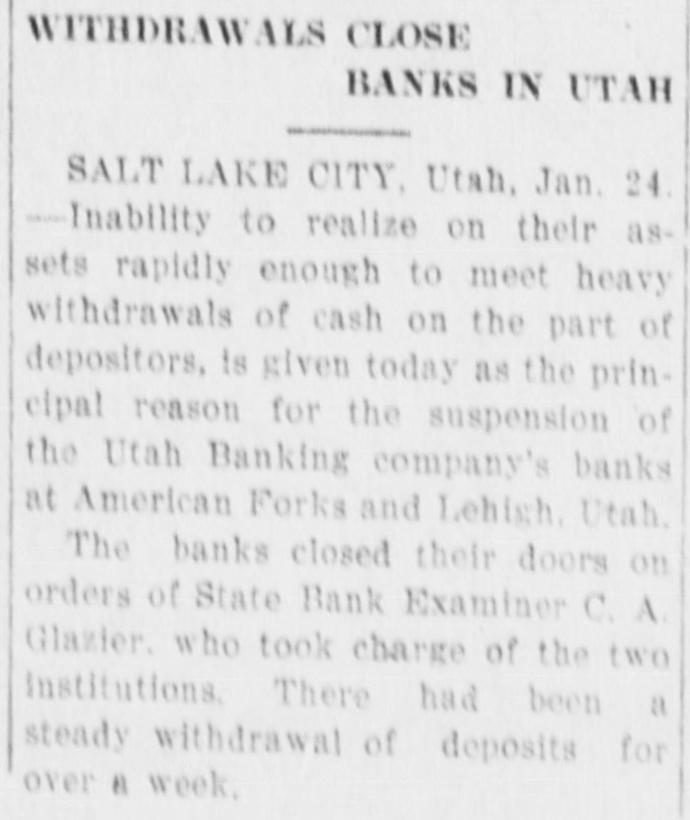
WITHDRAWALS CLOSE BANKS IN UTAH SALT LAKE CITY, Utah, Jan. 24. -Inability to realize on their assets rapidly enough to meet heavy withdrawals of cash on the part of depositors, is given today as the principal reason for the suspension of the Utah Banking company's banks at American Forks and Lehigh. Utah. The banks closed their doors on orders of State Bank Examiner C. A. Glazier. who took charge of the two institutions. There had been a steady withdrawal of deposits for over 8 week.


Article from The Alaska Citizen, January 30, 1911

Click image to open full size in new tab

Article Text

Utah Banks Suspend. SALT LAKE, Jan. 25. - The Utah Banking company, operating banks at Lehi and American Fork, suspended today because of the heavy withdrawals by depositors.


Article from The Salt Lake Tribune, February 9, 1911

Click image to open full size in new tab

Article Text

RECEIVER REPORTS ON FAILED BANKS Shows Where Assets of Company Have Been Found; $314,000 in Bills Receivable. Special to The Tribune. PROVO, Feb. 8.-Charles C. Friel, receiver for the Utah Banking company of Lehi, has filled his report of the condition of the company at the close of business January 21, 1911. in the district court here. The company's bank at Lehi and the branch at American Fork recently closed their doors. Following a the liabilities.


Article from The Salt Lake Tribune, March 5, 1911

Click image to open full size in new tab

Article Text

# Receiver Given Power to Sell. Special to The Tribune. PROVO, March 4.-Judge Booth made an order in the fourth district court today authorizing the receiver, Charles C. Friel, of the Utah Banking company of Lehi and American Fork to sell all or any portion of 1610 shares of the capital stock of the Price River Irrigation company at not less than $22.50 a share, and to redeem the stock of the Abraham Irrigation company at a price not to exceed $1 a share, and also to sell the notes of the Price River Irrigation company and the security held thereon at a discount not to exceed 15 per cent of the face value. The receiver's expense account to March 1, amounting to $1961.70, was approved by the court. The principal items in the expense account are: Bond of receiver, $1250; attorney fees, $250; stenographers and clerk, $100; receiver's salary $200.


Article from The Salt Lake Tribune, March 15, 1911

Click image to open full size in new tab

Article Text

INQUIRES INTO BOARD METHODS Senate Holds Up Governor's Appointments of State Land Commissioners. HEAR TESTIMONY OF LEHI BANKER CONCERNING CHECK Main Opposition Appears to Be to Confirmation of W.D. Candland. For two hours Tuesday afternoon the of the senate in executive sesthe of the present state of sion members governor discussed reappointment close board by of the land commissioners. At the the executive session Tuesday afternoon the senate had not acted on the appointments and they will be considered in executive session again this morning at 9:30 o'clock While none of the members of the selate would say anything with reference to the matters under discussion in executive session, it was patent that the discussion was with reference to the reappointment of the members of the land board. Before the executive session was begun Senator Benner X. Smith, who has been conducting a quiet probe into the affairs of the state land board. procured a number of books and documents bearing on the transactions of the land board. Friel a Witness. Later C. C. Friel, receiver for the Utah Banking company, owner of the banks at Lehl and American Fork which were re. cently closed by order of the state bank examiner, appeared before the senate in executive session. Over the long distance telephone Mr. Friel from his home in Lehi said that his testimony before the senate in executive session was of a confidential nature and that he did not care to divulge it. However, Mr. Friel admitted that it was concerning a loan made by the state land board to the Irrigated Lands com pany amounting to $100,000 on the Price river irrigation project. The loan. it is understood, was conditional and all checks against the $100,000 were to be signed by the secretary and treasurer of the Irrigated Lands company and by a member of the state land board. One check against this fund was brought to Salt Lake and exhibited to the senate by Mr Friel. It was for $75,000. The check was signed by W D. Livingston, secretary and treasurer of the Irrigated Lands company. and countersigned by W. D. Candland. president of the state board of land commissioners. It bore the date of July 21. 1908. Needs Explanation. Mr Friel said that the check was regularly drawn and payments were regularly made. Furthermore, he said that the mere statement that such a check was issued would appear misleading without an explanation that he thought should accompany the statement However, he said he was not in a position to make such an explanation. because he regarded that which transpired in the executive session of the senate as confidential He volunteered the statement that his testimony before the senate was not of a sensational nature. From the remarks dropped by the members of the senate it was evident that the inquiry into the transactions of the state land board was not concluded when the senate "sauntered" at o'clock Tuesday evening. It will probably be con tinued this morning. The senate expects to go into executive session at 9:30 o'clock this morning and to continue in executive session until it has agreed on the confirmation or rejection of the appointees. Fight on Candland. While the principal fight in the senate appears to be on the confirmation of the reappointment of Candland. the confirmation of all of the appointees to the state land board is being deferred until the inquiry IS concluded. The members of this board. all .reappointed by Governor Spry are W. D. Candland, president: W. J. Lynch, secretary M. M. Steele, W. H Thain and A.G. Giauque. Two years ago the senate refused to confirm the appointments of Candland and Thain. Immediately after the adjournment of the state legislature both were named as recess appointees by Governor Spry and they are at present members of the board Early in the present session Senator Benner X. Smith gave an indication of an intended inquiry into the methods employed by the state land board through the introduction of a resolution asking for information relative to the leasing of certain grazing land east of Mt. Pleasant And also relative to the loans. if any, which had been made to members of the state land board or to corporations in which they were stockholders. Within the Law. Secretary Lynch of the state land board in response to the resolution submitted a report covering the matters contained in the resolution. The report showed that the land concerning which informa tion was sought had been leased by the state land board to W. D. Candland for grazing purposes It had been leased to him prior to the time of the passage of the law prohibiting the leasing of lands of the state to members of the state land board. and although the lease had been renewed since the passage of the Continued on Page Seven


Article from The Salt Lake Tribune, July 13, 1911

Click image to open full size in new tab

Article Text

Committee of Depositors Returns Seathing Report at Meeting With Receiver. BREAKING LAWS CAUSED FAILURES, SAYS REPORT Judge Booth and Receiver Point Way for Payment of Claims in Two Years. Special to The Tribune. LEHI, July 12.-The depositors of the Utah Banking company, whose banks at American Fork and Lehi were closed by the secretary of state last December, held their first regular meeting at Lehi last night. Several hundred were present from the half dozen towns in the north end of Utah county and they all wanted their money Judge J. E. Booth. who is directing the receiver and attorney in closing up the banks' affairs, had called the meeting and was present, as were Receiver C. C. Friel and Attorney Jacob Evans. his advisor. These officials explained the progress made in untangling the affairs of the banks and expressed an opinion that the depositors would get their money in about two years more. An explanation was made showing why this delay would be necessary. About $156,000 of the "cream" of the company's notes and securities had been hypothecated to secure $96,000. which the bank had in turn loaned out again. A small part of these preferred creditors have 8 been paid. but most of their paper past due and can be closed in on at any time. The receiver is trying to make peace with them and his policy is to satisfy them at the earliest possible date and get their "glit-edged" security back in the bank again. He hopes to have these secured claims all paid off by the end of 1911 and then will begin paying dividends to the depositors. Long Time Notes Cause Trouble. The banks' trouble was caused by a lot of long time notes running from four to eight years. These provided for annual payments and interest. As these became due and were paid they became more "gilt-edged' and the receiver hopes in two years to be able to sell them for enough In addition to the other notes and secure the necessary money to satisfy the depositors in full. This method. the attorney stated. would satisfy every claim of the depositors, but would probably leave nothing for the stockholders. Judge Booth and Attorney Evans then left for their train, accompanied by Receiver Friel. after which the depositors organized by electing Alma Greenwood chairman and Eli J. Clayson secretary, and the fireworks commenced. A few depositors had previously met and elected Alma Greenwood R. L. Bolith and J. P. Aydelotte a committee to find out what caused the banks to go under and to learn If there was not a more speedy way of getting their money than that being pursued by the receiver. Committee's Report. The committee's report was a warm document. It stated that the officials of the banks had broken the law repeatedly in making loans and allowing overdrafts. At one time one company had an overdraft of $170,000 and when this was wiped out it was by questionable notes with unlawful indorsements. The report declared that the banks had made purchases of hundreds of thousands of dollars worth of notes in the hope of a deal going through which would net the banks a profit of about $100,000. but the slump in the money market came and with it the closing of the banks. The committee wanted the depositors to employ an attorney and compel an early settlement, which would probably mean the wiping out of any possibility that the stockholders would receive anything from the wreck. but would probably mean a levy upon them of an extra $50.000. But a more conservative course was taken by the adoption of a resolution telling the judge and the receiver that the depositors desired that the funds on hand now and those to be collected be used to pay off the secured debtors at the earllest possible date.


Article from The Salt Lake Tribune, October 19, 1911

Click image to open full size in new tab

Article Text

CLAIM TO BE SATISFIED. Order of Court in Case in Which the State Is Interested. Special to The Tribune PROVO, Oct. 18.-In the case of the state of Utah, by Charles S. Tingey, secretary of state, ys. Utah Banking company, a corporation. Judge Booth made the following order today in the Fourth district court: "In the matter of the sale of the Price River Irrigation company stock. which is held as security on the note signed by William D. Livingston in favor of the Utah Banking company, this court makes the following order, to wit: "To Charles C. Friel, Receiver of the Utah Banking Company, Lehi, Utah: "You are hereby directed to permit William D. Livingston to sell any or all of the Price River Irrigation company stock which you hold as partial security on the said Livingston's note in favor of the Utah Banking company. upon the following terms, to wit: "Not less than one-fourth of the sale price to be paid to you in money to be applied at part payment on the note of said William D. Livingston. "The bilance of said sale price, if any, may be made in three notes of equal amounts, to become due in periods of one, two and three years from date of said notes. bearing interest at the rate of 6 per cent per annum. Said notes to be made in favor of the said Willima D. Livingsten and indorsed by him to the Utah Banking company, with recourse. and to be held by you as additional security on the note of the said Livingston. The said notes to be secured by the whole amount of water stock sold to each person and to have a pledge attached to them giving the owner of the note nover to sell the said notes in case of default in the payment of said note or notes when due. "J. E. BOOTH, Judge."


Article from The Salt Lake Tribune, February 15, 1912

Click image to open full size in new tab

Article Text

Bound Over on Fraud Charge. Special to The Tribune. PROVO. Feb. 14.-Henry E. Giles was today given a preliminary hearing before Justice of the Peace E. L. Jones on a charge of obtaining money under false pretenses. Giles is accused of cashing two notes given by F. W. Newman and James Oler, payable to the Baldwin Plano company. at the Utah Banking company's bank at Lehi, before that institution went into the hands of a receiver. Giles was bound over to the district court, and released on $1000 ball.