21336. Bank of Garland (Garland, UT)

Bank Information

Episode Type
Suspension → Closure
Bank Type
state
Start Date
January 1, 1927*
Location
Garland, Utah (41.741, -112.162)

Metadata

Model
gpt-5-mini
Short Digest
c8ea893f

Response Measures

None

Description

Articles state the Bank of Garland suspended operations in January 1927 and was taken over by the state bank commissioner (receiver). Later litigation over pledged securities followed, including a receiver (Seth Pixton). No newspaper account describes a depositor run or a reopening; the bank is described as defunct. Therefore this is a suspension followed by permanent closure/receivership.

Events (2)

1. January 1, 1927* Receivership
Newspaper Excerpt
Ruling adverse to Seth Pixton, state bank commissioner. was made Wednesday by Judge Melvin C Harris ... in the case of Mr. Pixton as receiver for the defunct Bank of Garland ... Mr. Pixton announced upon his return to Salt Lake that an appeal ... would be taken to the state supreme court (Dec. 1, 1927).
Source
newspapers
2. January 1, 1927* Suspension
Cause
Bank Specific Adverse Info
Cause Details
Bank suspended operations and was taken over by the state bank commissioner (indicative of insolvency/financial failure).
Newspaper Excerpt
In January, 1927, the bank suspended operations and was taken over by the state bank commissioner.
Source
newspapers

Newspaper Articles (3)

Article from The Journal, December 1, 1927

Click image to open full size in new tab

Article Text

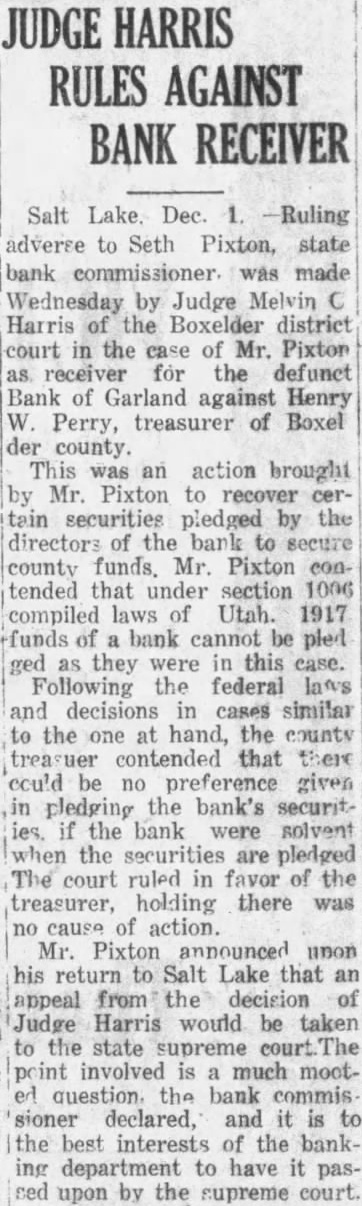
JUDGE HARRIS RULES AGAINST BANK RECEIVER Salt Lake. Dec. 1. Ruling adverse to Seth Pixton, state bank commissioner. was made Wednesday by Judge Melvin C Harris of the Boxelder district court in the case of Mr. Pixton as receiver for the defunct Bank of Garland against Henry W. Perry, treasurer of Boxel der county. This was an action brought by Mr. Pixton to recover certain securities pledged by the directors of the bank to secure county funds. Mr. Pixton contended that under section 1006 compiled laws of Utah. 1917 funds of a bank cannot be pled ged as they were in this case. Following the federal laws and decisions in cases similar to the one at hand, the county treasuer contended that there could be no preference given in pledging the bank's securit. ies. if the bank were solvent when the securities are pledged The court ruled in favor of the treasurer, holding there was no cause of action. Mr. Pixton announced unon his return to Salt Lake that an appeal from the decision of Judge Harris would be taken to the state supreme court The point involved is a much mooted question. the bank commis sioner declared, and it is to the best interests of the banking department to have it passed upon by the supreme court.
Article from The Salt Lake Tribune, June 30, 1928

Click image to open full size in new tab

Article Text

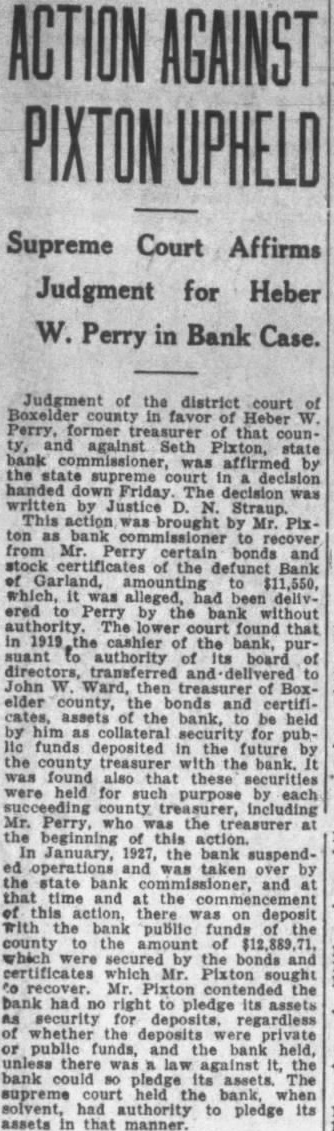
ACTION AGAINST PIXTON Supreme Court Affirms Judgment for Heber W. Perry in Bank Case. Boxelder Judgment of the district court county in favor of Heber Perry. former treasurer of that county, and against Seth Pixton, commissioner, affirmed by the state supreme court handed down Friday The decision was by Justice D. This action was brought by Mr. ton as bank commissioner to recover from Mr. Perry bonds and stock certificates of the defunct Bank Garland, to which, was alleged, had been to by the bank authority. The lower court cashier of the suant to authority board directors, transferred and delivered then treasurer of Boxelder county, the bonds and certificates, assets of the bank, to be him as collateral security for pub. funds deposited future county treasurer with the also that these securities held for such ucceeding county treasurer, including who treasurer at the beginning In January, 1927, bank suspendtaken over time and the this there with the public funds of the the of secured by the bonds and which Mr. Pixton sought Mr. the bank no right to pledge its assets for the deposits were private public funds, and the bank held, unless there was against court the bank, when solvent, had authority to pledge its in that manner.


Article from The Box Elder News, July 3, 1928

Click image to open full size in new tab

Article Text

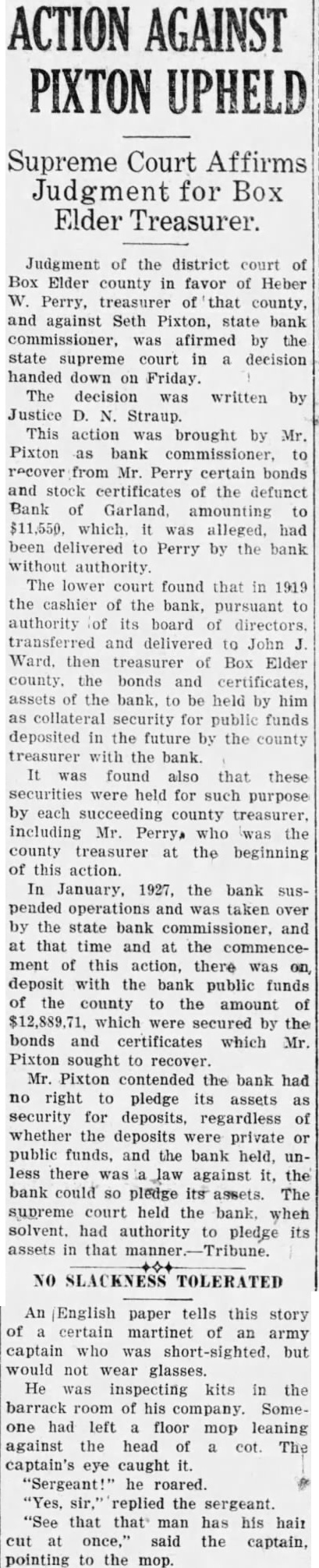
ACTION AGAINST PIXTON UPHELD Supreme Court Affirms Judgment for Box Elder Treasurer. Judgment of the district court of Box Elder county in favor of Heber W. Perry, treasurer of that county, and against Seth Pixton, state bank commissioner, was afirmed by the state supreme court in a decision handed down on Friday. The decision was written by Justice D. N. Straup. This action was brought by Mr. Pixton as bank commissioner, to recover from Mr. Perry certain bonds and stock certificates of the defunct Bank of Garland, amounting to $11,550. which. it was alleged. had been delivered to Perry by the bank without authority. The lower court found that in 1919 the cashier of the bank, pursuant to authority of its board of directors. transferred and delivered to John J. Ward. then treasurer of Box Elder county. the bonds and certificates, assets of the bank, to be held by him as collateral security for public funds deposited in the future by the county treasurer with the bank. It was found also that these securities were held for such purpose by each succeeding county treasurer, including Mr. Perry, who was the county treasurer at the beginning of this action. In January, 1927, the bank suspended operations and was taken over by the state bank commissioner. and at that time and at the commencement of this action, there was on deposit with the bank public funds of the county to the amount of $12,889,71. which were secured by the bonds and certificates which Mr. Pixton sought to recover. Mr. Pixton contended the bank had no right to pledge its assets as security for deposits, regardless of whether the deposits were private or public funds, and the bank held, unless there was a law against it, the bank could so pledge its assets. The supreme court held the bank. when solvent. had authority to pledge its assets in that manner-Tribune. NO SLACKNESS TOLERATED An English paper tells this story of a certain martinet of an army captain who was short-sighted. but would not wear glasses. He was inspecting kits in the barrack room of his company. Someone had left a floor mop leaning against the head of a cot. The captain's eye caught it. "Sergeant!" he roared. "Yes, sir." replied the sergeant. "See that that man has his hair cut at once," said the captain, pointing to the mop.