2129. Perpetual Building Association (Washington, DC)

Bank Information

Episode Type
Run Only
Bank Type
private
Start Date
February 4, 1931
Location
Washington, District of Columbia (38.895, -77.036)

Metadata

Model
gpt-5-mini
Short Digest
4c87f22e

Response Measures

Accommodated withdrawals, Borrowed from banks or large institutions, Public signal of financial health

Description

Multiple contemporaneous articles (Feb 5-6, 1931) describe a short-lived run started by false/malicious rumors. The institution did not suspend operations and returned to normal after other banks (and the Treasury) supplied cash and officials publicly displayed funds. I date the run to Feb 4, 1931 (articles report run 'started yesterday').

Events (1)

1. February 4, 1931 Run
Cause
Rumor Or Misinformation
Cause Details
Run instigated by malicious/anonymous false rumors (telephone calls and scare talk), blamed by some reports on 'communists'; unfounded reports of insolvency.
Measures
Other Washington banks supplied large amounts of cash (e.g., Riggs National supplied $500,000–$750,000), Treasury delivered $900,000 in currency; officials and bankers publicly displayed cash and reassured depositors; Secret Service and DOJ investigated; rewards offered for the rumor-monger.
Newspaper Excerpt
An unlimited amount of cash was placed at the disposal of the Perpetual Building Association by other Washington banks today as a run, started yesterday by false rumors, diminished.
Source
newspapers

Newspaper Articles (12)

Article from Evening Star, February 5, 1931

Click image to open full size in new tab

Article Text

An unlimited amount of cash was placed at the disposal of the Perpetual Building Association by other Washington banks today as a run, started yesterday by false rumors, diminished. The efforts of banking interests and business leaders to stabilize confidence in the building association obviously had a salutary effect overnight and a number of depositors who had hastened to withdraw their savings in the early hours of the excitement returned to reopen. accounts. The institution also reported the opening of a number of new accounts. Source of Reports Sought. In the meantime, Secret Service agents, at the direction of the office of the controller of the currency instituted a city-wide investigation to determine the source of the fake reports that weakened public confidence in one of Washington's largest and oldest financial institutions. Offers of rewards for information as to the perpetrator led investigators to believe that the person would soon be found. When the building association opened at 9 o'clock this morning, there were approximately 300 persons waiting in an orderly line, which ran out E street from Eleventh to Twelfth, and a short distance up Twelfth toward F street. A half hour later the line extended closer to F street, but diminished as the accounts of the depositors were closed out. In the line, however, were a number of persons who wanted to make deposits, and they were permitted to enter the building through a side entrance on E street. Throughout the day the depositors continued to file in and out of the Perpetual Building, but shortly after 2 o'clock the line had shortened materially in length, stretching from the front door of the building on Eleventh street near E to Twelfth and E streets. Despite the withdrawals, Edward C. Baltz, secretary of the institution, announced that up to 2 o'clock this afternoon 26 new accounts had been opened representing a total deposit of nearly $100,000. This was considerably in excess of a normal day's business. New accounts. he said, average 20 a day. One of the latest of the new accounts was opened by the Washington Savings Bank with a deposit of $10,000. The total amount of withdrawals. however. will not be tabulated until the institution closes its doors with evening. Some Decline to Withdraw. No attempt was made by officials of the building association to dissuade any depositors from withdrawing funds. and the clerks handed over the money as men and women. some of them with children, passed before the long marble counter and surrendered their pass books for redemption. Some of those who got into the building left, however, without withdrawing their deposits after conferring with officials and being given further reassurance that there is every reason why the association should command complete confidence. The association, it was pointed out, is permitting the wholesale withdrawals in the face of the banking laws which gives it the privilege of withholding payments for 30 days. Officials explained that when the bank opened business this morning it had on hand $1,750,000 in cash, $750,000 of which was brought in early this morning from the Riggs National Bank. This $750.(Continued on Page 2, Column 5.)
Article from The Marshall News Messenger, February 5, 1931

Click image to open full size in new tab

Article Text

Halt Run by Display of Bank Funds Washington, Feb. 4. ing to stem a run on the Perpetual Building Association here late to. day, President Robert Fleming of the Riggs National Bank shook in the faces of crowd in the lobby $500,000 in $100 and $1,000 bills. The building association officers had $1,800,000 in cash on hand and this was augmented with half million from the prominent Riggs bank. Other bank president joined the attempt to reassure the and John Poole of the Federal American, stood precariously on ledge outside the building and declared to the crowd of more than 1,000 in the street that the stitution was sound. The spectacular methods of the in lack of bank presidents allaying confidence were successful after several officials closing doors, after announcing all who their had tors sought deposits been paid. Fleming, througing down on table behind the bank's counter the half million in yelled the "Come and get it afraid where that there's plenty more came from. The association is $24,000,000 institution with approximately 000 clients. Poole brought from his bank other in currency to distributed. President Francis G. Addison of the Security Savings and Commer cial Bank, addressing the crowd said he had received information that Communist agitation was sponsible.


Article from The Herald-Press, February 5, 1931

Click image to open full size in new tab

Article Text

RUN ON WASHINGTON BANK IS STARTED OFF WITH HUSKY DEPOSIT WASHINGTON Feb 5 (UP) -A line of customers two and one half blocks long greeted officials of the Perpetual Building association, banking institution, against which run was started by rumors yesterday, when the bank opened today The first transaction, however, was a deposit of $2,153.96 by an electrical contractor. Business men were sending other deposits to demonstrate confidence in the institution which other bankers pronounced sound There was close to $2,000,000 in cash in the vaults when the doors opened, including three quarters of million sent this morning by the Riggs National bank. The Riggs bank had furnished half million dollars yesterday. Yesterday's withdrawals amounted to $800,000, bank officials


Article from The Times-Tribune, February 5, 1931

Click image to open full size in new tab

Article Text

COMMUNISTS ARE BLAMED FOR RUN ON CAPITAL BANK BUILDING AND LOAN INSTITU TION IN WASHINGTON SOUND BUT DEPOSITORS BELIEVE SCARE TALK. Washington Feb. Perpetual Building association doing business as usual today after rumors its solvency caused several hundred depositors to storm its paying windows with for their The association' directors and Washington newspapers offering total of in rewards for information revealing the tity of the person started the run by making anonymous tele phone calls depositors with warning You better draw your is going up. Communists today were being blamed for the false rumors. While excited and women clamored inside and outside of the building officials of other banks, after the of situation of association. tried to assure them that their fear was needless as the was able and willing to pay off all of them they wanted to cancel their accounts. Association Is Held Sound. The bankers won the confidence of the depositors exhibiting stacks of green gold bills and piles of silver currency. $1,800,000 all told Then Robert V. Fleming. president the Riggs National bank, stood upon desk and opened before the crowd. "There $500,000 in this satchel.' he told them as their eyes scanned the Fleming and other bankers them the association it had been the victim of malicious lies and asked them not to withdraw their money During the day $800,000 had been withdraw while $80,000 was deposited by the customers who were convinced the institution was solvent Francis G. Addison, Jr. president of the Savings and Combank. to the radio tell the bank was sound and he "there was little doubt that the run was caused by


Article from The Capital Journal, February 5, 1931

Click image to open full size in new tab

Article Text

RUN STARTS ON CAPITAL BANK Washington line customers and one half blocks greeted officials of the Perpetual Building association, banking sociation, against which run started rumors Wednesday, when the bank opened Thursday. The first however, deposit of by electrical men other deposits to demonstrate in the institution which other bankers pronounesound. There close to $2,000,000 cash in the vaults when the doors opened. including three quarters million sent Thursday morning the Riggs National bank. The Riggs bank had furnished half million dollars Wednesday. Wednesday's withdrawals amounted officials said. The line customers orderly. few policemen on guard. Tellers took care of withdrawals without question and the tellers were handling customers faster than the line was growing.


Article from Evening Star, February 6, 1931

Click image to open full size in new tab

Article Text

BANKERS APPOINT HOTEL COMMITTEE Additional Aids Named for Annual Convention of D. C. Association. Members of the Hotel Committee have been appointed by Frederick P. H. Siddons, general chairman of the 1931 Convention Committee of the District of Columbia Bankers' Association, it was announced today. In addition to Luther E. Schreiner, chairman, and J. T. Exnicios. vice chairman, previously announced, the members of the committee are as follows: J. D. Howard, president, Seventh Street Savings Bank; Louis C. Eckloff, assistant cashier, National Metropolitan Bank; H. G. Meem, vice president, Washington Loan & Trust Co.: F. Cuniberti, president, International Exchange Bank: W. R. Lewis, cashier, Northeast Savings Bank: Thomas P. Hickman, vice president. Franklin National Bank: R. L. Flather, assistant secretary, American Security & Trust Co., and R. L. Schreiner, president, Bank of Brightwood. Perpetual Shows Soundness. The end of the run on the Perpetual Building Association was a major topic of discussion in financial circles today, Expressions of gratification at the conclusion of the run were general. Success of the institution in withstanding the two-day withdrawals. backed up by the support of Washington banks, was said to have been a substantial factor in increasing public confidence. This confidence, bankers admitted, had been showing signs of nervousness since the recent failure of a big investment house here, and the acid test through which the old Perpetual passed during the past two days was said to have done more than anything else to restore confidence in the soundness of financial institutions of this city. There were many expressions of profound regret that such a situation should have developed, and that an institution with "100 per cent reputation" should have been subjected to such an experience. But now that it is over. as one banker expressed it, speaking generally for the good of the whole financial situation here in the city, "it couldn't have happened to a better one." Baltz's Statement. In a statement issued today, Edward C. Baltz, secretary, said his institution had returned to "normal." He expressed appreciation for the co-operation offered. for the confidence of the majority of the patrons, and explained that it was not necessary for the Perpetual to use the financial assistance tendered by the Washington banks. "We expect to participate. he said, "during the coming months in the gradual revival of business prosperity in this community, which we believe will soon become an assured fact." Capital Traction Income. An increase in net income of the Capital Traction Co. for December is shown in the monthly report filed yesterday with the Public Utilities Commission. December was the fifth month of operation under increased fare. December net income was $67.651.36, which was an increase of $411.69 over the same month in 1929. For 12 months, however. net income was $489.339.72, which is a decrease of $72,634.70 under 1929. Corporate stock and bond financing in January totaled $629,800,000, against $141,800,000 in December, $764,300,000 in January, 1930, and $1,218,800,000 in January, 1929, according to the Standard Statistics Co. of New York. The trend toward issuance of bonds instead of stocks is still pronounced, bonds accounting for $545,100,000 of the $629,800,000 total last month. During the last half of January the slight improvement evident in American trade after the turn of the year petered out. according to Business Week. The business index has been sagging for three weeks, and as the month closed it was slightly under the December low, at 76.8 per cent of normal, by preliminary figures, against 78.7 in the previous week and 94.1 per cent in the corresponding week last year. Commodity Price Drop. The January level averaged about the same as November, but a little above December January's upturn in pig iron output-first since last April-may be another sign that the low point was passed in December. But the recent slackening of the rate of improvement in steel, coal and power production, building, car loadings and check payments suggests how irregular, feeble and protracted recovery is likely to be when it is left merely to the "invisible hand" and like "natural" forces within business itself, without the support and stimulation of external factors brought to bear by intelligent, courageous and co-operative banking policies. Moreover. the steady downward drift of commodity price levels, the widening circle of debt repudiations or moratoria, the increasing political chaos and conflict precipitated by group resistance to deflation show that the mere postponement of recovery is not the worst danger in the blind acceptance of this process. Sooner or later it must be checked by deliberate effort


Article from The Washington Times, February 6, 1931

Click image to open full size in new tab

Article Text

BANK RUN ENDS; CAUSE BEING SOUGHT Edward C. Baltz Lauds Those Aiding in Crisis; Many Redeposit Funds With Company "We have returned to normal business conditions." This was the reassuring statement issued today by Edward C. Baltz. secretary-treasurer of the Perpetual Building Association, Eleventh and E Streets Northwest. For the last two days there had been heavy withdrawals due to malicious rumors, which were without foundation. Normalcy Has Returned In a statement lauding the aid of the press, Washington bank and business interests here for their aid in showing worried depositors that the institution is stable, Mr. Baltz said: "As a result of the unfaltering confidence of the large majority of our patrons in the essential and basic soundness of the Perpetual Building Association. coupled with the prompt and generous co-operation of the banks, the press, and business interests in Washington, today we can report that we have returned to normal business conditions. "This co-operation has been a source of constant inspiration to and all others connected with past me strenuous the association 48 hours during grateful we have the experienced. We are and concreciative. We want to thank all those who have helped. Uneasiness Is Allayed believe that the abnortwo mal past "We conditions days prevailing and the in quick the and effective return to normalcy have served not only to the public's conour to any fidence have strengthen served in institution, allay but uneasiness that may have prevailed in financial circles of this community. "It was not even necessary for the Perpetual to avail itself of the financial assistance so freely offered by the Washington banks through their clearing house association. We expect to participate, during the coming months, in the gradual revival of business prosperity in this community, which we believe will soon become an assured fact." Wait to Redeposit A number of persons were waiting early this morning before the doors of the institution opened to redeposit money taken out the day before. A number of new accunts also were opened by individuals and organizations convinced of the stability of the association. Chief among these new accounts was one for $1,000 opened by the Washington Board of Trade. Police yesterday afternoon, attempted to safeguard depositors from pick-pockets. They were successful except in one instance. A man, wishing to withdraw the money he had in the institution, reached into his pocket for his wallet with his passbook in it and discovered that some lightfingered person had stolen it. He then decided that his money would be saler in the institution than in his pocket. Run Being Probed Information, believed to establish identity of the person who started the "run" on the Perpetual Building Association, was turned over to Governmental agents, Mr. Baltz revealed last night. Since withdrawals of deposits started Wednesday morning, agents of the Department of Justice, members of the United States Secret Service, and Washington headquarters detectives have been trying to run down the source of the rumors. Rewards totaling $2,000 have been offered for the capture and conviction of the person or persons who started the vicious rumors concerning the institution.


Article from Evening Star, February 6, 1931

Click image to open full size in new tab

Article Text

"PERPETUAL" BACK TO NORMAL AS RUN BREAKS SUDDENLY Only 26 Persons in Line, 6 to Make Withdrawals, When Doors Open Today. $500,000 SENT TO AID RETURNED TO TREASURY Distribution of 100 Copies of Star by Depositor Credited With Large Part in Calming Fears. Conditions at the Perpetual Building Association returned to normalcy today following the short-lived run on the institution, instigated by false rumors, which ended late yesterday as abruptly as it started Wednesday afternoon. With public confidence apparently fully restored, the association resumed business this morning with the disturbing conditions that prevailed in the preceding 48 hours leaving only a memory of a new experience. Solid as it is, the institution withstood the sustained run without exhausting its own cash reserve. More than $1,000,000 in cash, placed at its disposal by other Washington banks, which united to support the association, remained in the vaults, ready to be returned. Many Make New Deposits. Instead of a line of worried depositors, the association found, on opening its doors at 9 o'clock this morning, 26 men and women waiting, only 6 to withdraw deposits. In the group, too. were some who had withdrawn their savings in the early excitement, and returned to redeposit it. Officials of the association were generous in their praise for the co-operation of Washington's banks. newspapers and business leaders, which did much to restore public confidence and put an end to the run. In a statement issued to the press, Edward C. Baltz, secretary, said: "As a result of the unfaltering confidence of the large majority of our patrons in the essential and basic soundness of the Perpetual Building Association, coupled with the prompt and generous co-operation of the banks, press and business interests of Washington, today we can report that we have returned to normal business conditions. "This co-operation has been a source of constant inspiration to me and all those connected with the association during the past strenuous 48 hours we have experienced. We are grateful and appreciative. We want to thank all who have helped. Uneasiness Is Allayed. "We believe that the abnormal conditions that prevailed during the last two days and the quick and effective return to normalcy have served not only to strengthen the public's confidence in our institution, but to allay any uneasiness that may have prevailed in financial circles in this community. "It was not even necessary for the Perpetual to avail itself of the financial assistance so freely offered by Washington banks through their clearing house association. We expect to participate during the coming months, in the gradual revival of business prosperity in this community which we believe will soon become an assured fact." Baltz made preparations this morning to return to the Treasury approximately $500,000 of the $900,000 in cash delivered to the association late yesterday to augment the cash reserve. The remaining $400,000, together with the institution's own cash reserve now on hand and deposits from Washington's banks, Baltz explained, will give it a cash reserve in excess of the $1,800,000 it had when the run started. Board of Trade Aids. At the head of the line when the Perpetual opened today was Mrs. M. L. Ridgeway of 912 Tenth street southeast, who said she wanted to inquire about the condition of her passbook. One man-Carl W. Johnson of 494 Fourth street-said he wanted to withdraw a small sum for three small children for whom he is the guardian. Johnson said five members of his family have accounts in the Perpetual and he wished he had more money to deposit. "I don't know of any place in which it would be safer," he said. Among the new depositors today were the Washington Board of Trade and Joseph P. Tumulty, secretary to the late President Wilson. The trade organization opened an account of $1,000. Tumulty also made a substantial deposit. George Plitt, president of the trade board, announced in opening the account, that his organization "regrets the most uncalled-for situation which arose through the spreading of false rumors regarding the Perpetual Building Association." Board is Confident. "The board from its surveys and from its contacts," he said, "has the utmost confidence in the soundness and stabil(Continued on Page 2, Column 5.)

Article from The Washington Times, February 6, 1931

Click image to open full size in new tab

Article Text

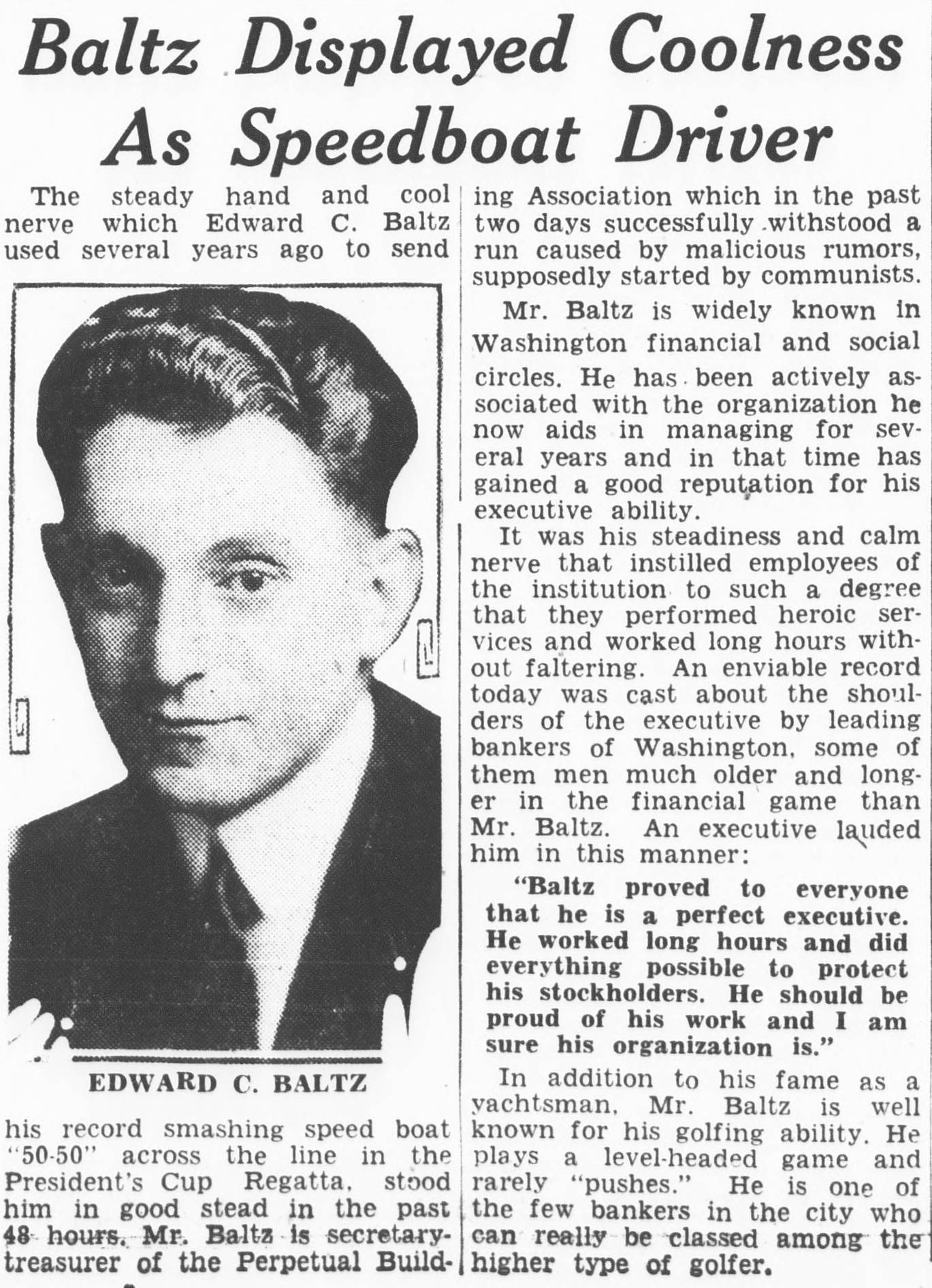
Baltz Displayed Coolness As Speedboat Driver The steady hand and cool ing Association which in the past nerve which Edward C. Baltz two days successfully withstood a used several years ago to send run caused by malicious rumors, supposedly started by communists. Mr. Baltz is widely known in Washington financial and social circles. He has been actively associated with the organization he now aids in managing for several years and in that time has gained a good reputation for his executive ability. It was his steadiness and calm nerve that instilled employees of the institution to such a degree that they performed heroic services and worked long hours without faltering. An enviable record today was cast about the shoulders of the executive by leading bankers of Washington, some of them men much older and longer in the financial game than Mr. Baltz. An executive lauded him in this manner: "Baltz proved to everyone that he is a perfect executive. He worked long hours and did everything possible to protect his stockholders. He should be proud of his work and I am sure his organization is." In addition to his fame as a EDWARD C. BALTZ yachtsman, Mr. Baltz is well his record smashing speed boat known for his golfing ability. He 50-50" across the line in the plays a level-headed game and President's Cup Regatta, stood rarely "pushes." He is one of him in good stead in the past the few bankers in the city who 48 hours. Mr. Baltz is secretarycan really be classed among the treasurer of the Perpetual Buildhigher type of golfer.


Article from Evening Star, February 6, 1931

Click image to open full size in new tab

Article Text

"PERPETUAL" " BACK TO NORMAL TODAY Congratulatory Flowers Bank Offices as Usual Business Is Carried On. (Continued From First Page.) ity of the financial institutions of the city, and urges all its members to suppress to the utmost all malicious and unfounded rumors, and to assist the authorities in every way possible to bring to light the source of any deliberate attempt to undermine the good name of Washington banks and financial institution. As an evidence of the organization's faith in the Perpetual Building Association we are depositing $1,000 today with that organization." Mr. Tumulty said he made his deposit "to give proof of my loyalty to and my high confidence in the management of this excellent institution." "Members of my family," he declared, "have been assosiated with it as depositors for years. They, like myself, have confidence in the fine integrity of those in charge. "This institution will grow and prosper more and more with the passing years. Its new prosperity will put to shame those who ran and deserted it when in a moment of passion they became the victims of cruel propaganda." Two Events Credited. Two events which Perpetual officials credit with aiding in breaking the run occurred yesterday afternoon-the ceremonious delivery of the $900,000 in currency by the Treasury and the action of George G. Webster, a retired electrical dealer, and depositor, in distributing more than 100 copies of The Evening Star to the worried depositors in line, pointing out that the directors of this paper had the unmost confidence in the soundness of the institution. Webster also pointed out the news story on the front page calling attention to the reassuring statements of the association's condition by Washington's financial and business leaders. Webster bought all the papers he could from the newsboys in the vicinity of the Perpetual Building, and then went to The Star office for an additional supply. The man's act was praised by Frank D. Addison, jr., president of the Security Savings & Commercial Bank, who had remained in the Perpetual Building throughout the day calming the fears of skeptical depositors. It was not long after Webster distributed the papers that the line in the vicinity of the Perpetual Building began to diminish perceptibly. And shortly afterward an armored Treasury Department truck, escorted by a motor cycle patrol and secret service men, arrived with the $900,000 in currency and delivered it to the association. This appeared to again reassure the worried and a number of others dropped out of the line. and when the association closed its doors, every depositor who wanted to withdraw had been paid in full. Lecturer Talks to Crowd. When the currency arrived, Mr. Baltz and Miss Janet Richards, Washington lecturer and a depositor at the institution, mounted the counter and pointed to the pile of crisp new bills, telling those inside the building that the money was there if they wanted it. Miss Richards also declared that the depositors would be "foolish" to take their money out of an institution as safe and sound as the Perpetual. "Where are you going to put it after you draw it out?" she asked. "In your stocking I suppose." She said she had $12,000 on deposit in the association and intended to leave it there. News of the Perpetual's return to normalcy spread throughout Washington today as quickly as did the false rumers on Wednesday, and hundreds of persons telephoned their congratulations to officials of the institution. A number of others said it with flowers, and the Perpetual Building was a myriad of roses, carnations and tulips. In addition, the District Building Council, through its Executive Committee, sent a message announcing that it had gone on record expressing "complete confidence" in the financial stability of the association and in the "ability and integrity of its officers and directors. The council is the representative body of all the 24 building and loan associations in the District, having a total capitalization of $65,000,000, all of which, with the exception of cash reserves, is invested in first trusts on dwellings in Washington. None of the funds are invested in notes or securities of other business enterprises. The search for the origin of the false rumor about the Perpetual was continued today by secret service agents, and headquarters detectives, but no definite lead has yet been developed. Inspec-


Article from The Daily Republican, February 20, 1931

Click image to open full size in new tab

Article Text

POLISH "CORRIDOR" DANGEROUS SPOT Miss Janet Richards, of Washington, Delivered Lecture as Benefit for Whitford Lodge Miss Janet Richards of Washing ton. D. C., gave the second of ies of three lectures for the benefit of Whitford Lodge. Tuesday evening at the New Century Club. West Chester. In her first lecture. Miss Richards discussed Home Affairs including the Wickersham Report and the Report of the Commission on Communism Last evening, she passed on to Europe and gave brief resume of each of the 13 Republics and 12 kingdoms there. and the relation of each to It's neighbors. The most dangerous spot in the world. she stated was the Polish corridor, that strip which cuts Germany in two and was given to Poland by the Versailles treaty Poland has developed sea ports here which are envied by Germany The radical party in the German Rek stag led by Hitler. is based on the old militaristic principles and is ing to get control of the government to stage revolution to get back the possessions taken from Germa ny at the close of the war. At the last election. the Hitlerites jumped to 107 members and have caused much disturbance on the floor of the Reich stag. Miss Richards praised the successful establishment of Republics in Czecho-Slovakia and Finland. The Finns had braved the red army of Russia and maintained their own independence in very heroic way Austria is being dominated by the party and is very poverty stricken. having been reduced from a population of 51 millions to millions. and is constantly petitioning the League of Nations to be allowed to join Germany. Greece and Turkey presented a very interesting situation. For the first time since the beginning of time. Greece has made a treaty with Turkey which is based on an exchange of commodities and promises to be lasting. Turkey has very ctern dictator who has forceably modernized the people much against their will. France, Miss Richards stated is letermined to be peaceful. Briand Las stated, "As long as am Prime Minister there will be no war." France has, however, made a defensive treaty with Poland and will be forced to war if Poland should be attacked by Germany. With brief review of Russia Miss Richards showed how the Soviet gov ernment is carrying on a five year campaign designed to undermine the markets of the world and spread red propaganda everywhere. Papers have been discovered in Washington which prove that the "red" plans are to cause runs on banks shake the public's confidence in established institutions She told a very graphic story of recent run on the Perpetual Building Association in Washington which 7as started by "maliclous rumors" of this kind With one million dollars in cash piled up on table behind the cashier ready to the depositors, Miss Richards has stood up on counter and addressed the anxious crowd. She had plained the malacious rumors to them and the run on the bank was stopped. The greatest menace the world at present, Miss Richards stated was the "malacious, diabolic system of Russia to undermine the capitalistic institutions of other countries Miss Richards closed her most interesting talk by promising to discuss Spain at the next lecture, Tuesday evening. February 24th at 8 m. at the New Century Club House.


Article from Casper Star-Tribune, February 24, 1931

Click image to open full size in new tab

Article Text

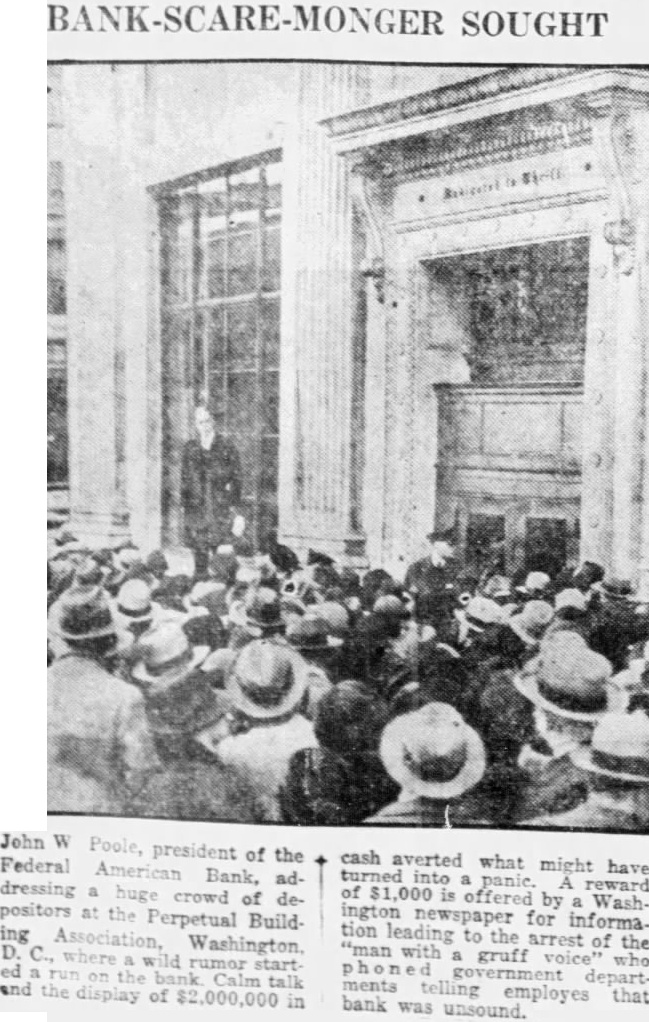
BANK-SCARE-MONGER SOUGHT John W Poole, president of the Federal American Bank, addressing a huge crowd of depositors at the Perpetual Building Association, Washington, D.C., rumor start the bank Calm talk and the display of $2,000,000 in cash averted what might have turned into of $1,000 is offered panic. by reward Wash. ington newspaper for information leading to the arrest of the "man with gruff voice" who government departments telling employes that bank was unsound.