Article Text
POOL'S LAWYERS ASK COURT TO QUASH CASES
Testimony Starts in Banker's Case After Court Overrules Motions
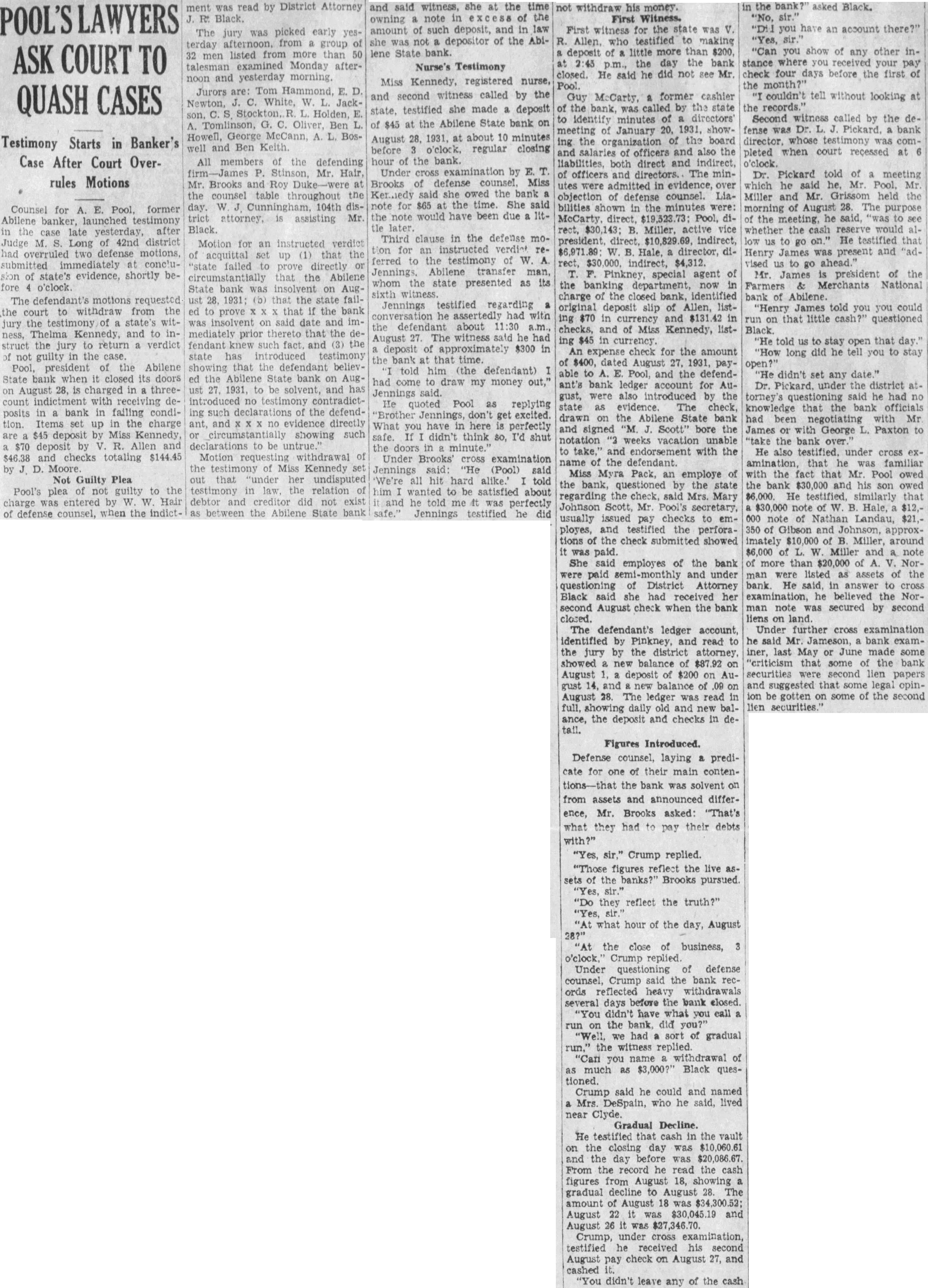
Counsel for A. E. Pool, former Abilene banker, launched testimony in the case late yesterday, after Judge M. S. Long of 42nd district had overruled two defense motions, submitted immediately at conclusion of state's evidence, shortly before o'clock. The defendant's motions requested the court to withdraw from the jury the testimony of state' witness, Thelma Kennedy, and to instruct the jury to return a verdict of not guilty in the case Pool, president of the Abilene State bank when it closed its doors on August 28, is charged in a threecount indictment with receiving deposits in a bank in failing condition. Items set up in the charge are a $45 deposit by Miss Kennedy, $70 deposit by V. R. Allen and $46.38 and checks totaling $144.45 by J. D. Moore Not Guilty Plea Pool's plea of not guilty to the charge was entered by W. W. Hair of defense counsel, when the indict- ment was read by District Attorney J. R. Black. The jury was picked early yesterday afternoon. from a group of 32 men listed from more than 50 talesman examined Monday afternoon and yesterday morning. Jurors are: Tom Hammond, E. D. Newton, J. C. White, W. L. Jackson, C. S. Stockton. R. L. Holden, E. A. Tomlinson, G. C. Oliver, Ben L. Howell, George McCann, A. L. Boswell and Ben Keith. All members of the defending firm-James P. Stinson, Mr. Hair, Mr. Brooks and Roy Duke-were at the counsel table throughout the day. W. Cunningham, 104th district attorney, is assisting Mr. Black.
Motion for an instructed verdict of acquittal set up (1) that the "state failed to prove directly or circumstantially that the Abilene State bank was insolvent on Aug. ust 28, 1931; (b) that the state failed to prove X X X that if the bank was insolvent on said date and immediately prior thereto that the defendant knew such fact. and (3) the state has introduced testimony showing that the defendant believed the Abilene State bank on August 27. 1931, to be solvent, and has introduced no testimony contradicting such declarations of the defendant, and X no evidence directly or circumstantially showing such declarations to be untrue. Motion requesting withdrawal of the testimony of Miss Kennedy set out that "under her undisputed testimony in law. the relation of debtor and creditor did not exist as between the Abilene State bank and said witness, she at the time owning a note in of the amount of such deposit, and in law she was not depositor of the Abilene State bank.
Nurse's Testimony
Miss Kennedy, registered nurse, and second witness called by the state, testified she made a deposit of $45 at the Abilene State bank on August 28, 1931, at about 10 minutes before 3 o'clock, regular closing hour of the bank. Under cross examination by E. T. Brooks of defense counsel. Miss Ker.nedy said she owed the bank note for $65 at the time. She said the note would have been due a Iittle later Third clause in the defense motion for an instructed verdict referred to the testimony of W. A. Jennings. Abilene transfer man, whom the state presented as its sixth witness. Jennings testified regarding conversation he assertedly had with the defendant about 11:30 a.m., August 27 The witness said he had a deposit of approximately $300 in the bank at that time. told him (the defendant) had come to draw my money out," Jennings said. He quoted Pool 2.S replying "Brother Jennings, don't get excited What you have in here is perfectly safe If I didn't think so, I'd shut the doors in minute.' Under Brooks' cross examination Jennings said: "He (Pool) said We're all hit hard alike. told him wanted to be satisfied about and he told me It was perfectly safe." Jennings testified he did not withdraw his money. First Witness. First witness for the state was V. R. Allen, who testified to making deposit of little more than $200, at 2:45 p.m., the day the bank closed. He said he did not see Mr. Pool. Guy McCarty, a former cashier of the bank, was called by the state to identify minutes of a directors' meeting of January 20, 1931, showing the organization of the board and salaries of officers and also the liabilities, both direct and indirect, of officers and directors. The minutes were admitted in evidence, over objection of defense counsel. Liabilities shown in the minutes were: McCarty direct, $19,523.73; Pool, direct, $30,143; B. Miller, active vice president direct, $10,829 69, indirect, $6,971.89 W. B. Hale, a director, direct, $30,000, indirect, $4,312. T. F. Pinkney, special agent of the banking department, now in charge of the closed bank, identified original deposit slip of Allen, listing $70 in and $131.42 in checks, and of Miss Kennedy, listing $45 in currency. An expense check for the amount of $400, dated August 27, 1931, payable to A. E. Pool, and the defendant's bank ledger account for August, were also introduced by the state as evidence. The check, drawn on the Abilene State bank and signed "M. Scott' bore the notation weeks vacation unable to take,' and endorsement with the name of the defendant. Miss Myra Pack, an employe of the bank, questioned by the state regarding the check, said Mrs. Mary Johnson Scott, Mr. Pool's secretary, usually issued pay checks to employes, and testified the perforations of the check submitted showed it was paid. She said employes of the bank were paid semi-monthly and under questioning of District Attorney Black said she had received her second August check when the bank closed. The defendant's ledger account, identified by Pinkney, and read to the jury by the district attorney showed a new balance of $87.92 on August 1, deposit of $200 on August 14, and new balance of .09 on August 28. The ledger was read in full, daily old and new balance, the deposit and checks in de-
Figures Introduced.
Defense counsel, laying a predicate for one of their main contentions-that the bank was solvent on from assets and announced difference, Mr. Brooks asked: "That's what they had to pay their debts with?"
"Yes, sir," Crump replied. "Those figures reflect the live assets of the banks?" Brooks pursued. "Yes, sir." "Do they reflect the truth?" "Yes, sir." "At what hour of the day, August 28?"
"At the close of business, 3 o'clock," Crump replied. Under questioning of defense counsel, Crump said the bank records reflected heavy withdrawals several days before the bank closed. "You didn't have what you call a run on the bank, did you?" "Well, we had sort of gradual run." the witness replied. "Can you name withdrawal of as much as $3,000?" Black questioned. Crump said he could and named Mrs. DeSpain, who he said, lived near Clyde. Gradual Decline. He testified that cash in the vault on the closing day was $10,060.61 and the day before was $20,086.67 From the record he read the cash figures from August 18, showing a gradual decline to August 28. The amount of August 18 was $34,300.52: August 22 it was $30,045.19 and August 26 it was $27,346.70. Crump, under cross examination, testified he received his second August pay check on August 27, and cashed it. "You didn't leave any of the cash in the bank?" asked Black. "No, sir.' "Dil you have an account there?" "Yes, sir." "Can you show of any other instance where you received your pay check four days before the first of the month?" "I couldn't tell without looking at the records." Second witness called by the defense was Dr. L. J. Pickard, a bank director, whose testimony was completed when court recessed at 6 o'clock. Dr. Pickard told of meeting which he said he, Mr. Pool, Mr Miller and Mr. Grissom held the morning of August 28. The purpose of the meeting, he said, "was to see whether the cash reserve would allow us to go on." He testified that Henry James was present and "advised us to go ahead.' Mr. James is president of the Farmers & Merchants National bank of Abilene. "Henry James told you you could run on that little cash?" questioned Black "He told us to stay open that day." 'How long did he tell you to stay open?" "He didn't set any date." Dr. Pickard, under the district attorney's questioning said he had no knowledge that the bank officials had been negotiating with Mr James or with George L. Paxton to "take the bank over. He also testified. under cross examination that he was familiar with the fact that Mr. Pool owed the bank $30,000 and his son owed $6,000. He testified. similarly that $30,000 note of W. B. Hale, $12,000 note of Nathan Landau, $21,350 of Gibson and Johnson, approximately $10,000 of B. Miller, around $6,000 of L. W Miller and a note of more than $20,000 of A. V. Norman were listed as assets of the bank. He said, in answer to cross examination, he believed the Norman note was secured by second liens on land. Under further cross examination he said Mr. Jameson, bank examiner, last May or June made some "criticism that some of the bank securities were second lien papers and suggested that some legal opinion be gotten on some of the second lien securities."