20946. Planters Bank (Nashville, TN)

Bank Information

Episode Type
Suspension → Reopening
Bank Type
state
Start Date
October 16, 1857
Location
Nashville, Tennessee (36.166, -86.784)

Metadata

Model
gpt-5-mini
Short Digest
64bc2c23

Response Measures

None

Description

Planters' Bank of Nashville suspended specie payments on Oct 16, 1857 (joined with Union Bank) explicitly citing the late general suspensions of the Banks throughout the Union. Newspapers state there was no run on the bank. It resumed specie payments on June 17, 1858. Classified as suspension_reopening (suspension without a run, later resumption).

Events (2)

1. October 16, 1857 Suspension
Cause
Macro News
Cause Details
Suspension taken explicitly in consequence of the late general suspensions of the Banks throughout the Union and because of the inability of other Tennessee banks to move products and provide facilities under prevailing circumstances.
Newspaper Excerpt
In consequence of the late general suspensions of the Banks throughout the Union... we, the Union and Planters' Banks of Tennessee, have this day resolved to suspend temporarily the payment of coin for the notes of our respective Banks.
Source
newspapers
2. June 17, 1858 Reopening
Newspaper Excerpt
The Planters' and Union Banks resumed specie payments on the 17th inst. During the suspension, these banks have been fortifying themselves, and were fully prepared for the step they have taken.
Source
newspapers

Newspaper Articles (15)

Article from Weekly Clarksville Chronicle, October 2, 1857

Click image to open full size in new tab

Article Text

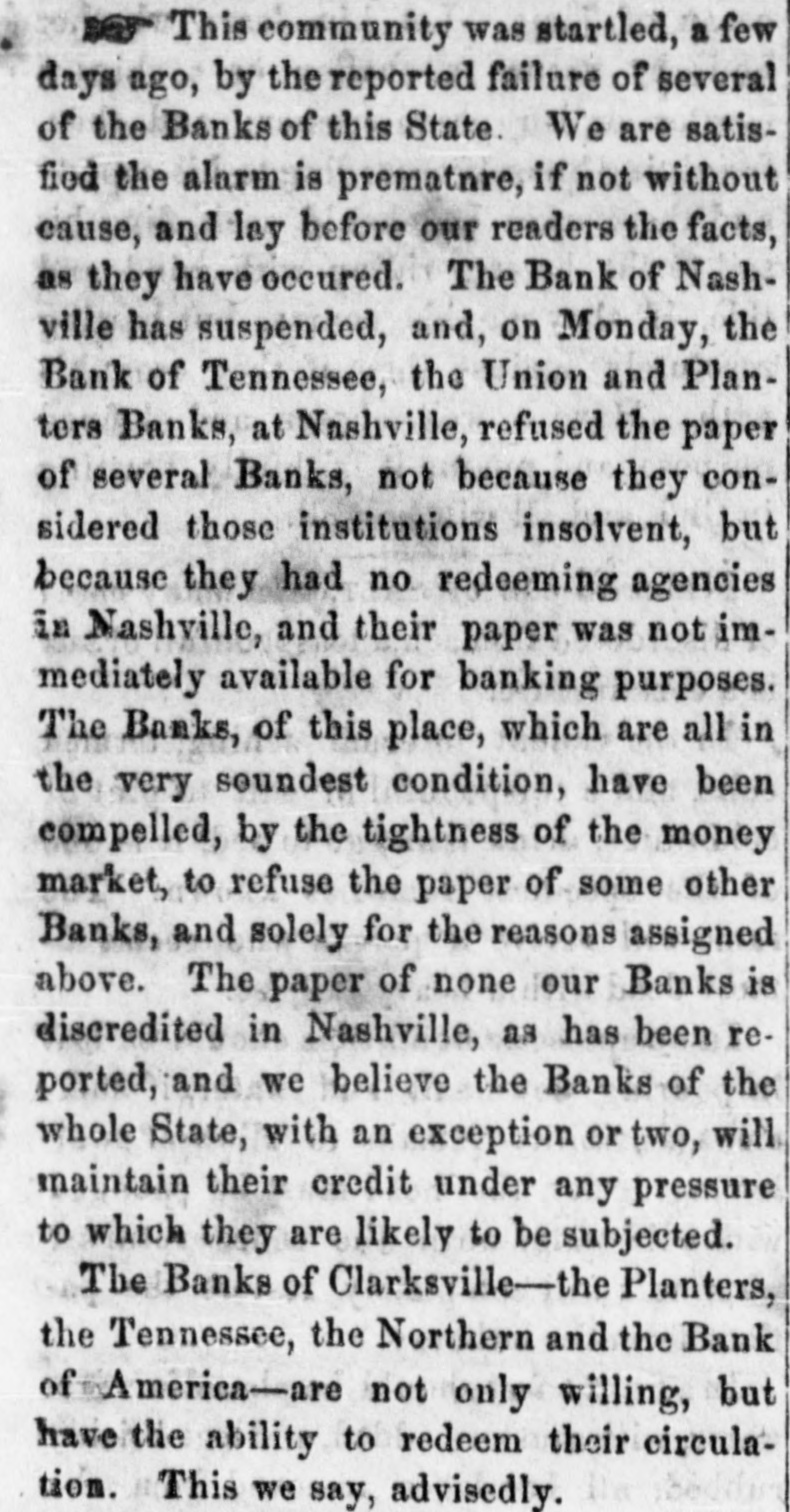
This community was startled, a few days ago, by the reported failure of several of the Banks of this State. We are satisfied the alarm is prematnre, if not without cause, and lay before our readers the facts, as they have occured. The Bank of Nashville has suspended, and, on Monday, the Bank of Tennessee, the Union and Planters Banks, at Nashville, refused the paper of several Banks, not because they considered those institutions insolvent, but because they had no redeeming agencies in Nashville, and their paper was not immediately available for banking purposes. The Banks, of this place, which are all in the very soundest condition, have been compelled, by the tightness of the money market, to refuse the paper of some other Banks, and solely for the reasons assigned above. The paper of none our Banks is discredited in Nashville, as has been reported, and we believe the Banks of the whole State, with an exception or two, will maintain their credit under any pressure to which they are likely to be subjected. The Banks of Clarksville-the Planters, the Tennessee, the Northern and the Bank of America-are not only willing, but have the ability to redeem their circulation. This we say, advisedly.


Article from Fayetteville Observer, October 8, 1857

Click image to open full size in new tab

Article Text

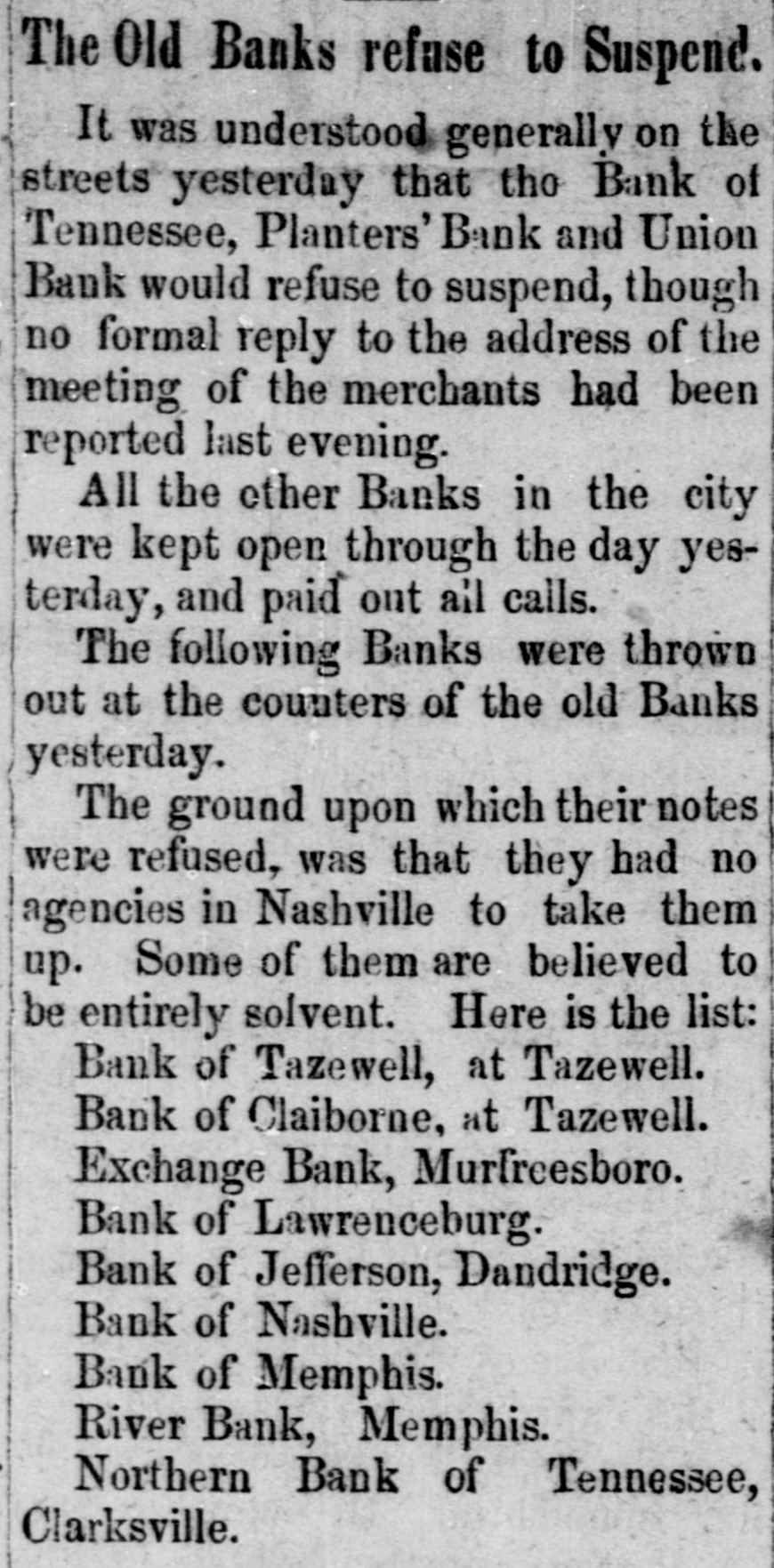
The Old Banks refuse to Suspend. It was understood generally on the streets yesterday that the Bank of Tennessee, Planters' Bank and Union Bank would refuse to suspend, though no formal reply to the address of the meeting of the merchants had been reported last evening. All the other Banks in the city were kept open through the day yesterday, and paid out all calls. The following Banks were thrown out at the counters of the old Banks yesterday. The ground upon which their notes were refused, was that they had no agencies in Nashville to take them up. Some of them are believed to be entirely solvent. Here is the list: Bank of Tazewell, at Tazewell. Bank of Claiborne, at Tazewell. Exchange Bank, Murfreesboro. Bank of Lawrenceburg. Bank of Jefferson, Dandridge. Bank of Nashville. Bank of Memphis. River Bank, Memphis. Northern Bank of Tennessee, Clarksville.


Article from Daily Nashville Patriot, October 17, 1857

Click image to open full size in new tab

Article Text

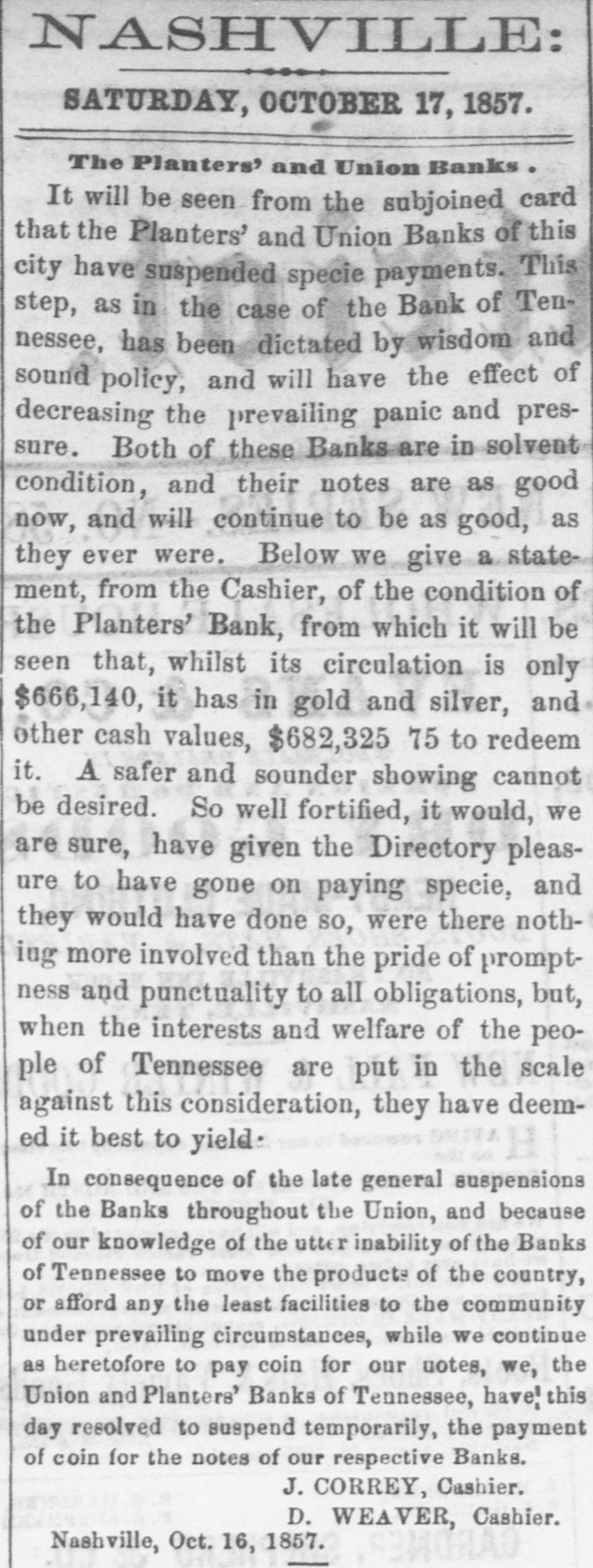
NASHVILLE: SATURDAY, OCTOBER 17, 1857. The Planters' and Union Banks It will be seen from the subjoined card that the Planters' and Union Banks of this city have suspended specie payments. This step, as in the case of the Bank of Tennessee, has been dictated by wisdom and sound policy, and will have the effect of decreasing the prevailing panic and pressure. Both of these Banks are in solvent condition, and their notes are as good now, and will continue to be as good, as they ever were. Below we give a statement, from the Cashier, of the condition of the Planters' Bank, from which it will be seen that, whilst its circulation is only $666,140, it has in gold and silver, and other cash values, $682,325 75 to redeem it. A safer and sounder showing cannot be desired. So well fortified, it would, we are sure, have given the Directory pleasure to have gone on paying specie, and they would have done so, were there nothiug more involved than the pride of promptness and punctuality to all obligations, but, when the interests and welfare of the people of Tennessee are put in the scale against this consideration, they have deemed it best to yield: In consequence of the late general suspensions of the Banks throughout the Union, and because of our knowledge of the utter inability of the Banks of Tennessee to move the products of the country, or afford any the least facilities to the community under prevailing circumstances, while we continue as heretofore to pay coin for our uotes, we, the Union and Planters' Banks of Tennessee, have this day resolved to suspend temporarily, the payment of coin for the notes of our respective Banks. J. CORREY, Cashier. D. WEAVER, Cashier. Nashville, Oct. 16, 1857.


Article from Nashville Union and American, October 17, 1857

Click image to open full size in new tab

Article Text

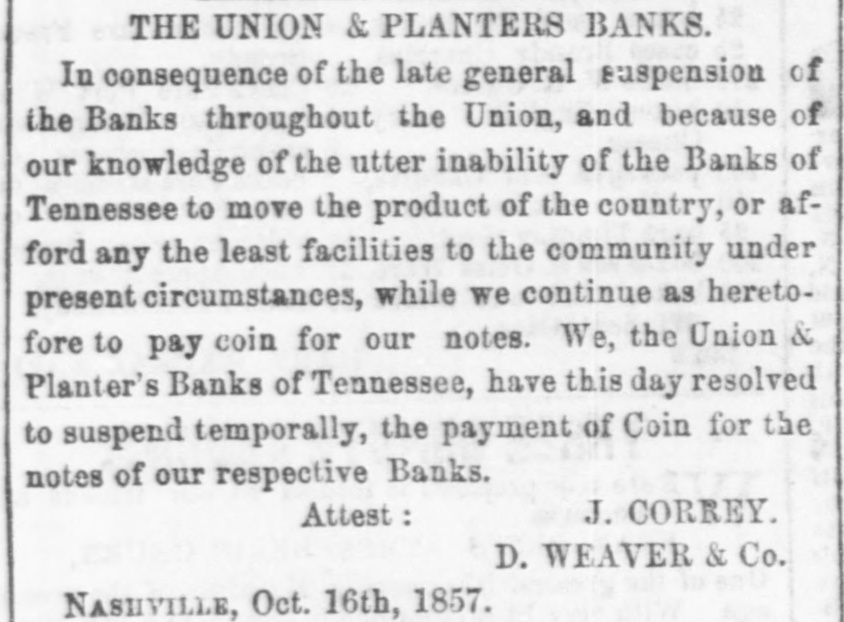
# THE UNION & PLANTERS BANKS. In consequence of the late general suspension of the Banks throughout the Union, and because of our knowledge of the utter inability of the Banks of Tennessee to move the product of the country, or afford any the least facilities to the community under present circumstances, while we continue as heretofore to pay coin for our notes. We, the Union & Planter's Banks of Tennessee, have this day resolved to suspend temporally, the payment of Coin for the notes of our respective Banks. Attest: J. CORREY. D. WEAVER & Co. NASHVILLE, Oct. 16th, 1857.


Article from Daily Nashville Patriot, October 21, 1857

Click image to open full size in new tab

Article Text

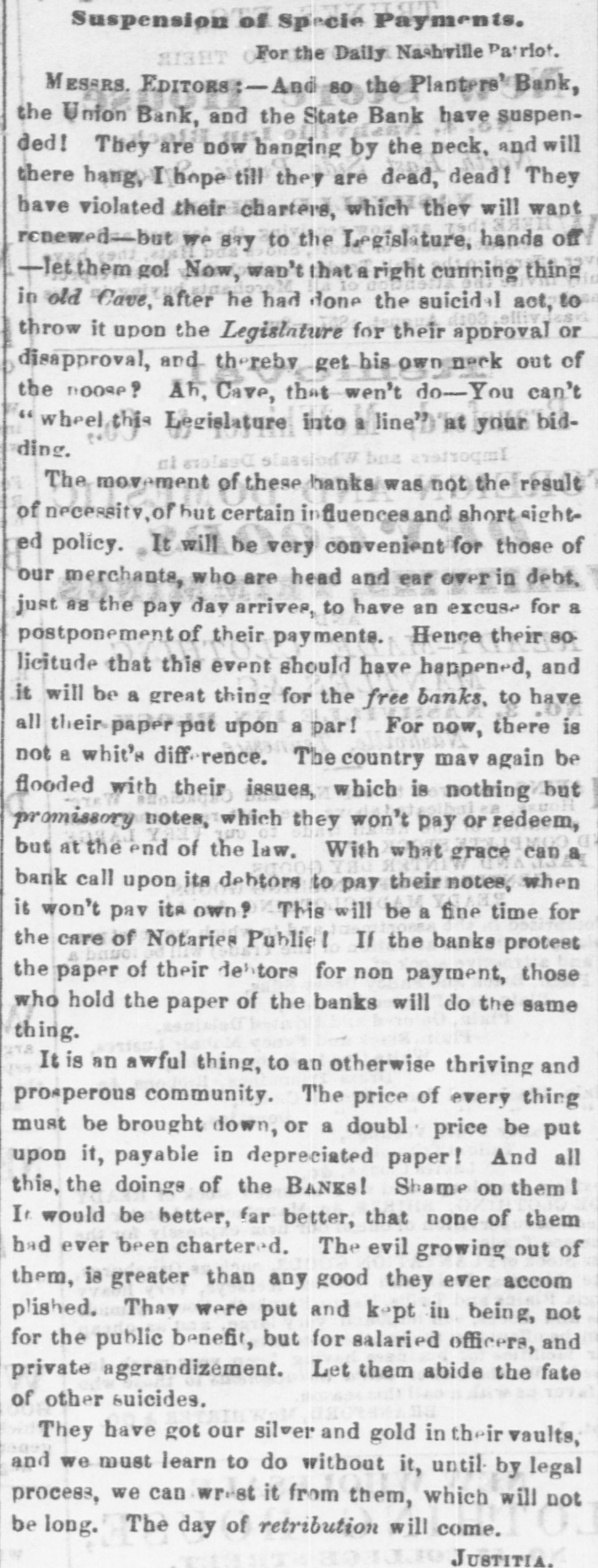
Suspension of Specie Payments, For the Daily Nashville Patriot. MESSRS. EDITORS:-And 80 the Planters' Bank, the Union Bank, and the State Bank have suspended! They are DOW banging by the neck, and will there hang, I hope till they are dead, dead! They have violated their charters, which thev will want renewed-but we say to the egislature, hands off -let them go! Now, wan't that a right cunning thing in old Cave, after he had done the suicidal act, to throw it upon the Legislature for their approval or disapproval, and thereby get his own neck out of the noose? Ah, Cave, that wen't do-You can't wheel this Legislature into a line" at your bidding. The movement of these hanks was not the result of necessity, of but certain in fluences and short sighted policy. It will be very convenient for those of our merchants, who are head and ear over in debt, just 88 the pay day arrives, to have an excuse for a postponement of their payments. Hence their 80licitude that this event should have happened, and it will be a great thing for the free banks, to have all their paper put upon a par! For now, there is not a whit's diff rence. The country mav again be flooded with their issues, which is nothing but promissory notes, which they won't pay or redeem, but at the end of the law. With what grace can a bank call upon its debtors to pay their notes, when it won't pav ita own? This will be a fine time for the care of Notaries Publiel If the banks protest the paper of their tors for non payment, those who hold the paper of the banks will do the same thing. It is an awful thing, to an otherwise thriving and prosperous community. The price of every thing must be brought down, or a doubl price be put upon it, payable in depreciated paper! And all this, the doings of the BANKS! Shame on them I It would be better, far better, that none of them bad ever been chartered. The evil growing out of them, is greater than any good they ever accom plished. Thav were put and kept in being, not for the public benefit, but for salaried officers, and private aggrandizement. Let them abide the fate of other suicides. They have got our silver and gold in their vaults, and we must learn to do without it, until by legal process, we can wrest it from them, which will not be long. The day of retribution will come. Justitia.


Article from Fayetteville Observer, October 22, 1857

Click image to open full size in new tab

Article Text

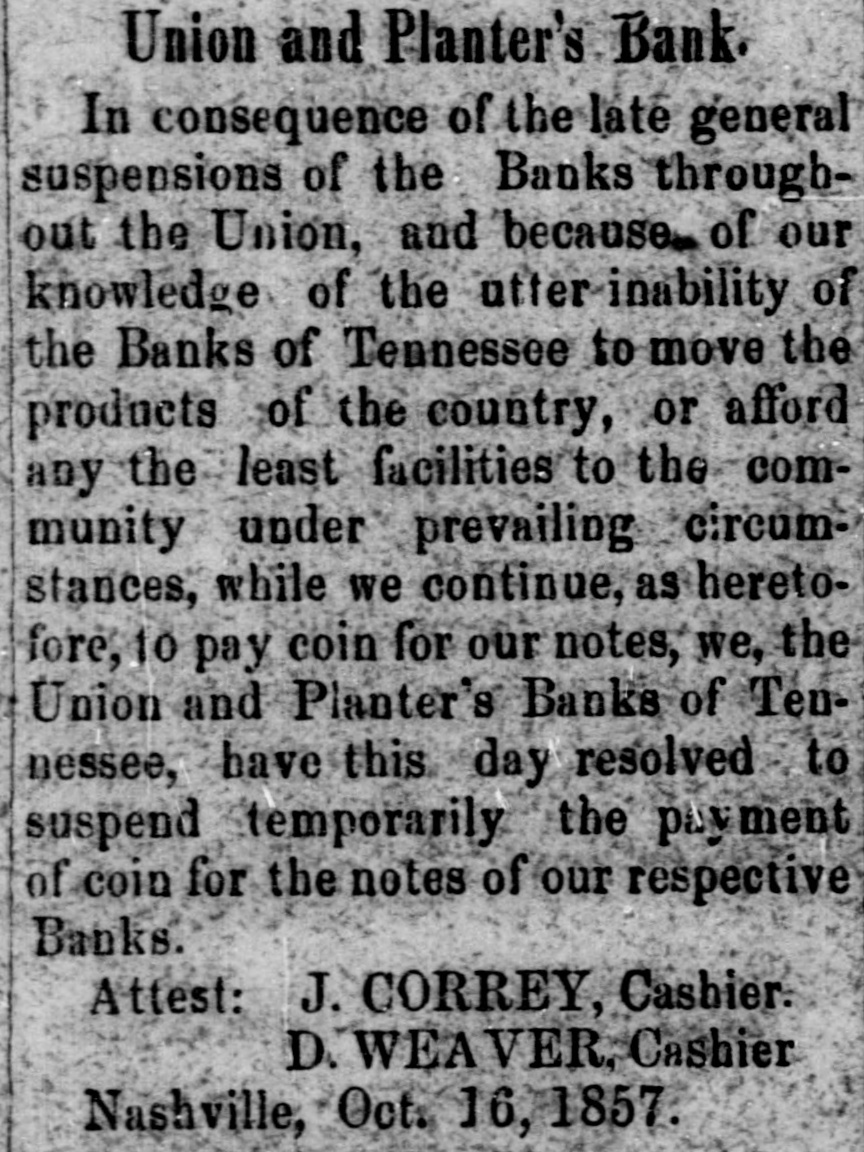
Union and Planter's Bank. In consequence of the late general suspensions of the Banks throughout the Union, and because... of our knowledge of the utter inability of the Banks of Tennessee to move the products of the country, or afford any the least facilities to the community under prevailing circumstances, while we continue, as heretofore, 10 pay coin for our notes, we, the Union and Planter's Banks of Tennessee, have this day resolved to suspend temporarily the payment of coin for the notes of our respective Banks. Attest: J. CORREY, Cashier. D. WEA VER, Cashier Nashville, Oct. 16, 1857.


Article from The Athens Post, October 23, 1857

Click image to open full size in new tab

Article Text

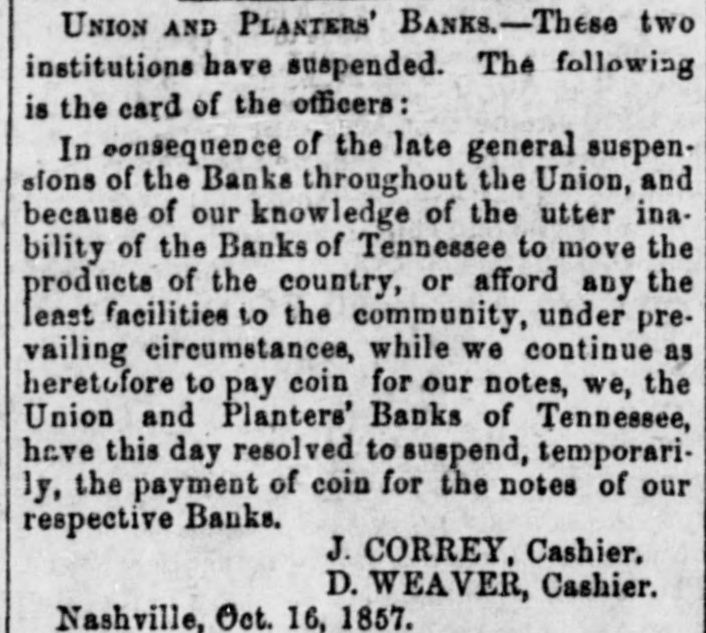
UNION AND PLANTERS' BANKS.-These two institutions have suspended. The following is the card of the officers : In consequence of the late general suspensions of the Banks throughout the Union, and because of our knowledge of the utter inability of the Banks of Tennessee to move the products of the country, or afford any the least facilities to the community, under prevailing circumstances, while we continue as heretofore to pay coin for our notes, we, the Union and Planters' Banks of Tennessee, have this day resolved to suspend, temporarily, the payment of coin for the notes of our respective Banks. J. CORREY, Cashier. D. WEAVER, Cashier. Nashville, Oct. 16, 1857.


Article from Weekly Clarksville Chronicle, October 23, 1857

Click image to open full size in new tab

Article Text

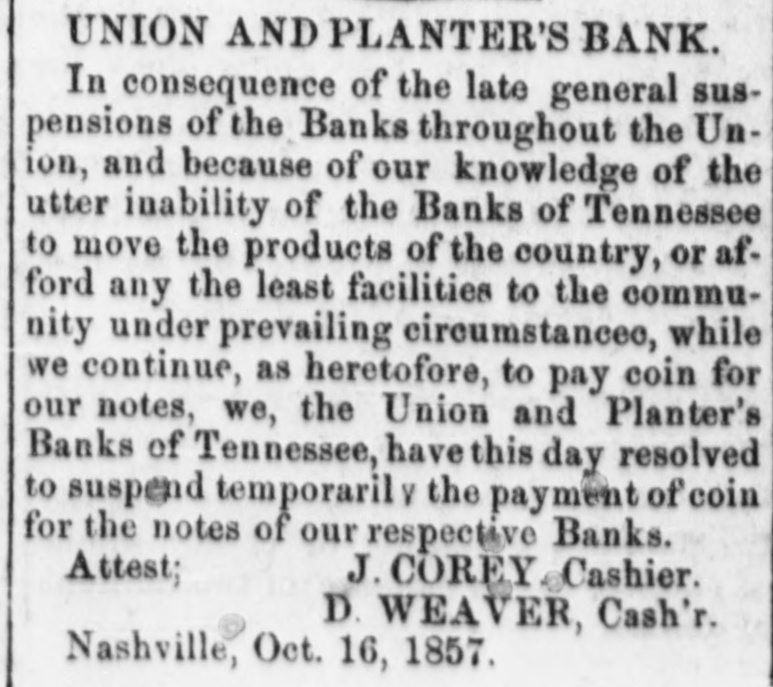
UNION AND PLANTER'S BANK. In consequence of the late general suspensions of the Banks throughout the Union, and because of our knowledge of the utter inability of the Banks of Tennessee to move the products of the country, or afford any the least facilities to the community under prevailing circumstancee, while we continue, as heretofore, to pay coin for our notes, we, the Union and Planter's Banks of Tennessee, havethis day resolved to suspend temporarily the payment of coin for the notes of our respective Banks. Attest; J. COREY Cashier. D. WEAVER, Cash'r. Nashville, Oct. 16, 1857.


Article from Daily Nashville Patriot, October 24, 1857

Click image to open full size in new tab

Article Text

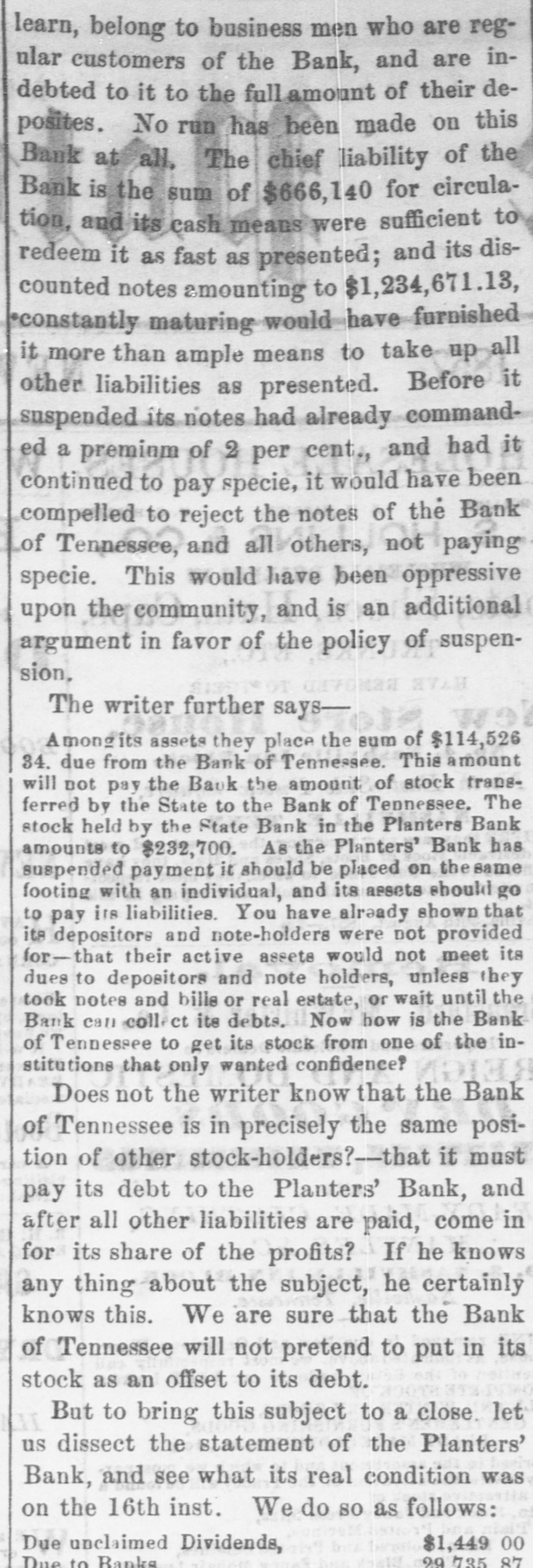
learn, belong to business men who are regular customers of the Bank, and are indebted to it to the full amount of their deposits. No run has been made on this Bank at all. The chief liability of the Bank is the sum of $666,140 for circulation, and its cash means were sufficient to redeem it as fast as presented; and its discounted notes amounting to $1,234,671.13, constantly maturing would have furnished it more than ample means to take up all other liabilities as presented. Before it suspended its notes had already commanded a premium of 2 per cent., and had it continued to pay specie, it would have been compelled to reject the notes of the Bank of Tennessee, and all others, not paying specie. This would have been oppressive upon the community, and is an additional argument in favor of the policy of suspension. The writer further says- Among its assets they place the sum of $114,526 34. due from the Bank of Tennessee. This amount will not pay the Bank the amount of stock transferred by the State to the Bank of Tennessee. The stock held by the State Bank in the Planters' Bank amounts to $232,700. As the Planters' Bank has suspended payment it should be placed on the same footing with an individual, and its assets should go to pay its liabilities. You have already shown that its depositors and note-holders were not provided for-that their active assets would not meet its dues to depositors and note holders, unless they took notes and bills or real estate, or wait until the Bank can collect its debts. Now how is the Bank of Tennessee to get its stock from one of the institutions that only wanted confidence? Does not the writer know that the Bank of Tennessee is in precisely the same position of other stock-holders?--that it must pay its debt to the Planters' Bank, and after all other liabilities are paid, come in for its share of the profits? If he knows any thing about the subject, he certainly knows this. We are sure that the Bank of Tennessee will not pretend to put in its stock as an offset to its debt. But to bring this subject to a close. let us dissect the statement of the Planters' Bank, and see what its real condition was on the 16th inst. We do so as follows: Due unclaimed Dividends, $1,449 00 Due to Banks 29 735 87


Article from Daily Nashville Patriot, October 24, 1857

Click image to open full size in new tab

Article Text

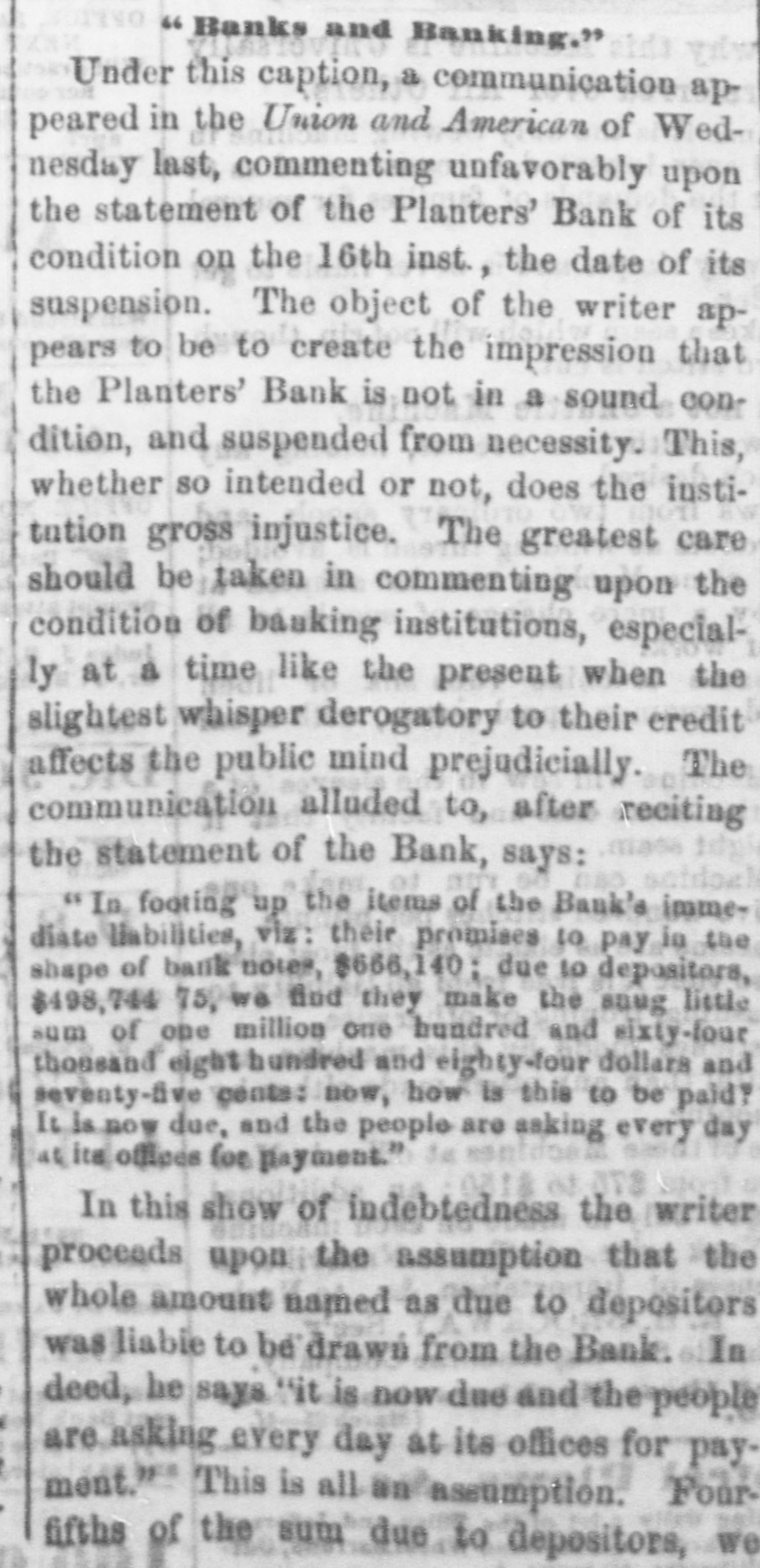
"Banks and Banking." Under this caption, a communication appeared in the Union and American of Wednesday last, commenting unfavorably upon the statement of the Planters' Bank of its condition on the 16th inst., the date of its suspension. The object of the writer appears to be to create the impression that the Planters' Bank is not in a sound condition, and suspended from necessity. This, whether so intended or not, does the institution gross injustice. The greatest care should be taken in commenting upon the condition of banking institutions, especially at a time like the present when the slightest whisper derogatory to their credit affects the public mind prejudicially. The communication alluded to, after reciting the statement of the Bank, says: "In footing up the items of the Bank's immediate liabilities, viz: their promises to pay in the shape of bank notes, $666,140; due to depositors, $498,744 75, we find they make the snug little sum of one million one hundred and sixty-four thousand eight hundred and eighty-four dollars and seventy-five cents: now, how is this to be paid? It is now due, and the people are asking every day at its offices for payment." In this show of indebtedness the writer proceeds upon the assumption that the whole amount named as due to depositors was liable to be drawn from the Bank. In deed, he says "it is now due and the people are asking every day at its offices for payment." This is all an assumption. Four-fifths of the sum due to depositors, we


Article from Arkansas True Democrat, November 17, 1857

Click image to open full size in new tab

Article Text

on Bank that James K. Polk with Paper unfeigned Money. satisfaction of the country W leading observe democratic against journals the evils of bank oththe are lifting their voice currency. Among serers, the Nashville the teachings of JAMES K. monopolies vice in reporducing and democratic paper Union preforms principles timely that of specie great expounder of on the suspension the Union payment POLK. Comment by the menting Bank of Tennessee, yestersays: institution closed her vaults on own will the The people day This and intelligence refuses longer will be to of redeem the unexpected State her as it to great mass of the and injurious in its be fact of its the confidence and the From discouraging the hold being upon State v other institution, bank, of it had obtained greater than that of uneasiness its cotes of security people in the midst sought of the for general by the laboring people in these the have country been as their has greatest been but few business weeks uncertain times It our merchants and anxious to since meeting of naturally, were more than to see men, who, accommodate very dations for debts, themselves held a meeting and passed State Banks provide benake pay their honest resolution requesting to susin the our Union, city order Planters, to give and timely policy aid to which their cus- the tomers pend, and debtors," the has very DOW adopted. for reasons The and Bank of Tennessee was then declined thought worthy of Col. the proposition manner which we that institution Johnson published centlement in who contro a card 10 the world in which and ready be he said: The Bank of Tennessee against it whatever is able and howjustified excused ever to meetal made, demands and for would not, refusing payment therefore, of its notes or when demanded.' of Tennessee was and able to meet If the Bank against it, whenever crisis, of course all made, demands at the beginning now, of as the she has been every there it equally able the shock We conclude, to close day pre paring officers for have thought proper some cause its fore, that and its dishonor its paper from With such an acvaults inability to pay. their reasons, hatknowledgment than an before them, not likely to satisfy the bered ever they may public be, are whose pockets are encumof the not time first Bank indiscrimin with their depreciated currency. that the continued Tennessee This is has institution suspended for and another if it ten years, financial be the last. Our present gambling, financial and it will not but another mode of necessarily policy is though large one, when must all the cards re-shuffled, have the game, an end every few years, and dealt over 1839, again are for another trown up, azard and circumstances, another loss. the In Union, board, Planters' under precisely and similar State Banks suspended went by the That the may and were for understand three years the history and injury of that the and pens reader its deleterious comprehend effects thereby the what following may be peop anticipated from this, message we make of Gov James the to extract from the able Legislature, in 1839. After have troubles K. Polk, shown to the causes of our currency, starthaving an inflated paper cities, he resulted ing first with from the banks of the eastern that Upon the receipt of the information little more than their some of the banks last the resumption had again imm year from specie payments, the question what had propended the public mind, would be the ately arose in and what banks course duced the suspension, to be pursued by the As to the east represent far as are informed have the arisen suspension specie continue lack self- of preservation, power under drained the form out of of keep- the for suspension but of the specie Without from being the means of knowing how the fact may banks, be, but absolute inability payment to meet their the resp unsibilities promptly been the cause of the suffi ground And whatever payments may have by the banks for the east, of furnish payment by our banks, Like they debtors, they have should ability meet to pay. their liabilities be course a contrary adoptWhat few of the banks at the east they are still lvent; ed? the public that but to follow ing and represent and not from necessity, their examretain their specice; in the and, interior, which are not also bethe under represented ple, the banks to be solvent, necessity suspend to also, do but cause they because are the eastern banks the have sus banks simply So that the suspension of dulged excessive ded. which may have credits, promoted single issue city of bank paper and bank ver-action trade, as a operate thus stimulated which and may have ulterior suspension objects payments view, made by all to the banks in of Philadelphia, the country Surely bank our suspend banks to follow the condition example unless no reason they for are compelled by their reason, do so. The apprehension of the drain for one of of their the specie conthemse ditions can be of o sufficient their corporate privileges all times is, in that condi they When suspenby banks, shall tion to keep meet their liabilities. place sion of specie payments immediately takes depreciates but the value their and circulation the loss falls not on the banks bears the loss, The labor of the country of suspension most people. whilst the banks, during profitable period business. are often doing that their the Bank of Tennessee, entertained of whose was ability hoped to pay specie do so. no doubt She did is pay day would after the continue Union and to Planters' banks vielded had suspen- to the pavie around of measure ded; but regret her and to say stopped, finally Hot from inabili- Her prudence. course ty to pay, much but as to a be regretted, demanded and an early by the reinterests all her sumption of is the my State. judgment By maintaining engagements, firm every stand, honestly same meeting time extending to her with debtors her as State and at possible the indulgence compatible institution of unsafety, her credit character will be maintained, sound and curren- to the doubted of her means, to furnish extent be preserved. In the future is mange- excluCV will that institution, owned as the credit ment of by the State, and supported by conin to view, of sively the State, it should be confine cardinal her object, operations stantly kept her means, to meet her responsibilities her cirpromptly, within and sound to preserve state at all times culation No one can in fail see how admirably suited Gov. remarks are to the present time. and living would those Polk could not justify the not suspension justify it then, now if he were arguments which he advanced applica- against such The same policy at that time are precisely recommendations ble Two years passed by, and, and contrary to their to Gov. OWD of message pledges, Polk's these banks were to still the Legislature suspended Therefore, he again in his treated the subject Legislature as follows. 1841, the members of the present by his learn Let wisdom from and take warning suggestions: hoped and belived, when the banks It was su-pended the payment of specie of the State years ago, that it would be of temporary to the General Assembly second time, near duration. two In the reports made


Article from Nashville Union and American, June 19, 1858

Click image to open full size in new tab

Article Text

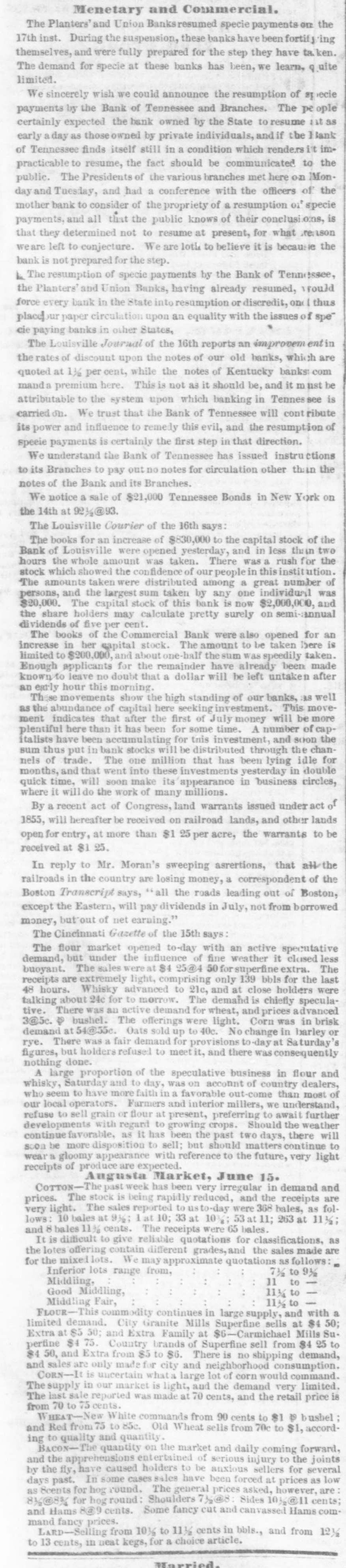
Menetary and Commercial. The Planters' and Union Banksresumed specie payments on the 17th inst. During the suspension, these banks have been fortify ing themselves, and were fully prepared for the step they have ta.ken. The demand for specie at these banks has been, we learn, uite limited. We sincerely wish we could announce the resumption of ecie payments by the Bank of Tennessee and Branches. The ople certainly expected the bank owned by the State to resume it as early a day as those owned by private individuals, and if the ] lank of Tennessee finds itself still in a condition which rende.rs it impracticable to resume, the fact should be communicated to the public. The Presidents of the various branches met here on Monday and Tuesday, and had a conference with the officers of the mother bank to consider of the propriety of a resumption of specie payments, and all that the public knows of their conclusion is that they determined not to resume at present, for what reason weare left to conjecture. We are loth to believe it is because the bank is not prepared for the step. his The resumption of specie payments by the Bank of Tennessee, the Planters' and Union Banks, having already resumed, would force every bank in the State into resumption or discredit, one I thus place| paper circulation upon an equality with the issues of spe" cie paying banks in other States, The Louisville Journal of the 16th reports an improvem ent in the rates of discount upon the notes of our old banks, which are quoted at 1½ per cent, while the notes of Kentucky banks com manda premium here. This is not as it should be, and it m ust be attributable to the system upon which banking in Tennessee is carried on. We trust that the Bank of Tennessee will cont ribute its power and influence to remedy this evil, and the resumption of speeie payments is certainly the first step in that direction. We understand the Bank of Tennessee has issued instru ctions to its Branches to pay out no notes for circulation other than the notes of the Bank and its Branches. We notice a sale of $21,000 Tennessee Bonds in New York on the 14th at 921,@93. The Louisville Courier of the 16th says: The books for an increase of $830,000 to the capital stock of the Bank of Louisville were opened yesterday, and in less than two hours the whole amount was taken. There was a rush for the stock which showed the confidence of our people in this instit ution. The amounts taken were distributed among a great number of persons, and the largest sum taken by any one individual was $20,000. The capital stock of this bank is now $2,000,000, and the share holders may calculate pretty surely on semi-:annual dividends of five per cent. The books of the Commercial Bank were also opened for an increase in her capital stock. The amount to be taken here is limited to $200,000, and about one-half the sum was speedily taken. Enough applicants for the remainder have already been made known to leave no doubt that a dollar will be left untaken after an early hour this morning. These movements show the high standing of our banks, as well as the abundance of capital here seeking investment. This movement indicates that after the first of July money will be more plentiful here than it has been for some time. A number of capitalists have been accumulating for this investment, and soon the sum thus put in bank stocks will be distributed through the channels of trade. The one million that has been lying idle for months, and that went into these investments yesterday in double quick time, will soon make its appearance in business circles, where it willdo the work of many millions. By a recent act of Congress, land warrants issued under act of 1855, will hereafter be received on railroad lands, and other lands open for entry, at more than $1 25 per acre, the warrants to be received at $1 25. In reply to Mr. Moran's sweeping asrertions, that all the railroads in the country are losing money, a correspondent of the Boston Transcript says, "all the roads leading out of Boston, except the Eastern, will pay dividends in July, not from borrowed money, but of net earning." The Cincinnati Gazette of the 15th says: The flour market opened to-day with an active specutative demand, but under the influence of fine weather it closed less buoyant. The sales were at $4 25@4 orsuperfine extra. The receipts are extremely light, comprising only 139 bbls for the last 48 hours. Whisky advanced to 21c, and at close holders were talking about 24c for to morrow. The demand is chiefly speculative. There was an active demand for wheat, and prices advanced 3@5c. $ bushel. The offerings were light. Corn was in brisk demand at 54@55c. Oats sold up to 40c. change in barley or rye. There was a fair demand for provisions to-day at Saturday's figures, but holders refused to meeti and there was consequently nothing done. A large proportion of the speculative business in flour and whisky, Saturday and to day, was on account of country dealers, who seem to have more faith in a favorable out-come than most of our local operators. Farmers and interior millers, we understand, refuse to sell grain or flour at present, preferring to await further developments with regard to growing crops. Should the weather continue favorable, as it has been the past two days, there will soon be more disposition to sell; but should matters continue to wear a gloomy appearance with reference to the future, very light receipts of produce are expected. Augusta Market, June 15. COTTON-The past week has been very irregular in demand and prices. The stock is being rapidly reduced, and the receipts are very light. The sales reported to us to-day were 368 bales, as follows: 10 bales at 932; at 10; 33 at 10%; 53 at 11; 263 at 11½; and 8 bales 11% cents. The receipts were 65 bales. It is difficult to give reliable quotations for classifications, as the lotes offering contain different grades,and the sales made are for the mixed lots. We may approximate quotations as follows: Inferior lots range from, 7½ to 9½ 11 to Middiing, Good Middling, 11½ to Middling Fair, 11½ to FLOUR-This commodity continues in large supply, and with a limited demand. City Granite Mills Superfine sells at $4 50; Extra at $5 50; and Extra Family at $6-Carmichael Mills Superfine 75. Country brands of Superfine sell from $4 25 to 84 50, and Extra from $5 to $6. There is no shipping demand, and sales are only made for city and neighborhood consumption. CORN-It is uncertain what: large lot of corn would command. The supply in our market is light, and the demand very limited. The last sale reported was made at 70 cents, and the retail price is from 70 to 75 cents. WHEAT-New White commands from 90 cents to $1 * bushel and Red from 75 to 85c. Old Wheat sells from 70c to $1, according to quality and quantity. BACON-Th quantity on the market and daily coming forward, and the apprehensions entertained of serious injury to the joints by the fly, have caused holders to be anxious sellers for several days past. In some cases sales have been forced at prices as low as Scents for hog round. The general prices asked, however, are 8½@8% for hog round: Shoulders 7%@8 Sides 10%@11 cents; and Hams 8@9 cents. Some fancy cut and canvassed Hams command fancy prices. LARD-Selling from 10½ to 11½ cents in bbls., and from 12½ to 13 cents, in neat kegs, for a choice article. Married


Article from Fayetteville Observer, July 15, 1858

Click image to open full size in new tab

Article Text

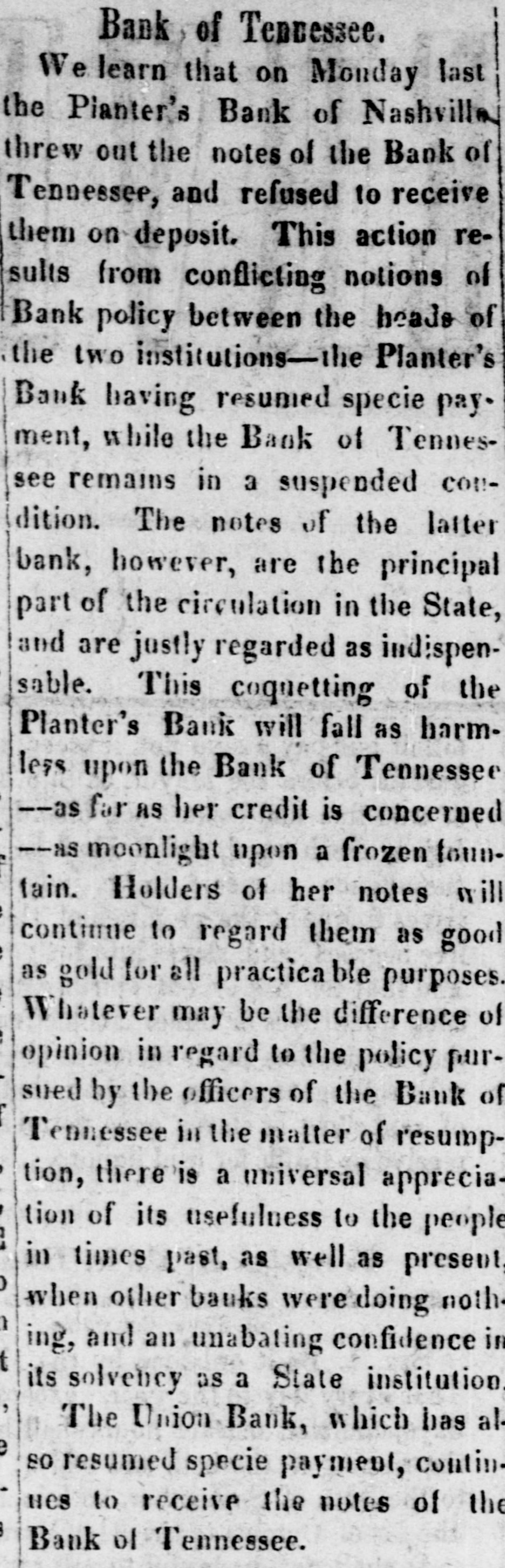
Bank of Tennessee. We learn that on Monday last the Planter's Bank of Nashville threw out the notes of the Bank of Tennessee, and refused to receive them on deposit. This action results from conflicting notions of Bank policy between the heads of the two institutions-the Planter's Bank having resumed specie pay. ment, while the Bank of Tennessee remains in a suspended condition. The notes of the latter bank, however, are the principal part of the circulation in the State, and are justly regarded as indispensable. This coquetting of the Planter's Bank will fall as harmless upon the Bank of Tennessee --as for AS her credit is concerned --as moonlight upon a frozen tountain. Holders of her notes will continue to regard them as good as gold for all practica ble purposes. Whatever may be the difference of opinion in regard to the policy pursued by the officers of the Bank of Tennessee in the matter of resumption, there is a universal appreciation of its usefulness to the people in times past, as well as present when other banks were doing noth. ing, and an unabating confidence in its solvency as a State institution The Union Bank, which bas alSO resumed specie payment, continuses to receive the notes of the Bank of Tennessee.


Article from The Athens Post, July 16, 1858

Click image to open full size in new tab

Article Text

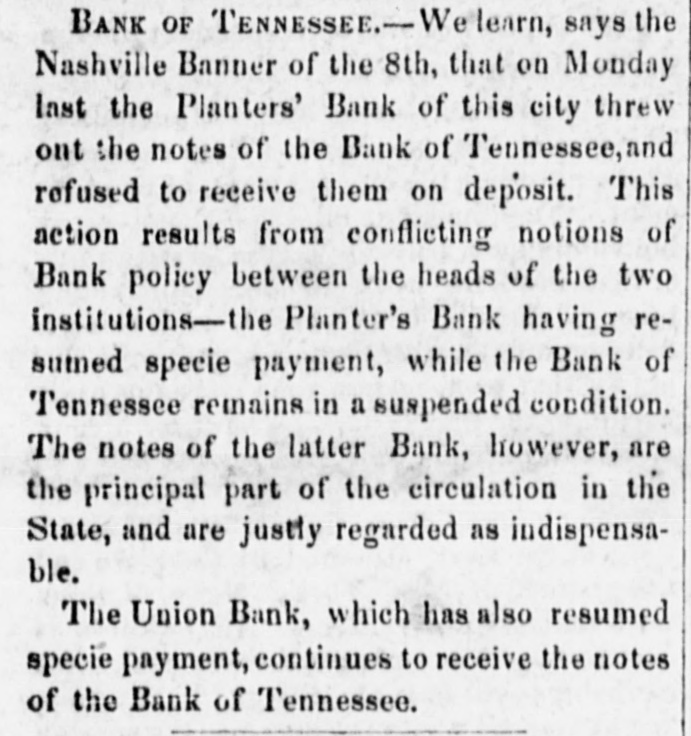
BANK OF TENNESSEE.-Welearn, says the Nashville Banner of the 8th, that on Monday last the Planters' Bank of this city threw ont the notes of the Bank of Tennessee, and refused to receive them on deposit. This action results from conflicting notions of Bank policy between the heads of the two institutions-the Planter's Bank having resumed specie payment, while the Bank of Tennessee remains in a suspended condition. The notes of the latter Bank, however, are the principal part of the circulation in the State, and are justly regarded as indispensable. The Union Bank, which has also resumed specie payment, continues to receive the notes of the Bank of Tennessee.


Article from Nashville Patriot, November 13, 1858

Click image to open full size in new tab

Article Text

lic one, derives additional weight from the fact that the preference has been inflexibly persisted in, notwithstanding three general bank suspensions—in 1814, 1837 and 1857— and the bank failures which occurred at those periods, and which have now and then occur- red on other occasions. This fact shows that, in the settled judg- ment of the people of the United States, great as have been the inconveniences and losses sustained by them in consequence of occasional bank failures and suspensions, this inconvenience and these losses have not been so great, by a good deal, as the hard-money declaimers would make them out to be—not so great as to induce the people to abolish the system, or so great as even to shake their confidence in its utility. In regard to the extent and universality of the injuries inflicted by bank failures, very erroneous estimates and very incorrect state- ments are not unfrequently made. Of the entire population of Tennessee, for instance, the number is small, relatively speaking, who ever lost anything by bank failures! Similar errors prevail in regard to the class of persons who are the greatest sufferers by reason of the failures of insolvent banks. The poor laboring men, it is often said, are the greatest sufferers. This is as great a fallacy as ever was uttered. Are the pockets of the laboring poor ever stuffed with bank notes? Are they holders of bank stocks? Do they make deposits in banks? How, then, is it possible that they should be the greatest sufferers from bank failures? But it is said, that the loss of one dollar to a poor man, being all he has, is relatively as great as the loss of a thousand dollars is to a man a thousand times richer. Not so. The poor man can, by a day's work, make an- other dollar, but the thousand dollar man will have to labor long and industriously be- fore he can replace the thousand dollars he has lost. Clearly it is upon the monied classes of society, or those which from the nature of their business pursuits are compelled to keep considerable amounts of money always on hand, and for daily or frequent use—it is up- on these classes, which constitute but a small portion, relatively speaking, of the commun- ity, that the losses occasioned by the break- ing of banks chiefly fall. Money is too valuable to be kept long idle. You don't find the farmers and planters, as a general thing, keeping enough on hand ever to be seriously injured by a bank failure. It is the merchants and traders, and the monied men generally, that are the chief sufferers on these occasions. It may with truth be asserted, that but a small portion, compared with the whole pop- ulation, of the people of Tennessee, have ever sustained any loss whatever by a bank failure—that of that small portion, the loss to the greater part, has not been such as seri- ously to incommode them—and that the whole aggregate loss sustained in Tennessee, since the first bank was chartered, by bank fail- ures, has been, to the community generally, insignificant, compared with the vast and in- calculable benefits which every class of socie- ty, farmers and planters, manufacturers and mechanics, merchants and traders, and espe- cially the poor laboring classes, have derived from the paper currency, which has been in use among them—benefits, I mean, over and above all which a purely metallic currency could by any possibility have conferred. If the injuries, and I would not underrate them, which have been sustained by the coun- try by reason of the failures of insolvent banks, be, as I have shown, greatly exag- gerated by the anti-bank writers and speakers, much more are the inconvenience and losses which have resulted from the temporary sus- pensions of solvent banks. Take, for illus- tration, the late suspension by the solvent banks of this State, particularly of the three old banks of this place, whose issues consti- tute the bulk of our circulating medium. A continued drain of gold from Europe had caused a drain thither from New York and other importing points on the Atlantic. The demand for gold for shipment to Europe at New York, caused a flow of gold from the in- terior of this country to that city. We were in debt to New York, and the gold in the vaults of our banks was wanted at that period, to be sent to England and France, from those countries to be sent to others far away in the East. Now, suppose our banks had had in their vaults a dollar in specie for every paper dollar of theirs in circula- tion, and had gone on to redeem all their notes by paying in exchange for them all their specie, what would have been the conse- quence? Why, the gold thus drawn out of the banks would not have remained in the coun- try and taken the place, as a circulating medium, of the bank notes that had been previously in circulation. Instead of remain- ing here, it would have gone out of the State, and we should have been left literally without any circulating medium at all—without either gold or bank notes. And what would have been the result of that operation? Wide- spread ruin—the like of which the people of this State have never seen, and which Heaven forbid they ever should see. By suspending, therefore, under the cir- cumstances which existed, our banks were enabled, by means of their notes then in cir- culation, to prevent a great calamity, and to preserve for the people a circulating medium, which answered all the domestic purposes of a medium of exchange—the purposes, that is, of purchasing property, paying debts, &c. Except when gold or exchange was wanted to pay a debt out of the State, the notes of the State, Planters', and Union banks, during the suspension, were just as useful, just as good, as they were before the suspension, or since the resumption of specie payments. Their suspension, under the circumstances, was imperatively demanded by the best in- terests of the people. It prevented wide-spread ruin. The inconveniences and losses occa- sioned by the suspension, when composed with the disastrous results that would have followed a refusal to suspend, are not worth a moment's consideration. So that, though a general suspension by the banks of any country be confessedly a great evil, the governments, the statesmen.