20944. Planters Bank (Nashville, TN)

Bank Information

Episode Type
Suspension → Reopening
Bank Type
state
Start Date
October 18, 1839
Location
Nashville, Tennessee (36.166, -86.784)

Metadata

Model
gpt-5-mini
Short Digest
633baba0

Response Measures

None

Description

Sources show the Planters' Bank (Planters' Bank of Tennessee) suspended specie payments on or about Oct 18, 1839 following suspensions in Philadelphia/Baltimore/Cincinnati; no explicit depositor run on this specific bank is described in the articles. Later coverage and personnel records show the bank continued operations in subsequent decades, indicating it reopened after the suspension.

Events (1)

1. October 18, 1839 Suspension
Cause
Macro News
Cause Details
News of suspensions at Philadelphia, Baltimore and Cincinnati (broader banking suspensions) prompted the Bank of Tennessee to draw specie and the Union and Planters' Banks to suspend payments on Oct 18, 1839; the Bank of Tennessee reported large balances due and refused payment by those banks, precipitating suspension by the Union and Planters' Banks and contagion effects in Nashville banks.
Newspaper Excerpt
This morning the Union and Planters' Banks have also suspended... BANK OF TENNESSEE, Oct. 18. 1839.
Source
newspapers

Newspaper Articles (9)

Article from The Herald, February 22, 1836

Click image to open full size in new tab

Article Text

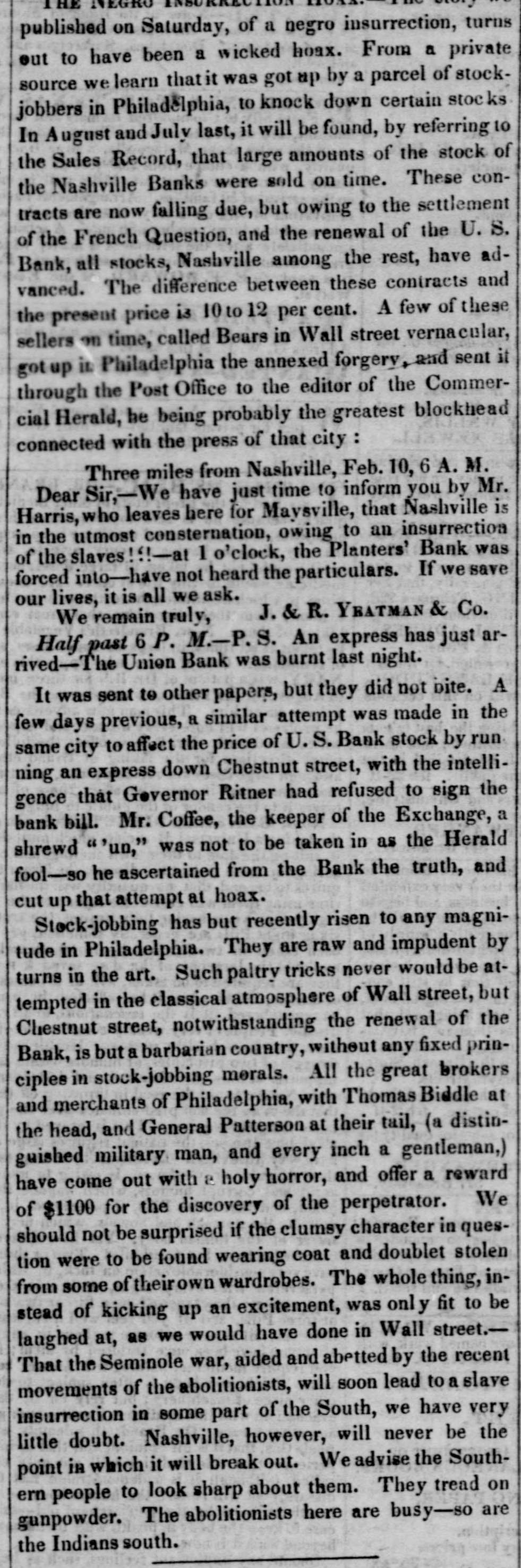
published on Saturday, of a negro insurrection, turns out to have been a wicked boax. From a private source we learn that it was got up by a parcel of stockjobbers in Philadelphia, to knock down certain stocl ks In August and July last, it will be found, by referring to the Sales Record, that large amounts of the stock of the Nashville Banks were sold on time. These contracts are now falling due, but owing to the settlement of the French Question, and the renewal of the U. S. Bank, all stocks, Nashville among the rest, have advanced. The difference between these contracts and the present price is 10 to 12 per cent. A few of these sellers on time, called Beurs in Wall street vernacular, got up it Philadelphia the annexed forgery, and sent it through the Post Office to the editor of the Commercial Herald, he being probably the greatest blockhead connected with the press of that city : Three miles from Nashville, Feb. 10, 6 A. M. Dear Sir,-We have just time to inform you by Mr. Harris, who leaves here for Maysville, that Nashville is in the utmost consternation, owing to an insurrection of the slaves!!!-a 1 o'clock, the Planters' Bank was forced into-have not heard the particulars. If we save our lives, it is all we ask. J. & R. YEATMAN & Co. We remain truly, Half past 6 P. M.-P.S. An express has just arrived-The Union Bank was burnt last night. It was sent to other papers, but they did not bite. A few days previous, a similar attempt was made in the same city to affect the price of U.S. Bank stock by run ning an express down Chestnut street, with the intelligence that Governor Ritner had refused to sign the bank bill. Mr. Coffee, the keeper of the Exchange, a shrewd "'un," was not to be taken in as the Herald fool-so he ascertained from the Bank the truth, and cut up that attempt at hoax. Stock-jobbing has but recently risen to any magnitude in Philadelphia. They are raw and impudent by turns in the art. Such paltry tricks never would be attempted in the classical atmosphere of Wall street, but Chestnut street, notwithstanding the renewal of the Bank, is but a barbarian country, without any fixed principles in stock-jobbing morals. All the great brokers and merchants of Philadelphia, with Thomas Biddle at the head, and General Patterson at their tail, (a distinguished military man, and every inch a gentleman,) have come out with a holy horror, and offer a reward of $1100 for the discovery of the perpetrator. We should not be surprised if the clumsy character in question were to be found wearing coat and doublet stolen from some of their own wardrobes. The whole thing, instead of kicking up an excitement, was only fit to be laughed at, as we would have done in Wall street.That the Seminole war, aided and abetted by the recent movements of the abolitionists, will soon lead to a slave insurrection in some part of the South, we have very little doubt. Nashville, however, will never be the point in which it will break out. We advise the Southern people to look sharp about them. They tread on gunpowder. The abolitionists here are busy-so are the Indians south.

Article from The Rhode-Island Republican, May 16, 1838

Click image to open full size in new tab

Article Text

$32,126,058 the Total, ova made to the House of dated 26th appears ber resentatives, By report March, it Repof these eighty-eight banks, forty-six ssthe entire ase them. That of enhad that, discharged twenty-eight others, balances due of the them. from e-1in twenty 88had that date been drawn the by the (abalances tire balances at owing remaining remaining for, eight, and m. half H million as appears by a report to the 29th March,) were arfor the public made bout available service, considered and subnject to draft." '8The following banks have availed themhe selves of the act of the 12th of October last, d by giving bond with the requisite security ay $24,870 Buffalo, N. Y. Commercial Bank, to 781,316 Natchez, Miss. Agricultural Bank, Union Bank, 87,519 Nashville, Tenn. e 529,820 Louisvilla, Ky. Bank of Kentucky, 12,935 Bank of Wooster, Wooster, Ohio, 489,039 Detroit, Miche Bank of Michigan, of The following have claimed the benefit of the act of the 12th of October, " and bonds have been sent to them, which are, it is supposed, in the process of execution." $853,891 Branch Bank of Ala. Mobile, Ala. 864,409 Natchez, Miss. Planters' Bank, 10,304 Planters' Bank, Nashville, Ten. Franklin Bank, Cincinnati, Ohio, 328,924 377,762 Indiana, State Bank of Ind. 243,930 Farmers' & Mee. Bank, Detroit, Mich. The following banks have been sued: $39,636 Boston, Commonwealth Bank, do. Franklin Bank, 16,800 the same the several of the banks still " lil that, In report, Secretary held balan. states credit of officers," were in the course of paid out time to time, as which ces from at the disbursing needed." being is the history of the much abused banks. Of which held at the deposite This they period thirty-two of suspension, millions about them about a been twenty-seven by millions four have and already of half beand in the progress secured under the act Conand about fifty doling millions already gress, amply only thousand $16,800 of in suit. Of this sum, bank selected in 1836, under stances as elicited in in lars a placed lately the investiga- circumtions Boston, of not a very reputable and the entire to have been character, other at appears balance placed due there from 1st of October last, as at reported the bank to overto the amount of since the the Secretary the $2,600 therefore, that be date if shall be ultimately these common justice drawn of any thing banks, lost could by either hardly it to defect in the system. it is shown by the of e the own report, all Thus, attribute Treasury's that Secretary after the which has been not one will be lost by the banks, by the last mentioned dollar outery -Madisonian. made, unless inserted the above at the request of respected subscriber, we Having highly which would apoffer a few comments upon it, in pi pear to us necessary to place the subject in M its true position. [E: The above statement has reference solely to the liquidation of the debts due to the Government by the late Deposite Banks, and we are happy to perceive that a sum is considered liable to be ullost. That this is timately 60 small favorable eareful result manner mainly owing to the in which the government funds have been withdrawn from some of the Banks, and We time allowed to others in which to pay, we presume will not be denied. But the attempt to draw from the circumstances of cop the ultimate liquidation of all the governriot in the banks, an argument renewal of the ment in favor deposites of a connection beand them and the government, does not iss the at issue peoap tween meet question before the they The plain facts of the case, as par to us, are these-the ticl appear ple. government its equivadeposited in the bank specie or not lent, with the express stipulation of its repayment, when called for, in the same medium.-The banks suspended specie payments, and refused to pay the government er and other creditors, in any thing but irreto deemablepaper.-The governmentis bound the laws to offer nothing in payment to its but specie or its by creditors equivalent, banks, was and by this act of its agents, the tion thus rendered almost totally unable to comcon the ply with the requisitions of the laws; but drafts were as usual given on many of the full deposite banks, and the government creditor had the option of receiving depreciated bank paper in payment, or of protesting tha is draft, and waiting an uncertain period to his dues from the government, Most of these obtain legal currency. creditors in the preferred the first course, and in this way Me many of the deposite banks paid all their Ne debts to the government, while others have been unable even so to pay, and, on the the recommendation of the President, have been allowed several months to meet the demands ped of the Government upon them. We have thus briefly stated the facts, and So it remains for the people to decide if a syscou tem, which has brought discredit and emparrassment on the Government, and loss Ch the public creditor, is worthy of renewal fort even if no loss is ultimately sustained by the Government from its connection with tain he banks. the the the A water spout passed over Sullivan's


Article from Morning Herald, October 30, 1839

Click image to open full size in new tab

Article Text

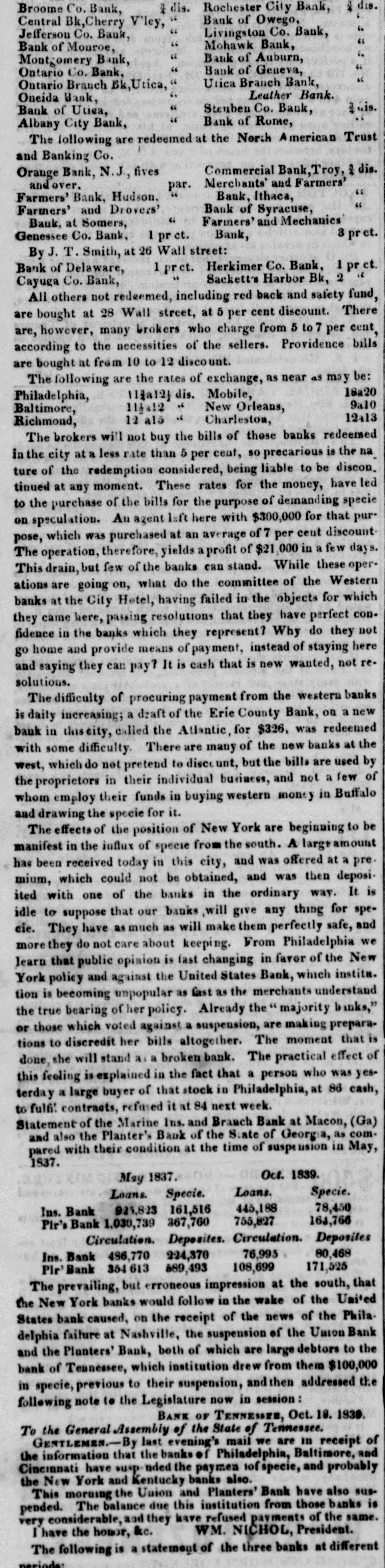
dis. dis. Rochester City Bank, Broome Co. Bank, Bank of Owego, Central Bk, Cherry V'ley, Livingston Co. Bank, Jefferson Co. Bank, " " Mohawk Bank, Bank of Monroe, " " Bank of Auburn, Montgomery Bank, " " Bank of Geneva, Ontario Co. Bank, " Utica Branch Bank, Ontario Brauch Bk,Utica, Leather Bank. Oneida Bank, " this. Steuben Co. Bank, Bank of Utiga, " Bank of Rome, Albany City Bank, The following are redeemed at the North American Trust and Banking Co. Commercial Bank,Troy, dis. Orange Bank, N.J., fives Merchants' and Farmers' and over. par. Bank, Ithaca, Farmers' Bank, Hudson. Farmers' and Drovers' Bank of Syracuse, Farmers' and Mechanics Bauk, at Somers, 3 pr ct. Genessee Co. Bank, 1 pr ct. Bank, By J. T. Smith, at 26 Wall street: Bank of Delaware, 1 pret. Herkimer Co. Bank, 1 pr ct. " Sackett's Harbor Bk, 2 Cayuga Co. Bank, All others not redeemed, including red back and safety fund, are bought at 28 Wall street, at 5 per cent discount. There are, however, many brokers who charge from 5 to 7 per cent according to the necessities of the sellers. Providence bills are bought at from 10 to 12 discount. The following are the rates of exchange, as near as may be: 18a20 112a12} dis. Mobile, Philadelphia, 9al0 New Orleans, 111x12 " Baltimore, 12:13 12 aló " Charleston, Richmond, The brokers will not buy the bills of these banks redeemed in the city at a less rate than 5 per cent, so precarious is the na ture of the redemption considered, being liable to be discon. tinued at any moment. These rates for the money, have led to the purchase of the bills for the purpose of demanding specie on speculation. An agent left here with $300,000 for that purpose, which was purchased at an average of 7 per ceut discount The operation, therefore, yields a profit of $21,000 in a few days This drain, but few of the banks can stand. While these operations are going on, what do the committee of the Western banks at the City Hetel, having failed in the objects for which they came here, passing resolutions that they have perfect con. fidence in the banks which they represent? Why do they not go home and provide means of payment, instead of staying here and saying they can pay? It is cash that is new wanted, not resolutions. The difficulty of procuring payment from the western banks daily increasing; a draft of the Erie County Bank, on a new bank in this city, called the Atlantic, for $326, was redeemed with some difficulty. There are many of the new banks at the west, which do net pretend te disco unt, but the bills are used by the proprietors in their individual business, and not a few of whom employ their funds in buying western money in Buffalo drawing the specie for it. The effects of the position of New York are beginning to be manifest in the influx of specie from the south. A large amount has been received today in this city, and was offered at a premium, which could not be obtained, and was then deposiited with one of the banks in the ordinary way. It is idle to suppose that our banks will give any thing for specie. They have as much as will make them perfectly safe, and more they do not care about keeping. From Philadelphia we learn that public opinion is fast changing in favor of the New York policy and against the United States Bank, which institu. tion is becoming unpopular as fast as the merchants understand the true bearing of her policy. Already the majority banks," or those which voted against a suspension, are making preparations to discredit her bills altogether. The moment that is done, she will stand as a broken bank. The practical effect of this feeling is explained in the fact that a person who was yesterday a large buyer of that stock in Philadelphia, at 86 cash, to fulfi: contracts, refused it at 84 next week. Statement of the Marine Ins. and Branch Bank at Macon, (Ga) and also the Planter's Bank of the State of Georgia, as com. pared with their condition at the time of suspension in May, 1937. Oct. 1839. May 1837. Loans. Specie. Loans. Specie. 78,450 445,188 Ins. Bank 925,823 161,516 164,766 755,827 Plr's Bank 1,030,739 367,760 Circulation. Deposites. Circulation. Deposites 76,995 80,468 Ins. Bank 496,770 224,370 171,525 108,699 Plr' Bank 354 613 689,493 The prevailing, but erroneous impression at the south, that the New York banks would follow in the wake of the United States bank caused, on the receipt of the news of the Phila. delphia failure at Nashville, the suspension of the Union Bank and the Planters' Bank, both of which are large debtors to the bank of Tennessee, which institution drew from them $100,000 in specie, previous to their suspension, and then addressed the following note to the Legislature now in session: BANK OF TENNESSEE, Oct. 18. 1839. To the General Assembly of the State of Tennessee. GENTLEMEN.-Bylast evening's mail we are in receipt of the information that the banks of Philadelphia, Baltimore, and Cincinnati have susp nded the paymen of specie, and probably the New York and Kentucky banks also. This morning the Union and Planters' Bank have also suspended. The balance due this institution from those banks is very considerable, and they have refused payments of the same. WM. NICHOL, President. I have the honor, &c. The following is a statement of the three banks at different neriods:


Article from Lynchburg Virginian, October 31, 1839

Click image to open full size in new tab

Article Text

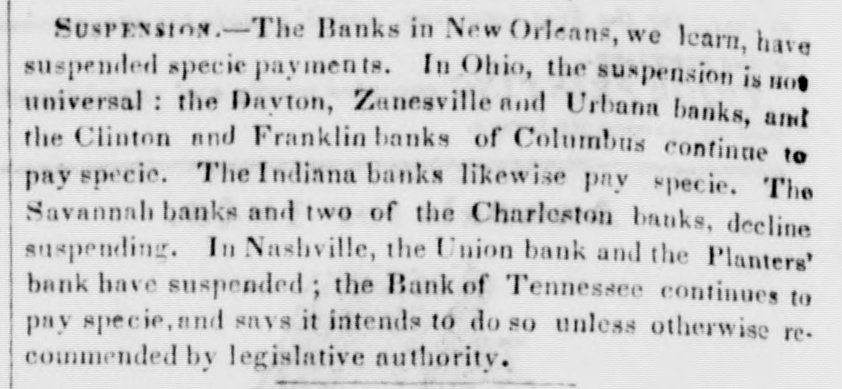
SUSPENSION.-The Banks in New Orleans, we learn, have suspended specie payments. In Ohio, the suspension is HOO universal : the Dayton, Zanesville and Urbana banks, and the Clinton and Franklin banks of Columbus continue to pay specie. The Indiana banks likewise pay specie. The Savannah banks and two of the Charleston banks, decline suspending. In Nashville, the Union bank and the Planters' bank have suspended; the Bank of Tennessee continues to pay specie, and says it intends to do so unless otherwise re. commended by legislative authority.


Article from Richmond Enquirer, November 1, 1839

Click image to open full size in new tab

Article Text

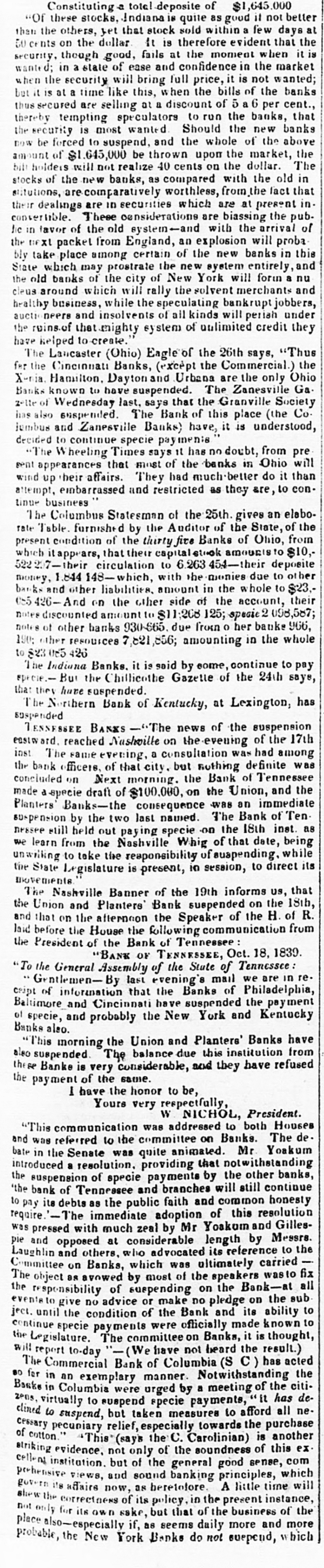
Constituting a total deposite of $1,645.000 Of these stocks, Indiana is quite good it not better than the others, yet that stock sold within a few days a 50 cents on the dollar It is therefore evident that the is security, though good, fails at the moment when it wanted in a state of ease and confidence in the market when the security will bring full price, it is not wanted; but is at a time like this, when the bills of the banks hus secured are selling at a discount of 5 per cent., thereby tempting speculators to run the banks, that the security is most wanted Should the new banks now be forced to suspend, and the whole of the above amount of $1.645,000 be thrown upon the market, The the holders will not realize 40 cents on the dollar. stocks of the new banks, as compared with the old in stitutions, are comparatively worthless, from the fact that in their dealings are ID securities which are at present consertible. These considerations are biassing the pubof the old system- with the arrival of the from England, an lic in next favor packet explosion banks will proba in bly take place among certain of the new this State which may prostrate the new system entirely, and the old banks of the city of New York will form a nu cleus around which will rally the solvent merchants and healthy business, while the speculating bankrupt jobbers, auctic neers and insolvents of all kinds will periah under the ruins.of that mighty system of unlimited credit they have helped to create. The Lancaster (Ohio) Eagle of the 26th says, "Thus for the Cincinnati Banks, (except the Commercial.) the X-nia. Hamilton. Dayton and Urbana are the only Ohio Banks known to have suspended. The Zanesville Ga. zette Wednesday last, says that the Granville Society has also suspended The Bank of this place (the Co. jumbus and Zanesville Banks) have, it 15 understood, decided to continue specie payments "The Wheeling Times says it has no doubt, from pre sent appearances that most of the banks in Ohio will wind up their affairs. They had much-better do it than attempt, embarrassed and restricted as they are, to continue business The Columbus Statesman of the 25th. gives an elaborate Table. fornish by the Auditor of the State, of from the condition of the thirty fire Banks of Ohio, present which it appears, that their amounts to $10, 22297-their circulation to 6.263 454-their deposite other money, 1.844 8-which with the monies due to banks and other liabilities. amount in the whole to $23.055426-And on the other side of the account, their notes discounted amount to $11;208 125; specie 2 098,587; notes of other banks 930-565. due from o her banks 966, 190: other resources 7,821,856; amounting in the whole to $23 065 426 The Indiana Banks. it is said by some, continue to pay specie.- But the Chillieothe Gazette of the 24th saye, that they have suspended. The Northern Bank of Kentucky, at Lexington, has suspended TENNESSEE BANKS "The news of the suspension eastward. reached Nashrille on the evening of the 17th inst The same evening, a consultation was had among the bank officers, of that city. but nothing definite was concluded on Next morning. the Bank of Tennessee the made specie draft of $100,000, on the Union, immediate and Planters Banks-the consequence was an Ten suspension by the two last named. The Bank of nessee still held out paying specie on the 18th inst. as we learn from the Nashville Whig of that date, while being unwilling to take the reaponsibility of suspending. the State Legislature is present, in session, to direct its movements The Nashville Banner of the 19th informs us, that the Union and Planters Bank suspended on the 18th, R. and that on the afternoon the Speaker of the H. of laid before the House the following communication from the President of the Bank of Tennessee "BANK OF TENNESSEE, Oct. 18, 1839. 'To the General Assembly of the State of Tennessee: Gentlemen- last evening's mail we are in recript of information that the Banks of Philadelphia, Baltimore and Cincinnati have suspended the payment of specie, and probably the New York and Kentucky Banks also. "This morning the Union and Planters' Banks have from also suspended The balance due this institution these Banke is very considerable, and they have refused the payment of the same. 1 have the honor to be, Yours very respectfully, W NICHOL, President. "This communication was addressed to both The Houses de. and referred to the committee on Banks. Yoakum bate was in the Senate was quite animated. Mr introduced a resolution. providing that notwithstanding the of payments by the other banks, 'the and branches to debts as the public faith and common pay suspension bank its of Tennessee specie will still resolution continue honesty require.'-1 immediate adoption of this Gilleswas pressed with much zeal by Mr Yoakum and Messrs. pie at considerable length by the who advocated its on which was ultimately fix Committee Laughlin and opposed and others, Banks, reference carried wasto to The object as avowed by most of the speakers all the responsibility of suspending on the Bank-at the sub eventato give no advice or make no pledge on ject. until the condition of the Bank and to to continue were officially specie payments made its it is known ability thought, the Legislature. The committee on Banks, will report to-day not beard the result.) The Commercial Bank of Columbia (S C) has acted the so for in an manner. Notwithstanding Baske in were urged by a deColumbia exemplary meeting of it the has citizens, to suspend specie payments, clined to but taken measures to virtually suspend, afford the purchase all necessary pecupiary relief, especially towards 'This' the C. Carolinian) striking not only of the soundness of cotton." evidence. (says of is this another com ex cellent institution. but of the general good sense, which perhensive views, and sound banking principles, will govern its affairs now, as heretofore. A little time shew the correctness of its policy. in the present instance, not only for its own sake, but that of the business of the place also-especially if, as seems daily more and more probable, the New York Banks do not suppend, which


Article from Staunton Spectator, and General Advertiser, November 7, 1839

Click image to open full size in new tab

Article Text

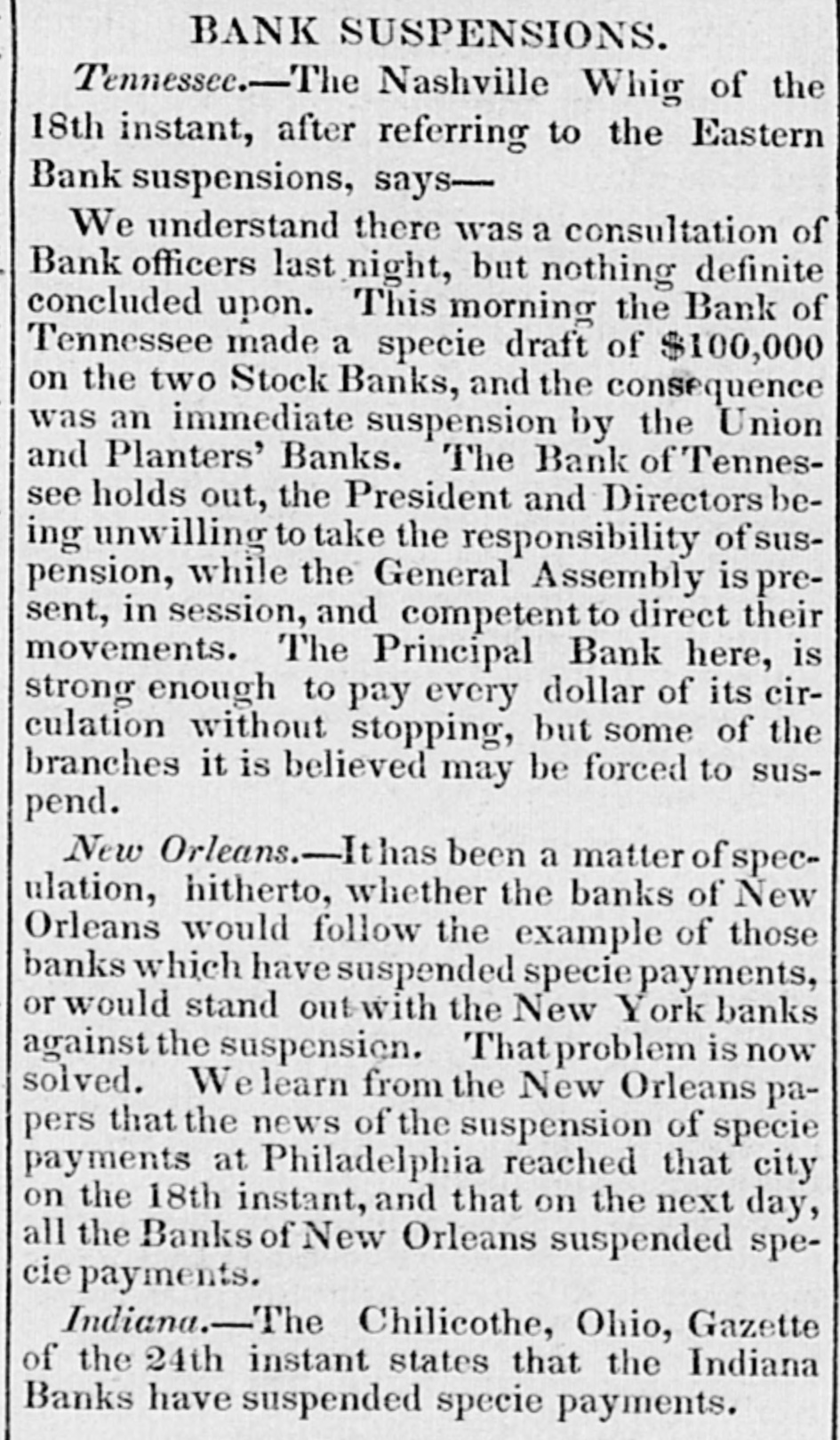
# BANK SUSPENSIONS. Tennessee. The Nashville Whig of the 18th instant, after referring to the Eastern Bank suspensions, says- We understand there was a consultation of Bank officers last night, but nothing definite concluded upon. This morning the Bank of Tennessee made a specie draft of $100,000 on the two Stock Banks, and the consequence was an immediate suspension by the Union and Planters' Banks. The Bank of Tennessee holds out, the President and Directors being unwilling to take the responsibility of suspension, while the General Assembly is present, in session, and competent to direct their movements. The Principal Bank here, is strong enough to pay every dollar of its circulation without stopping, but some of the branches it is believed may be forced to suspend. New Orleans. It has been a matter of speculation, hitherto, whether the banks of New Orleans would follow the example of those banks which have suspended specie payments, or would stand out with the New York banks against the suspension. That problem is now solved. We learn from the New Orleans papers that the news of the suspension of specie payments at Philadelphia reached that city on the 18th instant, and that on the next day, all the Banks of New Orleans suspended specie payments. Indiana. The Chilicothe, Ohio, Gazette of the 24th instant states that the Indiana Banks have suspended specie payments.


Article from Nashville Union and American, December 16, 1858

Click image to open full size in new tab

Article Text

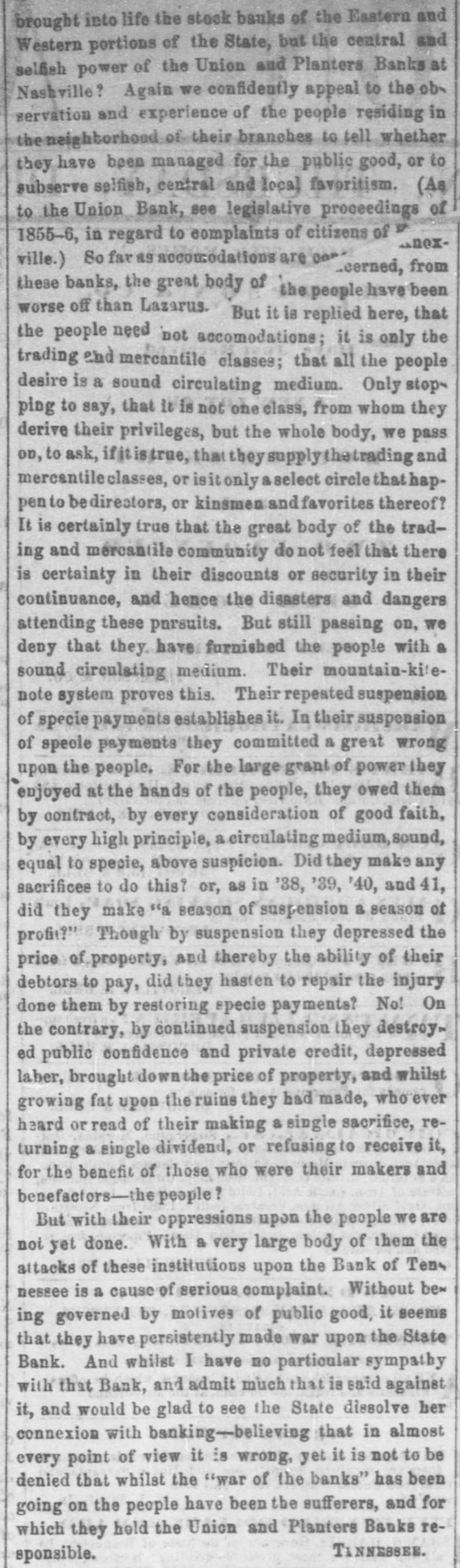
brought into life the stock banks of the Eastern and Western portions of the State, but the central and selfish power of the Union and Planters Banks at Nashville? Again we confidently appeal to the obs servation and experience of the people residing in the neightorhood of their branches to tell whether they have been managed for the public good, or to subserve selfish, central and local favoritism. (As to the Union Bank, see legislative proceedings of 1855-6, in regard to complaints of citizens of noxville.) So far as accomodations are 00 .cerned, from these banks, the great body of the people have been than off Lazarus. worse But it is replied here, that the people need not accomodations; it is only the trading end mercantile classes; that all the people desire is a sound circulating medium. Only stops ping to say, that it is not one class, from whom they derive their privileges, but the whole body, we pass on, to ask, if istrue, that they supply thetrading and mercantile classes, or isit only a select circle that happen to be directors, or kinsmen and favorites thereof? It is certainly true that the great body of the trading and mercantile community do not feel that there is certainty in their discounts or security in their continuance, and hence the disasters and dangers attending these pursuits. But still passing on, we deny that they. have furnished the people with a sound circulating medium. Their mountain-ki!enote system proves this. Their repeated suspension of specie payments establishes it. In their suspension of specie payments they committed a great wrong upon the people. For the large grant of power they enjoyed at the hands of the people, they owed them by contract, by every consideration of good faith, by every high principle, a circulating medium, sound, equal to specie, above suspicion. Did they make any sacrifices to do this? or, as in '38, '39, '40, and 41, did they make "a season of suspension a season of profit?" Though by suspension they depressed the price of property, and thereby the ability of their debtors to pay, did they hasten to repair the injury done them by restoring specie payments? No! On the contrary, by continued suspension they destroyed public confidence and private credit, depressed laber, brought the price of property, and whilst growing fat upon the ruins they had made, who ever heard or read of their making a single sacrifice, returning & single dividend, or refusing to receive it, for the benefit of those who were their makers and benefactors-the people But with their oppressions upon the people we are not yet done. With a very large body of them the attacks of these institutions upon the Bank of Tens nessee is a cause of serious complaint. Without be ing governed by motives of public good, it seems that they have persistently made war upon the State Bank. And whilst I have no particular sympathy with that Bank, and admit much that is said against it, and would be glad to see the State dissolve her connexion with banking-believing that in almost every point of view it is wrong, yet it is not to be denied tbat whilst the "war of the banks" has been going on the people have been the sufferers, and for which they hold the Union and Planters Banks reTinnessee. sponsible.


Article from Nashville Union and American, November 9, 1859

Click image to open full size in new tab

Article Text

'MAVa 3HL In referring, few dayssince, to the extraordinary Jo Banks 2018 om eq Avm which should this State. under charters like those of the Planters' -0q OM yorqu порвшлоји! uo ostimated am Rung queq Aue Jo streements the SB relible SW eq 04 live -xә uo program their 1941 offects JO SUBSIO change had amounted to forty cr fifty per cent. on their capital invested in bills. In this estimate, as 01 puotend you pip 9M 'smoqs uno matical accuracy, but we merely intended to give an the which profits am Jo statement Planter's Bank had realized, by reason of the powbeen peq прим quin Privides puu sua It is sufficient for our argument against the extenmons dank Planters atp 01 privides hous Jo 1018 that its prefits in the exchange business have at any -!xoadds masand 87! to роздаб an buying aus mated the amount stated. очм asoup Jo require out 01 Buoleq you op am "$ frequent the parlors of banks and bask in the sunshine of their royal favor, we have not been favor am Jo Ammanddo uu чтт per of the system of legerdemain by which those institutions realize their profits. What those profits: шолу ascritance Auo use OM "oun particular Aue 18 the nature of transactions in which they are known JOING being Abut OM have 01 with regard to the precise amounts which the Planters' Bank made from exchange during the last SLSmost upp been DABQ am persion which we can estimate its profits at an earlier peri-Jod.100m JO 108 present 81! Japun 811 Jo po ation. It will not avail the officers of that institution, then, to attempt to invalidate our statement, as the Nashville News professes to do by their authority by quibbling about dates. Such course is unPM pur Surpurts Jo gentement Jo work can scarcely believe that they would authorise the Editor of the News to deceive and mislead the peoB upons 01 Suprosed in uogsanb industrial THE uo ple miserable subterfuge. The material point, is what amount of pro+0.1 01 en been Bank Planters the lass sign -0J charter the to suotstaod the Japun alize newal of which is now asked for? We are informed, on reliable authority, and assured that reference to the books of the bank will verify the statement, that during the suspension of 37, and even since that time, the Planters' Bank charged from eight to ten per cent. for exchange. Buying sixty days bills at discount of one and half per cent., as is constantly done by the Planters' and other Banks, and re-investing the proceeds at a discount of three per cent the Bank realizes four and half per eent. on the transaction. Selling the exchange, then, at eight per cent. we have twelve 101 Bank the Jo signts the SU and Hot uptie four months, or thirty seven and a half percent.per annum. When the price of exchange was as high 01 eq pinom should the canth and tea SW forty-three and a half per cent. We do not know for how long these enormous rates continued, but single instance of such extortion is sufficient argument against a renewal of the charter which permits " But the News has not only been "authorized" as it says, by the President and Cashier of the Bank, to say that our statement, which is substantially verified above, "is totally unfounded in fact," but the same fortunate and favored organ has been furnished with astatement from which it learns that the average annual dividend paid by the Planters Bank to its stockholders on the share of $100 is only 5.75, Benevolent stockholders! Disinterested bankers! They have absolutely been furnishing a currency to the people of Tennessee, without realizing enough to pay their bonus to the State, according to the confiding and credulous News. astonishing that the News did not find out from this statement, in addition to the information which it imparts, that the Planters' Bank has accumulated surplus profits, not distributed to the amount of $493,186 80, more than one-third of its capital- all realized we learn since 1844 and that its dividends from the first of January 1857. to this time. including a di idend of five per cent last October, not mentioned in the statement amount toforty dollars on the hundred a pretty large tax levied on the productive labor of State the The News saw none of these things. It was oeeupied with its attempts to humbug the people by leading them to believe that the capitalists of the Planters Bank had been losing money in their benevolent exertions to furnish them with currency Let us look back to the early history of the Bank, and see whether its stockholders have actually been and W 18 capital now mo 01 48noua cent That most careful and exact statesman and public goods sin III "saxof M on the Sub-Treasury in Congress, April 1st, 1846. says, in regard to the organization of stock banks in Tennessee, (the Union and Planters' were the only ones.) that "I have never voted for Bank charter. But in the State of Tennessee they made banks some stock banks. They were an improvement on the old stock note system which exploded in 17. 18: and they required that the stock should be paid in my :ON jouop sign SEM puw plan -qns uosand puu poudo atom shood you DABY "Aus pToM att stop am Joj seribe brought any gold and silver. Those having the you soopit pinom urage am 10 make any difference subscribe. The managers at Nashville say that gold and silver not necessary. Pay us in the notes of specie-paying banks and if our bank, when it goes into operation, should require specie, she can call on the bank in whose notes you pay and get specie for them. In this way the first instalment on the stock of these banks "III pred SUM U ponss! JUL 1! SUM MoH. u! pred instruction 1841 SUM instruction us 401 e other uI chanter am SW pus plog Suvan ut mg :08 been DABY ABUL BOSED the stockholders got their notes ounted in banks: the proceeds of these notes were passed to their credit on the discount books of the banks: and then am uo clear oup 01 check JARS am элам Toup 1unours aig JOJ шоол our Jo apis am 1001 The 2018 our uo And 01 nodn colled yonut 08 JOJ the DARD am or state them uo pred book and there charged them with the amount of area shooq am snift pus Aup sup prud check am balanced Others paid in the notes of the bank And the people found two dollars of this paper cur oup Jo pollar блода 103 u! md About stockholders notes and bank notes paid in as capital The stock. statement of Mr. JONES has never been denied from 1846, when it was delivered, until the present time. It cannot, we presume. be truthfully denied So it appears that during the early periods of the Bank existence the stockholders were charging the people of Tennessee for their currency. based upon U uodn signed puu credit of which they issued tiro dollars for every one dollar that an Bank. they oured We hope the Legislature will be becomingly gratejo and and uo 10 sup 40J ["] the Planters Bank. our 10 Boddet THE The Daily News comes to the aid of the Nashville Banner and asserts that the repeal of the Missouri -Low STATES on: Jo Sujuado-aa SUM to 1.1ud Aue useq JOAJU If uonst JABQ am 1011 Kuop 01 owdand ano Mossing the Jo reder on UPM They heart punof Compromise line. What we say is this that the Jo our up!" punoj the line that with more or less bitterness they opposed the addmission of slave States before the repeal of the law establishing that line that, in 1850 they refused to extend that line to the Pacific that an Jo on poMoHoΓ exchement aug fugitive slave law in 1856, was asgreat as that which followed the repeal of the Missouri line and from 12th 01 U ponSus area JM facts asses tate, on the part of Northern Abolitionists. which no compromise short of the entire abolition of asseddu pmon 1 sr 1847 If 811 Jo LIOUS Surgiou pue 03 will satisfy the agitators. For Southern men to exSTM 1! 1041 punoas our uo a smp cuse sioned by the repeal of the Missouri compromise is a partext SEM 11 history JO story am Jo


Article from Nashville Union and American, May 26, 1875

Click image to open full size in new tab

Article Text

due EIque finding myself very often sick with and fever and withal very lonesome and with greatly diminished comforts, I determined to look around for another compan long which I found in the person of Sarah Aun Smith, the present companion of my woes and sorrows. She was born in Goochland county, Virginia, June 24, 1806, and was the daughter of Captain George SterlingSmith, of Madison county, Alabama, a sterling family and a sterling woman I have always found her to be. We were united in marriage at her father's house on the 24th of March, 1824, by the Rev. Willie Blount Peck, the stationed Methodist minister at Huntsville; Alabama. Aul по sdore OM1 made I mo sickety os 09 01 редоль vhhich the Гелер pus chill Will OS suffered determined to return to Nashville to my old homestead, in December, 1826. After recovering my health, I waselected, in April, 1828, chief book-keeper in United States Branch Bank, at Nashville, Jno. Sommerville was the Cashier and John Nichol the President. I remained in said bank about two years at a salary of $800 per annum, when an offer was made to me of the cashiership of the bank of State, by the Legislature of Tennessee, at salary of $1,500, which I accepted and gave a satisfactory bond for faithful performance. I took charge of the bank in the spring *0881 The bank was in great disrepute by the puz officers Former sig JO bad being underthe control of the Legislature had my reports to make to that body. the end of two years, for which period was elected, the Legislature re-elected me over Daniel Graham, a strong opponent a man well qualified, by a large and factory majority. This was a triumph which I was much pleased, as it was a full endorsement of the manner in which I had managed the affairs of the bank. SEM charter the the Planters' Bank of Tennessee, with capital of $2,000,000, the stock being subscribed and payments made sufficient put the bank into operation. The Board of Directors unanimously elected me Cashier on the 4th of March, 1834, Edward B. Littlefield, President, each at "munue per $2.000 Jo Subject The bank was successfully and profitably conducted until 1837, when the country was visited with apecuniary revulsion such as we have never before or since witnessed -sns the persond II States. Petiod the u! broke pue banks mo 118 Jo pension peeple ano JO thousands was the forerunner of the bankrupt law, 01 moj JOJ force up remained years. During all this time, I was prosperous and happy, when a large commission -isnq their JO branch e THE u! ness in New Orleans, was forced by suit into bankruptcy with a liability resting me for them for over $70,000. The amount of this liability was more than my property IInj pus Sunos being ng 'purtumos p[nom epn the isupuse dn poots JO adversity, and in the course of time mounted the pressure, felt myself a free man, and rejoiced over the success that many of my friends believed that would never be able to achieve. I remained in the Planters' Bank as Cashier until Sept. 1852, when, to great surprise of the Board of Directors, handed them my resignation, to take effect the 1st October following, or sooner if Board could find a suitable man to fill place. I was retained until about the Au 04 you Following December JO had I SE ! Am against Lut other business arrangements. While an officer of the Planters' Bank, had the satisfaction to believe that pleased the 01 as 'pue Director JO Breog the side world, it affords me pleasure to that they regretted the step I bad taken. had served in the bank about nineteen years, during which time I never was sent from my post for private recreation 01 Tisit B-SAEP ten SE Suo[ ass 0000 mg Aqua Springs-but several times for a days, and frequently on business for N 1843. 01 1888 шоу 'rueq feelings ever existed between the President and myself during the period we served to gether as executive officers, and I cultivated the most friendly relations with all subordinate officers of the bank, many survive. 11!7S шоца partient- E 1859 November JO 1st the "O ship agreement commenced between ley Wheless and myself, in the private banking and brokerage business, under name of Hobson & Wheless. Our business sucured SE uojun uno pur possperons SEM a happy one. The free banking system 1829 Rebruary u! E into passed availed ourselves of all the rights and privileges in that law, and on the 1st day August, 1853, changed our business to name and style of the Bank of Nashville '000'09$ Jo notes queq Jo issue uu THE prospered beyond our most sanguine College uo punor8 personsed peterions street, and erected a banking house, which, for comfort and convenience, surpassed anything of the kind in the city. This RECEIVE g Rive pur includes 01 seemed perity to our business, but in October, a general pecuniary panic con.menced New York, and ran over the country fire in dry stubble. Our Bank fell a Credit week ene up pus force its 01 tun bank in the city shared the same fate by suspension of specie payments. The Bank had enjoyed areputation and credit that houses could have acquired in 80 short period. We put the institution into immediate liquidation, as the junior partner had agreed to unite his future destiny Hewitt, Norton & Co., of New Orleans, and take charge of a branch of their house in Liverpool, England. In a short thereafter, the unfortunate civil war broke out between the North and the South, result of which is known to have been astrous to all classes of business in South. My partner and son-in-law, Wesley Wheless, died in Liverpool, 'Indy JO 4708 em no 'purls When I received intelligence of death, I left home for Liverpool on the of April, 1861, and returned to my home the 26th of May, bringing with me daughter and children, and her husband's remains, which are deposited in Mt. Olivet Cemetery, a monument designating place of his burial. In my hurry to finish the paper, T omitted to say anything about the war with England, then SEM I 1819, III commención young to become asoldier, and consequentstruggle the in and special ou 1001 "