20911. Fourth National Bank (Nashville, TN)

Bank Information

Episode Type
Run → Suspension → Reopening
Bank Type
national
Bank ID
1669
Charter Number
1669
Start Date
September 24, 1873
Location
Nashville, Tennessee (36.166, -86.784)

Metadata

Model
gpt-5-mini
Short Digest
6b418b5d

Response Measures

Accommodated withdrawals, Partial suspension

Other: Banks agreed among themselves to suspend payments on balances over $200 and to use certified checks/arrangements for trade.

Description

In late September 1873 the four Nashville national banks (including the Fourth National) posted a notice partially suspending payments on balances over $200 amid the New York panic. Newspapers describe evidence of a run and the joint partial suspension as a precaution; papers state banks expected to resume business once wider panic subsided. No permanent closure or receivership is mentioned.

Events (2)

1. September 24, 1873 Run
Cause
Macro News
Cause Details
Public alarm from the financial crisis and suspension of New York and other city banks (the 1873 panic) prompted depositors' withdrawals
Measures
Banks agreed to partially suspend payments on balances exceeding $200; posted notice and coordinated with other local national banks
Newspaper Excerpt
for the last few days there has been evidence of a run, and yesterday the following placard was placed at the entrance of our various banks
Source
newspapers
2. September 25, 1873 Suspension
Cause
Macro News
Cause Details
Partial suspension instituted as precautionary response to the money crisis and suspension of New York and other city banks; intended to protect liquidity and commerce
Newspaper Excerpt
it is hereby agreed by the four National Banks of this city that we suspend payments on all balances exceeding $200.
Source
newspapers

Newspaper Articles (3)

Article from Nashville Union and American, September 26, 1873

Click image to open full size in new tab

Article Text

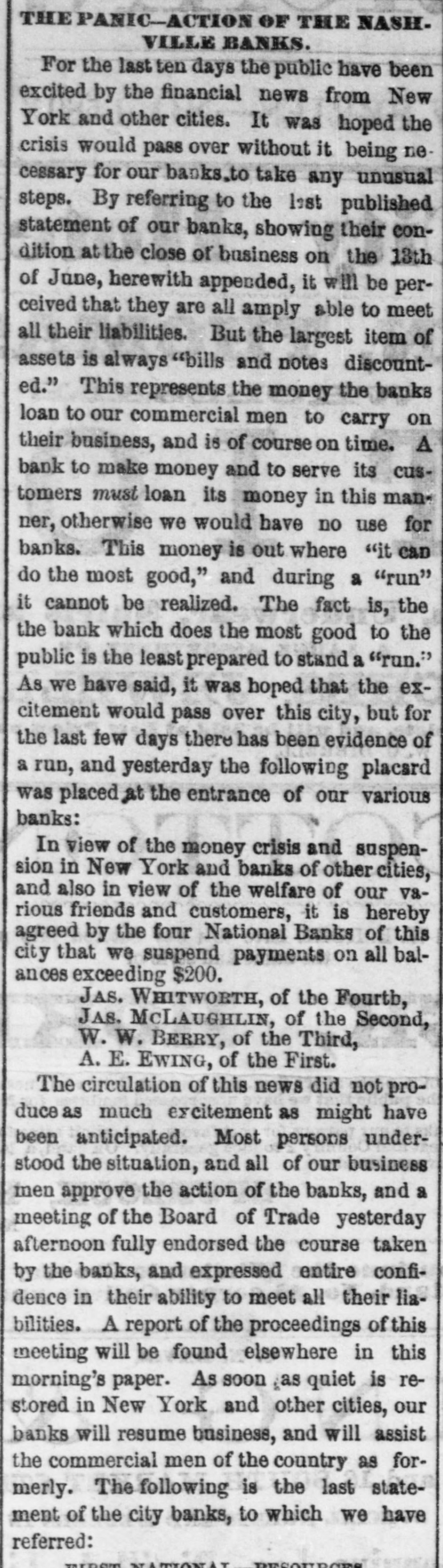
THEPANICACTION OF THE NASHVILLE BANKS. For the last ten days the public have been excited by the financial news from New York and other cities. It was hoped the crisis would pass over without it being necessary for our banks to take any unusual steps. By referring to the lost published statement of our banks, showing their condition at the close of business on the 18th of June, herewith appended, it will be perceived that they are all amply able to meet all their liabilities. But the largest item of assets is always "bills and notes discounted." This represents the money the banks loan to our commercial men to carry on their business, and is of course on time. A bank to make money and to serve its customers must loan its money in this manner, otherwise we would have no use for banks. This money is out where "it can do the most good," and during a "run" it cannot be realized. The fact is, the the bank which does the most good to the public is the least prepared to stand a "run." As we have said, it was hoped that the excitement would pass over this city, but for the last few days there has been evidence of a run, and yesterday the following placard was placed at the entrance of our various banks: In view of the money crisis and suspension in New York and banks of other cities, and also in view of the welfare of our VSrious friends and customers, it is hereby agreed by the four National Banks of this city that we suspend payments on all balances exceeding $200. JAS. WHITWORTH, of the Fourth, JAS. McLAUGHLIN, of the Second, W. W. BERRY, of the Third, A. E.EWING, of the First. The circulation of this news did not produce as much excitement as might have been anticipated. Most persons understood the situation, and all of our business men approve the action of the banks, and a meeting of the Board of Trade yesterday afternoon fully endorsed the course taken by the banks, and expressed entire confidence in their ability to meet all their liabilities. A report of the proceedings of this meeting will be found elsewhere in this morning's paper. As soon as quiet is restored in New York and other cities, our banks will resume business, and will assist the commercial men of the country as formerly. The following is the last statement of the city banks, to which we have referred:


Article from Nashville Union and American, September 26, 1873

Click image to open full size in new tab

Article Text

THE BOARD OF TRADE. Conference with the Bankers of the City. The Financial [Situation Debated. The Course of the Benks'Endorsed. A called meeting of the Nashville Board of Trade was held at 4 o'clock yesterday afternoon in the office of the Commercial Insurance Company, President H. C. Henslot in the chair, and R. L. Armistead Secreivj tary. President Hensley stated the object was to confer with the bank officers as to what was best togbe done'under existing circumstances. Judge Whitworth, President of the Fourth National Bank, being called upon, said the present state of affairs was a novel one to him. He had never seen anything like it. He was here to consult with the business men as to what was best to be done. The banks he thought were entirely solvent and able within a very short time to meet all their obligations, but could not do it in a day without a great sacrifice of their means and a total destruction of the (trade of the community for the time. Af er a consultation with all the National PAnks it was agreed that they shou'd partially suspend payment on all balances; over $200, but with this understanding that all deposits made after that hour should be paid in full and the business in all respects so far as the public was conceived should be conducted just as it was before the suspension, trusting to the collection of means due the banks and such cash means as they have in bank to pay, off their depositors in full, which he felt confident could be done in a short time. The banks expect to go on as usual and take bills of exchange drawn against shipments to the extent of their ability, which he believed would be sufficient to meet the wants of the mercantile emmunity. He said he had been asked if a check given by a bank here on a bank in New York was not honored, then what would be the result. He replied upon the return of the check dishonored, it would be taken up and paid by the bank suing it. The alternative was presented this day to the banks, as he believed, to take the course they have taken or to be so crippled by a run of their depositors as to be unable to afford the mercantile community any facilities in conducting their business or handling the produce of the country. Mr. Hensley asked the question of Judge Whitworth whether some arrangement could not be made by the banks by which settlements could be made between merchants dealing with the banks by means of certified checks. In reply to which he stated that he had no doubt it could, but no plan had yet been formally adopted, by the banks looking to that end. And also sail that with an appreciation of the situation by both merchants and bankers, there would not be much difficulty in carrying forward the trade and commerce of the country. Mr. Edgar Jones, Cashier of the Third National Bank, endorsed fally the remarks made by Judge Whitworth and referring to the question of certified checks, said he presumed some system would be adapted of that sort, for all settlements between banks belonging to the Clearing House Association in New York were made by certified checks. Mr. John W. Terrass wished to know if the banks would furnish facilities for the moving of produce 88 usual. In response to which the officers of the several banks present stated that that was the object of the partial suspension, and that every facility in that direction the banks could afford, would be given. Mr. Jas. A. McLanghlin, President of the Second National Bank, in a few brief remarks fully endorsed the statements made by Judge Whitworth and Edgar Jones, Esq. Mr. T. D. Craighead offered the following resolutions: Resolved, that the Board of Trade sanction the action taken by the banks to-day, believing it to be the wisest measure that could be inaugurated. Resolved, that we continue as usual to deposit from time to time in the banks and render them all the assistance in our power; and that our confidence in our financial institutions remains unimpaired. The resolutions were adopted by scela. mation, without a dissenting voice, and the meeting adjourced.


Article from Fayetteville Observer, October 2, 1873

Click image to open full size in new tab

Article Text

The Cash Crisis. The money "equeeze" to which we referred last week has extended to the West and South, and bunks are shutting down in all directions. The scare is out of all to the cause. the four Thursday proportion Nashville Last national banks suspended. It was done as a precautionary measurenot of necessity. The banks claim to be able to pay three dollara for one that they owe. It was plain to the officers that if they suffered a spontaneous raid the of depositors, business sacrificed, of the banks would not only be but the general mercantile interest of the whole community, as well, by the consequent stagnation of trade. They met and agreed to issue the following notice, which was shortly after conspicuously posted in the respective banks: In view of the monetary crisis, and suspension of New York and other city banks, and also in view of the interests of our various friends and customers, it is hereby agreed by the four National Banks of this city, that we sus- all pend currency payment on balances exceeding two hundred ($200) dollars. President JAMES Fourth WHITWORTH, National Bank. JAS. McLAUGHLIN, President Second National Bank. W. W. BERRY, President Third National Bank. A. G. EWING, For First National Bank. This notice at first produced quite a little breeze, and brought good many depositors to the to inquire what They were genbanks a and portended. it meant could erally told every depositor obeck out $200, and that within bal reasonable time, all their ances could be settled, if desired If money was wanted for a legiti- be mate business, it would also furnished to help any merchant out of a difficulty, but when man simply came through th promptings of fear, and desire to check out by wholesale, the would simply call "time" on him It seems evident that had the banks continued to pay cut at call by the end of the week the to would have been co.npelled close, and thus a disastrous pan is might have been precipitated which would have ramified through Middle Tennessee Thi would have ruined trade for thi because the circulating which WAS would have aeason, medium pendent, upon been it the with ol de drawn and stored away in chests and trunks and cupboard and yarn socks, and every othe known receptacle and nook an corner which might have bee measurably considered safer than banks. The crisis was brought to a hea by the Louisville and Nashvill and Great Southern and St Lou and Southeastern railroads refus ing to receive checks on the Nash ville banks inpayment for ineights Per contra, the Nashville and Cha tanooga and St. Louis railroads If ceived the checks in payment. Thursday evening the Nash a ville Board of Trade met and dopted the following resolution by acclamation: Resolved, That the Board o Trade sanction the action take by the banks today, believing to be the wisest measure th could be inaugurated. Resolved. That we continue usual, to deposit from time as time in the banks, and rend them all the assistance in o power; and that our confidence r in our financial institutions maine unimpaired. Rest Thos. B. Kercheval, ra