20903. Commercial National Bank (Nashville, TN)

Bank Information

Episode Type
Suspension → Closure
Bank Type
national
Bank ID
3228
Charter Number
3228
Start Date
March 25, 1893
Location
Nashville, Tennessee (36.166, -86.784)

Metadata

Model
gpt-5-mini
Short Digest
43eead39

Response Measures

None

Receivership Details

Depositor recovery rate
71.5%
Date receivership started
1893-04-06
Date receivership terminated
1899-05-27
OCC cause of failure
Fraud
Share of assets assessed as good
44.4%
Share of assets assessed as doubtful
15.4%
Share of assets assessed as worthless
40.3%

Description

The Commercial National Bank of Nashville suspended after heavy losses from the failure of cotton brokers Dobbins & Dazey (and related misconduct by its cashier). A receiver was appointed (Comptroller named a receiver March 30) and the bank remained in receivership; later dividends were paid by the receiver. There is reporting of citywide panic and runs on other banks, but the Commercial National closed/suspended (then placed in receivership) rather than experiencing a documented successful run-and-resume. OCR typos corrected (e.g., Porterfield for Porte: field).

Events (5)

1. July 22, 1884 Chartered
Source
historical_nic
2. March 25, 1893 Suspension
Cause
Bank Specific Adverse Info
Cause Details
Direct losses from the failure of Dobbins & Dazey (large indebtedness/exchange protested) and related misstatements/speculations by Dazey; bank hit by bad paper/overdrafts and alleged embezzlement by cashier Porterfield; suspension taken to avoid a run and permit equal distribution to creditors.
Newspaper Excerpt
The Commercial National Bank of this city suspended this afternoon after banking hours. The cause of the suspension was the failure two days ago of Dobbins, Dazey & Co.
Source
newspapers
3. March 30, 1893 Receivership
Newspaper Excerpt
Comptroller Hepburn said this afternoon that he would appoint a receiver for the Commercial National Bank of Nashville ... Frank Porterfield, the cashier of the bank, ... has been arrested for embezzlement.
Source
newspapers
4. March 31, 1893 Other
Newspaper Excerpt
Frank Porterfield, cashier of the suspended Commercial National bank of this city, has been arrested on a warrant sworn out by Bank Examiner McKnight. Porterfield gave bond in the sum of $10,000. The charges are perjury and making false statements to the department.
Source
newspapers
5. April 6, 1893 Receivership
Source
historical_nic

Newspaper Articles (25)

Article from The Times, March 26, 1893

Click image to open full size in new tab

Article Text

FAILURE OF DOBBINS & DAZEY. Mr. Dobbins Makes a Statement Giving the Cause of the Failure. NASHVILLE, TENN., March 25.-Mr. J. P. Dobbins has made the following statement concerning the failure of the firm of Dobbins & Dazey: The firm of Dobbins & Dazey has been in business sixteen years, and has steadily prospered. On March 9th, I had every reason to believe and did believe that our business was worth $500,000. On that day I received a telegram reporting that some drafts of our Nashville office had been protested. This greatly surprised me, as I did not think we owed any money, and had received no information about this from our Nashville office. I came by the next train to Nashville, going direct to Mr. Dazey, who seemed to think that our business was all right. Mr. Dazey was then and is now sick. On investigation at our office I found that we were largely in debt, much of it to New York and in the East. It seems that over $500,000 have been lost in various ways from our business, leaving us unable to meet our obligations, all of which are debts of the Nashville office. To protect our creditors we have made an assignment, surrendering all assets of all kinds belonging to the frm. Also all of my individual property. Nashville is our parent office, and Mr. Dazey, the resident partner. I reside at New Orleans. During sixteen years of most intimate association with Mr. Dazey I never questioned a statement he ever made; he had my fullest confidence. I have believed him to be a man of the highest order of integrity. I cannot explain his statements or his actions, and he has refused to explain them to me. Our legitimate business, conducted according to the purpose of our partnership, has always been profitable. It seems that heavy losses were made by outside speculations, which had nothing to do with our business. Among them is a heavy loss by the Union Mill Company. I mention this that the cause of our troubles may attach where it belongs, and not to any fault of our business. The managers of our branch offices are not liable in any way for our obligations: I will stay in Nashville for the present and look after the interest of the business. I do not think the suspension will have any effect on the cotton market, as we have little or no interest in it now. I do not think it will materially effect our local banks, as our branch offices owe nothing, and their business is in good shape. Our affairs may wind up much better than at present the outlook would seem to indicate. Failure of a Bank Results. NASHVILLE, TENN., March 25.-The Commercial National Bank, of this city, has failed. The cause is due to the failure a few days ago of Dobbins & Dazey. The capital of the bank is $1,000,000.


Article from St. Paul Daily Globe, March 26, 1893

Click image to open full size in new tab

Article Text

Commercial National, Nashville, Involved in the Dobbins-Dazey Failure. Pending the Arrival of the Examiner, a Director Has Charge. The Failed Firm's Indebtedness to the Bank $263,000. Most of the Amount in Exchange, Which Went to Protest. NASHVILLE' Tenn., March 25.-Dr rectly after the Commercial National bank closed its doors today its affairs were placed in the hands of one of the directors, E. R. Richardson, pending the arrival of a bank examiner. It seems that the bank had been involved in the recent failure of the Dobbins & Dazey firm. This firm, during the past sixteen years, has deposited millions of dollars of foreign exchange with various Nashville banks, and none of them has ever lost a cent, but it seems that during the past-few days there has been deposited exchange on John Monroe & Co., New York bankers, for a large amount, which went to a protest, and, with overdrafts and notes, makes Dobbins & Dazey's indebtedness amount to $263,000, in some of which the bank is secured. The capital stock of the bank is $500,000, surplus and undivided profits $190,000, and it is stated that even if the loss were twice as much there would be no loss to the depositors. It was stated that Mr. Dazey, who was engaged in speculating with the firm's money, is a mental and physical wreck. C. M. Spurr is president of the bank, and Frank Porterfield cashier. The capital stock of the bank is not impaired, except by the Dobbins & Dazey indebtedness. The President's Statement. The bank owes depositors about a half-million of dollars. Mr. Spurr, the president of the bank, makes the following statement: "The failure of the firm of Dobbins & Dazey involved the bank in a heavy loss, the exact amount of which cannot yet be ascertained. The stringency of the money market East rendered it difficult to rediscount, and as rumors detrimental to the interest of the bank were being circulated on the streets of Nashville, and in order that a run on the bank might be avoided and all creditors be permitted to share alike in its assets, a suspension was regarded as the only course left to the bank. Nearly the entire amount of the indebtedness of this firm to the bank was brought about by means of gross misstatements as to shipments of cotton made by Mr. Dazey to the cashier. From a careful estimate of the assets of the bank, there can be no reasonable doubt but that all the creditors will be paid in full just as soon as the assets of a bank can be realized on. Should the entire amount involved in the Dobbins & Dazey failure be a total loss and all other doubtful claims be charged off, after exhausting the surplus and undivided profits, the impairment of the capital stock cannot be very great. The surplus and undivided profits amount to about $190,000." The Commercial National bank holds life insurance policies upon the lite of Dazey, of the firm of Dobbins & Dazey, amounting to $175,000, part secu ity for the amounts due from that firm.


Article from The Morning Call, March 26, 1893

Click image to open full size in new tab

Article Text

CARRIED THE BANK DOWN. Disastrous Result of the Failure of a Cotton Firm. NASHVILLE, Tenn., March 25.-The Commercial National Bank of this city suspended this afternoon after banking hours. The cause of the suspension was the failure two days ago of Dobbins, Dazey & Co., with its chief offices in this city, and which firm was largely indebted to the National Commercial Bank. At a bankers' meeting of the repressntatives of other banks of the city the conclusion was unanimously reached that there was no reason in the present condition of affairs for apprehending any other suspensions among the banks of the city, and that business would go on as usual. The Commercial National Bank has a capital stock of $500,000 and a surplus fund and undivided profits of $96,000. It is believed that all depositors will be paid in full, and that the stockholders, when the affairs of the bank are wound up, will lose little, if anything. The bank owes depositors about $500,000. Mr. Spurr, the president of the bank, says the failure of Dobbins and Dazey involved the bank in a Heavy loss, the exact amount of which cannot yet be ascertained, and the stringency of the money market in the East rendered it difficult to rediscount. As rumors detrimental to the interest of the bank were-being circulated on the streets of Nashville, and in order that a run on the bank might be avoided and all creditors be permitted to share alike in its assets, suspension was regarded as the only course left. Nearly the entire amount of indebtedness of this firm to the bank was brought about by means of gross misstatements as to shipments of cotton, made by Mr. Dazey to the cashier. The bank holds life insurance policies upon the life of Dazey amount ing to $175,000. as a part of the security for the amounts due from that firm.


Article from The Daily Morning Astorian, March 26, 1893

Click image to open full size in new tab

Article Text

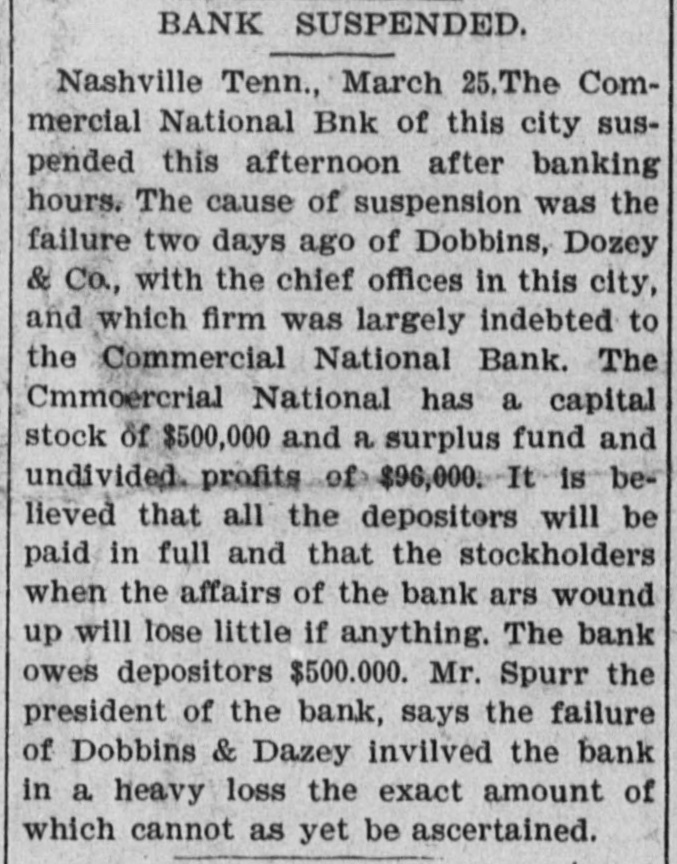
BANK SUSPENDED. Nashville Tenn., March 25.The Commercial National Bnk of this city suspended this afternoon after banking hours. The cause of suspension was the failure two days ago of Dobbins, Dozey & Co., with the chief offices in this city, and which firm was largely indebted to the Commercial National Bank. The Cmmoercrial National has a capital stock of $500,000 and a surplus fund and undivided. profits of $96,000. It is believed that all the depositors will be paid in full and that the stockholders when the affairs of the bank ars wound up will lose little if anything. The bank owes depositors $500.000. Mr. Spurr the president of the bank, says the failure of Dobbins & Dazey invilved the bank in a heavy loss the exact amount of which cannot as yet be ascertained.


Article from The Sun, March 26, 1893

Click image to open full size in new tab

Article Text

Bank Failure In Nashville. NASHVILLE. Tenn., March 25.-The Commercial National Bank of this city has suspended. The cause is the failure. a few days ago. of Dobbins & Dazey. The capital of the bank is $1,000,000.


Article from The Roanoke Times, March 28, 1893

Click image to open full size in new tab

Article Text

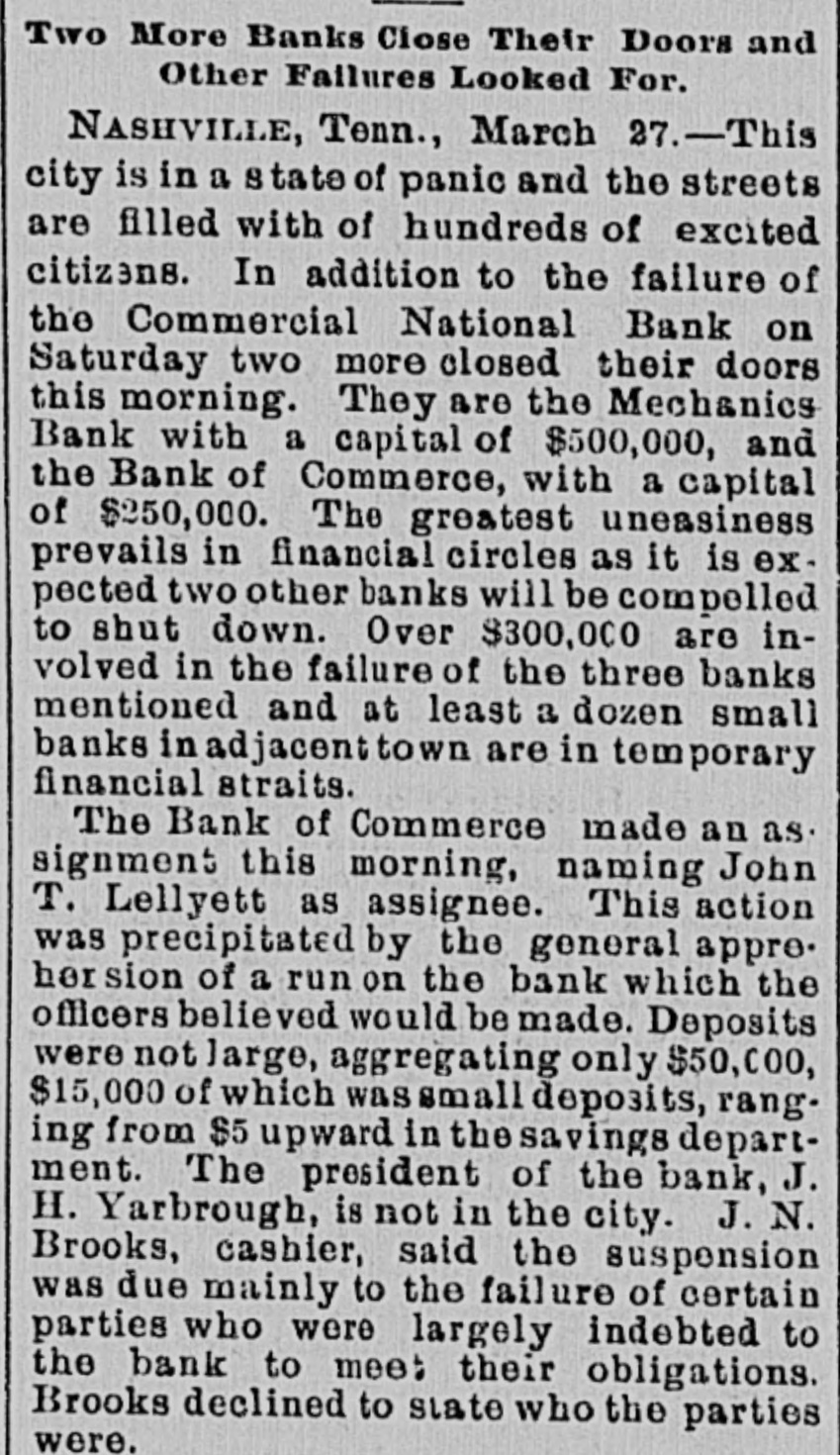
Two More Banks Close Their Doors and Other Failures Looked For. NASHVILLE, Tenn., March 27. - This city is in a state of panic and the streets are filled with of hundreds of excited citizens. In addition to the failure of the Commercial National Bank on Saturday two more closed their doors this morning. They are the Mechanics Bank with a capital of $500,000, and the Bank of Commerce, with a capital of $250,000. The greatest uneasiness prevails in financial circles as it is expected two other banks will be compelled to shut down. Over $300,000 are involved in the failure of the three banks mentioned and at least a dozen small banks in djacent town are in tem porary financial straits. The Bank of Commerce made an as. signment this morning, naming John T. Lellyett as assignee. This action was precipitated by the general appre. hersion of a run on the bank which the officers believed would be made. Deposits were not large, aggregating only $50,000, $15,000 of which was small deposits, ranging from $5 upward in the savings department. The president of the bank, J. H. Yarbrough, is not in the city. J. N. Brooks, cashier, said the suspension was due mainly to the failure of certain parties who were largely indebted to the bank to mee: their obligations. Brooks declined to state who the parties were.


Article from Connecticut Western News, March 30, 1893

Click image to open full size in new tab

Article Text

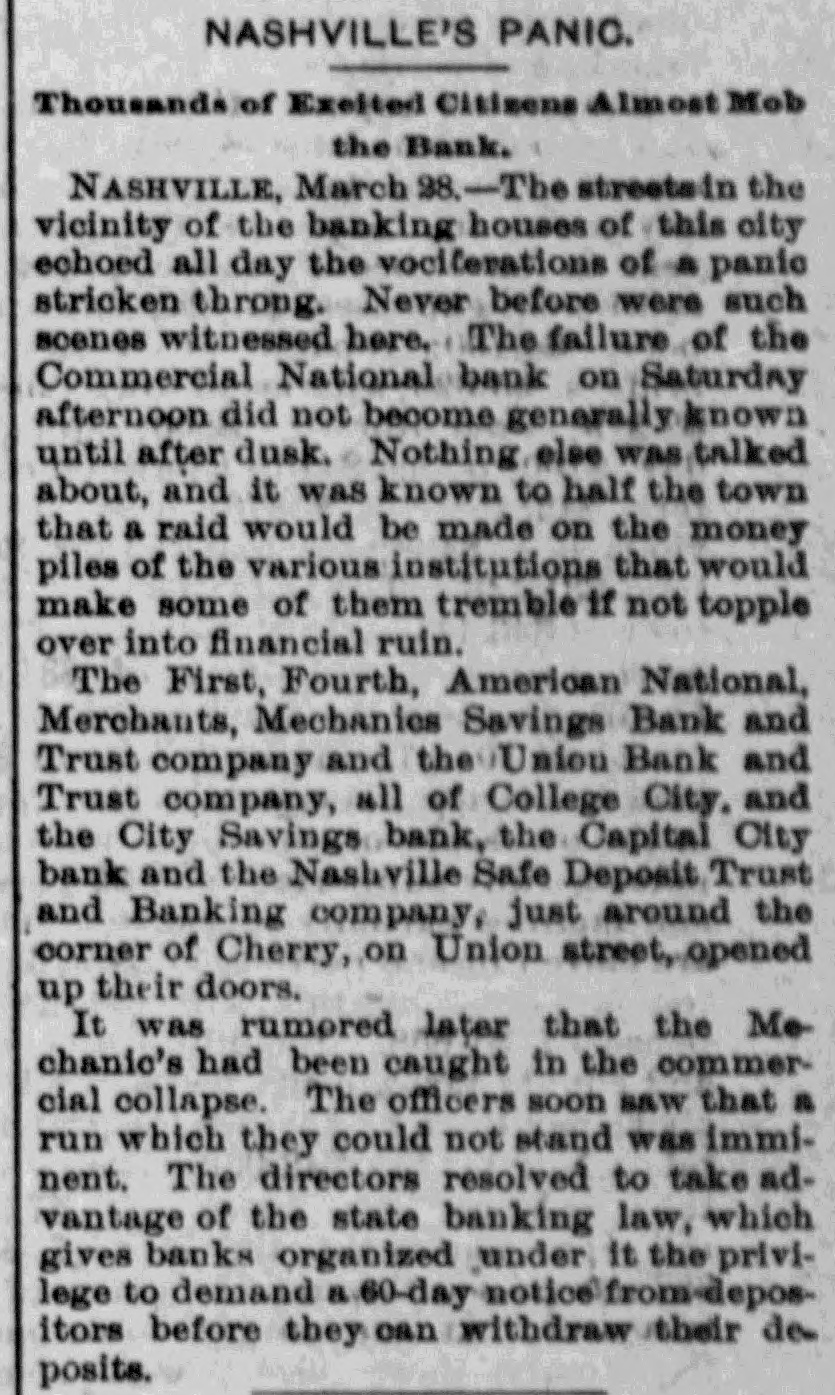
NASHVILLE'S PANIC. Thousands of Excited Citizens Almost Mob the Bank. NASHVILLE, March 28.-The streets in the vicinity of the banking houses of this city echoed all day the vociferations of a panic stricken throng. Never before were such scenes witnessed here. The failure of the Commercial National bank on Saturday afternoon did not become generally known until after dusk. Nothing else was talked about, and it was known to half the town that a raid would be made on the money piles of the various institutions that would make some of them tremble if not topple over into financial ruin. The First, Fourth, American National, Merchants, Mechanics Savings Bank and Trust company and the Union Bank and Trust company, all of College City. and the City Savings bank, the Capital City bank and the Nashville Safe Deposit Trust and Banking company, just around the corner of Cherry, on Union street, opened up their doors. It was rumored later that the Mechanic's had been caught in the commercial collapse. The officers soon saw that a run which they could not stand was imminent. The directors resolved to take advantage of the state banking law, which gives banks organized under it the privilege to demand a 60-day notice from itors before they can withdraw their deposits.


Article from Richmond Dispatch, March 31, 1893

Click image to open full size in new tab

Article Text

NASHVILLE'S BANK TROUBLE. Cashier Porterfield Arrested-Other Arreals May Follow. (By telegraph to the Dispatch. WASHINGTON, March 30.-Comptroller Hepburn said this afternoon that he would appoint a receiver for the Commercial National Bank of Nashville, The failure that at first seemed smell has since grown to larger proportions, and will exceed in amount $500.000. It is not felt here that any other national bank in Nashville will be affected. As a result of examination of the books of the bank Frank Porterfield, the cashier of the bank, at the instance of the Governor. has been arrested for embezzlement. and it is intimated that other arrests of higher officials may follow.


Article from The Morning News, March 31, 1893

Click image to open full size in new tab

Article Text

NASHVILLE'S BANK BREAK. The Cashier Arrested on a Charge of Embezzlement. W ASHINGTON, March 30-Controller Hep# burn said this afternoon that he would appoint a receiver for the Commercial National Bank of Nashville, Tenn. The failure, that at first seemed small, has since grown to larger proportions, and will exceed in amount $500,000. It is not felt here that any other national bank in Nashville will be affected. As a result of an examination of the books of the bank Frank Porterfield, cashier of the bank, at the instance of the government, has been arrested for embezzlement, and it is intimated that the arrest of others of the higher officials may follow.


Article from Huntsville Gazette, April 1, 1893

Click image to open full size in new tab

Article Text

Arrested the Cashier. NASHVILLE, Tenn., 31.-F. Porte: field. cashier of the suspended Comme: cial National bank of this city, has be arrested on a warrant sworn out Bank Examiner McKnight. Porterfie gave bond in the sum of $10,000. In charges are perjury and making fal statements to the department.


Article from Perrysburg Journal, April 1, 1893

Click image to open full size in new tab

Article Text

PANIC DOWN SOUTH. Intense Excitement in Nashville, Tenn.Three Banking Institutions Have Failed with a Total Involved of Over $3,000,000-More Failures Anticipated. NASHVILLE, Tenn., March 28.-Monday there was great excitement on the streets where the banks are located. At 9 o'clock, the hour the banks open, quite a crowd had gathered at the corner of College and Union streets, in the vicinity of the banks, and when the doors were opened a small run was made on the First national, but the depositors got their money so rapidly that they became convinced that their fright was an error and in nearly every instance redeposited. Two of the smaller banks, both doing business under state charters, atan early hour took advantage of the privileges given them by the law and required sixty days' notice of the withdrawal of deposits. Both of these banks had savings departments connected with them and upon these two banks the principal runs were made. One of them, the Bank of Commerce, doing a small business with deposits amounting to about $50,000, suspended payments, though it might have availed itself of the sixty days' notice from depositors. It made a general assignment under the state laws for the benefit of all creditors. This failure is a bad one. The Mechanics' bank, another state institution with a savings department and having many small creditors, opened its doors as usual, but soon it was evident that a run was being made upon it, and the directors met and decided to take advantage of the law requiring sixty days' notice from depositors and suspended payments. This bank will in all probability resume in a few days. The liabilities of the Bank of Commorce are $97,000; capital stock, $27, 000. As a result of the suspension of the Mechanics' bank Lewis T. Baxter, the president, made a special assignment Monday for the benefit of the bank and other creditors. The excitement growing out of the failure of the Commercial national bank in this city Saturday night continues to be intense. There are many rumors afloat and it is expected that there will be some startling developments when the affairs of the bank come to be inquired into by the official examiner. Criminal prosecution may follow. Other institutions of the city are thought to be involved in the collapse of the Commercial bank and that of Dobbins & Dazey, which was the primary cause of the troubles. More failures are apt to follow. Over $3,000,000 is involved in the failure of the three banks mentioned above, and at least a dozen small banks in adjacent towns are in temporary financial straits.


Article from The Farmers' Union, April 6, 1893

Click image to open full size in new tab

Article Text

F. PORTERFIELD, cashier of the suspended Commercial National Bank of Nashville, Tenn., has been arrested on a warrant sworn out by Bank Examiner McKnight. Porterfield gave bail in the sum of $10,000. The charges are perjury and making false statements to the department.


Article from The Sun, April 6, 1893

Click image to open full size in new tab

Article Text

asserting that he could prove that the government had sold judgeships and postmasterships and used the money for campaign purposes. He was called to order and compelled to withdraw. Horace C. Donoghue, a well known printer and publisher of Chicago, committed suicide at his home by cutting his throat from ear to ear. He was in good circumstances financially, and was undoubtedly laboring under a temporary aberration when he committed the deed. F. Porterfield, cashier of the suspended Commercial National bank of Nashville, Tenn., has been arrested on a warrant sworn out by Bank Examiner McKnight. Porterfield gave bail in the sum of $10,000. The charges are perjury and making false statements to the department. Peter W. Person, a wealthy liverman of South Omaha, was found dead in bed in his office recently with his skull fractured. The murder was evidently committed with a club found in the premises. Person did not reside with his wife, and she has not appeared on the scene, although she has been notified. Dick Gifford has been arrested on suspicion, and the police are looking for a man named Pender, alias Rodeman, who is missing from the stable where he worked. "Billy" Hawley, the king of green goods swindlers and represented to be a nephew of United States Senator Hawley, is under arrest at Chicago. He was captured in a saloon with "Billy" Brice or Burch, another famous crook. The Chicago postal inspectors think they have evidence enough against Hawley to make a conviction this time a certainty. The specific complaint on which he was arrested was made by Marion Skinner of High Hill, Mo., who received several of his circulars. The Vienna Neue Freie Presse states that last year the Irish bishops, in the presence of their American colleagues, asked the pope frankly why he did not renounce the temporal power and give up the friction of his captivity, and Leo replied evasively: "It would not be seemly for me to do so." The Neue Freie Presse protests against the pope expecting the Catholics of the world to take up arms against Italy when not a single Italian cardinal believes the restoration of the temporal power possible,


Article from The Monmouth Inquirer, April 6, 1893

Click image to open full size in new tab

Article Text

NASHVILLE'S PANIC. Thousands of Excited Citizens Almost Mob *the Bank. NASHVILLE, March 28. - -The streets in the vicinity of the banking houses of this city echoed all day the vociferations of a panic stricken throng. Never before were such scenes witnessed here. The failure of the Commercial National bank on Saturday afternoon did not become generally known until after dusk. Nothing else was talked about, and it was known to half the town that a raid would be made on the money piles of the various institutions that would make some of them tremble if not topple over into financial ruin. The First, Fourth, American National, Merchants, Mechanics Savings "Bank and Trust company and the Union Bank and Trust company, all of College City. and the City Savings bank, the Capital City bank and the Nashville Safe Deposit Trust and Banking company, just around the corner of Cherry, on Union street, opened up their doors. It was rumored later that the Mechanic's had been caught in the commercial collapse. The officers soon saw that a run which they could not stand was imminent. The directors resolved to take advantage of the state banking law, which gives banks organized under it the privilege to demand a 60-day notice from depositors before they can withdraw their de posits.


Article from The Indianapolis Journal, April 7, 1893

Click image to open full size in new tab

Article Text

Other Business Troubles, WASHINGTON, April 6.-The report of the examiner in charge of the Commercial National Bank, of Nashville, Tenn.. indicates that it will require an assessment of about 80 per cent, on the stockholders to pay off its indebtedness. The assets are stated at $2,400,000, and estimated losses, 8850,000, leaving the value of the assessments $1,550,000. The amount due depositors is $1.500,000. and the total liabilities, aside from capital stock, $1,900,000. CLEVELAND, April 6.-John Wild has been appointed receiver of the Washington Union Fire Insurance Company, of this city. The company is one of the oldest in the State. having obtained its charter in 1831. For some time, it is alleged, the company has been in a shaky condition. Its liabilities and assets are small. CINCINNATI, April 6.-William Roncheim & Co., clothiers. No. 70 West Pearl street, have assigned to Jacob Schroeder. Assets, $40,000; liabilities, $80,000 to $100,000. The assets are all exhausted by preferences.


Article from The Abbeville Press and Banner, April 12, 1893

Click image to open full size in new tab

Article Text

THREE BANKS FAIL. A Panic in Nashville (Tenn.) Commer. cial Circles. Three banks in Nashville, Tenn., which had been regarded as substantial failed to open their doors on the morning after the failure of Dobbins & Dazey, the big cotton brokers. In consequence there was a panic in commercial circles and confidence in the stability of other institutions was shaken. The first announcement was that the Commercial National Bank had failed. This was soon followed by the reports that the Mechenics' Savings Bank and Trust Company and the Bank of Commerce were in difficulties. A run on all the banks was feared, and to avoid this the banks made assignments, thus protecting equally the interests of all the creditors. The Commercial National Bank had enjoyed the utmost confidence of the people of Nashville. The suspension is the direct result of the failure of Dobbins & Dazay. cotton brokers. The amount stated as the indebtedness of that firm to the Commercial was $30,000. It has since been learned that the bank's total loss on Dobbins & Dazey's paper, their foreign exchangeand overdraft amounted to $263,000. The Bank of Commerce made assignment naming John T. Lellyett as assignee. This action was precipitated by the general apprehension of a run on the bank, which the officers believed would be made. The deposits were not large, aggregating only about $50,000. The Mechanics' Bank suspended withdrawais by depositors for sixty days. The three failures will break about thirty small banks in the country towas and the losses in all will reach one million and a half dollars. Two small State banks failed that day. The failure will stagnate business and the loss from that source will be equally as great.


Article from The Weekly Union Times, April 14, 1893

Click image to open full size in new tab

Article Text

The Wrecked Nashville Bank. WASHINGTON, D. C.-Comptroller Hepburn appointed Janies W. Blackmore, of Gallatin, Tenn., receiver of the Commercial National Bank of Nashville, Tenn. Blackmore is president of the First National Bank of Gallatin.


Article from St. Paul Daily Globe, April 17, 1893

Click image to open full size in new tab

Article Text

A Tennessee Savings and Trust Company Driven Into Bankruptcy. The Cashier Uses $65,000 of Its Funds in Playing Bucket Shops. Two Men Killed in a Bloody Battle Between Italians and Hungarians. The Latter Become Dismayed and Flee Precipitately From the Field. NASHVILLE, Tenn., April 16.-This afternoon there was given to the public the fact that John Schardt, cashier of the Mechanics' Savings Bank and Trust Company. was short in his accounts from $40,000 to $80,000. Schardt is sick at his home and not allowed to talk. The directors of the bank have been in session all day and are still in session behind closed doors, and will not talk, From one, however, it is learned that it is believed the shortage is $65,000. Immediatsly after 12 o'clock tonight the bank will make a general assignment, which is now being prepared. It is a case of stealing, and affects none of the other banks of the city. Schardt has been cashier about three months. Before that he had been the teller of the bank, and was thoroughly trusted. It is stated that a discovery of a probable shortage occurred yesterday, when a check for $4,000 was presented and the teller could find no credits for Schardt at his home sick, being the amount. the at president the time and directors were notified, an examination entered upon, and it was discovered that there was a shortage. The plan he worked was this: He would take deenter them upon the pass book and them upon the posits, not put books Schardt of the bank. It is also stated that had confessed to having used $40,000 of the bank's money. He is under bond for $20,000. and carries $80,000 insurance,which, it is alsostated, has been transferred to the bank. Until the ashas been filed signment definite and the direct- be talk. nothing more can the obtained. ors During financial failure of flurry the recently, caused by the National bank. bank for one day an suspended Commercial paying this deposit- the ors. rectors Upon became examination satisfied it was diand resumed business. No is trouble sound anticipated tomorrow have with the other banks, as they through the few weeks. passed past safely Schardt lost ordeal the money of the He he in was speculator, took a heavy speculating bucket and lost shops. old heav- and ily. He is about thirty years has It is a family. which understood made the his company, here bond, Guaranty represented arrested by `Theodore tomorCooley, will have him is current a and believed, row. quite generally There sickness. that report, Schardt will recover from said tonight the A director not his that $50,000 if did not go over the bank pay depositors as holds the bond of stealings the bank would the in Guaran- full, for of North on Schardt, unof $26,000. divided tee $20,000 Company profits and there America Schardt's are have a year, to keep for peculations over been but them going he covered was on was never seen This bank was shops. up, clever and enough organized around with bucket under five or six years ago, a stock of $50,000, It was state $15,000 capital laws deposits. and always had about as until a three or four days ago looked on in safe institution, and the stock sold the market from 130 to 150. Schardt succeeded in pulling the wool over the of the officials when they made an examination eyes at the time of the failure of the Commercial National bank. NASHVILLE, Tenn., April 17.-2a.n is reported that Schardt, the cashier, has committed suicide, but the rumor has not yet been confirmed.


Article from The Dawson News, April 19, 1893

Click image to open full size in new tab

Article Text

"SOCIETY" has ripened another nice specimen of its peculiar product. This time it is young Cashier Porterfield, of the Commercial National Bank. Nashville. The bank is in the hands of a receiver and Porterfield is in the hands of the sheriff. Where the money is the dispatches do not state. Redwine, Ralph Davis, Whyte, Hand and Porterfield, all within six weeks time. "Society" is doing well!


Article from The Bolivar Bulletin, April 21, 1893

Click image to open full size in new tab

Article Text

TENNESSEE STATE NEWS Money and Mystery NASHVILLE, April 14.-The claim made a few days ago that the defunct Commercial National Bank was indebted to the firm of Dobbins & Dazey in the sum of $250,000 or $300,000 instead of the firm being indebted to the bank, as at first stated, has added new interest to the mystery surrounding the affairs of the bank, F. Potterfield & Company, and the causes which led to the suspension of the cotton firm named above. The heroic efforts of most of the parties concerned to cover up everything bearing upon the mystery is causing a feeling of indignation, especially among business men and financiers. The most persistent efforts on the part of the press to unravel the web which envelops F. Porterfield & Co., and the transactions of that now famous concern, fail to bear fruit. Just who composed the firm outside of Porterfield no one can tell, or will tell with any degree of accuracy. The impression is growing that there was never any corporate firm of that name; that there was, in other words, no written agreement, but that Porterfield and a number of other parties had a sort of verbal understanding for speculative purposes, and that the "company" was made up of these individuals in the background. Many of the most prominent men in town are said to have been in the swim for revenue only. Last summer pretty much the same crowd was engaged in buying and bulling Tennessee 3 per cent. bonds in the hope that when the 6s and 5s were refunded the 3s would go to par, and they would all get rich at one fell swoop. This crowd was hustling around raising all the money it could get for the purpose of cornering as many of the bonds as possible. Several hundred thousand dollars worth of these bonds were bought up, some of them as high as 80 cents. Like the effort to bull Tennessee Coal and Iron a few months previously, however, they did not have enough stuff to prop up the deal, and the bottom fell out. Porterfield is believed to have been caught in this slump along with the others. He never made his appearance around the stock boards, but played his part of the game from behind the curtain. This effort to get rich upon the rise of the bonds is believed to have had as much to do with Porterfield's downfall as anything else.


Article from Chicago Eagle, June 10, 1893

Click image to open full size in new tab

Article Text

# FOR THE EAGLE. A Collation of News from All Over the World. A Feast of Political, Commercial and General Intelligence, Thoroughly Sifted for Eagle Readers. Protects Depositors First. It is the law that shareholders in national banks are liable to an assessment of the face value of their stock if the bank fails and its assets are insufficient to meet the demands. It has been the custom of previous Comptrollers to exhaust the available assets of bursted national banks before assessing the shareholders. The object was to give the shareholders a chance to prepare for the Government demand that might be made upon them and also to tie up as little local capital as possible in the hands of the bank receiver. According to a Washington correspondent Mr. Eckels has changed all that. The stockholders (or shareholders) of the Commercial National Bank of Nashville, which failed some time ago, have been notified to deposit with the receiver their face value assessment. The assets of the bank have not been exhausted, and they protest. Their liabilities are $1,500,000. Mr. Eckels declares that the depositors of the bank must be protected, and that if given time the shareholders might so cover up their property that an assessment would be worthless. It is his idea to protect the depositors and to breed into the people the belief that a national bank should be as secure a place of deposit as a safety vault.


Article from The Bolivar Bulletin, October 20, 1893

Click image to open full size in new tab

Article Text

Miscellaneous LAST week Mrs. William Gregory, an old and highly respected woman, died at Humboldt of general debility, aged 79 years. She was a member of the Cumberland Presbyterian Church. THE Obion County Sunday School Convention met at Troy last week with its enthusiastic workers, teachers and friends. The crowds were large and the work run on smoothly under the control of President F. M. McRee. JEFF ROBERTSON, a farmer who lived near Boon's Hill, felled a tree last week and being deceived as to the direction the tree was falling, ran under it. A large limb struck him on the back of the head, killing him stantly. THE Southern spoke factory at Humboldt big begun operations last week after a rest of over four months. This factory gives employment to eighty hands, and is a branch of the largest factory of this kind in the country. THE Tennessee State Baptist convention, which met at Jackson last week, elected Rev. T. J. Henderson, of Mossy Rev. G. of Creek, president; M. Savage, of NashJackson, and Rev. J. M. Frost, ville, vice-presidents; Rev. O.L. Hailey, of Knoxville, secretary; J. M. Senter, of Trenton, statistical secretary, and W. M. Woodcock, of Nashville, treas urer. There were more than 200 ministers and delegates present. The report on State missions showed a slight decrease in mission collections, but an increase in collections for foreign missions. ESSIE LONG and John Williams, the two negroes who, several weeks ago, their escape from the Madison and a asplotted County jail, made murderous in which sault on Jailer Brooks, and Sheriff Brooks was shot down by Williams, who succeeded in escaping, had their trial last week. Long was given sixteen years in the penitentiary as the of the plot, fiforiginator and Williams counts teen years. There are other against Williams which will increase his term. NOTICES similar to those posted by Whitecappers on ginsi Mississippi and Alabama have been posted on several gins in the western part of Madison County, warning the owners not to gin any cotton till the price advances to 10 cents per pound. No one seems notices to know are who the authors of these must to a They belong secret organization of some kind, and their handiwork appearing in the last two weeks in at least three States would indicate that this clan is widespread in extent. RECEIVER BLACKMORE of the Commercial National Bank of Nashville has received from the Comptroller of the Treasury checks for $138,525.99, covering the second dividend of the 10 per cent. declared. Receiver Blackmore has previously paid out the following sums in dividends: July 1, $376,321.25; August 31, $19,416.44 and $17,451.59. Including the amount now being paid out the total amount of dividends aggregate $551,715.97. The total amount of claims proved so far amount to $1,379,265.38, paid these leaves and the amount on a balance of $827,449.41 unpaid. There are a of other number claims, however, but which have not been allowed, are being held under advisement. MRS. MARTHA BELL, an old and much esteemed lady, died at Memphis last week. Mrs. Bell was in her 82d year, and probably she was one of the oldest residents of Shelby County, having lived there about 60 years. She was esteemed and beloved by all who knew her, and many will be pained to learn of her death. FOUR hundred miners, who have been out on a strike for two months in Coal Creek and Briceville districts, returned to work last week on a compromise with the companies, which was a 10 per cent reduction in wages and $10 off on the house rents,


Article from The Farmers' Union, January 4, 1894

Click image to open full size in new tab

Article Text

Not Escaped-Concise Review of Current Events. January. 1. New York has 23 new cases of typhus fever. 2. Gigantic strike of coal miners in Saar distriot, Germany; troops summone 8. Crafts chosen Speaker or Illinois lower house. Fire at Memphis, Tenn., $156,000; Fort Wayne, Ind., electric company's plant: $150,000. Niagara frozen over. Henry Duncan lynched at Knoxville, Tenn. At Bakersville, b C., 12 officers and 36 of a lynching m killed: lynchers successful. and string up Calvin Snypes. 4. Natural gas explosion in Chicago: 32 infured, 3 fatally Suicide at Des Moines of Butter, wife murderer. 6. Fierce blizzards from Northwest to Atlantie coast Leed's failure at Sioux City. 8. Break of Cincinnati Ice gorge: $300,000 damage. 10. Democratic inauguration at Springfield. III Senator Kenna, of West Virginia, dies at $1,Washington Blizzard in Northwest 000,000 fire at Boston New York harbor blocked with ice Twenty four miners killed at Como, Colo. 11. Gen. B. F. Butler dies at Washington. 12. Unprecedented ice blockade at New York harbor. $300,000 fire at Kansas City. 14. Southern States visited by unprecedented cold. 15. Many Ohio and Indiana towns without gas or coal for fuel; terrible suffering at Cincinnati. 17. R. B. Hayes, ex-President, dies at Fremont O. 18. Forty-third anniversary of California discovery. gold 19. Coughlin, of Cronin murder notoriety. granted a new trial. 20. Hugh Dempsey convicted of poisoning mon-union Homestead workmen. 21. Oil train explodes at Alton Junction, Ill.; a killed. 60 injure many fatally. 22. Failure of Capital National Bank, Lincoin, Neb., for $1,000,000. 23. Associate Justice L. Q. C. Lamar, of Mississippi, dies at Macon. Ga. Death of ton. Phillips Brooks, the great clergyman, at Bos24. Three killed in collision at Joliet. III. 25. Judge John Martin, of Topeka, Kan., lists. phosen Senator by the Democrats and Popu26. John L. Mitchell, of Milwankee, chosen Senator by Democrats. ton. 27. Death of James G. Blaine at Washing30. Funeral of Blaine Pottstown, Pa., Iron Company fail for $2,000,000. bill. 31. Senate passes Washburn's anti-option February. 1. Severe storms in Northwest Negro ravisher burned at the stake at Paris, Texas, by a mob numbering thousands Minister Stevens establishes a protectorate by United States over Sandwich Islands. Italy. 8. Death of Algernon Sartoris, at Capri, 4. Death of Mrs. W. C. Whitney Pine Ridge Indian murders. Hawaiian Commissioners reach Washington. Ive lives lost on steamer Pomerania by tidal wave. 6. Blizzard through Northwest, mercury dropping 57 degrees in 10 hours in Montana. Senator. Nebraska Populists choose Judge Allen 8. Congress counts the electoral vote. 9. Perished by fire: 44 lunatics at Dover, N. H.: hotel guests at Centerville. Iowa, and 4 at Cincinnati Panama boodlers sentenced at Par 8. 11. Ten quarrymen killed at Rutland, Vt Chicago. Lincoln memorial services in New Nork and 12. Death of Dr. Norvin Green, famous teleSix mingraph manager. at Louisville, Ky ers killed at Villa Grove, Colo. 13. Death of Justice Scholfield of the Illinois Supreme Court. 14. Fight between Kansas Legislators at Topeka. 15. President Harrison's message favors HaTopeka. watian annexation Militia assembled at 17. Populists concede Republicans' claims at Topeka: troops withdrawn. 18. Senate confirms Judge Jackson's nomination to United States Supreme Court Failare of Manufacturer Walker. of Youngstown, O., involving Gov. McKinley $35,000. Orleans 20. Death of Gen. Beauregard at New Dissolution of the Reading combine. 22. Western Indiana switchmen at Chicago strike Observance in all cities of Washington's birthday American flag raised on the steamer New York. 23. Death of Rufus Hatch. Wall street operator, at New York. 25. Death of Alanson Reed. Chicago 8 pioneer fiano dealer Miss Julie Force. temporarily Insane. kills her two sisters, at Atlanta Ga Kansas Supreme Court declares the Republican legislature the legal one. 27. Falling wall at hicago kills ten people. the Fearful Northwest. storm of wind, snow and rain in 28. Battleship Indiana launched at Philadelphis Northwest snowbound. March. 2. Lauchlin & McManus, Philadelphia broAers. grain. fail for half a million Big advance in Washington. Cleveland inaugurated President at 5. Sandgate. England. is wrecked by the subsidence of the earth. 7. Safety Mutual Insurance Company, of Stoux City closes its doors A money scare in New York causes all markets to decline. 10. Many killed and $1,500,000 in property destroyed by fire at Boston. 11. Disastrous floods East and West. 12. Grand River floods in Michigan. 13. Failure of Kansas Trust and Banking 800. Company, Senator Ingalls President. for $800,14. Michigan rivers break all flood records Nine killed in an Anderson (I. T.) mine Four killed by falling walls at Chicago cagoan. Death of Louis Nettelhorst, prominent Chi16. G. A. R. meeting at Springfield. Ill. St. Pa17. Death of Jules Ferry at Paris trick's Day generally observed. 18. Death of Squire Abingdon, pugilistic patron. at New Orleans Big fight in Minnesota Legislature with the coal combine. Four killed, two injured. in saw-mill explosion at Rome Iowa. 19. Tremont Temple, Boston. burned: loss, $4,000,000. 20. Confirmation of news of loss of freight steamer Naronic. with seventy-two souls 21. Litchfield (III.) mill explosion: loss, $1,600,000 Charles de Lesseps, Baihant, and Blondin convicted of Panama bribery. 22. Frazer. a German miner. near Albia. Iowa, murders his wife and sister-in-law, cuts his baby's leg off and is lynched. 23. Kelly, Tenn. wiped out by a cyclone: many other towns in that State, Mis ouri, and Five Mississippi suffer: several fatalities burned to death at Cleveland. Ohio. 25. Failure of Commercial National Bank at Nashville: run upon all the other local banks. Death of Col. Elliott F. Shepard. editor New York Mail and Express. 26. Escape of Murderer Latimer from Jackson. Mich., prison. after poisoning two guards. 28. Capture of Latimer Death of Gen. E. Kirby Smith at Sewanee. Tenn. 30. Thos. F. Bayard appointed minister to England French cabinet resigns. April. 1. Five lives lost in burning hotel at Bradford. Pa Te) miners killed at Shamokin, Pa cona. Iowa. Four killed by boiler explosion at La4. Carter Harrison elected mayor of Chicago by 20,000 majority. Pu5. Reappearance of cholera in Russia gilist Donovan killed at Syracuse. 6. Dedication of the Mormon Temple at Salt Lake Murderers executed

Article from Omaha Daily Bee, December 8, 1896

Click image to open full size in new tab

Article Text

BROKEN BANK WILL OPEN AGAIN, Union National of New York, La., is Now in " Solvent Condition. WASHINGTON, Dec. 7.-The Union National bank of New York, La., which suspended payment September 9, 1896, complied with all the conditions imposed by the comptroller of the currency precedent to resumption, is now in a solvent condition and has been permitted to reopen its doors for business. The comptroller of the currency has da. clared dividends in favor of insolvent na. tional banks as follows: Ten per cent. the First National bank of Sundance, Wyo., & per cent, the Commercial National bank of Nashville, Tenn.


Article from The Age-Herald, May 23, 1899

Click image to open full size in new tab

Article Text

U.S. SUPREME COURT HAS ADJOURNED Disposed of 519 Cases and Left 313 on the Docket. CHIEF JUSTICE M. W. FULLER And His Associate, Justice Brewer, Will Sail for Paris to Participate in the Veneztelan Boundary Arbitration Washington, May 22.-The supreme court of the United States adjourned today for the term. During the session the court disposed of 519 cases, Leaving 302 cases on the docket. At the close of the last previous term the docket contained 313 cases. Chief Justice Fuller and Justice Brewer expect to sail for Paris on the 31st instant, whither they go to participate in the Venezuelan boundary arbitration. Justice Harlan goes immediately to Yale college to deliver a course of lectures. The court today rendered the first decision given by its bearing upon the present bankruptcy law. The opinion was announced by Justice White in the case of the George M. West company vs. Lea Bros on certificate from the United States circuit court for the Fourth circuit. The decision was on a question certified, and was as ollows: "As a deed of general assignment for the benefit of creditors is made by the bankruptcy act, alone sufficient to justify an adjudication in voluntary bankruptcy against the debtor making such deed without reference to his solvency at the time of the filing of the petition, the denial for insolvency by way of defense to a petition based upon the making of a deed of general assignment is not warranted by the bankruptcy law. In an opinion handed down by Justice Shiras, the court confirmed the opinion of the circuit court of appeals for the second circuit in the case of K. K. Hayden, receiver of the Capital National bank, of Lincoln, Neb., vs. the Chemical National bank, of New York. The contention of Mr. Hayden was that he had a right to recover on behalf of the Nebraska bank on remittances sent to the New York bank which were en route when the Nebraska concern failed. The decision in this court as in that below was adverse to the claim. Justice Harlan announced the opinion in the case of the San Diego Land and Town company vs. the City of Nationl City, Cal., and others. The case involved the validity of the California state law authorizing county and town and city authorities in that state to fix annually the rates that shall be charged by any person or corporation for water furnished within its limits. The suit grew out of the rates fixed by National City for 1895 for which the land company claimed were SQ low as to be confiscatory. The circuit court refused to accept his view and issued a decree dismissing the bill. Justice Harlan's opinion confirmed this view. In passing upon the merits of the case he entered at considerable length into the question as to whether the case was of a character to justify the interference of the judiciary, concluding that the judiciary should not intervene in such cases except to prevent flagrant abuses. This case was not to the mind of the court of that character. The court ordered a new trial in the case of Marcus A. Spurr, late president of the Commercial National bank, of Nashvile, Tenn., charged with acts which assisted in wrecking that bank. This order is in reversal of the decree of the circuit court of appeals for the Sixth circuit. The court, through Justice Brown, held that planks or boards planed on one side and tongued and grooved should have been admitted free of duty as "dressed lumber" until the tariff act of 1894, and not as "a manufacture of wood." The decision was rendered in the case of the United States vs. Frank Dudley, and originated in Vermont. The decision of the supreme court of the territory of New Mexico in the case of the Rio Grande Dam and Irrigation company, which was favorable to the company, was reversed by an opinion handed down by Justice Brewer. The case originated in a bill by the United States to constrain the company from constructing a dam across the Rio Grande in New Mexico that would interfere with navigation. Justice Brewer's opinion ordered a reversal and the remanding of the case with instructions to set aside the decree of dismissal and to order an inquiry into the question whether the intended acts of the defendants in the construction of a dam and in approaching the waters of the Rio Grande, which substantially diminish the navigability of that stream within the limits of present navigability, and if so, to