20891. Central Bank (Nashville, TN)

Bank Information

Episode Type
Suspension → Closure
Bank Type
state
Start Date
February 29, 1856
Location
Nashville, Tennessee (36.166, -86.784)

Metadata

Model
gpt-5-mini
Short Digest
e85e99df

Response Measures

None

Description

Multiple newspaper items (Mar 1–7, 1856) report the Tennessee legislature repealed the charter of the Central Bank of Tennessee and the bank immediately suspended payment and closed its doors. No run is described; suspension follows government action and appears permanent (charter repealed).

Events (1)

1. February 29, 1856 Suspension
Cause
Government Action
Cause Details
Tennessee legislature passed a bill repealing the bank's charter, prompting immediate suspension and closure.
Newspaper Excerpt
the legislature of Tennessee passed a bill repealing the charter of the Central Bank. The concern immediately suspended payment and closed its doors.
Source
newspapers

Newspaper Articles (9)

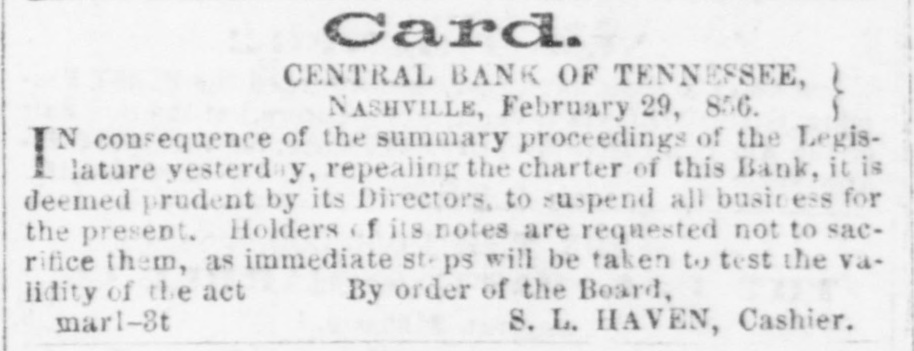
Article from Nashville Daily Patriot, March 1, 1856

Click image to open full size in new tab

Article Text

Card. CENTRAL BANK OF TENNESSEE, are Nashville, February 29, 856. the summary proceedings of the Legisrepealing the charter of this Bank, it is deemed prudent by its Directors, to suspend all busic ess for the present. Holders of its notes are requested not to sacrifice them, as immediate St. ps will be taken to test the vaBy order of the Board, lidity of the act marl-3t S. L. HAVEN, Cashier.


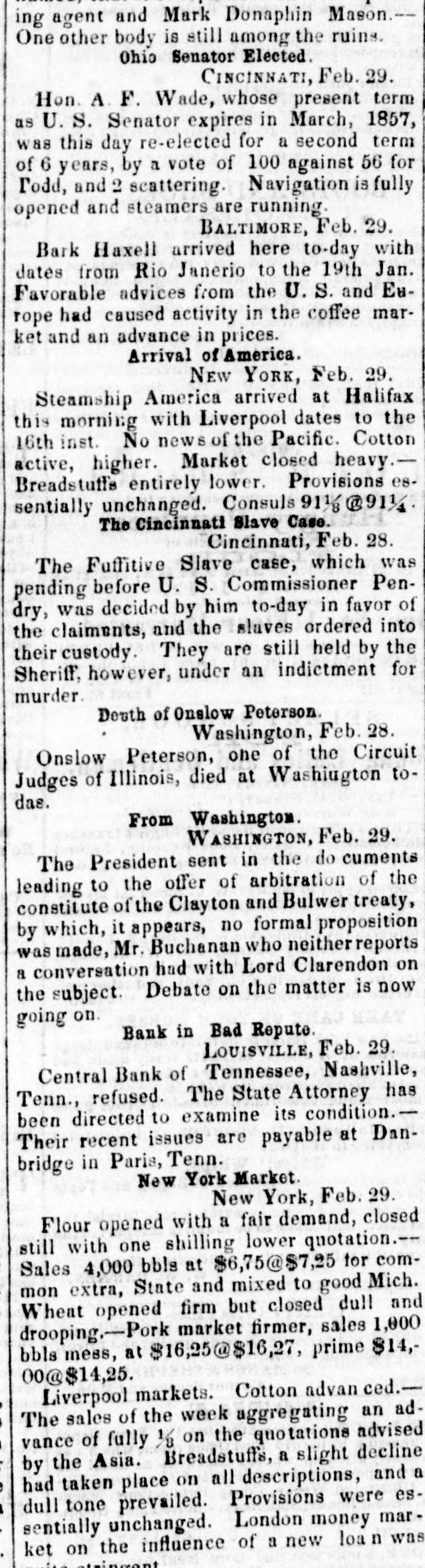
Article from The Davenport Daily Gazette, March 1, 1856

Click image to open full size in new tab

Article Text

ing agent and Mark Donaphin Mason.-One other body is still among the ruins. Ohio Senator Elected. CINCINNATI, Feb. 29. Hon. A. F. Wade, whose present term as U.S. Senator expires in March, 1857, was this day re-elected for a second term of 6 years, by a vote of 100 against 56 for Todd, and 2 scattering. Navigation is fully opened and steamers are running. BALTIMORE, Feb. 29. Bark Haxell arrived here to-day with dates from Rio Janerio to the 19th Jan. Favorable advices from the U. S. and Europe had caused activity in the coffee market and an advance in prices. Arrival of America. NEW YORK, Feb. 29. Steamship America arrived at Halifax this morning with Liverpool dates to the 16th inst. No news of the Pacific. Cotton active, higher. Market closed heavy.Breadstuffs entirely lower. Provisions essentially unchanged. Consuls 9115@9114 The Cincinnati Slave Case. Cincinnati, Feb. 28. The Fuffitive Slave case, which was pending before U. S. Commissioner Pendry, was decided by him to-day in favor of the claiments, and the slaves ordered into their custody. They are still held by the Sheriff, however, under an indictment for murder. Death of Onslow Peterson. Washington, Feb. 28. Onslow Peterson, one of the Circuit Judges of Illinois, died at Washiugton todas. From Washington. WASHINGTON, Feb. 29. The President sent in the do cuments leading to the offer of arbitration of the constitute of the Clayton and Bulwer treaty, by which, it appears, no formal proposition was made, Mr. Buchanan who neither reports a conversation had with Lord Clarendon on the subject. Debate on the matter is now going on. Bank in Bad Repute. LOUISVILLE, Feb. 29. Central Bank of Tennessee, Nashville, Tenn., refused. The State Attorney has been directed to examine its condition.Their recent issues are payable at Danbridge in Paris, Tenn. New York Market. New York, Feb. 29. Flour opened with a fair demand, closed still with one shilling lower quotation.-Sales 4,000 bbls at $6,75@$7,25 for common extra, State and mixed to good Mich. Wheat opened firm but closed dull and drooping.-Pork market firmer, sales 1,000 bbls mess, at $16,25@$16,27, prime $14,00@$14,25. Liverpool markets. Cotton advan ced.The sales of the week aggregating an advance of fully ½ on the quotations advised by the Asia. Breadstuffs, a slight decline had taken place on all descriptions, and a dull tone prevailed. Provisions were essentially unchanged. London money market on the influence of a new loa n was stringent


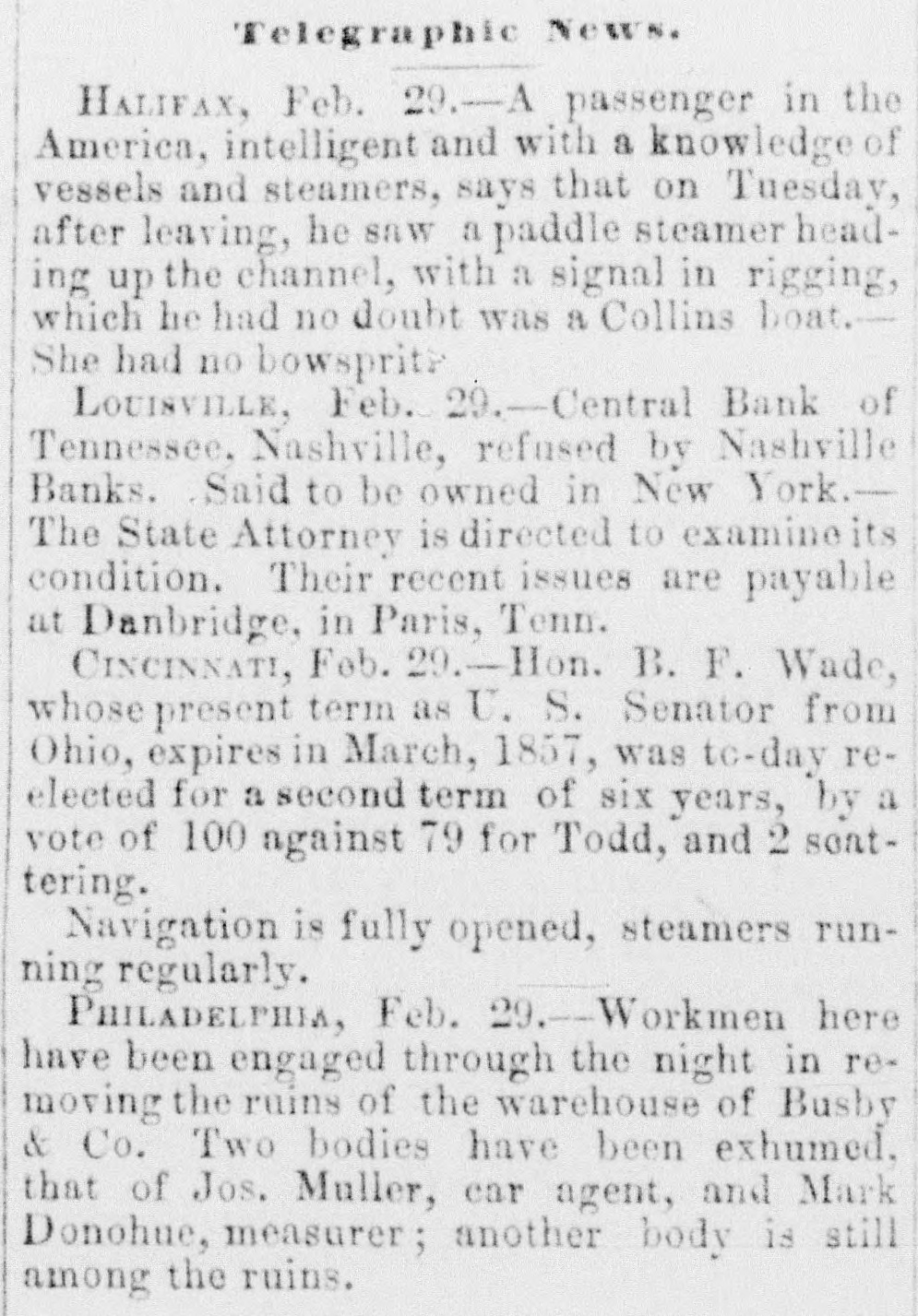
Article from The Daily Gate City, March 5, 1856

Click image to open full size in new tab

Article Text

Telegraphic News. Halifax, Feb. 29.-A passenger in the America, intelligent and with a knowledge of vessels and steamers, says that on Tuesday, after leaving, he saw a paddle steamer heading up the channel, with a signal in rigging, which he had no doubt was a Collins boat.She had no bowsprite LOUISVILLE, Feb. 29.-Central Bank of Tennessee, Nashville, refused by Nashville Banks. Said to be owned in New York.The State Attorney is directed to examine its condition. Their recent issues are payable at Danbridge, in Paris, Tenn. CINCINNATI, Feb. 29.-Hon. B. F. Wade, whose present term as U. S. Senator from Ohio, expires in March, 1857, was tc-day reelected for a second term of six years, by a vote of 100 against 79 for Todd, and 2 senttering. Navigation is fully opened, steamers running regularly. Philadelphia, Feb. 29.--Workmen here have been engaged through the night in removing the ruins of the warehouse of Busby & Co. Two bodies have been exhumed, that of Jos. Muller, car agent, and Mark Donohue, measurer; another body is still among the ruins.


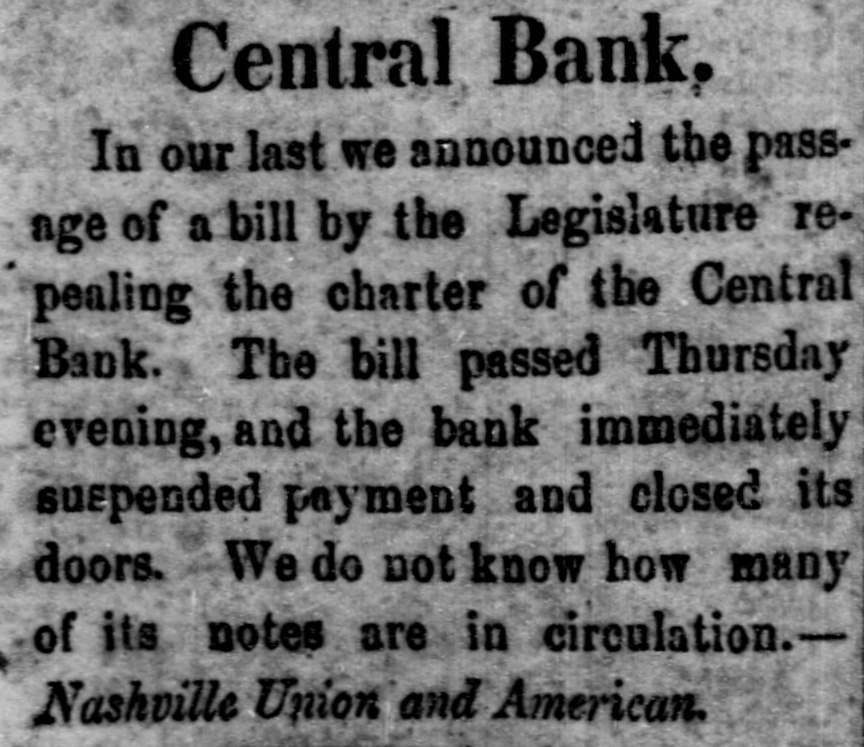
Article from Fayetteville Observer, March 6, 1856

Click image to open full size in new tab

Article Text

Central Bank, In our last we announced the passage of a bill by the Legislature repealing the charter of the Central Bank. The bill passed Thursday evening, and the bank immediately suspended payment and closed its doors. We do not know how many of its notes are in circulation.Nashville Union and American.


Article from The Daily Dispatch, March 7, 1856

Click image to open full size in new tab

Article Text

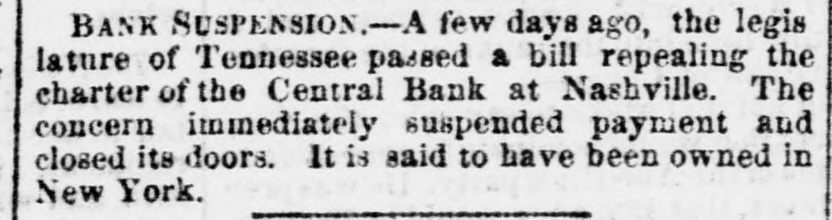
BANK SUSPENSION.-A few days ago, the legis lature of Tennessee passed a bill repealing the charter of the Central Bank at Nashville. The concern immediately suspended payment and closed its doors. It is said to have been owned in New York.


Article from Nashville Union and American, February 17, 1857

Click image to open full size in new tab

Article Text

# BANKS AND BANKING. We have published several communications on the subject of Banks, in which the writers propose changes in the present system of Banking. We believe that Barks have done serious injury to the great mass of the people, and that the injury is in proportion to the number created. We refer back to the time when our legislature gave every body the previlege to bank, and soon thereafter the country was flooded with Kincannon tickets, Chaffin, Kirk & Co. shinplasters, and others of like material. All these, like the moras multicaulis, became worthless, except as fuel to kindle a morning fire. Subsequently the Fermers' and Merchants Bank of Memphis was chartered. Then came the Bank of East Tennessee. The next birth in the Bank family was named the "Lawrenceburg Bank." The legislature of 1851-2 chartered the Citizens' Bank, and passed a general law allowing any person banking privilezes who would deposite $50,000 in bonds with the Comptroller. If the legislature following had looked back to the condition of the banks chartered by their illustrious predecessors, and made an estimate of the loss sustained by the hard working people in consequence of bank failures, surely they would have waited a while to see what tax the people could stand before burthening them with any more banks. But there was not yet a stopping place. After the adjournment of the legislature of 1853-4, (the same body that made JOHN BELL Senator,) we find on the statutes charters for eight more new stock banks. Three of them the Mechanics Bauk at Memphis, the Central Bank at Nashville, and the Miners' and Manufacturers' Bank at Knoxville, have failed. Two others the Bank of West Tennessee, at Memphis, and the Agricultural Bank at Brownsville, are said to be shivering in the chilly breeze of adversity. There was yet no stopping place Although JOHN BELL had failed politically and the three banks above named had failed pecuniarily, yet with all these evils staring them in the face, the legislature of 1855-6 chartered the Bank of America, with the power to establish two branches and the privilege of incressing its capital to one million two hundred thousand dollars, and to issue two dollars for one of capital paid. This same legislature seemed, by their action, to be of the opinion that there had been rather a loose way of banking in Tennesseee, and they passed an act requiring all the banks and branches to make semi-annual reports to the Governor, and that the branch bark reports should be "separate and d stinct from the return of the mother bank." But not one single branch has complied with this act. (It may be proper here to remark that the act makes an exception as to the State Bank, and that the Bank of America, Union, Planters and Citizens' Banks, are all that have branches. Even the Bank of America, chartered at the same session which required branches to report to the Governor, has paid no attention to this act. The same act also prohibits any bank or branch bank from having a circulation which shall "exceed its discounts more than $2,000." If the branches had made reports as required by law, the people could see and understand the practice of dodging the payment of their debts by giving the people of Clarksville notes payable at Rogersville or Dresden, and by giving the people of Nashville notes payable at Athens, Pulaski, Jackson or Knoxville. Now we ask the reader to run over the list of baks named in this article and estimate if he can the heavy tax sustained by the people in consequence of the failure of banks ereated by our legislature from the days of Kincannon to the present time. On whom has this loss fallen? Even at the risk of wounding the feelings of what, in refined circles, are called "commercial men," we say that the great injury dote by the breaking of a bank is done to the farmer, the mechanic and the day laborer. You rarely see a "commercial man" with broken bank money on his hands. He is right at the door of some bank where he can deposite such funds as will not get him exchange to pay his Northern or Southern debt he can deposite every day, and the next day the meanest money he has deposited is paid out on his check to the farmer for his cotton, corn, or other articles of trade, and to the mechanic for labor done on his house or steamboat. But suppose the bank breaks where the "commercial man" keeps his account: don't he lose then? In nine cases out of ten, not a red, but oftener makes by the failure; for he generally has a note or bill in the bank and he checks for the deposite to be applied to the payment of the note or bill ard often has a chance to buy up the notes of the bank at a heavy discount to take up his own paper. If he has no note of his own, he knows of a friend who has, and he will work in his broken bank deposite. The only way these "commercial men" lose by bank failures is when they become too knowing and buy up tank notes when the bank is going down hill and are caught in their speculation. We think it clear that banks have greatly injured the people pecuniarily. We go further:- With the single exception of a hypocritical know-nothing clergy, we think banks and banking are far shead of any thing in injuring the morals of the community. They do every thing in their power to avoid paying their debts. For instance: A cotton speculator draws a bill on his New Orleans merchant for $10,000. The bank discounts the bill. On looking over the money he has received for his bill he finds that it is all payable at Jackson, or Pulaski, or Dresden. He goes to one of these points to make his purchases and finds that by paying gold he can purchase at a lower price; so he goes to the branch bank and gets the coin. The cashier is mad because he had to pay an honest debt, and he immediately writes to the parent bank, tells what notes he redeemed fand what sort of man presented them. When this letter reaches the parent bank, there is a whispering between the president, cashier, and teller and the identity of Mr. Cotton speculator is fixed. Do you suppose he could ever get a bill discounted in that bank again? Not a bit of it. Why? Was that bill he drew not paid? Oh yes, the cotton speculator's bill was met promptly; but the bank did not expect to pay their notes! And because the bank was not successful in avoiding the payment of its notes, it will have no dealings with the man that makes it pay. But again: Banks injure the morals of the people by giving character to the paper of other Banke which they believe to be unsound, and if banks can do this thing, the example is apt to be followed and the fraud becomes general. For instance: A new bank is started without capital- The first object is to get out a circulation. The


Article from The True Democrat, April 14, 1857

Click image to open full size in new tab

Article Text

11. nature gave every body the pri vilege to flooded bank, d soon thereafter the country was Kincannon tickets, ith others of like material. inplassers, and Chaffin, became worth- Kirk & Co., All the morus multicalis, fuel to kindle a the Farmers' and as chartered. came hese, ss, ank subsequently except of like Memphis as The morning Then Merchants' next birth e Bank of East Tennessee. bank family was named the 'LawrenceBank." The legislature of 1851-2 charred urg the Citizens' Bank, and passed general who W allowing any person baking privileges ould deposit $50,000 in bonds with the comp looked oller. If the legislature following had by ck to the condition of the banks chartered eir illustrious predecessors, and made working unestiate of the loss sustained by the hard in consequence of bank what would have waited a while could stand before was with more banks. But eople em ey x the people any failures, to burthening there see surely stopping place. After the adjournot yet a of the legislature of 1853-4, (the same find ent dy that made JOHN BELL senator,) we new the statutes, charters for eight more Mechanics banks. Three of them--the Nashank tock at Memphis, the Central Bank at Bank ille, and the Miners' and Manufacturers' others-the Knoxville, have failed. Two and ank of West Tennessee, at Memphis, are said Agricultural Bank at Brownsvi e shivering in the chilly breeze of adversity. here be was yet no stopping place. Although three ohn Bell had failed politically and the above named had failed pecumiarily, the vet ith all these evils staring them in the face, of of 1855-6 chartered the Bank two egislature merica, with the power to establish its ranches and the privilege of increasing thousand apital to one million two hundred of ollars, and to issue two dollars for one capi- by il paid. This same legislature seemed, had of loose way heir action, to be of the opinion banking that in there Tenneseen and rather they passed an act requiring all the reanks ee, and branches to make semi-annual branch orts to the Governor, and that the distinct ank reports should be separate and But not the return of the mother bank.' rom single branch has complied with this the act. act ne It be proper here to remark that Bank, and may exception as to the State and makes at the an Bank of America, Union, Planters' Banks, are all that have branch Even tizens' the Bank of America, chartered at the ane session which required branches to to report this the Governor, had paid no attention bank or et. The same act also prohibits any which ranch bank from having circulation $2,000." "exceed its discounts more than hall the branches had made reports as understand required the people could see and of their y law, practice of dodging the payment notes he by giving the people of Clarksvi lle givof notes Nashville ebts vable at Rogersv lle or Dresden, and payable by at g the Pulaski, people Jackson or Knoxville. banks Now thens, ask the reader to over the list of the amed e this estimate if he can conse. tax sustained by the people in our eavy of the failure of banks created by mence egislature from the of Kincannon loss fallen? to the has this of the wounding the feelings commercial hat, the great injury done by the the and You mechanic reaking bank done to the farmer, rarely bank broken money n his hands. He is right the door of some will where he can deposit such funds northern as or he can deposit ank ot get him exchange to pay his every day, and outhern he next debt day the meanest money he has farmer deosited is paid out on his check to the of trade, or his cottou, corn, or other articles his But steamboat. nd to the mechanic for labor done the on bank suppose ouse ks where the keeps red, oftener makes ccount: don't he lose then? In by the failre; f ten, for he generally has note he for the checks deposit ank, lied and to the of the note notes of the ften has chance to buy up the If cavy discount take up his own paper. of note of he knows has and he will work in his broken ban ho eposite. has, The only way these belose by bank failures is when bank they notes too knowing and buy up and are then the the bank going down hill speculation. aught it clear that banks have greatly pecuniarily. Wego further jured the single exception of a hypoeritical Vith now-nothing elergy, think banks community g are far ahead of any thing They in injuring orals in their of the power to avoid paying their New his Orleans hing or instance: A cotton speculator for $10,000. On bill. the the ank discounts for his bill he finds honey or Pulaski, or of these points so en. that by paying he The coin. ranch he had he redeemed he and parent presented them. When this letter an bank, there parent president, cashier and teller, and the Do you ty of Mr Cotton speculator fixed uppose he could again? ever Not get bit of Why hat bank that bill he drew not paid? Oh yes, the but Vas otton speculator's was met promptly; the bank was not he bank did expect to pay their in and becaus the payment of its notes, it will it voiding o dealing with the man that makes of pay. the But again: Banks injure the morals of other to believe people by giving character to the be paper unsound and banks which can do they this thing, the example general. is apt 0 f be followed and the fraud become without 'or instance: bank is started circuapital. The first object is to get out its eyesation. The little kitten has opened ma arrange. begins to Knoxville, craw Nashville Has and Memphis, nents whenever at the youthful varmint" be gets hat either of these large cities it shall pro- that to The farmer and mechanic let it all ected. is protected by through bankers, conclude the State-it to has pass-it to goes be large wildcat. Its owner meets berown day, huge, bristling monster-it The owner every exceedingly troublesome. "protect" any omes nds it has grown too large; its longer, claws and are too he ong concluded for him to to "let her rip." The protectors conseis, that the owner and its to the neuce riveit away and continues its rambles his friends and neither the owner nor rambling country, by the depredations of the of re injured Such was pretty much the history that late Central bank. Bankers in owner had been largely in bank principal he ildeat. stated know engaged the banks, and it was rthwestern that every bank with which he to ote had failed. Yet all he then he bought Tennessee in connected Reporters charter protected was had arrangements to have his issues written to us ur principal cities. Letters were and our re.


Article from Nashville Union and American, January 30, 1858

Click image to open full size in new tab

Article Text

NITHNVHA ao Constit- out eSauyo 01 B,NVRMEN N -1100 Jepun Supeq Jo State and jo noting sideration, were read as follows: the JO article elevent the 10 seetion 419 The #: BY Peed 01 se pepuent 08 eq 11"4" 01 power ou base 11848 The 9 ong grant or renew bank charters, unless first submit regular 18 eldood the JO 01 aurss the Bun elections for members of the Legislature: and no bank or corporation for banking privileges shall be JO approval the The 11.048 # 3 majority of the legal voters of the State at large; enthorize 01 have the 1184s JOU -oad 01 ssed shall pus desdand Aue 10J Internes hibit the sale of lottery tickets in this State. The ninth section of the eleventh article of the -103 ss read 07 88 pepueurs 08 eq Ilems SMOT SEC 9. The Legislature shall have no power to issue the bonds of the State for any purpose what .10 by State em 10 oredit the shall you given in aid of any person, association, municipal ity, or corporation; only under the following terms 000 Arm Instruction and :IIM 07 ipuoo pus tract debts to meet casual deficits or failures in the signaty direct deficit have ng revenued peeced emme Aue 78 you shall the u! 10 400,000 dollars, and the money arising from loans seasodand em 07 11848 debtate your creating for which they were obtained, or to repay such debt: nor shall the Legislature authorize any debt to be contracted on behalf of the State except for the above specified purposes, unless provisions be made 01 X81 Isnuue us collect pus Iny Lherein pay the interest stipulated, and to discharge the debt within thirty years; nor shall such act take effect until it shall have been submitted to the people at a general election, and shall have received majority of all the votes cast for and against it. Provided that the Legislature may contract debts by borrowing money to pay any part of the debt of the State without submission to the people, and 108 the u! provisisns Suppum missing the same for a tax to discharge the debt 80 contracted, or the interest thereon. Provided further. that the State may contract debts to repel invasion, suppress insurrection, or, if hostilities are threat ened, to provide for the public defence. Mr. NEWMAN Said: Mr Speaker: These resolutions are intended to strike at and destroy two ruinous evils- banking institutions of the State, and wasteful expenditure of the public credit. To check the issuance of State bonds, and protect the people from the evil effects of log rolling legislation. These, sir, are J0 in JOJ am Am states u! ou assq spoq honorable siq7 object, and the end aimed to be attained by presentresolu 1hese Jo [sug the pus 'Suissed 'Sur Constitute the 01 se peaple the &q suon uon The first proposition proposes to settle the quessay 01 prople the 01 I 71 banks JO uon whether they will have a currency created and regu lated by these intitutions or not. They will decide against all of them, in my opinion. I, for one, de sire to see the whole banking system abolished to strike down and destroy the evils of a paper cur rency, which, in all instances, has been based on credit, and credit alone. For my part, desire gold and silver alone, a pure metallic currency, as [18 18 Awn usui Coder 1847 "unipom times know the value thereof; that he may to-day pus MOJIOUI-0 THOM eq II!AA 11 16qM u! dais euo take 01 01 prodose 'JIS these the S'S , reform Jo direction Softs call it. They propose to grant no new char ters, and to renew no old ones. By this mode no new banking institutions can come into existence The old charters expiring, they will have to go to the people for renewals, which will never,be granted Their civil existance having expired under the law let them die by the law This mode will be gradual and easy Take, for instance, the Union and Plan ters' Banks Their charters expire in 1863, Let them not be renewed. unless the people declare it 80, and asthey are suspended to-day let them be suspended forever So too, sir, with the State Bank Her charter will expire in 1868: let it then stop, be closed forever as, inmy opinion, will be other IIV ano Jo qsim pus II!M que bank charters in the State will share the same fate; each expiring according to limitation, and like siqn IIIM "11"" . mo.r E Suipuis whole system go out of existence, leaving in its place: currency that cannot fluctuate, and the one intended by the framers of the Constitution- purely 811 at character Now, Sir, would ask the friends of shinplaster currency what benefits have the people derived by this Have they grown better wiser or wealthier by making paper issues the medium, instead of coin need not go out of puu uomsodord the 01 State UMO show that they have been ruinously swindled P10 the example JOI Takes stip iwassee Railroad and Banking Company, which yes pus 'sn quin the u! dollars pussnom h uuq hands of the hard working, laboring men of the country; and though her issues were redeemed long years after, in State bonds and the stock of the company, it was not until the whole of it had fallen Surgery poolq 'Subunq JO spare the speculators, who fatten on the industry of the coun08 UU punors Suvy Tollowers dureo 88 An that after battle they may strip the dead and rob the wounded So stand these operators around the broken and suspended banks; ready to destroy the living, rob the poor, and steal from labor its hard earnings, under the sanction of law. Next in order came the Farmers and Merchants' Bank of Memphis, with seven hundred thousand lollars in issues. and to-day they are in the hands the people. Were they a benefit or an injury to the country Are her notes the atives of currency, or printed illustrations of fraud and cor wondna After this came the Central Bank at Nashville, perpuny the no Purfud pus Summer Burnes alos the 10J 'Aud 01 procrises 10 dollars puesnoq Supeedsnsun pus honest em Surportap Jo beer How well did they succeed? Its paper in the hands our alone can answer the question. Bank the TIM umop 0.111 1847 of puy sm quit op 01 16qm peeple am JO Ruug out behald OM urede "Jepao m 1100 East Tennessee her issues flooded the country the amount, the number, and character of her paper 01 steries Im ueppty SB spunts any of her creditors. Every family have more or asn Aluo one 1hese Jo unipour am 10 to moreal the quiod 01 ST мош which 10 esedand pm the past and keep the people watchful of the future [811A eq1 8! suchmism qo enurguo OM u"4S 010A pus 0010A Au SU any og sourn am 10 donsent system em qui SUMU op 01 eq II!M 11 of us: peaple am uo pus S'B 11 Surprise They have insured a loss to Tennessee of over five illions of dollars. Has this been benefit They a Jo 88 10 useds useq DATE they do away with the savage nature of man Are these gambling shops the true road to enlightenment And their facilities to swindle true test a nation's dvancement in the arts Are these nodern Juggernauts necessary for a people to be proficient in science as some gentlemen tell us But, sir, are these losses to Tennessee all? Let us Following equal Anunoo am 01 1001 rief statement of the losses by banks in our country Lossesby bank failure Losses by suspensions of specie pay ments by banks and consequent depreciation of their notes- very 000'000'96 Loss by destruction of bank notes accident by 7,121,882 Losses by ounterfeit bank notes be S801 puoA LL III 0100 Losses by fluctuations in bank currency affecting prices, extravagances in living, sacrifices on property, M and by only part of the other inci dents to the banking system not com 000'000'091 puted at least not half the amount] ggregate dd for nited States bank and others IPSI 090'000'94 An accurate computation of the losses occasioned the present failures of the banks would add put 9A18 ЭМ oq1 01 410.8. the depreciation of the value of real estate cot af farm produce,stecks, and bank bills,and all other perpuny used 1981 100 01 innows mom she fifty millions. Add this amount to former esti 48 losses ting rom paper money banks, and 18 124 This is probably below


Article from Arkansas True Democrat, February 16, 1858

Click image to open full size in new tab

Article Text

furnished by the banks. Experience driven out the better circulation is always valuable that more worthless- the more circulaby the And yet, sir, this paper not the cheaper. which is su ect to such fluctuation, the tion, drives specie from our country, but more peo- by ple of only the United States annually lose suspensions, depreciation of this currency by and the the total failures, and defalcations, of banking, thousand and other incidental abuses of our govlet us into came than would pay the entire expense the State of ernment. But and see something of what our much own Tennessee have lost by their banks. How Merchants' people lose by the Farmers' and worthbauk did they at Memphis, which now calculation, utterly half suppose, at the lowest lose million less? of dollars. How much did whose they charter by was remember the Central bank at stolen Nashville, through the Legislature? you At least quarter of million Agricultural did they lose by the How much at Brownsvill owned by set of thieving hundred bank From seventy-five to a Yankees? How much by the Miners' histo- and thousand more. bank at Knoxville, whose Manufacturers' believe is similar to that of the suppose Central bank? ry `wenty five thousand more much by the would be safe estimate. How which bank of East Tennessee at Knoxville, all? I supthe most stupendous windle of truth in putwas I would fall far short of the million of pose circulation at half ting down its impossible, in fact, to ascertain dollars. amount It is of circulation this mammoth learn what had out, but *from all I can "wild-cat" safe in setting down at half million. feel How much have they lost by being compelled paper of submit to discounts or shaves on the stock least hundred to the suspended free banks and thousand smaller dollars banks? Thus At we see, sir, that the people of their this more. have within the last few years lost hundred by banks State actual cash, one million, four low thousand dollars. This, think, sir, nothIn this estimate have said Kinestimate. of the losses by the shinplasters" that of ing Chaffin & Kirk, and other of Nor of an estimate cannon, have confined myself to recent the millins dates. of dolhave that made have been and will yet be lost in of con- her of the depreciation in the price induced sequence property and products of the country This-al by the present monetary pressure banking systhis-is but part of the cost of our told that tems to the people. along without And yet banks- we are they cannot commercial get luxury with which no luxury civilized people can dispense. Well, sir, if would say they are rather an LegisOh! sir, wish could prevail upon this laxury our consider the cost of lators woul my to voice could be heard by State-by every man the within the limits of our proud land-that people--the sovereigns of the and could induce them to stop and think, and that sider the cost of this system to them. they might be persuaded never to send who is this hall to make laws for them, man to against banks and bank influe not pledged miracle, Mr. Speaker, that with this Is it not : burthen, this onerous tax upon us, we grievous ever attained unto the degree of prosperity been have now enjoy And oh! sir, had we but free we from this burthen, what people would have been? But, Mr. Speaker, the gentlema from Shelby objected to that provision in the Senate's and which prohibits banks from selling gold silver at any price, and from selling exchange Why, greater premium than two per cent. these banks debts- -they refused to pay sir, them-have suspended, and why Because, as they allege they have not sufficient specie this redeem their And when --when they tell us they have not now specie to redeem their circulation, shall authorise cient them sell or dispose of what specie they have on hand? Would that be guarding, should, the interests of our constituents as who hold their notes? No. sir, no! to They have issued their notes promising demand, and yet when the honest holder presents them and demands payment them they refuse, have the power to compel do so? or at least to see that they do to squander their effects until by legal proceeding what are forced into liquidation? If not, they is our boasted liberty worth? Where cacy of our free institutions? And exchange, the of gold--they ship their gold and check on it, and shall we allow them to refuse to pay their gold to the holder who is justly entiteld to it, and ship New York or Philadelphia and check from five to ten per cent. premium as they are now doing? Why, sir, in times of suspension, these banks fatten and grow rich, and we low them suspended and sell exchange at exorbiant prices they never will resume, and ruin the merchants of the county they need and must have this exchange If will redeem their notes and furnish the mercial with gold, they can perhaps either us them pay the at est debts able They premium it profitable of per infavor limiting furnishing Why, furnish price. banks these of notes thing to-day, allow them to ling soon the their for they will have disposed of all their redeem their Sir, without this provision, the bill would be materially defective us protect the of the -holder, by prohibiting the banks from making way with their and thus postponing indefinitely the period of resumption Again, sir, this Senate bill provides that if any bank shall refuse to accept of its provisions as amendments to charter, the Attorney General shall proceed against it to forfeiture of of charter. This the only means we have compelling them to obey our law af have made it. Why, the law already requires that they shall be paying out specie, and vet they are every day violating and disregarding it. If they disregard laws made by previous to Legislatures, what more respect will they pay those we may enact? We must retain this provision in order to force obedience to our enactments. And, indeed, so well am satisfied of the wisdom of this provision, that if this Legislature refuses to pass it, am then prepared to vote for a resolution directing the Attorney Geberal to have every one of them wound up. But bank advocates here say: If you oppress the banks, the banks will oppress the people," or in other words Mr. Speaker, their position is this: Let the Legislature take care of the banks, and the banks will take care of their constituents. Indeed, sir, when logically considered, the position of bank advocates every where is: Let the Legislature take care of the rich, and the rich will take care of the poor, or the the poor may take care of themselves. poor man, sir, that gets bank accommodations? Are the great mass of the people accommodated by them? By no means. If a poor man gets note discounted at is thought the influence of some rich friend, or perhaps in order to enable him to pay debt he owes some rich man, and then he had as matter of course to be indorsed by men of property. No. sir: the fact of the is, that the poor are always the sufferers by the defaulting, non paying banks and while the banks are solvent they receive no accommodations whatever. Sir, to am not in favor of returning at once