20875. Bank of Nashville (Nashville, TN)

Bank Information

Episode Type
Suspension → Closure
Bank Type
state
Start Date
June 1, 1865
Location
Nashville, Tennessee (36.166, -86.784)

Metadata

Model
gpt-5-mini
Short Digest
4ac62f37

Response Measures

None

Description

All provided articles discuss the Bank of Tennessee (a state bank) and its post-Civil War winding up. Although the prompt listed Bank of Nashville, the articles clearly refer to the Bank of Tennessee headquartered in Nashville; I have corrected the bank name accordingly. The Legislature passed an act to wind up the bank (Feb 16, 1866) and the President and Directors executed a deed of trust and assigned assets to Samuel Watson, who filed as trustee/receiver (May 24, 1866). This is a suspension/liquidation that resulted in receivership/closure, not a depositor run.

Events (3)

1. June 1, 1865 Other
Newspaper Excerpt
The assets were seized by Gen. Upton, of the United States army, and returned to the State ... the assets, books and papers of the bank were delivered to Gov. Brownlow about the first of June, 1865, and appear to have been examined by a Legislative Committee ...
Source
newspapers
2. February 16, 1866 Suspension
Cause
Voluntary Liquidation
Cause Details
Legislative act (Feb 16, 1866) ordering the bank to be wound up and settled; directors instructed to assign assets in trust.
Newspaper Excerpt
the Legislature on the 16th day of February, 1866, passed an act entitled 'An Act to wind up and settle the business of the Bank of Tennessee,' whereby it was provided that the President and Board of Directors of said bank, should make an assignment of the assets of the bank in trust, etc., and that said bank go into liquidation.
Source
newspapers
3. May 24, 1866 Receivership
Newspaper Excerpt
The President and Board of Directors of the bank, on the 4th day of May, 1866 ... did execute a deed of trust by the terms of which they assigned to Samuel Watson all the assets of the bank in trust for the settlement of its affairs. ... He filed his bill in the Chancery Court at Nashville for the execution of the trust, and was appointed receiver under the orders of said court. ... he executed a bond in the penal sum of $50,000, as trustee and receiver (May 24, 1866).
Source
newspapers

Newspaper Articles (6)

Article from Brownlow's Knoxville Whig, and Rebel Ventilator, June 7, 1865

Click image to open full size in new tab

Article Text

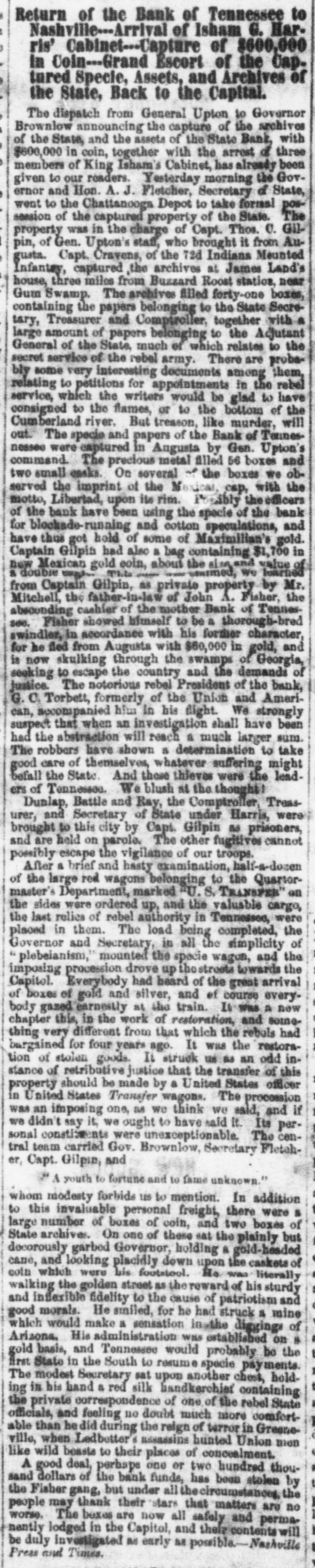
Return of the Bank of Tennessee to Nashville--Arrival of Isham G. Harris' Cabinet--Capture of $600,000 in Coin--Grand Escort of the Cap. tured Specie, Assets, and Archives of the State, Back to the Capital. The dispatch from General Upton to Governor Brownlow announcing the capture of the archives of the State, and the assets of State Bank, with $600,000 in coin, together with the arrest of three members of King Isham's Cabinet, has already been given to our readers. Yesterday morning the Governor and Hon. A. J. Fletcher, Secretary of State, went to the Chattanooga Depot to take formal possession of the captured property of the State. The property was in the charge of Capt. Thos. C. Gilpin, of Gen. Upton's staff, who brought it from Augusta. Capt. Cravens, of the 72d Indiana Meunted Infantry, captured the archives at James Land's house, three miles from Buzzard Roost station, near Gum Swamp. The archives filled forty-one boxes, containing the papers belonging to the State Secretary, Treasurer and Comptroller, together with & large amount of papers belonging to the Adjutant General of the State, much of which relates to the secret service of the rebel army. There are probably some very interesting documents among them, relating to petitions for appointments in the rebel service, which the writers would be glad to have consigned to the flames, or to the bottom of the Cumberland river. But treason, like murder, will out." The specio and papers of the Bank of Tennesnessee were exptured in Augusta by Gen. Upton's command. The precious metal filled 56 boxes and two small-easks. On several - the boxes we observed the imprint of the Mexical, cap, with the motto, Libertad, upon its rim. Posibly the efficers of the bank have been using the specie of the bank for blockade running and cotton speculations, and have thus got hold of some of Maximilian's gold. Captain Gilpin had also a bag containing $1,700 in new Mexican gold coin, about the size, value of & double english. This - - wasimed, We loarned from Captain Gilpin, as private property by Mr. Mitchell, the father-in-law of John A. Fisher, the absconding cashier of the mother Bank of Tennessee. Fisher showed hitnself to be a thorough-bred swindler, in accordance with his forther character, for he fled from Augusta with $60,000 in gold, and is now skulking through the swamps of Georgia, seeking to escape the country and the demands of justice. The notorious rebel President of the bank, G. 0, Torbett, formerly of the Union and American, accompanied him In his flight. We strongly suspect that when an investigation shall have been had the abstraction will reach a much larger sum. The robbers have shown & determination to take good care of themselves, whatever suffering might befall the State. And these thleves were the lenders of Tennessee. We blush at the thought! Dunlap, Battle and Ray, the Comptroller, Treasurer, and Secretary of State under Harris, were brought to this city by Capt. Gilpin M prisoners, and are held on parole. The other fugitives cannot possibly escape the vigilance of our troops. After a brief and hasty examination, half-a-dozen of the large red wagons belonging to the Quartormaster's Department, marked "U. S. TRANSFER" on the sides were ordered up, and the valuable cargo, the last relies of rebel authority in Tennessee, were placed in them. The load being completed, the Governor and Secretary, in all the simplicity of plebelanism," mounted the specie wagon, and the imposing procession drove up thostreets towards the Capitol. Everybody had heard of the great arrival of boxes of gold and silver, and of course everybody gazed earnestly at the train. It was a new chapter this, in the work of restoration, and soinething very different from that which the rebuls had burgained for four years ago. It was the restoration of stolen goods. It struck us as an odd instance of retributive justice that the transfer of this property should be made by a United States officer in United States Transfer wagons. The procession was an imposing one, as we think we said, and if we didn't say it, we ought to have said It. Its personal constituents were unexceptionable. The central team carried Gov. Brownlow, Secretary Fletcher, Capt. Gilpin, and , A youth to fortune and to fame unknown." whom modesty forbids us to mention. In addition to this invaluable personal freight, there were a large number of boxes of coin, and two boxes of State archives. On one of these eat the plainly but decorously garbed Governor, holding a gold-headed cane, and looking placidly down upon the caskets of coin which were his footstool. Ho was literally walking the golden street as the reward of his sturdy and inflexible fidelity to the cause of patriotism and good morals. He smiled, for he had struck a mine which would make a sensation in-the diggings of Arizona. His administration was established on # gold basis, and Tennessee would probably be the first State in the South to resume specie payments. The modest Secretary sat upon another chest, holding in his hand a red silk handkerchief containing the private correspondence of one of the rebel State officials, and feeling no doubt much more comfortable than he did during the reign of terror in Greeneville, when Ledbetter's assassins hunted Union men like wild boasts to their places of concealment. A good deal, perhaps one or two hundred thousand dollars of the bank funds, has been stolen by the Fisher gang, but under all the circumstances, the people may thank their stars that matters are no worse. The boxes are now all safuly and permanently lodged in the Capitol, and their contents will be duly investigated M early M possible.-Nashville Eness 1



Article from Public Ledger, February 27, 1867

Click image to open full size in new tab

Article Text

THE NOON DISPATCHES LOUISVILLE, February 27.-John Ma. son Brown, was nominated by the Une e ionists at Frankfort, yesterday, for At torney-General instead of LieutenantGovernor. R. T. Baker is the nominee for the latter office. a WASHINGTON, February 27. - The House Fortification bill has passed. The Committee of the Whole has dis posed of only 20 of the 275 amendments to the Tax bill reported by the Committee on Ways and Means. NASHVILLE, February 27.-A decision has been rendered in the Supreme Court that notes of the Bank of Tennessee cannot be received for taxes due the State. It has caused a decline of the notes to 20 cents. The Legislature has adopted a resolution to pay the members in gold standard. SAN FRANCISCO, February 27.-Over seven feet of snow has fallen in the mountains. WASHINGTON, February 27.-General Griffin, of the Freedmen's Bureau in Texas, says that outrages on freedmen will be punished, if need be, with a military force. The Secretary of the Treasury ordered the suspension of the sales of illicit whiskey. In the Senate, Trumbull's amendment to the Army Appropriation bill was adopted, directing the officers of the Freedmen's Bureau to prohibit maiming and whipping in the late rebellious States. The Committee on the New Orleans Riots say they confined their action to the start of the resolution regarding appointments. It does not appear that Mr. Kellogg made appointments of persons he had reason to believe had been connected with rebellious service, nor deemed it his duty to inquire as to the antecedents of applicants, Some officers had been removed when it appeared that they had aided the rebellion. The Committee say that great care should be taken to appoint officers who will prevent frauds on revenue; that such care has been uniformly taken in all departments of the Custom House, Mr. Boyer dissenting from this last proposition that it is not expedient to recommend to the House of Representatives any action concerning the appointments of the New Orleans Custom House. The Committee says of two hundred and fifty-two employes, seventy-seven have served in the United States army, seventeen in the navy, and twenty-eigh as clerks in the army. Some late rebels obtained appointments under cover of the test oath, but were dismissed when the Collector ascertained it. A Washington special says that General Grant yesterday expressed his intention of visiting the President for the purpose of advising him to sign the Milk itary Reconstruction bill. The Tax bill contains a severe penalty against selling cigar boxes with canceled stamps on them. A special says a man pretending to be Surratt's brother attempted to obtain an interview yesterday, but the guards were not satisfied with his indentity and re fused to admit him. Professor Benj. Pierce was appointed Superintendent of the Coast Survey, vice Bache deceased. A Baltimore special says it is understood that Governor Swann will decline the Senatorship and retain the Gubernatorial chair. The Senate Committee on foreign af fairs yeterday voted on the nominations of Dix and Ewing as ministers to France and the Hague. There were three for confirmation and three for rejection, Johnson, of Maryland, being absent, who would have gone for confirmation.


Article from Nashville Union and American, December 2, 1874

Click image to open full size in new tab

Article Text

in the funds thereinafter specifically pledged, and to give indemnity for all losses arising from such deficiency. It further provided (see 2) that the capital stock of said bank should be $5,000,000, to be raised and constituted as follows: The whole of the common school fund and the proceeds of the Ocoee lands, and the surplus revenue then in the State Treasury, were to constitute a part of its capital; and in addition thereto the State was to raise a sufficient sum of specie to make the capital $5,000,000. It further provided (sec. 6) that the Governor should appoint twelve directors of said bank, subject to confirmation or rejection by the General Assembly, (one of whom should be President,) to continue in office two years or until their successors were nominated and confirmed. Said act further provided (sec 8) that $118,000 of the dividends of said bank should be appropriated for the benefit of schools and academies, and the remainder of the dividends applied to the payment of interest on the State bonds as a sinking fund. It also provided (sec. 12) that the notes of said bank should "be receivable at the Treasury of the State, and by all tax collectors and other public officers, in all payments for taxes or other moneys due the State." An act of the General Assembly of Tennessee, supplementatory to the above act, passed Jany. 26, 1838, provided among other things that the President and Directors of the Bank of Tennessee, should appoint twelve Directors for each of the branches of said bank, and that the capital of said bank should be divided among the bank and branches in a manner therein specified; and that the dividends of the branches should be paid into the principal bank semi-annually. By an act of the General Assembly passed 1839, entitled "An act to provide for the reduction of State debt,' the capital of said bank was reduced to $3,500,00 0, and so remained SO far as the law was concerned; but according to the books of the bank, the actual capital of the bank never reached $3,500,000, though it was at times nominally more than this. Reports of the President of the Bank of Tennessee show that it did a very prosperous business previous to the late war. From 1839 to 1858, its profits upon its capital stock averaged 8 per cent. per annum. The assets of the bank on the first day of January, 1861, were $7,011,283.90, as per Exhibit A to this report, of which sum $681,493.7 were in gold and silver. The assets of the bank in May, 1865, according to its books, were $14,902,312.77, as per "Exhibit B" to this report. Of this amount $6,280,487 were in Confederate bonds and about $4,256,310.1 in Tennessee war bonds and claims against the Military Board and State Treasurer for funds checked out by the Board and Treasurer. The assets of the bank, together with its books and papers, were removed from Nashville about the middle of February, 1862, by Cashier Fisher, President Torbett and others; and the officers of most of the branches joined the officers of the principal bank in the South, with their books, papers and assets. The statement of H. L. Claiborne shows that the bank was first removed from Nashville to Memphis, thence to Chattanooga and afterwards to Atlanta, Griffin, Greensboro, Macon, Raleigh and Augusta, and that the assets were seized at Augusta. The assets were seized by Gen. Upton,of the United States army, and returned to the State under guard, being accompanied by Jesse F. Brown, Cash er of the Trenton branch. The assets, books and papers of the bank were delivered to Gov. Brownlow about the first ot June, 1865, and appear to have been examined by a Legislative Committee appointed for that purpose, but their schedule was so indefinite and uncertain as to be worthless. It wholly failed to itemize any of the assets, and wholly omitted many valuable assets. The Legislature on the 16th day of February, 1866, passed an act entitled "An Act to wind up and settle the business of the Bank of Tennessee," whereby it was provided that the President and Board of Directors of said bank, should make an assignment of the assets of the bank in trust, etc., and that said bank go into liquidation. The President and Board of Directors of the bank, on the 4th day of May, 1866, in pursurance of said act, did execute a deed of trust by the terms of which they assigned to Samuel Watson all the assets of the bank in trust for the settlement of its af fairs. Said Watson accepted the Trusteeship, but did not give bonds as Trustee, for the alleged reason that the bond required by law was too large. He filed his bill in the Chancery Court at Nashville for the execution of the trust, and was appoint ed receiver under the orders of said court He has had possession and control of the assets and affairs of the bank since May 24, 1866, on which day he executed a bond in the penal sum of $50,000, as trustee and receiver. He was also elected president of the bank soon after the return of the as sets, and was president when the assign ment was made to himself. Settlement with Watson, Trustee. In obedience to the foregoing resolution your committee met at the Bank of Ten nessee, in Nashville, on the 6th day of Oc tober, 1873, for the purpose of investigating the affairs of the Bank. The committee had expected to find Mr. Watson fully prepared to make a full exhibit of the affairso the Bank, and of his doings as Trustee. But on the contrary not a step had been taken to make such exhibit, and the committee were forced to wait for Mr. Watson to make out the various statements desired by the committee. It will be seen that the resolution re quires the committee to "settle" with Mr Watson. This, the committee could no do, in the present condition of the assets and the committee have theretore state the account with the trustee in a genera way as per "Exhibit C" to this report which is as accurate and specific as it car be made from the data in possession o reach of the committee. Said exhibit C shows that the whole amount of assets received by said Watso: as trustee was $12,927,759.47, except rea estate unsold, and rents received, and pro ceeds of bank furniture sold, which are no included in this sum. Of this sum $8,644,391.02 were in Confederate bonds, Confederate coupons Confederate treasury notes, certificates o deposit on Confederate Treasury, Tennes see war bonds, and accounts against th State Treasury and Military Board; and therefore, worthless and unavailable a assets. include


Article from Nashville Union and American, December 3, 1874

Click image to open full size in new tab

Article Text

# THE BANK OF TENNESSEE TANGLE. By a joint resolution of the last Legislature, a committee was appointed to investigate the present status of the affairs of the old Bank of Tennessee and "settle" with the Trustee, Judge S. Watson. The report of this committee, consisting of Messrs. N. Smithson, James D. Tillman and E. A. James, on the part of the Senate, with Horatio R. Moore and Jesse F. Brown, on the part of the House, has recently been presented, and was published in the UNION AND AMERICAN yesterday. Nearly nine years ago, Feb. 16, 1866, the Legislature passed an act to wind up and settle the business of this bank, in virtue of which, Judge Watson, the then President of the Bank, became its Trustee, on May 4, and twenty days after filed his bond for $50,000 in the Chancery Court of Nashville, becoming receiver under the orders of that court. We may remark, en passant, that such a bond was utterly inadequate in view of the large assets of the bank, in the way of claims, mortgages and real estate scattered over the State. The matter has dragged on since from court to court, from Legislature to Legislature, with as little prospect as ever for the old creditors of the bank receiving a dividend, or the rights of the State being adjusted. The committee appointed by the last Legislature met in this city Oct. 6, 1873, when a few days' session developed that the Trustee was not ready to "settle," and his accounts were in such shape that an intelligent investigation was hardly possible. Judge Watson, however, made out various exhibits at the request of the committee. The first of these shows the total assets of the bank Jan. 1, 1861, to have been $7,011,283.90. The second shows the total credits of the bank and branches when turned over to the Federal authorities in May, 1865, to have been $14,902,312.77, and liabilities the same amount. The third shows the Trustee's account with the bank, the footings of which are as follows: Watson, Trustee, Debtor................$12,927,759 47 " " Creditor......... 10,808,990 38 Assumed balance of notes, bills and assets, unsettled and out-standing................................$ 2,118,769 09 So far as it can be ascertained, this last exhibits the present status of affairs in a nutshell—a trustee under $50,000 bond, holding assets whose par value is over $2,000,000. Of the $12,927,759.47 that came into Mr. Watson's hands as Trustee, $8,644,391.02 were in Confederate bonds, Confederate coupons, Confederate treasury notes, certificates of deposit on Confederate Treasury, Tennessee war bonds, and accounts against the State Treasury and Military Board; and, therefore, worthless and unavailable as assets. There were also $172,480.23 of notes of the Bank of Tennessee. Deducting these two sums, and Tennessee money burned and canceled, and also amount of expenses and attorneys' fees, and also the assets now in the hands of the Trustee, the assumed or supposed balance of notes, bills and other assets, outstanding and unsettled, is $2,118,769.09 This statement is predicated on the statements of Judge Watson, with no means of verification by the committee beyond the counting of the assets now on hand, which were found correct. Among these are $175,000 in Tennessee bonds, $59,000 of which seem to have been purchased with coupons cut off of the other bonds. No account could be obtained of how many or what bonds belonged to the original assets, or from whom the others were received or when. The committee is of opinion that 8,000 of these bonds, known as Capitol bonds, have either been paid by the State or are part of the old school fund. The same disregard of ordinary book-keeping was found to prevail generally. The Trustee presents a bill of attorney's fees for $45,603.82, and $92,009.06 expenses, as paid by him, without exhibiting vouchers or details as to whom these sums were paid and when. The amomnt of notes, bills, judgments and claims due the bank, still outstanding in the hands of the Trustee's attorneys cannot be ascertained from his books or papers. But few of his attorneys have made any report for a year past. A cash account is filed, including old and new issues of the bank and United States currency without distinction, thus wholly failing to show the amounts of the respective kinds of money. It further seems that the Trustee, in many cases took greenbacks in payment for debts, and subsequently converted them into Tennessee money. In this way he explains a discrepancy of $19,909, between receipts and disbursements. Again, in the deed of trust executed by the bank to Watson appear "an amount" of Union and Planters' banks notes, and $110,000 Tennessee bonds bought of the Nashville and Northwestern Railroad, but Mr. Watson says be never received any such notes or bonds, though H. G. Scovel, a Director at the time, thinks there were such notes among the assets. in regard to the notes of the old


Article from Memphis Daily Appeal, December 4, 1874

Click image to open full size in new tab

Article Text

Some Reveals An Overhanling that Oneer Financial OperationsSuggestive Figures and Facts. Where the People's Money Has Gone To-How the Funds of the Bank Have Been Swallowed Up in Settlement. Another Rich Treasure of Experience for the People of Tennessee Farther Investigation is Trans ferred to a Chancery Court. The Nashville papers of Wednesday publish the following report of the joint investigating commit appointed the last legislature to inquire into anagement of the affairs of the State under process bank, in Trustee Watson. document worhelp thy the times another straw to break the tax payer's back and the conviction that economy and trenchment are absolutely essential the life and growth of the State the find Enclosed please majority bank of Tennessee, direct and without amendme let the now public. and have papers they naughty enough any Please transfer the gen Yours eral assembly with mess In making the report the adopted joint lude the general the thirty -eighth thorizing them with the trustees the bank Tenner 'to the cause fully and the menlitigation the and delay man tioned and trustee the which to him. the trust next to the same genthe the for the assembly also The same gives the send persons the shall and and papers their aid oaths minister tigations They then start out with the HISTORY OF THE BANK OF of Tenne The Bank Tenby act the passed things among of bank said provided that for and name the tablished. and faith State the the that fit of State the bank of said support supply deficiency the funds there ally pledged for al arising from defic further prov ided said of the should stock capital and to raised 000 000, whole the the follows as school fund and the Ocoe lands and the eurolus State the then capital and its stitute a part of State the thereto tion sum make ficient further 000 It that directors twelve (one assembly general by the continue whomshould be office two years. and were further 118,000 of the dividends of said benefit the should remain demies the schools and an to dividends applied the pay the bonds State of interest ment was fund. sinking notes that the State, st the treasur all tax and by for officers in all pay ments taxes An State due the moneys other assembly of the general January the things. that of the bank for branches each directors the that said bank. and of bank should be divided among the bank manner therein branches and of dividends the the and that fied: paid bank semi annually By an act of the the capital duction of the State debt said bank was redit and so remained so far as but ccording the the bank bank times at was of the Reports this. that Tenn show bank the business to to From 1839 war. late stock were capital ts upon assets annum first day bank 90, report, this silver assets he and gold May the bank as per books, were report this hibit B" to bonds $6,280 about and the claims bonds against and state and board tary the board out treasand by urer The assets of the bank together and papers its with books middle the about Nashville from Fisher 1862. February by and others. and Torbet President the the officers of most the officers of the principal bank the south with their books, and sets. that the bank was first from Nashvil afterward and anooga, Griffin, Greensboro, Macon. Raleigh and Augusta, and that the assets seized at Augusta. The assets Upton, General by State returned and the States army. being under guard, Jesse Brown cashier of the Trentor and assets books The papers branch of the bank were del vered wnlow about the first of June, and appear to have been examined lative committee, appointed their but that purpose, and indefinite failed wholly worthiess be itemize any of the assets. and valuable The many omitted on the day An ruary, 1866, passed an act entitled set wind up and settle the busin was the bank Tennessee, whereb the that bank said should of directors bank the of the ssignment said that and bank etc trust. and The board of directors of the bank, on the fourth 1866 of said day May, deed the of trust, by act. did execute terms which they assigned Sam net Watson all the assets the bank trust for the affair Said atson accepted the but did not give bonds as trustee for alleged reason that the board by law was too large. He filed his the Nashville, court at for the chancery trust the and of execution app the orders under said receiver ed and had has He court. the and affairs of the bank since May 24, 1886, ou which day be ex ecuted bond the penal suns $50, 000. as trustee and recei He was also elected president of the bank soon


Article from The Morristown Gazette, October 11, 1876

Click image to open full size in new tab

Article Text

Nashvilla the Bank to and Keep Confederatemoved the lines. them confederate who was that I see Torbett, the bethe of bank from President the of the end war, ginning in before gave. position in a March, of committee Gen. that 1870, order the the of assets bank from of ville Nash After I my went made army the with headquas of commanding General the The Conbeing of in G. the custody C federate FishJohn A. Torbeth, er. with and Teller, Flippin. Cashier, of the some officers branches. with my From association the fawas consta General. miliar situation, of the and kept officers of military the bank the time time advised of and when safety, for such them places of, necessary, as were of the the transportation reservation the full was necessary this extent the manage or assets 1863 bank. early with Late in exhibitTorbett ed an to me by the of the Secretary for the ment my of in the 1864, order Col. Treasury issued impress- of the States the of TenBank for the basis apcial of nessee the GovConfederate operations the me time informing ernment. of the of coin banks had of the States already been to I went Richmond, the an had Secretary inand President, the of the assets formed a of the bank propertbelonghatthey private of ed to the essee, Tennes people in the and were hands of of the and the probank, officers or the tested against At of the my coin. seizure impressurequest was and the anded count order ermanded the it. and with the coin saved, of the bank, other remained of of in the the the officers custody to the war. of the bank no and bad other knew, of than other every knowing meaus the from reports citizen, published or of coin the how much other bank, the had. Dank, assets in Col. states Torbett his was that about there in the when bank specie $600,000 in his also went states South, was coin $50,000 in deposition that and diver for given sterling exchange to was paid salary about year's in and bank coin. State officers I of the Col. that also Young, the 5th receipted of 18th officer May, for 1865, fifty-seven of the Iowa the Cavalry, bank kegs the and boxes aggregute 3,296 pounds. if the that by Iam Degold bankers in the was prousual the by banks, 3.296 portions to be the would equal quite pounds I that upon subject $600,000 inalso been I have know nothing. the that coin, when assets, formed of the and were bank papers were they Nashville. rooms dumped and at Capitol, under books returned down to in one remained of the there of guard but I see soldiersthat Governor the days or weeks of this I know Brownlow nothing. in the Oct. message was there Legislatureturned in gold 6.719,70, invested his 3, 1865, and says silver that coin, in $446.715 $618,250 of of R. Geo of the whrich 7.30 United was States from bonds. the deposition al was the and 1865, It appears that he Bank, soon which after, depository was sident organized bank in was made of the the State, the through political among ** "this of the funds influences, the with leading that Radicals to was this bank be their financial understa ending of the State support the Radical agent, to run the maand money it. they chine, wanted whenever the general Herstanding over and prior talked of the bill the bank making the State. in This and subsequent frequently to the the passage fiscal agent of the 250 That 1866, $618, May, S. U. of 7:30 were bonds deposited in the and Bank, National Tennessee of the the of that drafts members of the the and members Legislature the bank upon leaders Radical * party Radical SO run were freand and was bank heavy other to support the the machine," that the quent to and in800a driven suspension solvency. to of the the showing According of the the officers party, four through of war Republican the coin less than cent., bank preserved with loss but of I doubt much very diminishthe amount years chirty-three whether per it was invested in the year's ed beyond exchange and and bank the the Torbett. salary officers, sterling paid as stated to several by State Col. hands and was, beIt passed reached through the Capitol, very carefully reached I guarded between that of fore it apprehend, not the time counting it and

