Click image to open full size in new tab
Article Text
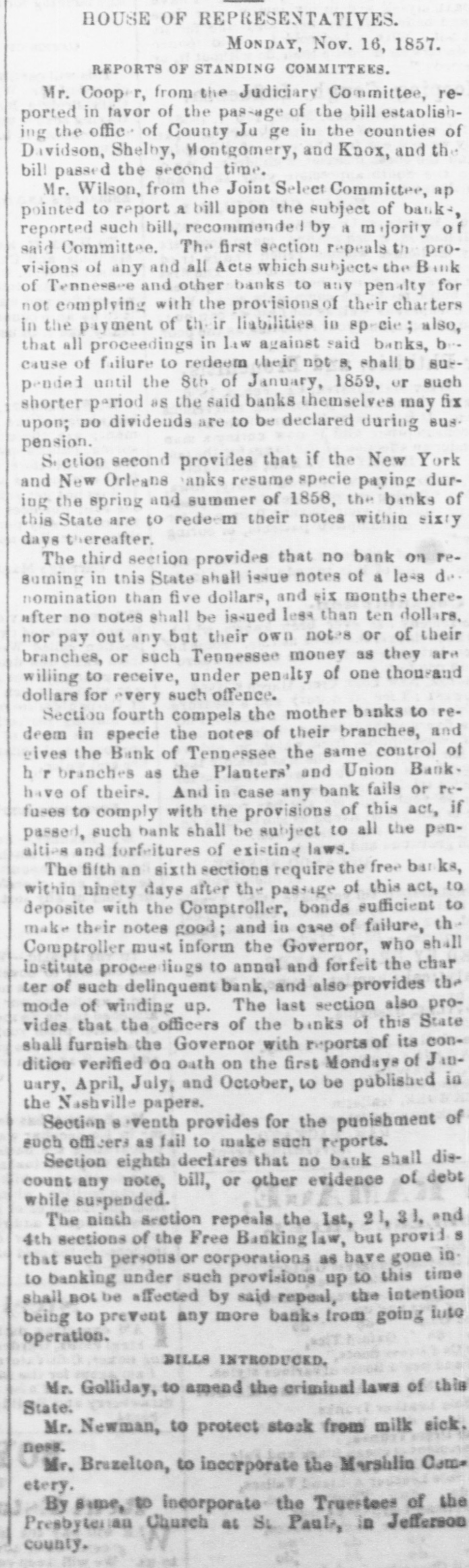
The bill [286] to make more secure the rights of vendors of land-recommending passage.
The bill [189] relative to debt contracted by women before marriage-recommending rejection.
The bill [208] to vest magistrates with power to make appropriations to pay themselves for attending quorum and quarterly courts-recommending rejection.
The bill [88] to amend the act requiring the sale of land and negroes to be advertised in a newspaper -recommending rejection.
The bill [198] requiring Clerks and other county officers to live within their county towns, and for other purposes-recommending rejection.
The resolution [64, Mr Copeland's] to amend the State Constitution-recommending rejection.
The bill [97] to amend the criminal laws-which was recommitted-recommending, again, rejection.
The bill [192] to establish a Mayor's Court for the town of Shelbyville-recommending passage.
Mr NEWMAN, from the Committee on Internal Improvements, reported.
The bill [187] to autherize the erection of mill dams across Duck river below Columbia-recommending passage.
The bill [158] for benefit of Nashville and Northwestern, and other Railroad Companies, and lessen the State liability with an amendment, recommending passage.
The resolution directory to the President of the Louisville and Nashville Railroad Company, asking to be discharged from its consideration.
The Senate bill (56) to amend the Act amendatory of the charter of the Nashville and Cincinnati Railroad Company-recommending passage, with the amendment for benefit of Louisville and Nashville Railroad Company; recommending the rejection of the House amendment for the benefit of the Atlantic, Tennessee and Ohio Railroad Company; and recommend also, that the Louisville and Nashville Railroad Company be authorized to elect a Vice President, and that the iron mentioned in the bill be under the control of the Road Commissioner.
PROPOSITIONS PASSED THE FIRST READING.
Mr CARTER of Carter, introduced a bill [No. 284] to charter the Virginia, Tennesseee and North Carolina Railroad Company.
Mr EWING introduced a la bill [No. 285] to amend the criminal laws.
Mr WHITE of Knox, introduced a bill [No. 2861 to provide for the maintainance of the Deaf and Dumb Asylum at Knoxville.
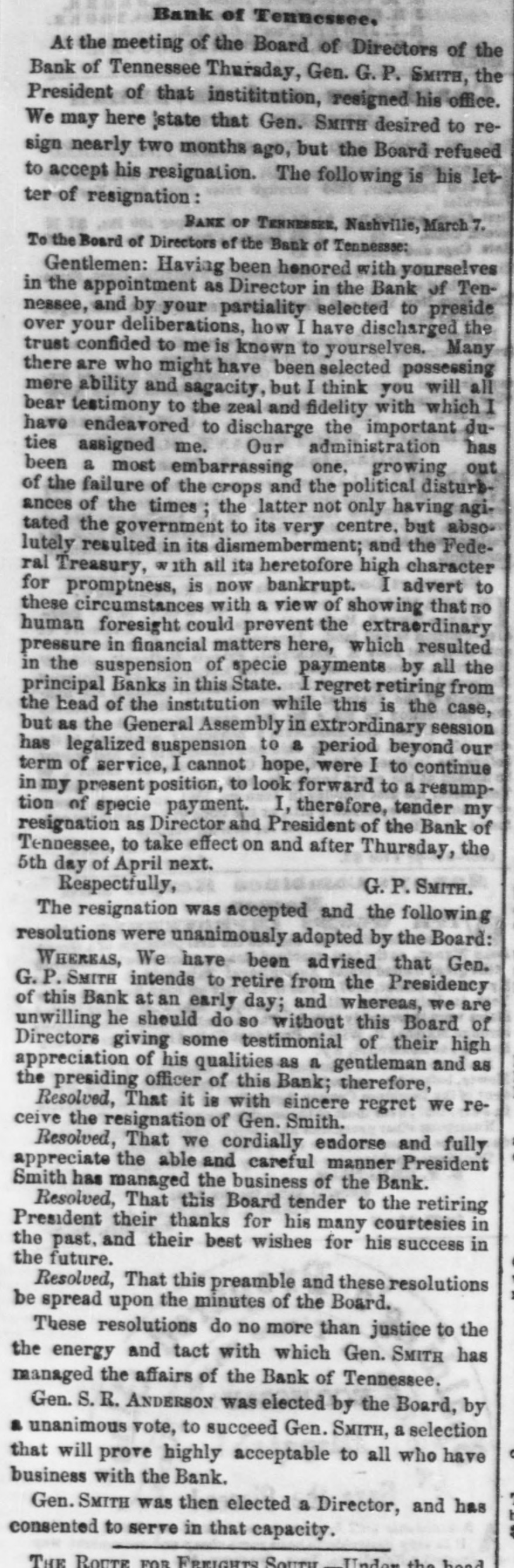
LIQUIDATION OF THE BANK OF TENNESSEE.
Mr ALGEE submitted the following, which lies over:
Pasche Committee nanas be, and they are hereby required to take into consideration that part of the Governor's message which relates to the State Bank, recommending the putting of that institution into a state of liquidation, and report a bill in conformity therewith.
THE HOLIDAYS.
Mr BRADFORD submitted the following, which lies over:
WHEREAS, It has heretofore been the custom of a large portion of the members of the Legislature of Tennessee to visit their homes during the Christmas holidays, so as not to leave a quorum, or number sufficient to transact business, thereby encumbering the State with a heavy expense, without a corresponding benefit. Therefore,
Be it resolved by the General Assembly of the State of Tennessee, That to avoid a useless drain upon the treasury, the present General Assembly will adjourn on Saturday, 18th of December, to Monday, the 4th day of January, 1858.
NEW COUNTY OF SEQUATCHIE.
On motion by Mr RAWLSTON, the House took up the consideration of the bill (23) to establish the county of Herndon, with Mr Roberts' amendments of boundary.
The amendments were adopted.
Mr RAWLSTON proposed further to amend, by striking out "Herndon," and inserting "Sequatchie."
Mr WHITE believed that name would be preferred by the people set off; it was appropriate, name from the aborigines of the country and he would like to have it preserved in this way.
The amendment was adopted; and so the bill passed the second reading.
LAUDERDALE REVENUE.
On motion by Mr LACKEY, the bill (102) for benefit of the securities of a Lauderdale Revenue Collector, was taken up. The Judiciary Committee's bill in lieu, having been adopted heretofore, was passed the third and last reading in the House of Representativer.
SOMERVILLE.
On motion by Mr MARIS, the bill (278) to amend the Charter of the town of Somerville, was taken up and passed the second reading.
GILES COUNTY JUDGE.
On motion by Mr WILLIAMS, the House took up the consideration of the Senate's amendment to the bill establishing the 14th civil district in the county of Hickman, to wit: authorizing the Governor to appoint a Giles county Judge for the December term; and the same being read by the Clerk, was concurred in by the House of Representatives.
SPECIAL ORDER-BANKS AND BANKING.
On motion by Mr ROWLES, the House now resumed the unfinished special order, to wit: Mr Polk's bill (265) to regulate the business of Banking -the question being on Mr Polk's amendment, for the suppression of small notes issued without the State of Tennessee.
Mr ROWLES proposed to amend, by inserting appropriately the word, "knowingly," so as to read, "If any person shall knowingly bring into this State," &c.
Mr POLK said it would destroy the force of the provision.
Mr FRAZER made a general speech in opposition.
Mr STANTON followed-looking to the Congress of the United States for remedy against the evils of small notes of circulation.
Mr WILLIAMS said:
Mr Speaker, I must beg the kind indulgence of the House, to submit a few remarks on the very important subject now under investigation. I have offered no bill of my own for the action of the House, not caring to be officious or prominent in the matter, and being willing to rely on the very sound judgement of the many learned and able gentlemen whose opinions accord with my own. I may, perhaps, suggest an amendment or two to some of the provisions of the various bills before us. The currency of every country is the great vital moving power that gives life and momentum to every department of its governmental and social policy, and whatever deranges that currency, is felt by all its relations proportionately, to destroy it, is not only to destroy the social relations of a country, but the government itself. The agriculturist plows the field-the mariner plows the main, because he sees in that a reward for his toil-the mechanic pours out his sweat only because he expects to receive a remuneration in money. View it as we please, sir, money is the great motive power that urges men to action; the wheels of government would stop to roll, and society would be reduced to confusion without it. Commerce could not subsist without some great medium and regulator. So obviously necessary is a currency to the convenience and comfort of man, that we find from the remotest ages of antiquity it was known and used It is likewise, knownto ali nations, from the barbarous African, to enlightened christaindom, and by all it seems to be taciturnly agreed, that that currency should be constituted of silver and gold. By international comity, the particular coin of one country recognized in another, and hence its importance asa commercial agent is immensely magnified. Then, if a currency is necessary, (and long usage, teaches that it is)it isjust as necessary that it should be uniform and not subject to sudden and violent fluctuations, it is important not only that it should be good to day, but in all times to come. For several thousand years the precious metal was its own represon-tative, and while that was so, although nations were swept away, and dynasties annihilated, no fluctuation, no panic or pressure was known, but for the last two or three centuries the ingenuity of man has been continually exerted to find some substitute for a metalic currency, alledging that there was not enough of the precious metals to supply the increasing wants of the commercial world, and hence, we have been cursed by fluctuatious, contractions and revulsions, occasioned by the system of banking, which blights not only the prosperity of our own country, but of every country where banks are known.
The system was founded on two great fundamental absurdities. One, that there was not gold and silver enough to supply commercial wants; and another still greater absurdity, that paper money, or rather bills of credit, could be made a valuable and reliable substitute for metalic currency. To refute the former, we need only look at the thousands of millions of gold and silver floating through the commercial world-the golden strands of California and Australia, and the gold studded hills of South America. The greatest danger is of their being too much, which might depreciate its value. But that paper issues or bills of credit cannot be made a reliable substitute, is a truth demonstrated everywhere where it is in use. The colonies tried it during their revolutionary struggle, but it rolled back over them an overwhelming tide of ruin, more disastrous than the British arme. The United States Bank tried it on