20871. Bank of Commerce (Nashville, TN)

Bank Information

Episode Type
Suspension → Closure
Bank Type
state
Start Date
March 27, 1893
Location
Nashville, Tennessee (36.166, -86.784)

Metadata

Model
gpt-5-mini
Short Digest
09b47725

Response Measures

None

Description

Multiple contemporaneous newspapers report the Bank of Commerce (state-chartered) did not open on March 27, 1893, and its directors made an assignment (naming an assignee). Action was taken in anticipation of a run but articles state the immediate precipitant was the failure of large debtors to meet obligations. The bank made an assignment (receiver/assignee named) and remained closed; therefore classified as suspension followed by closure/receivership. Mechanics' Savings Bank separately invoked the 60-day rule but is not the subject here.

Events (2)

1. March 27, 1893 Receivership
Newspaper Excerpt
The Bank of Commerce made an assignment ... John T. Lellyette was named as assignee / Lewis T. Baxter, president, made a special assignment for the benefit of the bank and other creditors.
Source
newspapers
2. March 27, 1893 Suspension
Cause
Bank Specific Adverse Info
Cause Details
Failure of certain large debtors to meet their obligations left the bank unable to stand an anticipated run; directors closed and made an assignment in anticipation of withdrawals.
Newspaper Excerpt
The Bank of Commerce did not open its doors to-day ... and an hour or two later, after a conference of the directors had been held, an assignment was made.
Source
newspapers

Newspaper Articles (21)

Article from Deseret Evening News, March 27, 1893

Click image to open full size in new tab

Article Text

A Bank Assigns. NASHVILLE, March 27.-The Bank of Commerce has assigned in anticipation of a run. The deposits amounted only to about $50,000. The failure of certain persons largely indebted to the bank to meet their obligations put the bank in a position not to be able to stand a run. The assets of the bank are about $100,000.


Article from The Indianapolis Journal, March 28, 1893

Click image to open full size in new tab

Article Text

of the quarrel that began when Mr. Voorhees received such prompt recognition at the White House. SMALL PANIC AT NASHVILLE. Carbstone Loungers Start Runs on the Banks -Two Small Ones Suspend Payments. NASHVILLE, Tenn.. March 27.-To-day there was some excitement on the streets where the banks are located. but the chief exoitement was caused by curbstone loung. ers, who were predicting the failure of the principal banks of the city, and whose conversation made doubting depositors somewhat uneasy. The business portion of the city was not at all agitated, and conducted busiLees as usual. At9 o'clock, the hour the banks open, quite a crowd had gathered at the corner of College and Union streets, in the vicinity of the banks, and when the doors of the banks were opened a small run was made on the First National. but the depositors got their money 60 rapidly that they became convinced that their fright was an error, and in nearly every instance redeposited. At the other large State and national banks' business went on as usual. In all of these banks the deposits during the day exceeded the withdrawals Two of the smaller banks, both doing business under State charters, at an early hour took advantage of the privilegee given them by the law, and required sixty days' notice of the withdrawal of deposits. Both of these banks had savings departments connected with them. and upon these two banks the principal runs were made. One of them. the Bank of Commerce, doing a small business with deposits amounting to about $50,000, suspended payments. though it might have availed itself of the eixty days' notice to depositore. This break is rather a bad one, but only email amounts. The Mechanics' Bank, another small State institution with a savings deposit department and having very many small creditors, opened its doors as usual, but soon it was evident that a run was being made upon it and the directors met and decided to take advantage of the law requiring sixty days' notice from depositors, and suspended payments. This bank will in all probability resume in a few days, as soon as the unquiet feeling disappears, as this bank has assets in excess of its liabilities, and only suspended for the benefit of all creditors. All the other banks transacted business as usual, and report deposits in excess of withdrawals. The feeling of uneasiness produced by the suspension, Saturday. of the Commercial National Bank has almost disappeared.


Article from The Helena Independent, March 28, 1893

Click image to open full size in new tab

Article Text

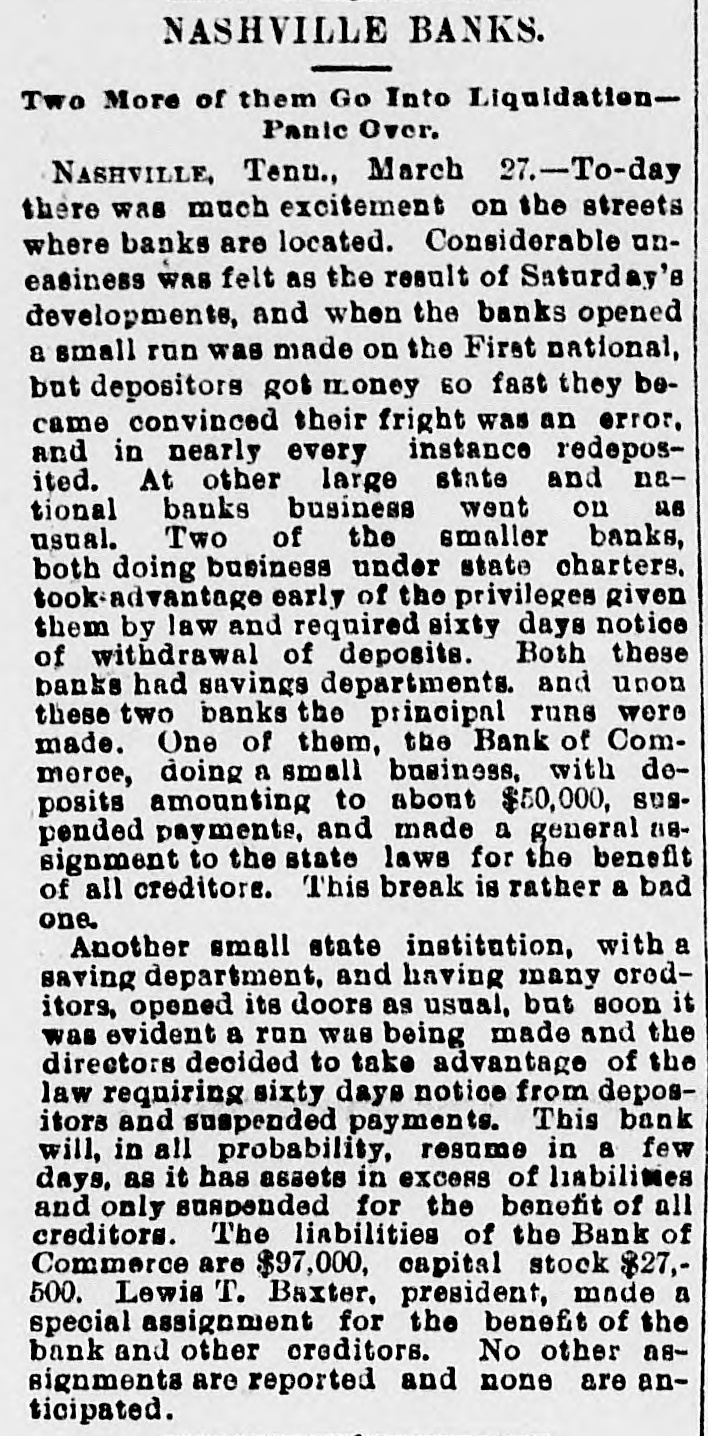
NASHVILLE BANKS. Two More of them Go Into LiquidationPanic Over. NASHVILLE, Tenn., March 27. - -To-day there was much excitement on the streets where banks are located. Considerable uneasiness WAS felt as the result of Saturday's developments, and when the banks opened a small run was made on the First national, but depositors got money 60 fast they became convinced their fright was an error, and in nearly every instance redeposited. At other large state and national banks business went on as usual. Two of the smaller banks, both doing business under state charters. took-advantage early of the privileges given them by law and required sixty days notice of withdrawal of deposits. Both these banks had savings departments. and upon these two banks the principal runs were made. One of them, the Bank of Commerce, doing a small business, with deposits amounting to about $50,000, suspended payments, and made a general 818signment to the state laws for the benefit of all creditore. This break is rather a bad one. Another small state institution, with a saving department, and having many creditors, opened its doors as usual, but soon it was evident a run was being made and the directors decided to take advantage of the law requiring sixty days notice from depositors and suspended payments. This bank will, in all probability, resume in a few days, as it has assets in excess of liabilities and only suspended for the benefit of all creditors. The liabilities of the Bank of Commerce are $97,000, capital stock $27,500. Lewis T. Baxter. president, made a special assignment for the benefit of the bank and other creditors. No other assignments are reported and none are anticipated.


Article from New-York Tribune, March 28, 1893

Click image to open full size in new tab

Article Text

ANOTHER NASHVILLE FAILURE. THE BANK OF COMMERCE MAKES AN AS SIGNMENT THE MECHANICS' BANK DEMANDS SIXTY DAYS' NOTICE OF WITHDRAWAL OF DEPOSITSCREDITORS OF BOTH LIKELY TO GET THEIR MONEY - PRECAUTIONS AGAINST RUNS ON OTHER INSTITUTIONS. [BY TELEGRAPH TO THE TRIBUNE.] Nashville, Tenn., March 27.-The Bank of Commerce of this city did not open its doors to-day at 9 o'clock, the usual time: and an hour or two later, after a conference of the directors had been held, an assignment was made. John T. Lellyette was named as assignee. The bank was a small one, its assets and liabilities being approximately as follows: Assets-Notes discounted, $76,000; real estate and cash, $21,700; total, $97,700. Liabilities-Capital stock paid in. $27,500; deposits, savings account, $14,000; deposits, special account, $15,000; general deposits, $19,000; profit and loss, $22,200; total, $97,700. The Mechanics' Savings Bank and Trust Company, capital $250,000, took advantage of the State law permitting sixty days' notice to be demanded before deposits can be withdrawn. At least a dozen small banks in adjacent towns are said to Le in temporary financial straits. The assignment of the Bank of Commerce was filed late in the afternoon. The closing of the doors was brought about by an apprehension that a run on the bank would be made in the course of the day. Under the State Banking laws the bank could have required small depositors in the savings department to give sixty days' notice of their intention to withdraw deposits. This, however, would not have prevented the withdrawal of regular deposits, which would leave the small depositors at a disadvantage. The directors there. fore decided, in the interest of all depositors alike, to close the bank. The failure of certain persons, who owe the bank large sums, to meet these obligations was the principal cause of the suspension. None of the directors or officers of the bank are indebted to the institution. Mr. Brooks, the cashier, thinks the stockholders, as well as the depositors, will be paid in full if the amounts due the bank can be collected, and that if only 50 per cent of the indebtedness can be collected the depositors ought to get all that is due them. The suspension of the Commercial National Bank on Saturday afternoon occasioned considerable excitement, which had, however, quieted down by this morning, a change of feeling largely due to the belief of various bankers that the depositors of the Commercial Bank would not lose anything. Before beginning business to-day all the banks had fortified themselves with money sufficient to meet all demands that might be made, and had arranged for large amounts in addition. There was a mild run for a while on the First National Bank, but the amount deposited largely exceeded the amount checked out. This was the case at all the banks in the city, men of means pouring ample funds into the vaults. At no time was there the least excitement. The depositors who felt panicky simply drew out their money and went quietly away. The First National was more crowded all the morning than any other bank. Everything was quiet at the American National Bank, and the doors were open till 4 o'clock. Several of the wealthy stockholders signed a notice, which was conspicuously displayed, pledging and binding their personal estates to satisfy any obligations of the bank. After a number of persons had entered the Mechanics' Savings Bank and Trust Company's office and several small checks had been cashed, the directors saw that a run was possible, and to prevent demoralizing excitement, decided to take advantage of the statute which gives a bank organized under the State laws the privilege of demanding a sixty-day notice from depositors before they can withdraw their deposits. Payments were accordingly stopped, and an explanatory notice was posted, which closed with an announcement that the bank would keep its doors open and continue to do business as usual, save that the sixty days' notice of withdrawals would be required for the present, and a denial of the rumor that the bank had sustained a loss by the suspension of the Commercial National Bank. After this business proceeded quietly as usual. United States Bank Examiner J. M. McKnight arrived in the city this morning, and at once took charge of the affairs of the Commercial Bank. S. J. Keith, president of the Fourth National Bank, said to-day that the situation was not nearly as bad as it might appear. Although one small bank had closed its doors permanently and another had availed itself of the sixty days allowed savings banks, yet it was evident that the other banks were amply prepared to take care of themselves. He added that the business condition of the city was entirely healthy.


Article from The Times, March 28, 1893

Click image to open full size in new tab

Article Text

A PANIC IN NASHVILLE. TWO MORE BANKS FAIL AND TWO MORE EXPECTED TO SHUT DOWN. Besides the Commercial, the Mechanics' Savings Bank and the Bank of Cominerce Suspend-The Cause Assigned. NASHVILLE, TENN., March 27.-The Bank of Commerce failed to-day, while a other bank, the Mechanics' Savings Bank, fearing a run that it would not be able to meet, took advantage of a standing rule, and required depositors to give sixty days' notice of the withdrawal of deposits. It has been a squally day in Nashville, and, but for the fact that the banks had time between Saturday night and this morning to prepare themselves, there might have been more trouble. With the exception of the Bank of Commerce, however, all the Nashville banks are perfectly silvent, but, of course, do not keep money on hand to pay off all depositors on sudden demand. Since Saturday, however, the larger banks had secured from one hundred thousand to a half million dollars each. To-day when the doors were opened great stacks of currency were piled up on the teller'r desk and in a plain view inside the vaults. All the Nashville banks are located near College and Union streets, and this morning before 9 o'clock the pavements were crowded mostly, however, by idlers. There were many people itching to see a general run, but they were disappointed. All the banks opened for business, except the Bank of Commerce, which at 10 o'clock posted a notice of assignment. This bank had about decided to make an assignment last week. Its statement is $19,000; profit and loss. $22,000; total, $97,000. as follows:Assets-Notes discounted,$76,000 Liabilities: Capital stock paid in, $27,500; deposits, savings acount, $14,000; deposits, special account, $15,000; general deposits real estate and cash, $21,700; total, $97,700. The fact that it did not open its doors increased the nervous feeling to some extent, and the Mechanics' Saving's Bank directors decided that the best plan for them would be to require depositors to give sixty days' notice of withdrawal as provided in their rules. They therefore announced this would be enforced. It is thought the Mechanics' Bank will resume business as usual in a day or two, as soon as the nervous feeling has been entirely abated. With very few exceptions the people who drew their money from the other were small depositors. Those having large accounts were satisfied of their safety, and interviews to-night with all the leading bankers show their friends have come to the rescue, and that today's deposits are in excess of what was drawn out. At the American National Bank a notice was displayed in the window that a dozen of the wealthiest men in Nashville, whose names were signed thereto, pledged their personal estates to secure all depositors. One of the signers to this was General W. H. Jackson, owner of Belle Mead. The statement of the Commercial Bank, which failed Saturday, is as follows: Assets-Loans and discounts, $1,600,000. Cash and cash items, $144,000. Due from reserve agents, $2,000,000. Due from other banks, $225,000. Stocks, bonds and other securities, $125,000. Total, $2,294,000. Liabilities, individual deposits, $685,000. Certificates of deposits, $93,000. Bank deposits, $550,000. Rediscounts, $150,000; bills payable, $2,000. Total, $1,678,000. Capital stock, $500,000; surplus, $100,000; undivided profits, $95,000; total, $695,000.
Article from Richmond Dispatch, March 28, 1893

Click image to open full size in new tab

Article Text

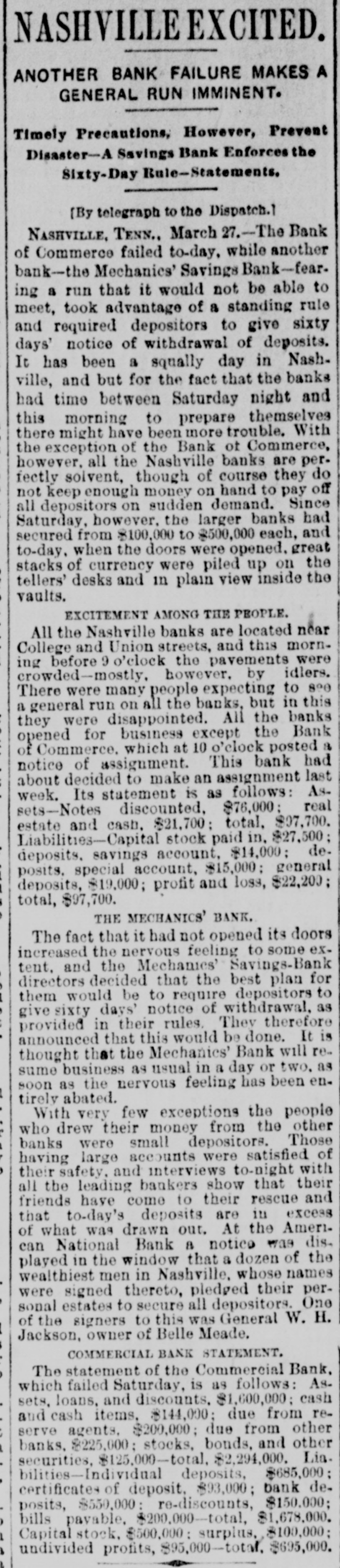
NASHVILLE EXCITED. ANOTHER BANK FAILURE MAKES A GENERAL RUN IMMINENT. Timely Precautions, However, Prevent Disaster-A Savings Bank Enforces the Sixty-Day Rule-Statements. (By telegraph to the Dispatch.1 NASHVILLE, TENN., March 27.-The Bank of Commerce failed to-day. while another bank--the Mechanics' Savings Bank-fearing a run that it would not be able to meet, took advantage of a standing rule and required depositors to give sixty days' notice of withdrawal of deposits. It has been a squally day in Nashville, and but for the fact that the banks had time between Saturday night and this morning to prepare themselves there might have been more trouble. With the exception of the Bank of Commerce, however, all the Nashville banks are perfectly solvent, though of course they do not keep enough money on hand to pay off all depositors on sudden demand. Since Saturday, however, the larger banks had secured from $100,000 to $500,000 each, and to-day. when the doors were opened. great stacks of currency were piled up on the tellers' desks and in plain view inside the vaults. EXCITEMENT AMONG THE PEOPLE. All the Nashville banks are located near College and Union streets, and this morning before 9 o'clock the pavements were crowded-mostly, however, by idlers. There were many people expecting to 890 a general run on all the banks, but in this they were disappointed. All the banks opened for business except the Bank of Commerce. which at 10 o'clock posted a notice of assignment. This bank had about decided to make an assignment last week. Its statement is as follows: Assets-Notes discounted, $76,000; real estate and cash. $21,700; total, $07,700. Liabilities-Capital stock paid in, $27,500; deposits. savings account. $14,000; deposits. special account, $15,000; general deposits, $19,000; profit and loss, $22,200; total, $97,700. THE MECHANICS' BANK. The fact that it had not opened its doors increased the nervous feeling to some tent. and the Mechanics Savings-Bank directors decided that the best plan for them would be to require depositors to give sixty days notice of withdrawal, as provided in their rules. They therefore announced that this would be done. It is thought that the Mechanics' Bank will resume business as usual in a day or two. as soon as the nervous feeling has been entirely abated. With very few exceptions the people who drew their money from the other banks were small depositors. Those having large accounts were satisfied of their safety. and interviews to-night with all the leading bankers show that their friends have come to their rescue and that to-day's deposits are in excess of what was drawn out. At the American National Bank a notico was dis. played in the window that a dozen of the wealthiest men in Nashville, whose names were signed thereto, pledged their personal estates to secure all depositors. One of the signers to this was General W. H. Jackson, owner of Belle Meade. COMMERCIAL BANK STATEMENT. The statement of the Commercial Bank, which failed Saturday, is as follows: Assets, loans, and discounts. $1,600,000; cash and cash items. $144,000; due from reserve agents. $200,000; due from other banks, $225,000; stocks. bonds, and other securities, $125,000-total, $2,294,000. Lia. bilities-Individual deposits, $685,000; certificates of deposit. $93,000; bank deposits, $550,000 : re-discounts, $150.000; bills pavable. $200,000 total, $1,678,000. Capital stock, $500,000: surplus, $100,000; undivided profits, $95,000-total $695,000.


Article from The Evening Herald, March 28, 1893

Click image to open full size in new tab

Article Text

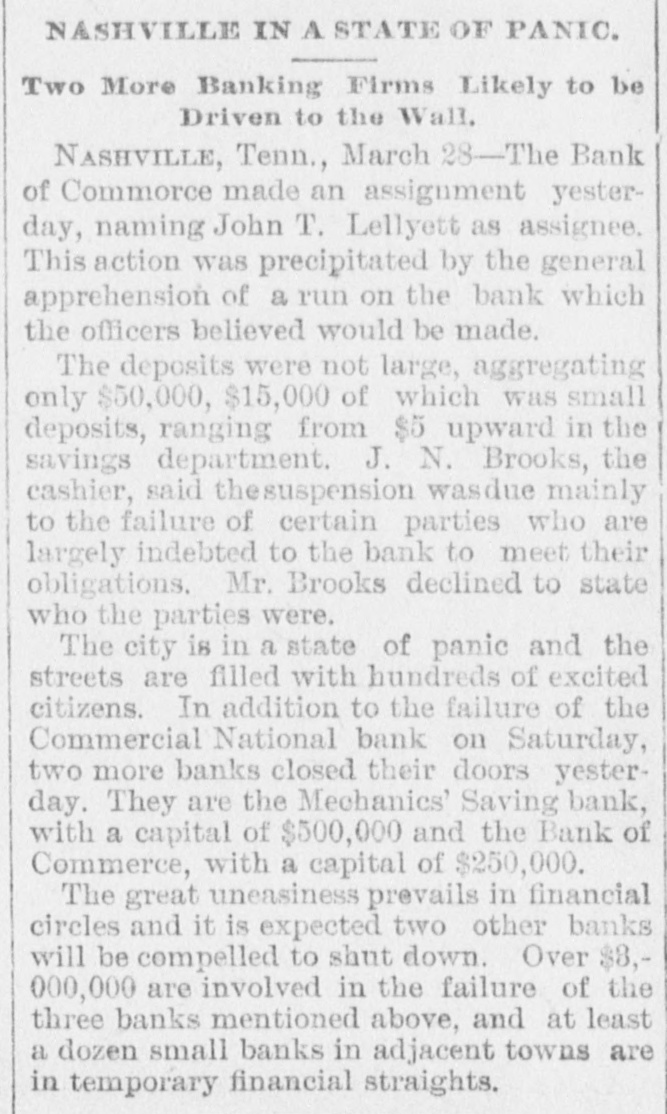
NASHVILLE IN A STATE OF PANIC. Two More Banking Firms Likely to be Driven to the Wall, NASHVILLE, Tenn., March 28-The Bank of Commorce made an assignment yesterday, naming John T. Lellyett as assignee. This action was precipitated by the general apprehension of a run on the bank which the officers believed would be made. The deposits were not large, aggregating only $50,000, $15,000 of which was small deposits, ranging from $5 upward in the savings department. J. N. Brooks, the cashier, said thesuspension wasdue mainly to the failure of certain parties who are largely indebted to the bank to meet their obligations. Mr. Brooks declined to state who the parties were. The city is in a state of panic and the streets are filled with hundreds of excited citizens. In addition to the failure of the Commercial National bank on Saturday, two more banks closed their doors yesterday. They are the Mechanics' Saving bank, with a capital of $500,000 and the Bank of Commerce, with a capital of $250,000. The great uneasiness prevails in financial circles and it is expected two other banks will be compelled to shut down. Over $8,000,000 are involved in the failure of the three banks mentioned above, and at least a dozen small banks in adjacent towns are in temporary financial straights.


Article from St. Paul Daily Globe, March 28, 1893

Click image to open full size in new tab

Article Text

SUSPENDED PAYMENT Two Small Savings Banks at Nashville in Financial Difficulties. They Take Advantage of the Required Sixty Days' Notice. One of Them Will Probably Resume Business in a Few Days. All of the Other Banks Transacted Business as Usual. NASHVILLE. Tenn., March 27.-Today there was some excitement on the streets where the banks are located, but the chief excitement was caused by curbstone loungers, who were predicting the failure of the principal banks of the city, and whose conversation made doubtful depositors somewhat uneasy. The business portion of the city was not at all agitated, and conducted its business as usual. At 9 o'clock. the hour the banks open, quite a crowd gathered at the corner of College and Union streets, in the vicinity of the banks, and when the doors of the banks were opened a small run was made on the First National, but the depositors got their money so rapidly that they became convinced that their was an error. and in nearly every fright instance state and redeposited. At the other large national banks business went on as usual. In all of these banks the deposits during the day Exceeded the Withdrawals. Two the smaller doing of under banks, charters, both at business state an hour took privileges them by reearly given advantage the of law the the and withquired sixty days' notice of drawal of deposits. Both of these banks had savings departments connected with them. and upon these two banks the principal runs were made, one of them, the Bank of Commerce, doing a small business, with deposits amounting to about $50,000, suspended payments, though have of the to sixty it days might provided availed depositors, itself and made a under laws of all This a creditors. today the state general break for small the assignment is benefit amounts. rather bad one, but only for The Mechanics' bank. another small state institution with a savings department and having very many small creditors, opened its doors as usual, but soon it was evident that a run was being made upon it, and the directors met and decided to take advantage of the law requiring sixty days notice from depositors. and suspended payments. This bank will, in all probability. Resume in a Few Days, as soon as the disappears. as this has assets 111 excess of its for liabilities. bank unquiet and only feeling suspended All the benefit of all its creditors. the other banks transacted business as usual, and report deposits in excess of withdrawals. The feeling of uneasiness produced by the mercial there is no to peared, suspension and National bank Saturday has doubt almost of the that disap- Commorrow business will resuine its usual channels and the banks will have no further trouble. The officers of the Mechanics bank suspended are Lewis T. Baxter, president, and John Schardt, cashier. The officers of the Bank of Commerce assigned are J. H. Yarbrough, president, and J. N. Brooks. rashier. The liabilities of the Bank of Commerce are $97,000; capital stock, $27,500. The consensus of opinion of all the leading financial and business men of the city, is that the flurry is over and that the storm has expended its fury. As a result of the suspension of the Mechanies' the made a president, bank. Lewis special T. the assignment Baxter, bank for the benefit of and and none are other today Special are reported creditors. Bank Examiner No other assignments anticipated. J. M. Mcof has and is in city, Knight, Louisville, charge of the reached suspended the Commercial National bank.


Article from Pawtucket Tribune, March 28, 1893

Click image to open full size in new tab

Article Text

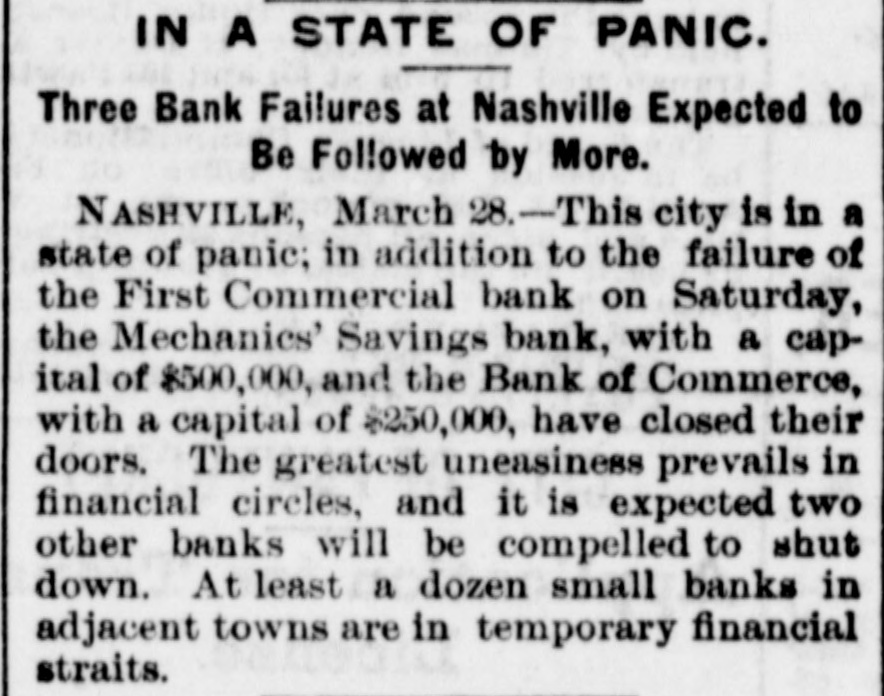
IN A STATE OF PANIC. Three Bank Failures at Nashville Expected to Be Followed by More. NASHVILLE, March 28.-This city is in a state of panic; in addition to the failure of the First Commercial bank on Saturday, the Mechanics' Savings bank, with a capital of $500, 000, and the Bank of Commerce, with a capital of $250,000, have closed their doors. The greatest uneasiness prevails in financial circles, and it is expected two other banks will be compelled to shut down. At least a dozen small banks in adjacent towns are in temporary financial straits.


Article from The State Chronicle, March 28, 1893

Click image to open full size in new tab

Article Text

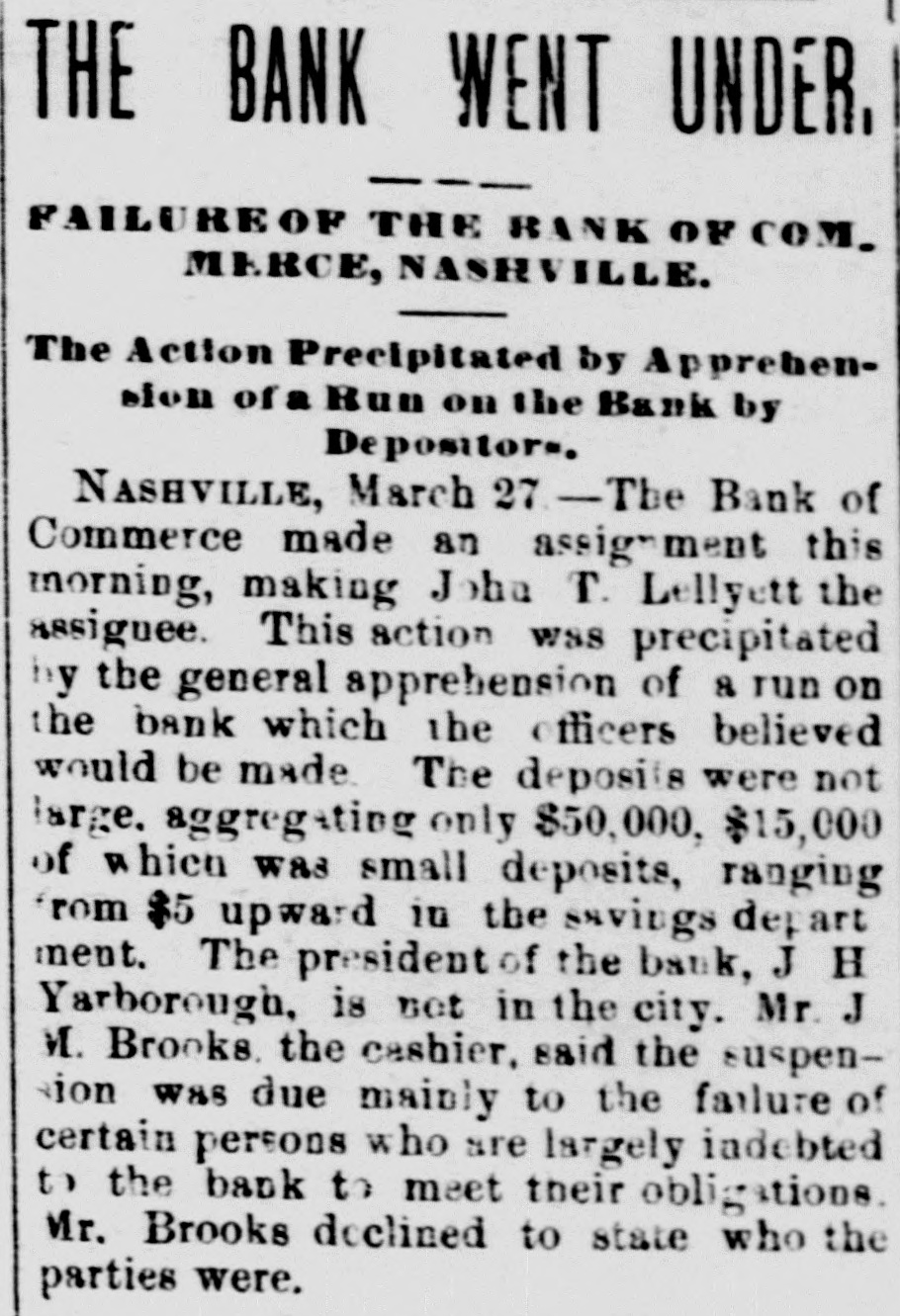
THE BANK WENT UNDER. FAILUREOF THE RANK OF COM. MERCE, NASHVILLE. The Action Precipitated by Apprehension of a Run on the Bank by Depositors. NASHVILLE, March 27 - The Bank of Commerce made an assignment this morning, making Joha T. Lellyett the assiguee. This action wss precipitated by the general apprehension of a run on the bank which the officers believed would be made. The deposits were not large. aggregating only $50,000. $15,000 of whien was small deposits, ranging 'rom $5 upward in the savings depart ment. The president of the bank, J H Yarborough, is not in the city. Mr. J M. Brooks. the cashier, said the suspenion was due mainly to the failure of certain persons who are largely indebted to the bank to meet their obligations. Mr. Brooks declined to state who the parties were.


Article from The Morning Call, March 28, 1893

Click image to open full size in new tab

Article Text

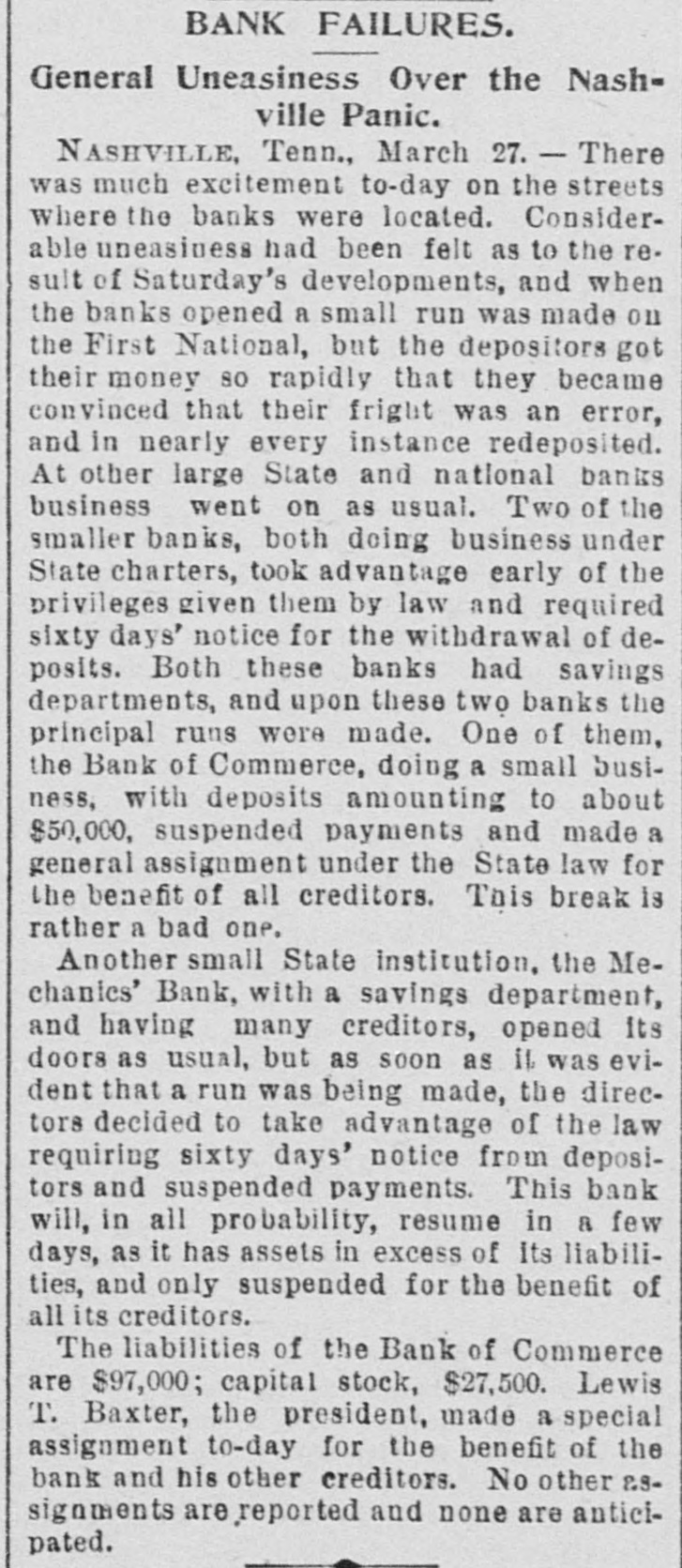
BANK FAILURES. General Uneasiness Over the Nashville Panic. NASHVILLE, Tenn., March 27. - There was much excitement to-day on the streets where the banks were located. Considerable uneasiness had been felt as to the result of Saturday's developments, and when the banks opened a small run was made on the First National, but the depositors got their money so rapidly that they became convinced that their fright was an error, and in nearly every instance redeposited. At other large State and national banks business went on as usual. Two of the smaller banks, both doing business under State charters, took advantage early of the privileges given them by law and required sixty days' notice for the withdrawal of deposits. Both these banks had savings departments, and upon these two banks the principal runs were made. One of them, the Bank of Commerce, doing a small business, with deposits amounting to about $50,000, suspended payments and made a general assignment under the State law for the benefit of all creditors. This break is rather a bad one. Another small State institution, the Mechanics' Bank, with a savings department, and having many creditors, opened its doors as usual, but as soon as il was evident that a run was being made, the directors decided to take advantage of the law requiring sixty days' notice from depositors and suspended payments. This bank will, in all probability, resume in 8 few days, as it has assets in excess of Its liabilities, and only suspended for the benefit of all its creditors. The liabilities of the Bank of Commerce are $97,000; capital stock, $27,500. Lewis T. Baxter, the president, made a special assignment to-day for the benefit of the bank and his other creditors. No other 23signments are reported and none are anticipated.


Article from The Daily Morning Astorian, March 28, 1893

Click image to open full size in new tab

Article Text

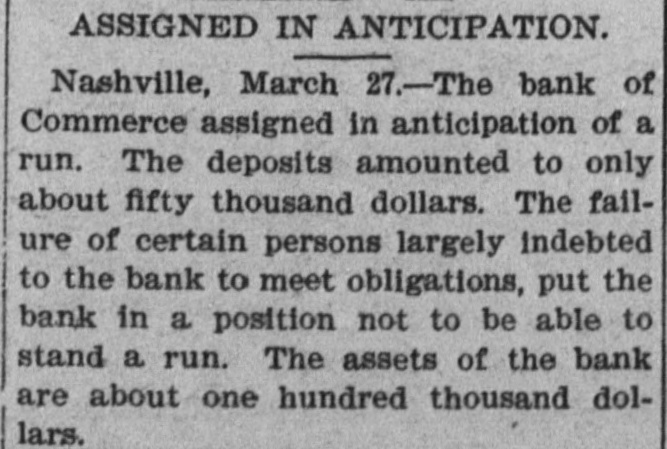
ASSIGNED IN ANTICIPATION. Nashville, March 27.-The bank of Commerce assigned in anticipation of a run. The deposits amounted to only about fifty thousand dollars. The failure of certain persons largely indebted to the bank to meet obligations, put the bank in a position not to be able to stand a run. The assets of the bank are about one hundred thousand dollars.


Article from The Seattle Post-Intelligencer, March 28, 1893

Click image to open full size in new tab

Article Text

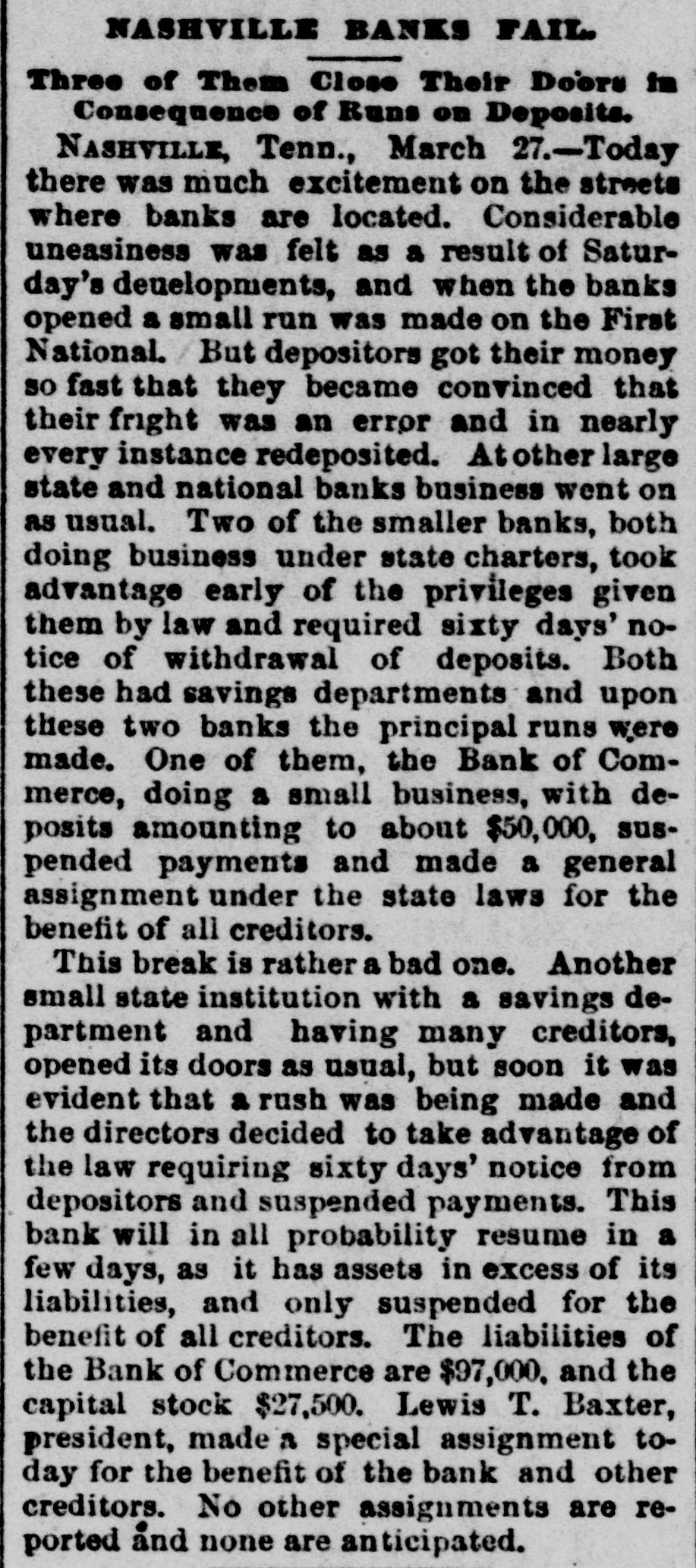
NASHVILLE BANKS FAIL. Three of Them Close Their Doors in Consequence of Runs on Deposits. NASHVILLE, Tenn., March 27.-Today there was much excitement on the streets where banks are located. Considerable uneasiness was felt as a result of Saturday's developments, and when the banks opened a small run was made on the First National. But depositors got their money so fast that they became convinced that their fright was an error and in nearly every instance redeposited. Atother large state and national banks business went on as usual. Two of the smaller banks, both doing business under state charters, took advantage early of the privileges given them by law and required sixty days' notice of withdrawal of deposits. Both these had savings departments and upon these two banks the principal runs were made. One of them, the Bank of Commerce, doing a small business, with deposits amounting to about $50,000, suspended payments and made a general assignment under the state laws for the benefit of all creditors. This break is rather a bad one. Another small state institution with a savings department and having many creditors, opened its doors as usual, but soon it was evident that a rush was being made and the directors decided to take advantage of the law requiring sixty days' notice from depositors and suspended payments. This bank will in all probability resume in a few days, as it has assets in excess of its liabilities, and only suspended for the benefit of all creditors. The liabilities of the Bank of Commerce are $97,000. and the capital stock $27,500. Lewis T. Baxter, president, made a special assignment today for the benefit of the bank and other creditors. No other assignments are reported and none are anticipated.


Article from The Wilmington Daily Republican, March 28, 1893

Click image to open full size in new tab

Article Text

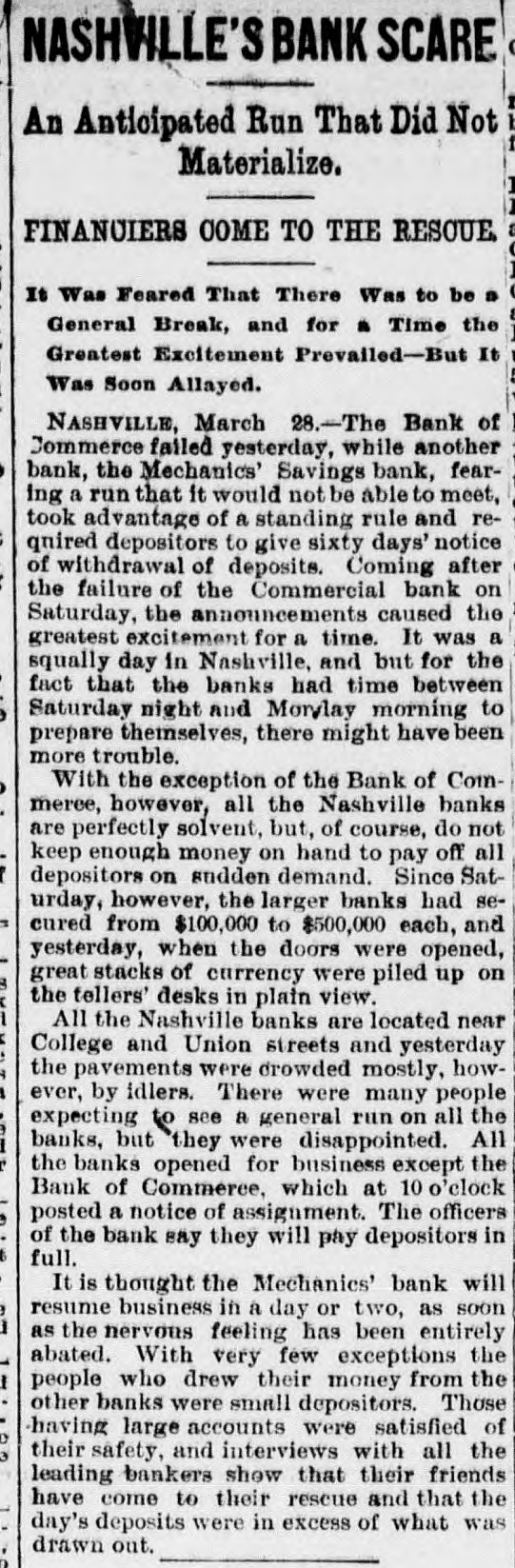
NASHVILLE'S BANK SCARE An Anticipated Run That Did Not Materialize. FINANCIERS COME TO THE RESQUE It Was Feared That There Was to be a General Break, and for a Time the Greatest Excitement Prevailed-But It Was Soon Allayed. NASHVILLE, March 28.-The Bank of Commerce failed yesterday, while another ) bank, the Mechanics' Savings bank, fearing a run that it would not be able to meet, took advantage of a standing rule and required depositors to give sixty days' notice of withdrawal of deposits. Coming after the failure of the Commercial bank on Saturday, the announcements caused the greatest excitement for a time. It was a squally day in Nashville, and but for the fact that the banks had time between Saturday night and Monylay morning to prepare themselves, there might have been more trouble. With the exception of the Bank of Commeree, however, all the Nashville banks are perfectly solvent, but, of course, do not keep enough money on hand to pay off all depositors on sudden demand. Since Saturday, however, the larger banks had secured from $100,000 to $500,000 each, and yesterday, when the doors were opened, great stacks of currency were piled up on the tellers' desks in plain view. All the Nashville banks are located near College and Union streets and yesterday the pavements were drowded mostly, however, by idlers. There were many people expecting to see a general run on all the banks, but they were disappointed. All the banks opened for business except the Bank of Commerce, which at 10 o'clock posted a notice of assignment. The officers e of the bank say they will pay depositors in full. It is thought the Mechanics' bank will resume business in a day or two, as soon I as the nervous feeling has been entirely abated. With very few exceptions the I people who drew their money from the other banks were small depositors. Those having large accounts were satisfied of D 3 their safety, and interviews with all the leading bankers show that their friends have come to their rescue and that the day's deposits were in excess of what was drawn out.


Article from The Providence News, March 28, 1893

Click image to open full size in new tab

Article Text

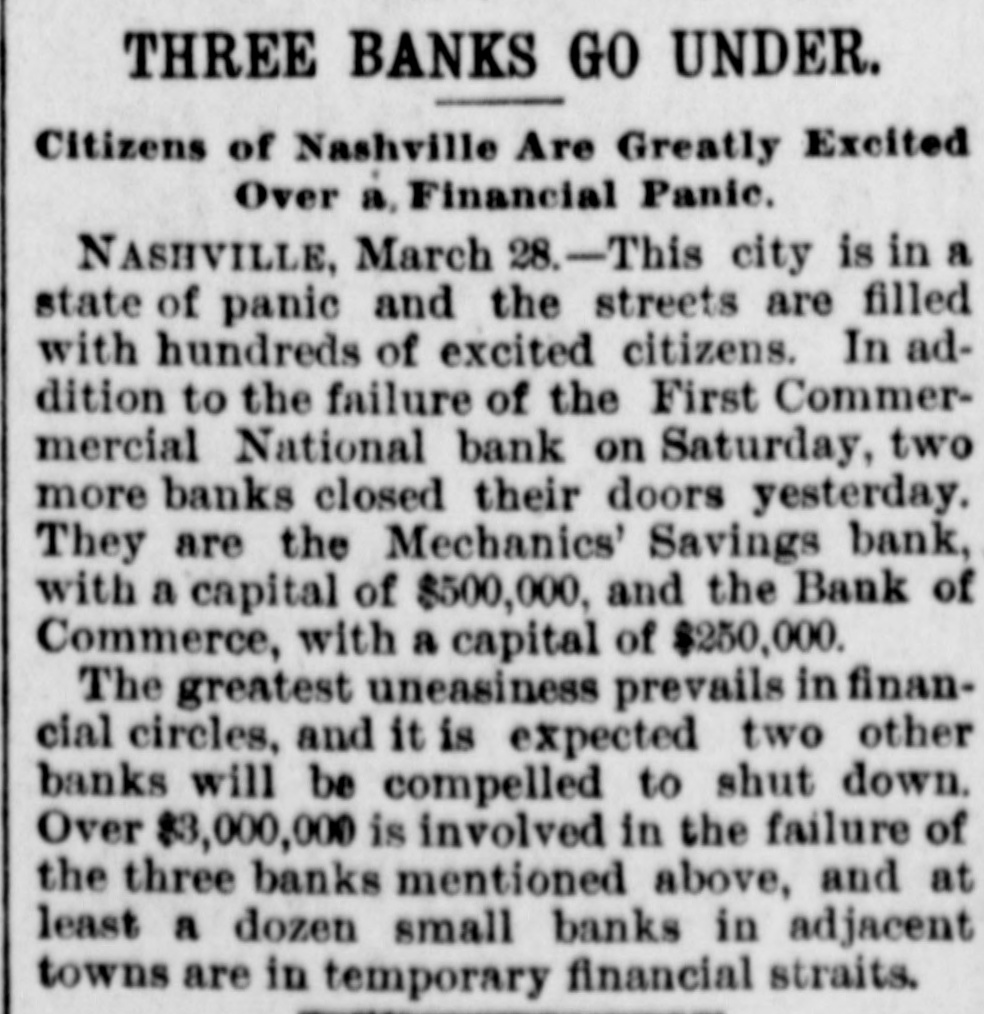
THREE BANKS GO UNDER. Citizens of Nashville Are Greatly Excited Over a. Financial Panic. NASHVILLE, March 28.-This city is in a state of panic and the streets are filled with hundreds of excited citizens. In addition to the failure of the First Commermercial National bank on Saturday, two more banks closed their doors yesterday. They are the Mechanics' Savings bank, with a capital of $500,000, and the Bank of Commerce, with a capital of $250,000. The greatest uneasiness prevails in financial circles, and it is expected two other banks will be compelled to shut down. Over $3,000,000 is involved in the failure of the three banks mentioned above, and at least a dozen small banks in adjacent towns are in temporary financial straits.


Article from Rock Island Daily Argus, March 28, 1893

Click image to open full size in new tab

Article Text

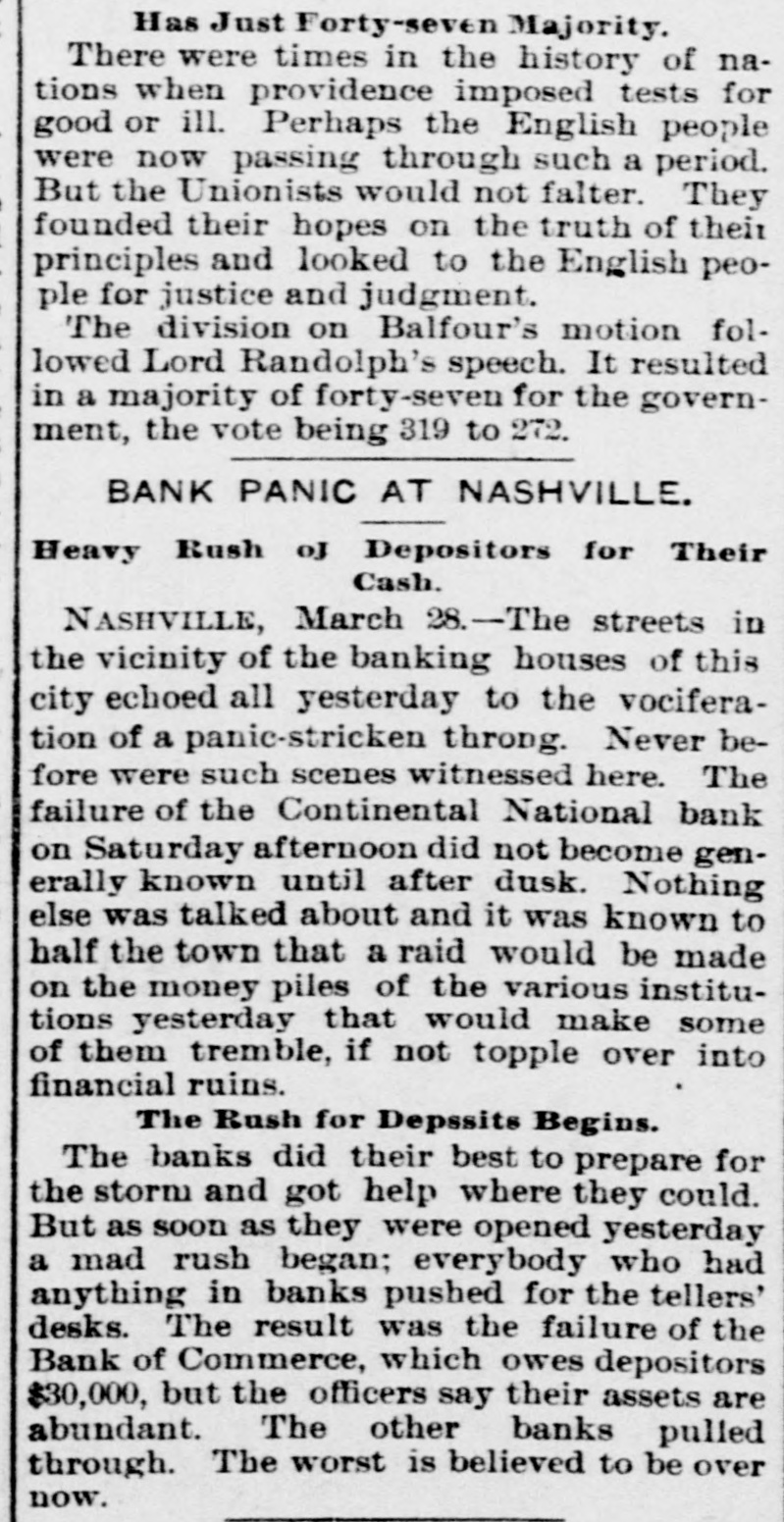
Has Just Forty-seven Majority. There were times in the history of nations when providence imposed tests for good or ill. Perhaps the English people were now passing through such a period. But the Unionists would not falter. They founded their hopes on the truth of their principles and looked to the English people for justice and judgment. The division on Balfour's motion followed Lord Randolph's speech. It resulted in a majority of forty-seven for the government, the vote being 319 to 272. BANK PANIC AT NASHVILLE. Heavy Rush of Depositors for Their Cash. NASHVILLE, March -The streets in the vicinity of the banking houses of this city echoed all yesterday to the vociferation of a panie-stricken throng. Never before were such scenes witnessed here. The failure of the Continental National bank on Saturday afternoon did not become generally known until after dusk. Nothing else was talked about and it was known to half the town that a raid would be made on the money piles of the various institutions yesterday that would make some of them tremble, if not topple over into financial ruins. The Rush for Depssits Begins. The banks did their best to prepare for the storm and got help where they could. But as soon as they were opened yesterday a mad rush began; everybody who had anything in banks pushed for the tellers' desks. The result was the failure of the Bank of Commerce, which owes depositors $30,000, but the officers say their assets are abundant. The other banks pulled through. The worst is believed to be over now.


Article from The Wheeling Daily Intelligencer, March 28, 1893

Click image to open full size in new tab

Article Text

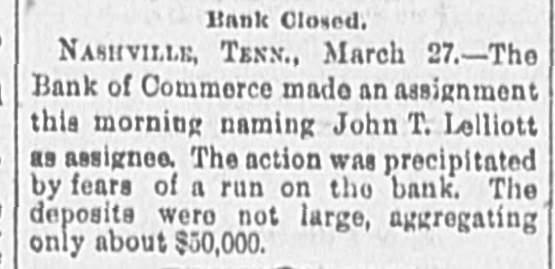
Bank Closed. NASHVILLE, TENN., March 27.-The Bank of Commerce made an assignment this morning naming John T. Lelliott as assignee. The action was precipitated by fears of a run on the bank. The deposits were not large, aggregating only about $50,000.


Article from Fort Worth Gazette, March 29, 1893

Click image to open full size in new tab

Article Text

ENEWS CONDENSED Little Rock, Ark., the Democratic central committee selected June 22 he date for holding the state convendetachment of Haytian revolutionists crossed from San Domingo and Ind Haytl. Maginat fears this unauthor Invasion may seriously interfere with plans. e Wisconsin legislature has adopted a orial to congress asking a submission amendment to the federal constituUnited In providing for the election of AS senators by a popular vote. O Italians, Antonio Lonzo and Louis Igno, maddened by drink and jealousy, at 8 duel with knives on the streets harpsburg last night. Both were so Y Injured neither will recover. Boston, Mass., the annual meeting of American Bell Telephone company was yesterday, The old directors and it's were re-elected and it was voted crease the capital stock to $20,000,strike of the Monongahela Valley is is practically ended, and before the the week It is probable all of the old men will be back at work. Fully strikers returned to the mines yesay. >AT Danville, Ky., Dick Crowder shot Instantly killed James Mender and ded John Harp so badly he died in NY hours. All the paties were mooners who had been conducting a still ing Gulch. Hawley, king of green goods swindand represented to be a nephew of d States Senator Hawley is under at Chicago. Postal inspectors think have evidence enough against Hawley the conviction sure. is announced that Vice-President of the Missouri, Kansas and Texas has tendered his resignation and has succeeded by F. B. Underwood, ml manager of the Minneapolis, St. and Sault Ste Main railway. Bank of Commerce of Nashville, made an assignment yesterday to T. Tellyitt, assignee. This action precipitated by the general appreon of a run on the bank, which the of the bank believed would be Deposits are not large, aggregatonly about $50,000. of which $15,000 small deposits, ranging from $5 upin the savings department. Charles Gudden and wife of LoMass., Ex-Governor James A. Wesand daughter of Manchester, N. H., y Gordon of Boston, and Mayor Franewett of Lowell, Mass., are at Gallooking into the condition of the wwestern Telephone and Telegraph Many with a view to its betterment. Budden is the treasurer of the comand the other gentlemen are direccount of Paris has sent a circular to the monarchistic committees stenout France. In it he says substan"the present movement Is most the chamber has lost credit Without the country: the government 7.00 courage to act against the Socialit is powerless at home and devold thority abroad. The time has come for ght minded men to unite in a supreme to restore the honor of France."


Article from The Princeton Union, March 30, 1893

Click image to open full size in new tab

Article Text

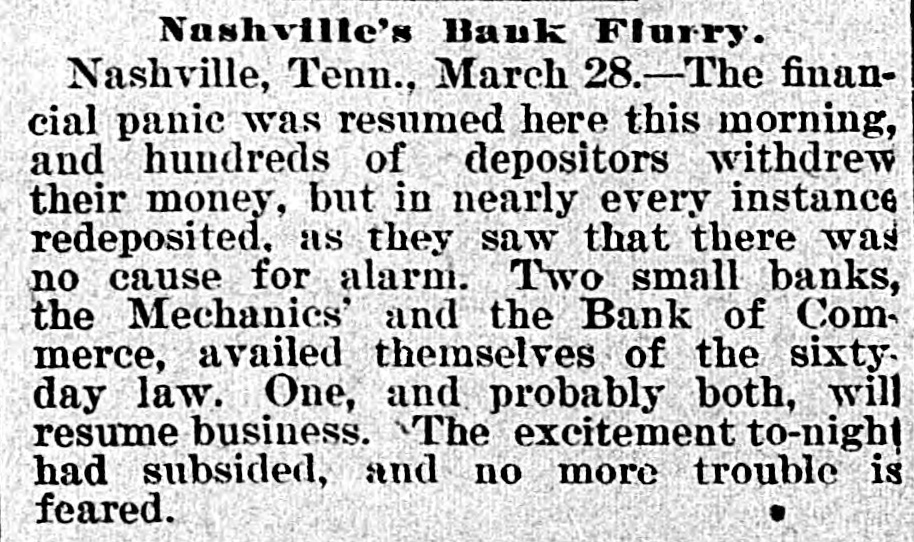
Nashville's Bank Flurry. Nashville, Tenn., March 28.-The financial panic was resumed here this morning, and hundreds of depositors withdrew their money, but in nearly every instance redeposited. as they saw that there was no cause for alarm. Two small banks, the Mechanics' and the Bank of Commerce, availed themselves of the sixty. day law. One, and probably both, will resume business. The excitement to-night had subsided, and no more trouble is feared.


Article from Arizona Weekly Citizen, April 1, 1893

Click image to open full size in new tab

Article Text

TELEGRAPHIC. WASHINGTON, D. C., March 27.-The report of the majority and minority the contested election case of L. E. Mantle, Senator appointed by the Governor of Montana, was made today, Hoar submitting a report of the majority in favor of seating Mantle. and Vance, chairman of the committee, a report agaiest the seating. There are two other cases, those of Beckwith, appointed by the Governor of Wyoming and Allen appointed by the Governor of Washington. In as much as the facts show the same test to be made in each case the Secator on whose credentials the report was made, it is not unlikely that as this is decided, so will be the othera. Both reports are rather lengthy and quote volumniously from the earlier decisions of the Senate upon cases dealing with the same questions. Minority reports adverse are to be made tomorrow by Vance. Call addressed the Senate on his resolution annulling the provision in the last legislative appropriation bill for the appointment of a commission of the Senate and the House to examine into the civil service of the executive departments. WASHINGTON, March 27.- The Presisident sent the following nominations to the Senate today: Felix A. Reeve Tennessee solicitor treasury; W. H. Seaman, Wisconsin U.S district judge eastern district of Wisconsin. Aibert B. Fall, New Mexico, associate justice of the supreme court of New Mexico; Samuel T. Fisher, Messachustte, assistant commissioner of Patents; Samuel F. Morse, Indiana, counsul general to Paris; Allen B. Morse, Michigan, consul at Glasgow: George J. Dennis, California, United States attorney for the southern district of California; Francisco Estudillo, California, agent for Indians Mission to Tale river Consolidated agency California, Postmasters; Mrs. A. Bates at Sonoma California. CHICAGO, March 27.-Horace Donahue, a well-known wealthy publisher, suicided today by cutting his throat with a razor in the presence of his wife. No cause known. CAICAGO, III., March 27.-From present indications it would appear that chinese laborers who reside in Chicago will all register under the Geary law and hat there will be no frictions. A good deal of inquiry has been made o late by chinese residing here as to the operation of the act and already several here have made application for registration. NASHVILLE, Tenn., March 27.-The Bank of Commerce has assigned in anticipation of a run. The deposits amounted to only about $50,000. Fail ure is due certain persons who are largely indebted to the bank being able to meet their obligations put the bank in a position not to be able to stand a run. Assette about $100,000. JACKSON, Mch., March 27.-Irving Latimer, under sentence imprisonment for life for the murder of his mother January 1889 is now at liberty armed with 8 riflle and it is not believed that ha can be captured alive. He has been allowed some privileges by night keeper Gill and took advantage of them to drug Gill and gate keeper Height, thus se curing the keys. Haight died from the effects of the poison. Gill is under ar rest as an accomplice in his escape. Hundreds of men are searching the city d surrounding country for him. ROME, March 25-The city is in a state of great excitement over an assault that was made this evening on King Humbert. The king was returning from the Villa Borghes where he had been spending a portion of the day, when a person having the general appearance of an Italian workingman threw a stone at the King, the missle almost striking the monarch. The as sailant was promptly taken in hand by the police and conveyed to prison, otherwise he would in all probability have been killed by the engry multitude. An immense crowd assembled cheered the king with frantic enthusiasm, and all the way to the palace the scene was like a triumphal procession. HONOLULU, March 28.- The uncertainity which prevails as to the probable fate of the Islands, so far as their annexation to the United States is concerned, is having a most depressing effect here. Business is du'l and 8 feeling of unrest has arisen. Opposition to annexation grows with the delay and the Royalists are showing more confidence in their assertain that the Queen will be restored to her throne. The resignation of the Minister of Finance, P. C.Jones, is reported because of ill health. There is an impression among certain prominent men here that Japan has designs on Hawair and would have annexed the Islands had not the United States forstalled her, If the United States abandons the protectorate Japan would declare that no government existed and would raise the Japanese flag. A company has been organized to engage in coffee growing on the Islands. SAN FRANCISCO, March 28.--The United States ship Alliance arrived from Honolulu this morning. She reports all quiet at the Islands, the only news being the resignation of Jones, Minister of Finance and the pointment of T. C. Porter in his place. Up to March 16, when the Allience left the American protectorate was still in force. SCRANTON, Pa., Mar. 28.-Barney McFadden, a miner, murdered his wife and


Article from Hot Springs Weekly Star, April 7, 1893

Click image to open full size in new tab

Article Text

GENERAL DOMESTIC NEWS The trial of the armored cruiser New York was an unprecedented success, the vessel breaking the record of first trials and developing the fact that she is the fastest vessel of her class afloat. The New York Times has been sold by the Jones-Morgan interests to a syndicate said to be headed by Chas. R. Flint. Considerable life insurance money appears to have gone into the purchase. The price paid is reported to be $950,000. The sale includes only the newspaper plant. Nashville, Tenn.. is in a state of panic, and the streets are filled with hundreds of excited citizens. In addition to the failure of the Commercial National Bank, for $260,000. two more banks have closed their doors. They are the Mechanics' Savings Bank, with a capital of $500,000, and the Bank of Commerce, with a capital of $250,000. A SO far unaccounted-for phenomenon was seen in the western sky at San Francisco and as far south as San Diego. It had the appearance of a large electric light, but flashed, flickered. changed colors -one moment being brilliant red, another white. then green. then blue -moving slowly from north to south. then gradually sank below the hills. A bank robbery. partaking of the daring shown at the famous Coffeyville affair last October. was enacted at Caney, Kan. The only thing missing to make it more closely resemble the robbery in which the Daltons took part. was that nobody was hurt. The bandits got $4,000, and a good start on their pursuers and perhaps will never be captured. Caney is a small town close to the Indian territory linc. O. W. Potter, the millionaire iron manufacturer who was sued by Ernest W. Dunnavant. an ex-newsboy who claimed $100,000 because, as he alleges, Potter had him railroaded to the penitentiary to keep him away from Gertrude W. Potter, the daughter of the millionaire, has broken his silence on the ca c. He denies that he had anything whatever to do with the prosecution of Dunnavant.