Article Text
Private dispatches to this city yesterday, announced the suspension of the Bank of Shelbyville, (stock bank,) the Bank of Trenton, and the Exchange Bank, at Murfreesboro, (free banks.)
b5a45922Full suspension
Other: Occurred during the Panic of 1857; described as a suspension and later resumption of specie payment.
Click image to open full size in new tab
Private dispatches to this city yesterday, announced the suspension of the Bank of Shelbyville, (stock bank,) the Bank of Trenton, and the Exchange Bank, at Murfreesboro, (free banks.)
Click image to open full size in new tab
"Repeating The song whose breath Might lead to death, But never to retreating." MERE-MENTION. The Wilmington Herald learns via. Norfolk, of the suspension of the Farmer's Bank of Elizabeth City, N.C. In Norfolk, the brokers are taking its notes at 50 per cent discount. The Elizabeth City Pioneer says that "holders of the notes of the bank need feel under no apprehension as regards their safety, as we understand the The last suspension is but temporary." great financial revolution was began in 1837, with the suspension of the United States Bank and all the State Banks, and ended in 1840, the very one that began the war. Within those years 30,000 houses broke, and took the benefit of the bankrupt law of 1841. Their debts amounted to $400,000.000-their assets to almost nothing. Private despatches received at Augnsta, announces the suspension of the Exchange Bank at Murfeesborough, the Trenton Bank at Trenton, and the Shelbyville banks, all in Tennessee ; and that other banks are of doubtful solvency. The Texas correspondent of the Journal of Commerce says SAM'L HOUSTON, thegreat defunct, purJ. R. E. Couposes H removal to Kansas. TRIER, Second Teller of the Bank of Charleston, Out is a defaulter to the extent of $12,000. of the forty-three signers of the memorial to President BUCHANAN, on the subject of Kansas, fifteen are directly connected with the government Messrs. JEWETT and faculty of Yale College. & Co., Boston publishers, have suspended. Their The town of liabilities amount to $100,00 Salisbury, North Carolina, on Saturday, voted to subscribe $25,000 to the Virginia and North CaroThe Columbia Engine Comlina Rail Road. pany, of New York, has resolved to visit London and Paris this fall, and have sent their engine to Philadelphia to have it refitted for the trip. Over nine thousand locomotives are now running The first on rail roads of the United States. female born in Galveston, Texas, was married a short time since. She is described as being young Au exchange says, the and handsome, Chicago Ledger, a full blooded Black Republican paper, is out in favor of nominating some negro
Click image to open full size in new tab
The Old Banks refuse to Suspend. It was understood generally on the streets yesterday that the Bank of Tennessee, Planters' Bank and Union Bank would refuse to suspend, though no formal reply to the address of the meeting of the merchants had been reported last evening. All the other Banks in the city were kept open through the day yesterday, and paid out all calls. The following Banks were thrown out at the counters of the old Banks yesterday. The ground upon which their notes were refused, was that they had no agencies in Nashville to take them up. Some of them are believed to be entirely solvent. Here is the list: Bank of Tazewell, at Tazewell. Bank of Claiborne, at Tazewell. Exchange Bank, Murfreesboro. Bank of Lawrenceburg. Bank of Jefferson, Dandridge. Bank of Nashville. Bank of Memphis. River Bank, Memphis. Northern Bank of Tennessee, Clarksville.
Click image to open full size in new tab
THE TENNESSEE BANKS. -- Accounts from Nashville as late as Monday, state that the citizens of Murfresboro have so much confidence in the stability of the Exchange Bank of that place, that when a run commenced on it, they rallied to its support, and are determined to sustain it. Its stockholders are men of high character and large wealth. The Bank of Shelbyville has immedi ate liabilities to the amount of $155,000, to meet which she has good assets, available in sixty days, to the amount of $276,000, being nearly two dollars' for one. She is offering good bills of exchange to any of the holders of her notes who has any distrust of them The cash ier of the Union Bank at Nashville writes that that Bank is receiving the notes of all the old State Banks, and also the notes of the Northern Bank at Clarksville. Bank of America at Clarksville and branches, Bank of Chattanooga, Bank 0: Memphis, Citizens' Bank, Memphis, Southern Bank, Memphis, Bank of Middle Tennessee, Bank of Paris, Farmers' Bank of Knoxville, and the Dandridge Bank. Some of these Banks had been partially discredited, from the fact that their notes were thrown out some days since. This statement has restored them to credit.
Click image to open full size in new tab
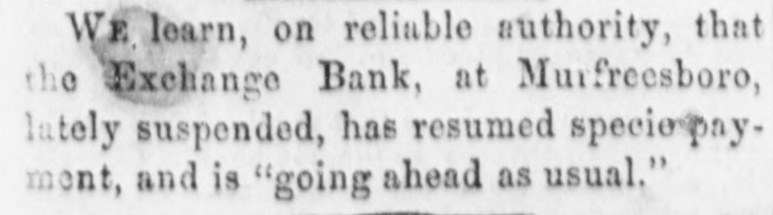
WE, learn, on reliable authority, that the Exchange Bank, at Murfreesboro, lately suspended, has resumed specien payment, and is "going ahead as usual."

Click image to open full size in new tab
Rutledge. Sullivan 1,480 00 Summer Jno. L. Bugg Tipton 174 00 Jno. Douglas. 90 00 G. B. Johnson. Van Buren Warren J. Morford. 1,493 00 *100 00 H. Hoss. Washington 49 00 W Jones. Wayne. 170 00 G. McWhirter. Weakley 7,320 00 Wilson J. McClain. 400 00 White G.G. Dibrill 2,606 00. Williamson W S. McLemore. 1,833 00 Individuals $95,046 00. It will be seen by reference to the above list, the amount reported by the different $95,046. Clerks, and by individuals to be Mr. Spence received of his circulation from $124,000 Bank of Tenn. on 13th May, 1858 1,507 He took up by his check 3,600 May 15 11,644 Rec'd through Mr. Carney 26 63 subsequently from Bank (See Morton deposition) $235,860 Theses veral sums added make Subtract from this returned to Comp92,500 troller and burned on 18th May, 1858. $143,360 and it leaves $143,360, as the ascertained amount of outstanding circul ation of the Exchange Bank. It will be readily discovered from these evidences, that the amount of bonds claimed by Mr. Spence falls far short of his circulation. His bonds, claimed as before stated, amount to $123,000 143,360 His outstanding circulation amounts to $20,360 Showing difference of.. in favor of circulation. when there should be a difference of 20 per cent. in favor of his bonds. The Committee infer from the communications of many of the clerks, and from various letters from adjoining States, that large amounts have not been reported. and could the entire circulation be ascertained, they are induced to believe it would greatly swell the aggregate here given, and are confident that it is at least $200 000. The Committee, shortly after the commencement of their session, called upon Mr. Spence for his Bank books. The one referred to, after a lapse of some two or three weeks was furnished us. and which he states was the only one which showed the amount of bonds deposited with the Comptroller and the amount withdrawn, and likewise the amount of circulation received, and the amount returned and cancelled. He also exhibited his large ledgers; but they afforded the Committee no information in regard to his bonds or circulation. The Committee also called upon Mr. Spence to furnish them with the receipts of the Comptroller for the amount paid by him upon the May and November calls. After the lapse of some two weeks, the following several amounts with receipts of the Comptroller, were delivered to us, (see copy) to-wit: 7 May 1857, deposited bonds 14 23, 11 Jan 26, 6 Circulation returned 38 Making a payment on this call of $38,000. Mr. Luttrell says, the receipts were executed by him on the days they bear date. The Committee would farther state, in reference to these calls, that they had examined the books of all the Free Banks kept in the Comptroller's office for the registration of the amount of circulation received by each bank. and they find on the back leaf of each book entries made in the handwriting of Comptroller Luttrell of the several amounts paid by each Free Banker. The Committee find in the Exchange Bank book in said office, the following entries, viz "Exchange book, June 26th, 1858. 11State 11,000 bonds $1 000 additional call 6,000 6,000 circulation returned, January 1, 1858. This bank has 20 per cent above its circulation." The receipts as will be discovered, show a payment of thirty eight thousand dollars upon his first call, and book, referred to, shows, paid upon the same call seventeen thousand dollars, showing a difference of twenty one thousand dollars in the payment of the call. This book, in the second entry, contradicts the depositions of Mr. Spence and Col. Luttrell in reference to the second call, as it shows no circulation returned. as was stated by them, in the payment of this last call. (See deposition.) The Committee are unable to determine which is the true, and which is the erroneous statement. It is obvious, however, to the Committe, that if Mr. Spence paid the thirty eight thousand dollars upon his first call, the Comptroller has been guilty of unwarrantable negligence or forgetfulness, in making the above entries. If he is correct in the second entry, Mr. Spence and Col. Luttrell are mistaken in their depositions-that he paid the second call by a return of circulation. The Committee find the following agreement entered into between the State Bank of Ten nessee and the President of the Exchange Bank of Murfreesboro, five days before the suspension and close of the latter Bank, viz: "The President and Directors of the Bank of Tennessee agree to receive the notes of the Exchange Bank of Murfreesboro, in payment of debts and other liabilities of the bank; but the same is, no time, to exceed thirty seven thousand dollars, for which bonds are filed in bank, of the State or endorsed bonds- fifty three in number. and as the notes of the Exchange Bank are received, they are to be sealed up in bundles of five thousand dollars, and interest thereon to be paid by the Exchange Bank from the time of sealing. C, JOHNSON Pres't." 13th May, 1858. Mr. Morton, the Cashier of the Bank of Tennessee, admits, the correctness of the copy here given, and sets forth the following explanation of the contract or agreement, viz, ($2650 he says "The bank officers knew, at the date of the agreement, that the issues of the Exchange Bank exceeded the amount of bonds on depoelt," and states, "when Mr. Spence settled with the Bank of Tennessee, on the 13th of May, he stated, that his entire circulation, as I recollect, was about one hundred sixty four thousand dollars. took the