20854. Tennessee National Bank (Memphis, TN)

Bank Information

Episode Type
Suspension → Closure
Bank Type
national
Bank ID
1225
Charter Number
1225
Start Date
March 25, 1867
Location
Memphis, Tennessee (35.150, -90.049)

Metadata

Model
gpt-5-mini
Short Digest
85572720

Response Measures

None

Receivership Details

Depositor recovery rate
17.3%
Date receivership started
1867-03-21
OCC cause of failure
Losses
Share of assets assessed as good
11.2%
Share of assets assessed as doubtful
88.8%

Description

Newspaper accounts (Mar 1867) report the Tennessee National Bank of Memphis closed and placed in the hands of a receiver due to deficiencies and alleged misappropriation of the State 'school fund'. No contemporaneous article describes a depositor run; government examiner/receiver actions and later lists of failed national banks confirm permanent closure. Dates are taken from dispatches: closure reported Mar 25–26, 1867. OCR typos in originals corrected (e.g., 'Menaphis' -> Memphis).

Events (3)

1. June 5, 1865 Chartered
Source
historical_nic
2. March 21, 1867 Receivership
Source
historical_nic
3. March 25, 1867 Suspension
Cause
Bank Specific Adverse Info
Cause Details
Deficiency in legal-tender reserve and alleged misappropriation/loss of State 'school fund' deposits; legal actions filed (bill in chancery) and refusal to pay a note to legislative committee precipitated intervention and receiver appointment.
Newspaper Excerpt
MEMPHIS, March 25.-The Tennessee National Bank ... has been placed in the hands of the Receiver.
Source
newspapers

Newspaper Articles (22)

Article from Nashville Union and Dispatch, March 26, 1867

Click image to open full size in new tab

Article Text

THE "SACRED" SCHOOL FUND. The Tennessee National Bond of Menaphis Refuses Payment-Rufter Declines to Come to a Consultation on the Subject-State Officials B neti claries-The Sacred Fund in Bad Way. From the Memphis Bulletin, Marell 21. The Tennessee National Bank closed yesterday at 2 o'clock. There have been various surmises and exaggerated reports as to the probable cause producing is sesulf. On inquiring we learn that theam mediate circumstances which oceanic are substantially as follows Abou filne months ago, be arrangement and pay of certain State officials, the Tennessee National Bank became the depository of the State funds for West Tennessee. A plic months ago Governer Brownlow, who as as all along acquainted with the fact, seized with a virtuous fear lest the fu is deposited in West Tennessee, by consen the officials for a consideration, should its lost, and the blame be justle laid alapria door. He therefore blowed aprillin State Treasurer, by calling the attention of the Legislature to the matter. That body of hungry patriots immediately dispatched a committee-ofwhich Spence, the President of the defunct Exchange Bank of Tennessee at Murtreesboro' was Chairman -to Memphis to demand the immediate payment of all the State funds, including the School fund. The officers of the Tennessee National Bank, it appears by the report of the committee to the Legislature, immediately paid over to the aforesaid Spence committee the sum of four hundred thousand dollars, and executed notes for the remainder of the State deposit. Subgenuently, S. Watson, Esq., assignee of the State Bank of Tennessee, at Nash ville, filed a bill in chancery to restrain the officers of the Tennessee National Bank from paying out any more of said funds to the Legislative committee, alleging that al of was to him School the said fund, funds, largely properly composed assigned the for the benefit of the stockholders of said bank; and recently an order to this effect was served on George R. Rutter, Esq. President of the National Bank in this city. Last Saturday one of the notes of the Tennessee National Bank of this city, given to the Legislative committee, fell due, and the President, George R. Rutter, Esq., act ing under the advice of the best legal counsel, refused its payment. Yesterday a dispatch was received from officials at Nashville to the effect that "matters were so complicated" that the presence of George Rutter, Esq, was desired there in consultation. It is understood that he declined to go there to hold a "consultation," and in consequence we stall doubtless be favored with the presence of some of the State officials, for said consultation, in a few days. It is due to the officers of the bank to say that all the ordinary demands have been met, and that it is scarcely likely that a single depositor will lose a cent by the closing of the bank. It seems probable, from all we can now learn, that if the State authorities push the payment of the notes given the Legislative committee, there will be no settlement of the difficulty except at the end of an interminable law suit.

Article from Nashville Union and Dispatch, March 26, 1867

Click image to open full size in new tab

Article Text

7-30, 2d and 3d series London advices of the 25th inst. quote United States at 741. At Frankfort the was 78 and at quotation 5-20,8 Paris bought 84}. Exchange on New York was by the banks yesterday at par, and i sold at 1 premium. There was but little doing in uncurrent FEE money, and we heard of no change in rates. Bank of Teanessee was inactive and the rates were nominal at 25c buying aud 32c selling. Union and Planters' bank notes were in good demand, the former at 90e, and the latter at 86c. Southern bank notes were dull at the advertised rates. Washvillecorporation checks were bought at 10c and sold at 8c discount. Tennessee bon is sold in New York on the 20th inst. as follows $7000 ex. conpons at 664c, $10,000 ex. coupons at 66&c, $20,000 new at 644c; and on the 21st $5000 new at 643c. North Carolina bonds sold at `50@49c for ex. coupons and new, and Virginia bonds at 60@57c. We print in this morning's UNION AND DISPATCH an article from the Memphis Bulletin in regard to the Tennessee National Bank and the school fund. The bank has not closed its doors (suspended) as stated by the Bulletin. A letter from a reliable source states that the bank was paying small checks on Saturday. We have the authority of Mr. Watson for saying that he has filed no bill in regard Mr. to the so-called school fund, and that with Rutter could not have been served the process referred to by the Bulletin. its The bank suffered the note given by officers in part consideration of the school that fund to go to protest, and the pretense Mr. Watson is claiming the fund or any portion of it, is t forth by Mr. Rutter as sort of justification for permitting to be protested, after assurance that it would positive his some note having bepromptly Norman, given We understand that Judge have met. the acting Comptroller, and others done to Memphis to see what can be imgone with the matter, but there is a general that whatever the legislative com- is pression did not secure of the school fund when mittee It will be remembered that from the lost. legislative committee came back Tennessee Memphis they whitewashed the to exNational Bank to such an extent as they good deal of remark. Why It is cite this a very few could understand. matter did improbable that this school fund that denot get into the courts, and reflect will yet will be made which will have envelopments credit upon parties who tracks." deavored but little to "cover up the moccasin The New York Times says in its money of the 21st instant: article An impression was attempted the quarterly to statement be Mon- made among the brokers banks, that to be made up temporary on of the week, national April 1, is but to we create are quite a well nation- aspressure day for so money far as the New York no occasion city for alsare sured that, concerned, there calling will in be of money, quarterly much of day ease in making of up the their law. They less a want the full standard fifteen millions in exnow returns of hold in the to required lawful money per in centage their net which deposits domestic they and are cess required_to exhibit with the tendency of the in favor of circulation, every quarter that the recurrence city. It is barely statement may other a this exchanges of the in quarterly nearly demand possible for money York in make the temporary of the extra country, obtains but notir among New some movement of parts An room speculators impression that up an before export the 1st of May of gold coin may (supposed) heavy credits for to besoon made May for gold travelers account remittances of the spring the Pariz Exposition, the amount foreign divi- and of the usual this spring and We see no present imports marketed United States 5-20s. this circula are dend on give much importance to plausible, we reason conceding it weeks of the coin tion:but within to less than six of to $24,000,000 be in gold disburse- less than belong now ment for-the by May the dividend Treasury to European of 5-20s, of free to supply holders. which leaving any from two-fifths $14,000, demand to $15,000,000. for gold: and European this is on States inter- the assumption other export be that reinvested no part in of other the United securities. est will The New York Post of the afternoon of the 21st inst. says: banks throughout statement the country in ten have country days to make As the their steads quarterfrom these balances of are the New more bank profitable York balances than legal count reserve equally there balances is a in this city, as tenders. For while


Article from New-York Tribune, March 26, 1867

Click image to open full size in new tab

Article Text

5308 1800 TENNESSEE. BY TELEGRAPH TO THE TRIBUNE. MEMPHIS, March 25.-The Tennessee National Bank, Geo. Butler, President, has been placed in the hands of the Receiver. Individual depositors are safe, but it is understood the State of Tennessee will lose heavily.


Article from Nashville Union and Dispatch, March 27, 1867

Click image to open full size in new tab

Article Text

London advices of the 26th inst. quote United States 5-20,s at 743. Exchange on New York was in good demand yesterday. The banks were buying at one-tenth premium and selling to premimm. There was no changei incurrent money and very little doing. Bank of Tennessee was very quiet at 25c buying and 32c selling. Union and Planters' bank notes were in good demand, the former at 90 and the latter at 87c. Southern bank notes were dull at the advertised rates. Nashville corporation checks were dull at 10e discount. Tennessee bonds sold in New York on the 22d inst. as follows: $10,000 new at 64ge and $7,000 new at 641c. North Card lina bonds sold at 49c. The Tennessee National Bank at Memphis was placed in the hands of a receiver on Monday, The ostensible reason for this step is that the bank was deficient in the amount of legal tender reserve required by law. It appears a government agent has been watching the bank for some time and pounced upon it Monday. A dispatch from Memphis says: "Individual depositors are safe, but it is understood that the State of Tennessee loses heavily." Judge Norman and Messrs. Bosson and Elliot, who went to Memhpis Saturday to look after the remainder of the "school fund," returned yesterday, and we learn that the Judge is hopeful that a considerable portion will yet be secured from the bank. It is not improbable that the securities of the Treasurer will be proceeded against to recover the amount of his bond, $100,000. Whether anything can be got from this source remains to be seen. We have no doubt the Treasurer's securities will contest the matter, and some rich developments may be looked for. As the matter now stands the school fund seems to be in an exceedingly precarious condition, if not absolutely lost to the State. We now learn from S. Watson, Trustee of the Bank of Tennessee, that he did have a bill of discovery filed in December last with a view to aid the State authorities in securing the so-called school fund deposited in the Tennessee National Bank, and on the 22d of this month an additional bill was prepared, the more effectually to accomplish this object. The bill required Mr. George R. Rutter, President of the Tennessee National Bank to show how he came in possession of the United States 7-30 bonds constituting the school fund, and what disposition he had made of these bonds, as well as other facts bearing upon the question. This bill has found its way to Memphis some how, and was served upon Mr. Rutter a few days ago. But bill has ever been filed to restrain the Ten 1. nessee National Bank from paying the e school fund, or any part of it, or any of the proceeds of it, to the Legislative committee. The following will show the stocks of cotton on hand at the various ports on the 1st of September, 1866, the Feceipts and , exports to foreign ports since that date and the stocks on hand at the dates designated


Article from The Bolivar Bulletin, March 30, 1867

Click image to open full size in new tab

Article Text

From the Memphis Bulletin 23d. Closing of the Tennessee National Bank. The Tennessee National Bank closed yesterday at 2 o'clock. There have been various surmises and exaggerated reports as to the probable cause producing this result. On inquiring we learn that the immediate circumstances which occasioned it are substantially as follows: About nine months ago, by arrangement and pay of certain Statu officials, the Tennessee National Bank became the depository of the State funds for West Tennessee. A few months ago Governor Brownlow, who was all along acquainted with the fact, was seized with a virtuous fear lest the funds deposited in West Tennessee, by consent of the officials for a consideration, should be lost, and the blame be justly laid at his door. He therefore blowed" on the State Comptroller by calling the attention of the Legislature to the matter. That body of hungry patriots immediately dispatched a committee-of which Spence, the President of the defanct " Exchange Bank of Tennessee at Mufreesboro" was Chairman-to Memphis to demand the immediate payment of all the State funds, including the School fund. The officers of the Tennessee National Bank, it appears by the report of the committee to the Legislature, immediately paid over to the aforesaid Spence committee the sum of four hundred thousand dollars, and executed notes for the remainder of the State deposit. Subsequently, S. Watson, Esq., assignee of the State Bank of Tennessee, at Nashville, filed a bill in chancery to restrain the officers of the Tennessee National Bank from paying out any more of said funds to the Legislative Committee, alleging that all the said funds, largely composed of the School Fund, was properly assigned to him for the benefit of the stockholders of said bank; and recently an order to this effect was served on George R. Rutler, Esq., President of the National Bank in this city. Last Saturday one of the notes of the Tennessee National Bank of this city, given to the Legislative Committee, fell due, and the President, George R. Rutter, Esq., acting under the advice of the best legal counsel, refused its payment. Yesterday a dispatch was received from officials at Nashville, to the effect that matters were 80 complicated that the presence of George Rutter, Esq., was desired there in consultation. It is understood that he declined to go there to hold a "consultation." and in consequence we shall doubtless be favored with the presence of some of the State officials, for said consultation, in a few days. It seems probable, from all we can now learn, that if the State authorities push the payment of the notes given the Legislative Committee, there will be no settlement of the difficulty except at the end of an interminable law suit.

Article from Nashville Union and Dispatch, April 25, 1867

Click image to open full size in new tab

Article Text

# THE SCHOOL FUND. That confounded school fund matter is going to give us more trouble. I feel in my bones that it is. Your letter saddling all the blame on Stanford won't do. We will have to pack it during this gubernatorial election. We can't fasten all of it on Stanford and Rutter. I was doing so yesterday, when a mean Rebel cuss shut me right up by asking me: "Were not eleven Radical members of the Legislature feed to use their influence to have the school fund put, contrary to law, in the Tennessee National Bank? Didn't some organ of the Radical party get twelve thousand dollars for using its influence in the same direction?" I couldn't imagine how the fellow found out anything, and I was regularly taken down. When I came to, I said these were disloyal slanders, but the fellow dared the Radical party to have an investigation of the books of the bank to see who got money that was charged to profit and loss. He offered to bet me that half the leading Radicals in the State had borrowed money out of the Tennessee National Bank, or had got money given to them. Says he: "Some Radicals doubtless borrowed money for business purposes just as others did, but I would like to know when some member of the Brownlow family had dealings with the bank. I would like to know at what time Arnell got those eight thousand dollars, and then I could guess whether the action of the State Legislature and of Stanford was influenced by them. As it is, I have nothing to say about them, but I dare the Radical party to have a public investigation of the books of the bank." I am afraid, very much afraid, my indomitable Governor, that the public will believe we were all to blame in that school fund business. The public would not have minded it so much if it had only been the three hundred and twenty thousand dollars that the State lost, but you see when the Tennessee National Bank stopped, the Treasury Department of the United States got alarmed, and ordered all the collections by Federal revenue officers and other United States officials to be sent to Cincinnati for safe keeping. Of course the money thus sent away would not come back for a long time in the regular course of trade, and this draining of over one hundred thousand dollars a week from Memphis soon checked trade and brought about bankruptcies and general prostration. A great many people say if the Radicals had not got money from the Tennessee National Bank, they would not have had the school fund put in it. If the school fund had not been put in it the State would not have lost between three and four hundred thousand dollars. If the State had not lost half the school fund the Tennessee National Bank need not have suspended; and if it had not suspended our Treasury Department would not have carried off a hundred thousand dollars a week. If the Treasury Department had not carried off the collections, trade would have kept up better, our banks could have given accommodations better, and many bankruptcies could have been avoided. They will blame the Radical party, sure.


Article from The New York Herald, June 11, 1867

Click image to open full size in new tab

Article Text

Steward. Cornelius Vanof Smith Barker, Jr., and John H. Vanderbilt, Vice derbilt was re-elected President, W. ary. President, and Augustus Scheil, Secre banks that have The following is a list of national rs, with the Bive failed and are now in the bands of rec. First Na. amount of circulating notes issued to eac National, tional, Attica, N. Y., $45,000; Merchants FrankWashington, D. C., $180,000; Venango Nationa Tenn., lin, Pa., $85,000; Tennessee National, Memphis, 200; $90,000; First National, Newton, Mass., $130, First National, Selma, Ala., $85,000; First N tional, New Orleans, La, $180,000. In addition to these two banks have taken up their bonds and deposited lawful money in the United States Treasury to the amount of outstanding circulation, viz:-First National Carondolet, New Orleans, $25,500; First National Columbia, New Orleans, $11,990-making a total of $832,490 reverting to the government, upon the return and destruction of which an equal amount of circulation will be at the disposal of the Comptroller of the Currency for distribution. The Sub-Treasurer in this city reports:Total receipts $1,465,816 Total payments. $1,563,316 For customs. 229,000 Balance 134,015,419 495,000 For gold notes The Chicago Clearing House statements of the past two weeks compare as follows:Balances. Clearings. $11,540,292 Week ending June 8 $1,002,558 9,207,614 Week previous 992,819 The following is a statement of the value of the imports entered at the port of Boston during the month of May:Value. Species of Goods, Wares and Merchandise. Imports-Dutiable, entered tor consumption $1,411,579 2,544,749 Imports-Dutiable, warehoused $3,956,328 Total paying duty Free 289,188 Total imports $4,245,516 Merchandise withdrawn from warehouse for $1,727,877 consumption The earnings of the undermentioned railroads during May of this and last year compare as follows:1867. 1866. $329,078 $316,432 Toledo, Wabash and Western 365,196 333,952 Michigan Central Cleveland and Toledo 210,783 180,675 51,710 55,133 Virginia and Tennessee Atlantic and Great Western 451,447 459,370 A St. Louis journal says:or the notes of the old "Bank of the State of Missouri, " which went out existence in 1857, and whose currency was barred in 1860, there 18 still afloat about $60,000 worth. The now existing Bank of the State of Missouri, lately organized as the "National Bank of the State of Missouri" agree to redeem this issue together with all of their own afloat, now amounting to about $50,000. The receiver of the Cataract City Bank of Paterson, N. J., notifies holders of the notes of that bank that all such notes must be presented for redemption to the Treasurer of the State of New Jersey, at Trenton, on or before November 30, 1867, and that holders and owners thereof who fail to present the same will be barred from all right to have the notes redeemed.


Article from The Daily Dispatch, June 12, 1867

Click image to open full size in new tab

Article Text

FAILURES OF NATIONAL BANKS.-The followis a list of national banks that have and are now in the hands of receivers, the amount of circulating notes issued each The First National Bank of Attica, Y., 845,000; the Merchants National Bank Washington, D. C. $180,000; the Venango National Bank of Franklin, Penn., $35,000; Tennessee National Bank of Memphis, Tenn $90,000; the First National Bank of Newton Mass., $130,000; the First National of Selma, Ala. $85,000; the First NaBank tional Bank of New Orleans, La., $180,000. In addition to these, two banks have taken up their bonds and deposited lawful money in the Treasury 01 the United States to the amount of their outstanding circulation-viz. : The First National Bank of Carondelet, New Orleans. $25,500 the First National Bank of Co. lumbia. New Orleans, $11,990; making a total $582,490 which has reverted to the Governupon the return and destruction of equal amount of circulation will be althe disposal of the Comptroller of the Currency for distribution, according to the terms and conditions prescribed in the national currency net. subject to the same rules that governed the distribution of the amount origimally authorized by the act of Congress.-New 1 to


Article from Nashville Union and Dispatch, June 13, 1867

Click image to open full size in new tab

Article Text

change Bank Spence Making a New Investigation-More Villainy than Even He had Imngined-Rutter to Go to State's Prison, etc., etc. From the Memphis Avalanche, June 11th. The festering sore that sprang from the projects of Radical legislators to get hold of the State fund sacredly devoted to the education of the children of the State, and which resulted in the collapse of the Tennessee National Bank and the sudden disappearance of half a million dollars of that sacred fund, is now likely to be exposed to the scorn and execration of all honest men. The plan to authorize, by legislative resolution, the transfer of the common school funds to irresponsible hands, was carried out, and then the scoundrels who concocted the villainy, under threats of ruining the bank, black-mailed it to the extent of one hundred thousand dollars. This would have given a large sum to each Radical legislator, but it is supposed that there was no honor among these thieves, and that a number who voted for taking the school funds out of safe hands got nothing at all, and that a few leaders secured most of the one hundred thousand dollars. Several whitewashing committees have been sent here to make it appear that the bank was wholly to blame and to keep clear out of sight the shameful complicity of the Radical leaders. Nothing came of these committees. It wasn't intended that anything should come of them. They were to make the public suppose that some one connected with the bank, some officer here, some backer elsewhere, was the criminal. They neyer breathed a word of the infamous fact that one hundred thousand dollars of the school fund money had gone into the pockets of Radical members of the Legislature and Radical leaders closely connected with Brownlow himself. Why did they not tell the public who the guilty parties were? Why did they fear to let out the facts? Was it because they knew that such an expose would strip from the Radical party the grab of hypocrisy with which it has covered its corruption and deformity? THE INVESTIGATION NOW GOING ON. The Avalanche some time ago denounced the villainous part played by the Radical leaders, and now another Radical committee has been sent here to examine the affairs of the bank and exonerate the Radical rognes, who have over a hundred thousand dollars of the school fund in their pockets, by denouncing somebody else. The man sent here by Gov. Brownlow on this errand is Senator Spence. He has been examining the books and accounts of the Tennessee National Bank, and indicates the points to be arrived at by declaring, in conversation, that there was more develish rascality than he ever before imagined. He knows what rascality in the management of a bank is. He was at the head of a bank at Murfreesboro that failed under shameful circumstances, and ruined thousands. He now says there was "more develish rascality in the way the school fund was stolen than he ever before imagined." Innocent Spence He says he means to have Rutter sent to State prison. If he can do that nobody will suppose that Radical members of the Legislature were the concoctors and leading promoters of the villainy and profited by it. He means to have Rutter sent to State prison. Rutter was only the tool of others. He is now to be the scapegoat. Why don't he want to have those sent to State prison who were the originators of


Article from The Tri-Weekly Standard, June 15, 1867

Click image to open full size in new tab

Article Text

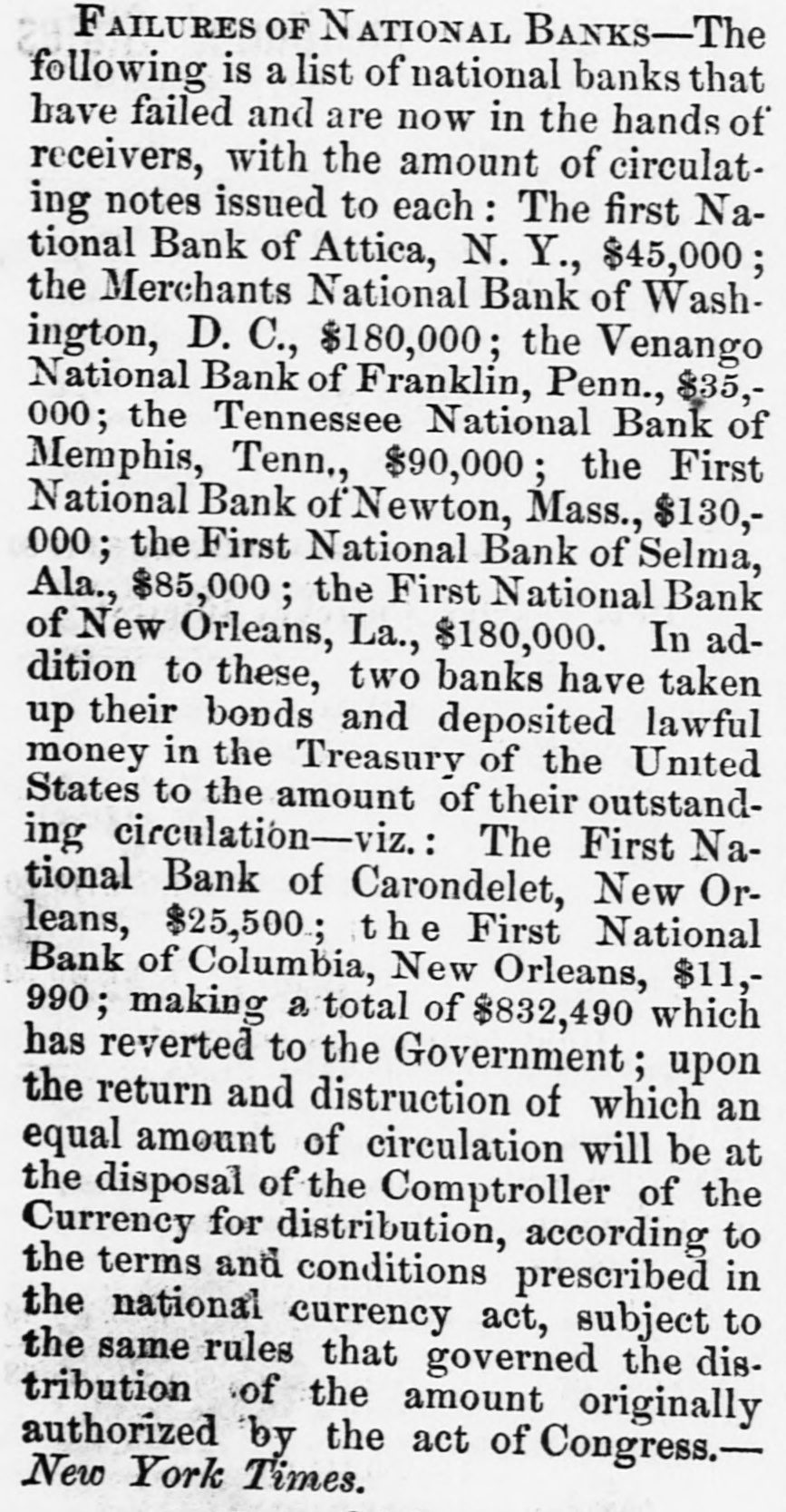
FAILURES OF NATIONAL BANKS-The following is a list of national banks that have failed and are now in the hands of receivers, with the amount of circulating notes issued to each : The first National Bank of Attica, N. Y., $45,000; the Merchants National Bank of Washington, D. C., $180,000; the Venango National Bank of Franklin, Penn., $35,000; the Tennessee National Bank of Memphis, Tenn., $90,000; the First National Bank of Newton, Mass., $130,000; the First National Bank of Selma, Ala., $85,000; the First National Bank of New Orleans, La., $180,000. In addition to these, two banks have taken up their bonds and deposited lawful money in the Treasury of the United States to the amount of their outstanding circulation-viz.: The First National Bank of Carondelet, New Orleans, $25,500; the First National Bank of Columbia, New Orleans, $11,990; making a total of $832,490 which has reverted to the Government; upon the return and distruction of which an equal amount of circulation will be at the disposal of the Comptroller of the Currency for distribution, according to the terms and conditions prescribed in the national currency act, subject to the same rules that governed the distribution of the amount originally authorized by the act of Congress.New York Times.


Article from The New York Herald, June 17, 1867

Click image to open full size in new tab

Article Text

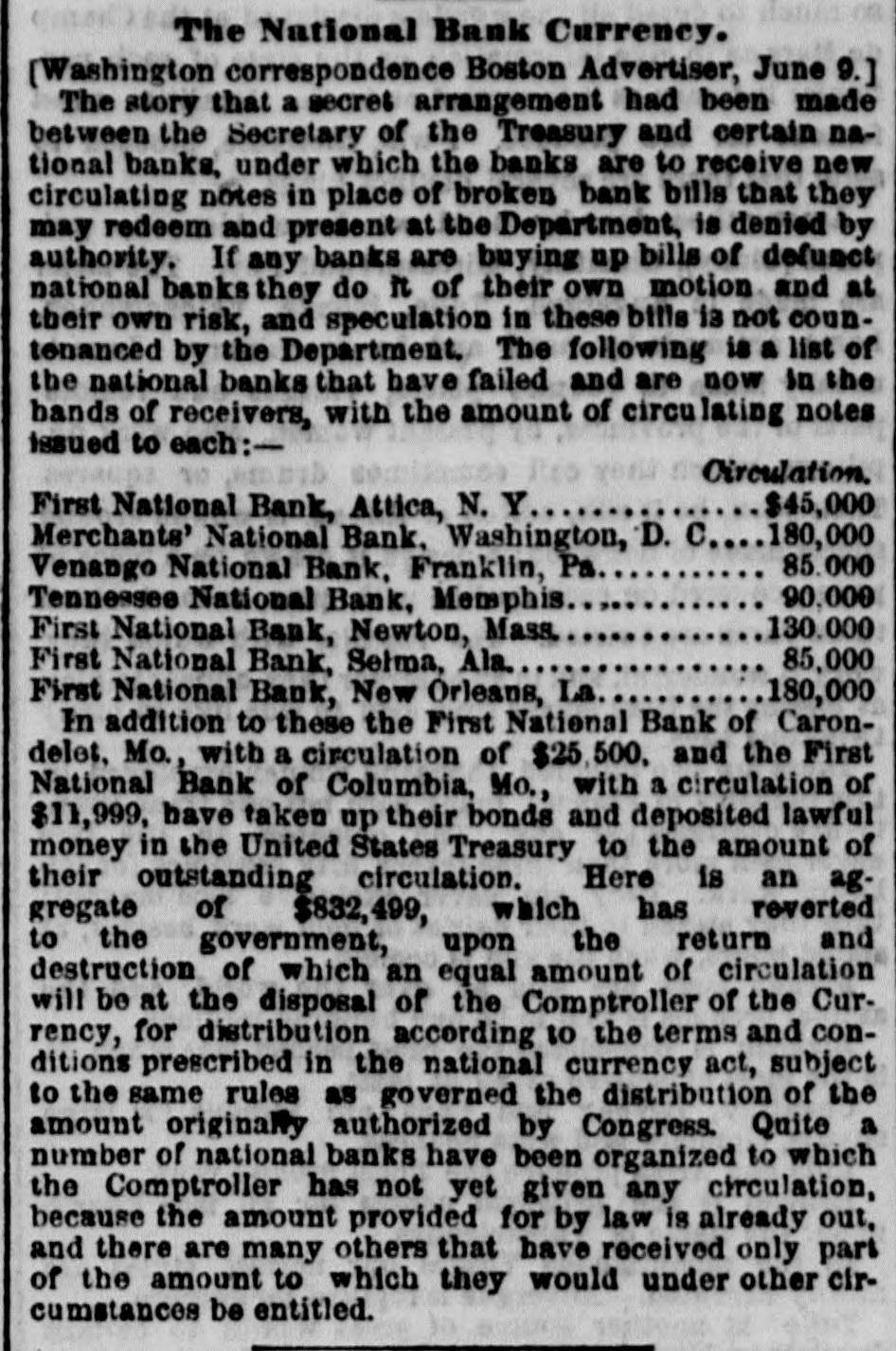
The National Bank Currency. (Washington correspondence Boston Advertiser, June 9.] The story that a secret arrangement had been made between the Secretary of the Treasury and certain national banks, under which the banks are to receive new circulating notes in place of broken bank bills that they may redeem and present at the Department, is denied by authority. If any banks are buying up bills of defunct national banks they do it of their own motion and at their own risk, and speculation in these bills is not countenanced by the Department. The following is a list of the national banks that have failed and are now in the bands of receivers, with the amount of circu lating notes issued to each:Circulation. $45,000 First National Bank, Attica, N. Y Merchants' National Bank, Washington, D. C 180,000 85.000 Venango National Bank, Franklin, Pa 90.000 Tennessee National Bank, Memphis 130.000 First National Bank, Newton, Mass. 85,000 First National Bank, Selma, Ala. 180,000 First National Bank, New Orleans, La In addition to these the First National Bank of Carondelet, Mo., with a circulation of $25,500. and the First National Bank of Columbia, Mo., with a circulation of $11,999, have taken up their bonds and deposited lawful money in the United States Treasury to the amount of their outstanding circulation. Here is an aggregate of $832,499, which has reverted to the government, upon the return and destruction of which an equal amount of circulation will be at the disposal of the Comptroller of the Currency, for distribution according to the terms and conditions prescribed in the national currency act, subject to the same rules as governed the distribution of the amount originalty authorized by Congress. Quite a number of national banks have been organized to which the Comptroller has not yet given any circulation, because the amount provided for by law is already out, and there are many others that have received only part of the amount to which they would under other circumstances be entitled.


Article from The Weekly North-Carolina Standard, June 19, 1867

Click image to open full size in new tab

Article Text

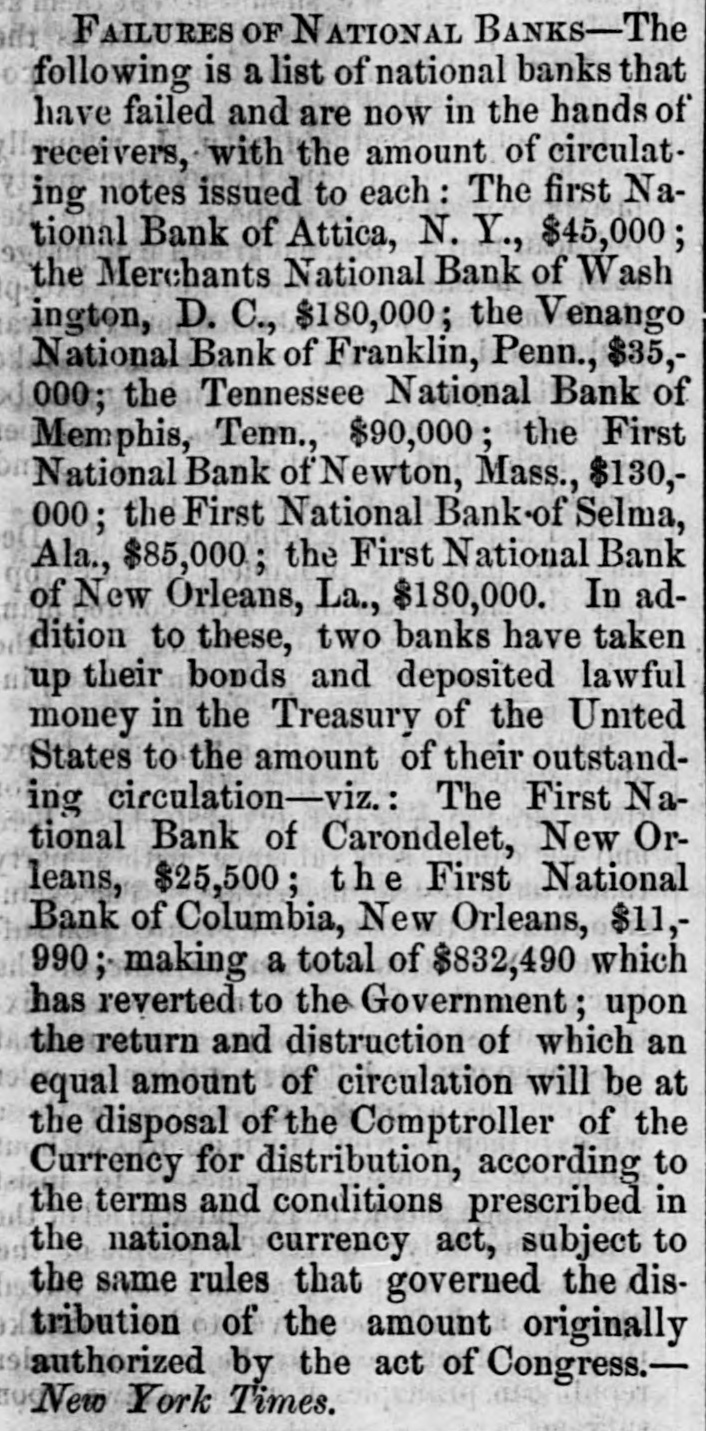
FAILURES OF NATIONAL BANKS- The following is a list of national banks that have failed and are now in the hands of receivers, with the amount of circulating notes issued to each : The first National Bank of Attica, N. Y., $45,000; the Merchants National Bank of Wash ington, D. C., $180,000; the Venango National Bank of Franklin, Penn., $35,000; the Tennessee National Bank of Memphis, Tenn., $90,000; the First National Bank of Newton, Mass., $130,000; the First National Bank of Selma, Ala., $85,000; the First National Bank of New Orleans, La., $180,000. In addition to these, two banks have taken up their bonds and deposited lawful money in the Treasury of the United States to the amount of their outstanding circulation-viz.: The First National Bank of Carondelet, New Orleans, $25,500; the First National Bank of Columbia, New Orleans, $11,990; making a total of $832,490 which has reverted to the Government; upon the return and distruction of which an equal amount of circulation will be at the disposal of the Comptroller of the Currency for distribution, according to the terms and conditions prescribed in the national currency act, subject to the same rules that governed the distribution of the amount originally authorized by the act of Congress.New York Times.


Article from Baton Rouge Tri-Weekly Gazette & Comet, June 20, 1867

Click image to open full size in new tab

Article Text

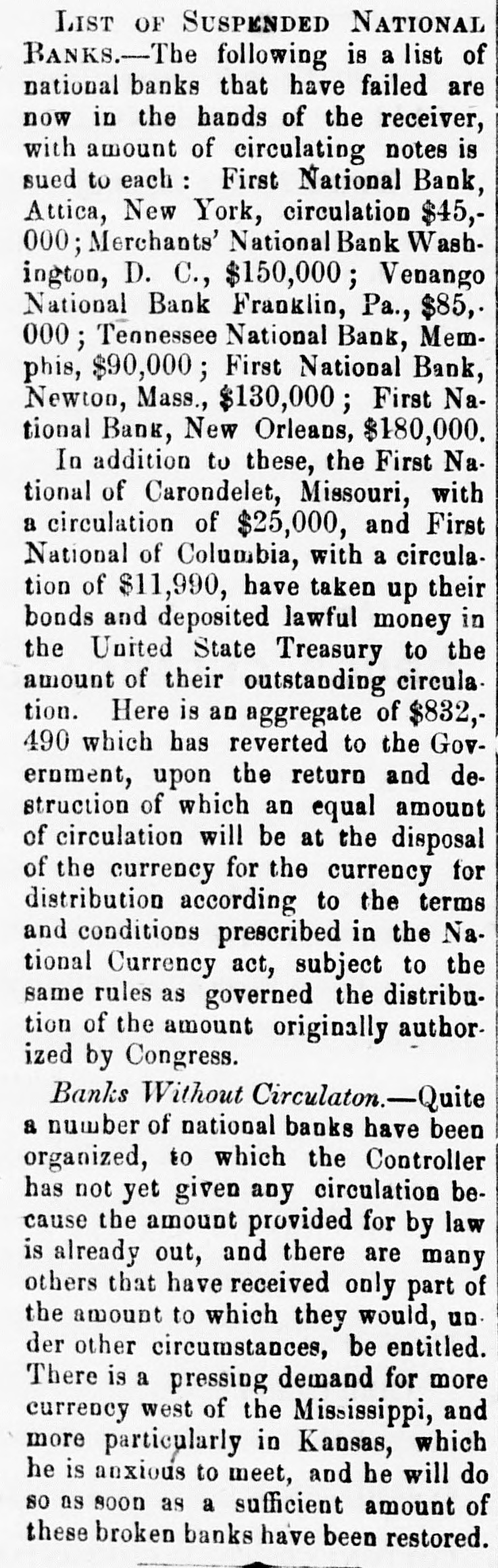
LIST OF SUSPENDED NATIONAL BANKS.-The following is a list of national banks that have failed are now in the hands of the receiver, with amount of circulating notes is sued to each : First National Bank, Attica, New York, circulation $45,000; Merchants' National Bank Washington, D. C., $150,000; Venango National Bank Franklin, Pa., $85, 000; Teonessee National Bank, Memphis, $90,000; First National Bank, Newton, Mass., $130,000; First National Bank, New Orleans, $180,000. In addition to these, the First Na. tional of Carondelet, Missouri, with a circulation of $25,000, and First National of Columbia, with a circulation of $11,990, have taken up their bonds and deposited lawful money in the United State Treasury to the amount of their outstanding circula tion. Here is an aggregate of $832,490 which has reverted to the Government, upon the return and destruction of which an equal amount of circulation will be at the disposal of the currency for the currency for distribution according to the terms and conditions prescribed in the National Currency act, subject to the same rules as governed the distribution of the amount originally authorized by Congress. Banks Without Circulation.-Quite a number of national banks have been organized, to which the Controller has not yet given any circulation because the amount provided for by law is already out, and there are many others that have received only part of the amount to which they would, un der other circumstances, be entitled. There is a pressing demand for more currency west of the Mississippi, and more particularly in Kansas, which he is anxious to meet, and he will do 80 as soon as a sufficient amount of these broken banks have been restored.


Article from The Jasper Weekly Courier, July 19, 1867

Click image to open full size in new tab

Article Text

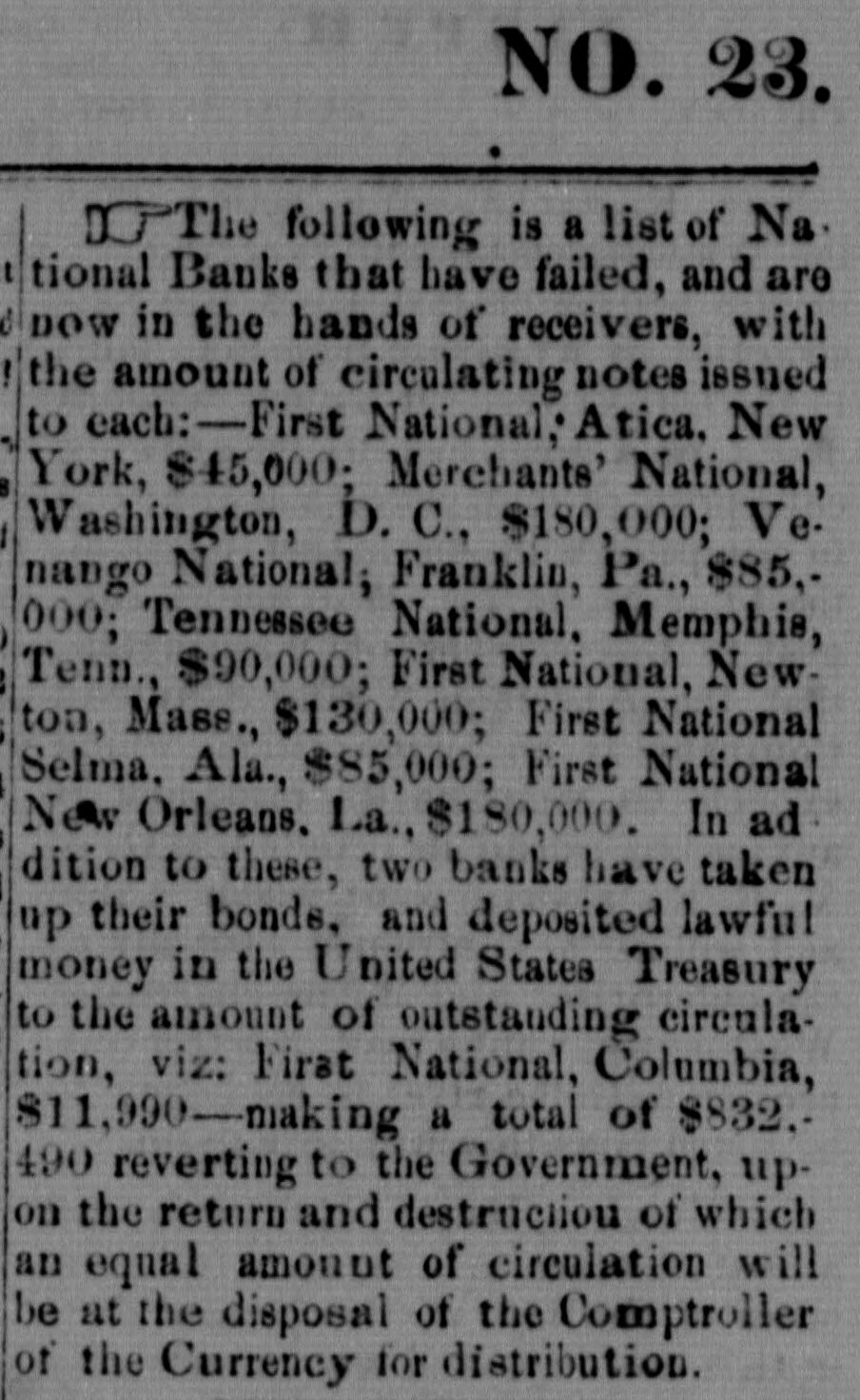
NO. 23. The following is a list of Na. tional Banks that have failed, and are DOW in the hands of receivers, with the amount of circulating notes issued to each:-First National, Atica. New York, $45,000; Merchants' National, Washington, D. C., $180,000; Venango National; Franklin, Pa., $85,000; Tennessee National, Memphis, Tenn., $90,000; First National, Newton, Mass., $130,000; First National Selma, Ala., $85,000; First National New Orleans, La., $180,000. In ad dition to these, two banks have taken up their bonds, and deposited lawful money in the United States Treasury to the amount of outstanding circulation, viz: Firat National, Columbia, $11,990-making a total of $832. 490 reverting to the Government, upon the return and destruction of which an equal amount of circulation will be at the disposal of the Comptroller of the Currency for distribution.


Article from Clearfield Republican, October 10, 1867

Click image to open full size in new tab

Article Text

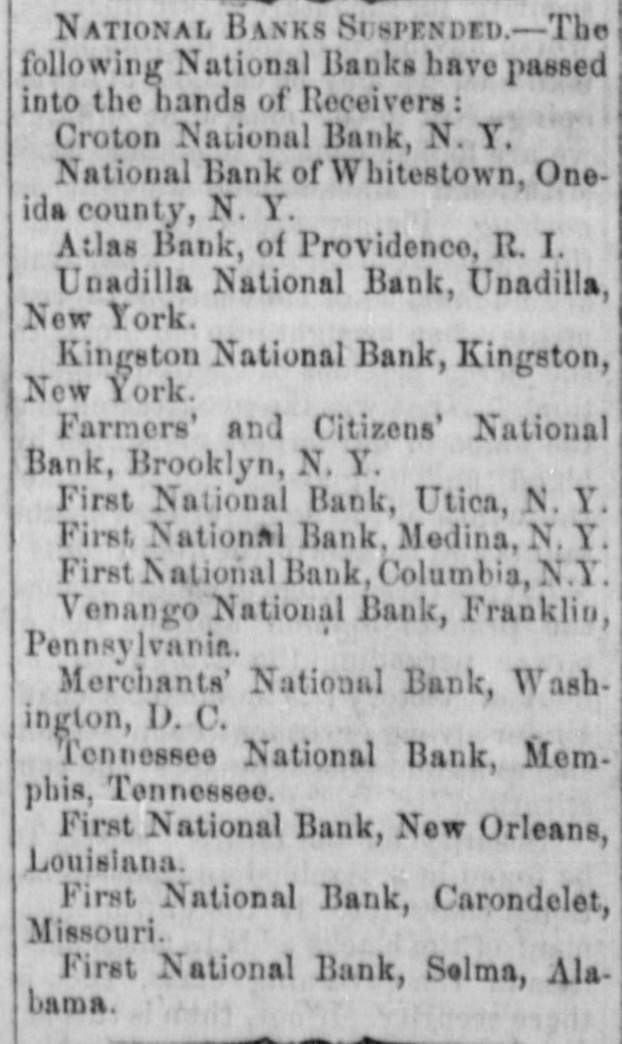
NATIONAL BANKS SUSPENDED.-The following National Banks have passed into the hands of Receivers: Croton National Bank, N. Y. National Bank of W bitestown, Oneida county, N. Y. Atlas Bank, of Providence, R. I. Unadilla National Bank, Unadilla, New York. Kingston National Bank, Kingston, New York. Farmers' and Citizens' National Bank, Brooklyn, N. Y. First National Bank, Utica, N. Y. First National Bank, Medina, N.Y. First National Bank, Columbia, N.Y. Venango National Bank, Franklin, Pennsylvania. Merchants' National Bank, Washington, D. C. Tennessee National Bank, Memphis, Tennessee. First National Bank, New Orleans, Louisiana. First National Bank, Carondelet, Missouri. First National Bank, Selma, Alabama.


Article from Indiana American, November 22, 1867

Click image to open full size in new tab

Article Text

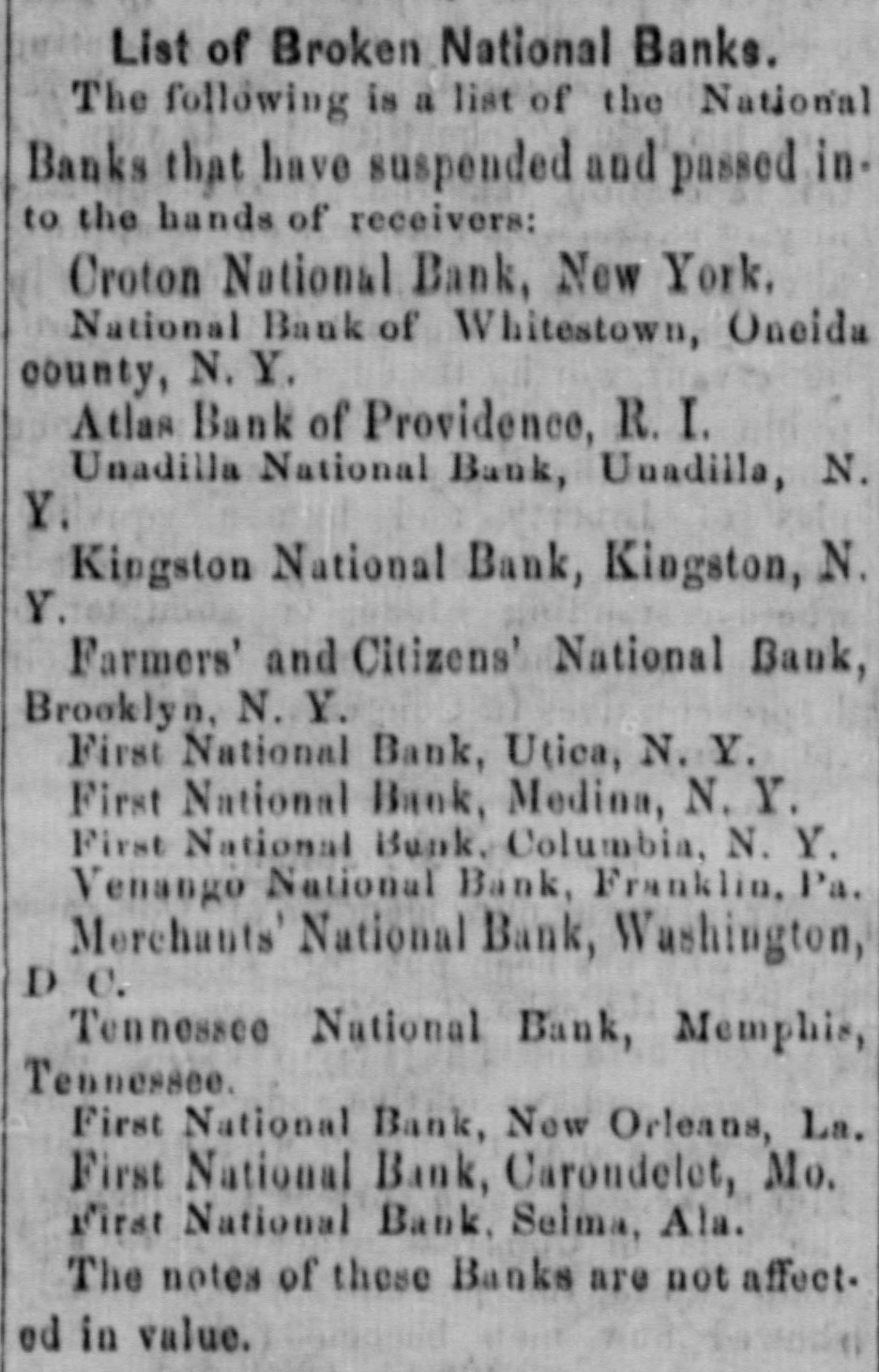
List of Broken National Banks. The following is a list of the National Banks that have suspended and passed in. to the hands of receivers: Croton National Bank, New York, National Bank of Whitestown, Oneida county, N. Y. Atlas Bank of Providence, R. I. Unadilla National Bank, Uuadilla, N. Y. Kingston National Bank, Kingston, N. Y. Farmers' and Citizens' National Bank, Brooklyn, N. Y. First National Bank, Utica, N. Y. First National Bank, Medina, N. Y. First National Bunk, Columbia, N. Y. Venango National Bank, Franklin, Pa. Merchants' National Bank, Washington, D C. Tennessee National Bank, Memphis, Tennessee. First National Bank, New Orleans, La. First National Bank, Carondelet, Mo. First National Bank, Selma, Ala. The notes of these Banks are not affect. ed in value.


Article from Public Ledger, February 4, 1869

Click image to open full size in new tab

Article Text

due him, holding balance subject to art Here followed a long correspondence, principally on the side of Hutchinson. A telegram from Washington, on June 14, 1866, from Hutchinson to Rutter, says: propose to make you a Government Depository to-morrow, The moment you receive the certificate publish it, and commence business at once. In his second letter, dated Washington, June 28, 1865, he says My brother takes out a blank draft, which I have instructed him to use in the purchase of quartermasters certificates. You must bear in mind your first quar terly report must be made before the 10th of July In making it,I advise you to put under the head of 'capital stock paid in" $50,000, which is all you are re . The Internal quired to do. Revenue Commissioner has not yet decided to give us the internal revenue deposits, but will, I think, give us a part of them. Be very vigilant in procuring deposits, in order to get as many as possible before your compete tion increases. Our surplus account is being pretty well drawn upon, and I am contracting liabilities somewhat February 7, 1866. he writes Rutter The B P. and W. Va. Petroleum company have two other valuable lenses to dispose of, in good boaring cerritory. The company have already enginee, and are preparing to boar. e urges Rutter to go into the boaring business. Hutchinson himself appears to have been trifle of a boar, and a pretty wild one at that March 12, 1866, from Washington, he writes Rutter The oil stocks bid fair to be extraordinary investment. Don't want to influence anybody against their will, but thisis no humbug affair. I honestly regard this as a remarkable chance for investment. We have opened large cannel coal vein, but the oil is the thing for profit. October 16, 1866, he writes Rutter Friends have advised me to go to Memphis, and if I make a favorable report all will be well, and we can transfer our capital to the Tennessee National easily without disorganizing the details. If go to Memphis it will be with the view of covering the present debt with all else. I desire you to write me at once, setting forth strong points, that I can show my friends with the view of increasing capi tal. December 11, 1865, from Washington, he advises Rutter By all means cure the services of Morgan as Cashier of his bank. He has had much experience. He also says: Friend A. H Bigelow visits your city- he is interested in our oil enterprise, which we havejust I started, and which is no humbug. hope you will take an interest of $5000 in it, and sell as much stock as you can in Memphis. I have a large interest in this enterprise. We will let you in on the ground floor. July 20, 1866, be writes Ratter to re mit for the $100,000 as early as possible. The certificate alluded to in Hutch inson's telegram of June 16, 1865, was the authority of the bank to do business. Lyman was a clerk in the office of GeneSpinner. He was useful by reason of hisinfluence. The oil stocks on the assets of the bank, as valued at $60,000. were pulchased of Hutebinson He paid on his stock subscription of $15,000 the sum of $5,000 in money and $10,000 in these oil stocks. The Willie alluded to in Hill's letter Hill' eldest son. In reference to what know of Hill's administration of the affairs of the bank as Receiver, I may state that I met him at Washington for the first time. He was recommended to me as a suitable Cashier by Mr. Hurl burd, Assistant Controller of the Currency. He was elected Cashier at asalary of $500, and continued in that capacity until the bank passed into the hands of a Receiver, about the time that J. H. Hounstein was sent out from Washington as an agent to examine into and look after the affairs of the bank. Mr. Hill then absented himself from the bank sent for to his hotel; said he wanted to be ap pointed receiver, and if Iappointed him he would divide with me. I never re ceived a cent from him however-on the contrary, he has dogged me for money from time to time. When the bank closed up he received five hundred dol lara for extra services, though I don't know what the extra services consisted of. His way of collecting the assets of the bank have been unsatisfactory and slow. He arrogates to himself to hold rod over me, and thereby intends to extort money from me to keep Willie in the shoe store. The letters submitted to me purporting to be from Mullins, Richards, Fines, Lewis, Arnell, W J. Smith, J. Sears, T.J Cypert, W. R. Dancan, W R. Hall, T. C. Muse. D. A. Nunn. Henry Brigga and John Martin are all gengine. Sums of money were given to so many parties and at 80 many times that I fail to remember each separate transaction, but I remember to have given Spence money several times. Q What persons received money from you in connection with the passage of the bill to manipulate the affairs of the bank. A. Some of them are Messra. Arnell Mullins, W. Spence, T. B. McElwee, General John Eaton, jr. J. D. Dayis Senator W, R Hall, W. Wines, J. S. Molloy, F.S Richards, D. A Nuno, Wilson Duggan, Barbour Lewis, R. S. Parham (lobbyist), Hepburn, of Memphia, formerly of Iowa,and John Martin (defunet) gaveDuggan a gold-headed cane. There were several thousand dollars spent Spence and McElwee made propositions as members of the committee appointed settle with me, looking to a little pecupiary accommodation Smith was against us at one time, but afterward became our friend. I told Smith that if he would settle up I would pay him, in the shape of attorney's fees, $6000 or $10,000. I did not give him that amount, however. Sears is partner of Smith. Parham was my agent to attend the Legislature. Davis, Eaton, Martin and others were agents help him along Spence, a member of the committee, had a note discounted by me


Article from New-York Tribune, August 18, 1869

Click image to open full size in new tab

Article Text

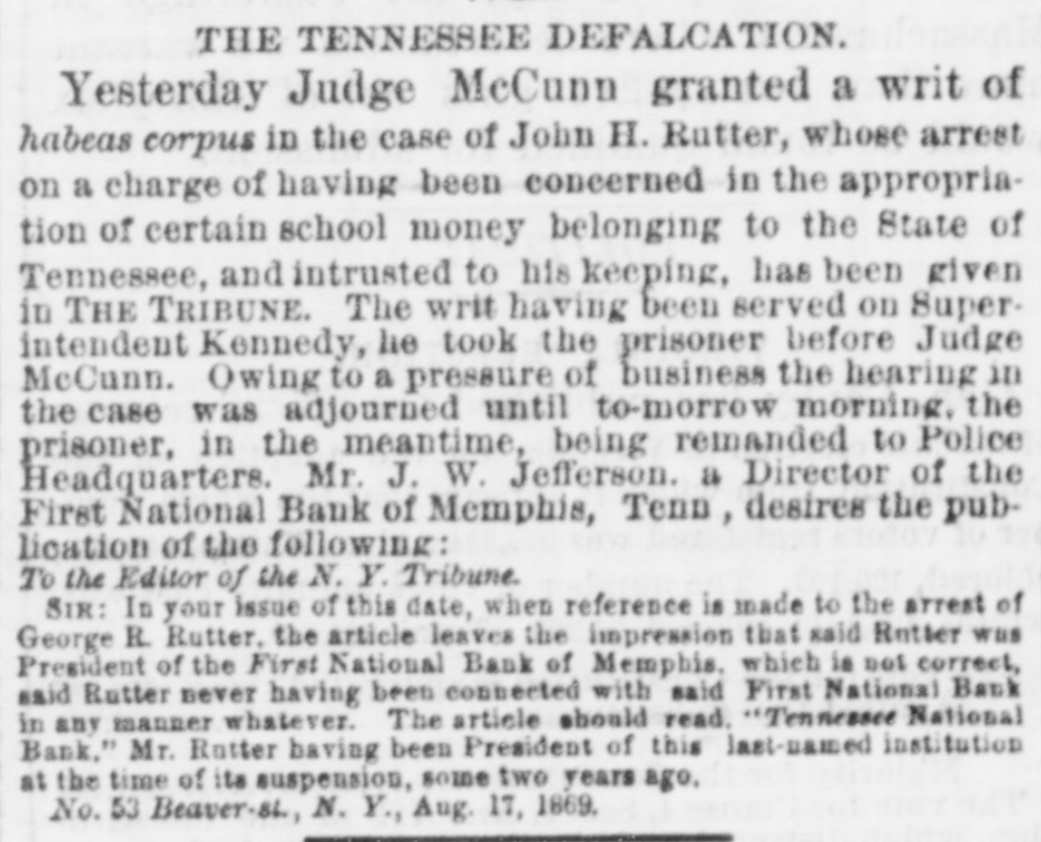
# THE TENNESSEE DEFALCATION. Yesterday Judge McCunn granted a writ of habeas corpus in the case of John H. Rutter, whose arrest on a charge of having been concerned in the appropriation of certain school money belonging to the State of Tennessee, and intrusted to his keeping, has been given in THE TRIBUNE. The writ having been served on Superintendent Kennedy, he took the prisoner before Judge McCunn. Owing to a pressure of business the hearing in the case was adjourned until to-morrow morning, the prisoner, in the meantime, being remanded to Police Headquarters. Mr. J. W. Jefferson. a Director of the First National Bank of Memphis, Tenn, desires the publication of the following: To the Editor of the N. Y. Tribune. SIR: In your issue of this date, when reference is made to the arrest of George R. Rutter, the article leaves the impression that said Rutter was President of the First National Bank of Memphis, which is not correct, said Rutter never having been connected with said First National Bauk in any manner whatever. The article should read. "Tennessee National Bank," Mr. Rutter having been President of this last-named institution at the time of its suspension, some two years ago. No. 53 Beaver-st., N. Y., Aug. 17, 1869.


Article from The New York Herald, August 18, 1869

Click image to open full size in new tab

Article Text

Musical and Theatrical Notes. Mr. J. Lester Wallack and family and Mr. and Mrs. W. J. Florence arrived in- the steamer Scotia yesterday afternoon from Europe. The former brings a number of new comedies and dramas from London, one of which will be the opening sensation at the Wallackian temple, while the latter brings three or four new plays from the British metropolis and one or two dramatic sensations from staid old Holland, with which he proposes starring from here to California. Brignoli, the "sitver-voiced" tenor, is at Long Branch snifing the "salt sea" air, prior to an operatic tour across the plains to San Francisco, whither he intends winging his way at an early day with an operatic troupe of his own. The Wednesday evening concerts of Theodore Thomas at the Park Mineral Springs have become very popular. Hundreds of delighted listeners assemble in the vicinity of the handsome Kiosk and the programmes are always of a first class order. THE FIRST NATIONAL BANK OF TEHN_SSEE. To THE EDITOR OF THE HERALD:In your issue of this morning, where you notice the arrest of George R. Rutter, ex-President of the First National Bank of Memphis, it should read "Tennessee National Bank," which bank suspended some two years ago, said Rutter being its president. Please do the "First National Bank" the justice to make this correction-that Mr. Rutter was president of the Tennessee National Bank of Memphis and never had any connection with the "First National Bank whatever.


Article from Fayetteville Observer, June 2, 1870

Click image to open full size in new tab

Article Text

ey over and above the $5,500, which is generally believed to be all he got. On the $5,500 which Arnell got, he paid, as a credit, $4,000. He received money at other times, the amount of which there was no account kept; but according to my judgment, $7,000 to $9,000 were paid to Arnell-given to him by Parham and others. One case that I remember, I gave to Mullins some money ($500) to give to Arnell, not being able to see Arnell personally. This money was given by Mullins to E. P. Cone, who, I afterwards learned, gave it to Arnell. Arnell was afraid to receive the money direct from me on account of its being found out on him. No receipt ever was taken for this money, not even a memoranda. 2d. Mr. Mullins received money to defeat a resolution introduced in the House of Representatives by Elliott, I believe "to convert the 7-30 notes or bonds into State bonds." Mullins went actively to work to defeat the resolution, because, he said, if the 7-30's were converted into State bonds, that I would be called on for them, and that he wanted money to defeat it, and I furnished him money. No receipt or note was given for this money. I will here state that I lost a lot of letters and papers and receipts from various persons, acknowledging the receipt of money by letter, and receipt of which have never been found. 3d. Mr. Richards received money also that has never been accounted for in any way. 4th. Mr. McElwee received money also that has never been accounted for. Also Spence, W. J. Smith and various others. What I mean by no account being taken of the money mentioned in this deposition is, that the bonds do not, nor ever did, hold any evidence of indebtedness for this money, disbursed as mentioned above. Owing to the pressure brought to bear upon this bank by various individuals, it was not able to meet its obligations. Mr. Lowenstein came out to Memphis as the special examiner of the condition of the bank under the provisions of the national banking law, with power to damage and otherwise injure the institution if he saw fit. I paid him money (black mail) to let the bank and its affairs alone, and not to meddle with it. I have not heard of Lowenstein since. I know of $500 paid him. The capital was but $100,000, and to discharge all the indebtedness of the bank occasioned by the draws made to meet the obligations to pay members of the Legislature and others mentioned in this deposition, the funds of the bank were used indiscriminately, also my personal funds. GEO. R. RUTTER. ADDENDA. Question. What time did the Tennessee National Bank become the depository of the State, and when were the first, funds received as a deposit by the bank? Answer. At the time of the passage of the fiscal agency bill, May 26, 1866, and soon after I received deposits from the State. Q-What amount of funds did you receive, and how were they deposited? A. We received revenue (I do not know the amount) and $618,250 of bonds, generally known as the school fund. Q.-Did you have any conference with any State officer in regard to the failure or suspension of the bank and the loss of the school fund, if so with what officer? A.-I did, with Governor Brownlow, in Knoxville, Tenn., and in that conversation, he favored the continuance of the bank as the fiscal agent of the State. I had frequent conversations with him before and after the suspension of the bank, and referred me to Judge Norman as a man who would do me good in any of my transactions. Brownlow at all times favored the bank. Q.-Did you receive any communication from Governor Brownlow in regard to your fiscal agency of the State, if so please file any such communication as part of your answer to this question. A-I did I received a letter


Article from The New York Herald, April 3, 1872

Click image to open full size in new tab

Article Text

Begging, Praying, Threatening for the Price of the Carriage. A Hundred-Dollar Quittance in New York. HULBURD, DAVIS AND CALLENDER The Knowledge of Callender's Guilty Proceedings. REPORTED RESIGNATION OF MR. HULBURD, WASHINGTON, April 2, 1872. Comptroller Hulburd nas informed the Secretary of the Treasury that his resignation is at Mr. Boutwell's disposal. This is the natural result of the investigation by the Committee on Banking and Currency, and was the only thing left to Mr. Hulburd after the revelations of George R. Rutter, in regard to the presentation of the carriage and harness, and the testimony in regard to Callender and the affairs of the Ocean Bank. The material parts of Rutter's testimony are as follows:UTTER TESTIFIES. National I met Mr. Hutchinson casular of the in 1865, and Bank of the Metropolis, at ashington, should start Mr. Hutchinson deteri uned that we up in would a national bank; told me that if would get aid the a lot of stockhold in Memphis he furnish any he organization of the bank and having amount of money that government was necessary, deposits at tnat about $1,500,000 of Metropolis we went on time in the Bank of ine June, 1865; this bank, think in and organized as to the month, for have tried to am not certain certain reasons; we organ forget these things for the institution ran about ized that bank, and the Tennessee Nathink; it was called two years, Memphis. would like to remark Lional Bank o commenced under very favorhere that that bank the time that we became able auspices, and up to District Tennesthe see bank ageut of the estern very the fiscal agent the uscal was making money and doing Western well; we peca me the political influence; of Tennessee through District by the radical party of they we were promised stood up for the party that they that as long as we whole strength would give ns their that they would do all would favor the institution; would deposit their money they and they could for it; were to believe leave there, it and required we $1,000 of stock paid in for would doso; subscribed become a director in the in; bank subser quent to that time that amount and paid time had standing my remember. name $5,000; took more; there one may have been more; MISSING CURRENCY. Q. How much THE did Mr. Hutchinson take? A. $10,000. on, and arate any mmittee circumstances in connection that you Q. Go bring before ine article in the HERALD want with this bank. saw reflected an both upon me and connec that think improperly with the bank and think explain; other persons like 10 have the liberty the to HERAL on the would in the comarticle was publis have come from that it was said to that the Comptroller had made 10th inst.; the article stated respect to the it mitteeroom; very damaging report also stated in that had Tennessee National Bank with some twenty -twothou- the gone off from the currency bank of the bank, leaving impression was returned-every sand dollars that never returned dollar that of money;that 10-anda the by cashier; of that copy office. certificate currency to certificate that effect was made sent to the Comptroller's WANTS TO GIVE EVIDENCE. relieved he would rather be following was letter After saying that in the case the had from testifying snown at Mr. all Rutter, and no said he written it:NEW YORK, Dec. 20, 1871. comyou are DEAR SIR-I see from the papers bank alfairs. I have me examine into nation who troller ttee leading gentl leman here The facts are and talk with the su ject. of the you al once mipurd. upon the national to Mr. Huidui to Southern Mr. relating present his special Havia's dirty work as have the proof receiver cluding Bank this special agent PresiOcean Liceall National and while was Hulburd money and his an property prope National from myself wank of Memphis, you directly few days, and dent the very very is and expect 10 20 South should should be am very some my inform was cest in public alla Compration would be and other others having no ented for in my time trouble, Consequently gton. you and be muneration for this once Please would would come me hear lication from you confidentially until treat this TTER. box 3,832 Post Office. York. further interview GRURGE 144 Pearl street, New Care R. Balter RANDA BANK To Hon. SAMURL A CURIOU USLY to MANAGEI now what you meant pro- by Q. will you please to st Mr. Hul ard which Well, you sir, facts in relation that letter? Tennessee the to disclose in iticians in much posed intriguing of shape and very through the very bad became the fiscal that bank got la said before, we Teanessee through mixed up as Western district of got this deposit of the and after we applications agent influence, Tennessee various political the State loaus of from xteen Tennessee, or besides from made for of that state, members were of the Legislature officers did in not lend them they money othersirom some that If we from us; they or twenty giving us to understand would take this thirty deposit letters asking for A. wrote monework some was the amount of the deposit nature of $618,250. TESTING ITS STABILITY of 107 we were the What was the the Western District in the bank Q. agent of bonds deposited school fund, and and fiscal there were soine were called the of Tennes see finally deterthese better some them assets of the Bank such demands that rather than others men the kept maki ing close up the bank yes to he black mined we away had and allow there oursel was a aggestion committee to give it all artnat in way; At my composed mailed by the Legislature bank at Memphi two of the Senate; down pointed members and visit the of the House and WO checks the upon balance the three came down and and drew the other money, for and they they for 850 $350.00 in twelve or eighteen bank-one $618,250; paid the for six. the bank migh of took our obligat tue balance; I hoped the mouths for in the meantime was about receive our recup erate facts to the into Comptroller; the nand the of depositors the began until suspic recovery e bank went were witadrawn W their and we collections 10us and withdre was dissipated the books Nashy every 10 be hope could of not do thing examined report the to the found came we down from and made a Rutter had and of the to that papers of the bank State that examine Mr. LIIO affairs Legislature them every facility his conduct WHS and exceedingly afforded bank, and that gration tound no cause through of the the correct, whole and that they of crimin proceed whatproper plaint, and nor any ground published with the to see the 01 comp report was to Wasnington state of the ever this 1 came on the whole came on ings; finally and told had him paid this money the Comptrolto Washington we Comptrolaer affairs, and that and had had talk better with go into was liquida- finally hands or ler told nim up wink all our snould aDairs go into Mr. the Hill had to been introduced uon and Wind that the bank to that time in washington as inent, Depart thought a receiver; Dest previous me by Hulb a at man to become By Mr. Coxan at the Treasury in that bank SHARE THE had PROFITS. better go on . cashier WANTED TO think with the introduced Comptrol to interview before, quently was came down and give Hill, your as said subst of the Dank, told A. me Mr Washingt and became and cashie the DA nk: receive Mr. Hill to re to Memphis, a receiver of salary as give the compme absequently that he wanted that his ne ned non to know W nether $6,000 year his salary; told me understood be bal got troller part not, but ne however, thin be did have or DO subsequently, such salary for his services:


Article from The Bloomfield Times, April 9, 1872

Click image to open full size in new tab

Article Text

GEO. B. RUTTER, one of the directors of the suspended Tennessee National Bank, of Memphis, testified before the Investigating Committee that he gave Comptroller Hubbard a carriage and harness worth $625 as a bribe. This is bringing to light bribery in high places, and we hope for the credit of the nation that the case will be further investigated and both briber and bribe taker punished.