20799. Farmers & Merchants Bank (Memphis, TN)

Bank Information

Episode Type
Suspension → Closure
Bank Type
state
Start Date
August 22, 1854
Location
Memphis, Tennessee (35.150, -90.049)

Metadata

Model
gpt-5-mini
Short Digest
e879a3fe

Response Measures

None

Description

Contemporary papers report the Farmers & Merchants Bank of Memphis suspended payment (variously dated Aug 16 or Aug 22, 1854) and later list it as failed. No article describes a depositor run on this specific bank; reporting ties its suspension/failure to the wider banking panic and refusal to redeem Western/Tennessee notes. Date discrepancies in sources noted (Aug 16 vs Aug 22); I use Aug 22 (multiple papers give Aug 22 for suspension).

Events (1)

1. August 22, 1854 Suspension
Cause
Macro News
Cause Details
Part of a broader mid‑August 1854 banking panic: Western/Tennessee bank notes were being refused and banks failed to redeem in eastern cities, precipitating suspension of payment at this bank.
Newspaper Excerpt
The Farmers and Merchants' Bank of Memphis, Tennessee, suspended payment on the 22d instant.
Source
newspapers

Newspaper Articles (17)

Article from New-York Daily Tribune, August 1, 1854

Click image to open full size in new tab

Article Text

sufficient to complete the entire track between Wheeling and Cincinnati. The earnings of the Ontario Simcoe and Huron Railroad for June, 1854, were $14,553, against $5,791 in June, 1853. In 1853, 42 miles were in operation; in 1854, 63. The Western Railroad Record states that the work on the Maysville and Big Sandy Railroad has been suspended, not from any want of means for its completion, but rather to await some definite action for the completion of the Maysville and Lexington Road, without which the Big Sandy Road would be of comparatively little use. The Boston Journal of yesterday says: "The Vermont Central Railroad Company Directors have not yet held a meeting, although two appointments have already been made, and there is considerable excitement among shareholders in consequence of the apparent neglect. There are but four Directors remaining of the Board: two of these reside in Vermont and two in Boston. The whole number is required to constitute & quoram, and the difficulty seems to be in getting this number together. Another meeting, we understand, has been appointed for this evening, and if this is not attended there will be a "moving of the waters" among the shareholders, who will no longer censent to such needless precrastination. The plan will be to call a special meeting of the shareholders, in accordance with the by-laws." The Alton Telegraph of July 27, says: "We are reliably informed that orders have been received from Col. Brough, for & total suspension of all work upon the Brough road. Not only have the laborers been discharged, but even the engineers who were running the lines. The cause of the suspension, we understand, is the tightness of the money market, and the utter impossibility of raising means for its presecution." The Legislature of New-Hampshire has passed the following law relative to over-issues of stocks: "Any president, cashier, treasurer or secretary, or any other officer or stockholder of any bank, railroad, manufacturing or other corporation in this State, who shall knowingly, falsely and willfully sign, issue, or cause to be issued, any shares, in the capital stock of their respective corperations, other than those authorized in their charter, or by some amendment thereto, shall be deemed and adjudged guilty of felony; and when duly convicted thereof, shall be punished by a fine not exceeding $1,000 and imprisoned in the State prison for not less than one nor more than seven years, at the discretion of the Court." It was reported at Louisville, on Monday, that the Commercial Bank of Tennessee, at Memphis, had stopped payment. Some of the Louisville brokers, en the strength of the rumor, refused the notes of the Commercial Bank of Memphis, the Tazewell Bank, the Citizens' Bank of Memphis, and the Farmers' and Merchants' Bank of Memphis. At Boston Money is abundant enough at from 10 to 12 per cent. outside of the Banks, on such paper and securities as will undergo close scrutiny, but very hard to obtain on any thing which does not come up to the required standard. There is less alarm and distrust in Money circles, but the return of confidence is necessarily slow, and it is not yet sufficiently diffused to remove the unnatural stringency of the market. A correspondent of The Boston Atlas gives the following as the two greatest years of commerce of the United States since the year 1789: Fenertato Imports from

Article from The New York Herald, August 18, 1854

Click image to open full size in new tab

Article Text

Thougent of the Farmers' and Mechanics' Bank, of Mem phis, Tenn., yesterday suspended payment of the bire of that institution. He states that the suspension will be only temporary. Notice is given by the receivers of the Cochitate Bank, Boston, that they will receive proofs of claims from note holders and others every Wednesday, from 10 to 12, as the Webster Bank, Bostom. The following dividends have been declared:-The New York Life and Trust Company, a semi annual dividend of 5 per cent, payable 10th proximo; the Back of Louistana, 5 per cent, paysble at the Merchan w' Bank on the 4th h September; the Circinnati, Hamliton and Dayton Rail read, 5 per cent, in scrip bearing 7 per cent interest, re. deemable in three years. The following is the eleventh weekly statement of the Boston banks:-


Article from The New York Herald, August 23, 1854

Click image to open full size in new tab

Article Text

# Wild Cat Banks. Within the last three or four days, the notes of most of the Western banks have almost altogether ceased to circulate in this city. Three banks, the Farmers' and Mechanics' Bank of Memphis, Tenn., the Erie and Kalamazoo Railroad Bank, Michigan, and the Bank of Washtenaw, Michigan, were advertised the day before yesterday as having suspended payment. Their suspension has affected the character of all the Western banks, more especially those of Michigan, Indiana, Illinois, and Wisconsin, and while some brokers take their notes at a discount varying from two to five per cent, others refuse them altogether. While we write, the panic is spreading; and it is by no means unlikely that the run it will create may lead to other suspensions, and the ruin of many of the present banking institutions of the West. The extent of the danger may be conceived, when it is remembered that some hundreds of thousands of Western paper is held in this State and the seaboard cities. We have no design to become alarmists, but it cannot be concealed that a large proportion of our banking institutions are by no means in a position to withstand a sudden run upon their funds. This applies as well to this State as to our neighbors. Besides the old banks, organized before the passage of the Free Banking law, whose notes are by no means adequately secured, we are morally convinced that were all the New York banks to wind up their affairs to-morrow under the superintendence of the State officer, the assets of several would not meet the amount of their notes. This arises from the error in our banking law by which banks are allowed to lodge with the Comptroller bonds and mortgages of uncertain value in lieu of State or Federal stocks. Should a sale of these be forced at present, the proceeds would in many cases fall short of the amount of notes which they secure, and the noteholders would suffer in proportion. If this is true of New York, the banks of the other States of the Union are in a worse position still. The security on which Eastern notes rest is generally very inadequate. A few banks in New England may be regarded as safe; but the adherence of most of the Eastern States to the old banking system deprives the holders of notes of even such a guarantee as we possess in New York. In the South, especially in Georgia, the banking system is such that very few banks could survive a run upon them. In the West, our Free Banking law has been adopted in Illinois, Wisconsin and Indiana. The notes issued by the banks of the two former States are secured by six per cent State stocks. Ohio notes are equally secure. Indiana notes are secured in like manner by five and six per cent State stocks; but the Comptroller has been authorized to take them at par, and thus the smallest decline in their current value would involve a proportionate loss to the holders of bank notes. With the exception of two banks, the whole currency of Michigan is unsecured, and a panic would be likely to involve many existing banks in the fate of the Erie and Kalamazoo and the Washtenaw banks. If the circulating medium used in each State were confined to native securities, there could be but little danger of serious loss occurring to note holders under the Free Banking law. But the worst feature in the present system of banking in the West is the practice of importing foreign and insecure notes, and issuing them side by side with the native notes which are tolerably if not wholly secured by State stocks. It is barely possible for a merchant of New York or Illinois to know the relative standing of the banks in Michigan or Tennessee; this very ignorance serves as an inducement to speculators to issue worthless foreign notes in distant States. By this means not only New York but every Western State is flooded with a currency which the banks pay out but will not redeem, and which circulates freely in trade until a crisis like the present arises suspicion, and brings to light its worthless character. Hundreds of thousands of dollars are now floating about the country in the shape of Western notes, many of which are of doubtful value, and all of which share the taint these produce. It is suggested by a leading financial organ that Western dealers in foreign currency should be compelled to redeem all the foreign notes they pay out. The plan would certainly mitigate a share of the evil. A better system still would be to prevent the circulation of the notes of one State in any other; providing for their exchange by a sort of State clearing house; and thus confining the attention of legislators to the condition and safety of their own banks. If we are to pass through another of those periodical convulsions called commercial crisis, let us be prepared for it. We cannot control events in Europe, nor can we now repair the mischief that has been wrought by reckless railroad financiering. Foolish people who have bought stocks without inquiring into the value they represented, must pay the penalty of their obtuseness. But if we cannot rebuild the ship or get rid of worthless timbers, we can at all events trim her sails and make all fast and square for a squall. Therefore do we caution the public against dealing recklessly in foreign bank notes. Some are good, as good, if not better, than our own; but others are not worth one cent on the dollar. The shrewdest cannot discriminate between the two classes, when a day may shake the foundation of the most sub-


Article from New-York Daily Tribune, August 28, 1854

Click image to open full size in new tab

Article Text

FAILURE OF THE FARMERS AND MERCHANTS BANK OF MEMPHIS. LOUISVILLE, Saturday, Aug. 26, 1854. The Farmers and Merchants' Bank of Memphis, Tennessee, suspended payment on the 22d instant.


Article from New-York Daily Tribune, August 28, 1854

Click image to open full size in new tab

Article Text

The receipts of the Virginia and Tennessee Railroad for the first six months of this year are about $70,000, against $40,000 during the same months last year. It will, it is thought, pay 6 ₽ cent. on the finished portien of the road this year. The North Pennsylvania Railroad has called in its eighth installment of $5 per share, payable on or before the 8.h day of September next. We understand that the Belvidere and Trenton Railroad Company are about taking means to raise the necessary amount of money to complete and equip that road to Belvidere. The Mousum River Bank is the name of a new bank just started at Sanford, Me. Wm. C. Starbuck, Cashier of the late Cochituate Bank of Boston, has been chosen its Casbier, and R B. Hubbard President. According to the returns made by the various Railroad Companies of Great Britain, it seems that the aggregate receipts of all the Railroad Companies during the past year in that country were about eight millions sterling, or nearly ninety millions of dollars. A dispatch from Louisville states that the Farmers' & Merchants' Bank of Memphis, Tenn., suspended payment on the 22d inst. The Delaware, Lackawanna and Western Railroad had called for the eighth installment of 10 P cent. on the increased capital stock, payable at the Phenix Bank on the 1st September. The Circular of Mr. Isaac O. Davis of Cincinnati, for the week ending Wednesday evening, Aug. 23, 1854, gives the following financial information: We have no material change to note in the Money market since our last report, except a slightly increased stringency consequent on a continued want of confidence and the disturbed state of our currency. The issues of the Indiana Free Banks of less denominations than 85 are still refused by our bankers and brokers, except at a discount of 1@2 ₽ cent., thus causing great inconvenience to the mercantile community. The Bankers have made arrangements to meet the requirements of the New Bank Law, which goes into operation October 1, prox., by classifying the foreign issues less denominations than 810, thus: First Class-The remote Indiana Free Banks, received till 1st prox. Second Class-The Virginia Banks, receivable till 11th prox. Third Class-All Indiana Free Banks, refused after 20th prox., and Fourth Class-All Foreign issues, refused after 1st Oc. toter. The Free Banks of Indiana are about making arrangements to redeem their issues, either in this City or at Indiabalos. Such a consummantion would benefit them much. A Committee has been appointed by the Bankers of this City to attend a meeting at Indianapolis, for perfeeting this end. In the Stock Market we have to note an entire stagnation of business, induced by the presentstate of the Money Market. We quote rates of interest for first class business paper at 1 ₽ cent. ₽ month. Less known commercial bills at about 2 ₽ cent., while Railroad securities can scarcely be negotiated at any rate of interest. In consequence of the continued and unparalleled stringency in the Money market, our transactions in the purchase and sale of Stocks have been limited. We look, however, for a more favorable change soon, and hope to give a better account The following transactions have taken place since our last report: 90 shares Covington and Lexington Railroad Stock at 50c. 50 shares Cincinnati and Indianapolis Railroad Stack at 50c. 110 shares Central Indiana Railroad Stock at 65c., 90 days. 4 $1.000 Dayton Xenia and Belpré Railroad Co. 10 P cent. 1st Morrage Boads at 85c. 130 shares Mad River red Like Eric R. R Stock at 65c., 90 days.) 165 shares ON and Mississippi Railroad Stock at 75c 4 months. 80 shares Cinciumati, Wilnington and Zanesville Railroad Stock at 30c. 60 days. 60 shares New Albank and Salem Railroad Stock 34.99c. 10 $1,000 2d Mortgage Maysville and Lexington Railroad Co. Boads at 10c.


Article from New-York Daily Tribune, August 30, 1854

Click image to open full size in new tab

Article Text

TUESDAY, Aug. 29-P. M. The Stock market was firm to day, and prices generally were higher than yesterday. The panic feeling which has existed for several days has pretty much subsided. The improvement in Eric Bonds is a noticeable feature in the market. Incomes sold at 741 @75, and the Conver ibies of 1871 at 61, an advance in each instance of 4 ₽ cent Erie stock opened at 38, run down to 37, and closed firm at 371. New-York Central advanced to 901 under an act ve demand for cash stock. Reading was active at 60) and closing at 69, withsales to the extent of 2,000 shares Harlem was in demand at 321. Clevelaud and Totedo sold at 69. Michigan Southern and Northern Indiana are offered at 90. Cumberland advanced to 28. Nicaragua opened at 192 and closed at 202, with large sales. The transactions in Railroad Bonds are confined principally to Erie, New-York Central and Illinois Central. Of the latter $44,000 were sold at 62 to 621. The bears have within a few days been large sellers of these bonds. There was no change to-day in the Money market. The demand is active and the supply fair. The amount of good paper on the market is not large: rates 10@12 cent. for first-class commercial and 12@18 for railroad acceptances. The Bank panic is over. The following is a list of the banks that have failed, with the discounts at which they are bought in Wall-st: Drovers' Bank, Ogdensbargh N.Y., failed at 11 A. M. Aug. 24, 25 discount: Bank of Milford, Delaware, failed at 11 A. M., Aug 24, 75 discount Bank of Carthage, N. Y., failed Aug 21, 15 discount; Erio and Kalamazoo Railroad Bank, Michigan, failed at 12 M., Aug 21, 50 discount; Back of Washtenew, Michigan, failed at 12 M., Aug. 21, discount - Farmers and Mer. chants Bank of Memphis, Tenn. failed at 12 M Aag. 16, discount 75; Adriance Insurance Company, 50 discount. It will be seen by the following notice that the Government is again in the market for the purchase of its debt, contrary to general expectation. TREASURY DEPARTMENT Aug. 26. 1854 Notice is hereby given 10 the Sockholders the follow derecribed stocks of the United States that this partment is pared to purchase at city time b. tween the date thereof and the 20th day of Nov. D x1. portions of those stocks nour ing in the aggregate 10 $3,840,000 in the manner and oz the terms hereinafter menticked I. case of EDV contingent competition. within the amount stated. preference given in the order of time in which and stocks may be offered. The resigned to th United States, by the parties who are to receive the amount thereof. must be trans milled this de ariment: upon the thereof. a price will be paid, componne(c) of the following 1. The par valan or in each certificate. 2. A premium on the stock of the authorized by the act of of July 1810. reseemable Nov. 12 1836 of sp cent. of the since the loan authorized by the act of 1642, redeemable 31. D 1862 of 11 P cent. on the stock of the loans authorized by the note of 1847 ALO 1848. and redeemable. the former on the 31st of Dec. 1867 and the latter OL the 30th June, 1868. of 16 ₽ cost and on the stock of the authorized by the ac of 850 and redeemship on the Slet of Dec. 1864, monty called the Tuxan indemnity 16 ₽ cent. 8. Interest on the per of each certificate from the 1st of Jaiy. 1854 to the date receipt and settlement al the Treasury with the allowerce (for the money to reach the owner) of one day's interest in addition. Payment for said stocks will be made in drafts of the Treasurer of the United States or. the Assistant Treasurer at Bosiun. New York 01 Priladelphia 88 the parties may direct But DO certificate will be entitled to the benefit of this notice which shall not be actually received at the Tressury on or before the said 20th day of Nov. belt JAMES GUTHRIE Secretary of Treasury It is a little singular that this announcement should be made just at this time, and there are those who are ungenerous enough to think that there has been collusion between the managers at Washington and the managers at Albeny. The State Loan of $1,250,000 is to be awarded on the 31st instant, and undoubtedly a great many bids have been sent in by country Banks. predicated upon the supposition that the UnitedStates would not be in the market just at present. This notice appears at 80 late & day that they will net have time to change their bids, and the loan will be taken by others, at three or four per cent. higher then it otherwise would. Freights are dull. To Liverpool 1,200 bales Cotton at d. A brig from New-York to Montevideo, Lumber $18. Coal vessels are wanted for Baltimore. Eastern freights are active. The payments through the Clearing-House to-day amount to $15,323,161.3 and the balances to $114,983 65. Mexers. Winslow, Lanier & Co. announce by advertisement in another column that they will pay, on the 1st Sop-


Article from Semi-Weekly Standard, September 2, 1854

Click image to open full size in new tab

Article Text

Fearful Tornado-Presbyterian Church Blown Down During Service-Twenty-Five of the Congregation Killed Instantly, and a Large Number Wounded. LOUISVILLE, Ky., Aug. 28. This city was visited by one of the most terrific and awtul tornadoes yesterday (Sunday) that has ever come within the knowledge of our people. The Fourth Presbyterian Church, which was filled with a large congregations, was levelled to the ground during service by the fierceness of the wind, and melancholy to relate, twenty five of the congregation were instantly killed. A large number are wounded, and the distress of relatives and friends, surpasses all conception. A large number of other buildings in the city were com pletely unroofed, and many blown down. NEW ORLEANS, August 26. By an arrival here to-day, we have Mexican dates to the 17th. Count Boulbon and other French officers have recently arrived at Mexico. They are charged with taking part in the rebellon, and were sentenced to be shot on the 17th. Another government victory is reportcd. Nothing has been heard from Alvarez. A general failure of the crops is reported, and great fears are entertained of a famine. NEW YORK, August 28. The drought around Buffaio, New York, and Bangor, Mc., continues as bad as ever. The fire in the woods is making awful revages. The pine woods near London, in Canada West, threaten the city with destruction. The smoke is on dense through the country, that the Great Western Railroad trains have discontinued. WASHINGTON, Aug. 28. New York, Boston, Philadelphia and Baltimore were visited by unprecedented heavy rains on Sunday night. It is still cloudy and threatening. SAVANNAH, Aug. 28. There were twelve deaths here from Yellow Fever on Friday and eight on Saturday. BANGOR, Me., Aug. 28. The drought still continues, and the fire in the woods is spreading with fearful rapidity. Terrible Conflagration and Destruction of Property. CLEVELAND, August 24. A frightful fire is raging in the woods at Cuyahoga Falls, extending to Franklin, Randolph, Ravenna, Robertson, Northfield, and parts of Summitt and Portage counties. The soil is burning to the depth of one and a half feet. Barns of hay, grain, &c., are destroyed, and apprehensions are entertained for the town of Hudson. The weeds near Painsville one mile in length, are burning, and all efforts to arrest the flames have been unsuccessful. Fire in the Woods-Immense Destruction-Iraxel Stopped. BUFFALO, Aug. 28. The pine woods near London, Canada West, are still burning and threaten the city with destruction. The smoke is so dense that the Great Western Railroad trains have been temporarily discontinued. BANGOR, Aug. 28. The fire in the woods still continues, and there is scarcely a town within fifty miles of here that has not suffered more or less. The drought still continues, and the crops are literally parched. The damage to the woodlands in this immediate vicinity from fire is estimated at over $10,000. The roads are impassable in many places. BOSTON, Aug. 28. In Tewsbury and Wilmington, in this State, the fires in the woods have been raging several days past, and were only checked yesterday. About 1,000 acres of woodland have been burnt over -loss estimated at $20,000. In some parts of Hillsboro' county, N. Y., the smoke from the burning woodlands partially obscures the vision in every direction. NEW ORLEANS, August 27. New cases of yellow fever are reported, but the number is not sufficient to cause alarm. MOBILE, August 27. The health of the city is good. Business of all kinds very dull. SAVANNAH, Aug. 28. The yellow fever is on the increase. Great alarm prevails. LOUISVILLE, Aug. 26. The Farmers' and Merchants' Bank of Memphis, Tennessee, suspended payment on the 22d.


Article from Weekly North Carolina Standard, September 6, 1854

Click image to open full size in new tab

Article Text

Fearful Tornado-Prealyterian Church Blown Down Dur ing Service-Ticenty-Fire of the Congregation Killed In stantly, and a Large Number Wounded. LOUISVILLE, Ky., Aug. 28. This city was visited by one of the most terrific and awtul tornadoes yesterday (Sunday) that has ever come within the knowledge of our people. The Fourth Presbyterian Church, which was filled with a large congregations, was levelled to the ground during service by the fierceness of the wind, and melancholy to relate, twenty five of the congregation were instantly killed. A large number are wounded, and the distress of relatives and friends, surpasses all conception. A large number of other buildings in the city were com pletely unroofed, and many blown down. NEW ORLEANS, August 26. By an arrival here to-day, we have Mexican dates to the 17th. Count Boulbon and other French officers have recently arrived at Mexico. They are charged with taking part in the rebellon, and were sentenced to be shot on the 17th. Another government victory is reported. Nothing has been heard from Alvarez. A general failure of the crops is reported, and great fears are ente tained of a famine. NEW YORK, August 28. The drought around Buffaio, New York, and Bangor, Me., continues as bad as ever. The fire in the woods is making awful revages. The pine woods near London, in Canada West, threaten the city with destruction. The smoke is on dense through the country, that the Great Western Railroad trains have discontinued. WASHINGTON, Aug. 28. New York, Boston, Philadelphia and Baltimore were visited by unprecedented heavy rains on Sunday night. It is still cloudy and threatening. SAVANNAH, Aug. 28. There were twelve deaths here from Yellow Fever on Friday; and eight on Saturday. BANGOR, Me., Aug. 28. The drought still continues, and the fire in the woods is spreading with fearful rapidity. Terrible Conflagration and Destruction of Property. CLEVELAND, August 24. A frightful fire is raging in the woods at Cuyahoga Falls, extending to Franklin, Randolph, Ravenna, Robertson, Northfield, and parts of Summitt and Portage counties. The soil is burning to the depth of one and a half feet. Barns of hay, grain, &c., are destroyed, and apprehensions are entertained for the town of Hudson. The weeds near Painsville one mile in length, are burning, and all efforts to arrest the flames have been unsuccessful. Fire in the Woods-Immense Destruction-Traced Stopped. BUFFALO, Aug.28. The pine woods near London, Canada West, are still burning and threaten the city with destruction. The smoke is so dense that the Great Western Railroad trains have been temporarily discontinued. BANGOR, Aug. 28. The fire in the woods still continues, and there is scarcely a town within fifty miles of here that has not suffered more or less. The drought still continues, and the crops are literally parched. The damage to the woodlands in this immediate vicinity from fire is estimated at over $10,000. The roads are impassable in many places. BOSTON, Aug. 28. In Tewsbury and Wilmington, in this State, the fires in the woods have been raging several days past, and were only checked yesterday. About 1,000 acres of woodland have been burnt over -loss estimated at $20,000. In some parts of Hillsboro' county, N. Y., the smoke from the burning woodlands partially obscures the vision in every direction. NEW ORLEANS, August 27. New cases of yellow fever are reported, but the number is not sufficient to cause alarm. MOBILE, August 27. The health of the city is good. Business of all kinds very dull. SAVANNAH, Aug. 28. The yellow fever is on the increase. Great alarm prevails. LOUISVILLE, Aug. 26. The Farmers' and Mer chants' Bank of Memphis, Tennessee, suspended payment on the 22d.


Article from The Weekly Minnesotian, September 9, 1854

Click image to open full size in new tab

Article Text

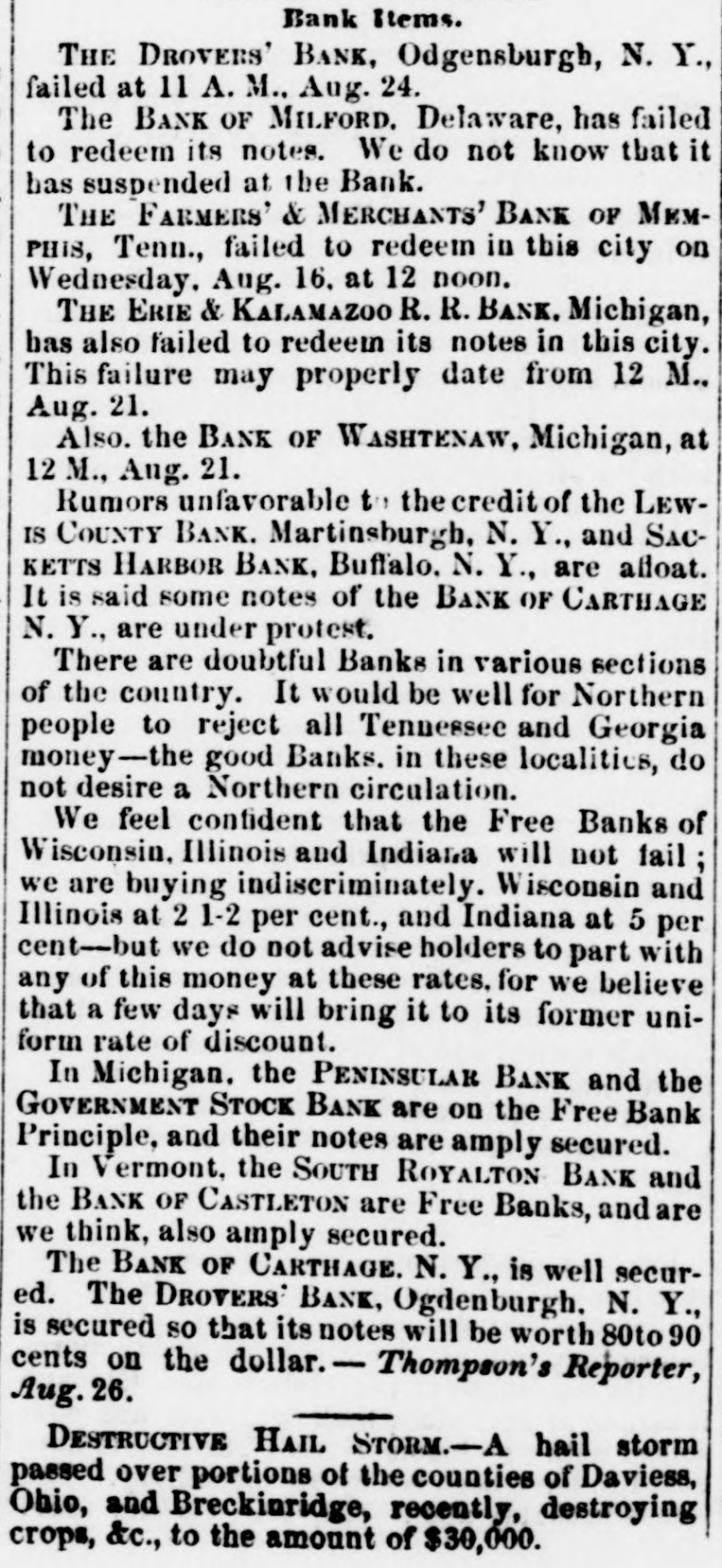
Bank Items. THE DROVERS' BANK, Odgensburgh, N. Y., failed at 11 A. M., Aug. 24. The BANK OF MILFORD. Delaware, has failed to redeem its notes. We do not know that it has suspended at the Bank. THE FARMERS' & MERCHANTS' BANK OF MEMPHIS, Tenn., failed to redeem in this city on Wednesday. Aug. 16. at 12 noon. THE ERIE & Kalamazoo R. R. Bank. Michigan, has also failed to redeem its notes in this city. This failure may properly date from 12 M.. Aug. 21. Also. the BANK OF WASHTENAW, Michigan, at 12 M., Aug. 21. Rumors unfavorable to the credit of the LEWIS COUNTY Bank. Martinsburgh, N. Y., and SACKETTS Harbor BANK, Buffalo. N. Y., are afloat. It is said some notes of the BANK OF CARTHAGE N. Y., are under protest. There are doubtful Banks in various sections of the country. It would be well for Northern people to reject all Tennessee and Georgia money-the good Banks. in these localities, do not desire a Northern circulation. We feel confident that the Free Banks of Wisconsin. Illinois and Indiana will not fail ; we are buying indiscriminately. Wisconsin and Illinois at 2 1-2 per cent., and Indiana at 5 per cent-but we do not advise holders to part with any of this money at these rates, for we believe that a few days will bring it to its former uniform rate of discount. In Michigan. the PENINSULAR BANK and the GOVERNMENT STOCK BANK are on the Free Bank Principle, and their notes are amply secured. In Vermont, the SOUTH ROYALTON BANK and the BANK OF CASTLETON are Free Banks, and are we think, also amply secured. The BANK OF CARTHAGE. N. Y., is well secured. The DROVERS' BANK, Ogdenburgh. N. Y., is secured so that its notes will be worth 80to 90 cents on the dollar. - Thompson's Reporter, Aug. 26. DESTRUCTIVE HAIL STORM.-A hail storm passed over portions of the counties of Daviess, Ohio, and Breckinridge, recently, destroying crops, &c., to the amount of $30,000.


Article from Minnesota Weekly Times, September 12, 1854

Click image to open full size in new tab

Article Text

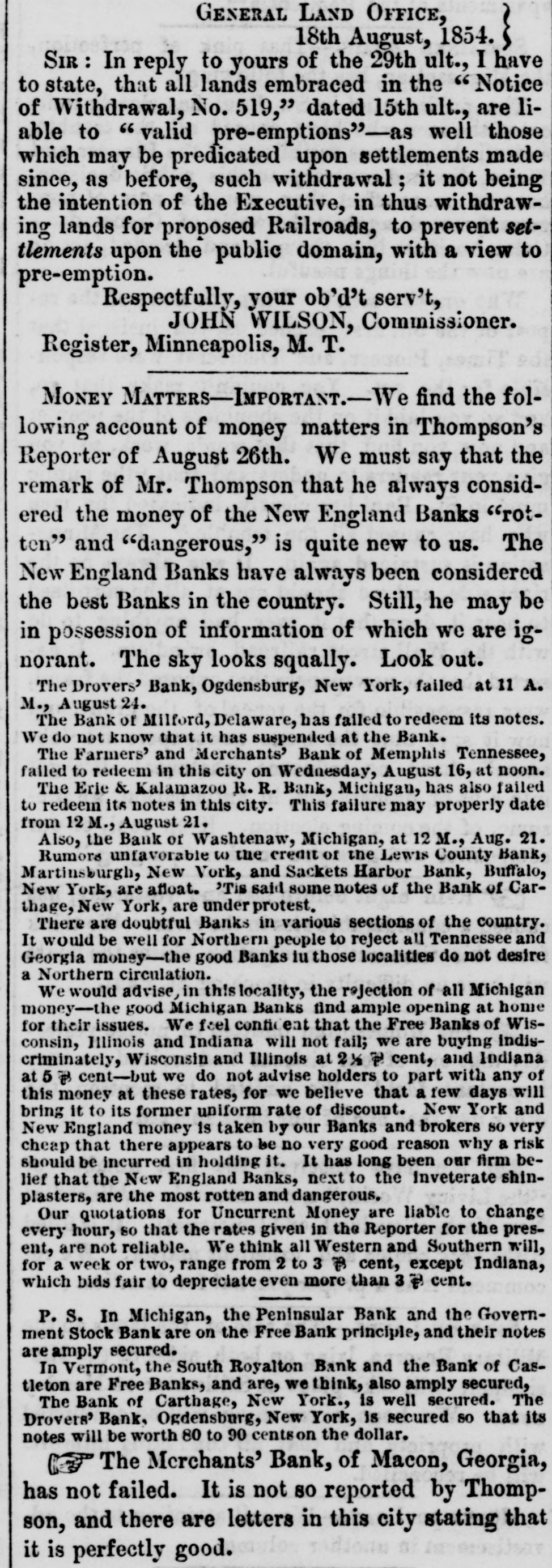
GENERAL LAND OFFICE, 18th August, 1854. SIR : In reply to yours of the 29th ult., I have to state, that all lands embraced in the " Notice of Withdrawal, No. 519," dated 15th ult., are liable to "valid pre-emptions"-as well those which may be predicated upon settlements made since, as before, such withdrawal it not being the intention of the Executive, in thus withdrawing lands for proposed Railroads, to prevent settlements upon the public domain, with a view to pre-emption. Respectfully, your ob'd't serv't, JOHN WILSON, Commissioner. Register, Minneapolis, M. T. MONEY MATTERS-IMPORTANT.-We find the following account of money matters in Thompson's Reporter of August 26th. We must say that the remark of Mr. Thompson that he always considered the money of the New England Banks "rotten" and "dangerous," is quite new to us. The New England Banks have always been considered the best Banks in the country. Still, he may be in possession of information of which we are ignorant. The sky looks squally. Look out. The Drovers' Bank, Ogdensburg, New York, failed at 11 A. M., August 24. The Bank of Milford, Delaware, has failed to redeem its notes. We do not know that it has suspended at the Bank. The Farmers' and Merchants' Bank of Memphis Tennessee, failed to redeem in this city on Wednesday, August 16, at noon. The Erie & Kalamazoo R. R. Bank, Michigan, has also failed to redeem its notes in this city. This failure may properly date from 12 M., August 21. Also, the Bank of Washtenaw, Michigan, at 12 M., Aug. 21. Rumors unfavorable to the credit of the Lewis County Bank, Martinsburgh, New Vork, and Sackets Harbor Bank, Buffalo, New York, are afloat. 'Tis said some notes of the Bank of Carihage, New York, are under protest. There are doubtful Banks in various sections of the country. It would be well for Northern people to reject all Tennessee and Georgia money-the good Banks iu those localities do not desire a Northern circulation. We would advise, in this locality, the rejection of all Michigan money-the good Michigan Banks find ample opening at home for their issues. We feel contic eat that the Free Banks of Wisconsin, Illinois and Indiana will not fail; we are buying indiscriminately, Wisconsin and Illinois at 21/2 cent, and Indiana at 5 F cent-but we do not advise holders to part with any of this money at these rates, for we believe that a few days will bring it to its former uniform rate of discount. New York and New England money is taken by our Banks and brokers so very cheap that there appears to be no very good reason why a risk should be incurred in holding it. It has long been our firm belief that the New England Banks, next to the inveterate shinplasters, are the most rotten and dangerous. Our quotations for Uncurrent Money are liable to change every hour, so that the rates given in the Reporter for the present, are not reliable. We think all Western and Southern will, for a week or two, range from 2 to 3 cent, except Indiana, which bids fair to depreciate even more than 3 F cent. P. S. In Michigan, the Peninsular Bank and the Government Stock Bank are on the Free Bank principle, and their notes are amply secured. In Vermont, the South Royalton Bank and the Bank of Castleton are Free Banks, and are, we think, also amply secured, The Bank of Carthage, New York., is well secured. The Drovers' Bank, Ogdensburg, New York, is secured so that its notes will be worth 80 to 90 centson the dollar. The Merchants' Bank, of Macon, Georgia, has not failed. It is not so reported by Thompson, and there are letters in this city stating that it is perfectly good.


Article from Minnesota Weekly Times, October 24, 1854

Click image to open full size in new tab

Article Text

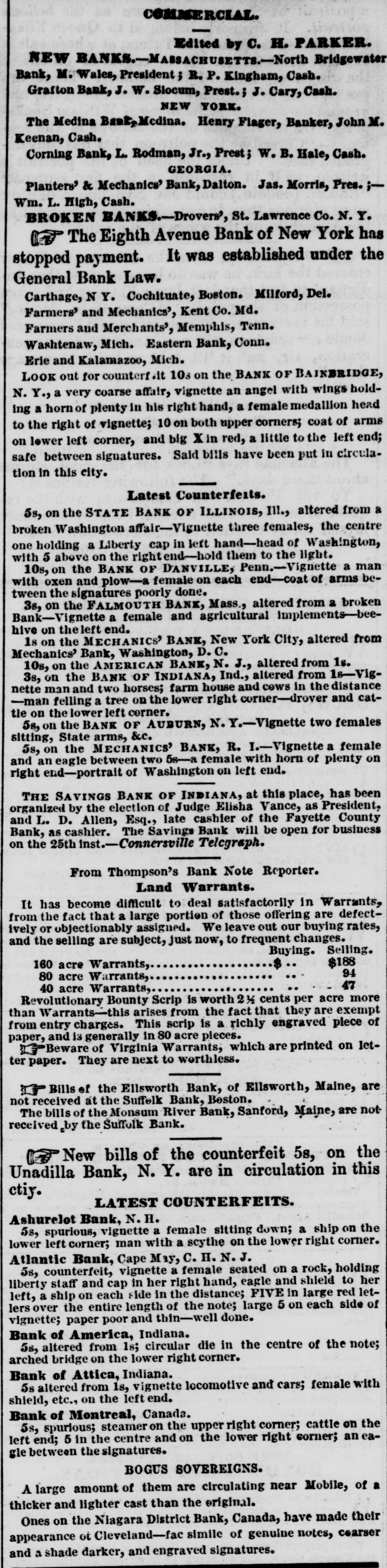
COMMERCIAL. Edited by C. H. PARKER. NEW BANKS.-MASSACHUSETTS.-North Bridgewater Bank, M. Wales, President R. P. Kingham, Cash. Grafton Bank, J. W. Slocum, Prest. J. Cary, Cash. NEW YORK. The Medina Bank,Medina. Henry Flager, Banker, John M. Keenan, Cash. Corning Bank, L. Rodman, Jr., Prest; W. B. Hale, Cash. GEORGIA. Planters' & Mechanics' Bank, Dalton. Jas. Morris, Pres. ;Wm. L. High, Cash. BROKEN BANKS.-Drovers', St. Lawrence Co. N. Y. The Eighth Avenue Bank of New York has stopped payment. It was established under the General Bank Law. Carthage, N Y. Cochituate, Boston. Milford, Del. Farmers' and Mechanics', Kent Co. Md. Farmers and Merchants', Memphis, Tenn. Washtenaw, Mich. Eastern Bank, Conn. Erie and Kalamazoo, Mich. LOOK out for counterf .it 10s on the BANK OF BAINBRIDGE, N. Y., a very coarse affair, vignette an angel with wings holding a horn of plenty in his right hand, a female medallion head to the right of vignette; 10 on both upper corners; coat of arms on lower left corner, and big X in red, a little to the left end; safe between signatures. Said bills have been put in circulation in this city. Latest Counterfeits. 5s, on the STATE BANK OF ILLINOIS, Ill., altered from a broken Washington affair-Vignette three females, the centre one holding a Liberty cap in left hand-head of Washington, with 5 above on the rightend-hold them to the light. 10s, on the BANK OF DANVILLE, Penn.-Vignette a man with oxen and plow-a female on each end-coat of arms between the signatures poorly done. 3s, on the FALMOUTH BANK, Mass, altered from a broken Bank-Vignette a female and agricultural implements-beehive on theleft end. 1s on the MECHANICS' BANK, New York City, altered from Mechanics' Bank, Washington, D. C. 10s, on the AMERICAN BANK, N. J., altered from 1s. 3s, on the BANK OF INDIANA, Ind., altered from 1s-Vignette man and two horses; farm house and cows in the distance -man felling a tree on the lower right corner—drover and cattle on the lower left corner. 5s, on the BANK OF AUBURN, N. Y.-Vignette two females sitting, State arms, &c. 5s, on the MECHANICS' BANK, R. I.-Vignette a female and an eagle between two 5s-a female with horn of plenty on right end-portrait of Washington on left end. THE SAVINGS BANK OF INDIANA, at this place, has been organized by the election of Judge Elisha Vance, as President, and L. D. Allen, Esq., late cashier of the Fayette County Bank, as cashier. The Savings Bank will be open for business on the 25th inst.-Connersville Telcgraph. From Thompson's Bank Note Reporter. Land Warrants. It has become difficult to deal satisfactorily in Warrants, from the fact that a large portion of those offering are defectively or objectionably assigned. We leave out our buying rates, and the selling are subject, just now, to frequent changes. Buying. Selling. $188 160 acre Warrants, 94 80 acre Warrants, 47 40 acre Warrants, Revolutionary Bounty Scrip is worth 2½ cents per acre more than Warrants-this arises from the fact that they are exempt from entry charges. This scrip is a richly engraved piece of paper, and is generally in 80 acre pieces. Beware of Virginia Warrants, which are printed on letter paper. They are next to worthless. Bills of the Ellsworth Bank, of Ellsworth, Maine, are not received at the Suffolk Bank, Boston. The bills of the Monsum River Bank, Sanford, Maine, are notreceived by the Suffolk Bank. New bills of the counterfeit 5s, on the Unadilla Bank, N. Y. are in circulation in this ctiy. LATEST COUNTERFEITS. Ashurelot Bank, N. H. 5s, spurious, vignette a female sitting down; a ship on the lower left corner; man with a scythe on the lower right corner. Atlantic Bank, Cape May, C. H. N. J. 5s, counterfeit, vignette a female seated on a rock, holding liberty staff and cap in her right hand, eagle and shield to her left, a ship on each side in the distance; FIVE in large red letlers over the entire length of the note; large 5 on each side of vignette; paper poor and thin-well done. Bank of America, Indiana. 5s, altered from 1s; circular die in the centre of the note; arched bridge on the lower right corner. Bank of Attica, Indiana. 5s altered from 1s, vignette locomotive and cars; female with shield, etc., on the left end. Bank of Montreal, Canada. 5s, spurious; steamer on the upper right corner; cattle on the left end; 5 in the centre and on the lower right corner; an eagle between the signatures. BOGUS SOVEREIGNS. A large amount of them are circulating near Mobile, of a thicker and lighter cast than the original. Ones on the Niagara District Bank, Canada, have made their appearance ot Cleveland-fac simile of genuine notes, cearser and a shade darker, and engraved signatures.


Article from Plymouth Advertiser, October 27, 1854

Click image to open full size in new tab

Article Text

# The Failing Banks The Cincinnati Commercial publishes a statement of the Kanawha bank, (of Va.,) showing a very safe state of affairs in that institution, and remarks- "While we know nothing of the institution except through the showing which it makes, and the character of some of its stockholders, we have no reason to suppose that we are in possession of less information than those who are endeavoring to do it an injury. An amount of assets equal to one dollar and twenty-seven cents for each dollar of its circulation is not a very bad state of things, certainly. We do not present ourselves as endorsers of the solvency of this or any other banking institution, but we should be sorry at this time of pecuniary oppression, to see the mitchief aggravated by an unjustifiable suspicion of any concern whatever. Of the Kentucky Trust Co. Bank at Covington, the same paper says- "This institution, closed its doors yesterday morning. The public generally have been taken by surprise, though there are many who seem to have anticipated the failure. For many months the amount of paper presented for redemption has averaged about $80,000 per week, which, at the usual high price of gold for sometime passed, absorbed nearly the whole profits of the bank. It is thought by some that the bank will be able to meet its liabilities; by others it is considered a complete failure. We saw some of its money selling for 90 cents in Covington, soon after the failure, which, at least is an indication that some of the people there have full confidence in the ability of the institution. The bank has a cirsulation of $800,000, a considerable part of which has been put out but recently. Speaking of the present state of Banks and money matters generally, the Sandusky Register says: "There can be no doubt but that the public mind is unnecessarily excited about the Indiana currency. The issues of the Free Banks are secured on what are considered good public stocks, and these securities if not forced on the market in an untimely manner are unquestionably sufficient to redeem the issues with small loss to the public, A panic forces the issues and the securities on the market, and the labor of the country suffers the loss. Those papers, which are busy stirring up this monetary excitement, should think of the ultimate effect of these excitements ere they launch out upon their ill-considered crusade against the banks." The following is a list of banks that have bursted within a short time past: Patchin Bank, Buffalo. Farmers' and Mechanics' Bank, Oswego. Farmers' Bank of Canandaigua. Dovers' Bank, Ogdensburg. Bank of Carthage. Farmers' and Merchants' Bank, Md. Bank of Milford, Delaware. Farmers' and Merchants' Bank, Memphis, Massillon Bank, Ohio. Ohio Savings Institute, Tiffin. Cochituate Bank, Boston. Bank of West Killingly, Connecticut. Eighth Avenue Bank, New York. Bank of Ellsworth, Maine. Elkhart County Bank, Indiana. Bank of Northern Indiana. Bank of Washtenaw, Michigan. Erie and Kalamazoo Bank, Michigan. Kentucky Trust Co. Newport (Ky.,) Safety Trust Bank. Savings Bank of Cincinnati. The Bank of Connersville. The Washington Star cautions the public against the reception of the notes of the Arlington and of the Farmers' and Mechanics' Banks of Washington. Both are worthless, being mere bogus machinery started there for the purpose of flooding the country with their irresponsible issues.


Article from The Ottawa Free Trader, November 4, 1854

Click image to open full size in new tab

Article Text

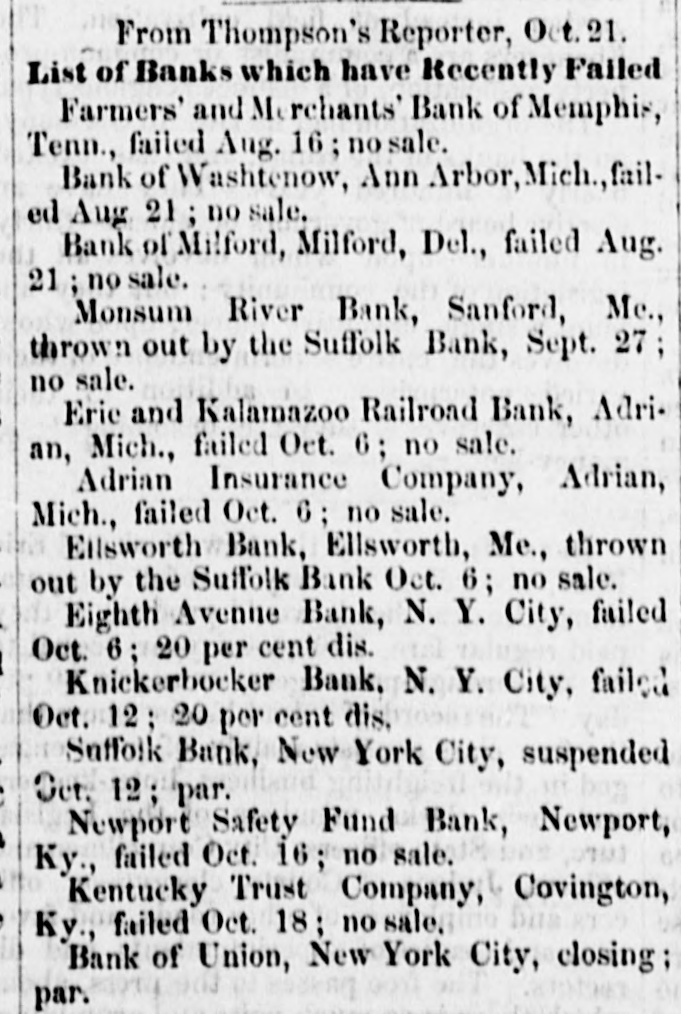
From Thompson's Reporter, Oct. 21. List of Banks which have Recently Failed Farmers' and Mc rehants' Bank of Memphis, Tenn., failed Aug. 16; no sale. Bank of Washtenow, Ann Arbor, Mich., failed Aug 21 ; no sale. Bank of Milford, Milford, Del., failed Aug. 21 ; no sale. Monsum River Bank, Sanford, Me., thrown out by the Suffolk Bank, Sept. 27; no sale. Erie and Kalamazoo Railroad Bank, Adrian, Mich., failed Oct. 6; no sale. Adrian Insurance Company, Adrian, Mich., failed Oct. 6; no sale. Ellsworth Bank, Ellsworth, Me., thrown out by the Suffolk Bank Oct. 6; no sale. Eighth Avenue Bank, N. Y. City, failed Oct. 6; 20 per cent dis. Knickerbocker Bank, N. Y. City, failed Oct. 12 ; 20 per cent dis. Suffolk Bank, New York City, suspended Oct. 12; par. Newport Safety Fund Bank, Newport, Ky., failed Oct. 16; no sale. Kentucky Trust Company, Covington, Ky., failed Oct. 18; no sale. Bank of Union, New York City, closing; par.


Article from The National Era, November 9, 1854

Click image to open full size in new tab

Article Text

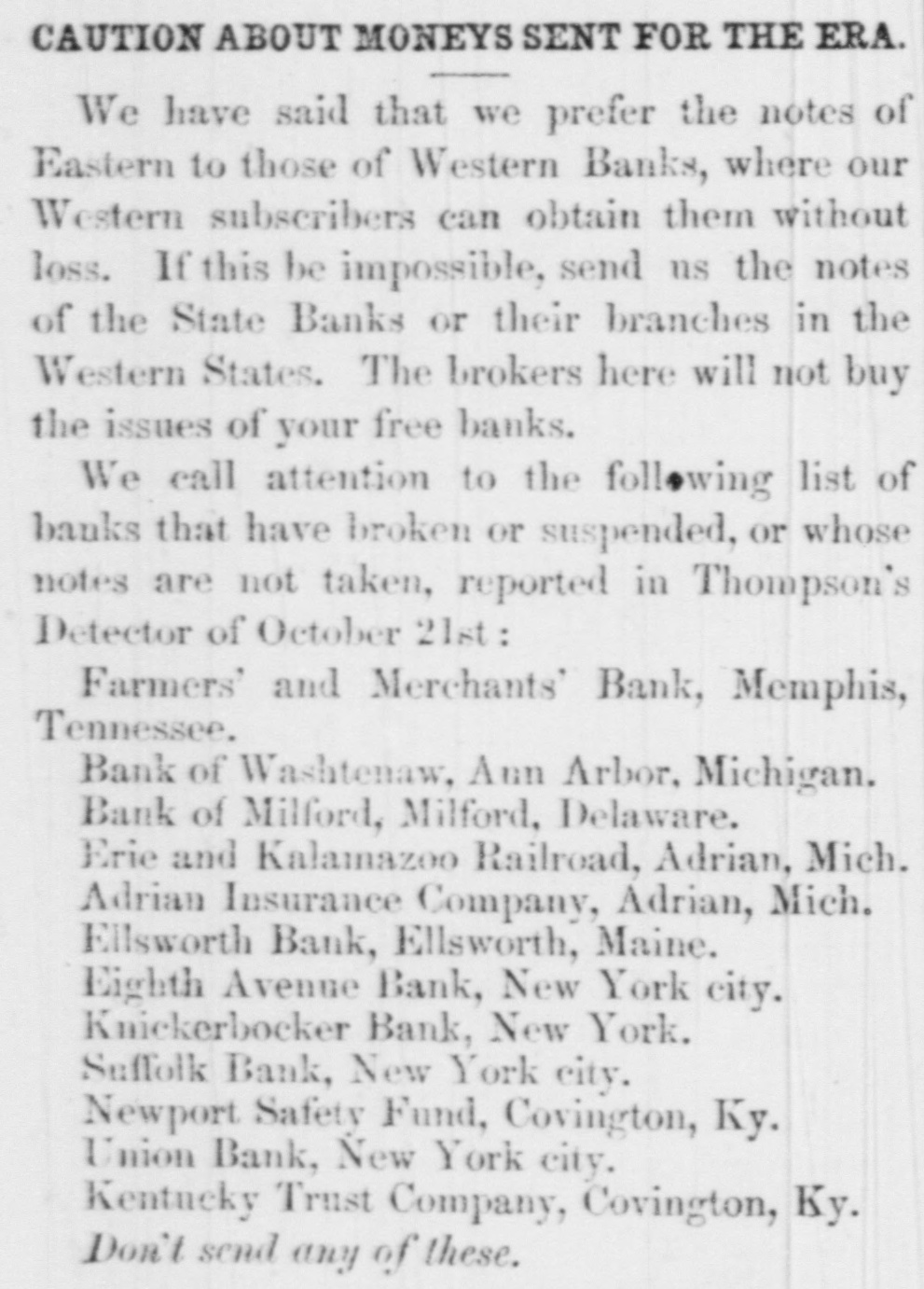
CAUTION ABOUT MONEYS SENT FOR THE ERA. We have said that we prefer the notes of Eastern to those of Western Banks, where our Western subscribers can obtain them without loss. If this be impossible, send us the notes of the State Banks or their branches in the Western States. The brokers here will not buy the issues of your free banks. We call attention to the following list of banks that have broken or suspended, or whose notes are not taken, reported in Thompson's Detector of October 21st: Farmers' and Merchants' Bank, Memphis, Tennessee. Bank of Washtenaw, Aun Arbor, Michigan. Bank of Milford, Milford, Delaware. Erie and Kalamazoo Railroad, Adrian, Mich. Adrian Insurance Company, Adrian, Mich. Ellsworth Bank, Ellsworth, Maine. Eighth Avenue Bank, New York city. Knickerbocker Bank, New York. Suffolk Bank, New York city. Newport Safety Fund, Covington, Ky. Union Bank, New York city. Kentucky Trust Company, Covington, Ky. Don't send any of these.


Article from Fayetteville Observer, November 9, 1854

Click image to open full size in new tab

Article Text

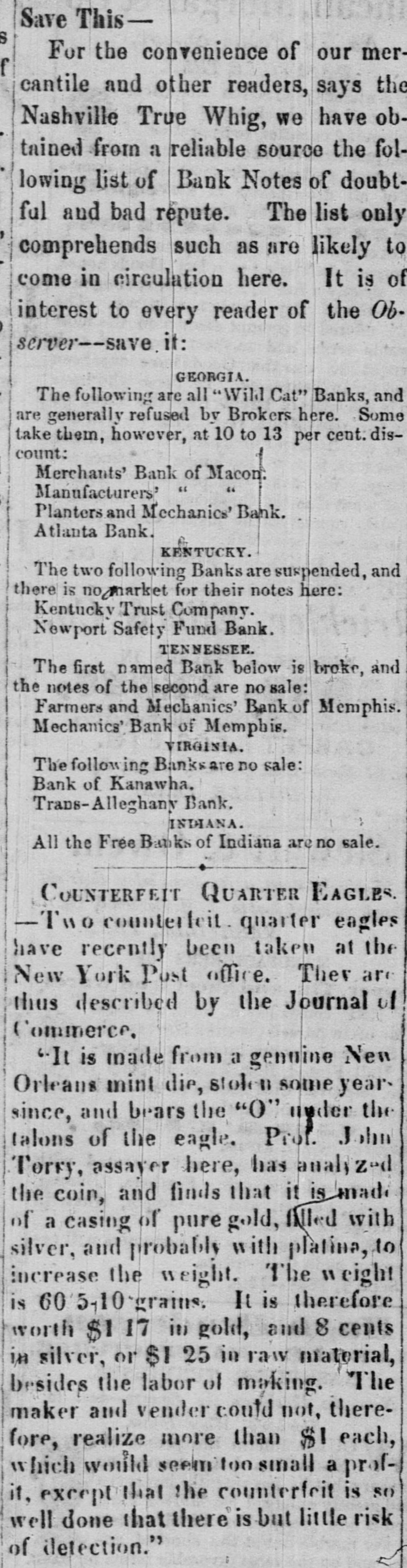
Save ThisFor the convenience of our mercantile and other readers, says the Nashville True Whig, we have obtained from a reliable source the following list of Bank Notes of doubtful and bad repute. The list only comprehends such as are likely to come in circulation here. It is of the Obinterest to every reader of server-save it: GEORGIA. The following are all "Wild Cat" Banks, and are generally refused by Brokers here. Some take them, however, at 10 to 13 per cent. discount: Merchants' Bank of Macon. " " Manufacturers' Planters and Mechanics' Bank. Atlanta Bank. KENTUCKY. The two following Banks are suspended, and there is nomarket for their notes here: Kentucky Trust Company. Newport Safety Fund Bank. TENNESSEE. The first named Bank below is broke, and the notes of the second are no sale: Farmers and Mechanics' Bank of Memphis. Mechanics' Bank of Memphis. VIRGINIA. The following Banksare no sale: Bank of Kanawha. Trans-Alleghany Bank. INDIANA. All the Free Banks of Indiana are no sale. COUNTERFEIT QUARTER EAGLES. -Two counterfeit. quarter eagles have recently been taken at the New York Post office. Ther are thus described by the Journal of Commerce. "It is made from a genuine New Orleans mint die, stole some years since, and bears the "O" under the talons of the eagle, Prof. John Torry, assayer here, has analy zed the coin, and finds that it is made of a casing of pure gold, filled with silver, and probably with platina, to increase the weight. The = eight is 60 5-10 grains. It is therefore worth $1 17 in gold, and 8 cents in silver, or $1 25 in raw material, besides the labor of making. The maker and vender could not, therefore, realize more than $1 each, which would seem too small a profit, except that the counterfeit is SO well done that there is but little risk of detection."


Article from The National Era, November 16, 1854

Click image to open full size in new tab

Article Text

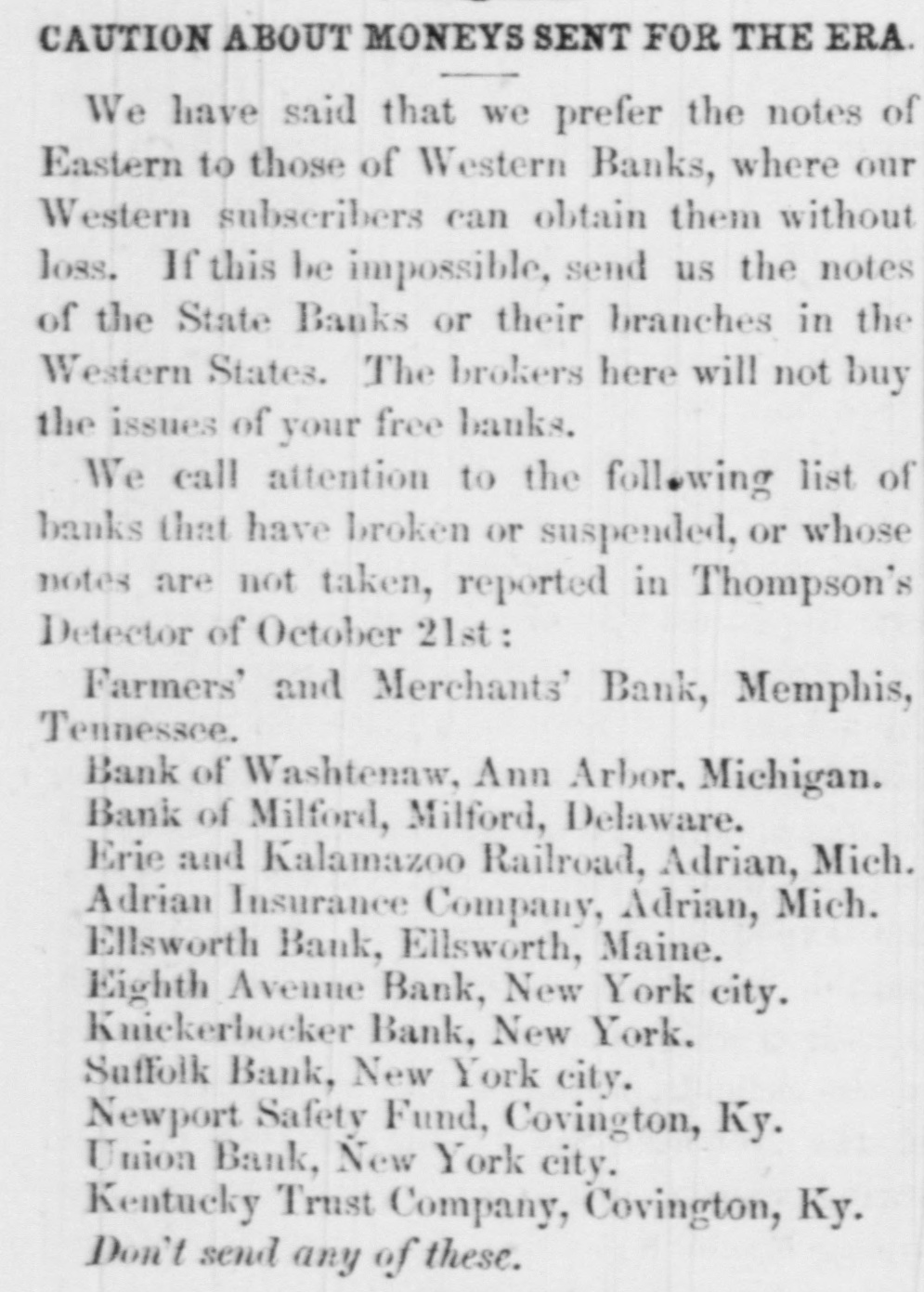
CAUTION ABOUT MONEYS SENT FOR THE ERA. We have said that we prefer the notes of Eastern to those of Western Banks, where our Western subscribers can obtain them without loss. If this be impossible, send us the notes of the State Banks or their branches in the Western States. The brokers here will not buy the issues of your free banks. We call attention to the following list of banks that have broken or suspended, or whose notes are not taken, reported in Thompson's Detector of October 21st: Farmers' and Merchants' Bank, Memphis, Tennessee. Bank of Washtenaw, Ann Arbor. Michigan. Bank of Milford, Milford, Delaware. Erie and Kalamazoo Railroad, Adrian, Mich. Adrian Insurance Company, Adrian, Mich. Ellsworth Bank, Ellsworth, Maine. Eighth Avenue Bank, New York city. Knickerbocker Bank, New York. Suffolk Bank, New York city. Newport Safety Fund, Covington, Ky. Union Bank, New York city. Kentucky Trust Company, Covington, Ky. Don't send any of these.


Article from The Belmont Chronicle, and Farmers, Mechanics and Manufacturers Advocate, November 24, 1854

Click image to open full size in new tab

Article Text

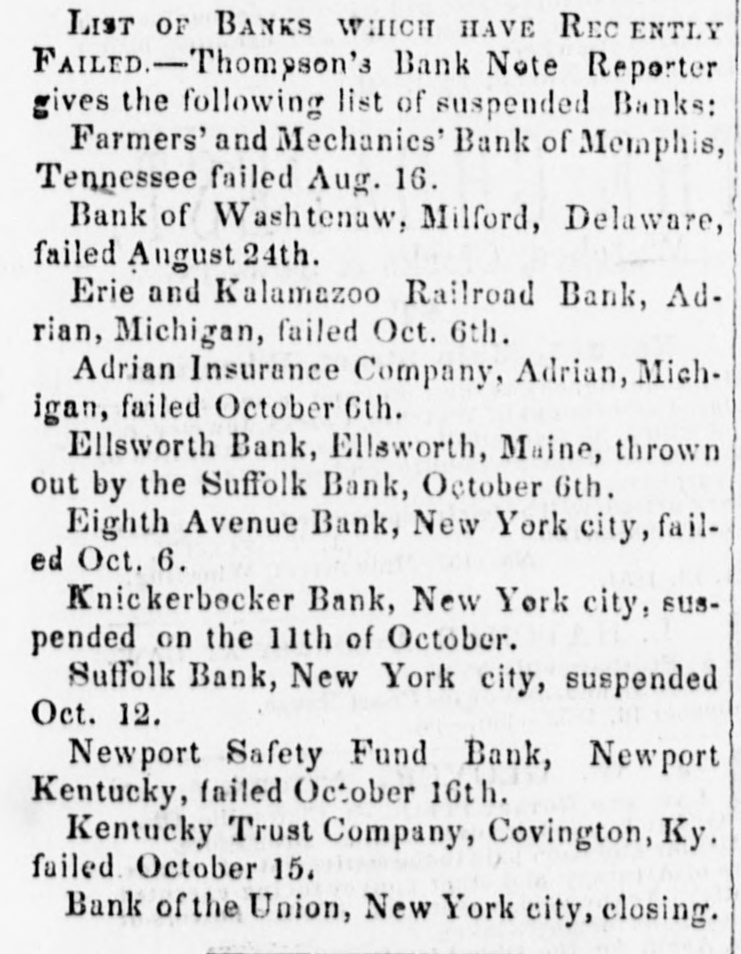
LIST OF BANKS WHICH HAVE REC ENTLY FAILED.-Thompson's Bank Note Reporter gives the following list of suspended Banks: Farmers' and Mechanics' Bank of Memphis, Tennessee failed Aug. 16. Bank of Washtenaw, Milford, Delaware, failed August 24th. Erie and Kalamazoo Railroad Bank, Adrian, Michigan, failed Oct. 6th. Adrian Insurance Company, Adrian, Michigan, failed October 6th. Ellsworth Bank, Ellsworth, Maine, thrown out by the Suffolk Bank, October 6th. Eighth Avenue Bank, New York city, failed Oct. 6. Knickerbocker Bank, New York city, suspended on the 11th of October. Suffolk Bank, New York city, suspended Oct. 12. Newport Safety Fund Bank, Newport Kentucky, failed October 16th. Kentucky Trust Company, Covington, Ky. failed October 15. Bank of the Union, New York city, closing.