20796. Farmers & Merchants Bank (Memphis, TN)

Bank Information

Episode Type
Run → Suspension → Closure
Bank Type
state
Start Date
May 1, 1847*
Location
Memphis, Tennessee (35.150, -90.049)

Metadata

Model
gpt-5-mini
Short Digest
cd2b5a38

Response Measures

Full suspension

Other: Later legal action: injunctions and receivership; allegations of internal fraud and directors stripping vaults.

Description

Multiple articles report a specie run in May 1847 (protested checks drawn on a Philadelphia bank triggered suspicion), board resolution suspending specie payments May 24, 1847, and later injunctions/receiver and apparent winding up in December 1847. Thus a run led to suspension and eventual receivership/closure.

Events (3)

1. May 1, 1847* Run
Cause
Correspondent
Cause Details
Run provoked by protested checks drawn on a Philadelphia correspondent which produced suspicion and heavy specie withdrawals.
Measures
Bank paid large liabilities (directors later said $600,000 in 90 days) and ultimately suspended specie payments by board resolution; public cautioned note-holders against sacrificing notes.
Newspaper Excerpt
the Farmers' and Merchants' Bank of Memphis ... has been run upon for specie, to the amount of from fifty to sixty thousand dollars. The cause of the run was the return of some protested checks drawn by the bank upon a Philadelphia institution
Source
newspapers
2. May 24, 1847 Suspension
Cause
Correspondent
Cause Details
Directors suspended specie payments after the run triggered by protested Philadelphia checks and consequent loss of confidence.
Newspaper Excerpt
Resolved, That the Farmers' and Merchants' Bank of Memphis suspend the payment of specie temporarily, and until due notice of a resumption shall appear in the newspapers.
Source
newspapers
3. December 3, 1847 Receivership
Newspaper Excerpt
an injunction was served ... restraining them from any further control over it, and placing its assets in the hands of a receiver, Joseph H. Talbot, Esq.; the injunction was issued at the instance of Mr. Evan Rogers ... and ... puts the Bank into liquidation and winds it up finally and forever.
Source
newspapers

Newspaper Articles (18)

Article from Democratic Banner, May 24, 1847

Click image to open full size in new tab

Article Text

Troops Encumped. -There are now encamped at the Carrollton Race Course, a detachment of the 16th Infantry, aggregating 460 men, under Lieut. Col. Webb. Also companies of the 15th Infantry-one company of the 7th Infantry, numbering in all 256 men, unper command of Maj. Lee, of the 7th Infantry; Capt. Gaither's company, 3d Dragoons, 108 men; Capt. King's company, 1st Infantry, 90 men; Capt. Blair's Voltiguers, 126 men; Capt. Mofford's company, 13th Infantry, 100 men, and Capt. McReynold's company of Dragoons' numbering 104 men. These troops will start the moment that transportation can be obtained.-[N. O. Delta, May 13th. Major Geo. T. M. Davis, aid to Gen. Shields, has addressed a letter to D. Hayden, Esq., of New Orleans, in which he expresses a confident hope of the recovery of the General. From the Seat of War.-A detachment of recruits from the rendezvous in this city left yesterday for the seat of war.-[Pittsburg Journal May 15th. The Spirit of Maryland.-Maj. Gen. John Spear Smith, of Baltimore, the present commander of the third division of Maryland militia, has written to Gen. Jones, adjutant general U. S. A., tendering through him to the President the services of a brigade of volunteers, from Maryland, to serve during the war with Mexico. More Copper.-Two or three veins of rich copper ore have been opened about 70 miles below the Sault, near the northern shores of Huron and within thirty hours' ran of Detroit. This is the nearest copper mine found on either side of the lake; in a single shaft, 150 tons have been taken out, of excellent copper ready for shipping. A Movement to Gov. Yell.--The Washington (Arks.) Telegraph, in a very handsome tribute to the failen brave of that State, proposes to erect a monument at Little Rock, at public expense, to "Col. A. Yell and the brave who fell with him at Buena Vista." The Methodist Book Concern, have now in process of erection at Cincinnati, a splendid building to be of the following dimensions: four stories, eighty feet deep, and fifty-six feet front. The building is to be completed this season. I T. W. Decourcy is raising a company of volunteers for Santa Fe in Clay county. Col. E. Billingsley of Glasgow, is raising a company of mounted men for Santa Fe. We understand that his company is nearly made up. Death of Achille Murat.-The Florida papers announce the death of Achille Murat, the son of Prince Murat and Caroline Bonaparte, King and Queen of Naples, aged 46 years. He died at his residence in Jefferson county, Florida, on the 17th ultimo. The Galena Gazette says seven companies have been raised in that city during the present war. They are fond of using cold lead, and know how to do it. The tolls on the New York canals, for the first week of navigation, will, it is said, exceed two hundredthousand dollars. Lake Ontaris.-The water in this lake is higher than at any former time, according to the 'oldest inhabitant' If it continues a few years longer, it will spill itself over the State. If The Governor of Alabama has issued a for of proclamation, calling five companies infantry and one of cavalry, from that State, to serve during the war, according to the requisition of the War Department. It It is stated that the BARINGS of London, have advanced 500,000 towards the progress of the Chesapeake and Ohio Canal. DEPRECIATED.-Holders of paper money issued by the Farmers' Merchants' Bank of Memphis, were yesterday seized with a panic in relation to the solvency of the institution named. We learn that several brokers refused to purchase, and that this depreciation is a'tributable to heavy protests east.-St. Louis Union. Shot.-In Calloway county, last week Mr. James Love was shot through the right


Article from Washington Telegraph, June 2, 1847

Click image to open full size in new tab

Article Text

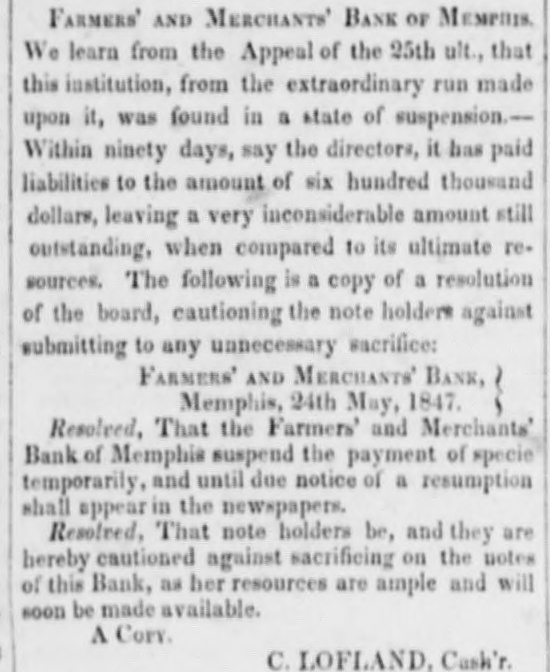
FARMERS' AND MERCHANTS' BANK OF MEMPHIS We learn from the Appeal of the 25th ult., that this institution, from the extraordinary run made upon it, was found in a state of suspension.-Within ninety days, say the directors, it has paid liabilities to the amount of six hundred thousand dollars, leaving a very inconsiderable amount still outstanding, when compared to its ultimate resources. The following is a copy of a resolution of the board, cautioning the note holders against submitting to any unnecessary sacrifice: FARMERS' AND MERCHANTS' BANK, Memphis, 24th May, 1847. Resolved, That the Farmers' and Merchants' Bank of Memphis suspend the payment of specie temporarily, and until due notice of a resumption shall appear in the newspapers. Resolved, That note holders be, and they are hereby cautioned against sacrificing on the notes of this Bank, as her resources are ample and will soon be made available. A Corr. C.LOFLAND. Cash'r.


Article from The Arkansas Banner, June 2, 1847

Click image to open full size in new tab

Article Text

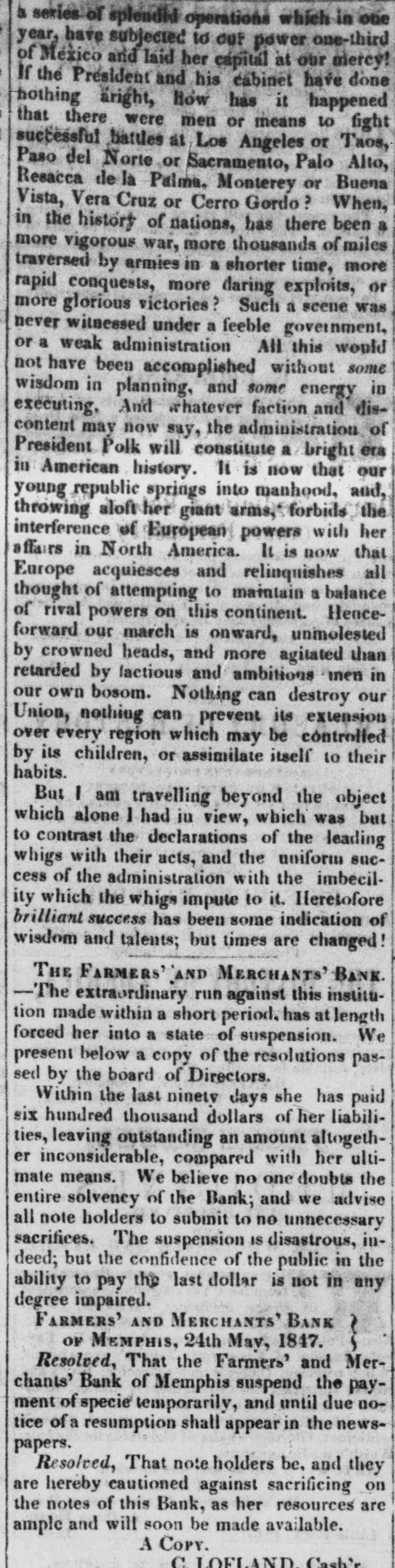
à series of splendid operations which in one year, have subjected to out power one-third of Mexico and laid her capital at our mercy! If the President and his cabinet have done nothing äright, How has it happened that there were men or means to fight successful battles at Los Angeles or Taos, Paso del Norte or de la Palma. or Buena Cruz or Cerro Gordo? Vista, Resacca Vera Sacramento, Monterey Palo When, Alto, in the history of nations, has there been a more vigorous war, more thousands of miles traversed by armies in a shorter time, more rapid conquests, more daring exploits, or more glorious victories? Such a scene was never witnessed under a feeble government, or a weak administration All this would not have been accomplished without some wisdom in planning, and some energy in executing, And whatever faction and disnow of will constitute a era content President may Polk say, the administration bright in American history. It is now that our young republic springs into manhood, and, throwing aloft her giant arms, forbids the interference of European powers with her affairs in North America. It is now that Europe acquiesces and relinquishes all thought of attempting to maintain a balance of rival powers on this continent. Henceforward our march is onward, unmolested by crowned heads, and more agitated than retarded by factious and ambitions inen in our own bosom. Nothing can destroy our Union, nothing can prevent its extension over every region which may be controlled by its children, or assimilate itself to their habits. But I am travelling beyond the object which alone I had in view, which was but to contrast the declarations of the leading whigs with their acts, and the uniform success of the administration with the imbecility which the whigs impute to it. Heretofore brilliant success has been some indication of wisdom and talents; but times are changed! THE FARMERS' AND MERCHANTS' BANK. -The extraordinary run against this institution made within a short period. has at length forced her into a state of suspension. We present below a copy of the resolutions passed by the board of Directors. Within the last ninetv days she has paid six hundred thousand dollars of her liabilities, leaving outstanding an amount altogether inconsiderable, compared with her ultimate means. We believe no one doubts the entire solvency of the Bank; and we advise all note holders to submit to no unnecessary sacrifices. The suspension IS disastrous, indeed; but the confidence of the public in the ability to pay the last dollar is not in any degree impaired. FARMERS' AND MERCHANTS' BANK } OF MEMPHIS, 24th May, 1847. Resolved, That the Farmers' and Merchants' Bank of Memphis suspend the payment of specie temporarily, and until due notice of a resumption shall appear in the newspapers. Resolved, That note holders be, and they are hereby cautioned against sacrificing on the notes of this Bank, as her resources are ample and will soon be made available. A COPY. C.LOFLAND Cash'r


Article from The New York Herald, June 3, 1847

Click image to open full size in new tab

Article Text

oidedly easy, and daily improving. Capital was plenty, at less than the legal rates of interest, on first rate securities. The banks were in the market for loans at six per cent, but good short business paper was scarce, and fancy stocks find very little favor with eastern banks and capitalists. Eastern railroad stocks for investment were firm, and scarce,at the present advanced rates. Bank stocks were not in favor. It is also stated that a heavy amount of state stocks, hold in London, have been purchased for American account, and brought home. They have paid a profit, and are a saving in the way of exchange. The stockholders of the Lancaster Bank of Massachusetts, have accepted the act of the last legislature, authorising them to increase their capital from $100,000 or $125,000. The directors have declared a dividend of nine per cent, payable June 1st, from the surplus profits. The additional capital was to have been paid in, June 1. The Farmers' and Merchants' Bank of Memphis, Tenn. has been run upon for specie, to the amount of from fifty to sixty thousand dollars. The cause of the run was the return of some protested checks drawn by the bank upon a Philadelphia institution, and the bank not opening its doors on the morning after until an hour after its usual time. The protested checks were promptly paid, and every bill presented redeemed, The cause of the checks being protested in Philadelphia, was that the bank in that city did not receive such paper to discount from the Farmers' and Merchants' Bank as it expected to receive, when authority was given to check. The amount of checks was very trifing, but sufficient to produce an excitement. The solvency of the Farmers' and Merchants' Bank is not generally questioned in Memphis, but whether it can sustain itself against a heavy run, is very doubtful. Very few of the banking institutions of the country can stand for any length of time an unexpected run for specie from its bill holders. The assets of the above named bank are large, are daily maturing, and are deemed ample under all ordinary exigencies to meet the liabilities promptly and in full.


Article from The New York Herald, June 7, 1847

Click image to open full size in new tab

Article Text

A comparison of prices current yesterday with those ruling at the close of the previous week, exhibits an impovement in Kentucky 6's, of 1/4 per cent, Penn. 5's 1/2. Illinois 1/4 Erie Railroad (old) 34, Long Island 2, Stonington 5, Farmers Loan 3/8, Harlem 1/1, North American Trust 1/6, and a decline in Norwich and Worcester of 1, and Morris Canal 3 per cent. At a recent meeting of the Board of Directors of the Phoenix Bank, it was determined to withhold all loans from fancy stock, and should any hereafter be made by the officers of the institution, they must be made entirely upon their personal responsibility. The hypothecators of the Norwich and Worcester, and Reading Railroad bonds were immediately directed to remove their deposits.This is a good beginning, and we hope but the commencement of a movement, that will shut fancy stocks entirely out of our banks. It is a reform long called for, and much required by the mercantile classes, and should the-example be faithfully followed by the other banks of this city, the money market would assume a steady and uniform character-the value of money would cease to fluctuate; the rate of interest would be more uniform, and there would not be those enormous inflations and entractions in the banking movement of the State which nearly every quarterly report exhibits. Legitamate business paper would have a better chance of being discounted, and the banks would confine themselves entirely to the business for which they were chartered. So long as our banks speculate in fancy stocks, or even loan on such securities, we shall see at one time money reduced below its intrinsic value, in order to inflate the stock market, and at another time raised SO high as to be beyond the reach of those engaged in fair business transactions. The value of merchandise imported into this district for the first four days in June, this year, was $883,747, against $612,083 for the corresponding period in 1846, showing an increase of $271,664 this year. The amount of duties for the same time this year was $204,552, against $188,173 last, showing an increase of $16,349. The Farmers' and Merchants' Bank of Memphis, Tenn. has suspended specie payments. The Memphis Eagle,of May 25th, says:The President has gone to New Orleans to forward specie. and we doubt not that the bank's receipts will be large during the coming thirty days. Its circulation, we understand to be about $450,000 while, its bill of exchange assets are near $700,000. We call the special attention of the public to the following notice of the bank:FARMERS' AND MERCHANTS' Bank, MEMPHIS, May 24, 1847. Resolved, That the Farmers' and Merchants 'Bank of Memphis suspend the payment of specie, temporarily, and until due notice of a resumption shall appear in the newspapers. Resolved, That note holders be and they are hereby cautioned against sacrifices on the notes of this bank, as her resources are ample and will soon be made available A copy. C. LOFLAND, Cashier.


Article from The State Guard, June 8, 1847

Click image to open full size in new tab

Article Text

Bank failure at Memphis, The N. Orleans Picayune of the 27 th ult, says that the Farmer's and Merchant's Bank at Memphis suspended payment the morning of the 24th ult.The Board of Directors voted to "suspend specie payments temporarily, and at the same time requested holders of the notes not to sacrifice them, as the resources of the Bank, according to them, are sufficiently ample to redeem every dollar of its issues.


Article from Richmond Daily Whig, June 8, 1847

Click image to open full size in new tab

Article Text

Memphis Bank. The Memphis Enquirer of the 25th ult. states, that, owing to the run on the Farmers' and Merchants' Bank of that city, (occasioned by suspicions of its insolvency growing out of a protest of its checks by one of the Philadelphia Banks,) the Board of Directors had the day previously resolved to suspend the payment of specie temporarily. They caution the note-holders, however, against sacrificing them, alleging that the resources of the Bank are ample, and will soon be made available.


Article from The Arkansas Banner, June 9, 1847

Click image to open full size in new tab

Article Text

The Tennessee Banks. The paper currency of this State for years past, has been formed chiefly from the issues of these and is the last six or eight months has evincreased io circulation. and Merchants' Bank" has idently banks, Farmers The suspension Tennessee created the note holders of other and a distrust prevails as to sta. of The consequence is the banks, a-panic bility among any. general that the first is even at the Memphis rate of discount, while other paper any 50 per cent not passable Tennessee Commer- is raThe Memphis states that the suspended in the State, and most solvent Journal only accounts Bank individuals is the for it, by the fact that a few stock enough to obtain of had the run purchased upon control of there the Institution. and the additional cause having been returned to her, several checks drawb on Philadelphia, protested It's generally supposed that the suspension will only be temporary. but the Louisville Democrat re works: "It arrant humbuggery to talk about resources" &c., when a if "ample know suspension that allowed. Every one must resources nad no sachave been considered too great to avoid the discredit and rifice ample would prostration existed that must follow a suspension, not only with this bank itself, but on all the rest of the state which will inevitably be effected by the panic created." We feel disposed to furnish our readers, with all the information which has reached us upon the subjec. and we give place to the following extract, from letter the Vicksburg Sentinel, said to be from intelligent source, dated MEMPHIS, May 26, 1847. here on Sunday morning, and found the people the by the (specic arrived payment, discussing Farmers probabilities & MerBank on the following select passages stead chants' of quoting morning, good of the people Holy inyet the faces of the as as that of the You could see them at Scriptures, hypocrite. were long greatest warmly Sunday all the before the hotel doors, about the ability of the go friends of the Bank streets on. disputing The and all Bank declaring State, to was the best bank in believe to be the and that (which she fully assets. the case) One could show more available remarked, that she would have for they had come man I do something, know, here for the money, and they would have it or something elac. Well, Monday morning came, and with it of "black spirits and white; and grey," in the came a-crowd blue spirits congregated usual blue in Monday style. They all front of a hotel on the opposite (or shady) of the street to the bank anxiously side the hour of 10 o'clock. Well, & awaiting, and open went the Planters' Merten came not so the Farmers & chants'. Union-b But through her massive windows be seen the mountain laboring-her Directory could were moving to and fro as rapidly mow were about (after many see sife But anon Tipperary tremulous window commene- to glaning been cast out of the can had of a pin the ercwd would swalwhat was kind bro't forth the mouse The large the low) bronze doors flew open. and out stepped front in black, and pasted on the gentleman of the Bank the resolutions of the directory." (There were published in our last, and when amounthis. We pay specie no longer; time, we ted t can, why we'll let you know- in the mean dont give yourself any trouble about it.) But this would not satisfy the confidence bethe note-holders. They would not Every lieve of but that the Bank was broke. holder nearly wants to get rid of his money, and the buyers are few, and twenty-five moderate per discount is the figure. -Some But transactions cent were made at a little less. are passed, and it now goes a begging and they The brokers have fixed no rate, there is 125. not buy. I am of opinion that diswill now in town at 25 was offered point-$5000 shout $150,000 yesterday The waiting following discountant found no sale. She the condition of the Bank. about $500,000 in the last 120 days cirredeemed about $620,000 outstanding claims to have ha eulation-s! she has assets thirty-five to the of fourteen hundred and resume amount dollars. I think she win be thousand in a few weeks, when there will will puff, again grand rush at her. She she another blow and struggle. and in the struggle, will relapae, and then good-by I would write you more about Memphis, But look will tire you out I fear. State. but this for the other banks in this on them, out rush is about to be made think and go that they Farmers a must.- & They Merchants', have tried but to had have sus- to tain the the Farmers & Merchants' receivable to stop, and many of their bills Farmers transferred banks, who refuse to take of them althe Merchants' other bills in payment for bills bot& the notes were given at though of said bank, and made payable it-Ten- her rowed I will stop. Mark with nessee counter.--But money will soon be on a par Mississippi banks. adgratified to bear that Gov remonstrating DREW has We were an official letter to Gen. Seott, unjust detendressed the perfidious treatment and and others against BORLAND, Capt. DANLEY, in Mexico, of regiment, as captive the for them had been and the friends and after tion the Maj. Arkansas exchange part of relatives, determined. Gov DREW reUpon feeling of community, the compresenting the and spirited appeal to of made General strong for an immediate adjustment will manding of such rumors this outrage, or give the adoption them liberty. measures as Various liberation of a most speedily reached us of their incarceration, part of them and have but again rely of upon the masassination nothing further than what has


Article from Portage Sentinel, June 9, 1847

Click image to open full size in new tab

Article Text

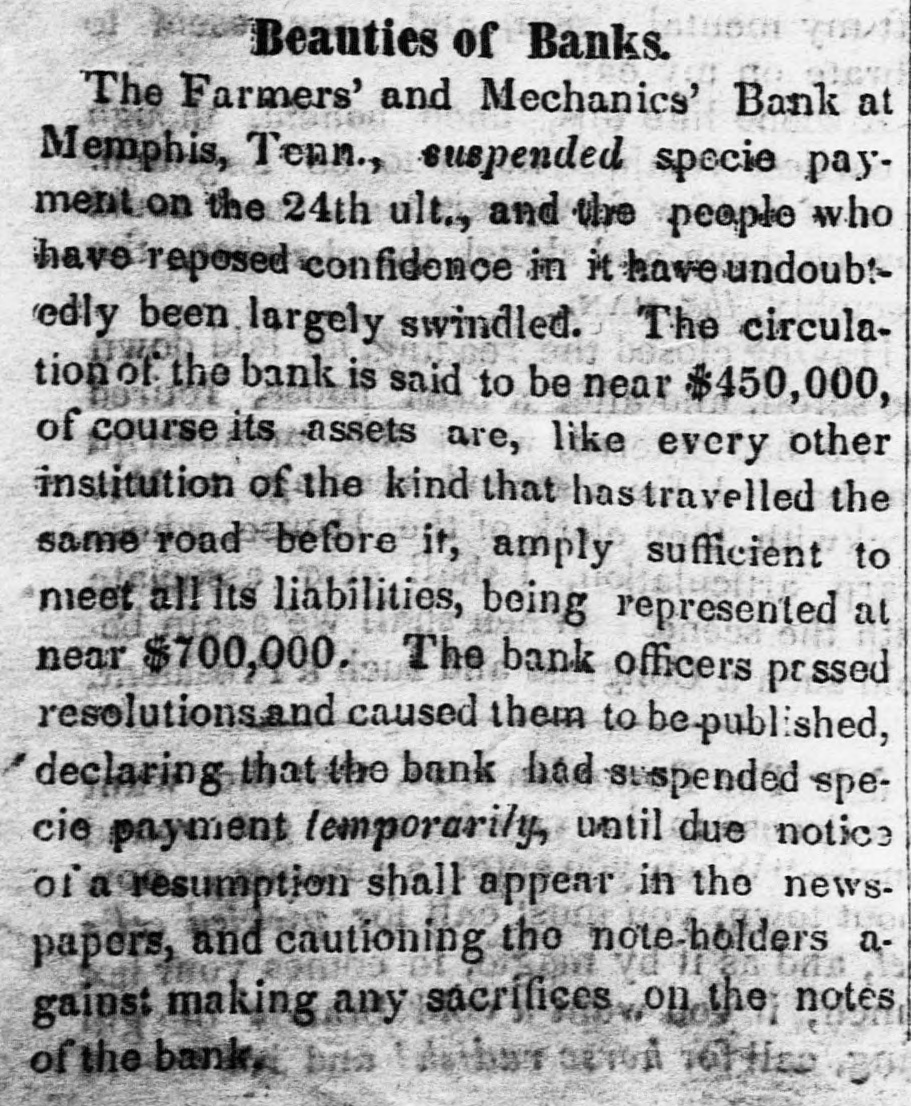
Beauties of Banks. The Farmers' and Mechanics' Bank at Memphis, Tenn., suspended specie payment on the 24th ult., and the people who have reposed confidence in it have undoubtedly been largely swindled. The circulation of the bank is said to be near $450,000, of course its assets are, like every other institution of the kind that hastravelled the same road before it, amply sufficient to meet all its liabilities, being represented at near $700,000. The bank officers prssed resolutions.and caused them to be published, declaring that the bank had suspended specie payment temporarily, until due notice of a resumption shall appear in the newspapers, and cautioning the note-holders agains: making any sacrifices on the notes SETOR of the bank whites


Article from New-York Daily Tribune, June 10, 1847

Click image to open full size in new tab

Article Text

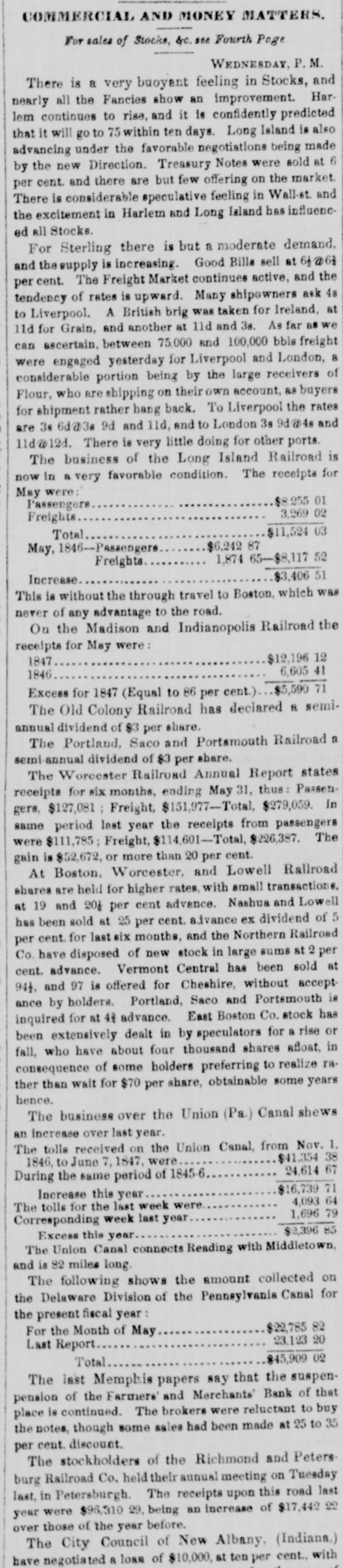
COMMERCIAL AND MONEY MATTERS. For sales of Stocks, &c. see Fourth Page WEDNESDAY, I There is a very buoyant feeling in Stocks, and nearly all the Fancies show an improvement. Harlem continues to rise, and it is confidently predicted that it will go to 75 within ten days. Long Island is also advancing under the favorable negotiations being made by the new Direction. Treasury Notes were sold at 6 per cent. and there are but few offering on the market. There is considerable speculative feeling in Wall-st. and the excitement in Harlem and Long Island has influenced all Stocks. For Sterling there is but a moderate demand, and the supply is increasing. Good Bills sell at 61@64 per cent. The Freight Market continues active, and the tendency of rates is upward. Many shipowners ask 48 to Liverpool. A British brig was taken for Ireland, at 11d for Grain, and another at 11d and 3s. As far as we can ascertain, between 75.000 and 100,000 bbla freight were engaged yesterday for Liverpool and London, a considerable portion being by the large receivers of Flour, who are shipping on their own account, as buyers for shipment rather hang back. To Liverpool the rates are 3s 6d@3a 9d and 11d, and to London 3s 9d@4s and 11d@12d. There is very little doing for other ports. The business of the Long Island Railroad is now in a very favorable condition. The receipts for May were: $8.255 01 Passengers 3,269.02 Freights $11,524 03 Total $6,242 May, 1846-Passengers 1,874 65-$8,117.52 Freights $3,406 51 Increase This is without the through travel to Boston, which was never of any advantage to the road. On the Madison and Indianopolis Railroad the receipts for May were: $12,196 1 1847 6,605 41 1846 Excess for 1847 (Equal to 86 per cent.) $5,590 71 The Old Colony Railroad has declared a semiannual dividend of $3 per share. The Portland, Saco and Portsmouth Railroad a semi-annual dividend of $3 per share. The Worcester Railroad Annual Report states receipts for six months, ending May 31, thus: Passen. gers, $127,081 Freight, $151,977-Total, $279,059. In same period last year the receipts from passengers were $111,785 Freight, $114,601-Total, $226,387. The gain is $52,672, or more than 20 per cent. At Boston, Worcester, and Lowell Rallroad shares are held for higher rates, with small transactions. at 19 and 20 per cent advence. Nashua and Lowell has been sold at 25 per cent. aivance ex dividend of 5 per cent. for last six months, and the Northern Railroad Co. have disposed of new stock in large sums at 2 per cent. advance. Vermont Central has been sold at 941, and 97 is offered for Cheshire, without acceptance by holders. Portland, Saco and Portsmouth is inquired for at 44 advance. East Boston Co. stock has been extensively dealt in by speculators for & rise or fall, who have about four thousand shares afloat, in consequence of some holders preferring to realize . ther than wait for $70 per share, obtainable some years hence. The business over the Union (Pa.) Canal shews an increase over last year. The tolls received on the Union Canal, from Nov. 1. $41,354 38 1846, to June 7, 1847, were 24.614 67 During the same period of 1845-6 $16,739 71 Increase this year 4,093 64 The tolls for the last week were 1,696 79 Corresponding week last year $2,396 8 Excess this year The Union Canal connects Reading with Middletown, and is 82 miles long. The following shows the amount collected on the Delaware Division of the Pennsylvania Canal for the present fiscal year: $22,785 8 For the Month of May 23.123 20 Last Report $45,909 Total The last Memphis papers say that the suspenpension of the Farmers' and Merchants' Bank of that place is continued. The brokers were reluctant to buy the notes, though some sales had been made at 25 to 35 per cent. discount. The stockholders of the Richmond and Peters burg Railroad Co. held their annual meeting on Tuesday last, in Petersburgh. The receipts upon this road last year were $96,310 29, being an increase of $17,442.22 over those of the year before. The City Council of New Albany, (Indiana,) have negotiated a loan of $10,000, at ten per cent., with


Article from New-York Daily Tribune, June 22, 1847

Click image to open full size in new tab

Article Text

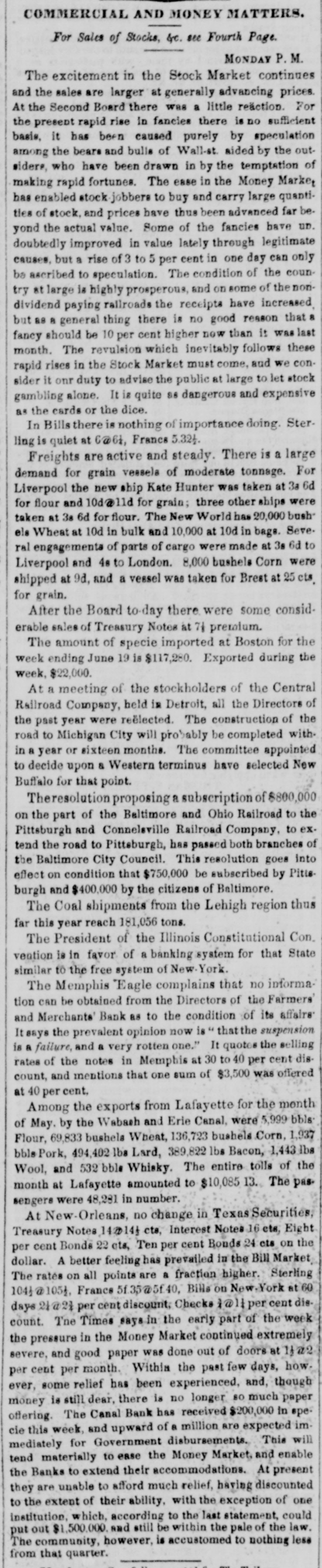
COMMERCIAL AND MONEY MATTERS. For Sales of Stocks, & see Fourth Page. MONDAY P.M. The excitement in the Stock Market continues and the sales are larger at generally advancing prices. At the Second Board there was a little reaction. For the present rapid rise in fancies there is no sufficient basis. it has been caused purely by speculation among the bears and bulls of Wall-st aided by the out. sidere, who have been drawn in by the temptation of making rapid fortunes. The ease in the Money Market has enabled stock jobbers to buy and carry large quantities of stock. and prices have thus been advanced far be. yond the actual value. Some of the fancies have un. doubtedly improved in value lately through legitimate causes but a rise of 3 to 5 per cent in one day can only be ascribed to speculation. The condition of the country at large is highly prosperous, and on some of the nondividend paying railroads the receipts have increased but as a general thing there is no good reason that 8 fancy should be 10 per cent higher now than it was last month. The revulsion which inevitably follows these rapid rises in the Stock Market must come, and we consider it onr duty to advise the public at large to let stock gambling alone. It is quite 88 dangerous and expensive as the cards or the dice. In Billsthere is nothing of importance doing. Sterling is quiet at 6@64, Francs 5.324 Freights are active and steady. There is a large demand for grain vessels of moderate tonnage. For Liverpool the new ship Kate Hunter was taken at 3a 6d for flour and 10d@lld for grain; three other ships were taken at 3s 6d for flour. The New World has 20,000 bush els Wheat at 10d in bulk and 10,000 at 10d in bags. Seve. ral engagements of parts of cargo were made at 3s 6d to Liverpool and 4s to London. 8,000 bushels Corn were shipped at 9d, and a vessel was taken for Brest at 25 cts for grain. After the Board to-day there were some considerable sales of Treasury Notes at 71 premium. The amount of specie imported at Boston for the week ending June 19 is $117,280. Exported during the week, $22,000. At a meeting of the stockholders of the Central Railroad Company, held is Detroit, all the Directors of the past year were reèlected. The construction of the road to Michigan City will probably be completed within a year or sixteen months. The committee appointed to decide upon & Western terminus have selected New Buffalo for that point. Theresolution proposing a subscription of $800,000 on the part of the Baltimore and Ohio Railroad to the Pittsburgh and Connelsville Railroad Company, to extend the road to Pittsburgh, has passed both branches of the Baltimore City Council. This resolution goes into effect on condition that $750,000 be subscribed by Pitts burgh and $400,000 by the citizens of Baltimore. The Coal shipments from the Lehigh region thus far this year reach 181,056 tons. The President of the Illinois Constitutional Con. vention is in favor of a banking system for that State similar to the free system of New-York. The Memphis Eagle complains that no information CAD be obtained from the Directors of the Farmers' and Merchants Bank as to the condition of its affairs says the prevalent opinion now is " that the suspension is a failure, and a very rotten one." It quotes the selling rates of the notes in Memphis at 30 to 40 per cent discount, and mentions that one sum of $3,500 was offered at 40 per cent. Among the exports from Lafayette for the month of May. by the Wabash and Erie Canal, were 5,999 bbls Flour, 69,833 bushels Wheat, 136,723 bushels Corn, 1,937 bbls Pork, 494,402 lbs Lard, 389,822 lbs Bacon, 1,443 lbs Wool, and 532 bble Whisky. The entire tolls of the month at Lafayette amounted to $10,085 13. The pas. sengers were 48,281 in number. At New-Orleans, no change in Texas Securities Treasury Notes 14@14} cts, Interest Notes 16 ets, Eight per cent Bonds 22 ets, Ten per cent Bonds 24 ets on the dollar. A better feeling has prevailed in the Bill Market The rates on all points are a fraction higher. Sterling 1041@1051 France 5f.35@5f.40, Bills on New-York at 60 days 21@21 per cent discount, Checks i@H per cent die count. The Times says in the early part of the week the pressure in the Money Market continued extremely severe, and good paper was done out of doors at 22 per cent per month. Withia the past few days, how ever, some relief has been experienced, and, though money is still dear, there is no longer so much paper offering. The Canal Bank has received $200,000 in specie this week, and upward of a million are expected immediately for Government disbursements. This will tend materially to ease the Money Market, and enable the Banks to extend their accommodations. At present they are unable to afford much relief, having discounted to the extent of their ability, with the exception of one institution, which, according to the last statement, could put out $1,500,000. and still be within the pale of the law. The community, however, is accustomed to nothing less from that quarter.


Article from The New York Herald, October 23, 1847

Click image to open full size in new tab

Article Text

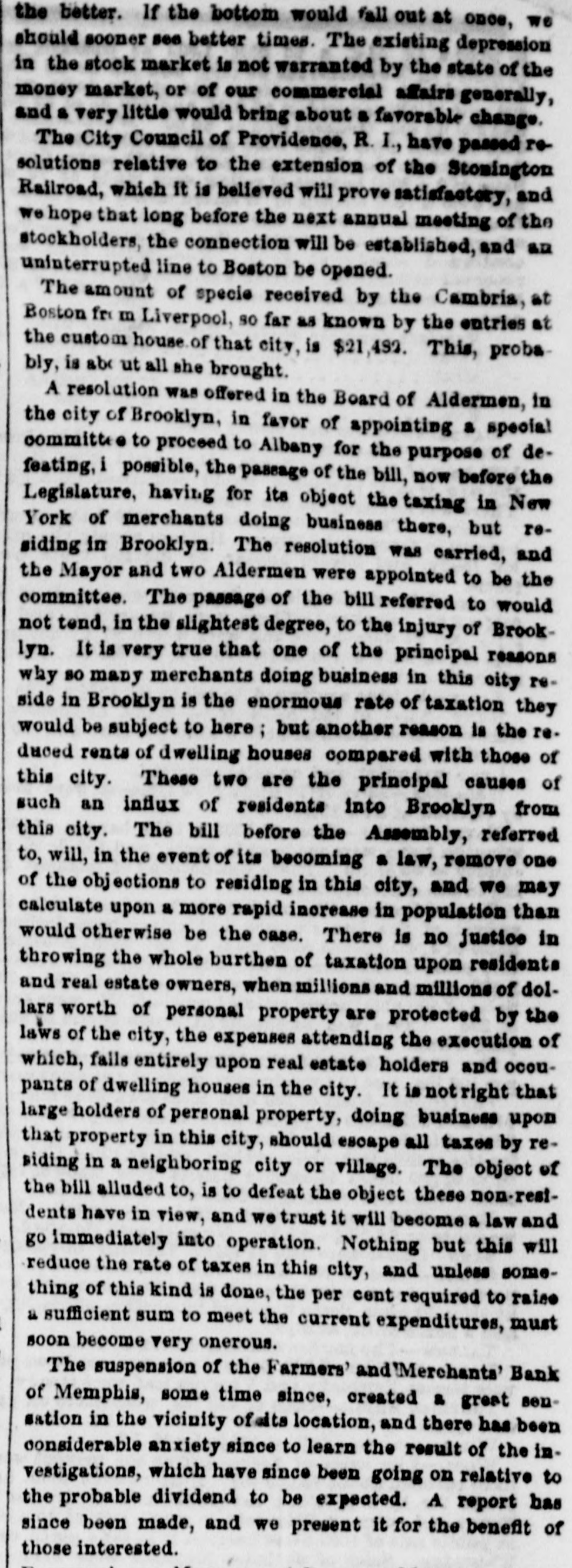
the better. If the bottom would fall out at once, we should sooner see better times. The existing depression in the stock market is not warranted by the state of the money market, or of our commercial affairs generally, and a very little would bring about a favorable change. The City Council of Providence, R. I., have passed resolutions relative to the extension of the Stomington Railroad, which it is believed will prove satisfactory, and we hope that long before the next annual meeting of the stockholders, the connection will be established, and an uninterrupted line to Boston be opened. The amount of specie received by the Cambria, at Boston from Liverpool, so far as known by the entries at the custom house of that city, is $21,492. This, probably, is about all she brought. A resolution was offered in the Board of Aldermen, in the city of Brooklyn, in favor of appointing a special committee to proceed to Albany for the purpose of defeating, if possible, the passage of the bill, now before the Legislature, having for its object the taxing in New York of merchants doing business there, but residing in Brooklyn. The resolution was carried, and the Mayor and two Aldermen were appointed to be the committee. The passage of the bill referred to would not tend, in the slightest degree, to the injury of Brooklyn. It is very true that one of the principal reasons why so many merchants doing business in this city reside in Brooklyn is the enormous rate of taxation they would be subject to here; but another reason is the reduced rents of dwelling houses compared with those of this city. These two are the principal causes of such an influx of residents into Brooklyn from this city. The bill before the Assembly, referred to, will, in the event of its becoming a law, remove one of the objections to residing in this city, and we may calculate upon a more rapid increase in population than would otherwise be the case. There is no justice in throwing the whole burthen of taxation upon residents and real estate owners, when millions and millions of dollars worth of personal property are protected by the laws of the city, the expenses attending the execution of which, falls entirely upon real estate holders and occupants of dwelling houses in the city. It is not right that large holders of personal property, doing business upon that property in this city, should escape all taxes by residing in a neighboring city or village. The object of the bill alluded to, is to defeat the object these non-residents have in view, and we trust it will become a law and go immediately into operation. Nothing but this will reduce the rate of taxes in this city, and unless something of this kind is done, the per cent required to raise a sufficient sum to meet the current expenditures, must soon become very onerous. The suspension of the Farmers' and 'Merchants' Bank of Memphis, some time since, created a great sensation in the vicinity of its location, and there has been considerable anxiety since to learn the result of the investigations, which have since been going on relative to the probable dividend to be expected. A report has since been made, and we present it for the benefit of those interested.


Article from New-York Daily Tribune, October 26, 1847

Click image to open full size in new tab

Article Text

COMMERCIAL AND MONEY MATTERS. For Sales of Stocks. sc see Fourch Page MONDAY P M. There was continuation to-day of the reaction the of Saturday afternoon in the Stock market, and Fancles were all buoyant. At the Second Board, bow. ever, prices again receded little. The Fancies are now at such point that the shorts come in at every appearance of rally, and thus the market is kept fluctuating The sound stocks were steady. and in fair demand. The business in Exchange for the French Steamer was not large, and rates are without change.- with Sterling is 9@9 nominally France 5 23105 22, fair supply The Steamer took about $60,000 in French silver. To Freights there is little or nothing doing. Liverpool In rates continue to be for Cotton, goods 6d for Grain, and 18d for Flour; 25.@30 for heavy To Havre the packet is full atte for Cotton In Uncurrent Money there is considerable activi- the ty but the demand is good for currency and takes all redemptions again. The activity of business in the departments employe all the circulation which Banks are entitled to. Money continues abundantly easy for all busipurposes. The Banks will be somewhat stringent until ness next week. but there is no difficulty in negotiating loans in the street at 5@7 per cent according to security de The Eagle Fire Insurance Company have of clared dividend of per cent payable on the 1st November The Boston Courier has published several able articles our relations with Brazil, from the pen of upon late Consul in which the great G.W. Gordon, Erq. our the dan value of our commerce with that country. and India ger of Interruptions! which It is exposed by the Wise.eretion-to epeak in the mildest term-of Mr. Brazil takes very large amount of our Breadstuffs and the manufactures annually, and the trade between countries being done almost exclusively to American bottoms, employs very large amount of American Mr ton nage, and of course large number of our seamen Gordon truly says: This commerce is too important to our The best Adminis interests be trided with by our Government. Mexican tration to already rode its hobby-horse when they first much farther than they expected should thrust upon It it time that they quent wisdom from experience, and consee ly examine well the ground before they take for the any people step Brazila: the with embroil United which may States will hold them fearful respon the If. in addition to the Mexican war, our comability merce destroyed or interrupted with the Brazile rela We how soon our peaceful commercial things that country may be placed among de tions exist The event which no longer that action of our Government for unless pends the Government obtain from the Administra the Brazilian Washington the satisfaction which con tion with that country plomatic be relations interrupted. to the great detriment of our in vinced. commerce which cannot exist or be carried on troubled waters. The extent and value of our commerce with Brazil is shown from the official reports Flour. In the fiscal year 1844-5, we exported to country 209,845 bble valued $1,083,318 being about one-fifth of our total exporto est article all countries and in 1845-6, Brazils took 296,460 bbla. valued at $1,675,756, belog very large Increase over the preceding year. The consumption of Flour in the Brazilamus naturally increase and with the population. which is new about 10,000,000, of which is Increasing rapidly. Of our manufactures 1844-5 exported to the Brazile to the amount $830,926 being about of our total port to countries. To our navigation interests our commerce the Brazile is truly of great importance. it being carried on almost entirely in American vessels. la 1844-5, not a single Brazilian vessel entered the United States during that fiscal year the foreign vessels which arrived in this country from the Brazile were 2 British, Swedish, 2 Danish and Sardinian, tonuaging 2,481 there were during that period 214 Ame rican vessels, navigated with 2,198 men and 40 boys, and tonnaging 50,230 tons. which entered the United States from the Brazile: and during the same year 192 American vessele navigated with men and 23 boys, and tonnaging 40,716 tons. cleared from this country, only small Brazilian vessel of 191 tons. navigated with 14 men, and British, Sardinian, 2 Hansestle, Spanish, and Hanoverian vessel. tonuaging in all 2,077 tons, including the Brazilian vessel. cleared from the United States for the ports of Brazil. The Austrians are in making great exertions to compete with us in Brazil Flour. and do already come in direct competition. From Trieste Flour is obtained as good as the American and labor to Austria is cheaper than in America. and the Austrian vessels are navigated cheaper, it is highly in portant the United States should be on the terms of the most favored nations with Brazil, as any commercial advantage given to Austria would destroy the American trade. The same effect would follow in re gard to manufacturers, from an advantage given to Eng land. Ualess our relations with this country are man aged with great prudence and in conciliatory spirit, we shall be very likely to lose the advantages of a commer cial treaty, placing us on an equal footing with other D& tions Our true polley to cultivate a friendly under standing with the growing nations of South America, and we trust Mr Polk and his Cabinet will not act rash ly in this matter. The people will scareely tolerate another war. At the meeting of the stockholders of the Har lem Railroad Company held at the Astor House, a Com mittee was appointed* consisting of Messro J H. D kers, Jacob Little D.S. Miller, H. Schuyler. and Jona. Stur. gas devise feasible plan for extricating the Company from its present embarraasments, and report the same to the stockholders on Thursday evening next. The report of the suspended Farmers' and Mechanica' Bank of Memphis, has been made and the Directors state that it is impossible in any event that the creditors anything. They pronounce the stock to be worth 86; after deducting the whole doubtful and bad debts. The Board state that the Bank was embarrassed when they took charge of it. and that they have since reduced the liabilities at the rate of $142,360 monthly, beside accumulating means to make still far ther reduction. In January 1847, the Bank had only $71,426 in specie against about $1,100,000 of circulation and deposite. The cash liabilities were $1,437,632, against $219,396 of cash assets The suspen debt was $693,028 Oa the 26th May, the circulation and de were $600,000, and the specle in vault $1,500 posits The outstanding cash liabilities on the 1st of October was $410,276, aud the cash assets $129,208 -curtailment $457,944 the specie and Bank notes were $36.819; since discounts and loans $342,436 suspended debt $530,224 deposits $90,154 circulation $294,895 The Directors express the opinion that the period is not very distant when the Bank will resume. The Memphis Ea gle of the 7th inst. states that the notes of the Bank were selling at 50@60 cents on the dollar. The Eagle says There appears to be but Hitle in the market; the amount suits brought the Bank together with of speculation large creating demand for it by its debtors, all that is thrown upon the market." Gov. Brown of Tennessee, in his message to the Legisiature, recommends the location of & branch or agency of the State Bank in Memphis. SALE REAL ESTATE By James Cole- -BROOKLYN lot on Ray mond-et. near Willoughby st 25 4x78 8 $245 gore lot cor. Fulton-av last St. Felix-at $325; 1 lot on Avenue adjoining 25x93 and 10. $325;1 do do do. 25x110 $325 side north St Lafayette Felix-St

Article from Tri-Weekly Journal, December 7, 1847

Click image to open full size in new tab

Article Text

BANK EXCITEMENT IN MEMPHIS.-The Memphis Eagle of Tuesday last has the following in relation to the Farmers' and Merchants' Bank of that place. There was a great and general excitement and wonder among some of our streets, yesterday, relative to statements currently afloat touching certain high-handed and extraordinary acts of the president and directors of the Farmers' and Merchants' Bank after the injunction of the court had been served on them wrestling from their further keeping and management the affairs and assets of the bank.The facts, as represented to us by one who heard them from the lips of the cashier, are these: That several hours after the writ of injunction had been served on the president and Messrs. Looney, Connel, and Maltbie, directors, they, with Mr. Gaines, another director, held a meeting in the bank and discounted each other's notes to an amount which cleaned the vaults ofits money, and enough of the notes of the suspended bank to make the amount $50,000! That they also discounted the president's (Dr. Fowlkes) notes to an amount sufficient to take up the bills drawn by the several directorsfor Fowlkes's benefit we suppose-on Cross, Connel, & Co., thus substituting his individual paper at twelve months, partly for their own responsibilities as drawers, &c., to a very large amount, leaving Fowlkes standing debtor on the books of the bank, it is said, for near four hundred thousand dollars! This being done, they afterwards surrendered the keys of the striped vault and bank to the sheriff, and walked out! If this does not cap the climax of bold financiering, then we give it up. Farmers' & Merchants' Bank, notes were yesterday bid thirty cents on the dollar for by the brokers; there were no operations, however, during the consternation and excitement about the institution. A few days will settle matters, probably, when something like a standard value will be placed on them. FURTHER,-For a better understanding of the above article we copy the following from the same paper of a preceding date. We learn that an injunction was served, on Friday last, upon the present managers of the Farmers' and Merchants' Bank; restraining them from any further control over it, and placing its assets in the hands of a receiver, Joseph H. Talbot, Esq. The injunction was issued at the instance of Mr. Evan Rogers, of Philadelphia, who is said to own or control many shares of the stock of the bank, and who came out here from Philadelphia at the instance of the Eastern stockholders, and who, in conjunction with R. I. Moore, Esq., of Nashville, recently spent about a fortnight here in examining into the condition and management of the bank. The exact character and object of the bill of injunction we have not ascertained. But we presume that it puts the bank into liquidation and winds it up finally and forever. The silent and prompt manner in which the management of the bank has thus been wrested from the hands of its managers, after Messrs. Rogers and Moore probed into their conduct, evinces at least their decided condemnation of it; and the allegations in the bill, we understand, are not only numerous but of a most serious and startling character. The money fell immediately some ten per cent., though really its intrinsic value, most people think, as do we, is enhanced by the change.


Article from Indiana State Sentinel, December 16, 1847

Click image to open full size in new tab

Article Text

Burst up of the Memphis Bank--The way the People were Swindled. By reference to the letter of our Cincinnati correspondent, it will be seen that the Farmers' and Mechanics' Bank of Memphis, Tennessee, has made a smash of it, and that the Cincinnati bankers refuse its notes at any price. From what we can learn, the whole matter was a regular built swindle, as bank bursts up usually are. It seems an injunction had been served on the present managers of the bank by Mr. Evan Rogers, an eastern stockholder, restraining them from any further control over it, and placing its assets in the hands of a receiver. The following account [says the Eagle] is from the lips of the Cashier: *That several hours after the writ of injunction had been served on the President and Messrs. Looney, Connell, and Moltbie, directors, they, with Mr. Gaines, another director, held a meeting in bank and discounted each other's notes to an amount which cleaned the vaults of its money, and enough of the notes of the suspended bank to make the amount $50 000! "That they also discounted the president's Dr. Fowlkes notes to an amount sufficient to take up the bills drawn by the several directors-for Fowlkes benefit, we suppose-on Cross, Connell, & Co., thus substituting his individual paper at twelve months, partly from their own responsibilities as drawers, &c, to a very large amount, leaving Fowlkes standing debtor on the books of the bank, it is said, for near four hundred thousand dollars! This being done, they afterwards surrendered the keys of the stripped vault and bank to the sheriff, and walked out! If this don't cap the climax of bold financiering, then we give it up." As long as it is made the interest of bank officers to burst up their banks, so long will it be done, and just so often will the Memphis game, or one similar to it, be perpetrated. The whole system is based on fraud, and hence such frauds as those narrated above, do not in the least surprise us.--0. Statesman.


Article from Richmond Palladium, December 22, 1847

Click image to open full size in new tab

Article Text

We find the following in the Memphis of Tuesday week. There was a great and general excitement and wonder among some in our streets, yesterday, relative tostatementscurrently afloat touching certain high-handed and extraordinary acts of the president and directors of the Farmers' & Merchants' Bank after the injunction of the court had been served on them wresting from their further keeping and management the affairs and assets of the bank The facts, as represented to us by one who heard them from the lips of the cashier, are these: That several hours after the writ of injunction had been served on the president and Messrs. Loonev, Connell, and Maltbie, directors, they, with Mr. Gaines, another director, held a meeting in the bank and discounted each other's notes to an amount which cleaned the vaults of its money, and enough of the notes of the suspended bank to make the amount $20,000 That they also discounted the president's (Dr. Fowlkes) notes to an amount sufficient to take up the bills drawn by the several directors--for Fowlkes' benefit we suppose-on Cross, Connell, & Co., thus substituting his individual paper at twelve months, partly for their own responsibilities, as drawers, &c., to a very large amount, leaving Fowlkes a standing debtor on the books, of the bank, it is said, for near four hundred thousand dollars! This being done, they afterwards surrendered the keys of the stripped vault and bank to the sheriff and walked out:If this does not cap the climax of bold financiering, then we give it up. Farmers' & Merchants' Bank notes were yesterday bid thirty cents on the dollar for by the brokers; there were no operations, however, during the consternation and excitement about the institution. A few days will settle matters, probably, when some thing like a standard value will be placed on them.


Article from The Arkansas Banner, December 27, 1847

Click image to open full size in new tab

Article Text

P. A. SWINK, Secretary. The Memphis Eagle, of the 36th ultimo, thus alludes to the finale of the Farmers' and Merchants Bank: We learn that an injunction was served OR Friday last upon the present managers of the Farmers' and Merchants' Bank; restraining them from any further control over it, and placing its assets in the hands of a receiver, Joseph H. Talbot.-The injunction was issued at the instance of Mr. Evan Rogers, of Philadelphia, who is said to own or control many shares of the stock of the Bank, and who came out here from Philadelphia at the instance of the Eastern stockholders, and who, in conjunction with R. I. Moore, of Nashville, recently spent about a fortnight here in examining into the condition and management of the Bank. The exact character and object of the/bill of injunction we have not ascertained. But we presume it puts the Bank into liquidation and winds it up finally and forever. The silent and prompt manner in which the management of the Bank has thus been wrested from the hands of its managers after Messrs. Regers and Moore probed and examined into the ir conduct, evinces at least their decided condemnation of it; and the allegations in the bill we understand are not only numerous but of a most serio-18 and startling character. The money fell immediately some 10 per cent., though really its intrinsic value most people think, as do we, is enhanced by the change. All we wonder at is, that this step, or at least the examinatory part of it by its distant stockholders was not made near six months ago. The first step taken by the new managers certainly should be to apprise the public of the condition of the concern as Lased on the late examination-the - note-holders require this, and it is he duty of these who have the means of doing so, to give it to them. Thus burst the bubble. The end is what the disinterested and sensible portion of this community preferred from the moment it came under its present management. The community here is gratified at the step which has closed the Bank. It has been a hard lesson, but it has taught that such speculations against the moral sense of the community cannot prosper IT What do you think of the Message?" is ask ed everywhere, says the Washington correspondent of the Charleston News, Although it occupies nine columns of the Union" newspaper, individuals have already digested it, and give opinions. The Whigs say it is plausible, but wants cander, and is delusive, The Democrats, generally, are pleased with it, and as a Senator remarked. it was a fair set-off to Mr. Clay's speech at Lexington, and the Demoeratic par(Delta. IV would stand by it.


Article from Indiana State Sentinel, December 30, 1847

Click image to open full size in new tab

Article Text

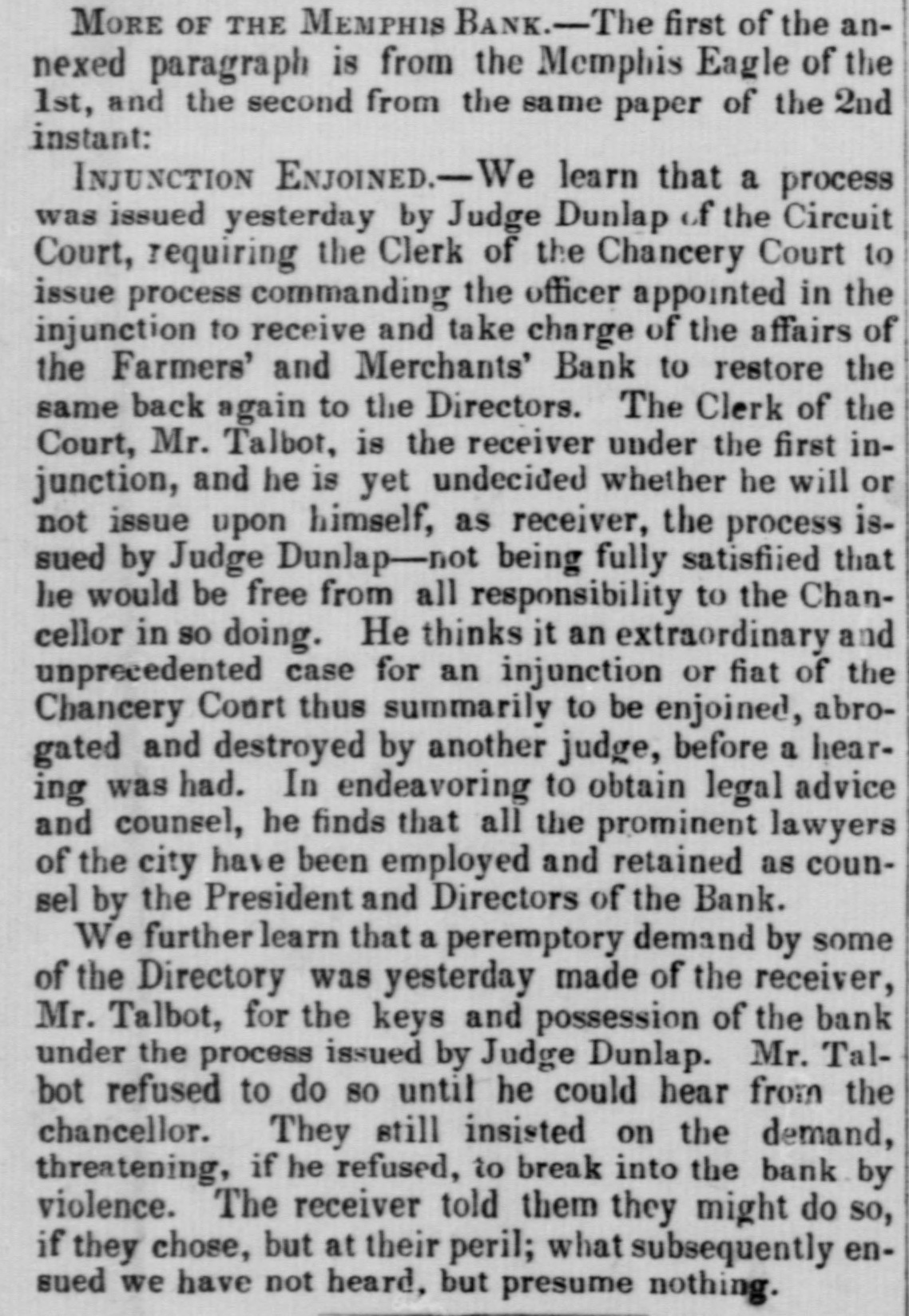
MORE OF THE MEMPHIS BANK.-The first of the annexed paragraph is from the Memphis Eagle of the 1st, and the second from the same paper of the 2nd instant: INJUNCTION ENJOINED.-We learn that a process was issued yesterday by Judge Dunlap of the Circuit Court, requiring the Clerk of the Chancery Court to issue process commanding the officer appointed in the injunction to receive and take charge of the affairs of the Farmers' and Merchants' Bank to restore the same back again to the Directors. The Clerk of the Court, Mr. Talbot, is the receiver under the first injunction, and he is yet undecided whether he will or not issue upon himself, as receiver, the process issued by Judge Dunlap-not being fully satisfied that he would be free from all responsibility to the Chancellor in so doing. He thinks it an extraordinary and unprecedented case for an injunction or fiat of the Chancery Court thus summarily to be enjoined, abrogated and destroyed by another judge, before a hearing was had. In endeavoring to obtain legal advice and counsel, he finds that all the prominent lawyers of the city have been employed and retained as counsel by the President and Directors of the Bank. We further learn that a peremptory demand by some of the Directory was yesterday made of the receiver, Mr. Talbot, for the keys and possession of the bank under the process issued by Judge Dunlap. Mr. Talbot refused to do so until he could hear from the chancellor. They still insisted on the demand, threatening, if he refused, to break into the bank by violence. The receiver told them they might do so, if they chose, but at their peril; what subsequently ensued we have not heard, but presume nothing.