20790. De Soto Bank (Memphis, TN)

Bank Information

Episode Type
Run → Suspension → Reopening
Bank Type
state
Start Date
September 25, 1873
Location
Memphis, Tennessee (35.150, -90.049)

Metadata

Model
gpt-5-mini
Short Digest
bb85a5dd

Response Measures

Full suspension

Other: Bank redirected maturing paper to State National Bank during suspension.

Description

De Soto Bank suspended payment on 1873-09-25 amid the national panic (inability to realize securities in New York). Newspaper accounts report a heavy run (spurred by suspension of First National and general panic) that precipitated or accompanied the suspension. The bank announced suspension but insisted assets were ample and later resumed operations (reported resumed 1873-10-04 and again noted full resumption by 1873-11-24).

Events (4)

1. September 25, 1873 Run
Cause
Macro News
Cause Details
Heavy withdrawals triggered by the broader financial panic and suspensions in New York and the local suspension of First National Bank; crowd rushes and depositor demands.
Measures
Closed doors; officers prepared office for defense; allowed depositors in singly and honored checks while possible.
Newspaper Excerpt
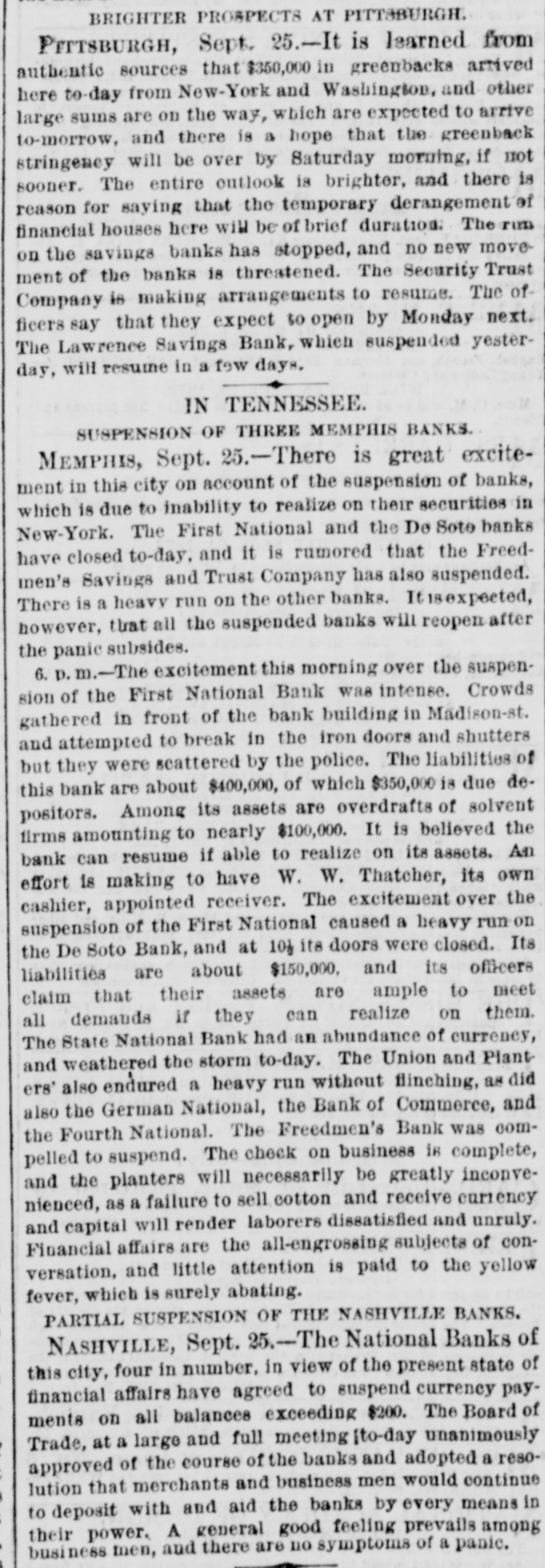
The excitement over the suspension of the First National caused a heavy run on the De Soto Bank, and at 10 its doors were closed.
Source
newspapers
2. September 25, 1873 Suspension
Cause
Macro News
Cause Details
Suspension due to inability to realize on securities in New York and general currency shortage during the 1873 panic; bank cited lack of convertible currency rather than insolvency.
Newspaper Excerpt
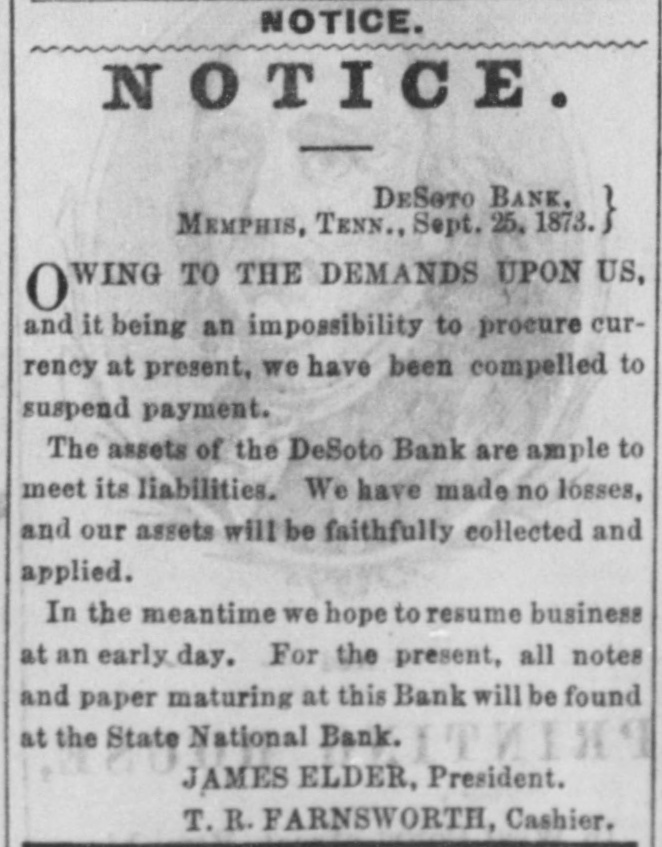
OWING TO THE DEMANDS UPON US, and it being an impossibility to procure currency at present, we have been compelled to suspend payment. The assets of the DeSoto Bank are ample to meet its liabilities.
Source
newspapers
3. October 4, 1873 Reopening
Newspaper Excerpt
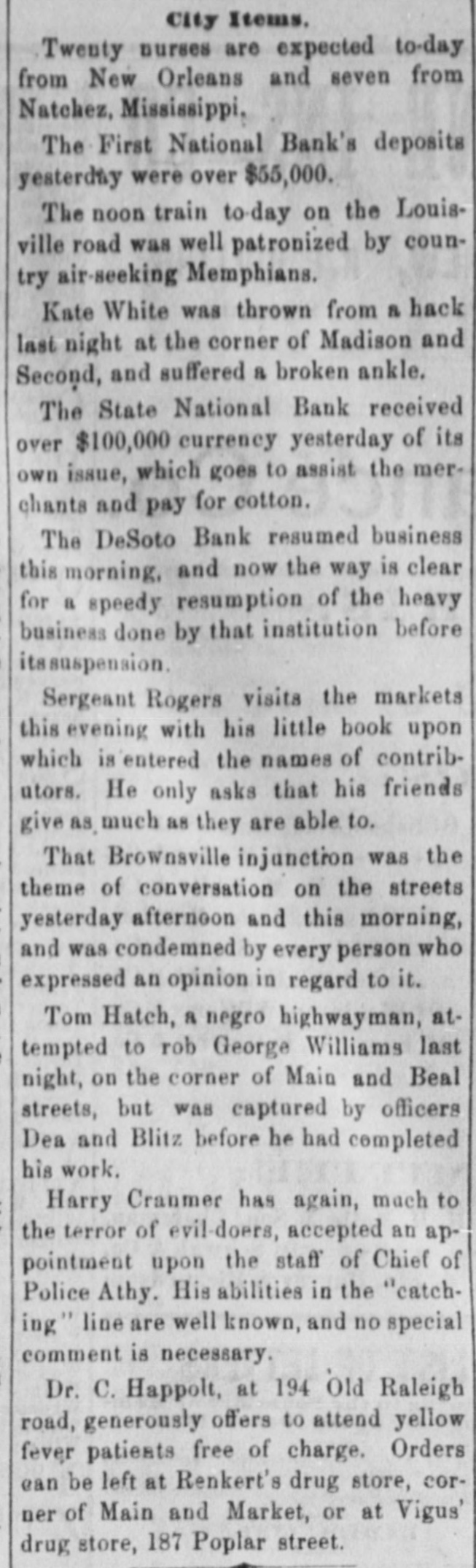
The DeSoto Bank resumed business this morning, and now the way is clear for a speedy resumption of the heavy business done by that institution before its suspension.
Source
newspapers
4. November 24, 1873 Reopening
Newspaper Excerpt
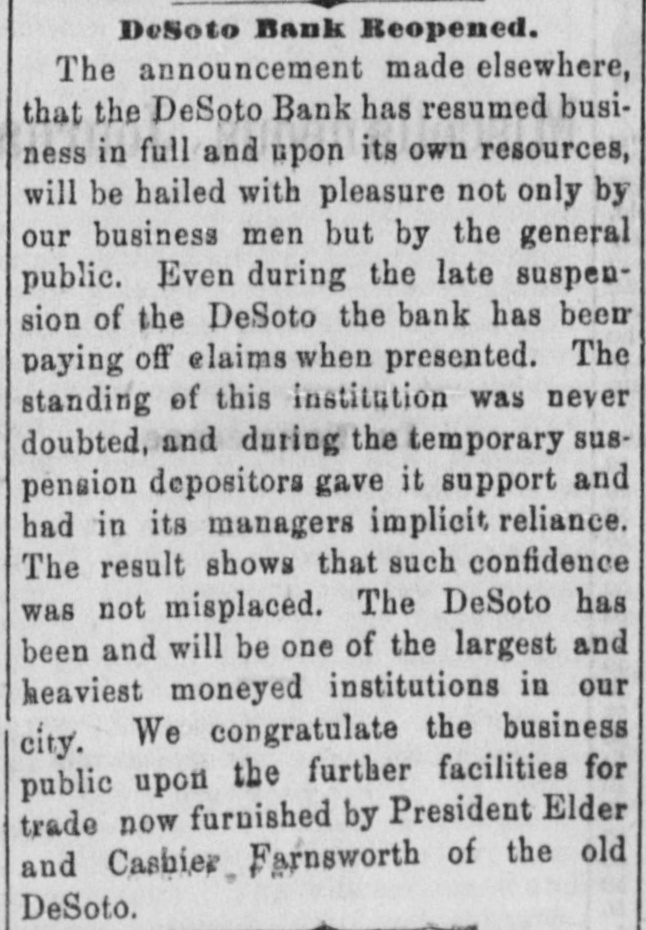
DeSoto Bank Reopened. The announcement made elsewhere, that the DeSoto Bank has resumed business in full and upon its own resources, will be hailed with pleasure...
Source
newspapers

Newspaper Articles (15)

Article from Public Ledger, September 25, 1873

Click image to open full size in new tab

Article Text

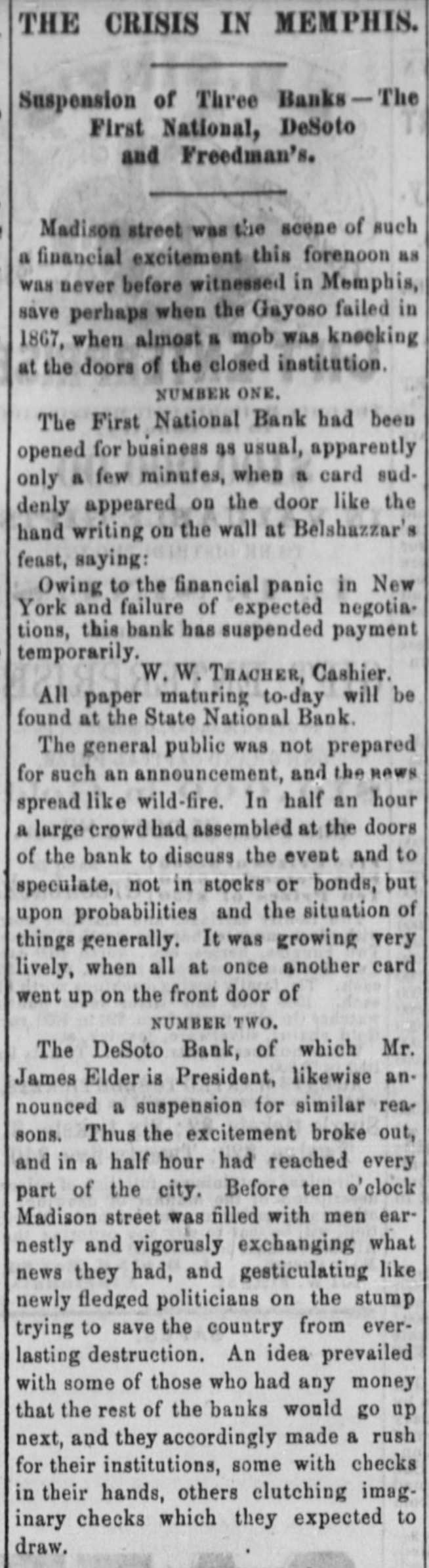
THE CRISIS IN MEMPHIS. Suspension of Three Banks-The First National, DeSoto and Freedman's. Madison street was the scene of such a financial excitement this forenoon as was never before witnessed in Memphis, save perhaps when the Gayoso failed in 1867, when almost a mob was kneeking at the doors of the closed institution. NUMBER ONE. The First National Bank had been opened for business as usual, apparently only a few minutes, when a card suddenly appeared on the door like the hand writing on the wall at Belshazzar's feast, saying: Owing to the financial panic in New York and failure of expected negotiations, this bank has suspended payment temporarily. W. W. TRACHER, Cashier. All paper maturing to-day will be found at the State National Bank. The general public was not prepared for such an announcement, and the news spread like wild-fire. In half an hour a large crowd had assembled at the doors of the bank to discuss the event and to speculate, not in stocks or bonds, but upon probabilities and the situation of things generally. It was growing very lively, when all at once another card went up on the front door of NUMBER TWO. The DeSoto Bank, of which Mr. James Elder is President, likewise announced a suspension for similar reasons. Thus the excitement broke out, and in a half hour had reached every part of the city. Before ten o'clock Madison street was filled with men earnestly and vigorusly exchanging what news they had, and gesticulating like newly fledged politicians on the stump trying to save the country from everlasting destruction. An idea prevailed with some of those who had any money that the rest of the banks would go up next, and they accordingly made a rush for their institutions, some with checks in their hands, others clutching imaginary checks which they expected to draw.


Article from The Wheeling Daily Register, September 26, 1873

Click image to open full size in new tab

Article Text

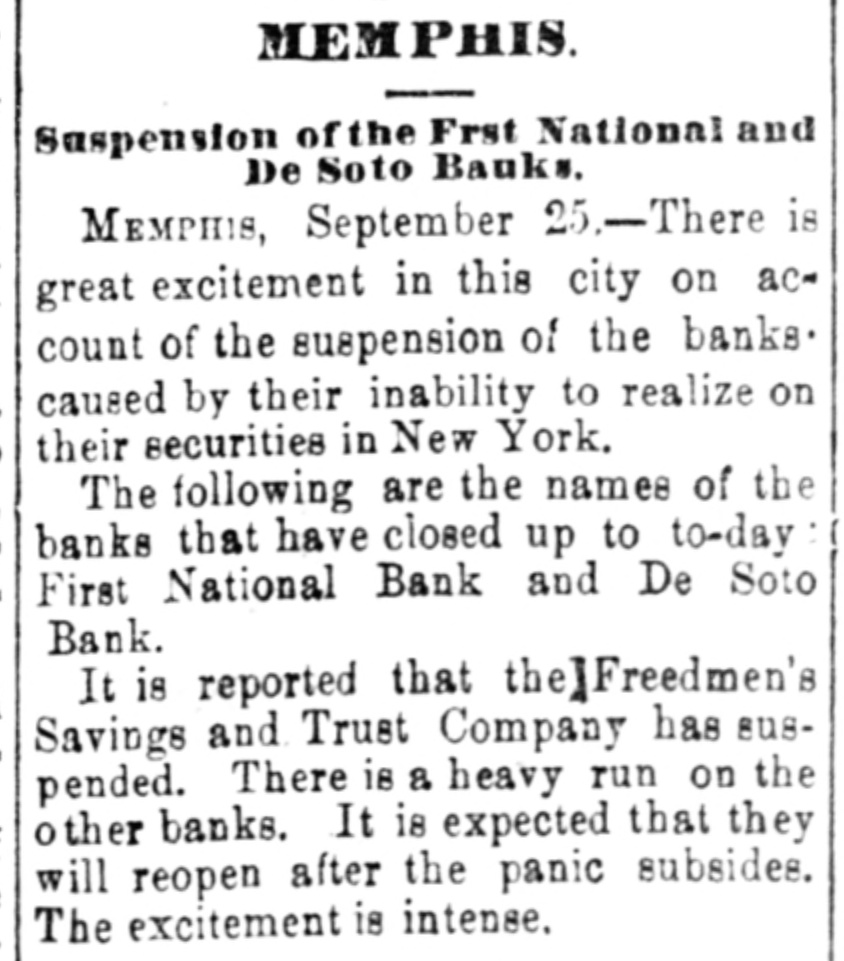
MEMPHIS. Suspension of the Frst National and De Soto Bauks. MEMPHIS, September 25.-There is great excitement in this city on account of the suspension of the banks. caused by their inability to realize on their securities in New York. The following are the names of the banks that have closed up to to-day First National Bank and De Soto Bank. It is reported that theIFreedmen's Savings and Trust Company has suspended. There is a heavy run on the other banks. It is expected that they will reopen after the panic subsides. The excitement is intense.


Article from The Cairo Bulletin, September 26, 1873

Click image to open full size in new tab

Article Text

ceiver of taxes at Verdan this morning paid the sure claimed. HENRY NLEWS & Co. state that the liabilities which their London house describe as "incurred account for New York house, are largely acceptances under commercial conditions for the account of various merchants in thiscity and elsewhere, to whom the drafts will be returned and who will meet them. being prepared so to do by having goods placed in their possession against which the acceptances were given. The apparent liabilities therefore of the London house will be reduced to the extent to which the acceptances under these conditions are provided for by parties OR whose account they were issued. AT INDIANAPOLIS INDIANAPOLIS, September 25.-Consid erable excitement was caused here this forenoon by the announcement of the precautionary measures adopted by the Chicago and Cincinnati banks, which were at first reported as having totally suspended. This excitement was heightened at noon by the suspension of the private banking house of Woolen. Webb & Co., owing mainly to the return of their drafts on the suspended Trust company of New York, and public confidence became so shaken that there was quite a heavy run on Ritzinger's bank,and on the Indianapolis sayings bank, by a class of generally small depositors. Some few persons have withdrawn their money from other banks. The First National bank, instead of closing at the usual hour. kept open an hour, to give any depositors an opportunity to withdraw their money if they wished, and when it closed, it received more money than it had paid out. The unquestionable solvency of all our banks, together with the fearless way in which they met the excitement, seems to haye sent home the crowds who thronged the streets. AT NEW ORLEANS. New ORLEANS, September 25.-There was a meeting this forenoon of all the bank presidents in the city, except two It was resolved to pay ao checks for more than one hundred dollors, all the larger checks to be certified. This arrangement is to continue for thirty days. This ac. tion they consider precautionary to preventa drain. AT SAVANNAH, GA. SAVANNAH, September 25.-A run commenced early this morning on the savings department of the Savannah Bank, and the Trust company and the Southern Bank of Georgia. Large crowds are congregated. Banks are paying dollar for dollar, and business is at a complete standstill for want of currency. AT WASHINGTON WASHINGTON, September 25.-The navy department is paying all employes to-day in anticipation of usual pay day,in order to lessen the stringency of the money market caused by the scarcity of currency. AT MEMPHIS. MEMPHIS, September 25.-There is great excitement in this city on account of the suspension of the banks, caused by inability to realize on securities in New York. The following named banks have closed to-day First National bank. DeSoto bank, and it is reported the Freed. man's savings bank and the Trust company. There are heavy runs on other banks. I: is expected that all will re. open after the panic subsides. The exeitement at present is intense.


Article from Public Ledger, September 26, 1873

Click image to open full size in new tab

Article Text

NOTICE. N OTICE. e DESOTO BANK, } MEMPHIS, TENN., Sept. 25. 1873. o WING TO THE DEMANDS UPON US, and it being an impossibility to procure currency at present, we have been compelled to suspend payment. The assets of the DeSoto Bank are ample to meet its liabilities. We have made no losses, and our assets will be faithfully collected and applied. In the meantime we hope to resume business at an early day. For the present, all notes and paper maturing at this Bank will be found at the State National Bank. JAMES ELDER, President. T. R. FARNSWORTH, Cashier.


Article from Public Ledger, September 26, 1873

Click image to open full size in new tab

Article Text

PANIC. THE The scenes of yesterday will long be remembered by all who were on Madison street in the forenoon. The closing of two leading banks was succeeded by an indiscriminate rush upon some of the others. The crowd was so great about the Union and Planters that a strong squad of police was sent to preserve order; and while the mounted members satlike videttes in frout of the curb-stone, two policemen kept order at the door. This only lasted an hour, when quiet and confidence were somewhat restored. The DeSoto Bank had made ample arrangements for all expected contingencies with a correspondent in New York, which of course were not available within the last few days. The assets of the bank are abundant, but not convertible at once into currency. The bills receivable OR hand amount to twice as much as the accounts of depositors, yet these resources amounted to nothing when sight exchange in New York was worth no more practically than 80 much brown paper. The bank is an old institution, with a charter giving extraordinary exemptions and privileges, which were extended for a term of years by the last Legislature. It seems to have been conducted within the rules of safe and legitimate banking at all times. The suspension resulted from a want of currency to weather the storm, which is sweeping all over the country. It originated in New York, and the closing of the doors was deemed more prudent while some funds yet remained in hand than to wait until every dollar was exhausted and then be compelled to suspend. We can say of this bank, as of others, that if the country does not go to ruin and everybody fail, it can resume at no distant day on a secure basis. If, however, everything goes to pieces and "bills receivable should still go a begging, there is no hope. No one can see far into the future, nor could the most clear-headed financier anticipate the present erisis three weeks ago. The unfortunate depositors of closed banks will have to await developments as best they can. The country seems to be going to the bad as fast as the most vindictive John Bull could desire. But we have a faint glinting of hope that after this disaster will follow reform and prudence, and that we will have less credit and more economy in private as well 8R public affairs, when people will learn to live within their incomes and be satisfied with safe, regular business rather than rush into all manner of reckless speculations. The productions of the country are the real basis of all values, and not fictitious issues of paper money, to be redeemed, if ever, by the sweat of toiling millions who pay all the taxes at last The banks in this city which survived yesterday's shock will probably stand any test that may be made of their stability. The Union and Planters' Bank proved itseli to be a solid institution, and has the confidence of moneyed men, for at the bight of the excitement yesterday they received large deposits voluntarily made. The total amount checked out was about $1,50,000, but $70,000 was deposited before the bank closed. Ample arrangements, which began many days ago, have been made for any contingency that may arise. There is not likely to be such a run again, but should it recur, the bank is believed to be able to pay every dollar that can be demanded, and


Article from The Bolivar Bulletin, September 26, 1873

Click image to open full size in new tab

Article Text

The DeSoto and First National banks of Memphis have suspended,


Article from The New York Herald, September 26, 1873

Click image to open full size in new tab

Article Text

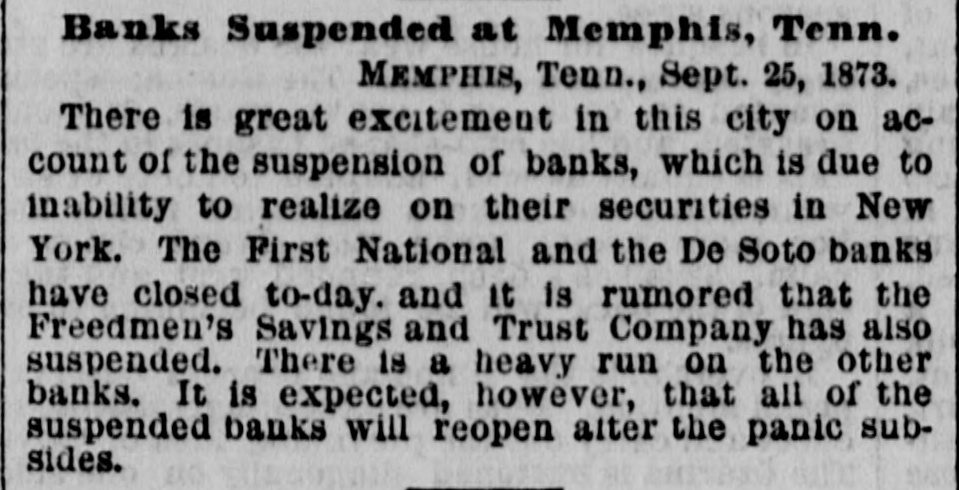
Banks Suspended at Memphis, Tenn. MEMPHIS, Tenn., Sept. 25, 1873. There is great excitement in this city on account of the suspension of banks, which is due to inability to realize on their securities in New York. The First National and the De Soto banks have closed to-day. and it is rumored that the Freedmen's Savings and Trust Company has also suspended. There is a heavy run on the other banks. It is expected, however, that all of the suspended banks will reopen after the panic subsides.


Article from New-York Tribune, September 26, 1873

Click image to open full size in new tab

Article Text

BRIGHTER PROSPECTS AT PITTABURGH PITTSBURGH, Sept. 25.-It is learned from authentic sources that $350,000 in greenbacks arrived here to-day from New-York and Washington, and other large sums are on the way, which are expected to arrive to-morrow, and there is a hope that the greenback stringency will be over by Saturday morning, if not sooner. The entire outlook is brighter, and there is reason for saying that the temporary derangement of financial houses here wild be of brief duration. The run on the savings banks has stopped, and no new move ment of the banks is threatened. The Security Trust Company is making arrangements to resume. The of ficers say that they expect to open by Monday next. The Lawrence Savings Bank, which suspended yesterday, will resume in a few days. IN TENNESSEE. SUSPENSION OF THREE MEMPHIS BANKS. MEMPHIS, Sept. 25.-There is great excitement in this city on account of the suspension of banks, which is due to inability to realize on their securities in New-York. The First National and the Do Sote banks have closed to-day. and it is rumored that the Freedmen's Savings and Trust Company has also suspended. There is a heavy run on the other banks. Itisexpected, however, that all the suspended banks will reopen after the panic subsides. 6. p.m.-The excitement this morning over the suspension of the First National Bank was intense. Crowds gathered in front of the bank building in Madison-st. and attempted to break in the iron doors and shutters but they were scattered by the police. The liabilities of this bank are about $400,000, of which $350,000 is due depositors. Among its assets are overdrafts of solvent firms amounting to nearly $100,000. It is believed the bank can resume if able to realize on its assets. An effort is making to have W. W. Thatcher, its own cashier, appointed receiver. The excitement over the suspension of the First National caused a heavy run on the De Soto Bank, and at 101 its doors were closed. Its liabilities are about $150,000, and its officers claim that their assets are ample to meet all demands if they can realize on them. The State National Bank had an abundance of currency, and weathered the storm to-day. The Union and Planters' also endured a heavy run without flinching, as did also the German National, the Bank of Commerce, and the Fourth National. The Freedmen's Bank was compelled to suspend. The check on business is complete, and the planters will necessarily be greatly inconvenienced, as a failure to sell cotton and receive currency and capital will render laborers dissatisfied and unruly. Financial affairs are the all-engrossing subjects of conversation, and little attention is paid to the yellow fever, which is surely abating. PARTIAL SUSPENSION OF THE NASHVILLE BANKS. NASHVILLE, Sept. 25.-The National Banks of this city, four in number, in view of the present state of financial affairs have agreed to suspend currency payments on all balances exceeding $200. The Board of Trade, at a large and full meeting [to-day unanimously approved of the course of the banks and adopted a resolution that merchants and business men would continue to deposit with and aid the banks by every means in their power. A general good feeling prevails among business men, and there are no symptoms of a panic.


Article from Chicago Daily Tribune, September 26, 1873

Click image to open full size in new tab

Article Text

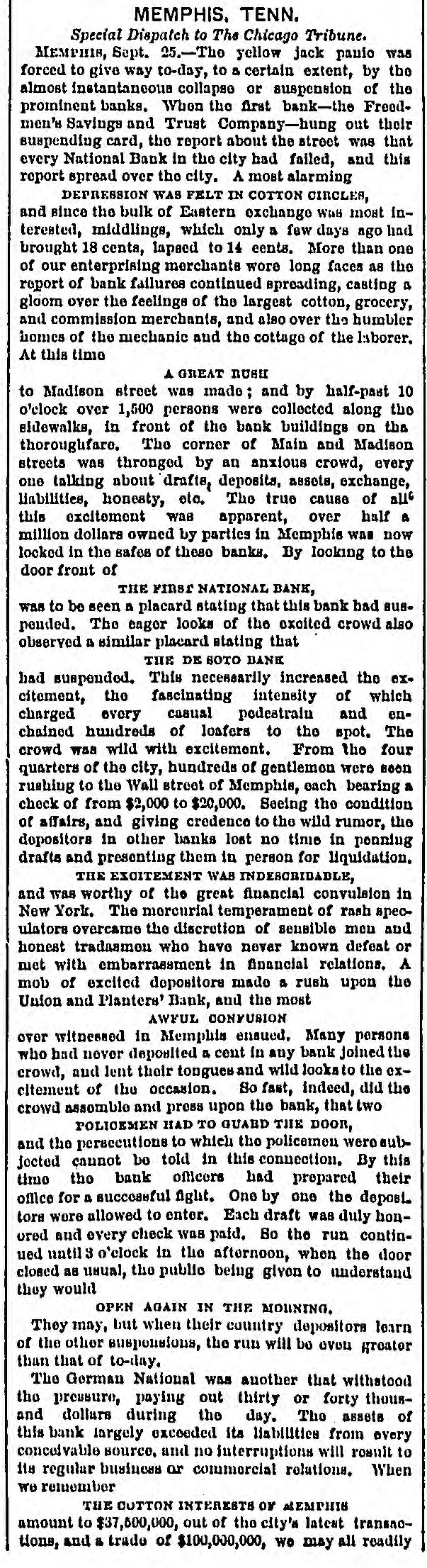
MEMPHIS. TENN. Special Dispatch to The Chicago Tribune. MEMPHIS, Sept. 25.-The yellow jack panio was forced to give way to-day, to & certain extent, by the almost instantaneous collapse or suspension of the prominent banks. When the first bank-the Freedmen's Savings and Trust Company-bung out their suspending card, the report about the street was that every National Bank in the city had failed, and this report spread over the city. A most alarming DEPRESSION WAS FELT IN COTTON CIRCLES, and since the bulk of Eastern exchange Was most interested, middlings, which only a few days ago had brought 18 centa, lapeed to 14 cents. More than one of our enterprising merchants wore long faces as the report of bank failures continued spreading, casting a gloom over the feelings of the largest cotton, grocery, and commission merchants, and also over the humbler homes of the mechanic and the cottage of the laborer. At this time A GREAT RUSH to Madison street was made; and by half-past 10 o'clock over 1,500 persons were collected along the sidewalks, in front of the bank buildings on the thoroughfare. The corner of Main and Madison streets was thronged by an anxious crowd, every one talking about drafts, deposits, assets, exchange, liabilities, honesty, etc. The true cause of all this excitement was apparent, over half a million dollars owned by parties in Memphis was now locked in the safes of these banks. By looking to the door front of THE FIRST NATIONAL BANK, was to be seen a placard stating that this bank had auspended. The eager looks of the excited crowd also observed a similar placard stating that THE DE SOTO BANK had suspended. This necessarily increased the excitement, the fascinating intensity of which charged every casual pedestrain and enchained hundreds of loafers to the spot. The crowd was wild with excitement. From the four quarters of the city, hundreds of gentlemon were soon rushing to the Wall street of Memphis, each bearing a check of from $2,000 to $20,000. Seeing the condition of affairs, and giving credence to the wild rumor, the depositors in other banks lost no time in ponning drafts and presenting them in person for liquidation. THE EXCITEMENT WAS INDESCRIBABLE, and was worthy of the great financial convulsion in New York. The morcurial temperament of rash speculators overcame the discretion of sensible men and honest tradasmon who have never known defeat or met with embarrassment in financial relations. A mob of excited depositors made a rush upon the Union and Planters' Bank, and the most AWFUL CONFUSION over witnessed in Memphis ensued. Many persons who had never deposited & cent in any bank joined the crowd, and lent their tongues and wild looks to the excitement of the occasion. So fast, indeed, did the crowd assomble and press upon the bank, that two POLICEMEN HAD TO GUARD THE DOOR, and the persecutions to which the policemen were subjocted cannot be told in this connection. By this time tho bank officers had prepared their office for a successful fight. One by one the deposi. tora were allowed to enter. Each draft was duly honored and every check was paid. Bo the run continued until 3 o'clock in the afternoon, when the door closed as usual, the public being given to understand they would OPEN AGAIN IN THE MOUNING. They may, but when their country depositors learn of the other suspensions, the run will be even greator than that of to-day. The Gorman National was another that withstood the pressure, paying out thirty or forty thousand dollars during the day. The assets of this bank largely exceeded its liabilities from every conceivable source, and no interruptions will rosuit to its regular business or commercial relations. When we remember THE CUTTON INTERESTS or AEMPHIS amount to $37,500,000, out of the city's latest transnotions, and a trade of $100,000,000, we may all readily


Article from The Osceola Times, September 27, 1873

Click image to open full size in new tab

Article Text

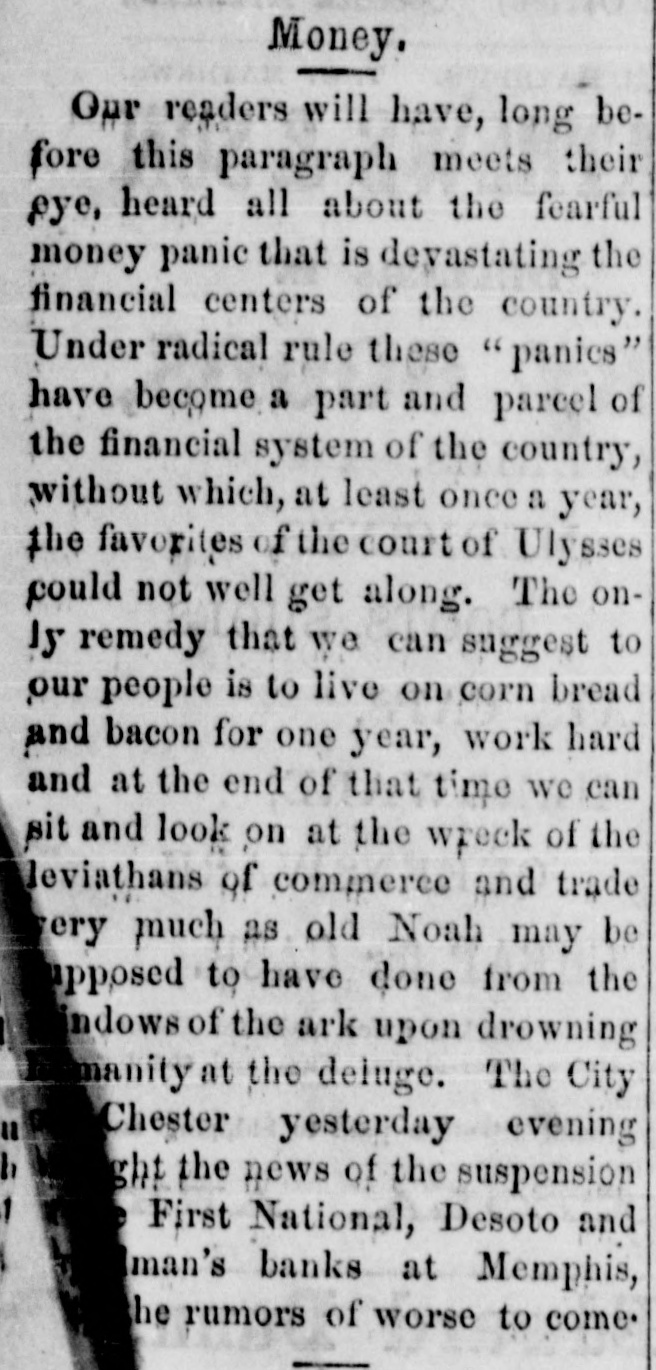
Money. 1 Our readers will have, long before this paragraph meets their eye, heard all about the fearful money panic that is deyastating the financial centers of the country. Under radical rule these "panics" have become a part and parcel of the financial system of the country, without which, at least once a year, the favorites of the court of Ulysses could not well get along. The only remedy that we can suggest to our people is to live on corn bread and bacon for one year, work hard and at the end of that time we can sit and look on at the wreck of the leviathans of commerce and trade ery much as old Noah may be apposed to have done from the indows of the ark upon drowning manity at the deinge. The City Chester yesterday evening ght the news of the suspension First National, Desoto and man's banks at Memphis, the rumors of worse to come.


Article from Public Ledger, October 4, 1873

Click image to open full size in new tab

Article Text

City Items. Twenty nurses are expected to-day from New Orleans and seven from Natchez, Mississippi. The First National Bank's deposits yesterday were over $55,000. The noon train to-day on the Louisville road was well patronized by country air-seeking Memphians. Kate White was thrown from a hack last night at the corner of Madison and Second, and suffered a broken ankle. The State National Bank received over $100,000 currency yesterday of its own issue, which goes to assist the merchants and pay for cotton. The DeSoto Bank resumed business this morning, and now the way is clear for a speedy resumption of the heavy business done by that institution before its suspension. Sergeant Rogers visits the markets this evening with his little book upon which is entered the names of contributors. He only asks that his friends give as much as they are able to. That Brownsville injunction was the theme of conversation on the streets yesterday afternoon and this morning, and was condemned by every person who expressed an opinion in regard to it. Tom Hatch, a negro highwayman, attempted to rob George Williams last night, on the corner of Main and Beal streets, but was captured by officers Dea and Blitz before he had completed his work. Harry Cranmer has again, mach to the terror of evil-doers, accepted an appointment upon the staff of Chief of Police Athy. His abilities in the "catching" line are well known, and no special comment is necessary. Dr. C. Happolt, at 194 Old Raleigh road, generously offers to attend yellow fever patients free of charge. Orders can be left at Renkert's drug store, corner of Main and Market, or at Vigus' drug store, 187 Poplar street.


Article from Eaton Weekly Democrat, October 16, 1873

Click image to open full size in new tab

Article Text

liquidation), is a"most gratifying one to its creditors. Their total assets are $3,468,504.94 liabilities, $2,203,326.02: excess of assets, $1,255,178.92. Over $16,000,000 in currency was received at Chicago by express between the 25th of September and the 2d of October. The new Michigan State House will be one of the finest public edifices in the country An unsophisticated gentleman hailing from New York city, was swindled out of $6,000 in Chicago, last week, by two gamblers. The Chicago Board of Trade gave $1,000 to the Shreveport sufferers The amount of bullion received at San Francisco from the mines during the quarter was nearly $10,000,000, and for the last nine months $24,000,000. THE St. Joseph (Mo.) Gazette has been sold at auction to Joseph A. Corby for $25,000. THE Third National Bank of Chicago, which suspended during the late flnancial unpleasantness, has resumed business The survivors of Capt. Jack's tribe have been sent to Fort Russell, Wyoming Territory Ex-Congressman John Law, of Evansville, Ind., is dead, aged 77. Mrs. Horton, of Van Wert, O., the other day left her infant in a cradle near the fire-place, and went out to witness a circus procession. When she returned her child was burned to a crisp. The South. THE New Orleans Picayune estimates the cotton crop at not less than 4,000,000 bales The first Ku-Klux trial before the North Carolina State Courts has just come off at Raleigh, N. C., and resulted in the conviction of three persons- white and one colored-of murder in the first degree. They were sentenced A. to be hung on the 13th of November J. Stephens, cashier of the St. Louis Mutual Life Insurance Company, has decamped with $6,500 of the institution's funds. The cotton crop of the Rio Grande valley has been seriously damaged by floods. The report, started by a Mexican paper, that armed United States soldiers had made another raid into Mexico, is untrue. YELLOW FEVER is raging as badly as ever at Shreveport, La., and Memphis, Tenn. At the former place the scourge is abated, if at all, only by the frightful depopulation it has already caused. The citizens of Memphis have issued an appeal for aid, addressed to the whole country, and begging for the co-operation of the mayors of the various cities to secure it. Money is most needed to buy food, The bury the dead, and shelter the orphans town of Lampasas, Texas, was recently inundated by the overflow of a creek which runs through the village. Twenty houses, including the postoffice and several stores, together with their contents, were swept away, and six or eight persons drowned. A herse ran away with a street-car in St. Louis, last week, and, colliding with another car, killed one of the passengers, and seriously injured four or five others Joseph H. Fore, of St. Louiswho some time ago murdered his brother-inlaw, who made three unsuccessful attempts to kill his wife, and who the other day came near murdering an attorney in court-has been sentenced to ten years in the penitentiary. THE tobacco crop now being secured is the best that has been raised in Virginia for years past. President Grant has ordered 5,000 army rations for the suffering and starving people of Shreveport The De Soto Bank, Memphis, has resumed. THE ravages of the yellow fever at Memphis are frightful to contemplate. A dispatch of the 6th inst. says The number of deaths in the infected district yesterday was SO great that the undertakers were unable to bury the bodies, and to-day in two or three instances whole families were carried to the buryingground at one load. Scenes in that part of the city are beyond description. Those not afflicted are 80 demoralized that they can be of no assistance to the sick, but seem chained to the locality, and make no effort to get away. THE South was visited by the first frost of the season on the 7th inst During the height of the yellow fever scare a number of citizens of Little Rock, Ark., chartered sleeping-coaches on the railroads, in which they slept, going out several miles on the railroad in the evening, and returning next morning. An old Itaiian padrone, with fourteen boys, who arrived at Little Rock a few ago, was taken in charge by the Italians, his money taken away from him and divided between the children, and he was ordered to leave the city. The bagging factory of Richardson, Henry & Co., of Louisville, has been burned. Loss, $70,000. Washington. CHARLES WILLIAMS (colored) is to be hung at Washington on the 14th of November for the murder of Frank Cohn, a Virginia drover. The railroad lobbyists and land-grabbers are organizing for the coming session of Congress. A Washington correspondent states that Ben Holliday, the Oregon railroad magnate, has taken a house at the capital for the session, in order to press the indorsement of his railroad bonds on which the interest was repudiated last winter. The Northern Pacific interest also boasts of its ability to get a Government indorsement on the ground that its bonds are so well diffused, through the constituencies, that enough members can be got to vote for their relief It is reported from Washington that a majority of President Grant's Cabinet are in favor of restoring the franking privilege to the departments. The Postmaster-Genera will oppose the restoration, however, in his next annual report The Chicago Tribuue's special Washington correspondent gives some gossip about the vacant Chief Justiceship. Senator Conkling is said to desire that Judge Ward Hunt should have it. Judge Pierrepont and Mr. Wm. M. Evarts are also prominently mentioned, the only objection to the latter being the fear that he will not keep the place for any length of time. Butler's opposition to Judge Hoar is thought to be sufficient to defeat the latter prospects, while Justice Miller, of Ohio, and Senator Howe, of Wisconsin, are reported as ahead in the race. no The President has declared he will call extra session of Congress. While he thinks that the financial situation does not demand an extra session, he still makes the announcement that he will put out the $44,000,000 reserve" as rapidly as is consistent with the Treasury's interest. Fant, Washington & Co., bankers, have resumed business. SECRETARY RICHARDSON says that the Government will lose nothing by the suspension of Clews & Co., in New York, or Clews, Habicht & Co., in London: also, that if Jay Cooke & Co. pay 33 per cent. the Government will be no loser by the failure of the First National Bank. He thinks that the country will be gratified to find in the public debt statement that the reserve" has not yet been touched, though he reiterates his purpose of using it whenever he judges it to be necessary The public debt statement for September shows a reduction of $1,901,467. The following are the figures $1,235,000,200 Six per cent. bonds 488,567,300 Five per cent. bonds Total coin bonds $1,723,567,500 14,678,000 $ Lawful money debt Matured debt 15,756,130

Article from Public Ledger, November 24, 1873

Click image to open full size in new tab

Article Text

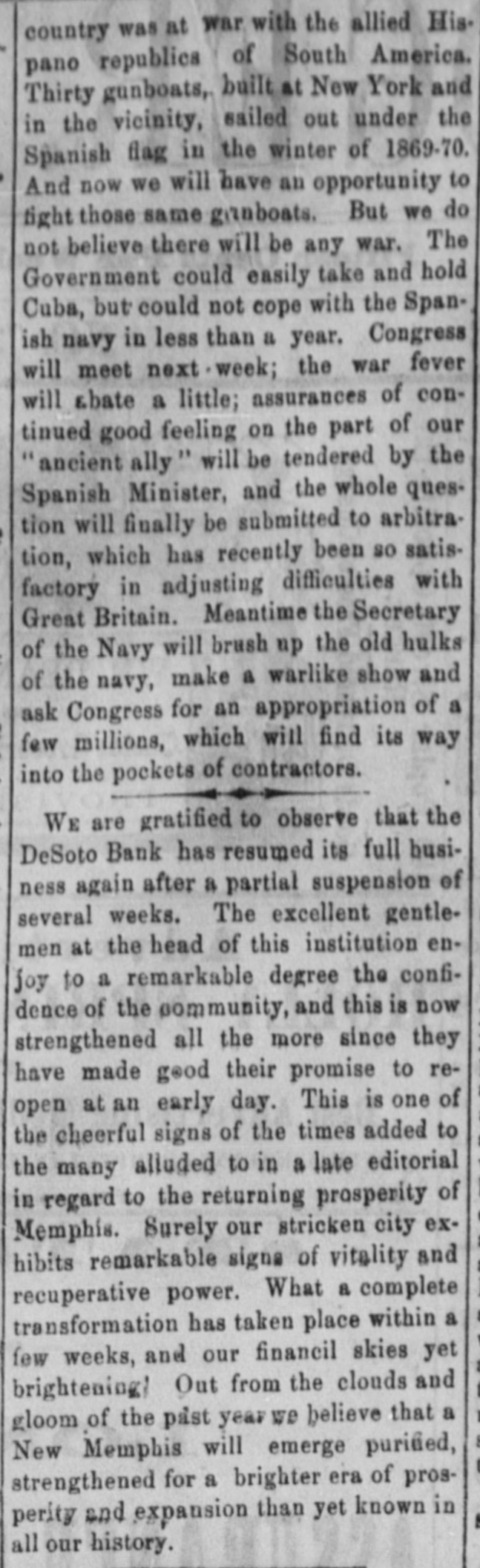
country was at war with the allied His. pano republica of South America. Thirty gunboats, built at New York and in the vicinity, sailed out under the Spanish flag in the winter of 1869-70. And now we will have an opportunity to tight those same ginnboats. But we do not believe there will be any war. The Government could easily take and hold Cuba, but could not cope with the Spanish navy in less than a year. Congress will meet next week; the war fever will &bate a little; assurances of continued good feeling on the part of our "ancient ally " will be tendered by the Spanish Minister, and the whole question will finally be submitted to arbitration, which has recently been so satisfactory in adjusting difficulties with Great Britain. Meantime the Secretary of the Navy will brush up the old hulks of the navy, make a warlike show and ask Congress for an appropriation of a few millions, which will find its way into the pockets of contractors. WE are gratified to observe that the DeSoto Bank has resumed its full business again after a partial suspension of several weeks. The excellent gentlemen at the head of this institution enjoy to a remarkable degree the confidence of the community, and this is now strengthened all the more since they have made good their promise to reopen at an early day. This is one of the cheerful signs of the times added to the many alluded to in a late editorial in regard to the returning prosperity of Memphis. Surely our stricken city exhibits remarkable signa of vitality and recuperative power. What a complete transformation has taken place within a few weeks, and our financil skies yet brightening Out from the clouds and gloom of the past year we believe that a New Memphis will emerge purided, strengthened for a brighter era of prosperity and expansion than yet known in all our history.


Article from Public Ledger, November 24, 1873

Click image to open full size in new tab

Article Text

DeSoto Bank Reopened. The announcement made elsewhere, that the DeSoto Bank has resumed business in full and upon its own resources, will be hailed with pleasure not only by our business men but by the general public. Even during the late suspension of the DeSoto the bank has been paying off elaims when presented. The standing of this institution was never doubted, and during the temporary suspension depositors gave it support and had in its managers implicit reliance. The result shows that such confidence was not misplaced. The DeSoto has been and will be one of the largest and heaviest moneyed institutions in our city. We congratulate the business public upon the further facilities for trade now furnished by President Elder and Cashier Farnsworth of the old DeSoto.


Article from The Dallas Daily Herald, November 25, 1873

Click image to open full size in new tab

Article Text

# THE LATEST NEWS. NEW ORLEANS, November 24. The delegates to the Peoples' Convention assembled this morning at the St. Charles hotel, and from thence proceeded to McEnery's office, where the committee of Seventy with the delegates adjourned to Greenwald Hall on Baronne street, which had been chosen for the session. The hall was tastefully decorated with numerous inscriptions and a profusion of flags, the busts of Washington, Clay, Webster and Chief Justice Martin being prominent. Ata quarter past 12 o'clock R. H. Marr, Chairman of the committee of Seventy, called the convention to order, and named Dr. Chappin, temporary Chairman and Thomas L. Maxwell, temporary Secretary, These nominations were adopted unanimously. Dr. Chappin, taking the chair, said he did so because he believed every man in Louisiana should contribute his mite in this struggle for liberty. Committees on credentials and organization were appointed, when a recess of half an hour was taken. After the recess the committee on organization nominated Judge W. B. Eagan, of Caddo, for President, and Thomas L. Maxwell, of New Orleans, Secretary. On mocion, the nominations were accepted. Judge Eagan, upon assuming the chale, addressed the convention, reviewing the situadoo, etc. Other addresses followed. After the appointment of the usual committees, the convention adjourned until 10 o'clock to-morrow morning. NEW ORLEANS, November 24. The board of United States engineer officers appoiated to deliberate upon the feasibility, of the proposed Fort St. Phillip canal, have arrived here. Cotion in good demand; sales 5300 bales. Prices easier. Good ordinary to strict good ordinary 14@15c; low midling to strict low midling 15@15½c; midling to strict midling 18@18½c; good midling 17@17½c for certified checks. Gold 8¼@8½; currency 14@1 sight 1¼ for certified checks; sterling 17¾@18 for certified checks. NEW YORK, November 24.-Edmund J. Randolph & Co., bankers, who sus-dended during the panie, have resumed. The Spanish iron-clad Arapeles has so far progressed in her repairs as to be almost ready to leave the navy yard. Coal will be put on board to-day. She will go to an anchorage in the North river to-morrow to take in coal, stores and powder, Her commander is determined to have her away at sea before December 1st. WASHINGTON, November 24. In the case of the United States vs. Lapine and others, the Supreme Court to-day decided that where a party advanced funds to a firm in New Orleans, to be used by their agents in the interior in the purchase of cotton prior to the capture of the city in 1862, all the parties being then im New Orieans and the city was captured by the Federal forces before th cotion was purchased with the funds so advanced, the agent having gone into the interior prior to the capture, his agency to purchase cotton was terminated by the hostile position of his principais toward the cotton of the owners, consequent upon the capture and that a purchase of cotton afterwards was an effectual aid to the enemy. It was forbidden by the soundest principles of public law. The purchaser therefore obtained no title to the cotton and had no claim against the governmeat for its capture. Mr. Justice Hunt delivered the opinion, Justices Miller and Fields dissenting. Secretary Richardson issues the following: "The instructions of the 27th ult., in reference to the limited disbursement of silver coin in lieu of currency, are hereby so modified that hereafter in making disbursements silver coin will be paid only in the fractional parts of a dollar." The Postmaster-General, having received a number of inquiries from Postmasters, as to whether a circular issued by a Rhode Island Postmaster calling for a convention of Postmasters at Washington on the 9th of January, is in accordance with his wishes, states that his name was used in the circular without authority, and he has directed the project to be abandoned and the circula to be withdrawn as far as possible. LIVERPOOL, November 24. Not below good ordinary shipped December and January 8"d; not below low middlings shipped November and December 8 5-16d. NEW YORK, November 24. The Spanish sloop or war Arapeles, left the navy yard this morning, and dropped down to the battery, preparatory to sailing for Cuba. Her repairs are incomplete. A full jury was drawn in the Ingersoll case to-day, and the trial will proceed. It is expected to be short, as the proof of his forgeries is said to be quite plain. The charity cor. missioners of Brooklyn state that they cannot meet a quarter of the demands for assista ace made on them by the poor of that city. A. L. Roberts and Valentine Greene were to-day arraigned before the Over and Terminer on forty-alne indictments for boad forgeries. There are sixty-eight indictments against them also at the court of General Sessions. The meeting of the Toust company to-day reached no final decision on the resumption of business, bot a director states that the company expect to resume Monday next. Several hundred men were at the navy yard to-day who were promised by politicians that they would be put to work, but they were all disappointed, as no men were taken on to-day. MATANORAS, November 24. The concession to construct a railway from the Rio Grande frontier to the city of Mexico and thence to the Pacific has been granted to a company of Mexicans. This defeats the Plum and Rosencranz project and leaves the matter in the hands of the Mexicans, who will doubtless interest other parties in their enterprise or dispose of their concessions to the greatest advantage to themselves. MEMPHIS, November 24. The De Soto bank resumes to-morrow. It is First National will resume