
20649. Citizens National Bank (Greeneville, TN)

Bank Information

Episode Type
Suspension → Closure
Bank Type
national
Bank ID
13482
Charter Number
13482
Start Date
June 1, 1933*
Location
Greeneville, Tennessee (36.163, -82.831)

Metadata

Model
gpt-5-mini
Short Digest
4c649cd8

Response Measures

None

Receivership Details

Depositor recovery rate
74.8%
Date receivership started
1933-06-03
Date receivership terminated
1941-01-23
Share of assets assessed as good
47.0%
Share of assets assessed as doubtful
46.0%
Share of assets assessed as worthless
7.0%

Description

Articles describe the Citizens National Bank of Greeneville as a 'closed bank' with a receiver appointed (June 1933) and criminal trial of its former president Rader for false statements/embezzlement in 1934. No article describes a depositor run; failure appears due to bank-specific malfeasance and shortage, leading to closure and receivership.

Events (6)

1. July 25, 1930 Chartered
Source
historical_nic
2. June 1, 1933* Receivership
Newspaper Excerpt
the closed bank, testified records showed ... the bank's receiver, Fuller, was the next witness. ... receiver for the appointed June 1933. The witness explained ... the closed bank ... now assist the bank's receiver, Fuller, was the next witness. (Article 1-2).
Source
newspapers
3. June 1, 1933* Suspension
Cause
Bank Specific Adverse Info
Cause Details
Bank examiner found shortages; assets (estate bonds) taken to cover shortages; evidence of improper loans/insider indebtedness and alleged embezzlement by president Rader led to closure and appointment of a receiver.
Newspaper Excerpt
receiver for the appointed June 1933. The witness explained that old Citizens Savings Bank ... became national bank in the fall of 1929.
Source
newspapers
4. June 3, 1933 Receivership
Source
historical_nic
5. January 19, 1934 Other
Newspaper Excerpt
Government today introduced evidence in Federal Court in an indictment charging Rader, former president the Citizens National Bank Greeneville, making false and financial statement of the bank's condition ... Hill, assistant cashier the closed bank, testified ... (Article 1).
Source
newspapers
6. March 24, 1934 Other
Newspaper Excerpt
Knoxville Journal: March Hill, former cashier closed Citizens National bank, today identified ... forged check ... Rader ... was convicted at the federal court Knoxville ... including embezzlement ... (Article 3).
Source
newspapers

Newspaper Articles (3)

Article from The Greeneville Sun, January 19, 1934

Click image to open full size in new tab

Article Text

R. Hill. Assistant Cashier Closed Bank Testifies To Records. Knoxville, Jan. 19. Government today introduced dence in Federal Court in an indictment charging Rader, former president the Citizens National Bank Greeneville, "making false and financial statement of the bank's condition the comptroller of the currency. Hill, assistant cashier the closed bank, testified records showed that on December 31, 1932, Rader three notes, taling $36,000. to the Hamilton National Bank of Chattanooga for Two notes, and one for signed jointly by Rader Dugger, Hill said. the other for signed by The three notes were returned Rader January 1933 letter from the Hamilton tional Bank explainincharging your suecial account with Over the objections of defense counsel showing the bank had $75,000 capital and surplus and under national banking laws not more than 10 percent of and surplus could be loaned borrower. Hill testified in the financial report comptroller Rader listed his debtedness to the bank at the two notes had been an asset of bank December 1932, what would have been Rader's tion to the Attorney asked Hill replied that Rader's total indebtedness would have Under the capitalization surplus what would be the mum which could be loaned any one person' Smith asked. replied Hill. Hill also testified that Rader had access "to the note Kutchens, national testified yesterday Rader admitted him in bonds belonging to Woodyard estate shortage in the accounts the old Citizens Savings bank." Kutchens sand he came Greeneville May 16, 1933 to amine records of the Citizens tional bank after had been in the hands of Rader servator. receiver for the appointed June 1933. The witness explained that old Citizens Savings Bank, state institution, made become national bank in the fall of 1929. The application, testified, was refused because shortage" was found the bank's In July, 1930, the old state bank nationalized and became the Citizens National bank. "Rader told Kutchens tified, "that the $10,000 bonds did NOT belong to the bank but were taken from the Woodyard estate to help make good the shortage in the old state "Did he make this statement the presence anyone Jack Smith, assistant S. district attorney. asked. was made in the of the end his store," Kutchens plied. Rader said he took the bonds and expected replace them. but hadn't been able Kutchens testified. The bank examiner said the bonds" were listed part the Citizens National bank's assets in its statement Dec. 1932. "Do you know that the records show that the old Citizens Savings bank bought the bonds the fall of 1929," Piper, defense attorney, asked on cross examination. bonds never had been chased,' Kutchens replied. der said he took R. Hill, 34, assistant cashier the closed bank and now assistthe bank's receiver, Fuller, was the next witness. He identified certificate deposit for drawn against estate "Jennie Britton. said the check carried NO dorsement and had been marked December 31, 1932. Hill testified that $900 of the check credited to the account Dickey, and the account of the "Home company. owned the Home Oil comAttorney Smith asked. H. Rader," the witness swered. Defense counsel objected grounds that Hill could NOT know owned the company. if you know, how do you Smith then asked. receiver for Homa (Continued
Article from The Greeneville Sun, January 19, 1934

Click image to open full size in new tab

Article Text

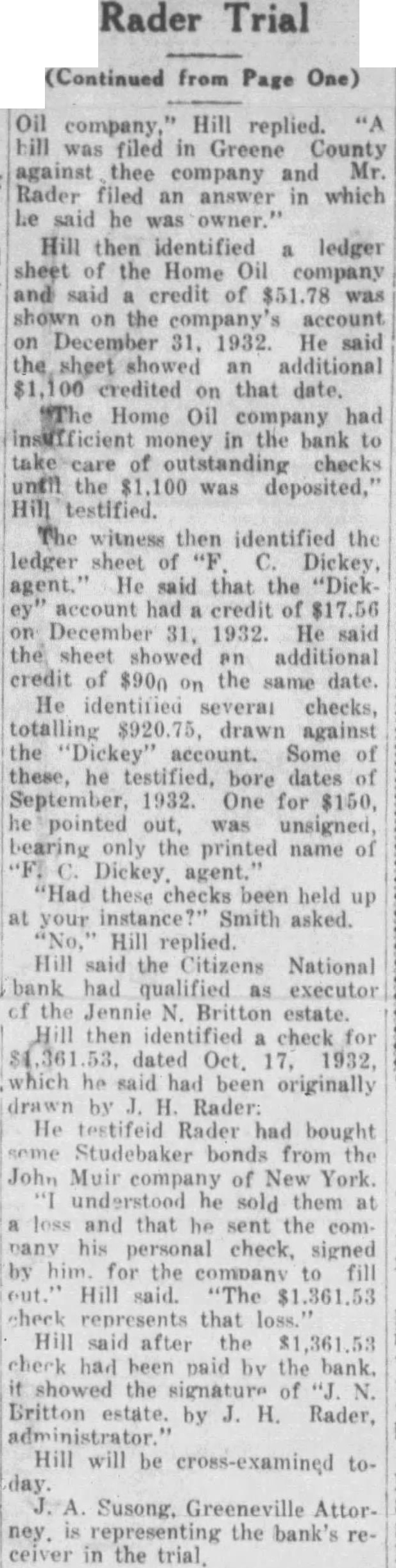
Rader Trial (Continued from Page One) Oil company, Hill replied. "A hill was filed in Greene County against thee company and Mr. Rader filed an answer in which he said he was owner.' Hill then identified a ledger sheet of the Home Oil company and said a credit of $51.78 was shown on the company's account on December 31, 1932. He said the sheet showed an additional $1 00 credited on that date. The Home Oil company had insufficient money in the bank to take of outstanding checks until the $1,100 was deposited,' Hill testified. The witness then identified the ledger sheet of "F C. Dickey, agent.' He said that the "Dickaccount had a credit of $17.56 on December 31, 1932. He said the sheet showed an additional credit of $900 on the same date. He identified several checks, totalling $920 drawn against the "Dickey" account. Some of these, he testified. bore dates of September, 1932. One for $150, he pointed out, was unsigned, bearing only the printed name of "F. Dickey agent. "Had these checks been held up at your instance Smith asked. "No," Hill replied. Hill said the Citizens National bank had qualified as executor of the Jennie N. Britton estate. Hill then identified a check for which he said had been originally drawn by H. Rader: He testifeid Rader had bought Studebaker bonds from the John Muir company of New York. understood he sold them at a loss and that he sent the comvany his personal check, signed by him. for the company to fill out. Hill said. "The $1,361.53 check represents that loss. Hill said after the $1,361.53 check had been paid by the bank. it showed the signature of Britton estate. by J. H. Rader, Hill will be cross-examined today. Susong. Greeneville Attorney. is representing the bank's receiver in the trial,


Article from The Knoxville Journal, March 24, 1934

Click image to open full size in new tab

Article Text

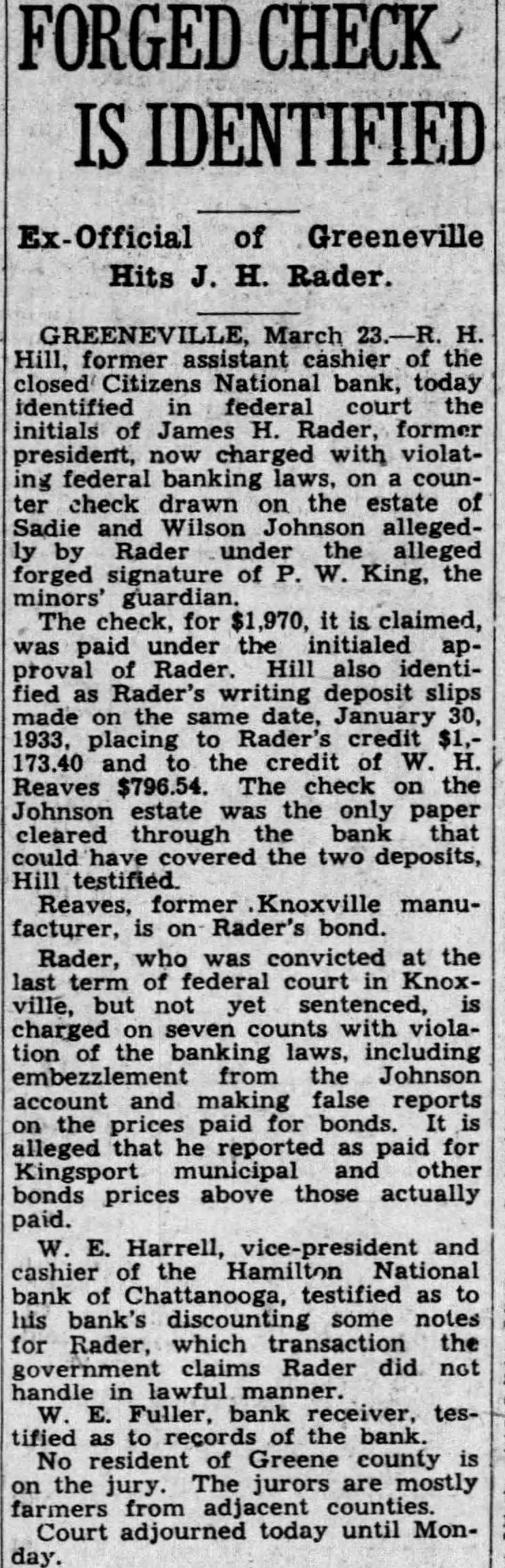
FORGED CHECK- of Greeneville Hits H. Rader. March Hill, former cashier closed Citizens National bank, today identified federal court initials James H. former violatfederal councheck drawn the estate of allegedby Rader the forged King, minors' check, for it claimed, was paid under proval Hill also identified as Rader's writing deposit made same January 1933, placing to Rader's credit credit Reaves $796.54. on the Johnson estate only cleared through bank the deposits, testified Reaves. Knoxville manufacturer, on Rader, was convicted at the federal court Knoxville, not charged counts with violabanking laws, including embezzlement from Johnson making false reports paid bonds. alleged reported as paid for bonds above those actually E. Harrell, and cashier testified to bank's some for Rader. which transaction the Rader did handle bank receiver, testified the bank. No resident Greene county the jury. jurors are mostly farmers Court adjourned today until Monday.