20611. Maury National Bank (Columbia, TN)

Bank Information

Episode Type
Run → Suspension → Reopening
Bank Type
national
Bank ID
4849
Charter Number
4849
Start Date
November 1, 1907*
Location
Columbia, Tennessee (35.615, -87.035)

Metadata

Model
gpt-5-mini
Short Digest
60bcacbb

Response Measures

Accommodated withdrawals

Description

Articles describe a November 1907 'flurry' (panic) that led to limited withdrawals ($25 per week) and reduced withdrawals, i.e., partial suspension/withdrawal restriction. By Jan 10, 1908 the bank is prospering with heavy deposits, indicating it reopened/returned to normal. Cause tied to wider financial storm (panic of 1907 / New York conditions).

Events (3)

1. November 1, 1907* Run
Cause
Macro News
Cause Details
A wider financial storm/panic originating in New York produced a local flurry and withdrawals from the bank.
Measures
Allowed depositors the privilege to withdraw $25 per week (restriction on withdrawals).
Newspaper Excerpt
less than twenty-five per cent have taken advantage of the privilege to withdraw $25 per week...the situation is very nearly what it was before the flurry began.
Source
newspapers
2. November 1, 1907* Suspension
Cause
Macro News
Cause Details
Bank imposed withdrawal restriction (weekly $25 limit) in response to the nationwide financial disturbance (panic).
Newspaper Excerpt
less than twenty-five per cent have taken advantage of the privilege to withdraw $25 per week.
Source
newspapers
3. January 10, 1908 Other
Newspaper Excerpt
GREAT DAY FOR MAURY NATIONAL... The Bank received on deposit $83,000; and paid out on checks... $58,000; leaving it at the close of the day's work with $25,000 more money than it had when it opened its doors (report of strong business/reopening/return to normal).
Source
newspapers

Newspaper Articles (2)

Article from The Columbia Herald, November 15, 1907

Click image to open full size in new tab

Article Text

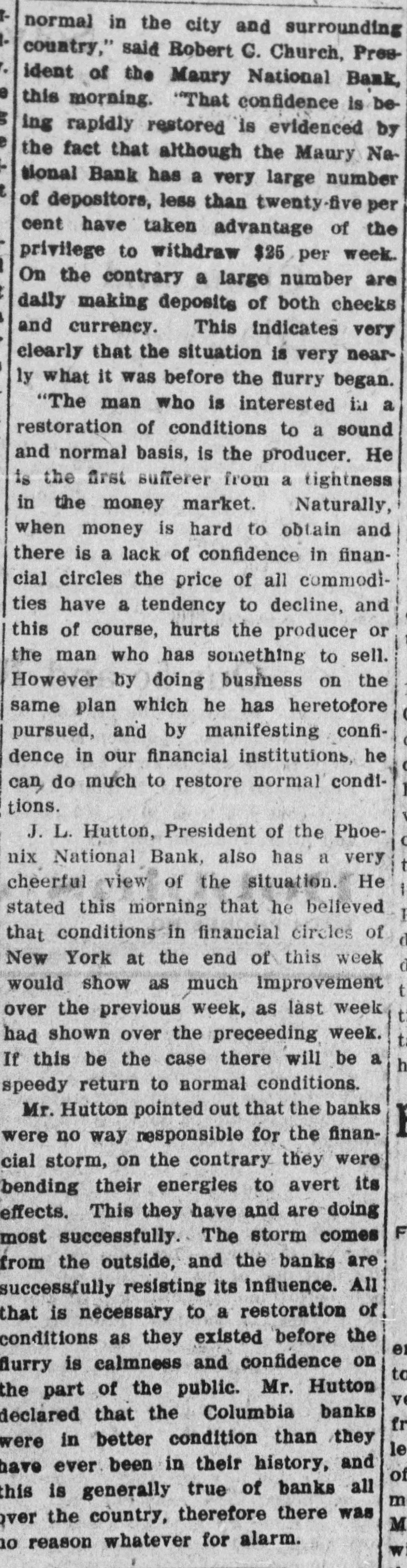
normal in the city and surrounding country," said Robert C. Church, President of the Maury National Bank, this morning. "That confidence is being rapidly restored is evidenced by the fact that although the Maury National Bank has a very large number of depositors, less than twenty-five per cent have taken advantage of the privilege to withdraw $25 per week. On the contrary a large number are daily making deposits of both checks and currency. This indicates very clearly that the situation is very nearly what it was before the flurry began. "The man who is interested in a restoration of conditions to a sound and normal basis, is the producer. He is the first sufferer from a tightness in the money market. Naturally, when money is hard to obtain and there is a lack of confidence in financial circles the price of all commodities have a tendency to decline, and this of course, hurts the producer or the man who has something to sell. However by doing business on the same plan which he has heretofore pursued, and by manifesting confidence in our financial institutions, he can do much to restore normal conditions. J. L. Hutton, President of the Phoenix National Bank, also has a very cheerful view of the situation. He stated this morning that he believed that conditions in financial circles of New York at the end of this week would show as much Improvement over the previous week, as last week had shown over the preceeding week. If this be the case there will be a speedy return to normal conditions. Mr. Hutton pointed out that the banks were no way responsible for the financial storm, on the contrary they were bending their energies to avert its effects. This they have and are doing most successfully. The storm comes from the outside, and the banks are successfully resisting its influence. All that is necessary to a restoration of conditions as they existed before the er flurry is calmness and confidence on to the part of the public. Mr. Hutton vo declared that the Columbia banks were in better condition than they le have ever been in their history, and of this is generally true of banks all over the country, therefore there was 10 reason whatever for alarm.


Article from The Columbia Herald, January 10, 1908

Click image to open full size in new tab

Article Text

GREAT DAY FOR MAURY NATIONAL THIS SPLENDID INSTITUTION DID AN ENORMOUS BUSINESS ON MONDAY. HEAVY DEPOSITS WERE MADE Bank Gains In Amount And Also Many New Cus tomers. Over at the Maury National Bank President Church and Cashler Parker, all the push in fact, are wearing a smile that won't come off; all because of First Monday's business. A Herald man heard that something had been doing there Monday, and he went to inquire what It was. He heard they had done a good business, and he asked them if they were satisfied. And they began to tell him some things, and he said, "I'm from Missouri; show me." And they showed him; and he saw more money than he ever saw before, at any one time, or any two times, or any several times, in all his life. As Old Wash would say, "its perfectly scandalous the way they had money layin' aroun' loose, пободу 'peerin' to keer fer it." How much in dollars and cents, exactly, we do not know; but it is a fact that their vault was actually crowded with money; much of it good, clean, new money. They had the gold stacked up in piles, and the silver in bags, and the currency in bundles, and the loose change in cigar Money was simply heaped up boxes. to get It out of the way. Twenty thousand dollars in glittering gold and shiping silver. As much of Uncle Sam's new, crisp currency, subject to call, but never even clipped apart. Money everywhere; and nobody seemto want it, or care for It; yet we ing suspect that it was there for a purpose: and that purpose, we are told, was to make more money. Monday's business was the biggest business this bankshas had since the first Monday in January of last year. The year 1907 was a prosperous year; it was a big business year, and the bank made money; but no one day of that prosperous year equalled the first Monday in January, 1908. The Bank received on deposit $83,000; and paid out on checks, (all in good money, no clearing house certificates) $58,000; leaving it at the close of the day's work with $25,000 more money than it had when it opened its doors in the morning; and, what Messrs. Church and Parker seemed to appreciate even more than the gain in cash, was the gain of quite a number of new customers. They not only did a rushing business all day; held all their money and added more; but they also held all their old customers and added more; and last but not least, was the general good feeling among all their customers; confidence and compliments were handed out to them ungrudgingly; "well done, thou good and faithful servants," were the greetings they received from all sides; directors, stockholders, depositors, all said "well done." And why shouldn't they? Out of a close squeeze and a panicky spell, with the lime light of public thought iand criticism full upon them, they emerge from the gloomy, dark days of the old year, out into the youth and glow of the new year, rich in experience, strong in the confidence of the people, and with more money than they know what to do with. With such a report as this from one ⑉ of the leading business institutions of the county; with mules selling