20494. International State Bank (Sioux Falls, SD)

Bank Information

Episode Type
Run → Suspension → Closure
Bank Type
state
Start Date
January 21, 1924
Location
Sioux Falls, South Dakota (43.550, -96.700)

Metadata

Model
gpt-5-mini
Short Digest
1870e088

Response Measures

Full suspension

Description

Contemporary articles (Jan 1924) report the International State Bank of Sioux Falls closed/failed after heavy withdrawals amid a wave of regional bank failures. Closure appears permanent (described as a failure). Cause is contagion from other local/regional bank failures and agricultural distress.

Events (3)

1. January 21, 1924 Run
Cause
Local Banks
Cause Details
Heavy withdrawals triggered by a wave of failures and banking panic in the region (other SD/Northwest bank failures and agricultural distress).
Newspaper Excerpt
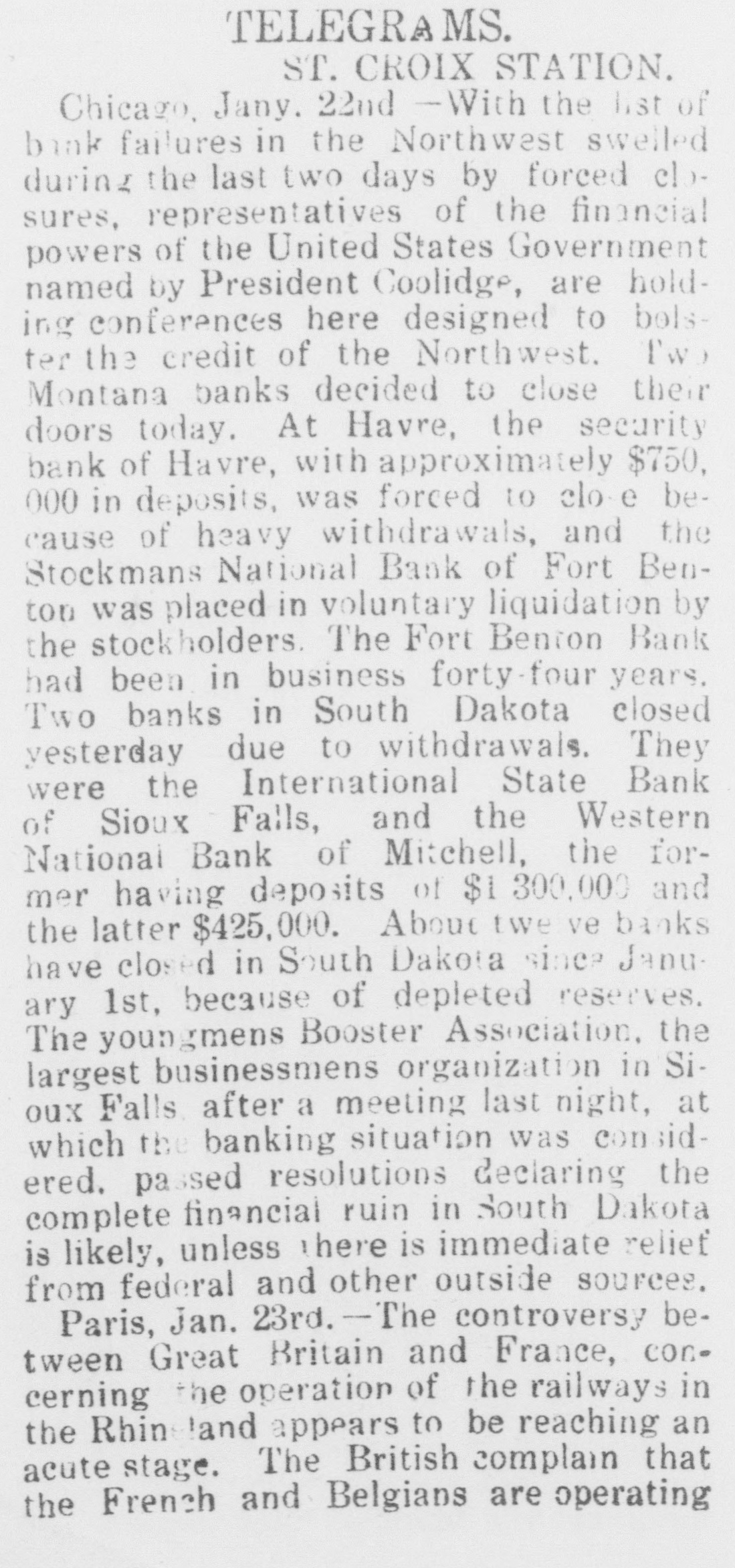
Two banks in South Dakota closed yesterday due to withdrawals. They were the International State Bank of Sioux Falls...
Source
newspapers
2. January 21, 1924 Suspension
Cause
Local Banks
Cause Details
Bank was forced to close/failed following depleted reserves and heavy withdrawals amid numerous concurrent bank failures in the state and region.
Newspaper Excerpt
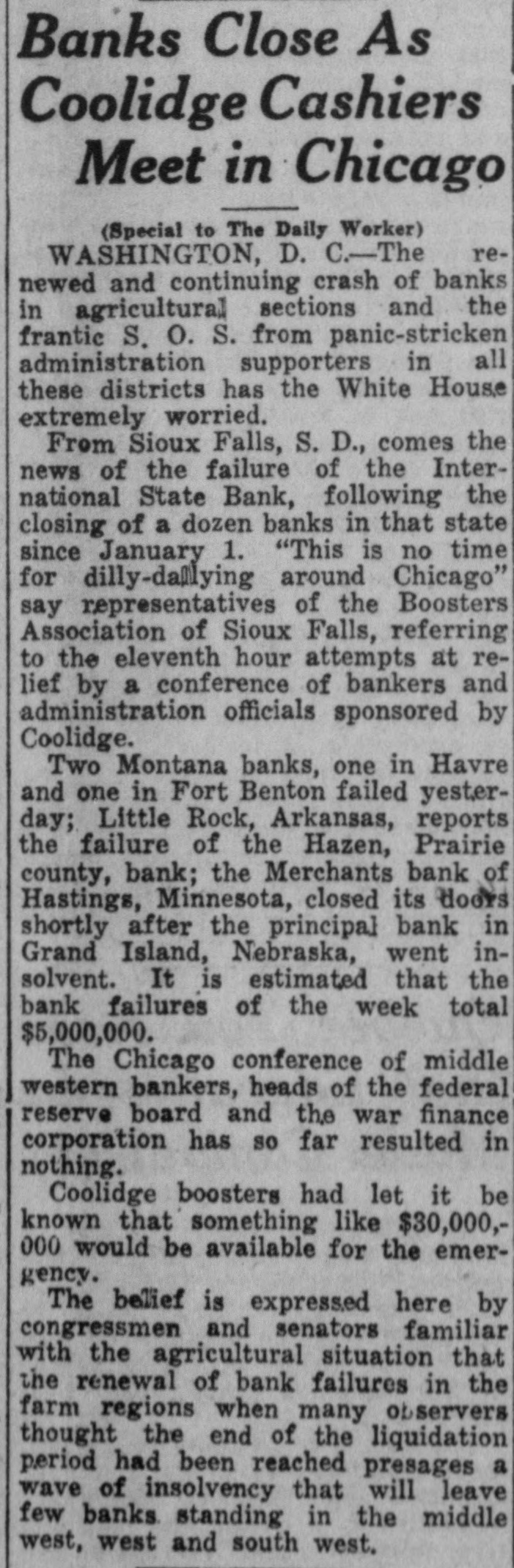
From Sioux Falls, S. D., comes the news of the failure of the International State Bank
Source
newspapers
3. January 23, 1924 Other
Newspaper Excerpt
The renewed and continuing crash of banks in agricultural sections... From Sioux Falls, S. D., comes the news of the failure of the International State Bank (news commentary on regional banking crisis).
Source
newspapers

Newspaper Articles (3)

Article from The Daily Worker, January 23, 1924

Click image to open full size in new tab

Article Text

Banks Close As Coolidge Cashiers Meet in Chicago (Special to The Daily Worker) WASHINGTON, D. C.-The renewed and continuing crash of banks in agricultural sections and the frantic S. O. S. from panic-stricken administration supporters in all these districts has the White House extremely worried. From Sioux Falls, S. D., comes the news of the failure of the International State Bank, following the closing of a dozen banks in that state since January 1. "This is no time for dilly-damlying around Chicago" say representatives of the Boosters Association of Sioux Falls, referring to the eleventh hour attempts at relief by a conference of bankers and administration officials sponsored by Coolidge. Two Montana banks, one in Havre and one in Fort Benton failed yesterday; Little Rock, Arkansas, reports the failure of the Hazen, Prairie county, bank; the Merchants bank of Hastings, Minnesota, closed its doors shortly after the principal bank in Grand Island, Nebraska, went insolvent. It is estimated that the bank failures of the week total $5,000,000. The Chicago conference of middle western bankers, heads of the federal reserve board and the war finance corporation has so far resulted in nothing. Coolidge boosters had let it be known that something like $30,000,000 would be available for the emergency. The belief is expressed here by congressmen and senators familiar with the agricultural situation that the renewal of bank failures in the farm regions when many observers thought the end of the liquidation period had been reached presages a wave of insolvency that will leave few banks standing in the middle west, west and south west.


Article from St. Croix Avis, January 26, 1924

Click image to open full size in new tab

Article Text

TELEGRAMS. ST. CROIX STATION. Chicago, Jany. 22nd -With the list of bank failures in the Northwest swelled during the last two days by forced closures, representatives of the financial powers of the United States Government named by President Coolidge, are holding conferences here designed to bolster the credit of the Northwest. Pwo Montana banks decided to close their doors today. At Havre, the security bank of Havre, with approximately $750, 000 in deposits, was forced to close because of heavy withdrawals, and the Stockmans National Bank of Fort Benton was placed in voluntary liquidation by the stockholders. The Fort Benton Bank had been in business forty-four years. Two banks in South Dakota closed yesterday due to withdrawals. They were the International State Bank of Sioux Falls, and the Western National Bank of Mitchell, the former having deposits of $1 300,000 and the latter $425,000. About twe ve banks have closed in South Dakota since January 1st, because of depleted reserves. The youngmens Booster Association, the largest businessmens organization in Sioux Falls. after a meeting last night, at which the banking situation was considered. passed resolutions declaring the complete financial ruin in South Dakota is likely, unless there is immediate relief from federal and other outside sources. Paris, Jan. 23rd. - The controversy between Great Britain and France, concerning the operation of the railways in the Rhindland appears to be reaching an acute stage. The British complain that the French and Belgians are operating


Article from The Daily Worker, February 4, 1924

Click image to open full size in new tab

Article Text

oldest institution in the town, closed its doors. Tied to this ak was the First Trust Company, organized under the state law, to take up the musty paper that had been accumulated thru years of bad loans by the First National. Fresh deposits were desired for the First National, and the only way these could be got was by the organization of the subsidiary company. One of the devices of the First Trust to coax new deposits, was to send out several hundred pass books to people of small means, inviting their deposits. A credit of one dollar was written in the pass book, providing the recipient of the book became depositor of the bank. This pass book a credit "come-on" system worked with a great many, with the result that a large number of people are now patiently awaiting the promised re-opening of the bank. The First National Bank was a favorite of the officers of the State Rural Credits Board. One of the members of the Rural Credits Board, Albert Zosky, was a director of the bank. How much Rural Credits funds, borrowed by the State on bonds sold to furnish loans on land to farmers, are tied up in the failure, nobody but the insiders know. The Rural Credits Board is a closed corporation, divulging nothing it can conveniently keep from the public. Panic Grips Sioux Falls. The acute stage of the panic which has been approaching for months, broke in Sioux Falls, with the failure of the Sioux Falls National Bank on the 10th of January. This bank had deposits of two and a half million dollars, and with it went a number of its satellite banks in the smaller towns. This failure was followed two days later by the failure of the Sioux Falls Trust & Savings Bank, with deposits of between four and five million dollars, and with this institution also went a number of its country correspondents. In the interim, other smaller banks in the State, having no relations with these banks, "went South." These huge failures startled the big boys at Washington, and last week we were informed that Coolidgequick to come to the aid of the banks but slow to recognize the farmer distress as the cause of the troublehad instructed the War Finance Corporation to come to the rescue of the banks of North and South Dakota and Minnesota, with a thirty million slice of War Finance Corporation funds. Eugene Meyer is now on the ground with the alleged purpose of plugging the financial storm sewer with public money, one third of which is to go to this State, and the balance to North Dakota and Minnesota. Coolidge Didn't Save Them. This promise of the administration to come to the rescue could not been taken seriously, however, for on Monday the Western National Bank of Mitchell, with deposits of nearly a million dollars and five branch banks, closed its doors. This bank is headed by W. S. Hill, who was formerly president of the South Dakota Farm Bureau Federation. He was a prospective "dirt" farmer choice for member of the Federal Reserve Board and later for an appointment to the Shipping Board. On the same day the International State Bank of Sioux Falls, with deposits of $1,300,000 turned the key in its doors. This makes the third big failure in Sioux Falls within ten days. The combined deposit obligations of the three failed Sioux Falls banks amounts to over eight million dollars, which makes the Coolidge donation of ten million dollars for South Dakota look like a drop in the bucket to the distressed bankers who are not yet closed, but are shivering on the brink. Banks Failed Mondav. The daily press of this section is running a "closed shop" on news of bank failures generally, but from current information available at this writing, eleven banks closed their doors in this State on Monday. It was Black Monday for South Dakota's financiers. Nobody can tell how many more banks will tumble within the next few days or weeks. ,Depositors are quietly withdrawing their funds from all the banks now open, so that a continuation of the bank explosions may be expected. Nobody, not even the bankers themselves, appear to believe that the dumping of thirty or even fifty million dollars into the banks of the northwest to take up the bad paper of the banks, would now do any