20484. First National Bank (Scotland, SD)

Bank Information

Episode Type
Run → Suspension → Closure
Bank Type
national
Bank ID
7048
Charter Number
7048
Start Date
February 1, 1907*
Location
Scotland, South Dakota (43.150, -97.718)

Metadata

Model
gpt-5-mini
Short Digest
6585f3c0

Response Measures

Full suspension, Books examined

Other: Receiver sold assets; president later arrested and convicted for embezzlement. Receiver Paul Landmann appointed and managed liquidation/sales.

Receivership Details

Depositor recovery rate
20.3%
Date receivership started
1907-02-04
Date receivership terminated
1909-09-30
OCC cause of failure
Fraud
Share of assets assessed as good
25.8%
Share of assets assessed as doubtful
33.6%
Share of assets assessed as worthless
40.6%

Description

Newspaper dispatches report heavy withdrawals after publication of a judgment against stockholders of the predecessor Bank of Scotland and/or the disappearance/flight of president C.C. King; examiner closed the First National Bank Feb. 2–4, 1907 and placed it in receivership (receiver Paul Landmann). Bank did not reopen and receiver liquidated assets. OCR errors corrected (e.g., dates and minor typos).

Events (6)

1. November 28, 1903 Chartered
Source
historical_nic
2. February 1, 1907* Run
Cause
Bank Specific Adverse Info
Cause Details
Publication of a Sioux Falls dispatch reporting a judgment against stockholders of the old Bank of Scotland, plus rumors about obligations of the old bank, led depositors to withdraw funds.
Measures
Bank officers called the national bank examiner; examiner was consulted and then took charge to protect depositors.
Newspaper Excerpt
the publication of a dispatch from Sioux Falls stating that a judgment for over $7,000 ... caused heavy withdrawals
Source
newspapers
3. February 2, 1907 Suspension
Cause
Bank Specific Adverse Info
Cause Details
Examiner closed the bank at request of officers after heavy withdrawals and suspicion arising from reports about the predecessor bank and possibly misapplication of funds by officers; action said to be to protect depositors.
Newspaper Excerpt
the First National Bank of Scotland was closed last Saturday at noon, by National Bank Examiner Silsby who is now in charge as temporary receiver.
Source
newspapers
4. February 4, 1907 Receivership
Source
historical_nic
5. March 2, 1907 Receivership
Newspaper Excerpt
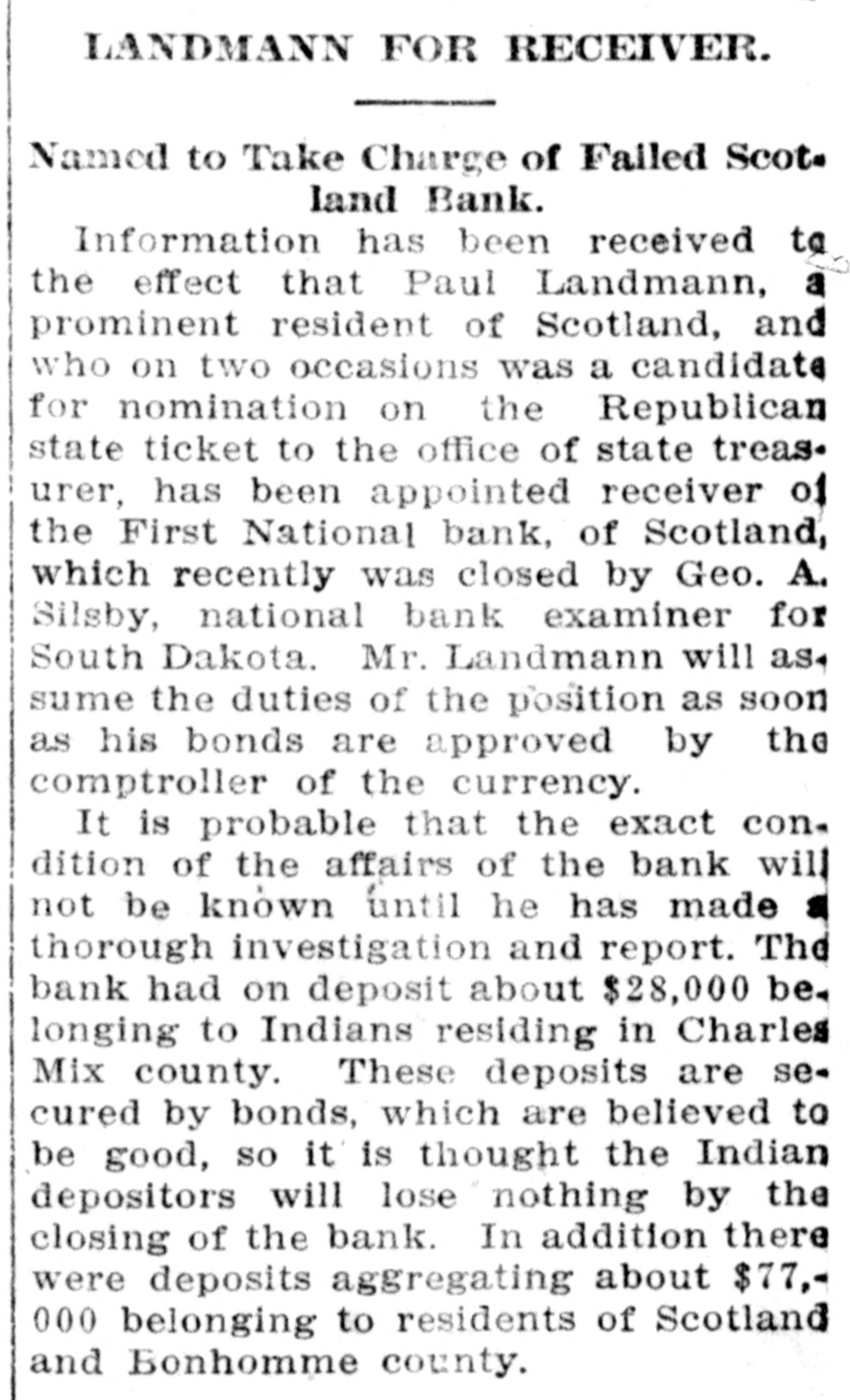
Paul Landmann ... has been appointed receiver of the First National bank of Scotland, which recently was closed by Geo. A. Silsby, national bank examiner for South Dakota. Mr. Landmann will assume the duties ... as soon as his bonds are approved by the comptroller of the currency.
Source
newspapers
6. April 23, 1907 Other
Newspaper Excerpt
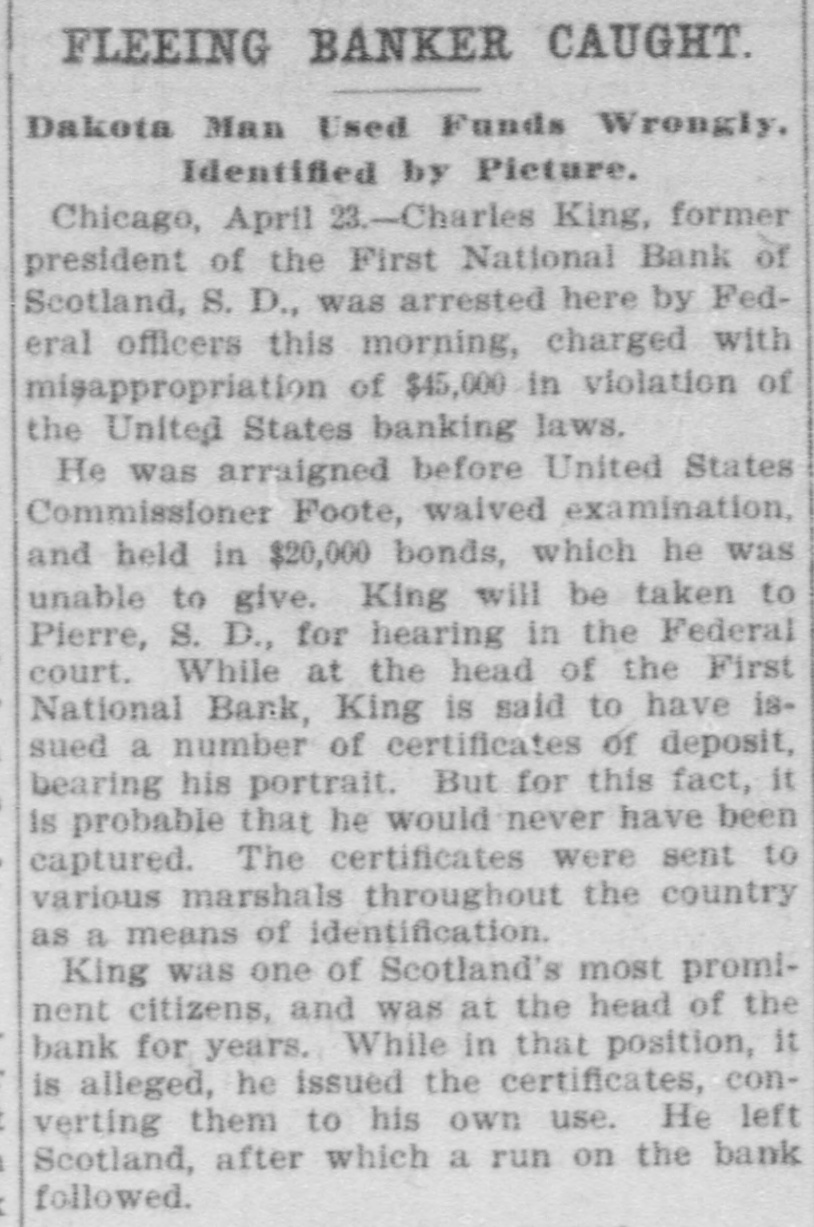
Charles King, former president of the First National Bank of Scotland, S. D., was arrested here by Federal officers this morning, charged with misappropriation ... He left Scotland, after which a run on the bank followed.
Source
newspapers

Newspaper Articles (24)

Article from Evening Journal, February 4, 1907

Click image to open full size in new tab

Article Text

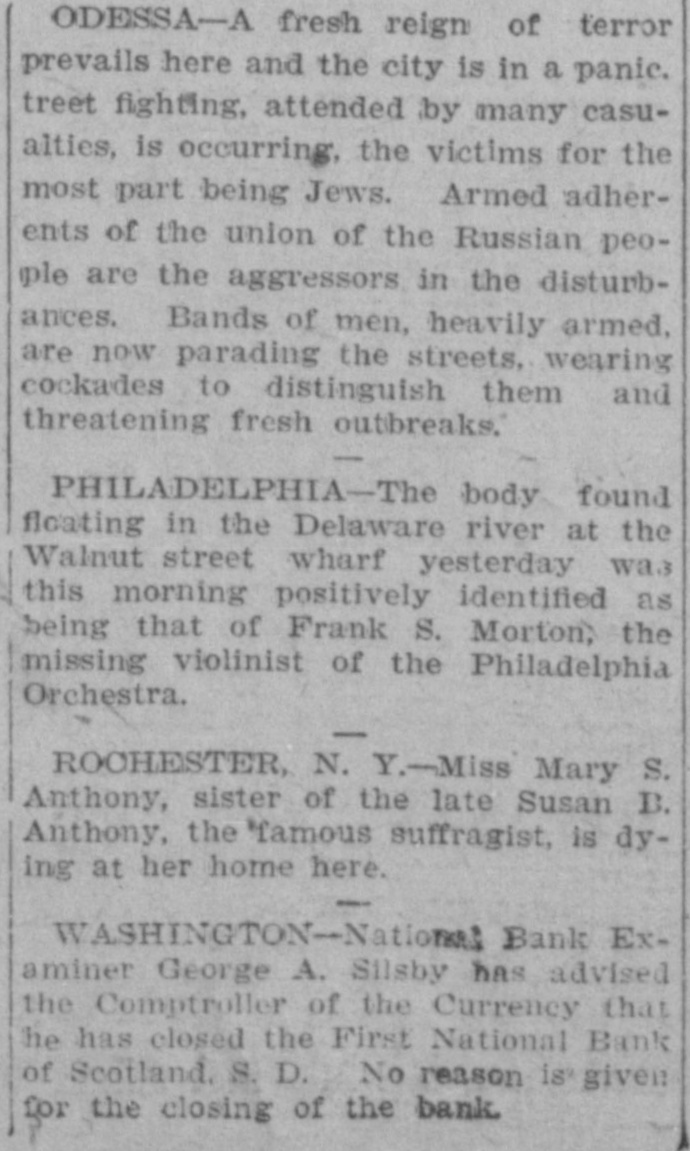
ODESSA-A fresh reign of terror prevails here and the city is in a panic. treet fighting, attended by many casualties, is occurring, the victims for the most part being Jews. Armed adherents of the union of the Russian people are the aggressors in the disturbances. Bands of men, heavily armed. are now parading the streets, wearing cockades to distinguish them and threatening fresh outbreaks. PHILADELPHIA-The body found floating in the Delaware river at the Walnut street wharf yesterday was this morning positively identified as being that of Frank S. Morton, the missing violinist of the Philadelphia Orchestra. ROCHESTER, N. Y.-Miss Mary S. Anthony, sister of the late Susan B. Anthony, the *famous suffragist, is dying at her home here. WASHINGTON-Nationss Bank Examiner George A. Silsby has advised the Comptroller of the Currency that he has closed the First National Bank of Scotland, S. D. No reason is given for the closing of the bank.


Article from Omaha Daily Bee, February 5, 1907

Click image to open full size in new tab

Article Text

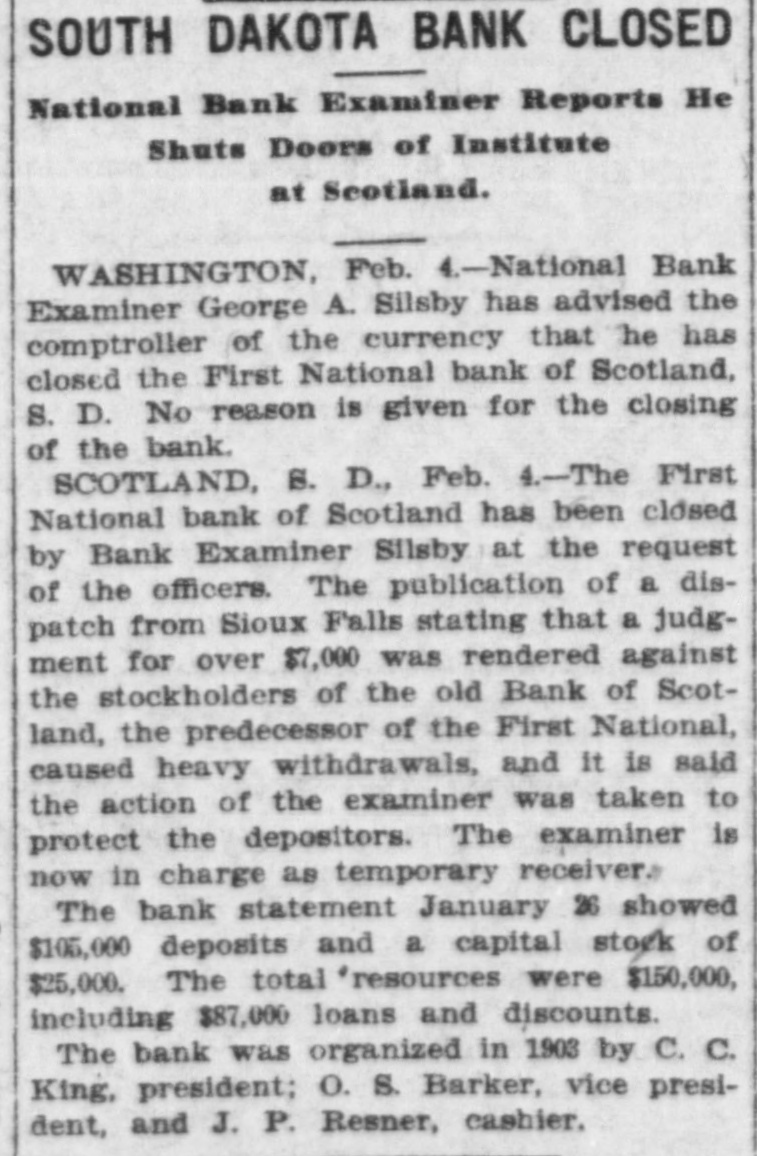
SOUTH DAKOTA BANK CLOSED National Bank Examiner Reports He Shuts Doors of Institute at Scotland. WASHINGTON, Feb. 4.-National Bank Examiner George A. Silsby has advised the comptroller of the currency that he has closed the First National bank of Scotland, S. D. No reason is given for the closing of the bank. SCOTLAND, B. D., Feb. 4.-The First National bank of Scotland has been closed by Bank Examiner Silsby at the request of the officers. The publication of a dispatch from Sioux Falls stating that a judgment for over $7,000 was rendered against the stockholders of the old Bank of Scotland, the predecessor of the First National, caused heavy withdrawals, and it is said the action of the examiner was taken to protect the depositors. The examiner is now in charge as temporary receiver. The bank statement January 26 showed $105,000 deposits and a capital stock of $25,000. The total *resources were $150,000, including $87,000 loans and discounts. The bank was organized in 1903 by C. C. King, president; O. S. Barker, vice president, and J. P. Resner, cashier.


Article from The Citizen-Republican, February 7, 1907

Click image to open full size in new tab

Article Text

First National Bank Closed The First National Bank of Scotland was closed last Saturday at noon, by National Bank Examiner Silsby who is now in charge as temporary receiver. A statement of the bank published the day before it closed, showing condition on January 26, 1907, showed that the bank was apparently in very fair condition, but of course the value of the securities given can not Fe told until the investigation by the examiner is completed. The First National Bank was organized Jan. 1st 1904, succeeding the Bank of Scotland which was organized under an old territorial charter, and run for many years by C. C. King. Mr. King also owned a controlling interest in the stock of the new bank and was its president, and J. P. Resner, cashier. A short time ago the bank was re-organized Mr. King having contracted to sell his stock to Mr. Andrew Resner, but it appears that this deal had not been completed at the time of the failure and that considerable of the stock is still held by Mr. King. In the new organization V. S. Barker was made president and J. P. Resner cashier. Last week a report from Sioux Falls appeared in the daily papers to the effect that a judgment of over $7,000 had been rendered against the stock holders of the old Bank of Scotland, but though Mr. King promptly settled the judgment the suspicion aroused by this report, together with rumors of other matters pending against the Bank of Scotland, caused heavy withdrawals by the depositors of the First National which it was feared, though perhaps without reason, might be held for the obligations of the old bank. Realizing that the bank could not stand a run the examiner was called and after consultation with the officers he decided to take charge of the bank. The last bank statement showed deposits aggregating over $105,000. Of these about half were time deposits and the other half deposits subject to check. In the bank were over fifteen hundred dollars of school money, Mr. Resner being school treasurer; about $1,800 of county funds, and a large amount of government money belonging to the Indian fund. It is hoped that a satisfactory settlement can be made 80 that the bank can be reopened, but if not a permanent receiver will be appointed and the affairs closed up to the best possible advantage to the creditors. Mr. and Mrs. Jac. Hoffman returned on Wednesday from their wedding trip to Gettysburg and


Article from The Mitchell Capital, February 8, 1907

Click image to open full size in new tab

Article Text

# HAVE DEFERRED FRANCHISE Mitchell One Co. Asked Counsel to Wait Several Weeks Before Taking Any Action. The city council met in regular session Monday evening with Mayor Branson in the chair and the following aldermen were present: Messis. Koch, Duncan, Kings, Curtis, Reeves, Wallace, Burns and Wells. Auditor Markham read the minutes of the previous meetings and they stood approved. The reports of the city officers were taken up. The report of Treasurer Kibbee was referred to the finance committee. Weighmaster McDonald reported the receipts of his office as amounting to $30.33. Justice Herbert had but one case in court during the month of January, and his fees amounted to $2.35. The bills against the city were presented, and having been audited by the finance committee, were allowed and warrants ordered drawn for their payment Among the bills was one for $7,000 for the payment of the new pump recently installed at the water works. Several bills were not allowed and were referred to the proper committees for investigation and a report to be made on them at a later meeting. There were quite a few people present in anticipation of the electric light franchise ordinance coming up for passage. When Mayor Branson called for the passage of ordinances, T. J. Spangler, attorney for the Mitchell Gas Co., made a statement to the council in behalf of the company. He stated that the company desired to defer action on the franchise ordinance until a later date, the reason for which he assigned to the unfortunate circumstance which happened at Scotland in the closing of the First National bank, in which one of the stockholders of the Mitchell Gas Co. was interested. The council granted the request and when it adjourned it was until Monday, Feb. 18, at which time the franchise ordinance will be taken up. The ordinance granting an increase of salary to the chief of police and the policemen to $75 and $60 per month, respectively, was placed on its second reading and passed. The city council will now have an opportunity to pass another franchise ordinance. E. M. Sinclair, who is associated with the Columbia Gas & Construction Co. of Sioux City, appeared before the council with a gas franchise, on which he asked favorable consideration. Associated with Mr. Sinclair in this city are D. E. Braught and A. C. Berry. The ordinance is practically the same as the present gas ordinance, with the exception that the rates are to be lower, charging $1.50 per hundred cubic feet for acetylene gas and $1.50 per thousand cubic feet for other gases that might be used by the company. The ordinance also provides for a lowering of these rates when the consumption of the gas shall have reached 3,000 cubic feet in twenty-four hours Mr. Sinclair stated that the company which is manufacturing these plants in Sioux City is desirous, of moving to another location and be held out as an inducement for a passage of the ordniane the pos ible removal of the company's plant to Mitchell. Mr. Sinclair also offered a contract to the city binding the new company to furnish $200 worth of gas to the city each year free of charge. The ordinance was referred to the ordinance committee for investigation. Bids were opened for the construction of additionl height to the smokestack on the city hall building. Fifteen feet of the stack is to be of brick and the balance of steel. Bids were made by Adolph Scheurenbrand and August Groeber for the brick work at $77, and by Frank Summers, whose bid was along the same line, but offering to make the entire stack of steel for $135. The bids were referred to the city hall committee hall with power to act. Alderman Burns called the attention of the council to the very poor condition of the roof on the library building, which is leaking badly and has spoiled much of the decorations placed their by the ladies and that more of it would be destroyed in the future if something was not done with the roof immediately. It was referred to the library committee with power to act in securing bids to place a new roof on the structure. The present roof is so constructed that where it is connected to the troughs the snow blows underneath, and melting seaps through


Article from Willmar Tribune, February 13, 1907

Click image to open full size in new tab

Article Text

C. C. Lewis, editor of the Normal, III., Advocate, was killed by a train at Bloomington. Racing in Tennessee was killed by the passage of the anti-pool selling bill. About 12 persons were killed by a snowslide that overwhelmed three buildings in Monarch, Col. Several men perished in a blizzard in South Dakota, a man was frozen to death in Leavenworth, Kan., and much stock was lost in the storms in the northwest. A legislative committee in Missouri reported that farmers and shippers had been mulcted by the Kansas City Stock Yards company. The Cincinnati congregation of Zion, founded by Dowie, voted to cut loose from the parent church in Zion City. Norman MacDougall, a well-known real estate dealer of Winnipeg, Man., and his little daughter were burned to death in a fire which destroyed their home. United States District Court Judge Charles D. Parlange died suddenly at New Orleans of apoplexy. Senator La Follette denied the announcement of the engagement of his daughter, Miss Fola La Follette. Mrs. Frank Schneck and her two little children were murdered at Centropolis, Kan., and Schneck was arrested. N. Dyment, a well known race horse owner and millionaire lumberman, died at Barrie, Ont. Fred Hamman, an old settler, admitted to the county jail at Chippewa Falls, Wis., on his own application, was found in his cell with his throat cut. The Panama Construction company, incorporated to finance the Panama contract, bid for by William J. Oliver, of Knoxville, Tenn., filed articles of incorporation with the secretary of state of New York. National Bank Examiner George A. Silsby has informed the comptroller of the currency that he has closed the First National bank of Scotland, S. D. John J. H. Kelly, late of the Fifth United States infantry, and a veteran of the Sitting Bull and Chief Joseph Indian wars, died while sitting in his chair at Springfield, III. Miss Margaret Sheppard ended her life at her residence in Oakland, Cal., by inhaling gas fumes. Disappointment in love is said to have been the cause. She formerly lived in Detroit, Mich. Capt. George Jackson Grammer, vice president in charge of freight traffic, New York Central lines, died in Chicago. He was 63 years old. The federal supreme court upheld the injunction restraining Chicago from reducing the price of gas to 75 cents. Twenty-two miners were killed by an explosion in a coal mine at Thomas, W. Va. Just as he was stepping from the engine cab of the Cleveland flyer at the Pittsburg & Lake Erie railroad station, Pittsburg, after completing the fast run from Cleveland, Engineer S. H. Morrow dropped dead from heart disease. A. G. Barker, assistant general passenger agent of the Chicago & Northwestern railway, whose headquarters were in Portland, Ore., died there of pneumonia. Ulderic Hugron, of Waterbury, Conn., entered an apartment in New York where a wedding party was gathered and blew out his brains. Lady Grenfell, daughter of Lord Grey, viceroy of Canada, died at Ottawa, of typhoid fever. Advices from Vladivostok say a number of men uniformed as sailors tried to blow up the steamers Gregory and Mercury with bombs in Vladivostok. "Perry Martin," who secured a position as bellboy in the Oaks hotel. Beaumont, Tex., has been discovered to be a woman of 25 years. She has disappeared. Three volunteer firemen were killed and four seriously hurt while fighting a blaze at White Plains, N. Y. Seven persons were hurt in a tenement house blaze in Cherry street, New York city. United States Senator John E. Dryden, of New Jersey, withdrew his name as a candidate for reelection because of poor health and "for the sake of his party and state." The Hotel Trimmer at Ashland, Wis., burned and William Thombs was asphyxiated. Chester Thompson, on trial for the murder of Judge George Meade Emery in Seattle, was found "not guilty by reason of insanity." G. Sinclair Moulton, proprietor of the Manhattan Square hotel of New York, committed suicide because of sickness. Asa Kenyon of Oneonta, N. Y., and Mrs. Marie Dedrick of Syracuse made a suicide pact and drank laudanum; the woman died, but the man may recover. The bark Charles Loring, lumber laden, was sunk by the Old Dominion steamer Seneca off Sea Girt, N. J., but the crew was rescued. The body of Miss Frances Martin, 18 years old, was found in a room in the Forest building, Washington, Pa. Whether or not she was murdered has not been determined.


Article from The Miller Sun, March 2, 1907

Click image to open full size in new tab

Article Text

LANDMANN FOR RECEIVER. Named to Take Charge of Failed Scot. land Bank. Information has been received to the effect that Paul Landmann, a prominent resident of Scotland, and who on two occasions was a candidate for nomination on the Republican state ticket to the office of state treas. urer, has been appointed receiver 01 the First National bank, of Scotland, which recently was closed by Geo. A. Silsby, national bank examiner for South Dakota. Mr. Landmann will as. sume the duties of the position as soon as his bonds are approved by the comptroller of the currency. It is probable that the exact condition of the affairs of the bank will not be known until he has made n thorough investigation and report. The bank had on deposit about $28,000 be. longing to Indians residing in Charles Mix county. These deposits are secured by bonds, which are believed to be good, so it is thought the Indian depositors will lose nothing by the closing of the bank. In addition there were deposits aggregating about $77,000 belonging to residents of Scotland and Bonhomme county.


Article from The Citizen-Republican, March 14, 1907

Click image to open full size in new tab

Article Text

CASTORIA Bears the The Kind You Have Always Bought Signature of The new German Bank of Scotland has employed Alex Treiber, formerly employed as agent for the J. H. Queal Lumber Co., to take charge of the bank as cashier, and as soon as their books arrive will be ready to commence business. Mr. Treiber's acquaintance with the people around Scotland will aid him in his work and inspire confidence in the new institution. Mr. Landmann, receiver of the First National bank, has reserved office room in the rear of the building for two years free of charge. While it is not expected that it will require that length of time to close up the affairs of the defunct bank, yet to avoid the possibility of having to pay any rent, and save as much as possible for the creditors, he thought it best to make provision to cover any contingency.


Article from The Washington Herald, April 24, 1907

Click image to open full size in new tab

Article Text

# FLEEING BANKER CAUGHT. Dakota Man Used Funds Wrongly, Identified by Picture. Chicago, April 23.-Charles King, former president of the First National Bank of Scotland, S. D., was arrested here by Federal officers this morning, charged with misappropriation of $45,000 in violation of the United States banking laws. He was arraigned before United States Commissioner Foote, waived examination, and held in $20,000 bonds, which he was unable to give. King will be taken to Pierre, S. D., for hearing in the Federal court. While at the head of the First National Bank, King is said to have issued a number of certificates of deposit, bearing his portrait. But for this fact, it is probable that he would never have been captured. The certificates were sent to various marshals throughout the country as a means of identification. King was one of Scotland's most prominent citizens, and was at the head of the bank for years. While in that position, it is alleged, he issued the certificates, converting them to his own use. He left Scotland, after which a run on the bank followed.


Article from The Mitchell Capital, April 26, 1907

Click image to open full size in new tab

Article Text

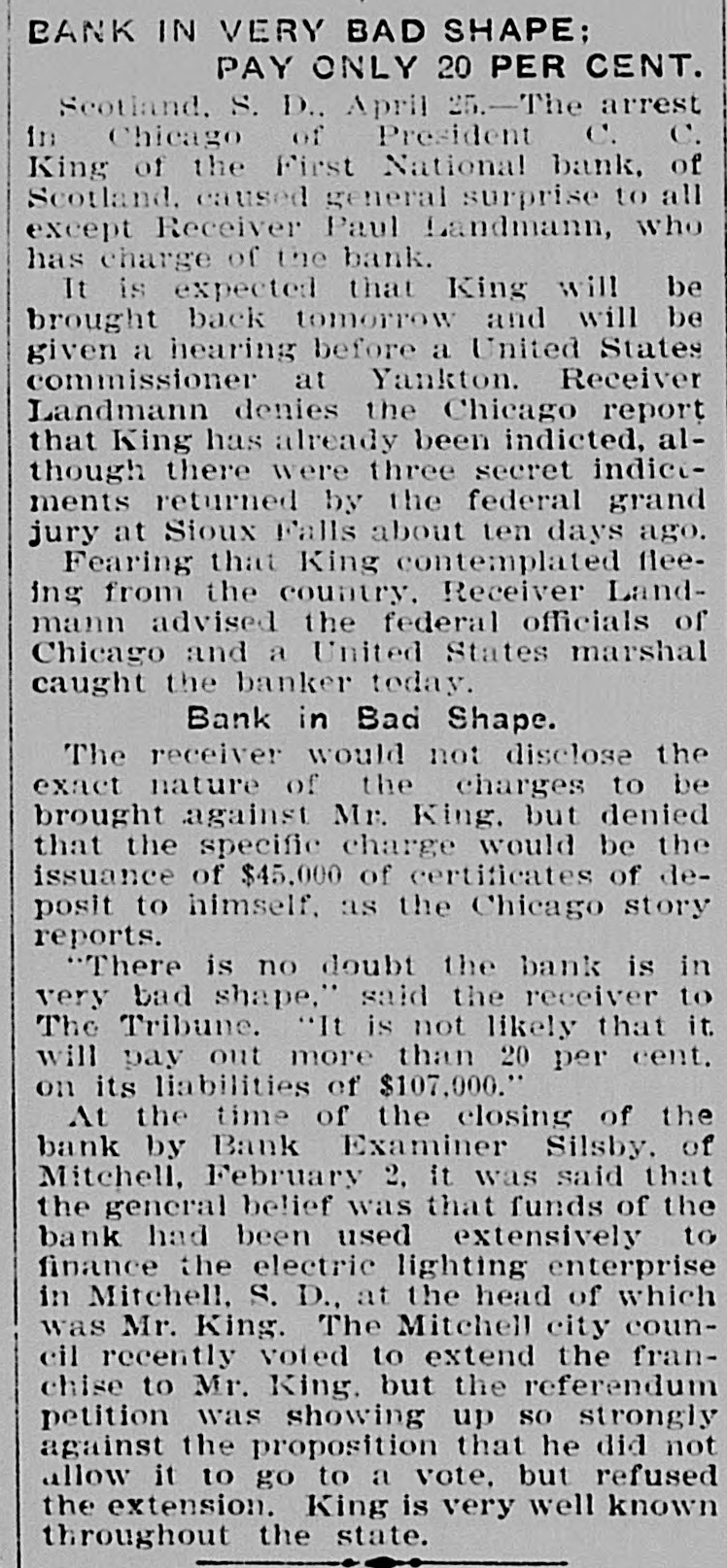
BANK IN VERY BAD SHAPE; PAY ONLY 20 PER CENT. Scotlend, S. D., April 25.-The arrest in Chicago of President C. C. King of the First National bank, of Scotland, caused general surprise to all except Receiver Paul Landmann, who has charge of the bank. It is expected that King will be brought back tomorrow and will be given a hearing before a United States commissioner at Yankton. Receiver Landmann denies the Chicago report that King has all andy been indicted, although there were three secret indictments returned by the federal grand jury at Slous Falls about ten days ago. Fearing that King contemplated fleeing from the country. Receiver Landmann advised the federal officials of Chicago and a United States marshal caught the banker today. Dank in Bad Shape. The receiver would not disclose the exact nature f the charges to be brought against Mr. King, but denied that the specific charge would be the issuance of $45,000 of certificates of deposit to himself, as the Chicago story reports. "There is Ro doubt the bank is in very bad shape," said the receiver to The Tribune. "It is not likely that it will pay out more than 20 per cent. on its liabiliti pef $107,000." At the tin of the closing of the bank by work Exariner Silsby, of Mitchell, bruary 3, it was said that the general belief was that funds of the bards had beei. used extensively to nance the electric lighting enterprise in Mit S. D., at the head of which was Mr. King. The Mitchell city council recently voted to extend the franchise to Mr. King, but the referendum petition was showing up so strongly against the proposition that he did not allow it to go to a vote, but refused the extension. King is very well known throughout the state.


Article from Twice-A-Week Plain Dealer, April 30, 1907

Click image to open full size in new tab

Article Text

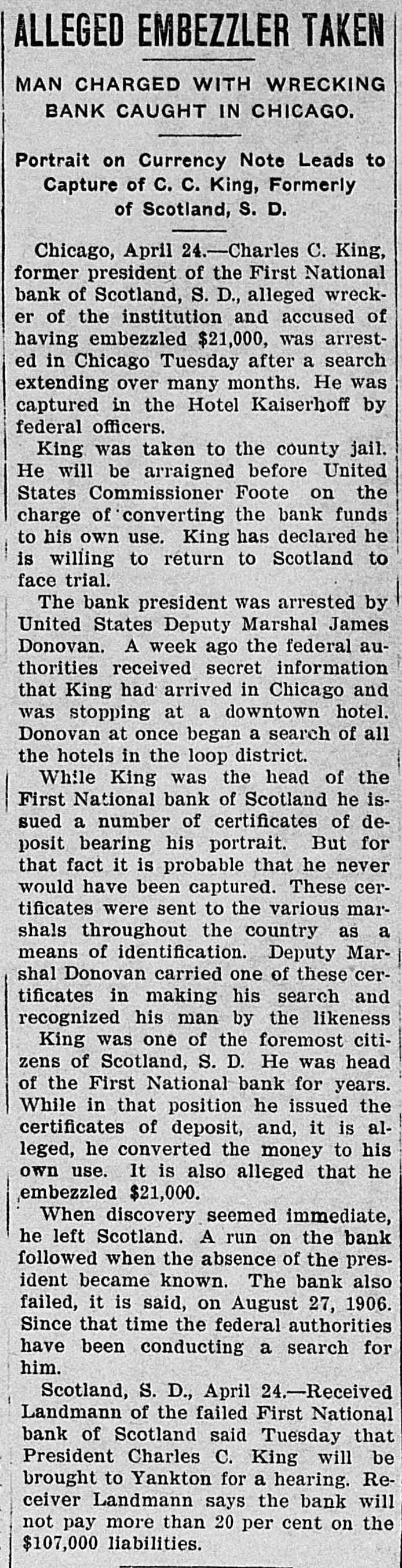
ALLEGED EMBEZZLER TAKEN MAN CHARGED WITH WRECKING BANK CAUGHT IN CHICAGO. Portrait on Currency Note Leads to Capture of c. c. King, Formerly of Scotland, S. D. Chicago, April 24.-Charles C. King, former president of the First National bank of Scotland, S. D., alleged wrecker of the institution and accused of having embezzled $21,000, was arrested in Chicago Tuesday after a search extending over many months. He was captured in the Hotel Kaiserhoff by federal officers. King was taken to the county jail. He will be arraigned before United States Commissioner Foote on the charge of converting the bank funds to his own use. King has declared he is willing to return to Scotland to face trial. The bank president was arrested by United States Deputy Marshal James Donovan. A week ago the federal authorities received secret information that King had arrived in Chicago and was stopping at a downtown hotel. Donovan at once began a search of all the hotels in the loop district. While King was the head of the First National bank of Scotland he issued a number of certificates of deposit bearing his portrait. But for that fact it is probable that he never would have been captured. These certificates were sent to the various marshals throughout the country as a means of identification. Deputy Marshal Donovan carried one of these certificates in making his search and recognized his man by the likeness King was one of the foremost citizens of Scotland, S. D. He was head of the First National bank for years. While in that position he issued the certificates of deposit, and, it is alleged, he converted the money to his own use. It is also alleged that he embezzled $21,000. When discovery seemed immediate, he left Scotland. A run on the bank followed when the absence of the president became known. The bank also failed, it is said, on August 27, 1906. Since that time the federal authorities have been conducting a search for him. Scotland, S. D., April 24.-Received Landmann of the failed First National bank of Scotland said Tuesday that President Charles C. King will be brought to Yankton for a hearing. Receiver Landmann says the bank will not pay more than 20 per cent on the $107,000 liabilities.


Article from Forest City Press, May 2, 1907

Click image to open full size in new tab

Article Text

BANK IN VERY BAD SHAPE: PAY ONLY 20 PER CENT. Scotland, S. D., April 25.-The arrest in Chicago of President C. C. King of the First National bank, of Scotland, caused general surprise to all except Receiver Paul Landmann, who has charge of the bank. It is expected that King will be brought back tomorrow and will be given a hearing before a United States commissioner at Yankton. Receiver Landmann denies the Chicago report that King has already been indicted, although there were three secret indictments returned by the federal grand jury at Sioux Falls about ten days ago. Fearing that King contemplated fleeing from the country. Receiver Landmann advised the federal officials of Chicago and a United States marshal caught the banker today. Bank in Bad Shape. The receiver would not disclose the exact nature of the charges to be brought against Mr. King. but denied that the specific charge would be the issuance of $45,000 of certificates of deposit to himself, as the Chicago story reports. "There is no doubt the bank is in very bad shape," said the receiver to The Tribune. "It is not likely that it. will pay out more than 20 per cent. on its liabilities of $107,000." At the time of the closing of the bank by Bank Examiner Silsby. of Mitchell, February 2, it was said that the general belief was that funds of the bank had been used extensively to finance the electric lighting enterprise in Mitchell, S. D., at the head of which was Mr. King. The Mitchell city council recently voted to extend the franchise to Mr. King. but the referendum petition was showing up so strongly against the proposition that he did not allow it to go to a vote, but refused the extension. King is very well known throughout the state.


Article from The Ordway New Era, May 3, 1907

Click image to open full size in new tab

Article Text

a freight engine drawing a was year the emboose O'Fallon, Mo., running boller rapidly of the engine exploded, kiling three trainmen, injurink two others, and wrecking the engine and cabooke. There is a serious lack of farm hands in the Northwest according to reports received by the Great Northern rallroad. Two thousand prairie dogs at $3 each have been contracted for in South Dakota by English lords who have the on their shooting reserves in exterminate rabbits and England hares and are languishing for sport. The Russo-Japanese negotiations b on the fisheries question are reported to have resulted in a satisfactory agreement. , e A lawsuit that has been in the courts 32 years was recently again argued in the Supreme court of Missourl. The motermen and conductors on e the Salt Lake City, Utah, street car lines to the number of 450 have struck I following a refusal of the company officials to arbitrate their differences. A new schedule to become effective b July 1, increases the pay of the rural free delivery carries from 9 to 25 per cent, based upon the number of miles traveled. of Binger Herman former of the general commissioner The trial land office reon of continuing 12 records a charge after destroying weeks, public sulted in a verdict of acquittal. Mo., asThe Sedalla, Busines contract Men's sociation has signed a with a shoe company a will be built at branch St. Louis factory by which Sedalia. six is being formed in of the wheat growing A principal plan wheat states for by the farmers to hold their one dollar per bushel. 3 A sensation was created in Joplin, the discovery that Mo., by luxuriously the police force were enjoying a furnished lounging room which had been donated by saloon keepers, dissolute women and gamblers of the city. Public sentiment was thoroughly aroused and the grand jury will investigate. In a letter written by President to the chairman of the Chicago Roosevelt Moyer-Haywood conference former the aspresident stands by his sertions and declares that the actions of the friends of the accused men are flagrantly improper, in that they are trying to influence judge and jury in the coming trial. Charge C. King. president of the First National bank of Scotland, S. D., has been arrested in Chicago charged with having misapplied the funds of the bank, which recently failed. The Zoeller packing plant at Pittsburg. Pa., was recently destroyed by fire. Five hundred thousand pounds of lard in one building was entirely consumed. The loss was placed at $300.000. The supreme court of Kansas has appointed Judge S. H. Allen, G. all H. Whitcourt and Judge T. F. Garver, of Topeka, as receivers for the Kan- A sas property of various breweries. joint bond of $45,000 was required. Secretary Wilson, by executive and order, has created the board of food drug inspection, whose duty it shall be to adminiter the national pure food law. The president heartily approves the plan. Frank H. Butler, a steamer deckhand, has been arrested charged with the murder of the four-year-old dis- son of Dr. Horace N. Marvin, who appeared from his home in Dover, Del., March 4. A recent bulletin issued by the secretary of the Oklahoma board of agriculture states that the wheat crop is only 60.8 per cent and the oats crop 30 per cent. A movement has been started in Milwaukee, Wis., to set aside a day the in May on which every union in country is to protest against Presi- that dent Roosevelt's assertion Moyer, Haywood and Debs are unde sirable citizens. Four million bushels of coal from were shipped down the Ohio river Pittsburg in one day recently, break- the ing all records for this time of year. The suit of the Copper Range Consolidated Mining company Colbert oth- C. Burrage, Thomas W. Lawson and has been settled out of court. ers, government forestry service


Article from Rocky Ford Enterprise, May 3, 1907

Click image to open full size in new tab

Article Text

force were enjoying a luxuriously room which bad donated by saloon furnished been lounging keepers. of dis- the solute women and gamblers Public sentiment was city. thorough- jury will ly aroused and the grand investigate In a letter written by President to the chairman of the Chistands by his ascago president Roosevelt Moyer-Haywood conference former the and declares that the actions of of the men are sertions the friends accused they are flagrantly improper. in that trying to influence judge and jury in the coming trial. c. King. president of the 8. bank of First Charge has National Scotland, Chicago D., been arrested in charged with having misapplied the funds of the bank, which recently failed. The Zoeller packing plant at Pittsburg. Pa., was recently destroyed by hundred thousand pounds one building was of fire. lard Five in entirely at consumed. The loss was placed $200,000. Four million bushels of coal were down the Ohio in one day Pittsburg shipped recently. river of break- from the ing all records for this time year. The supreme court of Kansas has Judge S. H. H. and Judge T. F. appointed Whiteourt Allen, Garver, the G. Kan- all of Topeka. as receivers for A was of various bond of $45,000 was joint property breweries. required. Wilson, by executive orcreated the board of der, Secretary has food It shall and drug inspection, whose duty be to adminiter the national pure food law. The president heartily approves the plan. Frank H. Butler. who was charged the murder of the Marvin boy at has been for want of with custody. Dover. Del. sufficient released from evidence against him. Frank H. Butler, a steamer deckhas been arrested charged with of the son of Horace N. Marvin, who hand, the Dr. murder four-year-old disappeared from his home in Dover, Del., March 4. has been started in Wis., to set a Milwaukee, A movement union aside In day the May on which every is to protest Roosevelt's dent country in assertion against Presi- unde- that Moyer. Haywood and Debs are sirable citizens. A recent bulletin Issued by the sec. of the Oklahoma ag. states that the crop riculture retary board wheat of is only 60.8 per cent and the oats crop 30 per cent. The Kansas supreme court has the petition of Gen- in eral for a granted Jackson receivership Attorney the ouster injunction cases against the brewery companies who have been doing business in Kansas contrary to the prohibitory law. t The main features at the opening of Jamestown exposition were the naval display spectacular the Roosevelt. and the The address of President exposition itself was not ready for visitors when the opening exercises were held. The suit of the Copper Range Consolidated Mining company Colbert C. Thomas W. Lawson oth0 been settled out Burrage, ers. has of and court. service government forestry has a circular consumes every year country The issued saying that between this three and four times more wood than is grown in all its forests in the same time. n Miss Violet Spencer. of Alton, III., e was recently attacked by a negro near and slashed across t with a razor. A n domen her home heavy the Several cloak abwas all that saved her life. suspects have been arrested. f n Superior Judge Hebbard, of San has sworn to a t Assistant against Francisco, District complaint Attorney charging criminal libel. the Eelevator company St. f Heney Harroun W. H. Harroun, ex-president of of Mo., pleaded guilty to forgery in fourth degree and was h Joseph. the He sentenced later to. 18 months in jail. was paroled. Chris Maier, a Topeka jointist has by Gov. y bond never to in been gave a pardoned $1,000 Hoch. engage He the liquor business again. field gun with the t The new being which armed n Japanese artillery is e has an effective range of about 8,500 yards. Each gun costs $5,000. advices are to the efk the peace e in Central fect progress Washington that negotiations America have in deadlock a rehostilities seems come newal to of a and that of probable. AmerThe Architectual league a convention with delegates ica ington is holding present in Wash- from all sectons of the country.


Article from The Citizen-Republican, June 27, 1907

Click image to open full size in new tab

Article Text

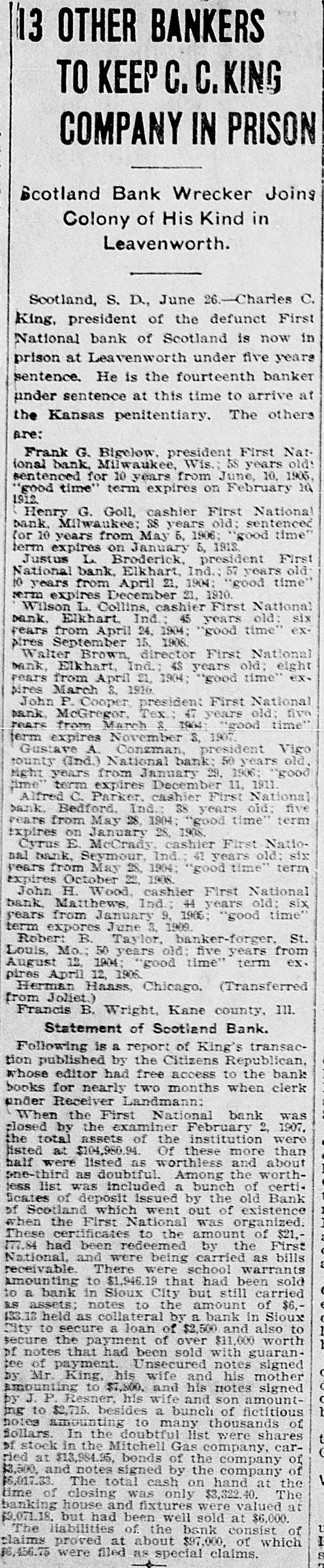
13 OTHER BANKERS TO KEEP c. C. KING COMPANY IN PRISON Scotland Bank Wrecker Joins Colony of His Kind in Leavenworth. Scotland, S. D., June 26.-Charles C. King, president of the defunct First National bank of Scotland is now in prison at Leavenworth under five years sentence. He is the fourteenth banker under sentence at this time to arrive at the Kansas penitentiary. The others are: Frank G. Bigelow, president First National bank, Milwaukee, Wis.: 58 years old: sentenced for 10 years from June, 10, 1905, "good time" term expires on February 10 1912. Henry G. Goll, cashier First National bank. Milwaukee: 38 years old; sentenced for 10 years from May 5, 1906: "good time" term expires on January 5, 1913. Justus L. Broderick, president First National bank, Elkhart, Ind.: 57 years old: 10 years from April 21, 1904: "good time" rerm expires December 21, 1910. Wilson L. Collins, cashier First National bank. Elkhart. Ind.: 45 years old: six years from April 24, 1904; "good time" expires September 15. 1908. Walter Brown director First National bank, Elkhart, Ind.: 48 years old; eight rears from April 21, 1904; "good time" ex. pires March 8. 1916. John P. Cooper, president First National bank, McGregor, Tex.: 47 years old: fivo rears from March 8. 1904: "good time" term expires November 3, 1907. Gustave A. Conzman, president Vigo county (Ind.) National bank: 50 years old. Mght years from January 29, 1906; "good time" term expires December 11, 1911. Alfred C. Parker. cashier First National bank. Bedford. Ind.: 38 years old: five years from May 28. 1904: "good time" term expires on January 28, 1908. Cyrus E. McCrady, cashier First National bank, Seymour, Ind.; 41 years old: six years from May 28, 1904; "good time" term expires October 22. 1908. John H. Wood, cashier First National bank, Matthews, Ind.; 44 years old: six years from January 9, 1905; "good time" term expores June 3. 1909. Robert B. Taylor, banker-forger, St. Louis, Mo.: 50 years old: five years from August 12. 1904; "good time" term ex. pires April 12, 1908. Herman Haass, Chicago. (Transferred from Joliet.) Francis B. Wright, Kane county, III. Statement of Scotland Bank. Following is a report of King's transaction published by the Citizens Republican, whose editor had free access to the bank books for nearly two months when clerk under Receiver Landmann: When the First National bank was closed by the examiner February 2, 1907. the total assets of the institution were listed at $104,980.94. Of these more than half were listed as worthless and about pne-third as doubtful. Among the worthless list was included a bunch of certiScates of deposit issued by the old Bank of Scotland which went out of existence when the First National was organized. These certificates to the amount of $21,177.84 had been redeemed by the First National, and were being carried as bills receivable. There were school warrants amounting to $1,946.19 that had been sold to a bank in Sloux City but still carried LS assets; notes to the amount of $6,433.18 held as collateral by a bank in Sioux City to secure a loan of $2,500 and also to secure the payment of over $11,000 worth Df notes that had been sold with guarantee of payment. Unsecured notes signed ( by Mr. King, his wife and his mother o amounting to $7,800, and his notes signed € by J. P. Resner, his wife and son amounting to $2,715. besides a bunch of fictitious notes amounting to many thousands of fiollars. In the doubtful list were shares t of stock in the Mitchell Gas company, care


Article from The Citizen-Republican, August 8, 1907

Click image to open full size in new tab

Article Text

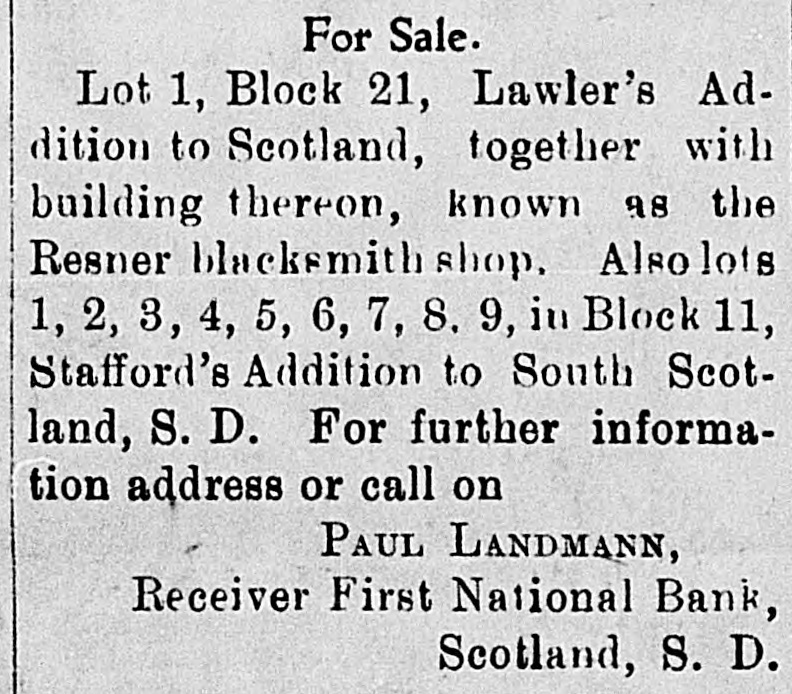
For Sale. Lot 1, Block 21, Lawler's Addition to Scotland, together with building thereon, known 98 the Resner blacksmith shop. Also lots 1, 2, 3, 4, 5, 6, 7,8,9, in Block 11, Stafford's Addition to South Scotland, S.D. For further information address or call on PAUL LANDMANN, Receiver First National Bank, Scotland, S. D.


Article from The Citizen-Republican, August 22, 1907

Click image to open full size in new tab

Article Text

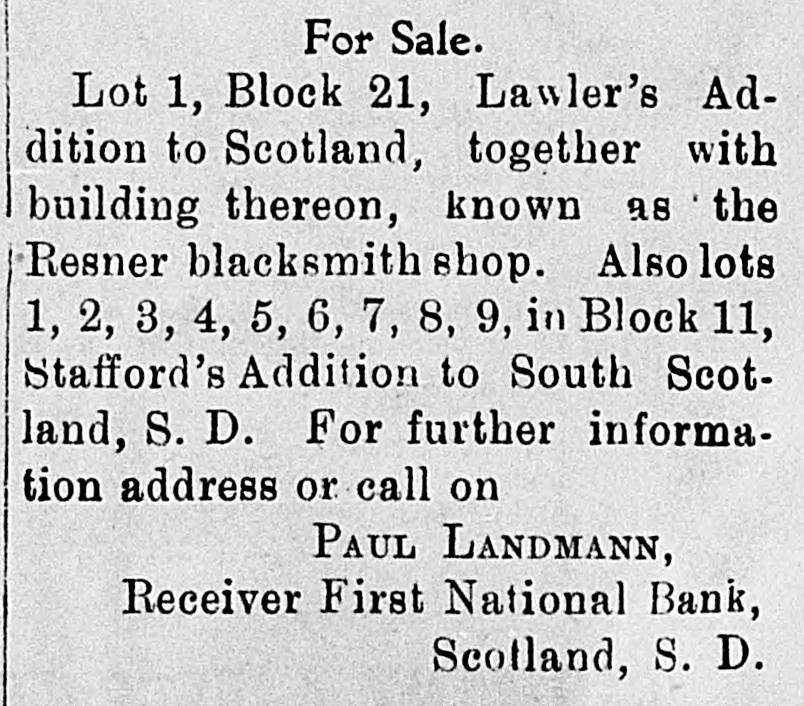
For Sale. Lot 1, Block 21, Lawler's Addition to Scotland, together with building thereon, known as the Resner blacksmith shop, Alsolots 1,2, 3, 4, 5, 6,7,8,9, in Block 11, Stafford's Addition to South Scotland, S.D. For further information address or call on PAUL LANDMANN, Receiver First National Bank, Scotland, S. D.


Article from The Citizen-Republican, September 5, 1907

Click image to open full size in new tab

Article Text

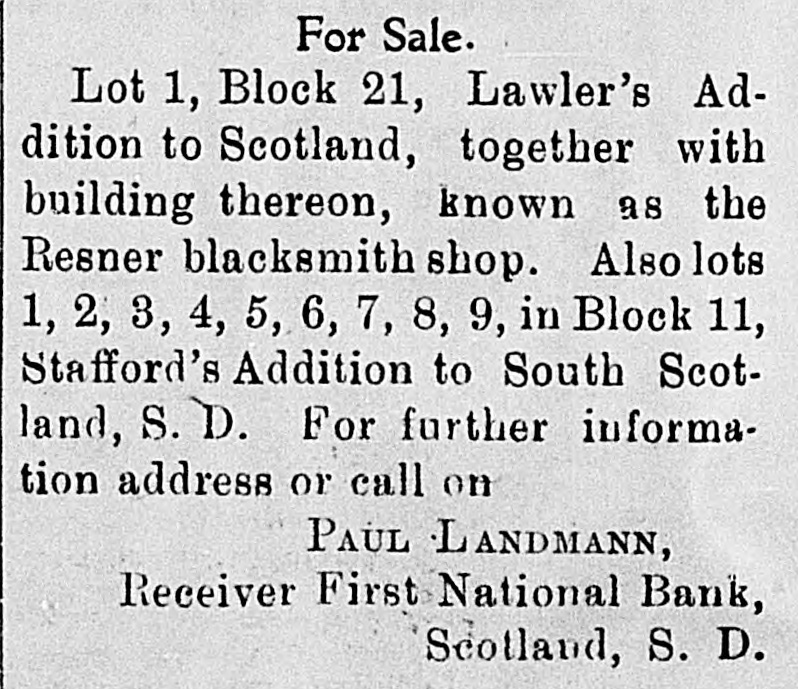
For Sale. Lot 1, Block 21, Lawler's Addition to Scotland, together with building thereon, known as the Resner blacksmith shop. Also lots 1, 2, 3, 4, 5, 6, 7, 8, 9, in Block 11, Stafford's Addition to South Scotland, S. D. For further information address or call on PAUL LANDMANN, Receiver First National Bank, Scotland, S. D.


Article from The Citizen-Republican, September 19, 1907

Click image to open full size in new tab

Article Text

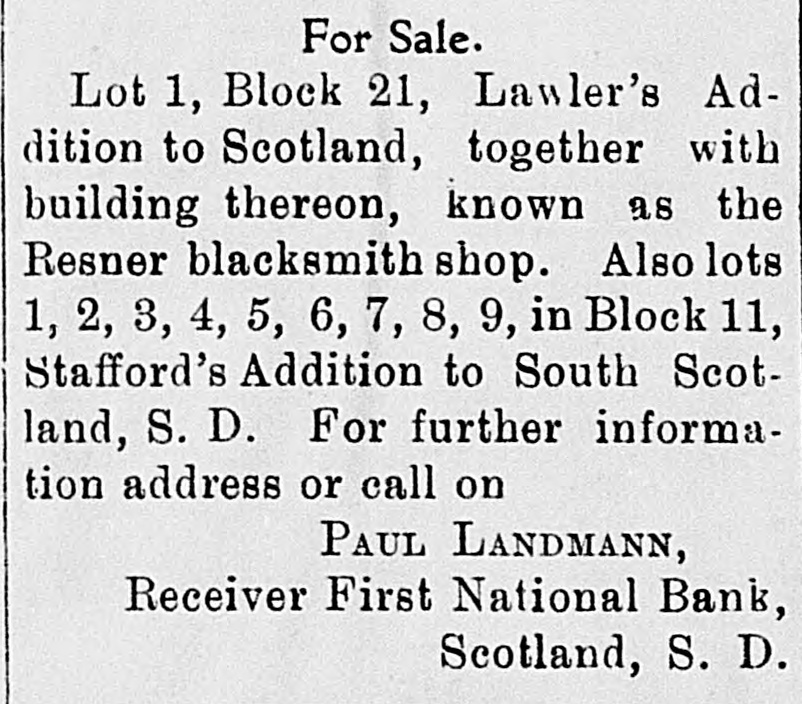
For Sale. Lot 1, Block 21, Lawler's Addition to Scotland, together with building thereon, known as the Resner blacksmith shop. Also lots 1, 2, 3, 4, 5, 6, 7,8, 9, in Block 11, Stafford's Addition to South Scotland, S. D. For further information address or call on PAUL LANDMANN, Receiver First National Bank, Scotland, S. D.


Article from The Citizen-Republican, October 10, 1907

Click image to open full size in new tab

Article Text

For Sale. Lot 1, Block 21, Lawler's Addition to Scotland, together with building thereon, known as the Resner blacksmith shop. Also lots 1, 2, 3, 4, 5, 6, 7, 8, 9, in Block 11, Stafford's Addition to South Scotland, S. D. For further information address or call on PAUL LANDMANN, Receiver First National Bank, Scotland, S. D.


Article from The Citizen-Republican, December 19, 1907

Click image to open full size in new tab

Article Text

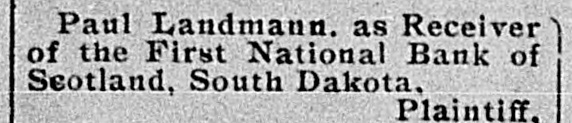
Paul Landmann. as Receiver of the First National Bank of Scotland, South Dakota, Plaintiff,


Article from The Greenville Journal, January 2, 1908

Click image to open full size in new tab

Article Text

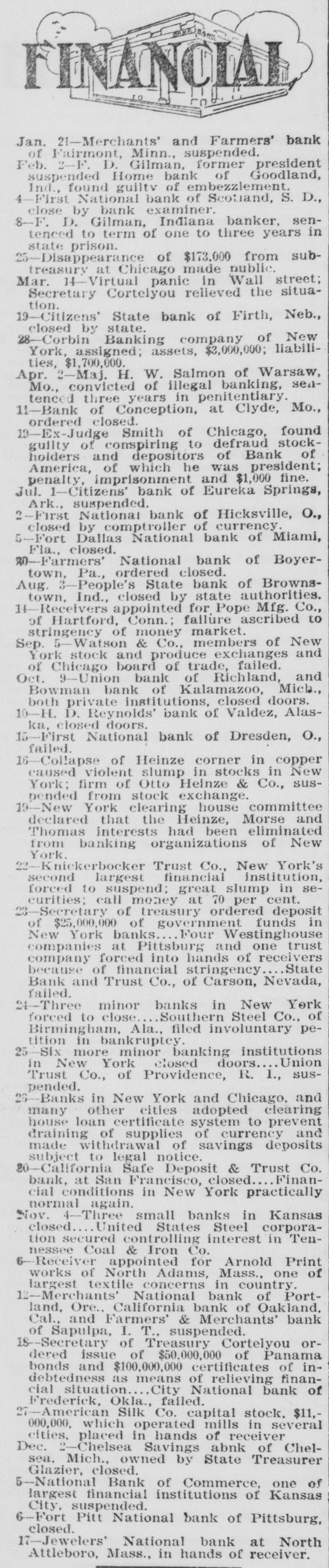
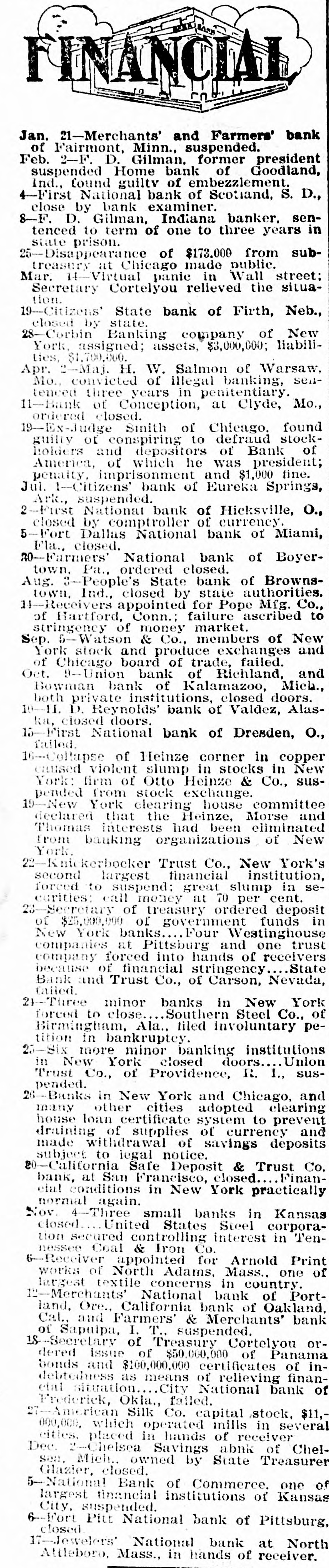
FINANCIAL to Jan. 21-Merchants' and Farmers' bank of Fairmont, Minn., suspended. Feb. 2-F. D. Gilman, former president suspended Home bank of Goodland, Ind., found guiltv of embezzlement. 4-First National bank of Scotland, S. D., close by bank examiner. 8-F. D. Gilman, Indiana banker. sentenced to term of one to three years in state prison. 25-Disappearance of $173,000 from subtreasury at Chicago made public. Mar. 14-Virtual panic in Wall street; Secretary Cortelyou relieved the situation. 19-Citizens' State bank of Firth, Neb., closed by state. 28-Corbin Banking company of New York, assigned; assets, $3,000,000; liabilities, $1,700,000. Apr. 2-Maj. H. W. Salmon of Warsaw, Mo., convicted of illegal banking, sentenced three years in penitentiary. 11-Bank of Conception, at Clyde, Mo., ordered closed. 19-Ex-Judge Smith of Chicago, found guilty of conspiring to defraud stockholders and depositors of Bank of America, of which he was president; penalty, imprisonment and $1,000 fine. Jul. 1-Citizens' bank of Eureka Springs, Ark., suspended. 2-First National bank of Hicksville, O., closed by comptroller of currency. 5-Fort Dallas National bank of Miami, Fla., closed. 20--Farmers' National bank of Boyertown, Pa., ordered closed. Aug. 3-People's State bank of Brownstown, Ind., closed by state authorities. it-Receivers appointed for Pope Mfg. Co., of Hartford, Conn.: failure ascribed to stringency of money market. Sep. -Watson & Co., members of New York stock and produce exchanges and of Chicago board of trade, failed. Oct. 9-Union bank of Richland, and Bowman bank of Kalamazoo, Mich., both private institutions, closed doors. 10-H. D. Reynolds' bank of Valdez, Alaska, closed doors. 15-First National bank of Dresden, O., failed. 16-Collapse of Heinze corner in copper caused violent slump in stocks in New York; firm of Otto Heinze & Co., suspended from stock exchange. 19-New York clearing house committee declared that the Heinze, Morse and Thomas interests had been eliminated from banking organizations of New York. 22-Knickerbocker Trust Co., New York's second largest financial institution, forced to suspend; great slump in securities; call money at 70 per cent. 23-Secretary of treasury ordered deposit of $25,000,000 of government funds in New York banks Four Westinghouse companies at Pittsburg and one trust company forced into hands of receivers because of financial stringency State Bank and Trust Co., of Carson, Nevada, failed. 24-Three minor banks in New York forced to close Southern Steel Co., of Birmingham, Ala., filed involuntary petition in bankruptcy. 25-Six more minor banking institutions in New York closed doors. Union Trust Co., of Providence, R. I., suspended. 26-Banks in New York and Chicago, and many other cities adopted clearing house loan certificate system to prevent draining of supplies of currency and made withdrawal of savings deposits subject to legal notice. 30-California Safe Deposit & Trust Co. bank, at San Francisco, closed Financial conditions in New York practically normal again. Nov. 4-Three small banks in Kansas closed United States Steel corporation secured controlling interest in Tennessee Coal & Iron Co. 6-Receiver appointed for Arnold Print works of North Adams, Mass., one of largest textile concerns in country. 12-Merchants' National bank of Portland, Ore., California bank of Oakland, Cal., and Farmers' & Merchants' bank of Sapulpa, I. T., suspended. 18-Secretary of Treasury Cortelyou ordered issue of $50,000,000 of Panama bonds and $100,000,000 certificates of in'debtedness as means of relieving financial situation City National bank of Frederick, Okla., failed. 27-American Silk Co. capital stock, $11,000,000, which operated mills in several cities, placed in hands of receiver. Dec. 2-Chelsea Savings abnk of Chelsea, Mich., owned by State Treasurer Glazier, closed. 5-National Bank of Commerce, one of largest financial institutions of Kansas City, suspended. 6-Fort Pitt National bank of Pittsburg, closed. 17-Jewelers' National bank at North Attleboro, Mass., in hands of receiver.

Article from River Falls Journal, January 2, 1908

Click image to open full size in new tab

Article Text

FINANCIAL Jan. 21-Merchants' and Farmers' bank of Fairmont, Minn., suspended. Feb. 2-F. D. Gilman, former president suspended Home bank of Goodland, Ind., found guiltv of embezzlement. 4-First National bank of Scotland, S. D., close by bank examiner. 8-F. D. Gilman, Indiana banker, sentenced to term of one to three years in state prison. 25-Disappearance of $173,000 from subtreasury at Chicago made public. Mar. 14-Virtual panic in Wall street; Secretary Cortelyou relieved the situation. 19-Citizens' State bank of Firth, Neb., closed by state. 28-Corbin Banking company of New York, assigned; assets, $3,000,000; liabilities, $1,700,000. Apr. 2-Maj. H. W. Salmon of Warsaw, Mo., convicted of illegal banking, sentenced three years in penitentiary. 11-Bank of Conception, at Clyde, Mo., ordered closed. 19-Ex-Judge Smith of Chicago, found guilty of conspiring to defraud stockholders and depositors of Bank of America, of which he was president; penalty, imprisonment and $1,000 fine. Jul. 1-Citizens' bank of Eureka Springs, Ark., suspended. 2-First National bank of Hicksville, O., closed by comptroller of currency 5-Fort Dallas National bank of Miami, Fla., closed. 20-Farmers' National bank of Boyertown, Pa., ordered closed. Aug. 3-People's State bank of Brownstown, Ind., closed by state authorities. 14-Receivers appointed for Pope Mfg. Co., of Hartford, Conn.; failure ascribed to stringency of money market. Sep. 5-Watson & Co., members of New York stock and produce exchanges and of Chicago board of trade, failed. Oct. 9-Union bank of Richland, and Bowman bank of Kalamazoo, Mich., both private institutions, closed doors. 10-H. D. Reynolds' bank of Valdez, Alaska, closed doors. 15-First National bank of Dresden, O., failed. 16-Collapse of Heinze corner in copper caused violent slump in stocks in New York; firm of Otto Heinze & Co., suspended from stock exchange. 19-New York clearing house committee declared that the Heinze, Morse and Thomas interests had been eliminated from banking organizations of New York. 22-Knickerbocker Trust Co., New York's second largest financial institution, forced to suspend; great slump in securities; call money at 70 per cent. 23-Secretary of treasury ordered deposit of $25,000,000 of government funds in New York banks Four Westinghouse companies at Pittsburg and one trust company forced into hands of receivers because of financial stringency State Bank and Trust Co., of Carson, Nevada, failed. 24-Three minor banks in New York forced to close Southern Steel Co., of Birmingham, Ala., filed involuntary petition in bankruptcy. 25-Six more minor banking institutions in New York closed doors Union Trust Co., of Providence, R. 1., suspended. 26-Banks in New York and Chicago, and many other cities adopted clearing house loan certificate system to prevent draining of supplies of currency and made withdrawal of savings deposits subject to legal notice. 20-California Safe Deposit & Trust Co. bank, at San Francisco, closed. Financial conditions in New York practically normal again. Nov. 4-Three small banks in Kansas closed. United States Steel corporation secured controlling interest in Tennessee Coal & Iron Co. 6-Receiver appointed for Arnold Print works of North Adams, Mass., one of largest textile concerns in country. 12-Merchants' National bank of Portland, Ore., California bank of Oakland, Cal., and Farmers' & Merchants' bank of Sapulpa, I. T., suspended. 18--Secretary of Treasury Cortelyou ordered issue of $50,000,000 of Panama bonds and $100,000,000 certificates of indebtedness as means of relieving financial situation City National bank of Frederick, Okla., failed. 27-American Silk Co. capital stock, $11,000,000, which operated mills in several cities, placed in hands of receiver Dec. 2-Chelsea Savings abnk of Chelsea. Mich., owned by State Treasurer Glazier, closed. 5-National Bank of Commerce, one of largest financial institutions of Kansas City, suspended. 6-Fort Pitt National bank of Pittsburg, closed. 17-Jewelers' National bank at North Attleboro. Mass. in hands of receiver


Article from Willmar Tribune, January 8, 1908

Click image to open full size in new tab

Article Text

FINANCIAL Jan. 21-Merchants' and Farmers' bank of Fairmont, Minn., suspended. Feb. 2-F. D. Gilman, former president suspended Home bank of Goodland, Ind., found guiltv of embezzlement. 4-First National bank of Scotland, S. D., close by bank examiner. 8-F. D. Gilman, Indiana banker. sentenced to term of one to three years in state prison. 25-Disappearance of $173.000 from subtreasury at Chicago made public. Mar. H-Virtual panie in Wall street: Secretary Cortelyou relieved the situation. 19-Citizens' State bank of Firth, Neb., closed by state. 28-Corbin Banking company of New York, assigned; assets, $3,000,000; liabilities, $1,700,000. Apr. 2-Maj. H. W. Salmon of Warsaw, Mo., convicted of illegal banking, sentenced three years in penitentiary. 11-Bank of Conception, at Clyde, Mo., ordered closed. 19-Ex-Judge Smith of Chicago. found guilty of conspiring to defraud stockholders and depositors of Bank of America, of which he was president; penalty, imprisonment and $1,000 fine. Jul. 1-Citizens' bank of Eureka Springs, Ark., suspended. 2-First National bank of Hicksville, O., closed by comptroller of currency. 5-Fort Dallas National bank of Miami, Fla., closed. 20-Farmers' National bank of Boyertown. Pa., ordered closed. Aug. 3-People's State bank of Brownstown, Ind., closed by state authorities. 11-Receivers appointed for Pope Mfg. Co., of Hartford, Conn.; failure ascribed to stringency of money market. Sep. :- Watson & Co., members of New York stock and produce exchanges and of Chicago board of trade, failed. Oct. 9-Union bank of Richland, and Bowman bank of Kalamazoo, Mich., both private institutions, closed doors. 10-H. D. Reynolds' bank of Valdez, Alaska, closed doors. 15-First National bank of Dresden, O., failed. 16-Coltapse of Heinze corner in copper caused violent slump in stocks in New York: firm of Otto Heinze & Co., suspended from stock exchange. 19-New York clearing house committee declared that the Heinze, Morse and Thomas interests had been eliminated from banking organizations of New York. kerbocker Trust Co., New York's second largest financial institution, forced to suspend: great slump in securities: call money at 70 per cent. 23-Secretary of treasury ordered deposit of $25,000,000 of government funds in New York banks Four Westinghouse companies at Pittsburg and one trust company forced into hands of receivers because of financial stringency State Bank and Trust Co., of Carson, Nevada, Cailed. 21-Turee minor banks in New York forced to close Southern Steel Co., of Birmingham, Ala., filed involuntary petition in bankruptcy. 25-Six more minor banking institutions in New York closed doors. Union Trust Co., of Providence, R. 1., suspended. 26-Banks in New York and Chicago, and many other cities adopted clearing house loan certificate system to prevent draining of supplies of currency and made withdrawal of savings deposits subject to legal notice. 20-California Safe Deposit & Trust Co. bank, at San Francisco, closed Financial conditions in New York practically normal again. Nov. 4-Three small banks in Kansas closed United States Steel corporation secured controlling interest in Tennessee Coal & Iron Co. 6-Recciver appointed for Arnold Print works of North Adams, Mass., one of largest textile concerns in country. 1"-Merchants' National bank of Portland. Ore., California bank of Oakland, Cal., and Farmers' & Merchants' bank of Sapulpa, I. T., suspended. 18-Secretary of Treasury Cortelyou ordered issue of $50,000,000 of Panama bonds and $100,000,000 certificates of indebtedness as means of relieving financial situation City National bank of Frederick, Okla., failed. 27-American Silk Co. capital stock, $11,000,000, which operated mills in several cities, placed in hands of receiver Dec. 2-Chelsea Savings abnk of Chelsea. Mich., owned by State Treasurer Glazier, closed. 5-National Bank of Commerce. one of largest financial institutions of Kansas City, suspended. 6-Fort closed Pitt National bank of Pittsburg, 17-Jewelers' National bank at North Attleboro, Mass., in hands of receiver.


Article from The Citizen-Republican, November 5, 1908

Click image to open full size in new tab

Article Text

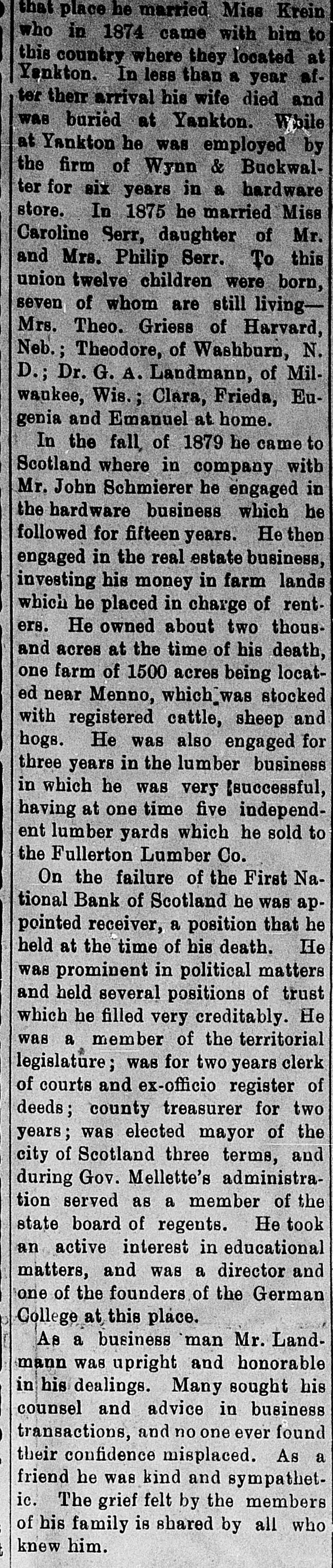
that place he married Miss Krein who in 1874 came with him to this country where they located at Yankton. In less than a year after their arrival his wife died and was buried at Yankton. While at Yankton he was employed by the firm of Wynn & Buckwalter for six years in a hardware store. In 1875 he married Miss Caroline Serr, daughter of Mr. and Mrs. Philip Serr. To this union twelve children were born, seven of whom are still living—Mrs. Theo. Griess of Harvard, Neb.; Theodore, of Washburn, N. D.; Dr. G. A. Landmann, of Milwaukee, Wis.; Clara, Frieda, Eugenia and Emanuel at home. In the fall of 1879 he came to Scotland where in company with Mr. John Schmierer he engaged in the hardware business which he followed for fifteen years. He then engaged in the real estate business, investing his money in farm lands which he placed in charge of renters. He owned about two thousand acres at the time of his death, one farm of 1500 acres being located near Menno, which was stocked with registered cattle, sheep and hogs. He was also engaged for three years in the lumber business in which he was very successful, having at one time five independent lumber yards which he sold to the Fullerton Lumber Co. On the failure of the First National Bank of Scotland he was appointed receiver, a position that he held at the time of his death. He was prominent in political matters and held several positions of trust which he filled very creditably. He was a member of the territorial legislature; was for two years clerk of courts and ex-officio register of deeds; county treasurer for two years; was elected mayor of the city of Scotland three terms, and during Gov. Mellette's administration served as a member of the state board of regents. He took an active interest in educational matters, and was a director and one of the founders of the German College at this place. As a business man Mr. Landmann was upright and honorable in his dealings. Many sought his counsel and advice in business transactions, and no one ever found their confidence misplaced. As a friend he was kind and sympathetic. The grief felt by the members of his family is shared by all who knew him.