Article Text
CHICAGO, TUESDAY, OCTOBER 14, 1873.
NEWS.
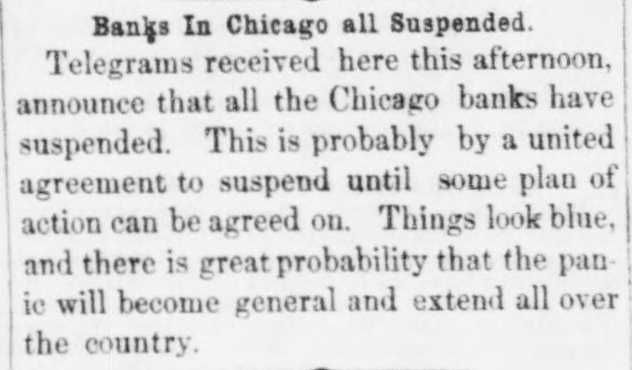
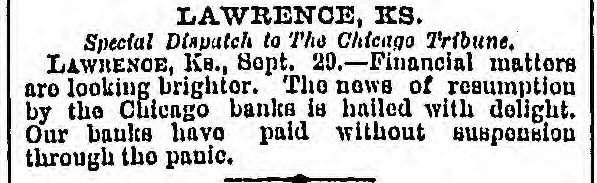
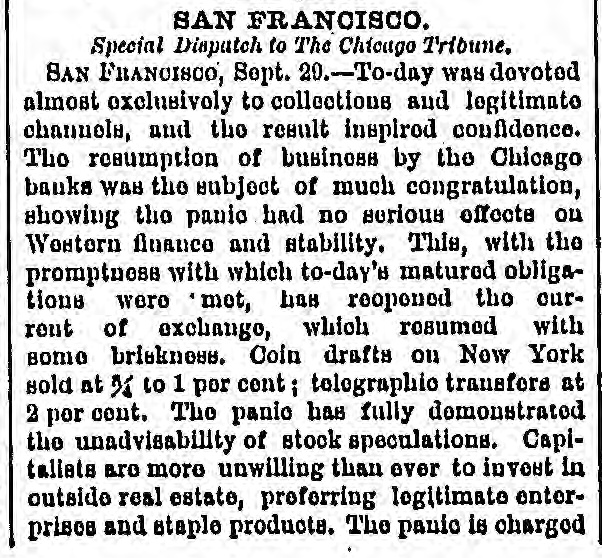
indication, and gave a tone to the general markets that was in improvement over preceding days. While there was great con- fidence in the solvency of our banks, there was much interest felt to see what developments would be made during the earlier hours of the Bank to Re- opening-day. At the usual hour this morning This every bank and banker in the Clearing-House Association, twenty-one in number, commenced full and unequivocal resumption.
THERE WAS NO EXCITEMENT, there was nothing about the appearance of the bank that indicated a run; the business of the day commenced and continued to the close with ply to the a degree of quiet that was remarkable. So far nts. as is known, there was not an anxious depositor presented himself at the banks. The amount drawn by depositors was probably less than usual on Monday. Certainly it did not ex- ceed the usual demands of the average busi- noss day of the week. While this was true, the deposits of currency were liberal and boyond the expectation of the banks. The largest number of the bankers report that they received more currency than they paid out. One e Cincinnati of the National Banks received in currency $100,- Ex- 000 more than they were called on to pay. Satisfactory results of the forenoon put
A NEW FACE ON THE MERCHANTS who assembled on 'Change. The attendance was larger than it had been for days, and every per- son seemed to be encouraged. The gen- o Injunction eral markets were improved in tone, n South- and the impression prevailed that we had en- tered fully upon the work of recuperation, and that restoration would proceed with rapidity. At the close of banking hours all acknowledged that the success of the first day of currency re- sumption had been complete.
THE LOAN-CERTIFICATES. Of $462,000 in Clearing-House certificates, $165,000 were canceled to-day, leaving less Have to Say to than $300,000 of certificates unredeemed. entions. Of the latter amount, under the ac- tion of the Clearing-House, 25 per cent will be redeemed to-morrow, and 25 per cent each week thereafter, for the purpose of equitably distributing the certificates. It was decided on Saturday that the banks should hold them until retirement in proportion to the adelphia Pre- business done by them respectively within a eduction definite period therein named.
NEW YORK. Special Dispatch to The Chicago Tribune.
THE INJUNCTION AGAINST SALES OF STOCK. NEW YORK, Oct. 13.-Judge Blatchford ren- ONAL. dored, to-day, in the United States District ors of the Union Court, the following decision in the case of , it was unani- George Bird Grinnell & Co., modifying the in- iness as usual at junction obtained by Henry Myers, restraining Blake Bros. & Co. from disposing of certain bonds and stocks:
ommunication of In this matter on motion of Blake Bros. & Co., let an in THE TRIBUNE order be entered modifying the injunction, so as to adopted: allow them to sell, according to the method of the CHICAGO, Oct, 13. New York Stock Exchange, all stocks and bonds re- umercial National maining in their hands, specifying the same, men- tioned in the affidavit of W. O. Olcott as having been deposited with Blake Bros. with profound & Co. by George Bird Grinnell & Co. n of the 10th inst., as collateral security, and to use the proceeds as if Bank should re- they were their own moneys, subject, however, and ausiness at once. receiving the right and power of this Court in case an r continued con- adjudication in bankruptcy and subsequent proceed- institution. We ings thereon to ascertain and liquidate liens and cois not misplaced. specific claims which have been or may be set up by of the Currency, Blake Bros. & Co., in respect to all or any of said meeting held this stocks and bonds, or of the proceeds of the same, reopen the Union and to manage and dispose of such proceeds, inst. Thanking and reserving the right to any Assignee in bank- of good will and ruptcy who may be appointed herein to question by suit or otherwise the validity of the pledge of securities deposited with Blake Bros. & Co. Св, by George Bird Grinnell & Co., on Sept. 10, 1873, name- AUGH, President, ly: 500 shares of the capital stock of the Union Rail- egrams from tho way Company, 400 shares of the common capital stock stating that the of the Chicago & Northwestern Railway Company, and the bank was il- 10,000 shares registered Lake Shore & Michigan South- free to resume ern Railway Company's sinking-fund bonds; and the ened. validity of the pledge of 30,000 of the last described bonds deposited with Blake Bros. & Co. by George informality con- Bird Grinnell & Co. on Sept. 26, 1873, and reserving Le voto was takon the right of such Assignee to question, in like n, some of the manner, the right of Blake Bros. & Co. to creas the law re- hold the surplus securities given on one oting shall bo by loan for a deficiency on any other loan, and reserving "his provision of the right to such Assignee to compel Blake Bros. & the time the ac- Co. to account to him in respect to the disposition and application of the proceeds of all securities deposited with Blake Bros. & Co., as mentioned in said affidavit ago Tribune. of Olcott, whether such securities have been already isdom of the do- sold or are yet unsold. This modification to be sub- s city, on Satur- ject to the condition that Blake Bros. & Co. shall file ments, has been in this Court, within two days after the future Co-day. At near- sale of any of said securities, a sworn state- gain in currency, ment of the particulars of the same. A pro- ith unexpected vision must be inserted, in order that nothing Juntarily retired contained in it shall be construed as a direction of ertificates. The the Court for the same securities within meaning of ely light, and the Sec. 22 of the Bankruptcy act, or otherwise as imply- he banks are not ing any assent by George Bird Grinnell & Co. to the sale, so far as such assent was or is necessary under the terms of the contracts of pledge. This order will be settled on notice to debtors and petitioning
The Clearing-House Committee appointed, on application of President Ellis, of the Bank of the Commonwealth, to investigate the condition of that establishment, with a view to a refutation of the statements of Receiver Bailey, reported to-day fully sustaining the charges of Mr. Bailey.
DREADSTTFFS. The flour market was exceedingly dull and heavy. Old family winter wheat and spring extras are in reduced supply and firmly hold. Good superfine steady and fairly active. At the close the market was lower for low and medium grades. Little change in the value of wheat, but the unfavorable news from Europe and liberal arrivals give buyers an advantage. The only feature of the market to- day is a more active demand for commercial sterling. The market closed with a demand chiefly for export.
FREIGHTS. The market for freights was fairly active, but rates were not materially changed, though tending in shippers' favor. In the charter- ing line there was a moderate demand for vessels suitable to the grain trade at previous rates. [To the Associated Press.]
NEW YORK, Oct. 13.-Papers were served to- day in the suit of William Scott, of Erie, Pa., against Kenyon Cox & Co. This suit is intend- ed to restrain Daniel Drew, who is a special partner in the firm, from disposing of his prop- erty, which, it is alleged, he is doing in order to escape his liabilities in connection with the Can- ada Southern Railroad bonds, which were said to cause the failure of Kenyon Cox & Co. The National Trust Company resumed busi- ness to-day, paying its depositors in certified checks on the Central National Bank, which is their Clearing-House. The bank of the Union Trust Company has not yet begun to pay its depositors. Judge Blatchford to-day modified the injunc- tion sufficiently to permit Blake Bros. & Co. to sell the securities held for money loaned to G. Bird Grinnell & Co. This decision may throw on the market 10,000 registered Lake Shore & Michigan Southern sinking fund bonds. The injunction was modified on condition that Blake Bros. & Co. file a sworn statement of their sales in the Clerk's office of the United States District Court in bankruptcy, to await such ac- tion as an Assignee in bankruptcy may take, providing such Assignee be appointed to collect and distribute the assets of Grinnell & Co. Loading houses in the piano trade to-day deny any intention of reducing wages. A few of the smaller houses have ceased operations for a short time owing to inability at present of mak- ing collections.
THE WALL STREET FINANCIERS ON THE PRESI- DENT'S VIEW OF THE PANIC. Wall street bank officers ridicule President Grant's views on the recent panic. Referring to the latter's statement that silver is on a par with currency, they deny it, and say there is a difference of from two to four per cent, and that so far as the country being able to absorb between $200,000,- 000 and $300,000,000, it would probably use no more than $40,000,000, the present amount of fractional currency in circulation. Silver is debased coin, and is not legal-tender for more than $5, and when on a specie basis is re- garded as something of a nuisance. They call attention to the President's wishes for the re- sumption of specie payment, and ask how he can reconcile such a wish with the projected action recommending the issue of the $44,000,000 reserve which immediately starts the country upon a new era of inflation. They characterize his scheme for a Post-Office Bank as impracticable. While he recommends the prohibition on the part of National Banks of the payment of interest, he proposes to establish a
POST-OFFICE BANK, operated by the Government, which shall allow 4 per cent on deposits. The result of this would be that 4 per cent would be the minimum rate for interest. When capitalists had money which they could not otherwise dispose of, they would deposit it with the Government receiv- ing 4 per cent, and when they could loan it or could use it otherwise they would draw it out. The same evil which private bankers complain of would be felt by the Government. At a time the deposits were
MOST NEEDED they would be withdrawn. Again, the question is asked, how the Government proposes to secure 4 per cent interest. Does it propose to go into a regular banking business? If so, an era of
FRAUD, DEFALCATION, AND WILD-CAT OPERATIONS generally will be the result. In addition to all this, supposing that the bank was practicable, it would be too great a centralization of power in the hands of the Government; too great a political instrument to be placed in its hands.